
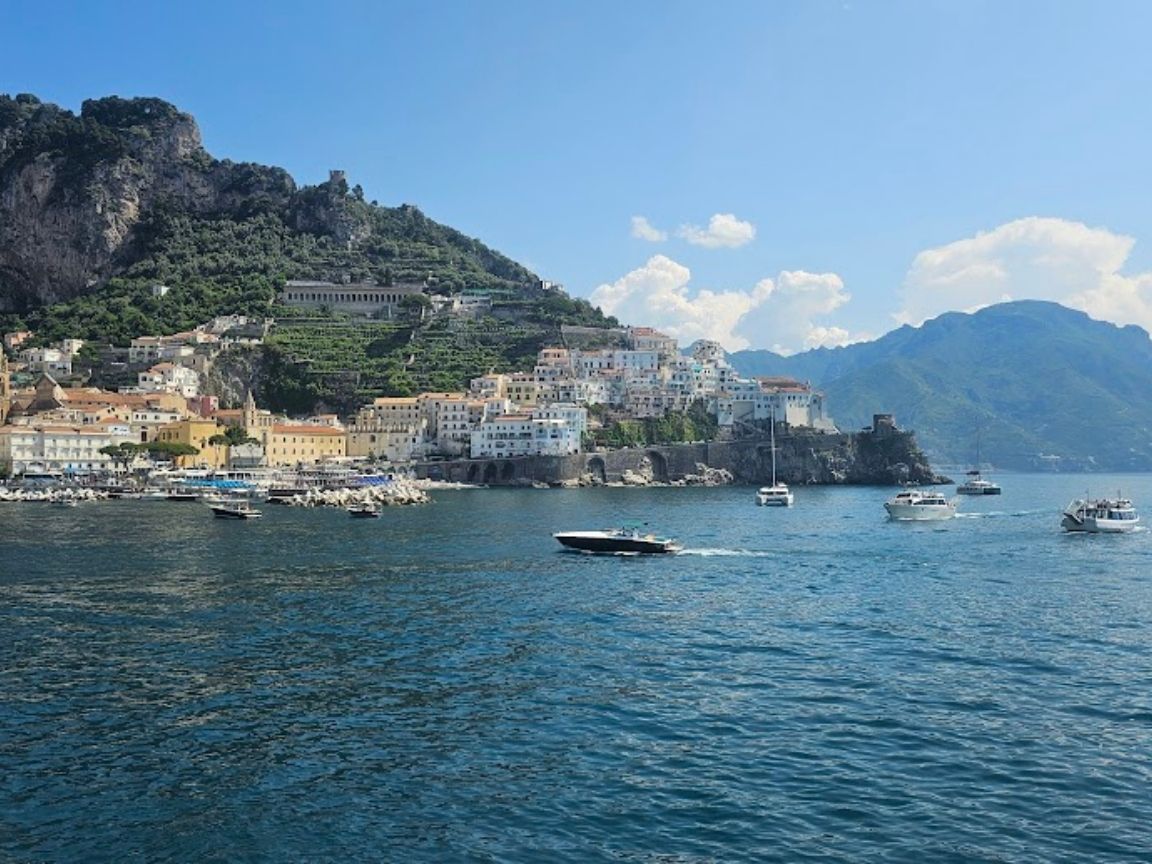
Where do cruise ships dock in Amalfi? They don’t dock — Amalfi’s harbour is too shallow. Ships anchor in the Gulf of Salerno and tender passengers directly into the town piazza. You step off the tender into the main square, cathedral immediately ahead, entire town walkable from that point. Smaller ships (Oceania, Viking, Seabourn, Azamara) tender directly into Amalfi. Some larger ships use Salerno as a gateway port instead.
Amalfi answers the “where do cruise ships dock” question with a slightly unusual answer: they don’t. The harbour is too small and too shallow. Ships anchor in the Gulf of Salerno and tender passengers ashore — which means you step off the boat directly into the main piazza, cathedral staircase rising in front of you, town entirely at your feet.
The catch is that not every ship does this. Some larger ships use Salerno as their Amalfi Coast gateway instead. The experience and the logistics are completely different depending on which situation applies to you. This guide covers both.
Quick Port Facts
| Fact | Detail |
|---|---|
| Port type | Tender port — ships anchor in Gulf of Salerno, tender to Marina Coppola pier |
| Which ships tender into Amalfi | Smaller luxury and premium ships: Oceania, Viking Ocean, Seabourn, Azamara, Silversea, Regent, MSC (smaller vessels) |
| Which ships use Salerno instead | Larger mainstream ships: Royal Caribbean, Norwegian, Carnival, Princess, MSC (larger vessels) — check your cruise documents |
| Distance to town centre | Zero — tender deposits you in Piazza del Duomo |
| Time zone | Central European Time (CET / CEST) |
| Currency | Euro (EUR) |
| Language | Italian; English widely spoken in tourist-facing businesses |
| Best months | May, June, September — warm, manageable crowds. July–August is peak season with higher prices and queues. |
Which port are you actually in?
This is the question the article needs to answer before anything else — because most of the “Amalfi Coast cruise” content online conflates two completely different situations.
If your ship tenders directly into Amalfi
You anchor offshore and take a tender boat (5–15 minutes depending on anchoring distance) to Marina Coppola pier, directly in the town centre. The entire town is on foot from the moment you step ashore. No transfers, no buses, no road. This applies to most smaller luxury and premium ships: Oceania, Viking Ocean, Seabourn, Azamara, Silversea, Regent Seven Seas, and smaller MSC vessels.
If your ship docks at Salerno
You’re at the Port of Salerno’s Zaha Hadid-designed terminal at Molo Manfredi — about 25km east of Amalfi town. Getting to Amalfi involves a 30–60 minute ferry or a 1–1.5 hour road transfer. Salerno is a legitimate destination in its own right (good food, medieval old town, less touristy than the coast), but if you’re planning an Amalfi day you need to factor in the transfer time both ways. See our full Salerno cruise port guide for the Salerno-specific logistics.
How to find out which applies to you: Check your cruise documents or your cruise line’s app — it will specify “Amalfi” or “Salerno” as the port. If you’re unsure, ask the shore excursion desk before you arrive.
Everything below assumes you’re tendering directly into Amalfi. If you’re docking at Salerno and heading to Amalfi, the ferry and transfer advice in the Salerno guide is the relevant starting point.
The tender process: what to expect
Tender operations depend on sea conditions. In rough weather the port does not operate — the ship will divert, usually to Salerno or Naples. Check with your ship’s daily programme the evening before. If the forecast shows strong wind or high swell, have a backup plan.
Tender priority for independent travellers: Most cruise lines give passengers booked on ship-sponsored excursions priority tender access. If you’ve arranged a private driver or independent tour, you’ll be in the general queue — typically 45–90 minutes behind ship excursion groups. On smaller luxury ships the process is faster, but priority still applies. Tell your driver to meet you no earlier than 90 minutes after the ship’s scheduled arrival time, and ask the shore excursion desk the evening before for the expected independent passenger tender window.
Amalfi town: what’s actually here
The town is small. A thorough exploration takes 2–3 hours, which leaves room for everything else in a standard port day. Don’t be in a hurry to leave it — the most common mistake is rushing to Positano or Ravello and spending half the day on a road rather than in a town.
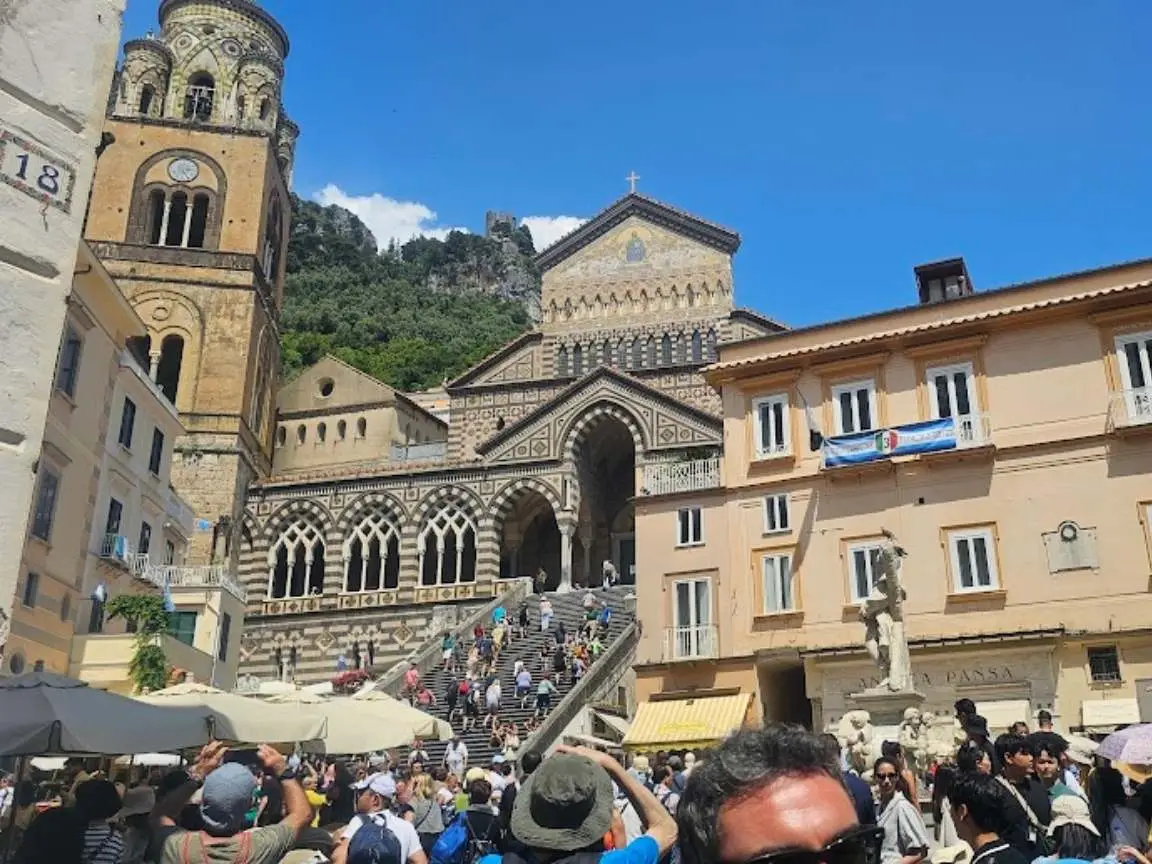
- Cattedrale di Sant’Andrea (Amalfi Cathedral) — directly ahead when you step off the tender. The Arab-Norman facade, the 62-step staircase, the Cloister of Paradise and the Crypt of St Andrew are worth at least 45 minutes. Modest dress required (shoulders and knees covered). Queues build mid-morning; arrive early or after 2pm.
- Arsenale della Repubblica — the medieval shipyards where Amalfi’s naval fleet was built. One of the best-preserved maritime sites in Italy, five minutes from the piazza, rarely crowded.
- Museo della Carta (Paper Museum) — a working 13th-century paper mill with live demonstrations of Amalfi’s historic papermaking tradition. Compact, genuinely interesting, not on most cruise excursion itineraries.
- The alleys above the piazza — the most undervisited part of town. Streets climbing behind the cathedral are quieter, more residential, and give a better sense of what Amalfi actually is rather than what it sells to tourists.
Getting to Ravello, Positano and beyond: the honest picture
This is where most port day planning goes wrong. The Amalfi Coast towns look close together on a map. In June through September they are not.
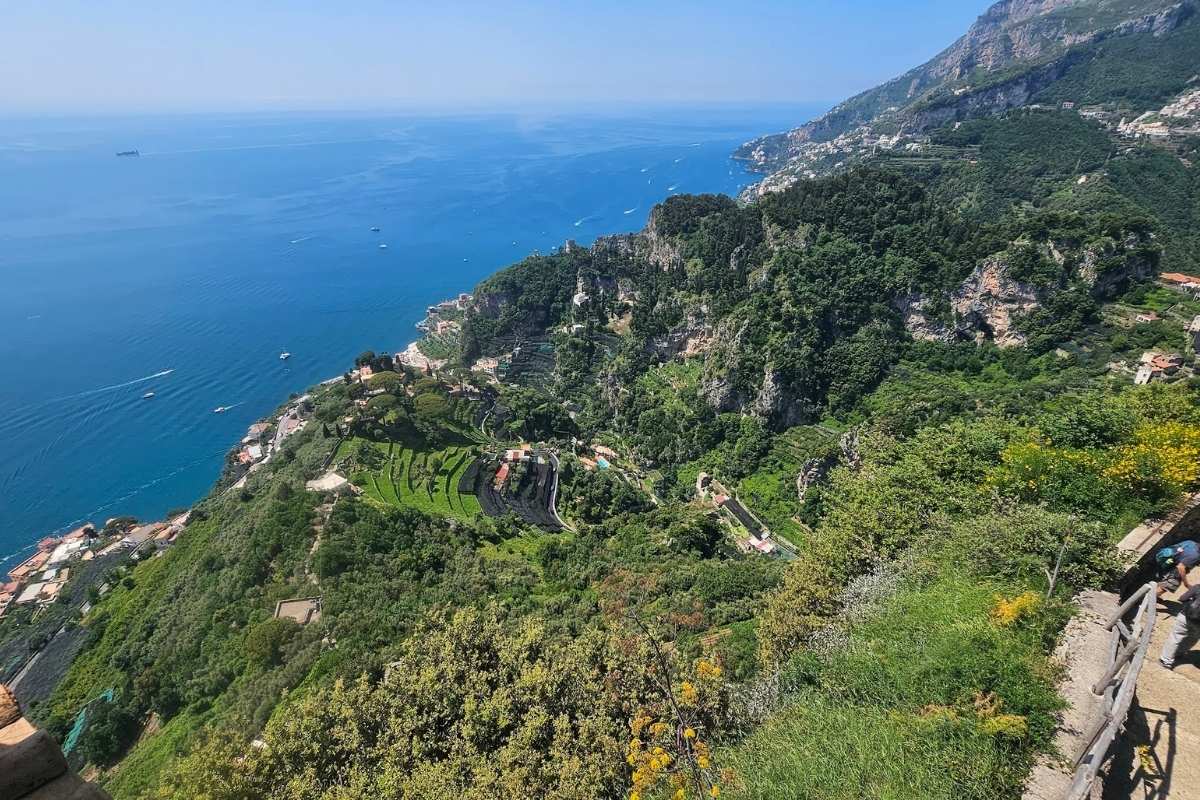
The SS163 — the single-carriageway coastal road connecting all the towns — is roughly 7 metres wide for two-way traffic with nowhere to overtake. In peak season the 50km full length can take upwards of two hours. Amalfi to Positano alone (17km) regularly takes 45–60 minutes in June, and longer on weekend afternoons.
The practical implication: if you want to visit Amalfi, Ravello AND Positano in a single port day with a 5pm all-aboard, you will almost certainly be rushing at least one of them. Experienced local drivers consistently recommend choosing two of the three in high season, not all three.
The licence plate restriction (June–September)
The SS163 operates an alternating licence plate restriction between 10am and 6pm from June through September. On odd-numbered dates, vehicles with even-numbered plates cannot drive the road. On even-numbered dates, vehicles with odd-numbered plates cannot. Taxis and professional transfer vehicles are exempt — if you’ve booked a licensed private driver, this almost certainly doesn’t apply to you, but worth a quick confirmation before the day.
What does a day in Amalfi actually look like?
The answer depends almost entirely on how long your ship is in port. Here are three realistic day shapes based on port time — not rigid timetables, but honest pictures of what’s achievable.
6 hours in port
This is enough for a genuinely satisfying Amalfi day if you stay in town and don’t try to add the coast. Step off the tender into the piazza, spend the morning at the cathedral and cloister, wander the alleys above the main street, find a side-street trattoria for lunch (the waterfront tables are fine but overpriced — one block back is better value), and spend the afternoon browsing the paper and ceramics shops before a slow walk back to the tender dock. You won’t feel rushed and you won’t miss much. The mistake is spending this kind of port time on a bus.
8 hours in port
Eight hours opens up a proper combination. The most natural shape is Amalfi in the morning, Ravello after lunch. Step off the tender early, do the cathedral and a coffee in the piazza, pick up your driver and head up to Ravello around midday. The drive takes 20–25 minutes and puts you above the coast with views down over the Gulf of Salerno. Villa Rufolo’s gardens and the Terrace of Infinity at Villa Cimbrone are worth 2 hours between them. Back in Amalfi by 3:30pm, a gelato on the waterfront, and the tender at 4pm.
Alternatively: a shorter morning in Amalfi, then the ferry to Positano. The sea crossing takes 25–35 minutes and the view of Positano arriving by boat is considerably better than the view from the road. Two hours in Positano — the main beach, the Church of Santa Maria Assunta, the shopping streets — then the ferry back. Be at the tender dock by 4pm.
10+ hours in port
A longer call is the only situation where all three towns make sense — and even then it requires discipline. Off the ship on the first tender, driver meeting you at 8:30am. Ravello first while the road is quiet, back to Amalfi for a proper lunch, ferry to Positano in the early afternoon, ferry back to Amalfi by 3:30pm. That’s the sequence that works. Trying to do it in the other order — Positano first, then fighting the SS163 back towards Ravello in the afternoon — is where the day falls apart.
A 10+ hour call also makes the Emerald Grotto viable as an addition to Amalfi town rather than a replacement for it. The round trip by boat takes about 90 minutes including the grotto itself — manageable before or after lunch if you’re not also doing the coast towns.
Your options for the day
Stay in Amalfi
The underrated option. Six hours in Amalfi comfortably covers the cathedral, the Paper Museum, lunch at a waterfront restaurant, and a proper wander. Crowds thin visibly once ship excursion groups depart for the coast. Most passengers feel obliged to leave, which is exactly why staying works.
Amalfi + Ravello
The most manageable combination. Ravello is 20–25 minutes up a steep winding road directly above Amalfi. Spend the morning in town, drive up to Ravello for Villa Rufolo’s gardens and the Terrace of Infinity at Villa Cimbrone (entry around €7–10 each), back down for lunch. Low stress, genuinely spectacular views.
Amalfi + Positano (ferry for one leg)
Rather than driving the SS163 both ways, take the coastal ferry from Amalfi to Positano — roughly 25–35 minutes by sea. Ferries run hourly in summer from kiosks at the harbour; no advance booking is usually needed, though on busy summer days it’s worth checking availability early. The sea crossing is the best way to see the coastline, avoids the traffic, and sidesteps the parking problem in Positano entirely. Your driver meets you in Positano, you explore, and return to Amalfi by road or ferry in time for the tender.
All three towns
Possible with an early start. Be off the ship on the first tender, tell your driver to meet you at 8:30am. Ravello first (before traffic builds), Amalfi mid-morning, Positano by ferry in the afternoon. Be back at the tender dock by 3:30–4:00pm for a 5:00pm all-aboard. One delay anywhere in this schedule and it unravels.
The Emerald Grotto (Grotta dello Smeraldo)
A sea cave 30 minutes west of Amalfi, accessible only by boat. The emerald colour comes from light refracting through an underwater opening. Round-trip boat from Amalfi is around €10; grotto entry around €6. A good option if you want something beyond town and aren’t doing Positano.
What to eat
- Scialatielli ai frutti di mare — a thick, short pasta unique to the Amalfi Coast, served with mixed fresh seafood. The waterfront restaurants all do it; quality is generally high.
- Sfusato Amalfitano — the local lemon variety, considerably larger and more fragrant than anything sold elsewhere as “Amalfi lemon.” Everything made from it in the town itself is the real thing.
- Colatura di alici — an intensely flavoured anchovy sauce from nearby Cetara, sold in small bottles. One of the best edible souvenirs on the coast.
- Delizia al limone — a lemon-soaked sponge cake, the local dessert. Ubiquitous, and correctly so.
- Where to eat: The waterfront restaurants have the views and tourist-friendly menus (mains €15–25). One or two streets back, prices drop and quality doesn’t. Trattoria da Gemma is the long-standing local favourite for refined Campanian cooking (€25–40, reserve ahead in high season).
Shopping
- Handmade paper (carta di Amalfi) — journals, stationery and art prints on thick, textured local paper. The Museo della Carta’s shop is the most reliable source.
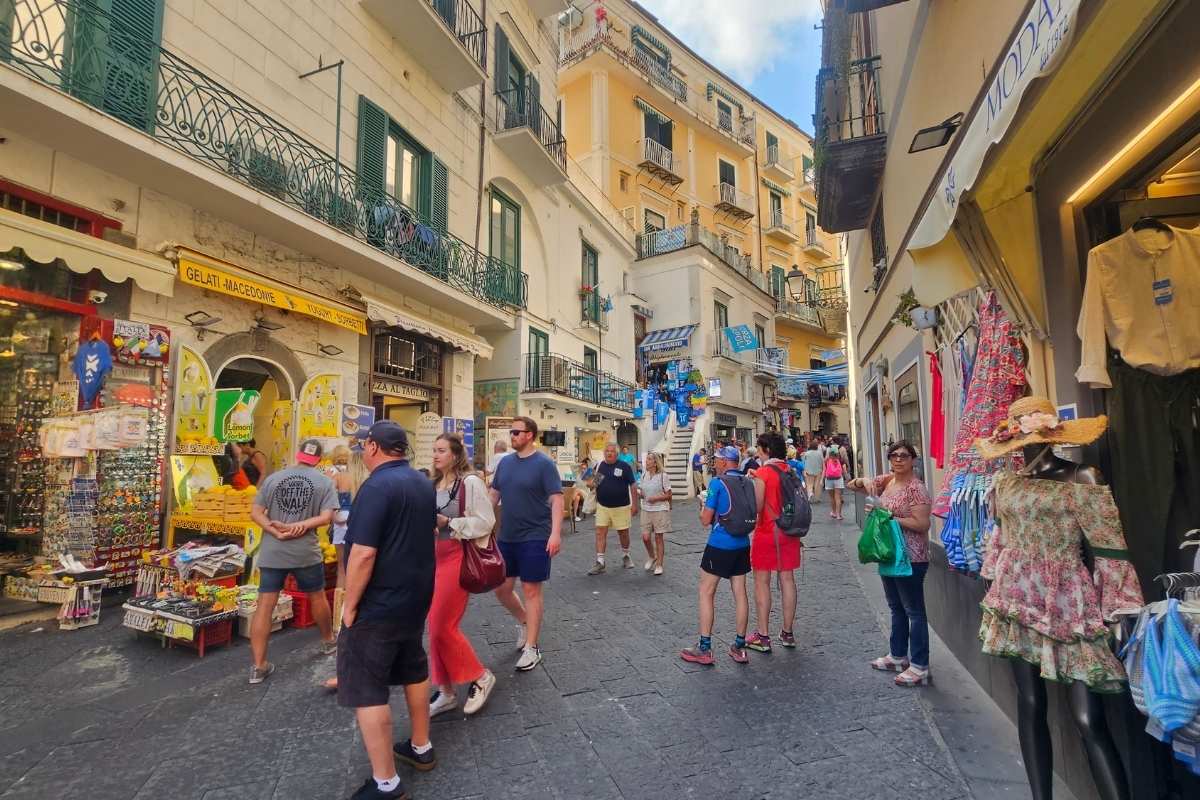
- Ceramics — hand-painted plates, bowls and tiles in lemon motifs. Look for “fatto a mano” (handmade) labels. Many shops will pack and ship internationally.
- Limoncello — buy from side-street shops rather than tourist-facing waterfront outlets. The locally produced versions are noticeably better and considerably cheaper.
- Linen — beachwear, shirts and embroidered blouses. Quality varies; check fabric and stitching. Prices typically €30–80.
- Shop hours: Most open 9:30–10am, close for lunch 1–4pm, reopen until 7–8pm.
Weather by month
| Season | Months | Temperature | What to expect |
|---|---|---|---|
| Spring | March–May | 12–22°C | Mild and increasingly sunny. April and May are ideal — blooming flowers, fewer crowds. Pack layers and a light rain jacket. Sea is cool for swimming. |
| Summer | June–August | 22–30°C | Hot, dry, peak season. Intense sun, crowded attractions, SS163 at its most congested. Bring sun protection and plenty of water. |
| Autumn | September–October | 15–25°C | September is warm and less crowded — often the best month. October is pleasant but rain increases. Sea swimmable through September. |
| Winter | November–February | 8–15°C | Mild but rainy. Many tourist businesses close or operate limited hours. Fewer cruise ships call. Quiet streets, lower prices, more local atmosphere. |
Practical information
- Cash: Euros. ATMs (Bancomat) in the town centre. Most restaurants and larger shops take cards; small vendors and market stalls often prefer cash. Have €50–100 in small notes.
- Accessibility: The tender landing is manageable. The town is steep — the main street (Via Lorenzo d’Amalfi) is mostly flat, but almost everywhere else involves steps. The cathedral requires climbing 62 steps. Mobility-limited passengers tend to find staying on the waterfront and piazza level more comfortable.
- Tipping: Not obligatory. Round up taxi fares or leave 5–10% in restaurants if service was good. A coperto (cover charge) of €1–3 per person is standard and not a tip.
- Emergency number: 112 (EU-wide, English-speaking operators)
- Nearest major hospital: Ospedale Ruggi d’Aragona, Salerno — +39 089 671111
Common Questions
Where do cruise ships dock in Amalfi?
They don’t dock — Amalfi’s harbour is too shallow. Ships anchor offshore and tender passengers to Marina Coppola pier in the town centre. Some larger ships use Salerno as a gateway instead — check your cruise documents to confirm which applies.
Can I visit both Amalfi and Positano in one port day?
Yes, but take the ferry between them rather than the road. The coastal ferry takes 25–35 minutes and avoids the SS163 congestion. By road in June through August, the same journey can take 45–60 minutes or more.
What happens if the weather cancels tendering?
The ship diverts — usually to Salerno or Naples. This is more common in spring and autumn than summer. Check the ship’s daily programme the night before and have a backup plan if weather looks unsettled.
Should I book a ship excursion or go independently?
For Amalfi town itself, independently is almost always better — you’re deposited right into it and it’s entirely walkable. The main advantage of a ship excursion is the guaranteed return: if the tour runs late, the ship waits. If your private transfer hits SS163 traffic, it doesn’t.
Is Amalfi accessible for passengers with mobility limitations?
The waterfront promenade and main street are manageable. The historic centre involves steep lanes and many staircases — the cathedral requires climbing 62 steps. Mobility-limited passengers tend to do better staying on the waterfront level or considering Salerno, which is considerably flatter.
How much time do I need in Amalfi town?
A realistic 6-hour call covers the cathedral, a leisurely lunch, and street wandering. Eight hours allows a boat trip to Positano or the Emerald Grotto plus full town exploration.
Related guides
Amalfi is one of several ports serving the Campania coast. Our Mediterranean cruise ports in Italy hub covers all the Italian stops on typical itineraries. For passengers based at other nearby ports, our Naples cruise port guide covers the most common alternative gateway to the Amalfi Coast, and our Amalfi Coast day trip from Naples port covers the logistics of doing it from there. If your ship docks at Salerno, the Salerno cruise port guide covers the ferry and transfer options in detail. The Sorrento cruise port guide covers the third common gateway, and Skip the Tour: Hidden Italy is worth reading if you want to get off the standard cruise circuit entirely. For the full regional picture, see our Western Mediterranean cruise ports hub.
About the author
This guide was written by Patricia, About2Cruise’s Mediterranean cruise expert. Patricia has sailed into Amalfi on three different cruise lines and made the mistake of trying all three coast stops in one day exactly once..
Last Updated: 9 August 2026