
The cruise line matters less than matching the ship to your child’s age, your group size and your budget. Royal Caribbean and Disney Cruise Line win on activities and theming, P&O Cruises and MSC Cruises offer solid value and no-fly departures, and families of five or more should sort the cabin before the brand.
Best cruise lines for families compared
More families are cruising than ever. The number of under-12s from the UK and Ireland taking an ocean cruise rose by 7% last year, part of a record 2.54 million UK and Irish passengers who cruised in total, according to CLIA. With that many families booking, the lines have had to sharpen up what they offer at every age and budget.
| Cruise line | Kids’ club ages (free hours) | Best suited to | Standout family feature |
|---|---|---|---|
| Royal Caribbean | Adventure Ocean, 6 months to 17 (free from age 3 until 10pm) | Tweens and teens who want thrills and independence | Icon-class ships add Surfside, multiple water parks and family suites for up to six |
| Disney Cruise Line | Oceaneer Club and Lab, Edge, Vibe, 3 to 17 (free) | Families with children aged 4 to 11 | It’s a Small World Nursery for ages 6 months to 3 years |
| MSC Cruises | Doremi clubs, 6 months to 17 (paid nursery under 2) | Budget-conscious and multigenerational families | Only major line accepting babies under 6 months |
| P&O Cruises | The Reef, 2 to 17 (free) | No-fly UK family holidays | Night Nursery for 6 months to 4 years included at no extra cost |
| Norwegian Cruise Line | Splash Academy and Entourage, 3 to 17 | Families who dislike fixed dining times and dress codes | Freestyle Cruising, no set dinner sitting |
| Carnival Cruise Line | Camp Ocean, Circle C, Club O2, 2 to 17 | Budget fares with solid age-grouped programming | Kids Sail Free promotions on multi-night sailings |
| Princess Cruises | Youth programme, 3 to 17 | Calmer, multigenerational groups | Less onboard thrill hardware, more relaxed pace |
Carnival Cruise Line proves a cheaper fare doesn’t mean a thrown-together kids’ club. Camp Ocean splits children into Penguins, Stingrays and Sharks by age, with Circle C for tweens and Club O2 for teens, and its Kids Sail Free promotions on multi-night sailings make it a strong option for a family of four.
Princess Cruises is the one to pick if you want a quieter ship with proper youth provision rather than theme-park bells and whistles. The youth programme covers ages three to twelve, with a separate teen programme for thirteen to seventeen, but there’s less onboard hardware than you’ll find on Royal Caribbean, MSC Cruises or Carnival Cruise Line.
Want a closer look at two of the biggest names head to head? Here’s Carnival vs Royal Caribbean for families.
Kids’ clubs by age: which programme fits your child
Royal Caribbean’s Adventure Ocean takes children from six months to seventeen, and it’s free from age three right up until 10pm, after which an hourly fee kicks in. Under-threes are nursery-only, and that always costs by the hour.
The newest Icon-class ships go further still, with a dedicated Teen Zone, a FlowRider surf simulator, a rock climbing wall, go-karts and water parks stacked across several decks, alongside some of the best water slides and aqua parks at sea.
Disney Cruise Line’s clubs are free for ages three to seventeen: the Oceaneer Club and Lab cover three to ten, Edge takes eleven to fourteen, and Vibe runs fourteen to seventeen. The only one that costs extra is the It’s a Small World Nursery, for babies from six months to three years.
MSC Cruises runs five Doremi clubs between them covering nearly every age: Baby Club Chicco for six months to two years, Miniclub Lego for three to six, Juniors Club Lego for seven to eleven, Young Club for twelve to fourteen and Teens Club for fifteen to seventeen. It’s the only major line that will take a baby under six months on board, though that comes with a paid nursery.
P&O Cruises groups children into The Reef: Splashers for two to four year olds, Surfers for five to eight, Scubas for nine to twelve, and a dedicated teen space, called Scene on Arvia and Iona or H2O on Azura, Britannia and Ventura, for thirteen to seventeen year olds.
These clubs run on Arvia, Azura, Britannia, Iona and Ventura. Arcadia and Aurora are adults-only ships, so steer clear of those two if you’re bringing children.
A supervised Night Nursery covers six months to four years, and both the daytime clubs and the nursery are included in the fare for standard sessions.
Norwegian Cruise Line drops fixed dining times and formal dress codes under its Freestyle Cruising model, which suits families who can’t be doing with a rigid schedule. Splash Academy covers the younger children and Entourage looks after teens aged thirteen to seventeen, but under-threes need a parent in the room rather than a drop-off nursery. The real draw here is the onboard hardware, not the club structure.
Safety sits behind all of this, not just the fun. The Reef’s clubrooms use secure door entry systems, balcony nets on request, and strict sign-in and sign-out for ages two to twelve.
P&O’s youth team, the Reef Rangers, all carry an enhanced DBS check, and anyone twelve or under has to be signed in and out by a parent, guardian or other authorised adult; nobody under eighteen is allowed to sign a younger child out. Disney issues every registered child an Oceaneer Band, scanned on the way in and out and linked to their name, age, stateroom, dietary needs and medical details.
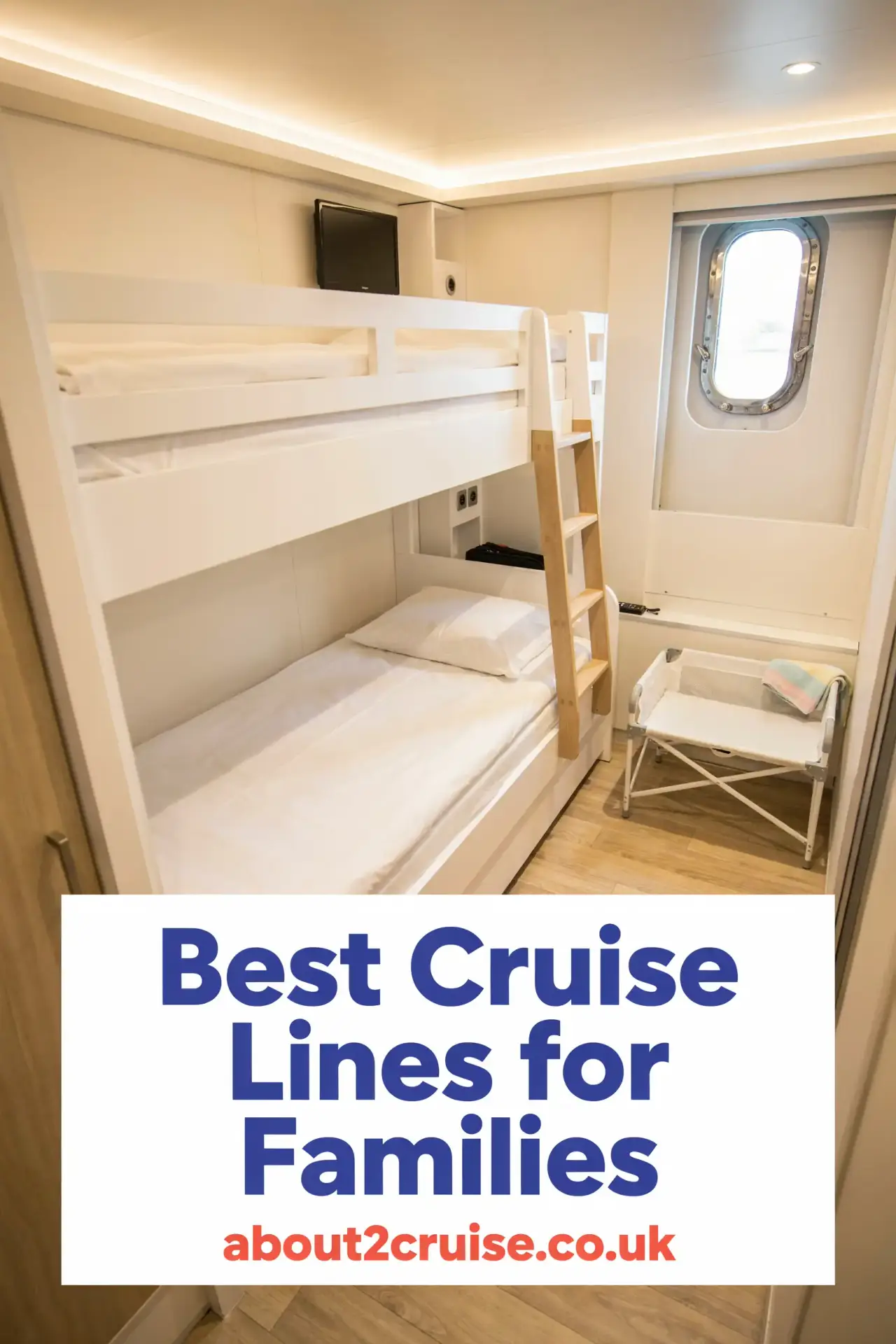
Family cabins: five-berth rooms, connecting cabins and travel cots
More ships now offer higher-occupancy cabins and interconnecting rooms, so a family can stay together under one roof instead of splitting up. These cabins get booked up fast, so getting in early matters more than almost anything else when you’re planning a family cruise. It’s worth comparing the different cabin configurations available before you settle on one.
P&O Cruises has added around fifty five-berth cabins across its three newest ships: selected Superior Deluxe Balcony cabins on Britannia, and selected Conservatory Mini-suites on Iona and Arvia. That gives a family of five one cabin to book instead of two connecting rooms.
If you’ve got a baby between six months and two years, Azura, Britannia and Ventura each have a limited number of cabins that will fit a travel cot, so check this at the time of booking rather than assuming it’ll fit.
These higher-occupancy and travel-cot cabins are limited in number, and they sell out fastest in school holiday periods, well before the sailing date. Book as far ahead as you can, or fall back on two standard connecting cabins instead, which are more widely available and give a family of five or six the same amount of space.
What’s included in a family cruise fare, and what costs extra
Standard daytime and evening kids’ club sessions are included in the fare across the big lines, for children aged three and up. What costs extra is childcare outside that: nurseries for under-threes on Royal Caribbean and Disney Cruise Line charge by the hour, and Royal Caribbean’s Adventure Ocean switches to an hourly charge after 10pm too.
P&O Cruises is the exception, since its Night Nursery for six months to four years is included at no extra cost alongside The Reef’s standard sessions.
Extras like speciality restaurants, drinks packages and wifi vary by line and by fare type, so check exactly what’s bundled in before you compare two fares side by side. A family cruise package deal can sometimes bundle flights, transfers and onboard credit together, which is worth weighing up against booking each part yourself.
Best cruises for large family groups and multigenerational trips
Sort the cabin first and the cruise line second if there are five or six of you travelling. P&O Cruises’ five-berth cabins on Britannia, Iona and Arvia cover this directly; most other lines solve it with two interconnecting cabins instead.
Multigenerational cruising has grown a lot: according to CLIA, 57% of passengers now travel in a group of three or more, 28% span three or more generations, and 10% span five or more. MSC Cruises’ broad range of Doremi clubs and strong-value European itineraries suit this kind of mixed-age group well, while Princess Cruises works better for multigenerational families who want a calmer ship and less onboard intensity for the grandparents.
For cabin layouts, deck positions and booking timing for bigger groups specifically, see the guide to large family cruises.
Which cruise line suits your child’s age: babies to teens
- Babies and toddlers (under 3): Disney Cruise Line suits toddlers aged two to five well, thanks to the nursery and the character meet-and-greets. Royal Caribbean’s splash areas on the newer ships work too, though its club doesn’t start until age three. Carnival Cruise Line’s Camp Ocean takes children from two, which makes it a cheaper toddler-friendly option, and MSC Cruises is the only line that will take a baby under six months old.
- Ages 3 to 9: Disney Cruise Line is the pick if the budget stretches that far; Royal Caribbean is the stronger value choice if it doesn’t.
- Ages 7 to 10: Royal Caribbean’s scale suits this age better than most, with waterslides, rock walls and a bit more independence for the kids.
- Tweens and teens (12+): Royal Caribbean tends to offer better value if most of your children are teenagers, since the Disney premium buys magic for little ones, not for teens who’ve grown out of it.
For more on whether a cruise holiday works for older children, see will teenagers enjoy cruising. Whatever age your children are, working through a family cruise packing checklist before you leave avoids a last-minute scramble over kids’ club paperwork and medication.
Family cruises from the UK: no-fly departures
P&O Cruises is the main no-fly choice for UK families, sailing from Southampton to the Mediterranean, the Norwegian fjords, the Canary Islands and Northern Europe without setting foot on a plane, plus fly-cruises to the Caribbean. MSC Cruises also sails no-fly from Southampton to Spain, France, Portugal and the Canary Islands, with fly-cruises available across the Mediterranean, Caribbean and Middle East.
Royal Caribbean sails from Southampton too, with its usual range of onboard attractions for children, teens and adults. See the full list of cruise lines sailing from Southampton for every departure option.
Norwegian Cruise Line is more often a fly-cruise from the UK, and since under-threes need a parent in the room rather than a drop-off nursery, it tends to suit older children better than babies on a no-fly trip.
For the full case for skipping the flight altogether, see the guide to no-fly cruises.
Choosing a region: Mediterranean, Norwegian fjords or the Caribbean
P&O Cruises’ no-fly Mediterranean and Norwegian fjords itineraries mix warm ports and scenic cruising with plenty of sea days aboard family ships like Iona, Arvia and Britannia. The Mediterranean family cruises guide breaks down which ports work best with children. Iona’s seven-night Norwegian fjords itinerary starts as a no-fly sailing from Southampton, calling at Stavanger, Hellesylt and Olden with days spent just exploring the ship itself.
Caribbean sailings suit families after guaranteed pool and beach time; the Bahamas family cruise guide covers which stops work well with children. Whichever region you pick, family shore excursions in the popular ports fill up fast, so book family shore excursions direct before you sail rather than waiting until you’re on board.
A river cruise is a different trip altogether, with far less in the way of kids’ clubs or pools. Read the guide to European river cruises for families before assuming a river sailing works the same way as an ocean one.
Booking around school holidays
Family cruises from Southampton are busiest in the school holidays, summer, Easter and half-term among them, and cabins for larger families get tight well before each of those windows opens. Booking as early as you can, rather than holding out for a sale, is the most reliable way round it. The guide to the best times for family cruises goes through this in more detail.
Is cruising safe for babies and young children?
Cruise ships build several layers of protection around children. Kids’ clubs run on secure entry systems and staff checks, and swimming pools carry their own age rules: children under six usually can’t use the adult pools at all, those aged six to twelve need supervision, and nobody in a nappy is allowed in any pool, a rule MSC Cruises applies and that other lines apply in much the same way.
Check a line’s own age and swim rules before you book, so the first pool day doesn’t come with a surprise.
Family cruise FAQs
Are cruises good for families?
Cruises suit most families well, because children’s activities, meals and often the childcare are all built into one price, and the main lines group children by age so toddlers, tweens and teenagers each get activities suited to them rather than sharing one programme.
Which cruise line is best for a family of six?
P&O Cruises is the most straightforward option, with a limited number of five-berth cabins on Britannia, Iona and Arvia. Most other lines solve a family of six with two interconnecting standard cabins instead.
Which cruises are the most kid friendly?
Royal Caribbean and Disney Cruise Line are generally the most kid-friendly for activities and theming, while MSC Cruises and P&O Cruises offer strong value with solid, age-grouped kids’ clubs included in the fare.
How much does a Disney cruise cost?
Disney Cruise Line fares move around by ship, itinerary and season throughout the year, so the only figure worth trusting is whatever Disney’s own booking system shows for the exact sailing and cabin you’re looking at.
What is the youngest age a baby can go on a cruise?
Most lines want a baby to be at least six months old to sail, rising to a year old for transatlantic crossings. MSC Cruises is the exception, taking babies under six months with a paid nursery.