
L’Anse aux Meadows is a UNESCO World Heritage Site on Newfoundland’s northern tip, marking the only authenticated Norse settlement in North America from around 1000 CE. Visitors explore reconstructed Viking sod buildings, archaeological remains, and a visitor center featuring Norse artifacts. The remote site offers insight into early transatlantic exploration and Viking daily life.
Quick Port Facts
| Fact | Detail |
|---|---|
| Port Type | Tender port (no traditional cruise dock) |
| Distance to UNESCO Site | 0.8-1.0 km walk from tender landing |
| Nearest Service Hub | St. Anthony (30 km south, 30-40 minute drive) |
| Currency | Canadian Dollar (CAD) |
| Official Site | Parks Canada – L’Anse aux Meadows |
| Main Attractions | L’Anse aux Meadows National Historic Site, Norstead Viking Village |
| Transport Options | Walking, organized shore excursions, pre-booked private drivers |
| Best For | History enthusiasts, archaeology fans, nature lovers |
Want to know more about Canada cruise ports and what makes each one unique? This northern destination is unlike any other port you’ll visit.
L’Anse aux Meadows Map
L’Anse aux Meadows sits at the very northern tip of Newfoundland’s Great Northern Peninsula, jutting into the Strait of Belle Isle. The tender landing is positioned close to the UNESCO World Heritage Site, with the reconstructed Viking settlement and visitor center (see map below) within easy walking distance. St. Anthony, the nearest town with services and amenities, lies roughly 40 kilometers to the south along Route 436, which forms part of the scenic Viking Trail. This is one of the most remote cruise stops in Atlantic Canada, surrounded by rugged coastline and sparse vegetation that looks remarkably similar to how it would have appeared when Norse explorers arrived a millennium ago.
Can You Walk to Town from the Port?
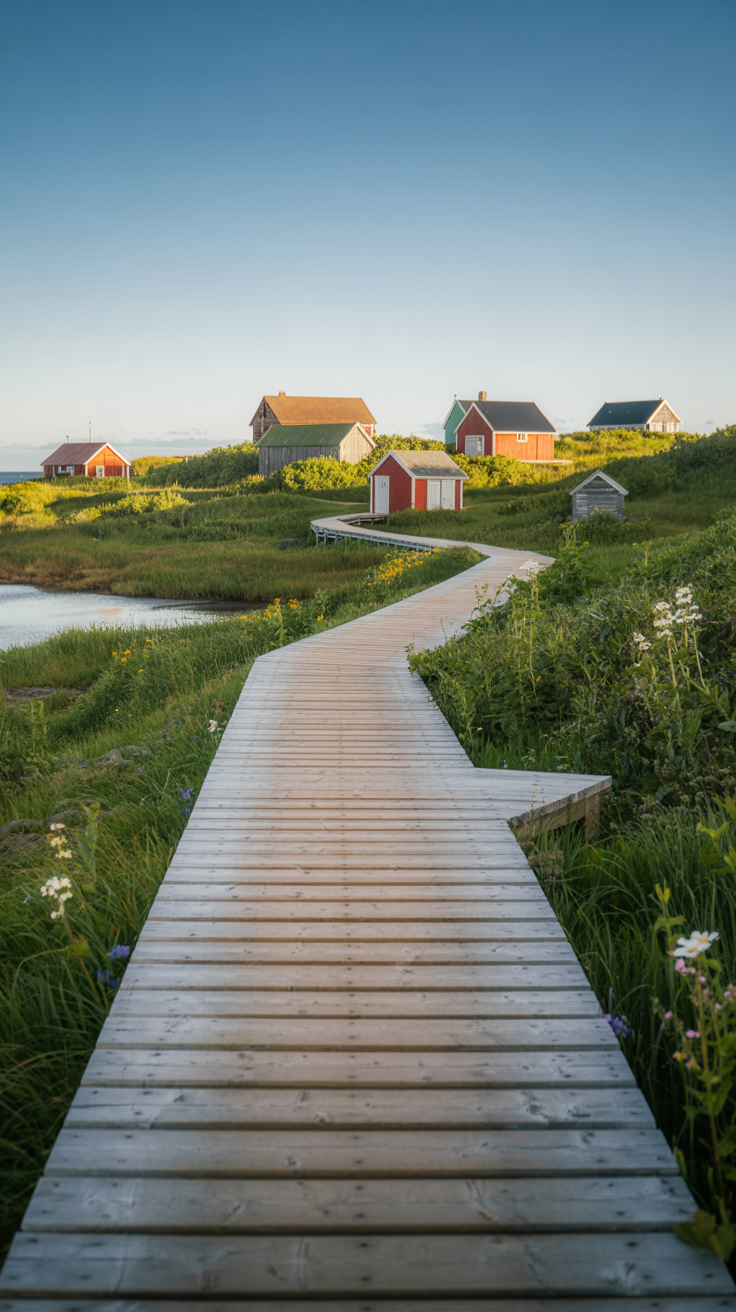
There isn’t a traditional “town” at L’Anse aux Meadows in the conventional sense. Here’s what you need to know about getting around on foot:
- Tender landing to UNESCO site: The walk from where the tender drops you off to the L’Anse aux Meadows National Historic Site entrance is roughly 0.8-1.0 km. This takes about 15-25 minutes depending on your pace and is straightforward on relatively flat terrain, though you’ll be walking on gravel paths in places. Double check it’s still open before you start planning your cruise.
- Norstead Viking Village: This recreated Viking port sits very close to the tender landing and is easily walkable. You can combine both attractions on foot without any issues.
- No town center: Unlike most cruise ports, there’s no main street with shops, restaurants, or cafes within walking distance. The area around the archaeological site is deliberately preserved and rural, with minimal commercial development.
- St. Anthony for services: If you want proper dining, shopping, or the Grenfell Interpretation Centre, you’ll need transport to St. Anthony, which is absolutely not walkable at 30+ km away.
- Wear proper footwear: The paths around the site can be uneven with gravel, grass, and occasionally muddy patches. A good pair of waterproof walking shoes will make the experience far more comfortable than fashion sneakers or sandals.
- Weather changes quickly: Even on a sunny morning, bring a windproof jacket. The coastal weather here is notoriously unpredictable, and you’ll be exposed on open terrain.
How to Get Around from L’Anse aux Meadows & Shore Transportation
Getting around here is different from typical cruise ports since there’s virtually no local transport infrastructure. You have limited but workable options.
Organized Shore Excursions
- Most reliable option: Your cruise line will offer excursions that include transport, guided tours, and timed returns. This eliminates stress about missing the tender back.
- Typical packages: Most combine the UNESCO site with Norstead Viking Village, and some add stops in St. Anthony or at natural attractions like Burnt Cape Ecological Reserve.
- Transport provided: Comfortable coaches with knowledgeable guides who understand the tight timing cruise passengers face.
- Book early: These excursions fill up quickly since it’s such a unique port and options are limited.
Private Drivers & Tours
- Pre-booking essential: There are no taxis waiting at the tender landing. If you want a private driver, you must arrange this well before your cruise, typically through operators based in St. Anthony.
- More flexibility: Private tours let you spend more or less time at each attraction based on your interests, and drivers often know hidden viewpoints and local stories.
- Cost consideration: Expect to pay significantly more than a group excursion, but you’ll have the vehicle and guide to yourself or your party.
- Communicate clearly: Make sure your driver understands your ship’s all-aboard time and builds in a buffer for getting back to the tender.
Car Rental
- Based in St. Anthony: The nearest rental agencies (Enterprise, Budget, Avis) operate from St. Anthony, not at the tender landing.
- Logistically tricky: You’d need to arrange pickup and drop-off, which eats into your already limited port time.
- Navigation straightforward: If you do rent, the route is simple – Route 436 connects everything, and there’s minimal traffic.
- Realistic for longer stays: This makes more sense if you’re spending multiple days in the area rather than a single cruise stop.
Walking
- Works for the main sites: You can easily walk between the tender landing, the UNESCO site, and Norstead without any motorized transport.
- Plan for weather: Bring layers, a windbreaker, and sturdy shoes. The coastal wind can be fierce even in summer months.
- Time your return: Keep a close eye on your tender ticket return time. Getting stranded ashore here is more problematic than at ports with regular public transport.
What to See Within Walking Distance from the Port
With limited time ashore, focus on the two core Viking attractions. Everything else is a bonus if timing allows.
L’Anse aux Meadows National Historic Site
- What it is: The only authenticated Norse settlement in North America, designated a UNESCO World Heritage Site. Eight structures were excavated here in the 1960s, proving that Vikings reached North America roughly 500 years before Columbus. The site features a modern visitor center with artifacts and excellent interpretive displays, plus full-scale reconstructions of three Norse buildings – a longhouse, a small hut, and a workshop.
- Why it matters: This fundamentally changed our understanding of transatlantic exploration. The archaeological evidence – including iron nails, a spindle whorl, and a bronze cloak pin – proved beyond doubt that Vikings established a presence here around 1000 CE. Standing in the reconstructed longhouse with its turf walls and central hearth gives you a visceral sense of how these explorers lived.
- Time needed: A minimum of 2-3 hours to see the visitor center exhibits, watch the introductory film, explore the reconstructed buildings, and walk the site where original structures were found. If you’re a history buff, you could easily spend 4 hours here. There are rarely queues since cruise ship timing is coordinated, but budget extra time if multiple ships are in port simultaneously.
- Practical tips: During summer periods, Parks Canada occasionally offers free admission – check current status upon arrival. The site is open daily during cruise season but hours vary, so confirm timing with your ship or the official Parks Canada website. Costumed interpreters are usually present during peak hours and add enormously to the experience. The reconstructed buildings can be dark inside (authentic to Viking construction), so your eyes need a moment to adjust. Photography is allowed throughout. Dress warmly – even the reconstructed buildings are unheated and drafty, just as they would have been historically. Accessible paths exist but the ground can be uneven in places.
Norstead Viking Village
- What it is: A living history site that recreates a Norse port of trade circa 1000 CE. While L’Anse aux Meadows shows you where Vikings actually lived, Norstead demonstrates how they lived through interactive demonstrations and period-accurate reconstruction. You’ll see a chieftain’s hall, a trading booth, and various workshops where interpreters demonstrate traditional skills.
- Why it matters: This brings the archaeology to life in a way that empty ruins cannot. Watching someone forge iron using Viking techniques or seeing how Norse looms worked gives context to the artifacts you saw in the Parks Canada visitor center. It’s particularly valuable if you’re traveling with children or teenagers who might find pure archaeology a bit dry.
- Time needed: 1-2 hours is sufficient to see all the buildings, watch demonstrations, and chat with the costumed staff. If you time it right, you might catch a “Viking feast” demonstration or see traditional music performances, which can extend your visit.
- Practical tips: Separate admission from the National Historic Site, though some cruise excursions bundle both. The village is run as a non-profit cultural attraction rather than a government site, so opening hours can be more flexible – confirm before walking over independently. The interpreters here are enthusiastic and knowledgeable, and they don’t mind questions. Some demonstrations are scheduled at specific times, so ask at the entrance what’s happening when to maximize your visit. There’s usually a small gift shop with Norse-themed items and local crafts. The site is less formal than the Parks Canada facility, which some visitors prefer.
Grenfell Interpretation Centre
- What it is: Located in St. Anthony (requiring transport from the tender landing), this museum tells the story of Sir Wilfred Grenfell, a British medical missionary who revolutionized healthcare in coastal Newfoundland and Labrador in the early 20th century. The center displays medical instruments, photographs, and personal effects, plus examples of Grenfell handicrafts – a distinctive embroidery style developed to provide income for local families.
- Why it matters: If you have time before or after the Viking sites and your excursion includes St. Anthony, this provides fascinating context about life in remote Newfoundland. Grenfell’s story is genuinely inspiring – he arrived in 1892 and spent 40 years establishing hospitals, nursing stations, orphanages, and cooperative ventures throughout the region.
- Time needed: 45 minutes to an hour covers the main exhibits. It’s not large but well-curated.
- Practical tips: Only worthwhile if your excursion specifically includes St. Anthony, as making a separate trip from the tender landing eats up too much of your port time. Modest admission fee. The center includes a tea room that’s convenient for a quick refreshment stop. Accessible facilities. The historic Grenfell House next door can sometimes be visited as well – ask at the center.
Burnt Cape Ecological Reserve
- What it is: A unique ecological area about 20 minutes north of the UNESCO site, featuring arctic-alpine plants typically found much farther north. The limestone barrens here create microclimates that support rare flora, including several orchid species and insectivorous plants. Marked trails lead through the reserve and along dramatic coastal cliffs.
- Why it matters: If you’re a nature enthusiast or photographer, this offers stunning coastal scenery and unusual botanical diversity. The limestone formations and wave-sculpted rocks are particularly photogenic, especially when fog creates an atmospheric backdrop.
- Time needed: 1-2 hours for a walk through the reserve and along the coast, depending on which trails you take.
- Practical tips: Only accessible if your shore excursion specifically includes it or if you’ve arranged private transport, as it requires driving from the tender area. Wear sturdy waterproof footwear – the limestone can be slippery and sharp in places. Bring binoculars for birdwatching if you’re interested; seabirds frequent the cliffs. No facilities or services at the reserve itself, so bring water and snacks. Free to visit. The trails are not particularly challenging but do require reasonable mobility for uneven ground. Best visited in late spring or summer when arctic-alpine flowers are blooming.
Where to Eat Near the Port
Let’s be honest – dining options at L’Anse aux Meadows itself are essentially non-existent. This is a remote archaeological site, not a tourist resort.
- Pack food from the ship: The smartest approach is to bring sandwiches, snacks, and water from your cruise ship’s buffet before tendering ashore. You can eat while enjoying spectacular coastal views, which beats most restaurant experiences anyway.
- Norstead Viking Village: Sometimes offers basic refreshments like coffee, tea, and simple snacks, but don’t count on a full meal. Availability varies by day and season.
- Parks Canada visitor center: May have vending machines or a very basic snack selection, but again, this isn’t a food destination.
- St. Anthony options: If your excursion includes time in St. Anthony, you’ll find proper restaurants there. The Grenfell Interpretation Centre has a tea room serving light meals and baked goods. Other St. Anthony spots serve traditional Newfoundland fare – think fish and chips, seafood chowder, cod tongues if you’re adventurous, and toutons (fried bread dough) for breakfast. Prices are moderate, with full meals typically ranging $15-25 CAD. Local restaurants often feature freshly caught seafood, which is genuinely excellent.
- Timing reality: Even if your excursion stops in St. Anthony, you may only have 30-45 minutes for lunch, which limits your options to quick-service places rather than sit-down restaurants. Confirm the schedule with your guide.
- Food safety: No particular concerns in this region. Tap water is safe throughout Newfoundland. Standard Canadian food safety regulations apply.
Shopping: What to Buy & Where to Go
Set your expectations appropriately – this is not a shopping destination in any conventional sense.
- Parks Canada gift shop: The visitor center at L’Anse aux Meadows has a small shop selling books about Viking history and archaeology, replicas of Norse artifacts, educational materials, and standard Parks Canada souvenirs. Quality is good but selection is limited. Prices are fixed (no haggling in Canada). Expect to pay $10-50 CAD for most items.
- Norstead Viking Village shop: Offers Norse-themed crafts, some locally made items, and historical reproductions. This is slightly more interesting than the Parks Canada shop if you want something with Viking flair. Credit cards accepted.
- Grenfell handicrafts: If your excursion includes St. Anthony, look for authentic Grenfell-style embroidery – a distinctive craft tradition featuring scenes of northern life worked in fabric. These items are genuinely local and meaningful as souvenirs. Prices reflect the handwork involved, typically starting around $50 CAD for smaller pieces.
- What to skip: Generic “Canada” souvenirs like maple syrup and mountie figures aren’t particularly relevant to this region’s history and culture. If you want those items, you’ll find better selection at larger ports.
- Opening hours: Shops at the historic sites keep the same hours as the attractions themselves, typically opening around 9am and closing by 5-6pm during cruise season. St. Anthony shops may have slightly extended hours but don’t expect late-night shopping.
- Bottom line: Come here for the history and landscape, not the shopping. If you do buy something, choose items that genuinely relate to Norse history or local Newfoundland culture rather than generic tourist tat.
Safety Tips
L’Anse aux Meadows is remarkably safe, with virtually no crime targeting tourists. Your main concerns are environmental rather than human-made.
- Weather hazards: Coastal conditions change rapidly. What starts as a sunny morning can turn foggy, windy, and cold within an hour. Hypothermia is a real risk if you’re caught out underdressed in wind and rain. Always bring a packable rain jacket, even if it looks beautiful when you leave the ship. Layering is essential – you can always remove layers if you’re too warm. Consider merino wool base layers for women or merino wool base layers for men which regulate temperature well in unpredictable conditions.
- Uneven terrain: Paths around the archaeological sites mix gravel, grass, and boardwalk. In wet conditions, wooden sections become slippery. Wear proper walking shoes with good grip – not sandals, not fashion sneakers. Twisted ankles are the most common injury in this environment.
- Missing the tender: The biggest “scam” risk here is being too casual about return times. If you miss the last tender, your options for catching up with your ship are extremely limited in this remote location. Set a phone alarm for at least 30 minutes before your required return time. If using your phone for photos, make sure you have battery life left to check the time.
- Wildlife encounters: You’re in genuine wilderness. While dangerous wildlife encounters are rare, moose can be unpredictable if encountered on paths. Keep a respectful distance from any wildlife. Don’t attempt to feed or approach animals.
- Medical considerations: If you have mobility issues, heart conditions, or respiratory problems, the coastal wind and walking distances might be more challenging than they first appear. Be honest with yourself about your fitness level. Shore excursions can arrange assistance if you notify them in advance.
- Tender operations: Getting in and out of tenders requires reasonable mobility and balance. The crew will assist, but seas can be choppy. If you’re nervous about small boats or prone to seasickness, consider motion sickness patches before the tender ride.
Emergency Contacts
- Emergency services (police, ambulance, fire): 911
- RCMP (Royal Canadian Mounted Police) St. Anthony detachment: +1 709-454-3543
- Charles S. Curtis Memorial Hospital (St. Anthony): +1 709-454-3333
- Parks Canada L’Anse aux Meadows emergency: Contact visitor center staff on-site or call Parks Canada general line +1 709-458-2417
- Marine emergency / Coast Guard: VHF Channel 16 or +1 800-565-1582
Save your cruise ship’s emergency contact number and your cabin number before going ashore. Make sure your phone works in Canada if you need to make calls – check roaming charges with your provider before the cruise.
Essential Items for Your Day in L’Anse aux Meadows
This remote northern port requires more preparation than typical cruise stops. Given the unpredictable weather, exposed terrain, and limited services, here’s what you should bring ashore:
- Weather protection: A packable rain jacket is essential even on sunny mornings – coastal weather changes within minutes. The wind can be fierce, so windproof outerwear makes a significant difference to your comfort.
- Proper footwear: Waterproof walking shoes with good grip are crucial for the mixed gravel, grass, and occasionally muddy terrain around the archaeological sites. Fashion sneakers or sandals will leave you uncomfortable and potentially unsafe.
- Layering pieces: Temperature fluctuates throughout the day, especially with wind chill. Merino wool base layers for women or merino wool base layers for men regulate temperature naturally and don’t hold moisture like cotton.
- Insect protection: During summer months, mosquitoes and blackflies can be persistent on the coastal trails. Bring insect repellent with DEET to make your outdoor exploration more pleasant.
- Viewing equipment: Compact binoculars enhance your experience tremendously – spot seabirds on the cliffs, watch for whales offshore during the tender ride, and pick out details on the rugged coastline.
- Day pack: A packable backpack lets you carry layers as you remove them, plus water and snacks. Choose something lightweight that can be stuffed away if not needed.
- Sun protection: Even on overcast days, UV exposure is significant in this northern latitude. Bring reef safe sunscreen SPF 50 and sunglasses for women or sunglasses for men.
- Hydration: There are no shops or water fountains along the trails. A collapsible water bottle saves space in your bag while ensuring you stay hydrated during the 2-3 hour walks.
- Photography protection: If taking your phone or camera on coastal walks, a waterproof phone pouch protects against sea spray and sudden rain showers.
- Tender preparation: If you’re prone to motion sickness, consider motion sickness patches before boarding the tender. The ride can be choppy depending on sea conditions.
- Hand warmers: In shoulder season (May-June or September-October), disposable hand warmers tucked in pockets make exposed coastal walks far more comfortable when wind chill drops temperatures.
Currency, ATMs & Money Matters
Financial practicalities are straightforward but worth planning ahead since you’re in a remote area.
- Local currency: Canadian Dollar (CAD). As of current exchange rates, £1 equals approximately $1.75 CAD, though rates fluctuate. US dollars might be accepted at some tourist facilities at unfavorable exchange rates, but don’t count on it.
- ATMs: There are no ATMs at L’Anse aux Meadows itself. The nearest ATMs are in St. Anthony, 30+ kilometers away. Withdraw Canadian cash before your cruise or from your ship if they offer that service. Some ships have ATMs aboard, though fees are typically high.
- Card acceptance: The Parks Canada visitor center and Norstead accept credit and debit cards for admission and shop purchases. Visa and Mastercard are universally accepted; American Express less reliably. Contactless payment is standard in Canada.
- How much cash to bring: If you’re on an organized excursion that includes admission and only plan to buy a small souvenir or snack, $20-40 CAD should cover you. If you’re paying your own admission (typically around $4-6 CAD per adult at the National Historic Site when fees apply; sometimes free) and want lunch in St. Anthony, budget $40-60 CAD per person.
- Notify your bank: Before your cruise, tell your bank and credit card companies you’ll be traveling to Canada. Otherwise, they may flag Canadian transactions as suspicious and freeze your cards, which is particularly problematic in a remote location.
- Tipping: Canadian tipping customs are similar to the US – 15-20% in restaurants. If you have a private driver or guide, $10-20 CAD per person is appropriate for good service. Shore excursion tour guides typically receive $5-10 CAD per person. Tipping isn’t expected at Parks Canada sites or gift shops.
- Taxes: Prices in Canada typically don’t include tax in the displayed amount. Federal GST (5%) plus Newfoundland provincial sales tax (15% HST total) will be added at the register. This surprises many visitors who aren’t used to tax-inclusive pricing.
- Currency exchange: Don’t bother with currency exchange in this remote location – there are no exchange bureaus. Handle currency exchange at major ports before or after, or withdraw Canadian cash from ATMs in larger cities. Your credit card usually offers better exchange rates than cash exchange services anyway.
Weather by Month
| Season | Months | Temperature Range | What to Expect |
|---|---|---|---|
| Late Spring | May-June | 4-12°C (39-54°F) | Cool with frequent fog and wind. Icebergs may still be visible offshore, which is spectacular but brings cold air. Pack warm layers and waterproofs. Daylight extends late into the evening. Arctic-alpine flowers begin blooming at Burnt Cape. Cruise season is just beginning, so sites are quieter. |
| Summer | July-August | 10-18°C (50-64°F) | The warmest months, though “warm” is relative in northern Newfoundland. Long daylight hours (18+ hours in midsummer) give you excellent light for photography. This is peak cruise season with more ships calling. Weather remains unpredictable – bring layers as temperatures can feel much colder with wind chill. Mosquitoes and blackflies can be persistent, especially on trails. Wildflowers are at their peak. Whales are frequently spotted offshore. |
| Early Autumn | September-October | 6-12°C (43-54°F) | Cooling temperatures and increasing wind. Autumn colors can be beautiful though vegetation here is low and scrubby. Fewer cruise ships call, so sites are quieter. This is migration season for seabirds. Weather becomes less predictable with increased chance of storms. Days shorten noticeably. You’ll definitely need warm, windproof clothing. |
| Winter | November-April | -10 to 2°C (14-36°F) | No cruise ships visit during these months. The site is often inaccessible due to snow and ice. Mentioned only for context if you’re considering an overland visit outside cruise season – don’t attempt this without serious cold-weather preparation and local guidance. |
Common Questions & FAQ
Do cruise ships actually dock at L’Anse aux Meadows?
No, there’s no cruise pier here. Ships anchor offshore and tender passengers to a landing point near the historic sites. The tender operation means you’ll board smaller boats (holding perhaps 100-150 passengers) for the transfer. This can take 15-30 minutes depending on sea conditions and how far offshore your ship anchors. If you’re nervous about small boats or prone to seasickness, bring medication – the tender ride can be bouncy in choppy conditions.
How long does it take to see the main Viking sites?
Budget 2-3 hours minimum for the L’Anse aux Meadows National Historic Site including the visitor center, and add another 1-2 hours if you’re visiting Norstead Viking Village. Most cruise passengers allocate 4-5 hours total for both attractions plus walking time. If you’re a serious history enthusiast who wants to read every interpretive panel and explore all the trails, you could easily spend 6-7 hours, but that’s not typical for cruise visitors.
Can I visit independently without a shore excursion?
Technically yes, but it’s complicated. You can walk from the tender landing to both the UNESCO site and Norstead without any transport. However, if you want to visit St. Anthony, Burnt Cape, or anything beyond walking distance, you’ll need pre-arranged transport since there are no taxis or public buses waiting at the landing. Most cruise passengers find organized excursions less stressful given the remote location and tight timing. If you do go independently, be paranoid about tender return times – missing the last boat has serious consequences here.
Is this port suitable for people with mobility issues?
Partially. The tender operation requires navigating stairs and stepping between the ship and a moving boat, which can be challenging. Once ashore, the main paths at the UNESCO site include some boardwalk and relatively flat sections, but also uneven ground, gravel, and grass. The Parks Canada visitor center is accessible, but the reconstructed Viking buildings have authentic low doorways and uneven floors that wheelchairs and walkers can’t navigate. If you have mobility concerns, discuss specific limitations with your cruise line’s accessibility coordinator before booking. Some passengers with moderate mobility issues do fine on organized excursions that provide transport and take their time, while others find the terrain too challenging.
What should I absolutely not miss if time is limited?
If you only have time for one thing, prioritize the L’Anse aux Meadows National Historic Site over Norstead. The UNESCO site is the actual archaeological location with genuine historical significance, while Norstead is a (well-done) recreation. Within the Parks Canada site, make sure you see both the visitor center exhibits – particularly the actual Norse artifacts – and the outdoor reconstructed buildings with costumed interpreters. If you skip the center and only see the buildings, you’ll miss crucial context about how the site was discovered and what makes it so important. The short film in the visitor center is genuinely worth watching before you explore the outdoor areas.
Are there really no restaurants or shops nearby?
Correct – this isn’t that kind of destination. You’ll find small gift shops at the Parks Canada visitor center and at Norstead, plus potentially basic refreshments, but nothing resembling a proper restaurant or shopping district. The nearest town with full services is St. Anthony, which requires transport. This remoteness is actually part of the site’s appeal – it looks remarkably similar to how it would have appeared when Vikings were here. Pack snacks and water, and embrace the wilderness experience rather than expecting tourist infrastructure.
What’s the best time of day to visit to avoid crowds?
Get on the first tender if possible. The earliest passengers ashore often have an hour or more at the sites before the main crowds arrive. This makes for better photographs, quieter moments with the interpreters, and a more contemplative experience of this historically significant place. If your ship offers multiple tender departure times, the first slot is worth setting an early alarm. The flipside is that costumed interpreters and some demonstrations may not start until mid-morning, so verify the daily program when you arrive.
Will I see icebergs or whales during my visit?
Possibly, depending on season and luck. Icebergs drift through the Strait of Belle Isle primarily in late spring and early summer (May-June), though occasional stragglers appear into July. Whales (humpback, minke, and sometimes orcas) feed in these waters, especially during summer months. You might spot them from shore or during the tender ride, though neither is guaranteed. Bring binoculars if you have them, and keep your eyes on the water during the tender transfer. The crew will sometimes announce whale sightings. Even if you don’t see whales or icebergs, the seabirds and coastal scenery are spectacular.
Personal Experience
Standing on the windswept shores of L’Anse aux Meadows feels like stepping into another world entirely. When our cruise ship docked at the nearby port, I wasn’t quite prepared for just how remote and beautifully desolate this corner of Newfoundland would be. Most shore excursions here focus on the UNESCO World Heritage Site where Vikings actually lived over a thousand years ago – not a replica, but the real deal. The bus ride from the port takes about an hour through some stunning coastal scenery, so bring your camera. At the site itself, you can walk through reconstructed sod buildings and chat with guides dressed in period clothing who demonstrate Viking crafts and daily life. The visitor center does an excellent job explaining the archaeological discoveries, and seeing the actual excavation sites where Norse artifacts were found gives you goosebumps.
Getting around independently is tricky since there’s not much in terms of public transportation, so booking an organized excursion makes the most sense unless you arrange a private driver ahead of time. The weather can be unpredictable even in summer – I wore layers and was glad for my windbreaker when the fog rolled in. Beyond the Viking site, some tours include stops at nearby fishing villages where you can grab fresh seafood and meet locals who are genuinely warm and chatty. This isn’t a port where you’ll find bustling markets or shopping districts. Instead, it offers something rarer: a quiet connection to history and landscape that feels worlds away from typical cruise stops.
For more insights on what to expect on your first cruise, check out our guide for new cruisers, and don’t miss our comprehensive cruise tips to make the most of every port day. If you’re exploring more of Atlantic Canada, our guides to Corner Brook, Saint Anthony, and Red Bay offer additional context for this remarkable region.