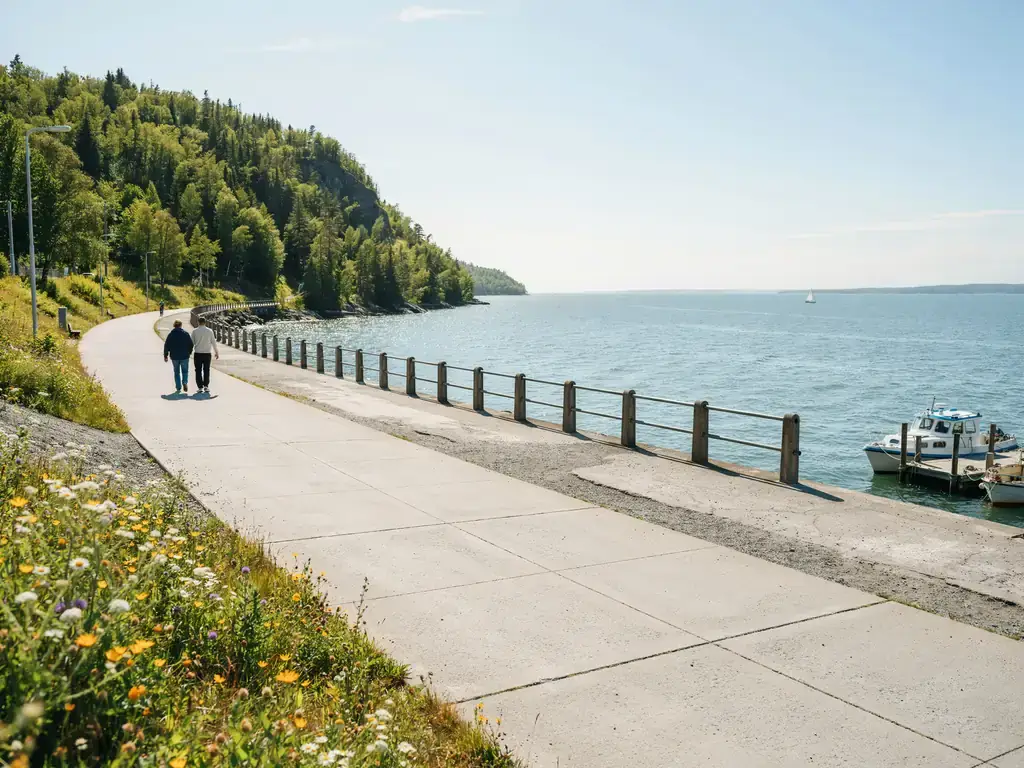
Saguenay, Quebec serves as a cruise port along the dramatic Saguenay Fjord, approximately 155 miles northeast of Quebec City. The port welcomes ships at La Baie’s Grande-Anse Marina. Visitors can explore stunning fjord scenery, observe beluga whales, visit charming villages, experience French-Canadian culture, and access outdoor activities including hiking and kayaking in this scenic wilderness region.
Quick Port Facts
| Fact | Detail |
|---|---|
| Port Name | Bagotville Wharf, La Baie (Saguenay International Cruise Terminal) |
| Location | Grande-Anse/Bagotville sector, La Baie, Saguenay |
| Coordinates | 48°20′42″ N, 70°52′42″ W |
| Berth Length | 196 metres (643 feet) |
| Water Depth | Up to 12 metres (39 feet), tide-dependent |
| Port Website | Port of Saguenay Official Site |
| Port Emergency | 418-812-6400 (24/7) |
| Currency | Canadian Dollar (CAD) |
| Language | French (English widely understood in tourist areas) |
Want to know more about other cruise ports in Canada?
Saguenay Map
The cruise terminal is located at Bagotville Wharf in the La Baie sector of Saguenay, positioned along the southern shore of the magnificent Saguenay Fjord. The Village Portuaire welcome area sits directly adjacent to the pier, with the main La Baie town centre a short distance away. Chicoutimi, the larger urban centre of Saguenay, lies about 15-20 minutes by road to the west.
Can You Walk to Town from the Port?
The short answer is yes, but with some caveats. The Village Portuaire area is literally steps from your ship, whilst the main La Baie town centre requires a proper walk.
- Village Portuaire (immediate pier area): You’re already there when you step off the gangway. Restaurants, artisan stalls, souvenir shops and tourist information kiosks are set up right at the terminal to welcome cruise passengers.
- La Baie town centre: Roughly a 20-minute walk from the pier along the waterfront, mostly flat terrain. Doable if you enjoy a stroll and don’t mind carrying any purchases back.
- Ha! Ha! Pyramid: This distinctive flood memorial sits within easy walking distance along the La Baie waterfront, making for a good photo opportunity without serious effort.
- Chicoutimi: Not walkable. This larger district requires a shuttle, taxi or excursion bus (15-25 minutes by vehicle).
- Shuttle service: Most cruise lines operate complimentary shuttles from the pier to La Baie town centre, running frequently throughout the port day. Some also offer paid transfers to Chicoutimi for those wanting to explore further afield.
How to Get Around from Saguenay & Shore Transportation
Transport options from the Bagotville terminal are straightforward, with most cruise passengers choosing between complimentary shuttles and taxis for independent exploration. The port authority has organised things to make getting around relatively painless.
Cruise Line Shuttles
- Free shuttles typically run from the pier to La Baie town centre on a loop schedule throughout your port day
- Some cruise lines offer paid shuttles or transfers to Chicoutimi for passengers wanting to explore beyond La Baie
- Check your cruise line’s daily programme for exact timings and pickup points
- These are usually the most convenient option unless you’re planning something specific off the beaten track
Taxis
- Taxis wait at the pier for cruise ship arrivals, making them easy to find
- Expect to pay around $15-20 CAD for a ride to La Baie town centre
- A taxi to Chicoutimi runs approximately $30-40 CAD one way
- Confirm the fare before departing to avoid any confusion
- Many drivers speak at least basic English, though French is the primary language
Public Transit
- The Société de transport du Saguenay (STS) operates local bus services throughout the region
- Routes and schedules can be challenging to coordinate with tight cruise port hours
- Better suited for visitors staying overnight rather than day-trippers from cruise ships
- If you’re determined to use public transit, ask at the Village Portuaire information desk for current routes and times
Car Hire
- Rental agencies operate in the greater Saguenay area, though not directly at the pier
- Best arranged in advance if you want the freedom to explore fjord viewpoints and surrounding villages independently
- Particularly worthwhile if travelling with a group to split costs
- Driving gives access to spectacular lookout points like Sainte-Rose-du-Nord that are otherwise difficult to reach
What to See Within Walking Distance from the Port
The immediate port area offers a handful of worthwhile stops, though the real attractions of Saguenay require venturing further afield by shuttle or taxi.
- Village Portuaire: The on-pier welcome village features artisan stalls selling local crafts, regional food products (especially blueberry items, for which the area is famous), and souvenir shops. There’s also a staffed tourism information point where you can pick up maps and ask questions. Zero walking time from your ship, making it perfect for a quick browse before or after excursions.
- Ha! Ha! Pyramid: This 21-metre aluminium pyramid along the La Baie waterfront commemorates the devastating 1996 Saguenay flood. Made from thousands of road signs collected after the disaster, it’s become an unexpected icon of community resilience. About 10-15 minutes’ walk from the pier along flat waterfront paths, making it an easy photo stop.
- Bistro Cafe Summum: Situated just outside the immediate port zone, this casual spot serves breakfast, lunch and dinner with local ingredients. Roughly a 5-minute walk from the terminal, convenient if you want a proper meal without straying far from the ship.
- O’Gelato et Cacao: A gelato shop about 3 minutes’ walk from the pier, perfect for a sweet treat whilst wandering the waterfront. The blueberry flavour is the obvious local choice.
- La Grange aux Hiboux: A small bistro about 6 minutes’ walk south from the port, offering local fare with fjord views. Better for evening meals, though cruise passengers will rarely be in port late enough to take advantage.
Must See Attractions in Saguenay for a One Day Cruise Visit

Saguenay’s main draws require getting beyond the immediate pier area, but they’re absolutely worth the effort. The fjord itself is the star attraction, with supporting acts from museums and charming villages.
Saguenay Fjord Cruise
- What it is: Boat excursions that take you deeper into one of the world’s longest southern fjords, with dramatic cliffs rising up to 500 metres straight from the water. Some tours venture into the confluence with the St. Lawrence River where beluga whales are often spotted.
- Why it matters: You’re already at one of North America’s most spectacular fjords. Seeing it from water level, with those sheer rock faces towering above you, provides the perspective that makes Saguenay memorable. Wildlife sightings (belugas, seals, seabirds) add an extra dimension.
- Time needed: Most fjord cruises run 2-3 hours. Factor in 15-20 minutes each way for check-in and boarding. A 3-hour tour realistically takes 3.5-4 hours door-to-door from your cruise ship.
- Practical tips: Book through your cruise line or in advance online, as these tours can sell out. Prices typically run $70-90 CAD per adult. Dress in layers even in summer – it gets genuinely cold and windy out on the water. A quality packable rain jacket is essential as conditions can change quickly on the fjord. Bring binoculars if you have them. Boats usually depart from near the cruise terminal, making logistics simple.
Musée du Fjord
- What it is: An interactive museum in La Baie focused on the unique ecosystem of the Saguenay Fjord, including aquariums showcasing local marine life and exhibits on the region’s geological formation and human history.
- Why it matters: It provides context for what you’re seeing from ship and shore. Understanding how the fjord was carved by glaciers and why its brackish waters support such unusual biodiversity makes the landscape more meaningful. The belugas exhibit is particularly well done.
- Time needed: Allow 1.5-2 hours for a thorough visit, plus travel time. It’s located a few kilometres from the port, so factor in shuttle or taxi time each way.
- Practical tips: Admission runs around $15-18 CAD for adults. The museum is family-friendly with hands-on exhibits that engage younger visitors. Some signage is French-only, though key information has English translations. Check if your cruise line offers an excursion that combines this with other La Baie attractions.
Sainte-Rose-du-Nord Village & Viewpoint
- What it is: A picturesque village about 30 minutes from La Baie, perched on the fjord’s edge. The main draw is the spectacular viewpoint overlooking a dramatic bend in the fjord, with forested cliffs plunging into dark water.
- Why it matters: This is where you get the postcard shot of Saguenay Fjord. The elevated perspective shows the scale and drama that’s harder to appreciate from sea level. The village itself is quintessentially Quebecois, with colourful houses and a peaceful atmosphere.
- Time needed: Plan for 2.5-3 hours including the 30-minute drive each way from the port. You’ll want at least an hour in the village to reach the viewpoint, take photos, and perhaps grab a coffee.
- Practical tips: This requires hiring a taxi (expensive for a return trip) or renting a car, making it better suited for groups who can split costs. The viewpoint involves a short but steep walk from the village car park, so wear comfortable walking shoes. Some cruise excursions include this stop as part of a scenic drive itinerary. If you’re visiting independently, bring cash for any small purchases as card acceptance can be spotty.
Chicoutimi Historic District
- What it is: The largest urban centre within Saguenay, featuring a walkable old quarter with 19th-century architecture, the striking Cathedral of St. Francis Xavier, independent shops, and cafes.
- Why it matters: If you want to experience authentic French-Canadian urban life beyond tourism infrastructure, Chicoutimi delivers. It’s where locals actually live and work, with a genuine neighbourhood feel and better dining options than you’ll find in the port area.
- Time needed: Give yourself 2-3 hours minimum to make the 15-20 minute drive worthwhile. A proper visit with lunch can easily fill 4 hours.
- Practical tips: Some cruise lines run shuttles here for a reasonable fee. A taxi runs about $30-40 CAD each way. The cathedral is free to enter and genuinely impressive inside. French is more dominant here than in the touristy port area, so a translation app might be handy. Rue Racine is the main commercial street for shopping and restaurants.
Parc national du Fjord-du-Saguenay
- What it is: A protected national park stretching along both sides of the fjord, offering hiking trails, kayaking opportunities, and wilderness camping. Several access points provide different experiences, from short interpretive walks to serious backcountry routes.
- Why it matters: For active cruise passengers who’d rather hike than sit on a tour bus, this park delivers genuine wilderness experiences with spectacular fjord overlooks as rewards. The trails range from easy 30-minute strolls to challenging half-day hikes.
- Time needed: Depends entirely on your chosen activity. A short interpretive trail might take 1-1.5 hours total including driving to the trailhead. A more ambitious hike to a fjord viewpoint could require 4-5 hours. Kayaking excursions typically run 3-4 hours.
- Practical tips: Park entry requires a daily pass (around $9 CAD per adult). This is best experienced through an organized shore excursion that handles transport and provides context. Independent visitors need a rental car to reach trailheads. Bring proper footwear, water, and layers regardless of season. Trails can be muddy and slippery, particularly in spring and after rain. Mobile phone coverage is unreliable once you’re away from populated areas.
Blueberry Farms & Local Producers
- What it is: The Saguenay-Lac-Saint-Jean region is Quebec’s blueberry capital. Several farms and producers near the port welcome visitors for tastings and purchases of blueberry wines, preserves, pies, and other products.
- Why it matters: If you enjoy agritourism and bringing home edible souvenirs, this offers something genuinely regional that you won’t find elsewhere. The blueberries here benefit from the short growing season and acidic soils, producing intensely flavoured fruit.
- Time needed: A visit to a single farm or producer takes 45 minutes to an hour including travel time. Some shore excursions combine this with other attractions.
- Practical tips: Peak blueberry season runs July through early September, though processed products are available year-round. Blueberry wine makes a good gift if you have space in your luggage. The liquids restrictions for cruise passengers don’t apply if you’re checking baggage at your final destination. Ask at the Village Portuaire for current recommendations on which farms are easiest to reach from the port.
Port Day Itinerary: Things to Do in 8 Hours
Here’s a realistic schedule that fits a typical 8am-5pm port day in Saguenay, assuming your ship docks by 8am and you need to be back aboard by 5pm.
- 8:00-8:30am | Disembark and orientation: Clear the ship, walk through the Village Portuaire to get your bearings, grab a coffee and perhaps a pastry from one of the on-pier vendors. Pick up a local map from the information desk if you’re planning any independent wandering later.
- 8:30-9:00am | Transfer to fjord cruise: Most morning fjord cruises depart around 9:00 or 9:30am. If you’ve pre-booked, head to the check-in point (usually near the terminal). Allow time for check-in and boarding. If you haven’t booked in advance, you can sometimes secure last-minute spots, though this is risky during peak season.
- 9:00am-12:00pm | Saguenay Fjord boat tour: Spend three hours on the water, cruising deeper into the fjord. You’ll see dramatic cliffs, possibly spot beluga whales or seals, and gain appreciation for the scale of this landscape. Guides provide commentary on geology, wildlife, and local history. Bundle up – even in summer it’s significantly colder on the water than on land.
- 12:15-1:30pm | Lunch in La Baie: Back at the port, catch a shuttle or walk to La Baie town centre for lunch. Try a local restaurant for tourtière (meat pie), poutine, or a Quebecois-style smoked meat sandwich. Several cafes along the waterfront offer outdoor seating with fjord views. This is also your chance to use actual washrooms rather than portable facilities.
- 1:45-3:00pm | MusĂ©e du Fjord: Take a taxi or arrange transport to the museum (a few kilometres from town centre). Spend an hour exploring the aquariums and exhibits that explain what you’ve just seen on your fjord cruise. The context makes the morning’s boat tour more meaningful. If museums aren’t your thing, substitute a visit to the Ha! Ha! Pyramid and some shopping instead.
- 3:00-4:15pm | La Baie shopping and snacks: Return to La Baie centre or the Village Portuaire area for souvenir shopping. Look for blueberry products, maple syrup, local crafts, and other regional specialties. Grab an ice cream or coffee as an afternoon pick-me-up. This is buffer time if anything earlier ran long.
- 4:15-4:45pm | Return to ship: Walk or catch the shuttle back to the pier with plenty of margin. Cruise ships in remote ports like Saguenay won’t wait for stragglers, and the next port could be a very long way away. Use this time to enjoy the last views of the fjord from the terminal area.
- 4:45pm | Final all aboard: Back on the ship with 15 minutes to spare before the 5pm all-aboard time, giving you a chance to drop off purchases, use the facilities, and change clothes if needed before the ship departs.
This schedule builds in reasonable buffer time whilst still hitting the main attractions. If you’re less interested in the museum, you could substitute a longer lunch or a taxi ride to one of the fjord viewpoints instead.
Where to Eat Near the Port
The dining scene immediately around Bagotville Wharf is limited to the Village Portuaire vendors and a handful of casual spots, but La Baie and Chicoutimi offer proper Quebecois cuisine if you’re willing to travel a bit.
- Village Portuaire stalls: The pier-side welcome area features several food vendors serving grab-and-go options like sandwiches, pastries, coffee, and snacks. Convenient if you’re pressed for time but nothing particularly memorable. Expect to pay $8-12 CAD for a basic sandwich and coffee. Look for anything featuring local blueberries – the region is famous for them.
- Bistro Cafe Summum: Just outside the immediate port zone, this casual restaurant serves breakfast, lunch, and dinner with an emphasis on local ingredients. The tourtière (traditional meat pie) is solid, and they do a decent job with regional fish. Mains run $15-25 CAD. About a 5-minute walk from the terminal, making it practical for cruise passengers who don’t want to venture far.
- La Baie restaurants: The town centre (shuttle or 20-minute walk from port) has several proper restaurants where locals actually eat. Look for classic Quebecois dishes: tourtière, poutine, pea soup, and anything made with maple syrup. Expect $18-30 CAD for main courses at sit-down restaurants. French menus are standard, though staff in tourist-facing spots usually manage English.
- Chicoutimi dining: If you venture to Chicoutimi (15-20 minutes by taxi or shuttle), you’ll find the region’s best restaurant selection along Rue Racine and the old quarter. This is where you can find everything from bistros to pizza joints to proper French-Canadian fine dining. Budget $25-45 CAD per person for a good meal with drinks. The extra travel time makes this better suited for longer port days.
- Blueberry everything: The Saguenay-Lac-Saint-Jean region produces most of Quebec’s wild blueberries. You’ll find them in pies, tarts, jams, sauces, wines, and even in savoury dishes. Don’t leave without trying at least one blueberry item – it’s the local specialty that actually lives up to the hype.
- Quick options: If you need something fast between attractions, the Village Portuaire and La Baie both have bakeries (patisseries) where you can grab excellent pastries and sandwiches for $5-10 CAD. Tim Hortons, the ubiquitous Canadian coffee chain, has locations in the area for predictable coffee and donuts.
- Food safety: Tap water is safe to drink throughout Quebec. Food hygiene standards are high. The biggest “danger” is overeating because portions tend to be generous and everything is covered in cheese or maple syrup.
Shopping: What to Buy & Where to Go
Saguenay isn’t a major shopping destination, but it offers good options for regional specialities and Canadian souvenirs. Set your expectations for artisanal and food products rather than luxury goods or fashion.
- Blueberry products: Jams, jellies, dried blueberries, blueberry wine, and blueberry chocolate are everywhere and make excellent gifts. The Village Portuaire stalls and La Baie shops stock plenty of options at reasonable prices ($6-20 CAD depending on item).
- Maple syrup and maple products: Quebec produces the vast majority of the world’s maple syrup. Buy the real stuff in tins or bottles ($12-25 CAD), along with maple butter, maple sugar, and maple candies. Check liquid restrictions if you’re flying home from a subsequent port.
- Indigenous crafts: Some vendors sell authentic First Nations artwork, including carved items, dreamcatchers, and textiles. Quality and prices vary widely. If authenticity matters to you, look for certification or buy directly from Indigenous-owned shops.
- Local art and crafts: The artisan stalls at Village Portuaire feature work from regional artists and craftspeople – pottery, paintings, woodwork, textiles. Prices are generally reasonable ($15-100+ CAD) and you’re supporting local makers directly.
- Quebecois specialities: Smoked meats, local cheeses, tourtière kits, and other food items are available at specialty shops. Check customs regulations for your home country before purchasing meat or dairy products.
- Clothing and outdoor gear: If you need fleece, rain jackets, or other practical items (and you might – it can be chilly and damp even in summer), La Baie and Chicoutimi have sporting goods shops with Canadian brands like Roots at moderate prices.
- Shop hours: Most shops in the Village Portuaire open when cruise ships are in port, typically 9am-5pm. In town, expect hours of roughly 10am-6pm on weekdays, with reduced hours on Sundays. Some smaller shops close for lunch.
- Haggling: Not expected or appreciated. Prices are fixed in shops and stalls. The only exception might be at outdoor artisan markets if you’re buying multiple items from the same vendor, where politely asking “what’s your best price for both?” sometimes yields a small discount.
- Payment: Credit cards are widely accepted in proper shops. The Village Portuaire vendors and some smaller artisan stalls may be cash-only or have card minimums. ATMs are available in La Baie if you need Canadian dollars.
Safety Tips & Avoiding Scams
Saguenay is genuinely safe for cruise passengers. Violent crime is rare and the biggest risks are missing your ship or succumbing to weather exposure. That said, some practical awareness helps ensure a smooth port day.
- Watch the clock: The single biggest “danger” in Saguenay is losing track of time and missing all-aboard. The port is somewhat remote and your ship won’t delay departure. Set multiple alarms, build in buffer time, and don’t rely on “I’ll just catch a taxi” as your backup plan when you’re 30 minutes away in Chicoutimi.
- Weather preparedness: The Saguenay Fjord creates its own microclimate. It can be cold, windy, and damp even when the forecast says otherwise. Passengers end up genuinely uncomfortable or even hypothermic on fjord boat tours if they don’t bring layers. Pack a proper jacket, hat, and closed-toe shoes even in summer.
- Taxi fare confirmation: Agree on fares before getting in taxis, particularly for longer trips to Chicoutimi or Sainte-Rose-du-Nord. Most drivers are honest but language barriers can lead to misunderstandings. Expect around $15-20 CAD to La Baie centre, $30-40 CAD to Chicoutimi.
- Unofficial tour operators: Stick with excursions booked through your cruise line or established local operators recommended by the port tourism desk. Random people offering “cheap tours” at the pier may not be insured or reliable. Given the remote location and tight timing, this isn’t the port to experiment with unlicensed guides.
- Wildlife viewing: If you take a fjord cruise or hike in the national park, follow guide instructions regarding wildlife. Beluga whales are protected and boats must maintain specific distances. Black bears live in the surrounding forests – unlikely but possible encounters on hiking trails. Make noise whilst hiking and never approach or feed any wild animals.
- Road conditions: If you rent a car for independent exploration, roads around Saguenay can be winding and steep, particularly routes leading to viewpoints. Drive cautiously, watch for wildlife, and leave plenty of time to return to port. Mobile phone coverage can be spotty outside populated areas.
- ATM safety: Use ATMs inside banks during business hours when possible. Cover your PIN. If a machine seems tampered with or doesn’t return your card, cancel the transaction and find another machine.
- Charity solicitations: Be wary of anyone approaching you for donations or charitable causes near the port. Legitimate charities don’t typically target cruise passengers at the pier. Politely decline and move on.
- Overpriced souvenirs: Compare prices between the Village Portuaire stalls and shops in La Baie town before making major purchases. The convenience premium at the pier can be significant, particularly for packaged foods and mass-produced souvenirs.
Emergency Contacts
- Emergency services (police, ambulance, fire): 911
- Port of Saguenay emergency line: 418-812-6400 (available 24/7)
- Port of Saguenay main office: 418-697-0250
- Saguenay Police Service (non-emergency): 418-699-6000
- La Baie police station: 491 Boulevard de la Grande-Baie Sud, La Baie, QC G7B 2C9
- Nearest hospital: Contact local emergency services via 911 for ambulance service to the appropriate medical facility
Save your cruise ship’s emergency contact number and the port agent’s details before going ashore. Your ship’s reception desk or shore excursion desk can provide these numbers.
Essential Items for Your Day in Saguenay
The dramatic Saguenay Fjord and surrounding wilderness demand proper preparation, even during summer months. Here are the essential items that will make your port day comfortable and worry-free:
- Layered clothing: Temperatures can vary dramatically between the town and out on the water. Merino wool base layers for women and merino wool base layers for men provide excellent insulation without bulk, perfect for wearing under your outer layers during fjord boat tours.
- Weatherproof outerwear: A packable rain jacket is absolutely essential for fjord cruises where wind and spray can soak you quickly. If rain is forecast, a rain poncho provides additional coverage and is easy to stuff in a daypack.
- Proper footwear: Whether you’re walking to town or hiking in the national park, comfortable shoes matter. Women’s walking shoes and men’s walking shoes with good traction handle the waterfront paths and trails around Saguenay.
- Sun protection: Even on overcast days, UV exposure is significant, especially on the water. Pack sunglasses for women or sunglasses for men, plus a packable sun hat that won’t blow off in fjord winds.
- Wildlife viewing gear: Compact travel binoculars enhance your fjord cruise experience, letting you spot beluga whales, seals, and seabirds at distance.
- Secure storage: An anti-theft backpack keeps your valuables secure during town walks, while a packable lightweight backpack provides extra space for souvenirs and layers you shed as the day warms up.
- Important documents: Keep your passport, ship card, and Canadian dollars secure in an RFID blocking travel wallet or money belt to protect against electronic theft.
- Tech essentials: A portable phone charger ensures your camera and phone last through a full day of photography. If you need power in your cabin, bring a European power adapter as Canadian ships often use 110V North American outlets.
- Hydration: A collapsible water bottle lets you stay hydrated without taking up space in your bag when empty – tap water throughout Quebec is safe to drink.
- Blister prevention: If you’re planning longer walks or hikes, blister prevention products can save your day, especially if you’re breaking in new walking shoes.
Currency, ATMs & Money Matters
Canada uses the Canadian dollar (CAD), and you’ll need local currency for many purchases in Saguenay, particularly outside the immediate port area.
- Local currency: Canadian dollar (CAD), divided into 100 cents. Coins come in 5¢, 10¢, 25¢, $1 (loonie), and $2 (toonie). Notes are $5, $10, $20, $50, and $100. One-cent pennies were phased out, so cash transactions are rounded to the nearest 5 cents.
- Exchange rates: As a rough guide, 1 CAD equals approximately 0.55 GBP, 0.65 EUR, or 0.75 USD, though rates fluctuate. Check current rates before departure.
- ATMs: Available in La Baie town centre and at banks in Chicoutimi. The immediate port area has limited ATM access, so withdraw cash before leaving the town if you’ll need it. Most Canadian ATMs charge fees of $3-5 CAD per transaction for foreign cards, plus whatever your home bank charges.
- Credit cards: Visa and Mastercard are widely accepted in shops, restaurants, and for excursions. American Express and Discover have more limited acceptance. Contactless payments are common. Some Village Portuaire vendors and small artisan stalls may be cash-only or have card minimums around $10 CAD.
- US dollars: Some tourist-facing businesses near the port may accept US dollars but will give you a poor exchange rate. Use Canadian dollars or cards instead.
- How much cash to bring: If you’re sticking to organized excursions and shopping in proper stores, $50-100 CAD per person should cover snacks, tips, and small purchases. If you’re planning independent dining or extensive souvenir shopping, bring more or plan to use ATMs.
- Notify your bank: Tell your bank and credit card companies you’ll be in Canada to avoid having your cards blocked for suspected fraud. This is particularly important for chip-and-PIN cards.
- Tipping: Expected in Canada at similar rates to the United States. Restaurants: 15-20% of the pre-tax bill. Taxis: round up or add 10-15%. Bar drinks: $1-2 per drink. Included in organized tour prices but guides appreciate $5-10 per person for excellent service.
- Taxes: Prices displayed don’t include tax. Quebec adds 9.975% provincial tax (QST) plus 5% federal tax (GST) to most purchases, so factor in roughly 15% being added at checkout. Some items like basic groceries are tax-exempt.
- Duty-free allowances: Check your home country’s rules about what you can bring back without paying duty. Canada has high taxes on alcohol and tobacco, making these expensive purchases compared to some cruise ports.
Weather by Month
| Season | Temperature Range | Conditions & What to Expect |
|---|---|---|
| May-June (Spring/Early Summer) | 10-20°C (50-68°F) | Cool to mild temperatures with unpredictable weather. May can still see frost at night. Rain is common. Trees are leafing out and wildflowers bloom, making hiking particularly scenic. Pack layers including waterproof jacket. Fewer cruise ships and smaller crowds. The fjord looks dramatic with runoff from snowmelt creating temporary waterfalls. |
| July-August (Peak Summer) | 15-25°C (59-77°F) | Warmest months but still comfortably cool by tropical standards. Perfect weather for fjord cruises and hiking, though it can still be windy and chilly on the water. This is peak cruise season with the most ship calls. Blueberries ripen in late July and August – best time for farm visits. Occasional hot, humid days but usually pleasant. Daylight lasts until 9pm or later. Book excursions in advance as tours fill quickly. |
| September (Early Autumn) | 10-18°C (50-64°F) | Lovely month with fall colours beginning to appear in the forests around the fjord. Cooler temperatures and fewer cruise ships mean smaller crowds at attractions. Weather can be variable – brilliant sunshine one day, cold rain the next. Dress in layers. Some seasonal businesses begin reducing hours or closing for winter. Wildlife viewing can be excellent as animals prepare for winter. |
| October (Autumn) | 3-12°C (37-54°F) | Peak fall foliage around early-mid October makes the fjord stunning, with forests ablaze in reds, oranges and yellows. Cold mornings and evenings. Very few cruise ships by late October. Some attractions and restaurants close for the season. Bring warm layers including gloves and a proper winter jacket. Can occasionally see early snow. |
| November-April (Winter) | -20 to -5°C (-4 to 23°F) | Extremely cold with heavy snow. The fjord partially freezes and the port is closed to cruise ships. This is ice fishing, snowmobiling, and cross-country skiing season for locals, but not practical for cruise passengers. If you somehow find yourself here in winter on an expedition ship, you’ll need serious cold-weather gear. |
The crucial takeaway is that even in summer, Saguenay is significantly cooler than Caribbean or Mediterranean ports, particularly out on the water. Always bring warmer clothes than you think you’ll need.
Common Questions & FAQ
Do I need a visa to visit Saguenay on a cruise?
Most cruise passengers from the UK, EU, US, Australia, and many other countries don’t need a visa for short visits to Canada. However, you do need an Electronic Travel Authorization (eTA) if arriving by air, though this doesn’t apply to most cruise passengers arriving by sea. Check the official Canadian government immigration website for your specific nationality’s requirements. Always carry your passport when going ashore – you’ll need it to re-board your ship. If your cruise includes stops in the United States before or after Canada, ensure you have the appropriate US entry documents as well.
Is Saguenay worth visiting if I’ve already been to Quebec City?
Absolutely. Whilst both are in Quebec, they offer completely different experiences. Quebec City is urban, historic, and European-feeling. Saguenay is all about wilderness, dramatic natural scenery, and outdoor activities. The fjord itself is unlike anything you’ll see in Quebec City. If you enjoy nature over architecture, Saguenay might actually be the more memorable stop. That said, if you’re not particularly outdoorsy and prefer cultural attractions, Quebec City offers more variety.
Can I see beluga whales from the cruise ship?
Possibly, though it’s not guaranteed. Beluga whales do inhabit the Saguenay and St. Lawrence confluence, particularly near the mouth of the fjord. Some passengers spot them from the ship during arrival or departure. However, your chances are significantly better on a dedicated fjord boat tour where the captain knows where pods have been seen recently and can position the boat appropriately. If whale watching is a priority, book a fjord cruise excursion rather than gambling on seeing them from the ship.
How much French do I need to get by in Saguenay?
The honest answer is that you can manage with zero French, though basic phrases will be appreciated and make interactions smoother. English is widely understood in tourist-facing businesses at the port and in La Baie. In Chicoutimi and more local establishments, French is more dominant but people generally try to help. Download a translation app on your phone as backup. Learning “Bonjour” (hello), “Merci” (thank you), “S’il vous plaĂ®t” (please), and “Parlez-vous anglais?” (Do you speak English?) will get you far. Remember that Quebec French has different pronunciation and vocabulary from European French, so even if you studied French in school, some local expressions might puzzle you.
What’s the best shore excursion if I only have time for one?
The fjord cruise is the obvious answer for most people. You’re at one of the world’s great fjords – seeing it from water level with those massive cliffs rising above you is the experience that defines Saguenay. It’s also fairly efficient time-wise and doesn’t require extensive travel from the port. If you’re not keen on boats or prone to seasickness, then a scenic drive excursion that includes viewpoints like Sainte-Rose-du-Nord plus a village visit would be second choice. Skip museum-focused excursions unless you’re particularly interested in marine biology or local history – those are better suited to people with extra time who’ve already done the fjord tour.
Is the water safe to drink?
Yes, tap water throughout Quebec is safe to drink and tastes fine. You can refill water bottles at your hotel or in restaurants without concerns. Bottled water is available for purchase if you prefer, but it’s an unnecessary expense. The same Canadian water safety standards apply here as anywhere else in the country.
Can I use my mobile phone without incurring massive charges?
That depends on your mobile plan. Canada is not included in most European or UK roaming packages, and data charges can be astronomical if you don’t have coverage. US plans often include Canada (check with your carrier). Your best options are: check if your cruise ship offers a port-day Wi-Fi package that works when docked; rely on free Wi-Fi at cafes and restaurants in La Baie; purchase a Canadian SIM card if your phone is unlocked and you’ll be in Canada for multiple ports (only worthwhile for longer visits); or simply embrace being offline for the day. Download maps and any important information before arriving in port so you don’t need data access ashore.
Are there other nearby cruise ports worth visiting?
If you’re cruising this region, your itinerary likely includes several other interesting Quebec ports. Baie-Comeau further down the St. Lawrence offers access to Manicouagan Crater and wilderness experiences. Sept-ĂŽles serves as a gateway to North Shore wilderness and Indigenous culture. Havre-Saint-Pierre provides access to the spectacular Mingan Archipelago National Park Reserve with its unique limestone formations. Each offers something different, with Saguenay standing out for having Canada’s most accessible dramatic fjord scenery. For more information on other Canadian ports, check out this complete guide to Canada cruise ports.
Personal Experience
When our cruise ship pulled into Saguenay, I wasn’t sure what to expect from this Quebec port, but it turned out to be one of the most stunning stops on our itinerary. The port itself sits right along the magnificent Saguenay Fjord, and honestly, the views start before you even step off the ship. Getting downtown to La Baie is super easy – there’s usually a shuttle service, or you can grab a taxi for about $15-20. If you’re feeling adventurous, it’s roughly a 20-minute walk along the waterfront. The real showstopper here is the fjord itself, so I’d definitely recommend booking a fjord cruise excursion ahead of time if you can. We did a three-hour boat tour that took us deeper into the fjord, and seeing those dramatic cliffs rising straight out of the water was absolutely worth it. I was glad I’d packed my lightweight jacket because it got genuinely cold on the water, even though it was warm on shore. Some people from our ship rented cars and drove to the Sainte-Rose-du-Nord lookout point, which they raved about.
For food, don’t leave without trying some local specialties. We stumbled into a little spot that served tourtière and poutine that hit the spot after a morning of exploring. The blueberries here are famous too – the region is known as “blueberry country,” and you’ll find blueberry everything from pies to wines. If you have time, the MusĂ©e du Fjord is worth a quick visit to learn about the area’s unique marine ecosystem. One tip: the port can get a bit remote if you want to do multiple things, so plan your day accordingly. We wished we’d budgeted more time because there’s actually quite a bit to see between the natural beauty and the charming Quebecois culture.
For those new to cruising, Saguenay offers a gentle introduction to Canadian ports without overwhelming crowds or complicated logistics. And if you’re looking for more cruise tips, remember that northern ports like this require different packing than Caribbean destinations – layers are your friend, even in summer.
  Last Updated: 26 December 2025