
Ships calling at Quebec City tie up at one of two terminals on the Saint Lawrence, the Ross Gaudreault Cruise Terminal at wharves 21 and 22, or the newer Terminal 30 a short hop across the basin. Both sit close enough to Old Québec that your cruise can start with a stroll rather than a shuttle bus queue.
Quebec City Cruises: Finding Your Terminal
The first question anyone asks about a Quebec City cruise is where exactly the ship parks. The map below shows both terminals sitting right along the lower town waterfront, tucked under the cliffs that carry Château Frontenac and the rest of the Upper Town.
The Port of Québec is still a small player on the wider cruise map, but it’s growing. A recent season saw 112 ships call in, bringing more than 150,000 passengers ashore, a fraction of the region’s much bigger annual tourism numbers, according to the Port of Québec.
Ross Gaudreault Cruise Terminal and Pier 30 Quebec City
The Ross Gaudreault Cruise Terminal sits at wharves 21 and 22, right in the heart of the Old Port, overlooking the waterfront and a few steps from Rue Dalhousie. It’s a purpose-built building, done properly for cruise passengers rather than bolted on as an afterthought, and it’s the one Princess Cruises uses most often.
Terminal 30, known locally as Pier 30 or Wharf 30, sits a short distance north across the basin. It opened as part of a major redevelopment of the port a few years back, doubling how many passengers the port can handle and making Quebec City the only homeport on the Saint Lawrence able to take the very largest ships, including Royal Caribbean International’s Oasis-class vessels.
Wharf 30 does double duty as an industrial and recreational dock outside the cruise season, so the access road gets restricted once ships start calling. One more reason a taxi or an organised transfer beats trying to self-drive to the dock on boarding morning.
Occasionally a ship gets sent to Dock 102, 103 or 104, further from the terminal buildings, and the port lays on shuttle buses to bridge the gap. So don’t panic if the map shows your ship somewhere you’ve never heard of.
Which Cruise Line Uses Which Terminal
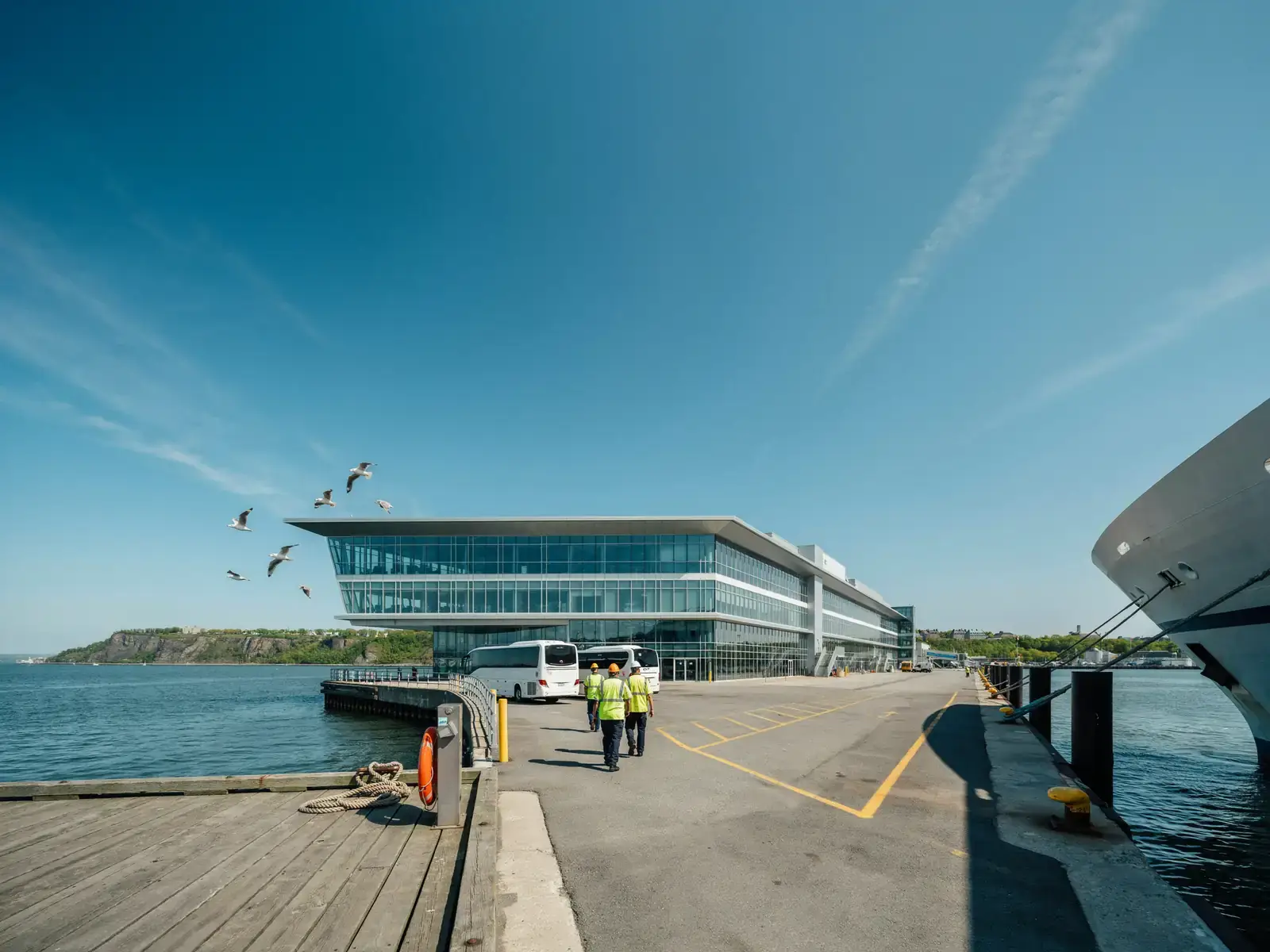
Princess Cruises passengers can expect wharves 21 and 22, the Ross Gaudreault Cruise Terminal, right in the thick of the waterfront district. Terminal 30 tends to take the bigger ships, including plenty of Royal Caribbean sailings, purely because it’s built to handle them.
Beyond those two, terminal assignment comes down to ship size and the day’s schedule rather than any fixed rule, so check the Port of Québec’s official cruise schedule for your own sailing date rather than taking a general guide’s word for it.
| Cruise Line | Terminal Typically Used |
|---|---|
| Princess Cruises | Wharves 21/22, Ross Gaudreault Cruise Terminal |
| Royal Caribbean International | Terminal 30, built to accommodate its largest ships |
| Holland America Line, Cunard Line, Norwegian Cruise Line, Silversea Cruises, Explora Journeys, Celebrity Cruises | Either terminal, depending on ship size and the day’s schedule |
If you fancy seeing what’s in port on any given day, both MarineTraffic and VesselFinder offer live, AIS-based ship tracking for the Port of Québec.
Getting to the Port from Quebec City Jean Lesage International Airport
Quebec City Jean Lesage International Airport (YQB) sits roughly 11 miles, or about 18 kilometres, from the Ross Gaudreault Terminal. WestJet, Air Canada, Porter, Delta and United all fly in, so most UK passengers will be connecting through a major Canadian or US hub to get there.
A taxi is the simplest way to cover that stretch. Taxis Coop Québec, the main operator at the airport rank, runs a flat rate for the roughly 25 minute trip, so there’s no meter clicking away and no surprise waiting at the end.
Public transport is technically possible but properly fiddly. Different sources list different route numbers for the Réseau de transport de la Capitale, and every version involves at least one change and well over an hour on the road. Take the taxi and spend the time you save exploring instead.
Most Quebec City hotels don’t run a free airport shuttle, so build the taxi into your pre-cruise budget if you’re staying over before boarding.
Drivers coming from the north can take Route 175 south to Boulevard Charest East, which turns into Rue Saint-Paul and then Rue Dalhousie, right at the terminal door. Drivers coming up from the south on Route 73 north should have passports ready at the border, then follow signs onto Boulevard Champlain, which also feeds into Rue Dalhousie.
Walking Into Old Québec From the Terminal
The best surprise about this port is how close everything is. It’s roughly a kilometre, about 10 to 15 minutes on foot, from the terminal to the heart of Old Québec.
If you’d rather not tackle the hill on foot, a funicular runs between Rue du Petit-Champlain in the lower town and the Château Frontenac up in the Upper Town, and it cuts out the steepest part of the climb entirely.
Cobblestones and steep lanes are the norm in Petit-Champlain and the Upper Town, so a pair of shoes with proper grip will do more for your day ashore than anything else you packed.
Homeport Sailings and Where They Go
Quebec City works as both a port of call and a homeport, meaning some cruises start or finish here rather than just stopping for the day. Princess Cruises runs sailings from the port that reach New England, the Canadian Maritimes and beyond.
Cunard Line, Crystal Cruises, Holland America Line and others also use Quebec City as a departure or arrival point, on itineraries that shift from one season to the next.
| Homeport Sailings From Quebec City | Typical Regions Covered |
|---|---|
| Princess Cruises | New England and the Canadian Maritimes |
| Cunard Line, Crystal Cruises, Holland America Line and others | Varies by sailing, Quebec City serves as either the start or end point |
Longer itineraries billed as Canadian Maritimes voyages sometimes stretch as far as Corner Brook, Newfoundland, Canada, so check the full itinerary rather than assuming it stays close to the Saint Lawrence.
Quebec City is also one of nine St Lawrence cruise ports of call, and several sailings that start or finish here take in these other Quebec ports too:
- Montreal, Quebec cruise port guide
- Trois-Rivières, Quebec cruise port guide
- Saguenay, Quebec cruise port guide
- Baie-Comeau, Quebec cruise port guide
- Sept-Îles, Quebec cruise port guide
- Gaspé, Quebec cruise port guide
- Havre-Saint-Pierre, Quebec cruise port guide
- Îles de la Madeleine cruise port guide
For the wider picture of how it all fits together, our Canada cruise ship ports guide covers every stop along the way.
When More Than One Ship Is in Port
The Port of Québec caps daily cruise traffic at 15,000 passengers, and limits turnarounds, where a ship both disembarks and re-embarks passengers on the same day, to two per day. That rule has held for around a decade, according to Cruise Industry News.
In practice, that means Old Québec rarely feels swamped even on a multi-ship day, though the walk from terminal to town, and the funicular queue, both take longer when two ships are alongside at once.
Weather and Making the Most of a Few Hours Ashore
Quebec City’s cruise season runs through the warmer months, but the Saint Lawrence sends a cool breeze off the water even on a sunny afternoon, and early or late season sailings can turn properly cold. A packable rain jacket earns its space in your day bag, since the weather off the river changes faster than the forecast admits.
With only a few hours ashore, most passengers stick to Old Québec rather than venturing further, and given how close the terminal sits, that’s the sensible call anyway.
Common Questions
Which terminal will my ship use, Ross Gaudreault or Terminal 30?
It comes down to your ship’s size and the sailing date. Princess Cruises usually docks at wharves 21/22, the Ross Gaudreault Terminal, while bigger ships tend to use Terminal 30. Check with your cruise line closer to departure.
Is there a live tracker showing which ships are in Quebec City today?
Yes. Both MarineTraffic and VesselFinder offer live, AIS-based tracking for the Port of Québec, and the port publishes its own official cruise schedule online too.
How far is the airport from the cruise terminal?
Around 11 miles, or 18 kilometres. A taxi covers it in about 25 minutes at a flat rate, which makes it the most predictable option for anyone arriving.
Can I take a public bus from the airport to the terminal?
It’s possible but not recommended. Sources disagree on the exact route numbers, and every option involves at least one transfer and over an hour on the move. A taxi is far more practical.
If my ship docks at Terminal 30, can I still walk into Old Québec?
Terminal 30 sits further from Old Québec than wharves 21/22, across the basin. Check with your cruise line whether a shuttle is laid on, since the walk is a fair bit longer than from the Ross Gaudreault Terminal.
What’s the easiest way up to the Upper Town from the terminal?
A funicular connects Rue du Petit-Champlain in the lower town with the Château Frontenac in the Upper Town, so you can skip the steepest part of the climb entirely.
Is Quebec City a cruise departure port or just a stop on the way?
Both. Some ships call in for the day, others begin or end their voyage here, sailing on to places such as New England or the Canadian Maritimes.
Do I need a passport if driving to the port from the United States?
Yes. Drivers coming up Route 73 north cross the Canadian border and will need a valid passport, whatever nationality you hold.
Are there facilities like restrooms and Wi-Fi at the terminal?
Yes, both terminals have public restrooms, free Wi-Fi, seating and porters. If you need wheelchair assistance, arrange it through your cruise line in advance.
Why Trust About2Cruise
This guide is built on official port documentation, cruise line information and published transport data, put together to give a clear picture of what passengers can expect at Quebec City’s cruise terminals. We haven’t sailed from this port ourselves, and where sources disagree, on bus routes or exact terminal assignments, we’ve said so rather than guessing.
You can read more about how we research and fact-check our port guides on our about us page.
Last Updated: 7 September 2026