
Vancouver’s Canada Place cruise terminal serves as the primary departure port for Alaska cruises and Pacific coastal voyages. Located downtown, the distinctive white-sailed building offers convenient access to hotels, restaurants, and attractions. The terminal provides modern facilities, baggage services, and streamlined embarkation processes. Most sailings operate seasonally, with the port handling over 900,000 passengers annually.
Quick Port Facts
| Fact | Detail |
|---|---|
| Official Port Name | Canada Place Cruise Terminal |
| Address | 999 Canada Place, Vancouver, BC V6C 3T4 |
| Distance to City Centre | Already in downtown core (walkable) |
| Main Cruise Season | May to September |
| Annual Passengers | Over 900,000 |
| Nearest Airport | Vancouver International (YVR) – 25-30 min by SkyTrain |
| Currency | Canadian Dollar (CAD) |
| Official Port Website | Port of Vancouver |
Want to know more about cruise ports throughout Canada and what each destination offers?
Vancouver Map
Canada Place sits on the Burrard Inlet waterfront in the heart of downtown Vancouver, adjacent to Waterfront Station and surrounded by Coal Harbour’s marina district. The North Shore mountains provide a spectacular backdrop across the harbour.
Can You Walk to Town from the Port?
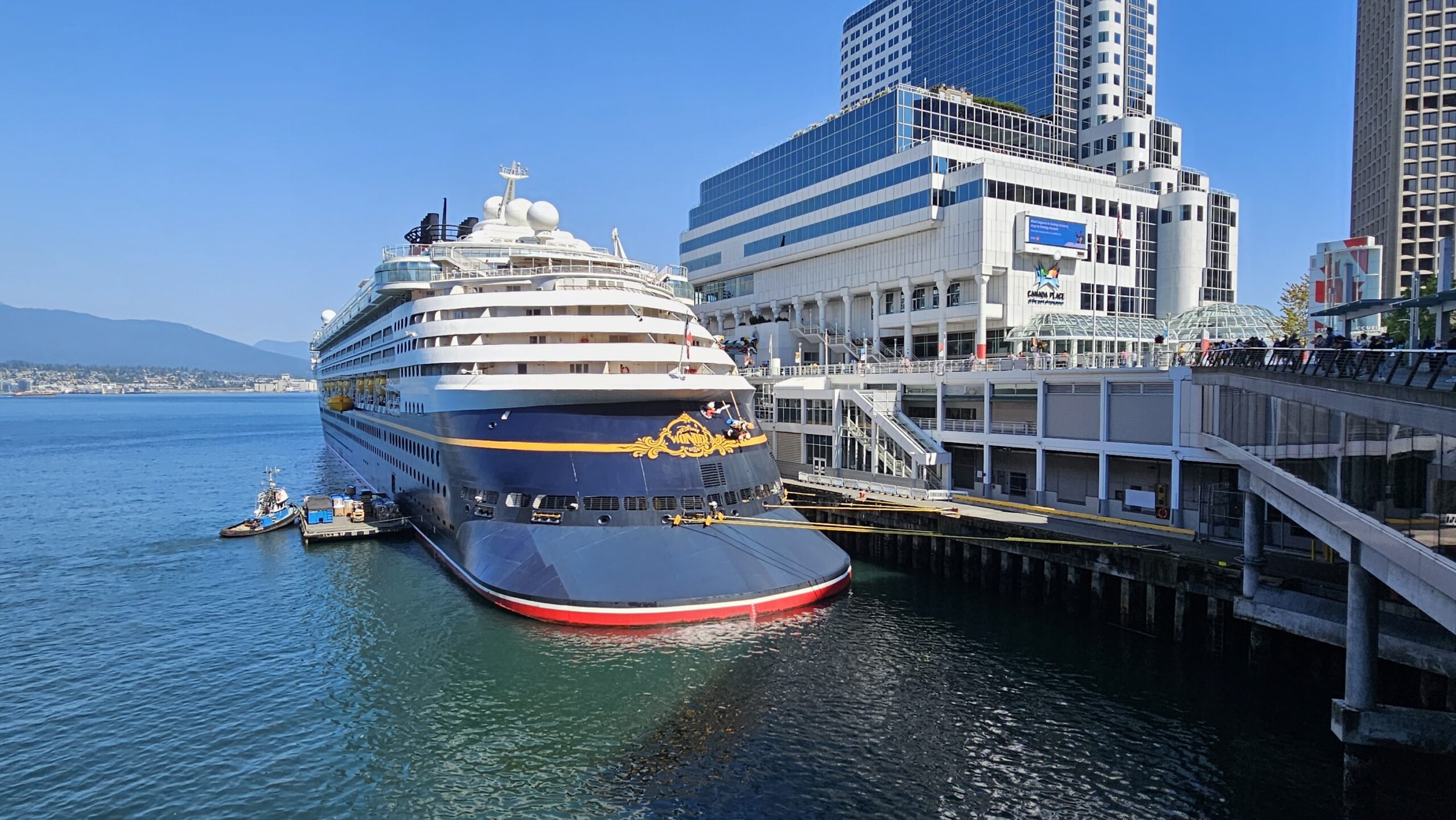
You’re already in town. Canada Place is positioned right in Vancouver’s downtown core, which makes it one of the most convenient cruise ports you’ll encounter. The moment you step off the gangway, you’re within minutes of restaurants, shops, parks, and major attractions.
- Immediate surroundings: The Canada Place Promenade wraps around the terminal building with harbour views, public art, and seating areas. It’s a pleasant five-minute stroll in either direction.
- Waterfront Station: Six to ten minutes on foot. This is your hub for SkyTrain, SeaBus, and local buses if you want to venture further afield.
- Gastown: About 15 minutes walking east along the waterfront or through city streets. You’ll pass historic architecture and plenty of cafés en route.
- Robson Street shopping district: Roughly 20 minutes south through downtown if you’re keen on retail therapy.
- Terrain: Flat, well-paved sidewalks throughout the waterfront and downtown core. Accessible for wheelchairs and strollers, though some historic Gastown streets have cobblestones.
How to Get Around from Vancouver & Shore Transportation
Vancouver’s public transport system is efficient and affordable, and you’ve got several solid options depending on where you want to go. The Canada Line SkyTrain connects the airport to downtown in under half an hour, and Waterfront Station is your jumping-off point for most destinations.
SkyTrain
- Canada Line: Runs from Vancouver International Airport through downtown to Waterfront Station. Trains arrive every few minutes during peak hours. A one-way ticket from the airport costs around $5 CAD (add a $5 CAD airport surcharge). You’ll need a Compass Card or contactless payment.
- Expo and Millennium Lines: Connect at Waterfront Station and reach neighborhoods like Commercial Drive, Burnaby, and Surrey if you’re staying outside the downtown core.
- Operating hours: Roughly 5 AM to 1 AM, with reduced frequency late evening.
- Accessibility: All stations have elevators and accessible entrances.
SeaBus
- A passenger ferry that crosses Burrard Inlet from Waterfront Station to Lonsdale Quay in North Vancouver. The 12-minute crossing offers excellent photo opportunities of the city skyline and mountains.
- Departs every 15-30 minutes depending on time of day. Same Compass Card or contactless payment as SkyTrain.
- Lonsdale Quay has a public market, restaurants, and is the gateway to Grouse Mountain or Capilano Suspension Bridge if you fancy a nature excursion.
Taxis and Rideshare
- Taxis queue outside the cruise terminal. Expect to pay around $35-45 CAD to most downtown hotels, more for airport trips.
- Uber and Lyft both operate in Vancouver. Pricing is comparable to taxis, sometimes cheaper during off-peak hours.
- During peak cruise embarkation and disembarkation times (typically 11 AM to 2 PM), wait times for rideshare can stretch. Plan accordingly or book ahead if possible.
Local Buses
- TransLink operates an extensive bus network. Routes 4, 7, and 50 serve the downtown and waterfront areas near Canada Place.
- Standard fare is around $3 CAD with a Compass Card or contactless payment. Exact change required if paying cash on board.
- Useful for reaching neighborhoods like Kitsilano or UBC if you’ve got extra time before or after your cruise.
Walking and Biking
- Vancouver is exceptionally walkable, particularly the waterfront and downtown areas. The Stanley Park Seawall is a must if you’re comfortable with a longer stroll or bike ride.
- Bike rentals are available near Coal Harbour and along Denman Street. Expect to pay around $10-15 CAD per hour or $40-50 CAD for a full day.
- Mobi by Shaw Go is Vancouver’s bike-share system. Stations are scattered throughout downtown and Stanley Park. Day passes cost around $10 CAD.
Getting to Canada Place from YVR
Vancouver International Airport sits under 10 miles from the cruise terminal, and there are four sensible ways to cover it.
Canada Line SkyTrain, the fastest and cheapest. YVR Airport Station to Waterfront Station takes about 25 to 30 minutes, then a 5 to 8 minute walk to Canada Place. Trains run every 6 to 12 minutes. Budget around CA$10, which includes the YVR AddFare charged when leaving the airport zone. Best if you are travelling light and happy to wheel a bag a short distance.
Taxi, which runs on a fixed airport flat rate of roughly CA$46 to downtown, taking 20 to 30 minutes depending on traffic. Door to door, no luggage handling, and the simplest option with multiple bags.
Uber and Lyft, both operating in Vancouver, typically CA$44 to CA$64 depending on vehicle size. Rarely cheaper than the flat-rate taxi, occasionally more.
Private transfers and hotel shuttles. Pre-booked vans give fixed pricing and luggage help, which is worth it for groups, families or anyone with mobility concerns. Several downtown hotels also run shuttles to Canada Place, so ask when you book.
If you are driving, Canada Place is reached via Highway 99 into downtown, following signs for Canada Place Way at the north end of Howe Street.
The Canada Place terminal: check-in, baggage and parking
Canada Place is a modern two-level terminal inside the larger white-sailed complex, handling several ships at once in peak Alaska season. Expect crowds and generally efficient processing.
Check-in. Follow port staff into the main lobby with documents and passport ready. Complete online check-in beforehand, it saves meaningful time. Security screening comes after check-in, before the gangways.
Baggage. Porters take checked luggage near the terminal entrance and it appears at your cabin later that day. Keep medications, valuables, documents and anything you need that afternoon in a carry-on.
Parking. The WestPark garage sits directly beneath Canada Place with lift access to the terminal, open around the clock and suitable for the length of a cruise. Rates are in the region of CA$25 to $35 a day and spaces go early, so book ahead. There is a free 15 minute zone for drop-offs. Off-site operators such as CruisePark and EasyPark charge less and run shuttles, which is the better-value choice if the garage is full.
Pre-cruise hotels near Canada Place
Staying the night before is genuinely worth it if you are flying in, because a single delayed flight is the difference between a relaxed embarkation and a missed ship.
- Pan Pacific Vancouver, the most convenient in the city. It is part of the Canada Place complex itself, directly above the cruise terminal, so you walk downstairs to check in. Harbour and mountain views, pool and spa, priced accordingly
- Fairmont Waterfront, across the road from Canada Place and about a five minute walk. Rooftop garden and harbour views
- Fairmont Hotel Vancouver, the landmark property about a mile away, roughly a 20 minute walk or a short taxi, near the Robson Street shopping
- JW Marriott Parq Vancouver and The Douglas, modern hotels in the Parq complex about 1.2 miles out, with restaurants and a casino attached. An easy rideshare to the port
One 2026 note: Vancouver is hosting FIFA World Cup matches this year, so downtown hotel availability and pricing around match dates are far tighter than usual. Book earlier than you normally would.
Arrival day: when to get there and what to expect
Fly in the day before if you can. It removes the flight-delay risk entirely and gives you an evening in Vancouver. If your cruise leaves at 4pm and your flight lands at 11am you are technically fine, but one cancellation and you are chasing the ship to Alaska.
If you must fly in on the day, land by 9am or 10am for an afternoon sailing. That leaves room for baggage, transport and check-in without a scramble.
Boarding usually opens around 11am or noon and closes about 90 minutes before departure. Your cruise line assigns a boarding window, and turning up at the earliest possible moment usually just means queueing longer.
Documents. Passport, not a driving licence. Plus your boarding pass and the health questionnaire your line emails a few days out. Have them to hand rather than in the bottom of a bag.
Eating near the terminal before you sail
Food immediately next to the terminal is limited, so plan rather than assume.
- Waterfront Centre food court, next door, with chains and grab-and-go. Fine for a coffee, not a meal
- Cactus Club Cafe Coal Harbour, a short walk, reliable and workable for groups
- Cardero’s, on the water at Coal Harbour about ten minutes away, seafood with harbour views and a good choice the evening before
- Gastown, fifteen minutes on foot, where the bistros and better brunch spots are
- Robson Street, also about fifteen minutes, for casual dining of every kind
The practical advice: eat before you arrive at the terminal, or accept the ship’s buffet as your first meal.
What to See Within Walking Distance from the Port
The Canada Place area is genuinely rich with walkable attractions. You won’t need transport to fill a few hours before or after your cruise.
- Canada Place Promenade: The waterfront walkway that encircles the cruise terminal building. Seaplanes take off and land just offshore, and you’ll get unobstructed views of the North Shore mountains and Burrard Inlet. Completely flat and accessible. Zero walking time – you’re already there.
- Jack Poole Plaza and Olympic Cauldron: A wide open plaza with the iconic Olympic torch from the 2010 Winter Games. Popular photo spot, especially at sunset when the light catches the mountains across the water. Five minutes west of Canada Place along the waterfront path.
- Harbour Green Park: A long stretch of grass and pathways along Coal Harbour with views of the marina, floatplanes, and mountains. Ideal for a picnic or just sitting and watching the harbour activity. Ten minutes west of the terminal. Flat, paved paths throughout.
- Gastown Steam Clock: The famous steam-powered clock on Water Street in Gastown, a historic neighborhood with cobbled streets and Victorian-era buildings. It whistles every 15 minutes. About 15 minutes east of Canada Place on foot. Some cobblestone streets and slight inclines in Gastown.
- FlyOver Canada: A flight simulation ride located inside Canada Place. You’re suspended in front of a giant screen with wind and mist effects as you “fly” over Canadian landscapes. Tickets are around $25-30 CAD. Literally inside the terminal complex – no walking required.
- Waterfront Station: A heritage building dating back to 1914. Even if you’re not catching a train, the interior is worth a quick look for its architecture and historical photos. Six to eight minutes northeast of the cruise terminal.
Must See Attractions in Vancouver for a One Day Cruise Visit
If you’ve got a full day in Vancouver before or after your cruise, focus on what makes this city distinctive: the combination of urban energy and accessible nature. Here’s what actually deserves your limited time.
Stanley Park and the Seawall
- What it is: A 400-hectare urban park bordered by the Pacific Ocean, with a 10-kilometer paved seawall path that loops the entire peninsula. You’ll pass beaches, forest trails, totem poles, and countless photo-worthy viewpoints.
- Why it matters: This is Vancouver’s signature attraction. The combination of old-growth forest, ocean views, and mountain backdrops in the middle of a major city is genuinely special. It’s also free to explore.
- Time needed: Two to three hours minimum if you’re walking a section of the seawall and visiting the totem poles at Brockton Point. A full loop on foot takes three to four hours. Biking the loop takes about an hour.
- Practical tips: The seawall is a one-way counterclockwise route for cyclists and inline skaters. Pedestrians can walk in either direction. Start from Coal Harbour (20 minutes west of Canada Place) for the most scenic stretch. Bring layers – it’s often windier and cooler along the water. A lightweight packable rain jacket is useful even on days that start sunny, as coastal weather can change quickly. Public washrooms are located at several points around the park. Bike rentals are available near the park entrance on Denman Street.
Granville Island Public Market
- What it is: A covered market under the Granville Street Bridge with dozens of food vendors, artisan stalls, bakeries, and seafood counters. The island also hosts galleries, theatres, and a brewery.
- Why it matters: It’s the best spot in Vancouver to sample local food – wild salmon, fresh oysters, artisan cheeses, and baked goods. The atmosphere is lively without being overwhelming, and it’s popular with locals, which is always a good sign.
- Time needed: One to two hours to browse the market and grab lunch. Add another hour if you want to explore the island’s shops and galleries.
- Practical tips: Take the Aquabus or False Creek Ferries from near the Olympic Village or Yaletown (about 15 minutes from downtown by bus or taxi). The small passenger ferries are part of the experience and cost around $5 CAD one-way. Arrive before 11 AM or after 2 PM to avoid peak crowds. Parking on the island is limited and fills up quickly. Cash is useful for some smaller vendors, though most accept cards. The market is open daily, but best visited on weekdays when it’s less packed.
Capilano Suspension Bridge Park
- What it is: A 137-meter-long suspension bridge strung 70 meters above the Capilano River, set in a temperate rainforest. The park also includes treetop walkways, a cliffside boardwalk, and interpretive displays about Coast Salish history and ecology.
- Why it matters: If you want to experience British Columbia’s rainforest environment without venturing far from the city, this is your best option. The bridge itself is thrilling for those comfortable with heights, and the surrounding forest is genuinely impressive.
- Time needed: Two to three hours including transport from downtown. The park itself takes 90 minutes to two hours to explore fully.
- Practical tips: Admission is steep – around $60-65 CAD for adults. Book online in advance for a modest discount. Free shuttle buses run from select downtown hotels including Canada Place during cruise season (check the park’s website for the current schedule). Alternatively, take a taxi or rideshare for about $25-30 CAD each way. The bridge sways noticeably, especially when busy. If heights aren’t your thing, stick to the treetop walkways and cliffside paths, which are less vertiginous. Wear sturdy shoes – some paths can be slippery after rain. The park gets very crowded in July and August; early morning or late afternoon visits are calmer.
Gastown
- What it is: Vancouver’s oldest neighborhood, dating back to the 1870s. Cobblestone streets, Victorian architecture, independent boutiques, and a concentration of restaurants and cafés.
- Why it matters: It’s the most photogenic part of Vancouver, and the Steam Clock on Water Street is a popular (if touristy) landmark. The area has gentrified significantly in recent years and now offers some of the city’s better dining and shopping.
- Time needed: One to two hours for a casual stroll, longer if you’re stopping for a meal or shopping.
- Practical tips: Walk from Canada Place in about 15 minutes heading east along the waterfront or up Cordova Street. Some side streets have a noticeable homeless population and can feel less comfortable after dark; stick to Water Street and the main thoroughfares. The Steam Clock whistles on the quarter hour – time your visit if you want to see (and hear) it in action. Parking is scarce and expensive if you’re driving; walking or public transport is far easier.
Vancouver Lookout
- What it is: An observation deck atop Harbour Centre Tower with 360-degree views of the city, mountains, and ocean from 169 meters up. A glass elevator takes you to the top in under a minute.
- Why it matters: It’s the best vantage point to understand Vancouver’s geography – how the city is sandwiched between water and mountains. On a clear day, you can see Vancouver Island to the west and Mount Baker in Washington state to the southeast.
- Time needed: 45 minutes to an hour including the elevator ride and time to walk around the deck.
- Practical tips: Admission is around $18-20 CAD for adults. Your ticket is valid all day, so you can return for sunset or evening views without paying again. The tower is located at 555 West Hastings Street, about 10 minutes on foot from Canada Place. Clear weather is obviously key – check the forecast before paying. The surrounding area (Downtown Eastside) has visible poverty and drug issues; the tower itself is safe, but be aware of your surroundings when walking nearby. Bring compact binoculars if you have them – they’re useful for spotting landmarks across the city and mountains.
Museum of Anthropology at UBC
- What it is: A world-class museum of First Nations art and culture on the University of British Columbia campus. The Great Hall houses massive totem poles and traditional canoes, and the collection includes thousands of objects from Indigenous communities across the Pacific Northwest and beyond.
- Why it matters: If you’re interested in understanding the Indigenous history and culture of this region, there’s no better place. The building itself – designed by architect Arthur Erickson – is stunning, with floor-to-ceiling windows overlooking the ocean and mountains.
- Time needed: Two to three hours including travel time. The museum itself takes 90 minutes to two hours to see properly.
- Practical tips: Located about 30-40 minutes from downtown by bus (take the 99 B-Line from Broadway-City Hall station). Admission is around $18-20 CAD. The museum is closed Mondays. Combine your visit with a walk through the nearby Museum of Anthropology grounds and Wreck Beach if the weather’s good. Not ideal if you’re short on time or prefer to stay central.
Port Day Itinerary: Things to Do in 8 Hours
Here’s a realistic schedule that fits a typical 8 AM to 4 PM port day, assuming you’re already docked and cleared to go ashore.
- 8:00 AM – 8:30 AM | Disembark and Waterfront Stroll: Clear customs and immigration, then step out onto the Canada Place Promenade. Spend 20 minutes walking around the terminal building to get your bearings and snap photos of the harbour and North Shore mountains. Grab a coffee from one of the nearby cafés if you haven’t had breakfast.
- 8:30 AM – 9:00 AM | Walk to Coal Harbour and Harbour Green Park: Head west along the waterfront path toward Coal Harbour. The marina and park offer excellent views of floatplanes taking off and landing. This is a pleasant, flat walk with plenty of benches if you want to sit and watch the water.
- 9:00 AM – 11:30 AM | Stanley Park and the Seawall: Continue west to Stanley Park. Walk or rent a bike for the seawall loop. If you’re on foot, do the stretch from Coal Harbour to Brockton Point (totem poles) and then to Prospect Point for the best views. Turn back from there if time is tight. If you’re biking, you can complete the full loop. Bring layers – it’s usually cooler and breezier along the water.
- 11:30 AM – 12:00 PM | Return to Downtown: Walk or bike back toward Canada Place via the seawall or cut through the park to Denman Street and catch a bus or taxi.
- 12:00 PM – 1:30 PM | Lunch in Gastown: Head to Gastown for lunch. Try one of the neighborhood’s seafood restaurants or grab fish and chips from a casual spot. Water Street has the highest concentration of options. Don’t miss the Steam Clock while you’re there – it whistles on the quarter hour.
- 1:30 PM – 2:30 PM | Explore Gastown: Stroll the cobblestone streets, browse the boutiques, and soak up the Victorian architecture. If you’re a souvenir hunter, this is your best bet for local artisan goods.
- 2:30 PM – 3:15 PM | Vancouver Lookout or FlyOver Canada: Choose one. The Lookout gives you panoramic views of the city from Harbour Centre Tower (10 minutes from Gastown). FlyOver Canada is a flight simulation ride inside the Canada Place complex (closer to the ship). Both take about 45 minutes including queuing and the experience itself.
- 3:15 PM – 3:45 PM | Last-Minute Shopping or Snack: Head back toward Canada Place. Stop at a café for a coffee or snack, or browse the shops in the terminal complex if you need last-minute provisions or gifts.
- 3:45 PM – 4:00 PM | Back to the Ship: Return to the ship with time to spare. Most cruise lines ask passengers to be back by 30-60 minutes before departure. Don’t cut it close – security lines can be longer than expected when everyone’s returning at once.
This timing works comfortably and allows for toilet breaks, photo stops, and a bit of browsing without rushing.
Where to Eat Near the Port
The Canada Place and Coal Harbour area is stacked with dining options at every price point. You’re in a major city, so expect urban prices – budget accordingly.
- Seafood on the waterfront: Cardero’s Restaurant on Coal Harbour Quay is a local favorite for fresh salmon, halibut, and oysters with harbor views. Mains run $25-40 CAD. It’s about a 10-minute walk west of the cruise terminal. The Cactus Club Café nearby offers similar West Coast fare with a more casual vibe and slightly lower prices.
- Pacific salmon: This is British Columbia, so salmon is the signature dish. Look for wild-caught Chinook, Sockeye, or Coho. Grilled, cedar-planked, or in sushi form – it’s all excellent. Expect to pay $20-35 CAD for a salmon entrée at mid-range restaurants.
- Quick and casual: Japadog on Burrard Street (about 15 minutes south of Canada Place) serves Japanese-inspired hot dogs with toppings like teriyaki sauce, seaweed, and bonito flakes. It’s cheap ($8-12 CAD), filling, and oddly delicious. There’s often a queue, but it moves quickly.
- Gastown dining: Water Street and the surrounding blocks offer everything from upscale seafood to ramen. The Flying Pig is a solid mid-range choice for Canadian comfort food with local ingredients. Reservations recommended for dinner. L’Abattoir is the neighborhood’s fine-dining option if you’re celebrating – book ahead.
- Granville Island Market: If you make it to Granville Island, the public market has prepared foods, fresh seafood, baked goods, and international snacks. Grab a spot on the waterfront patio and assemble a picnic-style lunch. Budget $15-25 CAD per person depending on how much you sample.
- Coffee culture: Vancouver takes its coffee seriously. Revolver on Cambie Street and Nemesis Coffee on Main Street are local roasters with excellent espresso. There are also plenty of independent cafés near Canada Place if you just need a quick flat white before exploring.
- Food safety: Tap water is safe to drink throughout Vancouver. Street food vendors are regulated and generally safe. Standard hygiene practices apply – if a place looks sketchy, trust your gut and move on.
Shopping: What to Buy & Where to Go
Vancouver isn’t a duty-free shopping mecca like some Caribbean ports, but it does offer quality Canadian goods if you know what to look for.
- Indigenous art and crafts: Totem poles (small replicas), carvings, jewelry, and prints by First Nations artists. Look for galleries in Gastown or the Hill’s Native Art store on Water Street. Prices range from $20 CAD for small items to thousands for significant pieces. Make sure you’re buying from reputable galleries that credit the artists – there’s a lot of mass-produced “Indigenous-style” junk that isn’t the real thing.
- Smoked salmon: Vacuum-sealed wild Pacific salmon from shops like Salmon Shop on Granville Island or The Salmon House. It travels well and makes an excellent gift. Expect to pay $15-30 CAD for a package depending on size and quality.
- Canadian maple syrup: The real stuff, preferably from BC or Quebec. Available at grocery stores, specialty food shops, and the Granville Island Market. A standard bottle costs $10-15 CAD. Avoid the cheap imitations – check the label for 100% pure maple syrup.
- Outdoor gear: Vancouver is a hub for high-quality outdoor brands like Arc’teryx, Mountain Equipment Co-op (MEC), and Herschel Supply Co. The Arc’teryx flagship store is on West Broadway; MEC has a large location near Olympic Village station. These brands are Canadian and sometimes cheaper here than elsewhere, though don’t expect dramatic savings.
- Ice wine: A dessert wine made from grapes frozen on the vine, produced in the Okanagan Valley and other BC wine regions. It’s sweet, expensive, and distinctly Canadian. Bottles start around $30-40 CAD for a small (375ml) bottle. Available at BC Liquor Stores or specialty wine shops.
- Shop hours and holidays: Most shops open around 10 AM and close between 6 PM and 9 PM depending on the neighborhood. Larger stores and malls stay open later. Sunday hours are often shorter. Major public holidays include Canada Day (July 1), Thanksgiving (second Monday in October), and Christmas. Expect reduced hours or closures on these dates.
- Haggling: Not expected or appropriate in Vancouver. Prices are fixed in shops, restaurants, and markets. Tipping is standard (15-20% in restaurants), but bargaining is not part of the culture.
Safety Tips & Avoiding Scams
Vancouver is a safe, well-managed city with low violent crime rates. That said, it has the usual urban issues you’d expect from a major North American port.
- Downtown Eastside: The area roughly bounded by Main Street, Hastings Street, and the waterfront has visible homelessness, drug use, and mental health crises. It’s not typically dangerous to tourists, but it can be uncomfortable if you’re not used to urban poverty. Stick to well-trafficked streets and don’t engage with aggressive panhandlers. The cruise terminal and main tourist areas are well separated from this neighborhood, but you might pass through it if walking to Gastown or taking certain bus routes.
- Bag and phone theft: Keep your phone in your hand or a secure pocket, not dangling loosely. Bags left unattended in cafés or on park benches are an easy target. Use common sense – if you wouldn’t do it in your home city, don’t do it here. An anti-theft backpack with slash-proof material and lockable zippers can give you peace of mind in crowded areas like Gastown or Granville Island.
- Parking scams: If you’re driving to the port and parking off-site, only use reputable lots with clear signage and online booking systems. Some unofficial “parking attendants” near the terminal will offer to “watch your car” for a fee – ignore them and use the official Vinci Park Canada Place facility or a recognized alternative like EasyPark.
- Fake ticket sellers: Don’t buy attraction tickets from anyone on the street. Book directly through official websites or your cruise line. There have been occasional reports of fake FlyOver Canada or Capilano Suspension Bridge tickets sold near the terminal – these are scams.
- Impersonation scams: Legitimate port staff and security wear clearly marked uniforms. If someone approaches you outside the terminal claiming to be port authority or cruise staff and asks for money or sensitive information, walk away and report it to actual uniformed staff.
- Wildlife awareness: If you’re exploring Stanley Park or other forested areas, be aware that black bears, coyotes, and raccoons are present. Don’t approach or feed wildlife. Keep food secured and dispose of trash properly. Bear encounters are rare but not unheard of in urban parks.
Emergency Contacts
- Police, Fire, Ambulance: 911 (for immediate emergencies)
- Vancouver Fraser Port Authority (port operations and security): 604-665-9000 (general line); 604-665-9086 (24-hour marine operations)
- Vancouver Police Non-Emergency Line: 604-717-3321
- BC Health Link (non-emergency health advice): 811
- Nearest Major Hospital: St. Paul’s Hospital, 1081 Burrard Street (about 15 minutes from Canada Place); Emergency line 604-682-2344
- Canadian Coast Guard (marine emergencies): VHF Channel 16 or 1-800-567-5111
Save your cruise ship’s emergency contact number and your cabin number before going ashore. Make sure someone on board knows your rough itinerary if you’re exploring independently.
Essential Items for Your Day in Vancouver
Vancouver’s weather can be unpredictable even in summer, and you’ll likely be doing a fair bit of walking between the waterfront, Stanley Park, and downtown neighborhoods. Here’s what will make your port day more comfortable:
- Layered clothing: Temperatures can swing from cool and breezy along the seawall to warm and sunny in sheltered downtown areas. A packable rain jacket is essential – even on clear days, coastal showers can roll in quickly. For cooler mornings or evenings, merino wool base layers provide warmth without bulk and dry quickly if you get caught in drizzle.
- Comfortable walking shoes: You’ll cover several kilometers if you’re exploring Stanley Park and Gastown. The terrain is mostly flat and paved, but Gastown has cobblestone streets that can be hard on your feet. Women’s walking shoes or men’s walking shoes with good arch support will save you from sore feet by the end of the day.
- Sun protection: When the sun’s out, it can be surprisingly strong, especially on the exposed seawall. Bring sunglasses, a packable sun hat, and reef safe sunscreen to protect your skin during extended outdoor exploration.
- Compact binoculars: Compact travel binoculars are brilliant for spotting wildlife in Stanley Park, getting a closer look at the North Shore mountains, or identifying landmarks from the Vancouver Lookout observation deck.
- Day bag: You’ll want something to carry your layers, water bottle, and any purchases. A packable lightweight backpack folds down small when empty and expands when you need it. If you’re concerned about pickpockets in crowded areas like Gastown, an anti-theft backpack with lockable zippers offers extra security.
- Reusable water bottle: Vancouver’s tap water is excellent and safe to drink. A collapsible water bottle saves space in your bag when empty and keeps you hydrated during long walks without needing to buy bottled water.
- Cruise essentials: Keep your ship’s keycard and ID secure in an RFID passport holder or RFID blocking wallet. A retractable waterproof cruise lanyard keeps your keycard accessible while protecting it from rain.
- Power bank: You’ll be taking lots of photos and possibly using maps on your phone. A portable phone charger ensures you don’t run out of battery mid-day, especially important if you’re using your phone for navigation or transit payments.
Currency, ATMs & Money Matters
Canada uses the Canadian Dollar (CAD), and while the exchange rate fluctuates, it’s generally weaker than the US dollar or British pound, which can make Vancouver feel slightly more affordable for foreign visitors.
- Currency: Canadian Dollar (CAD). Coins come in 5¢, 10¢, 25¢, $1 (loonie), and $2 (toonie) denominations. Bills are $5, $10, $20, $50, and $100. Pennies were phased out, so cash transactions are rounded to the nearest 5 cents.
- ATMs: Widely available throughout downtown Vancouver, including near Canada Place and Waterfront Station. Most ATMs accept foreign cards (Visa, Mastercard, Maestro, Cirrus). Withdrawal fees vary – your home bank will typically charge a foreign transaction fee plus the local ATM operator’s fee (usually $3-5 CAD). Avoid independent ATMs in convenience stores or tourist areas, as they often have higher fees and worse exchange rates.
- Credit and debit cards: Accepted almost everywhere, including taxis, restaurants, and shops. Contactless payment is common. Visa and Mastercard are universally accepted; American Express less so at smaller businesses. Chip-and-PIN is standard; some older US magnetic-stripe cards may have issues, but most terminals accommodate both.
- Exchange rates and fees: If you need to exchange cash, do it at a bank or a reputable exchange bureau like VanCity or VBCE (Vancouver Bullion & Currency Exchange). Avoid airport exchange counters and hotel desks – the rates are poor. That said, you’ll rarely need much cash in Vancouver; cards work nearly everywhere.
- Notify your bank: Let your bank or card issuer know you’re travelling to Canada to avoid having your card blocked for suspicious activity. This is especially important for US travelers, as some fraud detection systems flag cross-border transactions.
- Tipping: Expected in restaurants (15-20% of the pre-tax bill), bars ($1-2 CAD per drink), taxis (10-15%), and for hotel porters or housekeeping ($2-5 CAD per service). Tipping is not required in cafés or fast-food spots where you order at the counter.
- Sales tax: British Columbia charges 7% Provincial Sales Tax (PST) plus 5% Goods and Services Tax (GST) on most goods and services. This is added at the till, so the sticker price is not the final price. Some items (basic groceries, prescription drugs) are exempt from PST.
- Budgeting tips: A mid-range lunch costs $15-25 CAD per person. A nice dinner with drinks runs $50-80 CAD per person. Local transport (SkyTrain, bus) is $3 CAD per trip. Taxis from the airport to downtown are $35-45 CAD. Plan accordingly if you’re on a tight budget.
Weather by Month
| Season | Months | Temperature Range | What to Expect |
|---|---|---|---|
| Late Spring/Early Summer (Cruise Season Starts) | May – June | 12-20°C (54-68°F) | The weather is generally mild and increasingly sunny, though rain is still possible. Pack layers, a light waterproof jacket, and comfortable walking shoes. June is particularly pleasant with long daylight hours and blooming gardens. May can be wetter. |
| High Summer (Peak Cruise Season) | July – August | 15-24°C (59-75°F) | The driest and warmest months. Expect mostly sunny skies, warm afternoons, and cool evenings. This is the best weather window for outdoor activities like the seawall or Stanley Park. It can occasionally hit 30°C (86°F) during heat waves. Bring sunscreen, sunglasses, and a hat for daytime. A light sweater or jacket is useful for evenings, especially near the water. |
| Early Autumn (Cruise Season Ends) | September – early October | 10-18°C (50-64°F) | September is often lovely – warm, dry, and less crowded. October sees increasing rain and cooler temperatures. Fall colors appear in Stanley Park and other green spaces. Pack layers and a waterproof jacket. By late September, the days are noticeably shorter. |
| Autumn/Winter (Off-Season) | November – April | 3-10°C (37-50°F) | Vancouver’s rainy season. Expect frequent drizzle, grey skies, and mild temperatures. Snow is rare in the city itself but common in the nearby mountains. If you’re in Vancouver outside cruise season, bring waterproof everything and embrace the cozy café culture. The Christmas market at Jack Poole Plaza is a highlight in December. |
Common Questions & FAQ
How early should I arrive at Canada Place on embarkation day?
Most cruise lines open check-in around 11 AM and request passengers arrive by early afternoon. Arriving between 11:30 AM and 1 PM typically means moderate queues. Earlier is quieter, but you may wait for your cabin to be ready. Later in the afternoon (after 2 PM) can mean longer security lines as everyone rushes before the final boarding cutoff (usually 3-4 PM depending on your sailing). If you’re flying in the same day, book a morning flight with at least a three-hour buffer for customs, baggage claim, and transport to the terminal.
Is there luggage storage near the port for pre- or post-cruise days?
Yes, but options are limited. Some downtown hotels offer luggage storage for guests (sometimes for a fee). Westcoast Sightseeing and similar tour operators occasionally provide storage services in the Canada Place area – check their websites or call ahead. There’s no dedicated left-luggage facility at the cruise terminal itself, so plan this in advance if you’re exploring Vancouver before or after your cruise.
Can I walk to Victoria, BC from Vancouver?
No. Victoria is on Vancouver Island, across the Strait of Georgia. You’d need to take a ferry (BC Ferries from Tsawwassen, about 90 minutes including the sailing) or a floatplane (Harbour Air from Coal Harbour, 35 minutes). Victoria is a popular Alaska cruise port of call, so you may visit it during your sailing rather than as a separate trip.
Do I need a visa to visit Vancouver as a cruise passenger?
It depends on your nationality. US citizens need a valid passport (passport card is not sufficient for air travel, but acceptable if you’re crossing by land or sea). UK, EU, Australian, and New Zealand citizens need an Electronic Travel Authorization (eTA) if flying into Canada. The eTA costs $7 CAD, is valid for five years, and takes minutes to apply online. If you’re arriving by cruise ship (i.e., Vancouver is not your first entry point into Canada), different rules may apply – check with your cruise line and Canadian immigration authorities well before departure.
What’s the best way to get from the airport to Canada Place?
The Canada Line SkyTrain is fastest and cheapest – about 25 minutes and $5 CAD plus a $5 CAD airport surcharge. Trains run every few minutes during the day. Get off at Waterfront Station and walk 6-10 minutes to the cruise terminal. Taxis and rideshares (Uber, Lyft) cost $35-45 CAD and take 20-30 minutes depending on traffic. Some hotels offer shuttle services – check when you book. If you’ve got heavy luggage, a taxi or rideshare is more comfortable than navigating the SkyTrain with bags.
Is parking at the cruise terminal expensive?
Yes. The official Vinci Park Canada Place lot charges around $25-30 CAD per day. For a week-long cruise, that’s $175-210 CAD, which adds up. Off-site park-and-cruise options like EasyPark or similar services offer lower rates (sometimes $15-20 CAD per day) and include shuttle service to the terminal. Book online in advance – spaces fill up quickly during peak cruise season. If you’re staying at a nearby hotel, ask about parking packages; some offer multi-day rates that work out cheaper than port parking.
Are there any good hotels within walking distance of the cruise terminal?
Several. The Fairmont Waterfront and Pan Pacific Vancouver are both about 10 minutes on foot from Canada Place and offer harbour views. They’re pricey but convenient if you want to walk to the ship on embarkation day. The Skwachàys Lodge on Water Street in Gastown is a budget-friendly Indigenous-owned option about 15 minutes from the terminal. Mid-range chains like the Sandman Suites near Davie Street are a 20-minute walk or short taxi ride away. If you’re trying to save money, staying near a Canada Line SkyTrain station (like Yaletown or City Centre) gives you easy access to the port without paying waterfront hotel rates. For more detailed recommendations, check out our guide to the best hotels near Vancouver cruise terminal.
What should I do if I miss the ship at Canada Place?
Contact your cruise line immediately using the emergency number provided in your pre-cruise documents. They’ll advise on meeting the ship at the next port (often Nanaimo, BC or Ketchikan, Alaska, depending on your itinerary). You’ll be responsible for your own transport and any associated costs, which can be significant. Travel insurance with cruise cover may reimburse some expenses – check your policy. This is why arriving back at the ship with a solid time buffer is so important. If you’re on a ship excursion and the tour runs late, the ship will wait or assist you; if you’re exploring independently, you’re on your own.
Personal Experience
We arrived in Vancouver two days before our Alaska cruise, and honestly, it was one of the better decisions we made. The Canada Place cruise terminal is right downtown, which meant we could actually explore the city without rushing. We stayed at the Fairmont Waterfront because it’s literally a ten-minute walk to the port, and on embarkation day, we just wheeled our luggage over after a leisurely breakfast. If you’re looking to save some money, the hotels near Canada Line stations are solid options too – the SkyTrain drops you right at Waterfront Station, and from there it’s an easy walk or quick cab ride to the terminal.
Parking was something we debated forever. The port’s official parking runs about $25-30 CAD per day, which adds up fast for a week-long cruise. We ended up using an off-site lot called EasyPark that offered a park-and-cruise shuttle for quite a bit less. Just make sure you book ahead because spots fill up during cruise season. As for the embarkation itself, things moved pretty smoothly when we showed up around noon. The terminal can get busy between 11 AM and 1 PM, but the staff keeps things organized. One tip: have your passport, boarding docs, and customs declaration ready to go. Oh, and bring a light jacket – even in summer, that breeze off the water can be chilly while you’re waiting to board.