
P&O Cruises is the British line with seven ships out of Southampton, and for plenty of people it’s the default: drive to the port, pay in sterling, gratuities already in the fare. The catch is that a 6,264-guest resort ship and a 1,874-guest traditional ship both sail under the same name.
Is P&O Cruises good? Who it suits and who it does not
For a British holidaymaker who wants to drive to the ship, pay in sterling and have gratuities in the fare, P&O Cruises is good value. It’s a mainstream line, though, not a luxury one, and the biggest ships carry more than 6,000 guests at full occupancy.
It suits:
- No-fly holidaymakers. Southampton covers the Norwegian fjords, the Canary Islands, the Mediterranean, Northern Europe and the Baltic, the British Isles and short breaks. No airport at either end.
- First-timers. Familiar food, no daily gratuity to find at the end of the week, and a dining room set up for people who haven’t cruised before. The new to cruising guide covers what a first booking involves.
- Multi-generational families. Five of the seven ships are family ships with the Reef children’s clubs. Third and fourth guests sharing a cabin sail free on selected off-peak sailings of six nights or more from Southampton. Start with the family cruises guide if you’re booking around children.
- Couples and solo travellers. Inside single cabins on all but one ship, single balconies on five, and 18 solo cabins on Azura.
It is the wrong choice if:
- You want everything in one price. P&O is full board, not all-inclusive. Drinks, soft drinks, Costa coffee, Wi-Fi, speciality restaurants and shore excursions all go on the bill.
- You need a guaranteed child-free ship. Two ships are adults-only for most of the year, not all of it. The dates that open to all ages are the ones people miss.
- You’re expecting suite service throughout. Conservatory Mini-Suites give you a lounge and a deeper balcony, but no suite perks and no butler.
Most disappointment comes from booking the brand rather than the ship. P&O sells itself as a default British holiday, not a niche product.
People pick on price and itinerary, end up on a ship that isn’t the holiday they pictured, and blame the line for the mismatch. If you’re weighing lines rather than ships, the guide to other cruise lines sets out what each one is for.
P&O Cruises, Carnival UK and ATOL 6294: which brand you are booking
P&O Cruises is Carnival UK Ltd trading as P&O Cruises, registered in England and Wales with its office at Carnival House in Southampton. It holds ABTA V8764 and ATOL 6294, and it’s still very much operating, with seven ships in service.
Fly-cruises are covered by ATOL 6294, and non-fly cruises sold in the UK by ABTA. The protection travels with the booking, not with whoever sold it to you.
The Australian brand has gone. P&O Cruises Australia was retired into Carnival Cruise Line, and its ships became Carnival Adventure and Carnival Encounter. P&O Cruises (UK) is a separate brand in the group, and the change didn’t affect it.
The Britishness isn’t only marketing. Brodie’s shows Premier League football, Marco Pierre White is the name behind the Celebration Night menu, and there’s no 20% service charge like the one US lines add to a bar bill.
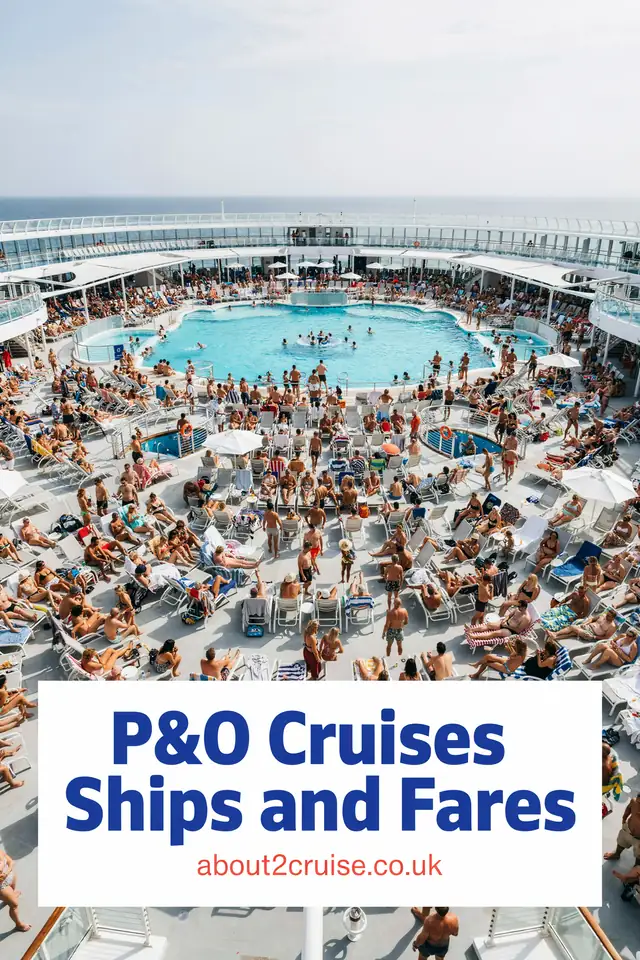
A 6,264-guest resort and a 1,874-guest traditional ship are both P&O
Guest capacity runs from 1,874 at double occupancy on the smallest ship to 5,206 on the largest, which becomes 6,264 at full occupancy. That isn’t one product in different sizes.
The two newest ships are around 184,000 gross tonnes each, with four pools, a SkyDome, climbing walls, splash zones and roughly 30 bars and restaurants. The smallest carries about a third of that and is built for long, quiet voyages.
A seven-night P&O cruise can mean a ship with a swim-up bar, an escape room and 6,264 people aboard, or a 1,874-guest ship where the pool deck is quiet and the voyage is the point. The fare headline barely tells them apart. That’s why the order to book in is ship first, itinerary second, fare third.
P&O Cruises ships: Arvia, Iona, Britannia, Azura, Ventura, Arcadia and Aurora
| Ship | Launched | Guests (double / full) | Family or adults-only | Best for |
|---|---|---|---|---|
| Arvia | 2022 | 5,206 / 6,264 | Family | Newest hardware, a swim-up bar and an escape room; more inside cabins and fewer suites than the other new ship |
| Iona | 2021 | 5,206 / 6,264 | Family | Fjords and winter Caribbean fly-cruises; 95 Conservatory Mini-Suites |
| Britannia | 2015 | 3,647 / 4,406 | Family | Big-ship feel at 3,600 guests, with both Club and Freedom dining; based in Southampton year-round |
| Azura | 2009 | 3,100 / 3,737 | Family | Mediterranean and Canary Islands fly-cruises; 18 solo cabins all on Deck 6 |
| Ventura | 2007 | 3,078 / 3,727 | Family | Four-berth family cabins and Club dining |
| Arcadia | 2004 | 2,094 / 2,458 | Adults-only most of the year | Long voyages, including a 124-night world cruise that calls at Tokyo and Nagasaki |
| Aurora | 2000 | 1,874 / 2,258 | Adults-only most of the year | Smallest ship in the fleet; the 75-night South America grand tour taking in Brazil and Chile |
The two newest ships do Freedom dining only. Club dining, the fixed early or late sitting with the same table and waiters every night, survives on the other five. That’s one reason repeat passengers stay with the smaller ships.
Select Price, Early Saver and Saver: what each fare buys
The fare type decides three things: whether you pick your cabin, how you eat, and what happens if you cancel. The cabin, main restaurants, buffet, entertainment and pools come with all three.
| Select Price | Early Saver | Saver | |
|---|---|---|---|
| Cabin number | You choose it | P&O assigns it | Allocated any time up to a day before departure |
| Dining | First priority for time and table size | Second priority | Third priority |
| Upgrades | First priority | Second priority | Third priority |
| Extras | Onboard spending money, or car parking at Southampton, or return coach travel, on cruises of seven nights or more | None | None |
| Money and changes | 15% deposit; changes allowed up to the balance due date | Can be upgraded to Select Price | Full balance at booking; 100% cancellation fee at any point before the holiday |
Saver looks cheapest on the screen and can cost you most in the end. A Southampton round trip of seven nights or more on Select comes with your choice of onboard spending money, parking at Southampton or coach travel. Saver has none of it, wants the full balance at booking and keeps 100% if you cancel.
Two details catch people out. On some ships a Saver fare means being given one of the three dining options without knowing which until you board. And Iona is Freedom dining only, so Select’s first priority for dining time and table size buys you nothing there: there’s no fixed sitting to be given.
What the fare covers, and what it does not
Gratuities are in the holiday price and no daily amount is added to your bill, which isn’t true everywhere. The guide to tipping on a cruise holiday sets out how the two systems differ. The fare is full board rather than all-inclusive, though, so drinks and Wi-Fi are separate.
- Included: cabin, main restaurant and buffet dining, poolside grills and pizzeria, entertainment, pools, gratuities, and flights and transfers on fly-cruises.
- Included drinks: water, tea and coffee all day in the buffet, juices at breakfast, and tea and coffee in the restaurants at mealtimes.
- Charged: alcohol, soft drinks, Costa coffee, Wi-Fi, speciality restaurants, shore excursions and the spa.
That’s why a P&O fare looks lower than it is. A week of drinks, a Wi-Fi package and two speciality dinners can add several hundred pounds a person before you’ve left the ship. The ways to save money on a cruise are mostly about what you pre-book rather than what you skip.
Drinks packages, Wi-Fi and the all-inclusive bundle
Beyond the water, tea and coffee in the buffet, everything is pay as you go unless you buy a package. Four packages are sold per person, per day, on cruises of five nights or more: Refresh for soft drinks, Alcohol-free, Classic and Deluxe.
Classic and Deluxe cost less per day on sailings of 15 nights or more than on shorter ones, and buying through My P&O Cruises up to three days before sailing takes 10% off.
P&O also sells an all-inclusive bundle on cruises of five nights or more. Classic pairs the Classic drinks package with Essential Wi-Fi and a dining credit that grows with the length of the cruise.
Deluxe pairs the Deluxe package with Ultimate Wi-Fi and a larger credit. It works with Select, Early Saver and Saver, and P&O puts the saving against buying the parts separately at up to 32% for Classic and 34% for Deluxe.
Whether a package beats paying as you go depends entirely on how much you drink. Work through whether all-inclusive drinks packages are worth the money before you add one for the whole cabin.
Wi-Fi is never free. Essential covers browsing, email and social media.
Ultimate adds streaming and video calls and can also be bought a day at a time. Both are charged per device, so two phones means two packages.
Cabins: what to book and what a Saver fare hides
A balcony earns its money on the fjords, where the scenery is the reason for the cruise and you can watch it from your own chair instead of standing at a rail on deck.
The grade to know about is the Conservatory Mini-Suite. Iona has 95 of them: a bedroom, a lounge, a conservatory and a deeper balcony, but no suite perks and no butler, so don’t book one expecting suite service.
On the two 5,000-guest ships, every Deck 8 balcony, Conservatory Mini-Suites included, looks straight onto the busy Promenade Deck. Book Deck 9 or higher if you want to sit out in privacy.
Single cabins are the quiet bargain: inside single cabins on all but one ship, single balconies on five, and on Azura 18 solo cabins, six inside and 12 outside, all on Deck 6. Check the fare on the sailing you want rather than assuming a single cabin comes without a supplement, and see the P&O Cruises solo travel guide for how the supplements fall.
Four-berth family cabins on the two oldest family ships use pull-down bunks, so the lower beds can’t be made into a double while the uppers are in use. The newer ships were designed around families. If you’re booking for three generations, the guide to large family cruises covers cabins that fit everyone.
Saver and Early Saver both leave the cabin number to P&O, which is how people end up under the buffet or over the theatre. The guide to cruise cabins explains which positions to avoid.
Food and entertainment as passengers find it
The main restaurants, the buffet, the poolside grills and the pizzeria are included. Sindhu, the Epicurean, The Beach House, The Glass House, The Limelight Club, Keel and Cow and 6th Street Diner are cover-charge venues, with The Beach House the cheapest and the Epicurean the dearest.
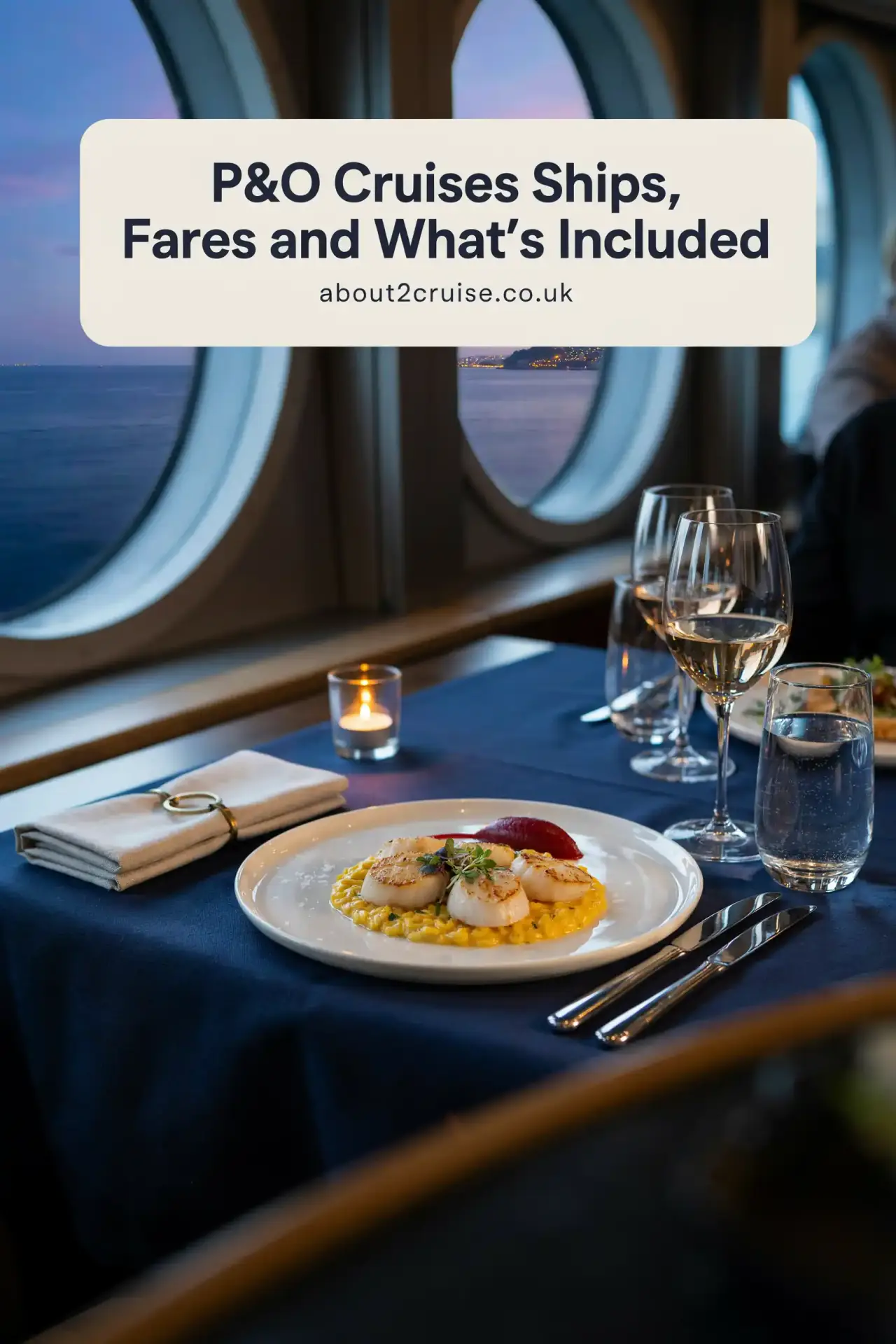
Dinner runs two ways. Club dining is the fixed sitting, roughly 18:30 or 20:30, with the same table and waiters every night.
Freedom dining runs about 18:00 to 21:30 with a virtual queue on the My Holiday app. Iona is Freedom only, with four main restaurants: Aqua, Coral, Opal and Pearl.
Celebration Nights are the dressed-up evenings, with a five-course menu overseen by Marco Pierre White. The two biggest ships hold one on cruises of two to ten nights and two on eleven to fourteen. The rest of the fleet holds one on one to six nights, two on seven to ten and three on eleven to thirteen.
Entertainment on the two biggest ships means around 30 bars and restaurants, a SkyDome pool lounge, the Headliners Theatre, a multi-screen cinema, The Limelight Club and The 710 Club. The quieter ships do less, in a more traditional register.
The buffet and main dining room are where P&O is weakest: lukewarm buffet food, bland main courses, and a buffet so busy at peak times that people give up on it. The speciality restaurants are consistently better, and the waiting staff usually get praised even when the food doesn’t.
Cutbacks show in small ways too. Evening turndown has gone, which regular P&O passengers notice more than first-timers do. Afternoon tea isn’t part of the fare either: it’s a set charge in the Epicurean, and the guide to afternoon tea on a cruise covers what else to expect on board.
Where P&O sails from, and what the itinerary decides
Southampton is the base. The no-fly programme covers the Norwegian fjords, the Canary Islands, the Mediterranean, Northern Europe and Scandinavia, the Baltic, the British Isles and short breaks, plus longer voyages to the United States and Canada. The current summer programme runs to 215 cruises, 121 destinations in 29 countries, 64 overnight calls and 69 late-evening departures, with fly-cruises from Malta as well.
Some of that matters more than the ship. An overnight call means an evening ashore without watching the clock.
The 36 weekend fjord departures, Fridays included, suit anyone fitting a cruise round a working week. The guide to cruises from Southampton covers the terminals and the drive down, and the no-fly cruises page sets out what you give up by staying in the UK.
The Caribbean runs as fly-cruises: 14-night sailings from Barbados, with Antigua and St Kitts added as departure points and Port Zante at St Kitts being upgraded so cruises can start and finish there. One ship is now based in Southampton year-round for the first time since it launched.
The long voyages sit with the small ships: a 124-night world cruise calling at Tokyo and Nagasaki, and a 75-night South America grand tour taking in Brazil and Chile.
For the ports rather than the ships, the Mediterranean cruises guide covers what each region asks of a port day.
Adults-only cruises: child-free most of the year, but check the sailing
P&O’s two adults-only ships are Arcadia and Aurora. Both are child-free for most of the year and neither has the splash zones, climbing walls or children’s clubs of the family ships, which is exactly why people book them.
They aren’t child-free all year. Around 20 sailings in the current programme are open to all ages, between December and September, and both ships stay adults-only for the rest of the calendar.
On those sailings there are no youth facilities and no babysitting, only children’s menus, baby changing, bottle warming, family activities and family entertainment, plus the adults-only spaces that remain: a pool on Aurora, a deck area on Arcadia and the Crow’s Nest bar from 6pm.
Passengers already booked on the affected departures were offered a refund or a free switch to another sailing. If a child-free ship is the whole point of the booking, check the date before you pay rather than after.
P&O Cruises FAQs
What is the dress code on P&O ships?
The dress code on P&O ships is Evening Casual on most nights and Black Tie on Celebration Nights, with no tailored shorts in the main venues and no denim except where a venue stays casual. The buffet, the Glass House, the Beach House, Keel and Cow and 6th Street Diner stay Evening Casual every night, and the codes don’t apply to under-18s.
Can I book speciality restaurants before I sail?
You can book speciality restaurants before you sail, or on board through the My Holiday system, and the popular venues and Celebration Nights are the first to go.
Is P&O a luxury cruise line?
P&O is not a luxury cruise line: fares cover main dining, entertainment and gratuities, but drinks, Wi-Fi and speciality restaurants are charged, and the largest ships carry over 6,000 guests at full occupancy. The smallest, quietest ships are the closest P&O comes to a traditional, adult-only style of cruising.
Do all adults in a cabin have to buy the same drinks package?
All adults in a cabin do have to buy the same drinks package, and each package is capped at 15 alcoholic drinks a person a day, one drink at a time. Children under 18 in the cabin get the Refresh package free when two adults buy the same all-inclusive bundle.
Last Updated: 4 November 2026