
A family of five or six can cruise, but not in just any cabin. Most cabins sleep four, a few sleep five and a handful sleep six, and the limit sits with the exact cabin rather than the grade name. Once you’ve found one that fits, you’ll be booking by phone or through an agent, not online.
How many people can share a cruise cabin?
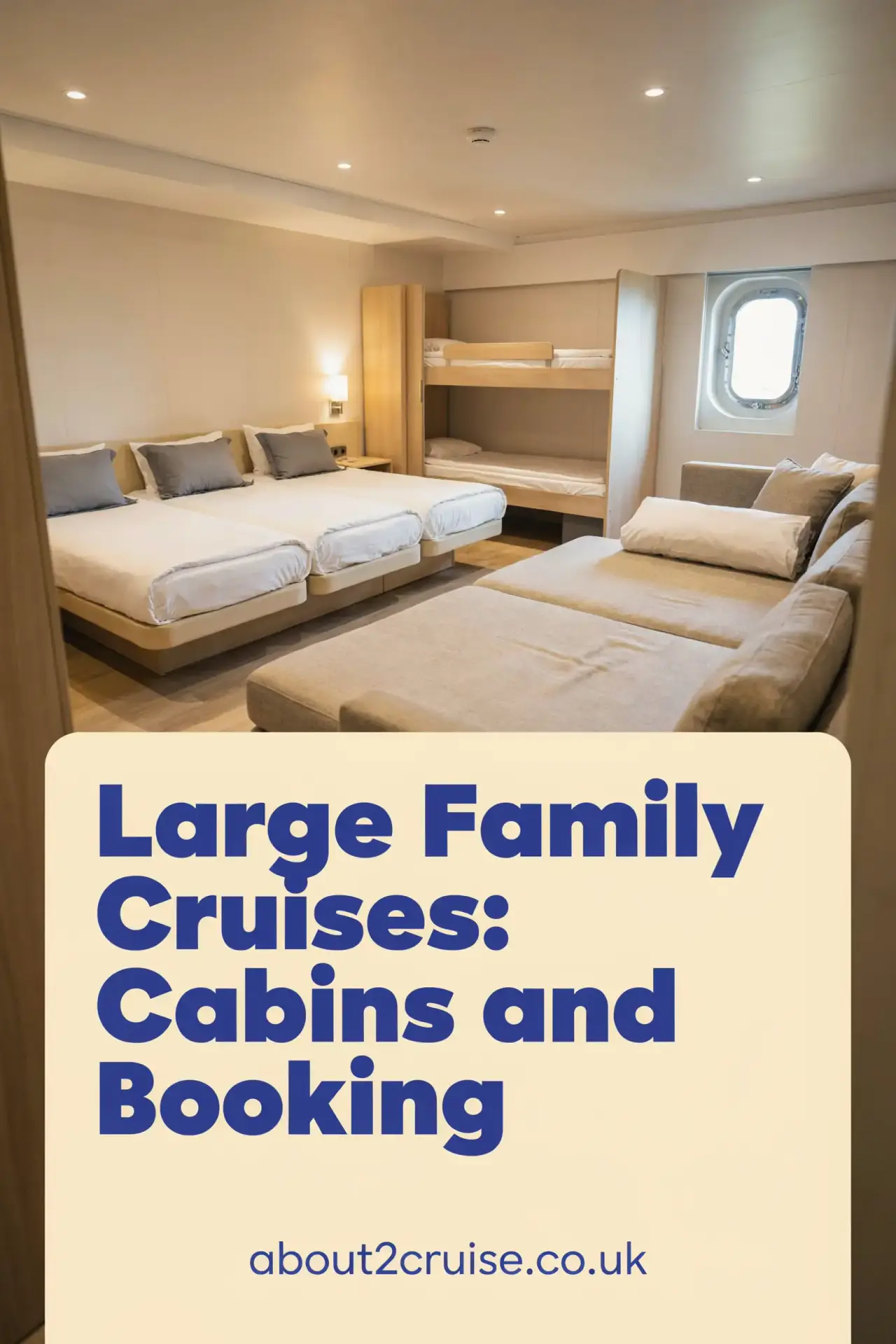
Four is the usual limit for a cruise cabin, five shows up on a small number of ships, and six exists in a handful of grades. The extra beds are usually a sofa bed that pulls out or a Pullman that folds down from the ceiling or out of the wall.
The exact cabin sets the capacity, not the category name, so two cabins in the same grade can have different limits. Disney Cruise Line won’t book five people into a four-person stateroom whatever their ages, an infant included. Carnival Cruise Line doesn’t go above five, and its suite capacity is tied to the individual suite.
Family cabins are a thin slice of any ship’s inventory too. They sell out first, older ships are the least likely to have them, and a shortlist built on price alone fills up with sailings that can never take your family.
Which cruise lines have cabins that sleep five or six?
Royal Caribbean’s Ultra Spacious Ocean View is the one that sleeps six in a single cabin. For five in one cabin with the widest choice, P&O Cruises has 50 five-berth cabins across Arvia, Iona and Britannia. Seven to ten is MSC Cruises’ Super Family Plus or a Marella Family Suite with Balcony.
| Cruise line | Cabin that sleeps five or more | Sleeps |
|---|---|---|
| Royal Caribbean | Ultra Spacious Ocean View (1K), Ultra Spacious Ocean View with Large Balcony, Family Interior, Family Balcony | Up to 6 |
| P&O Cruises | Conservatory Mini-suite on Arvia and Iona, Superior Deluxe Balcony on Britannia, BE suites on Azura and Ventura | 5, or 6 in the BE suites |
| Disney Cruise Line | Deluxe Family Oceanview with Verandah, Deluxe Family Oceanview, Concierge Family Oceanview with Verandah | 5 |
| Marella Cruises | Family Inside, Family Balcony, Family Junior Suite with Balcony, Family Suite with Balcony | 5 to 7 |
| MSC Cruises | Super Family, Super Family Plus | 6 to 10 |
| Carnival Cruise Line | Family Harbor Deluxe Ocean View, Deluxe Ocean View | 5 |
| Norwegian Cruise Line | Family Oceanview on the Away and Away+ class, Family Inside Suite on Norwegian Joy, B5 Family Balcony on Norwegian Sun | 5 to 6 |
Royal Caribbean’s six-berth cabin comes in two parts: two twins that make a Royal King, a second area with two Pullman or bunk beds, and a double sofa bed in the living area, plus one bathroom. It measures 271 sq ft on Oasis of the Seas and 328 sq ft on Navigator and Voyager. The line says it’s designed for larger travel parties.
P&O’s five-berth cabins are 15 Conservatory Mini-suites on Arvia, 23 on Iona and 12 Superior Deluxe Balcony cabins on Britannia. The Arvia ones are graded CZ and CW on Decks 8 and 9, and the Britannia ones DA and DB on Decks 12, 14 and 15.
You get a fixed double, one pull-down single and a double sofa bed, and the fifth guest pays no more than the third or fourth. Up to five adults can share, the ladder on the pull-down berth is rated to 130kg, and a cot can be the fifth berth on Iona and Arvia but not on Britannia, where four is the maximum with an infant.
Most five-berth cabins on Arvia and Iona adjoin a three-berth cabin, which gives you eight berths across the pair. Iona’s 8238 joins 8236, a four-berth, for nine.
Britannia has no adjoining cabins among its five-berth set, though it does have two accessible five-berth cabins; Arvia and Iona have none. P&O also carries a small number of six-berth BE suites, two each on Azura and Ventura.
The space doesn’t change. Beds are set up each evening and folded away each day, and P&O warns the cabin will feel more compact at night. With five people’s clothes in one room, compression packing cubes that squeeze the air out earn their place.
Disney’s five-berth cabins are the Deluxe Family Oceanview with Verandah at 284 sq ft, where the fifth bed is a single wall pull-down next to the sofa, and the Deluxe Family Oceanview at 237 sq ft. Every non-accessible Concierge 1-Bedroom Suite sleeps five, and some suites on some ships sleep seven.
Marella’s Family Inside and Family Balcony both sleep five. The Family Junior Suite with Balcony on Marella Discovery sleeps six, and the Family Suite with Balcony sleeps seven in two rooms with two bathrooms.
Carnival’s Deluxe Ocean View cabins sleep five with an extra half-bath, and the Family Harbor Deluxe Ocean View has a full bathroom plus a separate washroom. Norwegian’s Family Balcony sleeps four on most ships, but the B5 Family Balcony on Norwegian Sun sleeps five.
The Family Oceanview grades on Sun and Sky sleep five, and the Family Oceanview on Breakaway, Getaway, Escape and Joy can sleep six.
Four ways to sleep five or six
You’ve got four routes: one cabin built for five or six, two cabins with a door between them, two cabins with no door between them, or a suite with a cheaper cabin next door for the children. Each one trades space, bathrooms and price differently. The cabin types and how their layouts work are worth understanding before you pick.
- One 5- or 6-berth cabin. Cheapest on paper, and everyone is in one room with one bathroom. On Royal Caribbean that means a master bedroom, a bunk area and a sofa bed sharing a single bathroom.
- Two true connecting cabins. You get an internal door, two bathrooms and two lots of storage. Disney marks connecting staterooms with a V symbol on the deck plan, from standard inside cabins up to concierge suites. Royal Caribbean’s booking flow has a connecting rooms toggle that lets you put one adult in each room.
- Two adjacent or across-the-hall cabins. Far more combinations than connecting pairs, but no internal door, so the children are in a room you walk to.
- A suite plus an inside cabin, or two cabins sold as one unit. MSC sells two connecting balconies as a Super Family for up to six, and three connecting staterooms as Super Family Plus for up to ten with three bathrooms, at a fixed price per cabin regardless of how many of you are in them.
One big cabin or two ordinary ones: price it both ways
Two four-berth cabins can cost less than one quad-occupancy cabin, and you get twice the living space and two bathrooms. The family cabin isn’t automatically cheaper either: a Family Infinite Ocean View Balcony on Icon of the Seas is priced clearly above a Central Park View Balcony on the same sailing.
Offers can flip the maths back. A free third and fourth berth deal covers those berths only, needs two full-fare adults in the same stateroom, applies to new bookings, and leaves port taxes and government fees payable at full rate for every guest, children included. Two adults and four children can’t reach the fifth and sixth person with it.
Who counts as a full-fare guest matters just as much. P&O charges the first two guests in a cabin full price whatever their age, so a child booked as guest two pays the adult fare while a child booked as guest three doesn’t.
Disney charges the first two people in a stateroom the adult rate regardless of age, so putting the youngest child in as third person can cut the bill.
An adult alone in a cabin pays 200% of the full fare on Royal Caribbean group terms, which is what a grandparent booked separately is looking at. How to avoid single supplement fees is worth reading before that cabin is booked on its own.
An agent’s onboard credit normally applies to both cabins on a two-cabin booking, so compare the whole package rather than the fare line, starting with what’s included in family cruise packages.
How to book a cruise for a family of five or six
Book by phone or through an agent, because most booking engines quote up to four guests and then stop.
- Agree who sleeps where before you call. Two cabins of four and one cabin of five are different bookings, and the age rules decide who can be in which room.
- Ask for the exact cabin number and its berth count. The grade name isn’t the answer. Royal Caribbean holds a maximum of four guests per reservation, so a fifth in a qualifying cabin goes on a second, linked confirmation number, and a booking above four in one cabin can’t be made on its website. Disney’s engine refuses six or more in one stateroom and offers an Add Another Stateroom function instead.
- Say whether you need a door between the rooms. A true connecting pair is a different request from two cabins side by side. A guarantee fare hands the choice of cabin to the line, which isn’t how you land a pair that connects.
- Check the age rules for the ship you’ve chosen before the deposit goes down. A plan to put three children in the next cabin can be refused at the point of booking.
- Ask about a group block early if you’re heading towards eight cabins or about 16 people, because it has to be set up before individual bookings are made.
Book early: family cabins and connecting pairs go first
Family cabins and connecting pairs are the first things to go on any sailing, and school holiday departures take the hit hardest. Older ships are the least likely to have family staterooms at all, so the pool is smaller than the brochures suggest.
There’s no late-deal route into this. By the time a fare drops, the cabin that sleeps five has usually gone, and a guarantee fare won’t get you a connecting pair.
Pick the sailing, hold the cabin, then watch the price. On timing, see the best times for family cruises, and remember that a sailing from a UK port removes six flight seats from the budget, which is what no-fly cruises from UK ports are built around.
Age and supervision rules when you split across cabins
Each cruise line has a rule about who can be in a cabin without an adult, and they differ enough to decide which ship you pick.
- Royal Caribbean. The minimum age to sail unaccompanied is 21 on sailings from North America and 18 from Europe, South America, Asia, Australia and New Zealand. Nobody under 21 gets a cabin on a North America departure unless they’re sharing with an adult of 21 or over. The limit is waived for children in connecting staterooms, adjacent staterooms or staterooms directly opposite across the same corridor, as long as the doors open onto that corridor.
- P&O Cruises. A guest aged 12 or under must be booked into a cabin with someone aged 18 or over, and children aged 13 and over must share with a guest of 16 or over. No child of 12 or under can be left alone in a cabin at any time.
- Carnival Cruise Line. Passengers of 14 and under must be in the same or a connecting cabin as a relative or guardian aged at least 25. Ages 15 to 17 can be up to three staterooms away.
- MSC Cruises. The booking system requires an adult in each cabin of a Super Family or Super Family Plus block at the point of booking, so plan one adult per cabin even if the sleeping arrangements shift once you’re on board.
Cabin location and deck when you hold two or three cabins
Keep everyone on one deck unless there’s a reason not to, and settle early whether you need a connecting door or will accept next door. Only a true connecting pair has an internal door; two cabins side by side don’t, and neither do cabins across the corridor.
Disney marks connecting staterooms with a V symbol on the deck plan, and the partition between adjoining verandahs can be opened to make one shared balcony. Royal Caribbean lets you filter for connecting pairs in the booking flow, which is quicker than reading deck plans one at a time.
If anyone in the party is a poor sailor, position within the ship matters more than the grade. Choosing a cabin location that suits is worth ten minutes before five people’s luggage is committed to one room.
Kids’ clubs, age bands and the sibling split
Children are grouped by age, so a four-year-old and an eleven-year-old won’t be in the same club however close they are at home. MSC Cruises runs Mini Club for 3 to 6, Juniors Club 7 to 11, Young Club 12 to 14 and Teens Club 15 to 17.
Babies from six months to three use the Mini Club with their parents under the Babytime programme, and parents can leave one to three-year-olds with youth staff under MSC Babycare.
Carnival’s Family Harbor cabins sit next to a lounge with breakfast, snacks, board games, family movies and video games. They include unlimited free meals for children under 12 in the speciality restaurants plus one free evening of Night Owls babysitting, which otherwise runs from 10pm to 1am and is chargeable.
Those cabins are the Deluxe Ocean View grade on Deck 2 of Carnival Celebration, Horizon, Jubilee, Mardi Gras, Panorama and Vista.
When siblings land in different bands, the shared time moves to the pool, the sports deck and dinner rather than the club, which changes which ship works. With the older ones, whether teenagers will enjoy cruising decides more bookings than any cabin grade.
When a family of ten becomes a group booking
Eight cabins on one departure, holding around 16 passengers, is the usual threshold for a group block, and that’s where group rates and a free berth begin. Most lines give one complimentary berth, not a cabin, for every 16 full-fare passengers, refunded to the group leader after sailing.
Royal Caribbean sets its minimum at eight staterooms and 16 guests at double occupancy, with one tour conductor credit per 16 full-tariff guests. Third and fourth passengers don’t count towards it, and a single paying 200% counts as two guests.
Carnival’s minimum is eight staterooms in category 4B or above, with one free cruise fare per 16 full-fare guests, but only guests one and two in a booking count as full fare. Carnival holds group space on double occupancy, converts it to triples, quads or quints subject to availability, and starts giving Fun Points amenity credits from five booked cabins.
The threshold is the whole point. Eight or ten people in two or three cabins is an ordinary booking at the ordinary price; 16 people in eight cabins is a group and earns the free berth. Some families end up chasing a group rate that’s worse than a free-third-and-fourth offer on the same sailing, so price both before you commit.
Group blocks are a separate booking route too. Carnival can’t move individual bookings into a group block after the fact, and Royal Caribbean doesn’t count individual reservations transferred in towards group retention, although they are allowed below the group minimum. The block is set up first, through an agent or the line’s group department, and people are added to it.
What six people cost beyond six fares
The fare is only the start. Gratuities, drinks packages, wifi and shore excursions are charged per person, so six passengers means six of everything, and port taxes and government fees still apply at full rate to a child travelling on a free berth.
Excursions are the awkward part for a big party, because six places on the same departure is harder to find than two. Find out how to book family shore excursions before you sail rather than queueing at the desk. Run the per-person extras through a cruise budget calculator before you compare a family cabin with two ordinary ones.
Why ‘book two connecting cabins’ and ‘kids sail free’ don’t always work
- Two connecting cabins assumes the ship has two. Connecting pairs are far rarer than adjacent cabins, and on some ships and grades there are none. If the pair doesn’t exist, the choice is a family cabin or two rooms with no door between them.
- Kids sail free is not free. It covers third and fourth berths only, needs two paying adults in the same stateroom, is for new bookings, and still charges taxes and port fees for every child.
- One cabin for five stops working with teenagers. Five adults can share a P&O five-berth cabin, but it’s one bathroom, beds folded away every day and a cabin the line itself says will feel compact at night.
- A grandparent bolted on as the fifth berth runs into two rules. The supervision rules decide whether an adult can be in a separate cabin, and a cabin on its own means 200% of the fare.
- Some family cabins carry a minimum occupancy, so a party that drops below five can lose the cabin it booked.
- ‘Norwegian’s family balconies sleep four’ is true until it isn’t. The B5 Family Balcony on Norwegian Sun sleeps five and the Family Oceanview grades on Sun and Sky sleep five, so capacity is per ship and per cabin. There’s no fleet-wide figure.
Large family cruise FAQs
What is the minimum age to sail?
P&O Cruises takes infants from six months, rising to 12 months on holidays with three or more consecutive sea days or remote destinations. Royal Caribbean also starts at six months, rising to 12 months on transatlantic, transpacific, Hawaii and some South America cruises and on any cruise with three or more consecutive sea days.
Which family cabins have two bathrooms?
Carnival’s Deluxe Ocean View sleeps five with an extra half-bath, and the Family Harbor Deluxe Ocean View has a full bathroom plus a separate washroom. Marella Discovery’s Family Suite with Balcony sleeps seven in two rooms with two bathrooms, and MSC’s Super Family comes with two.
Can we open the balcony between two cabins?
On Disney Cruise Line, the partition between adjoining staterooms’ verandahs can be opened to create one shared balcony, so a family spread across two neighbouring balcony cabins gets a joined outdoor space.
Which Carnival ships have Family Harbor cabins?
Family Harbor cabins are on Carnival Celebration, Horizon, Jubilee, Mardi Gras, Panorama and Vista, in the Deluxe Ocean View grade on Deck 2, sleeping five.
Can eight people cruise without booking as a group?
Eight people can cruise without booking as a group, because a group block starts at around eight staterooms and 16 passengers on one departure. So eight people in two or three cabins book as an ordinary party and pay the ordinary fare.
Last Updated: 31 October 2026