
Midship, low down, near the ship’s centre of gravity, is where pitch and roll are smallest, and that’s the best spot on a cruise ship. That’s not always the quietest or cheapest cabin, though. What’s sitting above and below you on the deck plan, and whether you actually need a view, usually matters more than the deck number alone.
Why midship, lower-deck cabins reduce seasickness
Midship, lower-deck cabins cut down on seasickness because they sit right at the point where the ship pitches and rolls least, the pivot everything else swings around rather than the ends that get thrown about. Pitch is the front-to-back rocking from swells coming at you head-on, worst at the bow and stern, smallest in the middle.
Roll is the side-to-side wobble from waves hitting the side, worst up high, smallest down low near the waterline.
A ship’s centre of gravity sits toward the bottom of the hull, not halfway up, because the engines, machinery and fuel down there weigh a lot more than any cabin or theatre ever will. The hull’s shaped so the centre of buoyancy shifts as the ship tilts, pushing it back upright again, but whichever cabin swings through the shortest arc while that correction happens is always the one closest to the centre of gravity: midship, low down.
Feeling queasy at sea isn’t something you can book your way out of entirely. A review published by the National Center for Biotechnology Information found that up to 25% of passengers on a large ship feel some motion sickness within two or three days of setting off.
A separate study of 239 passengers on repeat cruise trips, published in the Journal of Travel Medicine, found that 94% reported at least one symptom, with 38% being sick, and found no link between how bad it was and where the cabin sat, only age and sex.
The physics of pitch and roll are real and worth booking around, but no cabin location comes with a guarantee.
Midship versus low deck: the trade-off you don’t expect
Midship and low deck pull in different directions once you start weighing up motion against view, light and price, because the steadiest spot on the ship isn’t always the one worth booking. A cabin that’s both midship and on the lowest deck, if it’s an oceanview, often means staring straight at a lifeboat or a slab of hull, and you’re about as far from the pool deck and the lifts as you can get.
| Position | Motion | Typical noise risk |
|---|---|---|
| Forward, high deck | Most pitch and roll of any position | Wind noise, anchor chain in port |
| Forward, low deck | Less roll, still heavy pitch | Anchor chain noise in port |
| Midship, high deck | Less pitch, more roll than lower decks | Pool deck or sunbathing area above |
| Midship, low deck | Least pitch and roll of any position | Furthest from lifts and entertainment |
| Aft, high deck | More roll, an up-and-down lift rather than pitch | Buffet or pool deck noise if sited aft |
| Aft, low deck | Less roll, mild vibration | Engine vibration and noise |
Midship on a middle deck, rather than the very lowest one, is usually the better compromise: still close enough to the pivot point for motion, a shorter walk to dinner and the shows, and generally the quietest category going. It’s also the cabin location that tends to sell out first, so decide early if this trade-off suits you better than the steadiest possible berth on the ship.
Not every balcony cabin stacks up the same way either, and it’s worth checking that before you book, in this guide to whether every balcony cabin on a cruise ship is really equal.
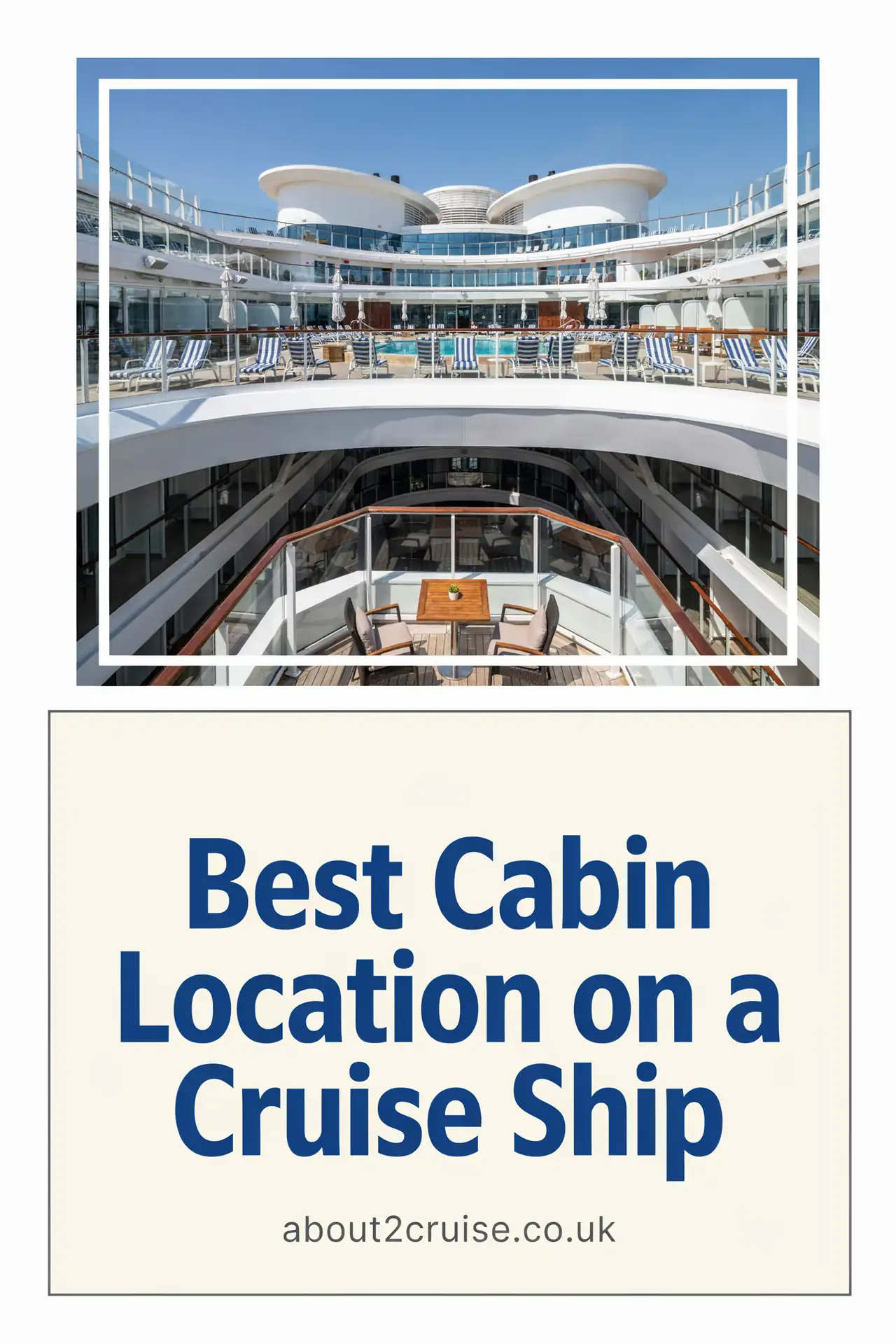
Noise sources to check on the deck plan before you book
A cabin can be dead centre midship and still sit under something loud. Skip anything directly below a pool deck, a buffet or a theatre, since sound drops straight through a ceiling, and look for a cabin with other cabins above and below it rather than a public space.
Even a well-placed midship cabin can pick up noise from the deck right above it. On Fred. Olsen’s Borealis, some of the Premier Suites on Deck 7 sit directly below the pool deck.
Early risers dragging loungers across the decking to bag a spot can be heard from below, though it’s muffled and over in a few seconds, and noise complaints about this ship are otherwise rare.
The same thing catches people out on bigger ships. On Royal Caribbean’s Brilliance of the Seas, the Deck 10 cabins sit below the Windjammer buffet and the pool deck, and passengers there report early-morning noise from breakfast being set up and chairs being moved overhead.
Interior cabins versus a balcony: the value trade-off
Interior cabins are worth a look when motion and noise matter to you less than price, because they cost noticeably less than a balcony, and the pitch-black dark often means better sleep than an oceanview cabin stuck above a busy pool deck. They make the most sense on a port-heavy trip where you’re off the ship most of the day, when you’re watching the budget, or when you sleep better without a scrap of light getting in.
They make far less sense on a scenic sailing with plenty of sea days, where you’d be paying for a view you’d barely use.
There’s one specific way this trade-off bites back: a window or balcony lets your eyes see the horizon, which helps your brain’s sense of balance agree with what your inner ear is telling it, and that can take the edge off nausea in rough seas.
An interior cabin takes that reference point away completely, which is why they can feel worse in a swell even when the position itself, midship and low, is exactly right. The other common gripe is oversleeping, since there’s no daylight to wake you, so set an alarm and expect to lose all track of time.
One trick that helps: if the ship has a bridge camera channel, use the cabin television as a fake window, switching it on with the sound off before bed so the room lightens naturally when the sun comes up.
If you’re still torn on cabin type before you even get to deck number, sort that out first: this guide to choosing the right cabin type for your cruise, or this breakdown of whether you should book an inside cabin, will help.
Connecting cabins and the noise the shared door lets through
Connecting cabins let through more noise than most families bargain for, because the door joining the two rooms is thinner than a normal cabin wall, a hollow slab rather than a proper insulated partition. Talk, the telly, snoring, early alarms, all of it carries through even when the door’s locked.
If you only need one cabin, the easiest fix is to steer clear of connecting rooms altogether rather than hope you get a quiet neighbour. Deck plans mark connecting cabins with a small door symbol next to the room number, so you can rule them out and pick a standard stateroom a few doors along instead, same location, none of the extra noise risk.
Forward or aft: the motion and noise trade-off
Forward cabins move more than anywhere else on the ship, since the bow rises and falls hardest through oncoming swells, and you also get wind noise plus the clatter of the anchor chain on mornings when the ship’s in port. Aft cabins move less dramatically, more of an up-and-down lift than a side-to-side roll, and they often come with bigger balconies and a wake view, but they sit closer to the engines, so a bit of vibration is normal.
A low cabin right at the front manages to combine both problems at once, so if you want a forward cabin for the view, go higher up and further from the anchor instead. Midship is still the steadier middle ground if motion worries you more than the view does.
Cabin location and accessibility
Cabin location and accessibility are tied together because accessible cabins tend to be grouped into specific zones rather than spread across the ship, so your choice of deck is narrower than the full plan suggests. Every ship only has a small number of them, with roll-in showers and doorways wide enough for a wheelchair, so they’re among the first cabins to sell out.
Book as early as you can, and look at where the accessible cabins sit in relation to the lifts, since a long corridor walk twice a day matters more than the deck number. If you don’t need the extra space or the fittings, book a standard cabin nearby instead and leave those ones free for passengers who do.
When the midship, low-deck rule doesn’t apply
The midship, low-deck rule matters less on a larger modern ship, because sheer size cuts down on motion in normal seas: a bigger vessel just moves less than a smaller one, wherever your cabin sits. On a smaller or older ship, including a lot of expedition vessels, the same midship and low-deck advice still holds, but it counts for more, because these ships move more overall and the gap between the steadiest cabin and the roughest one is bigger.
Smaller and older ships also tend to have less structural buffer between cabins and noisy public spaces, so a couple of wrong turns on the deck plan can land you under a pool deck, above a theatre, or next to a crew door, even when the cabin itself is midship.
Best cabin location FAQs
What is the best cabin location on a cruise ship for seasickness?
The best cabin location for seasickness is midship on a lower deck, where the ship pitches and rolls least because that’s the point closest to the vessel’s centre of gravity.
Why do lower, midship cabins move less than cabins at the bow or stern?
Lower, midship cabins move less because they sit nearest the ship’s centre of gravity, the pivot everything else rocks around, while the bow and stern swing through the widest arc of all.
Should I avoid booking a cabin under the pool deck?
Booking under a pool deck is worth avoiding if you’re a light sleeper, since lounger noise and early morning deck cleaning can carry straight through the ceiling, even on an otherwise quiet midship cabin.
Are connecting cabins noisy?
Connecting cabins can be noisy because the shared door between them is thinner than a standard cabin wall, letting through conversation, telly noise and alarms from next door even when it’s locked.
Is an interior cabin a good choice on a port-heavy cruise?
An interior cabin is a good choice on a port-heavy cruise, since you’ll spend most of the day off the ship anyway and the saving over a balcony cabin you’d barely use is a big one.
Is a forward cabin or an aft cabin better?
A forward cabin moves more than anywhere else on the ship and catches anchor chain noise in port, while an aft cabin moves less dramatically but sits closer to engine vibration; midship sidesteps both trade-offs.
Are accessible cabins available on every deck?
Accessible cabins aren’t available on every deck; they’re usually grouped into specific zones to allow for the extra turning space a wheelchair needs, so your choice of deck is narrower than it is for standard cabins.
Does a bigger ship mean less motion regardless of cabin location?
A bigger ship does move less in normal seas than a smaller one, which is why the midship, low-deck rule counts for more on smaller or older ships, including a lot of expedition vessels.
Last Updated: 19 October 2026