
Middle East cruise ports come in two halves. The Arabian Gulf has Dubai, Abu Dhabi, Doha, Bahrain and Muscat, and no line is sailing there at the moment. The Red Sea still runs, with Jeddah, Aqaba, Safaga, Ain Sokhna and Sharm el-Sheikh, each with a terminal a taxi or shuttle ride from town.
Middle East cruise ports map
The Middle East’s 8 cruise ports run from Safaga and Sharm el-Sheikh in the far west to Muscat and Dubai in the far east. Tap a pin to open that port’s guide.
Do cruise ships still sail the Arabian Gulf?
No line is running a regular Arabian Gulf season at the moment. Every line that planned one has cancelled, including TUI Cruises, MSC Cruises, Explora Journeys, Costa, AIDA, Celestyal and Aroya, and the cancellations cover the coming winter and the one after it.
The reason is the Strait of Hormuz. It’s the Gulf’s only way out for a cruise ship, and it’s effectively closed to commercial operations.
Winter deployment gets planned about a year ahead, so losing one season takes the next one with it. Even the strait’s status has swung about: it was declared completely open to commercial vessels by Iran’s foreign minister during a ceasefire, and then Iran’s security council said it would stay closed while that ceasefire was being violated.
The lines moved their ships rather than wait. Aroya ended its first Gulf season early and switched its winter programme to the Mediterranean from Istanbul, while keeping its Red Sea seasons from Jeddah. MSC sent MSC World Europa to the Caribbean for the winter, and Celestyal lengthened its Eastern Mediterranean programme instead.
You’ll still see Gulf fly-cruises from Dubai, Abu Dhabi and Doha advertised in places. Check the line’s own schedule and your confirmation before any deposit goes down. A Gulf itinerary with no confirmed ship behind it isn’t a booking yet.
United Arab Emirates cruise ports
Dubai and Abu Dhabi take the big turnaround ships, and Sir Bani Yas Island is the beach call in between.
Dubai (Mina Rashid and Dubai Harbour)
Dubai has two separate cruise areas about 25 km apart, and which one your ship uses decides your transfer. Mina Rashid, also called Port Rashid, sits beside Old Dubai. Dubai Harbour sits by Dubai Marina, JBR, Bluewaters and Palm Jumeirah.
Mina Rashid is the bigger turnaround complex and has exactly two terminals: Al Maktoum Cruise Terminal, known as T2, and Hamdan bin Mohammed Cruise Terminal, T3. Booking documents show the address as Port Rashid, Passenger Terminal 2 or 3. That number is the bit the driver needs; the port name on its own will get you a shrug.
For a day ashore the Mina Rashid side wins, with Al Fahidi Historical Neighbourhood, Dubai Creek, the abra crossings and the Deira souks all on that side of the city. Dubai Harbour puts you at the marina end instead, which is a different day out entirely.
Mina Rashid is close to Dubai International Airport: follow signs for Jebel Ali and Abu Dhabi, cross Al Grarhour bridge, then pick up Port Rashid and finally Passenger Cruise Terminal signs. There’s no parking at Port Rashid, Passenger Terminal 2 or 3, so a taxi or transfer is the realistic plan.
Emirates has check-in facilities inside the terminal, and eligible passengers can check in for their flight and hand over bags at Terminal 3 or at Dubai Harbour before leaving for the airport. Which beats dragging a case round the departure hall.
Abu Dhabi (Zayed Port)
Abu Dhabi’s cruise terminal is in Zayed Port, about five minutes by taxi from the city centre, which makes it one of the simplest turnarounds in the region. You’re in town before your coffee goes cold.
Allow roughly 40 minutes from Zayed International Airport, and about an hour and a half by coach or taxi from Dubai International Airport. Intercity buses run between Dubai and Abu Dhabi, with a taxi transfer from the Abu Dhabi bus station to the terminal.
Sir Bani Yas Island
Sir Bani Yas is a beach call rather than a city one: a purpose-built pier takes two ships and 5,000 passengers at once, and the beach oasis there is exclusive to MSC guests. On an itinerary full of souks and skylines, it’s the day you spend in the water and nowhere near a coach.
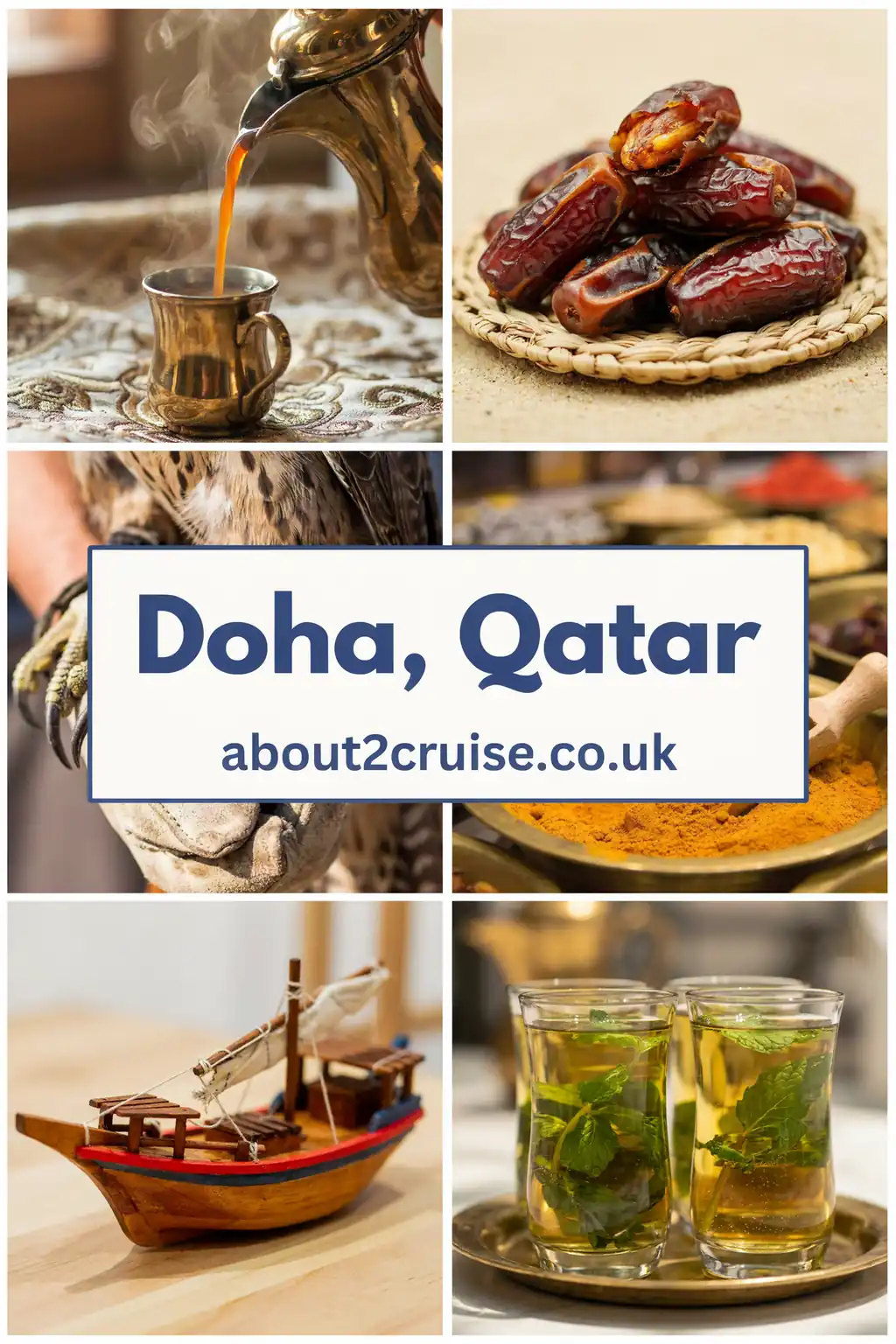
Qatar cruise ports
Doha (Grand Cruise Terminal)
Ships berth at the Grand Cruise Terminal on Corniche Road, in Doha’s old port beside the Mina District and Box Park, rather than out in a commercial harbour. No container yard, no hour on a shuttle before you see anything.
That makes Doha a walk-off port. The Mina District has cafés, restaurants, boutiques and a fish market in pastel-coloured buildings.
Box Park next door is built from reused shipping containers, with street-art murals and street food. Shuttles run from the terminal to central Doha as well.
The terminal itself sits minutes from the city’s main landmarks, and getting in and out is quick.
Bahrain cruise ports
Mina Salman (Khalifa Bin Salman Port)
Bahrain’s cruise calls berth at Khalifa Bin Salman Port, the country’s main commercial port, roughly 45 minutes from central Manama. Paid shuttle buses run to the city for passengers who aren’t on a ship excursion.
That transfer is the thing to plan around. Forty-five minutes each way plus the fare takes a sizeable bite out of a port day, so if Manama is the point of the call, be on the early shuttle rather than the one after breakfast.
Oman cruise ports
Muscat (Muttrah and Port Sultan Qaboos)
Ships berth at Muttrah, at Port Sultan Qaboos, which is the old historic centre of Muscat and where the big souk is. Central Muscat is about 21 km away.
Because the berth sits in Muttrah itself, this is a port where you can step off into the old town and the market rather than committing to a drive across the city.
Red Sea cruise ports
The Middle East cruises still running are Red Sea circuits linking Jeddah, Safaga, Ain Sokhna, Sharm el-Sheikh and Aqaba. Nine and ten-night versions are on sale, some with overnights in Jeddah and Safaga, and a longer routing adds Yanbu between Jeddah and Ain Sokhna.
Jeddah
Jeddah is the Saudi port on these routes, and some circuits start and end there. Others overnight, which gives you an evening in the city rather than a single rushed call.
Aqaba (for Petra and Wadi Rum)
Aqaba is Jordan’s only seaport and the access point for Petra and Wadi Rum. Both are done as ship excursions or pre-booked tours, and the time you have to be back on board is what decides how much of the site you see. That’s the difference between the Treasury and a photo of the Treasury.
Safaga (for Luxor and the Valley of the Kings)
Safaga is a working Red Sea port and the access point for Luxor’s temples and tombs. Some circuits overnight here, which is the version to look for if Luxor is the reason you booked.
Egypt‘s travel advice matters for this call. The FCDO advises against all but essential travel to the Western Desert except Luxor, Qina, Aswan, Abu Simbel and the Valley of the Kings, so the excursion area is carved out and permitted while the desert around it is not.
Ain Sokhna (for Cairo)
Ain Sokhna is the Red Sea port the circuits use for Cairo. On the sailings that call there the day runs long, with the ship alongside from early morning until late evening.
Sharm el-Sheikh
Sharm el-Sheikh is the resort call on these routes, sitting between Ain Sokhna and Aqaba on the run north. It’s the day on the itinerary where the draw is the water rather than a site.
Is it safe to take a Middle East cruise?
It depends on which countries your itinerary calls at. The Foreign, Commonwealth and Development Office advises country by country, not region by region.
For the UAE, Qatar, Bahrain and Oman, UK advice currently warns of regional tensions: the situation is unpredictable, it could escalate suddenly, and airports and airspace can close at short notice. Keep your flights home under review.
In Bahrain, the airspace and the King Fahd Causeway to Saudi Arabia have closed at the same time, which cuts off both ways out. The FCDO no longer advises against all but essential travel to the UAE, Qatar, Bahrain or Kuwait.
Where the FCDO does advise against all travel or all but essential travel, which covers Iran, Iraq, Israel, Palestine, Syria and Yemen and parts of Jordan, Lebanon, Pakistan, Saudi Arabia and Turkey, two things follow. Travel insurance is invalid if you go anyway, and reputable operators won’t sell a cruise to a destination under that advice.
In Jordan, the FCDO advises against travel within 3 km of the Syrian border, a long way from the cruise port at Aqaba.
Check the position before you book and again before you fly, because it has changed more than once. Start with the FCDO travel advice for the UAE, then work through every country on your route.
Middle East cruise port FAQs
Can you start a cruise in Doha?
Yes. Some itineraries begin and end at Doha’s Grand Cruise Terminal, which has handled a season of 72 cruise calls: 15 turnarounds, 40 transit calls and 3 maiden calls.
Is Sir Bani Yas open to every cruise line?
No. The beach oasis on Sir Bani Yas is for MSC guests only, even though the island’s purpose-built pier can take two ships and 5,000 passengers at the same time.
Is Dubai’s cruise terminal accessible?
Mina Rashid’s passenger areas are flat, paved and covered in the key areas, which suits wheelchairs and mobility scooters. The port is a large secured maritime district, so the accessible route depends on which terminal and gate your ship uses.
What facilities are inside Dubai’s cruise terminal?
Mina Rashid’s terminals have free Wi-Fi, duty-free, a tax refund desk, money exchange and ATMs, so you can sort currency and paperwork before you leave the building.
Can you join a Red Sea cruise at Aqaba or Safaga?
Some Red Sea programmes let you get on at any of the main ports, including Safaga, Ain Sokhna, Sharm el-Sheikh, Aqaba and Jeddah. If you’re flying in, check the full list of joining ports before booking flights. The right ship and the wrong airport is a miserable way to start a holiday.
What happens if your ship is in the Gulf when the strait closes?
It has happened. Six cruise ships were held alongside in Arabian Gulf ports for roughly two months while passengers were sent home, and Celestyal Discovery was the first to leave, with Celestyal Journey the day after.
Last Updated: 3 November 2026