
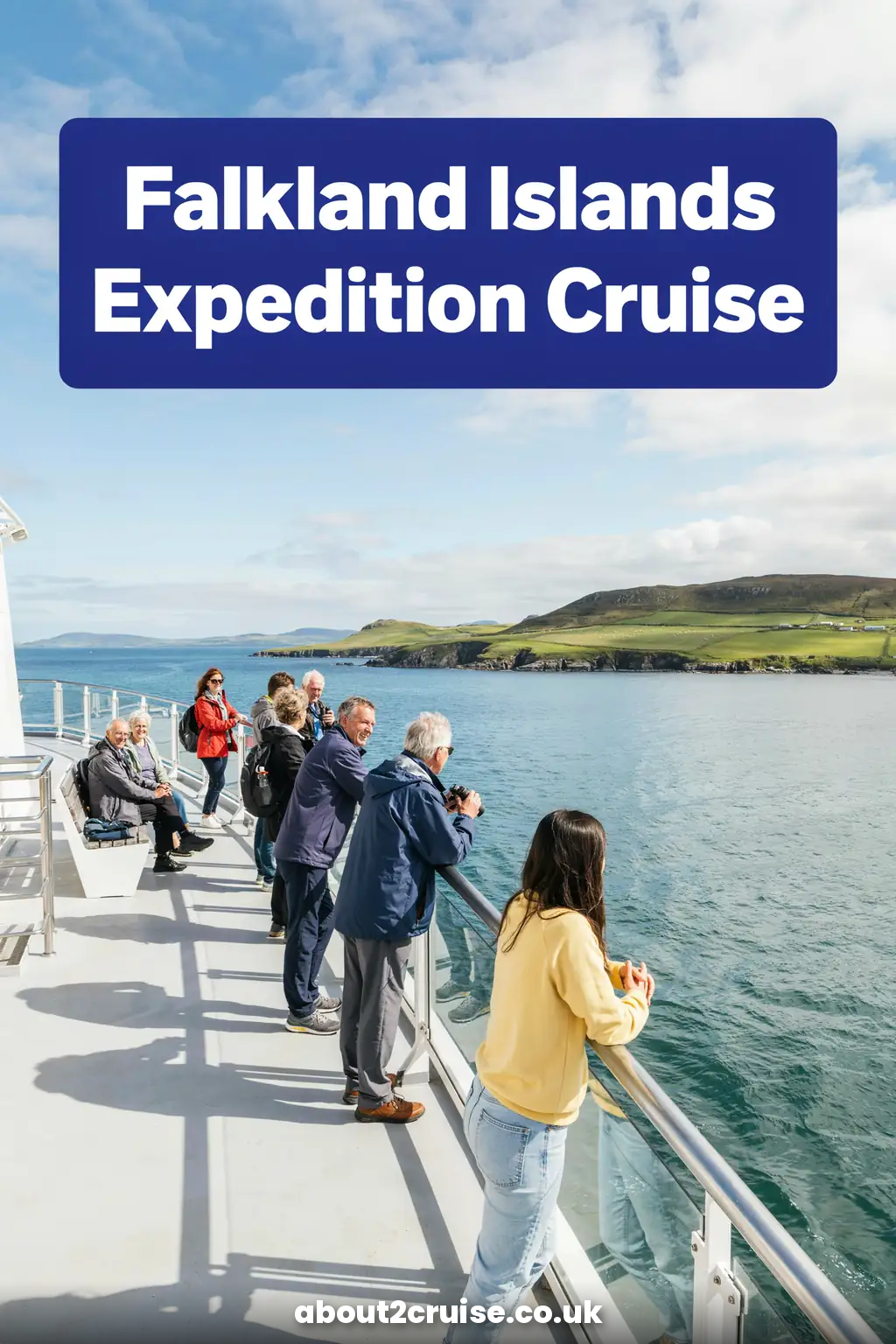
Falkland Islands cruises do two different jobs. Expedition ships land you by Zodiac on outlying islands to sit near king, gentoo, rockhopper and Magellanic penguins. Larger mainstream ships anchor off Stanley, tender you to the Jetty Visitor Centre and run overland 4×4 tours to Volunteer Point. Expect wind, sudden weather changes and a landing that is never guaranteed.
Expedition vs. Mainstream Falklands Cruises
An expedition cruise is built around the destination. It uses a small ship, carries naturalists and expedition guides, and includes shore landings and hikes in the fare. IAATO classifies these ships as C1 (13 to 200 guests) or C2 (201 to 500 guests). The largest expedition-style ships can still land guests, but no more than 100 people should be ashore at an Antarctic landing site at one time.
A mainstream cruise is built around the ship. Large vessels over 500 passengers are classed as cruise-only in polar waters: they cannot land at Antarctic Treaty sites, and their Falklands experience centres on Stanley. These ships anchor in deep water, tender passengers ashore, and sell overland tours such as Volunteer Point as optional excursions.
The practical difference is simple. Expedition passengers may walk a white-sand beach on Saunders Island or stand above an albatross colony on West Point Island. Mainstream passengers get a Stanley port day, usually six to nine hours, and access to the island interior by 4×4 or coach.
Falkland Islands cruise port map
Each pin shows how far that place is from the nearest cruise pier. Tap a pin for directions.
- FIPASSWhere ships dock
- Lady ElizabethShipwreck · About 20 min walk from FIPASS
- StanleyTown · About 2 km from FIPASS
- Jetty Visitor CentreVisitor centre · About 2 km from FIPASS
- Volunteer PointPenguin colony · About 21 km from FIPASS
- Gypsy CovePenguin colony · About 2 km from FIPASS
- Christ Church CathedralCathedral · About 3 km from FIPASS
- Falkland BeerworksBrewery · About 3 km from FIPASS
- Malvina HouseHotel · About 3 km from FIPASS
- The WaterfrontHotel · About 3 km from FIPASS
- Mount Pleasant AirportAirport · About 46 km from FIPASS
- Sapper HillHill · About 4 km from FIPASS
- Mount WilliamHill · About 9 km from FIPASS
- Mount TumbledownHill · About 10 km from FIPASS
- Mount HarrietHill · About 14 km from FIPASS
- Two SistersBattlefield site · About 15 km from FIPASS
- FitzroyBombing site · About 30 km from FIPASS
- Port PleasantBombing site · About 28 km from FIPASS
Where to See Penguins and Wildlife in the Falklands
The Falklands are best known for penguins. Five species breed in the islands: king, gentoo, southern rockhopper, Magellanic and macaroni. You don’t need to go to Antarctica to see them.
- Volunteer Point, about 80 km from Stanley, holds roughly 1,200 king penguins plus gentoo and Magellanic penguins.
- Gypsy Cove, only 8.5 km from the tender pontoon, has a reliable Magellanic colony.
- For birdwatchers, the headline species is the black-browed albatross. More than 227 bird species have been recorded.
- West Point Island, Saunders Island, Carcass Island, New Island and the Jason Islands all have significant albatross and penguin colonies.
- Sea Lion Island is the pick for marine mammals: southern elephant seals, sea lions, gentoo, Magellanic and rockhopper penguins, and orcas offshore as seal pups enter the water.
If you have only one main objective, Volunteer Point is the best place to see penguins on a port day. If your expedition ship offers landings on Saunders, West Point or New Island, take them: those are where the big rockhopper and black-browed albatross colonies are.
Best Time to Cruise the Falkland Islands
The cruise season runs from late September to early April. Penguins and albatrosses begin arriving in September and October. Eggs hatch from late November into December, and chicks fledge in February and March. The best all-round wildlife window is November to February.
January and February bring the warmest daytime temperatures, around 12 to 15°C in Stanley, but January is also the wettest month. March is the best month for whales. By mid-April most migratory wildlife and most passengers have gone. If you want long days and active penguin colonies, choose December or January. If you prefer quieter landings and can accept cooler weather, consider November or late February.
Which Ships and Cruise Lines Call at the Falklands?
Ships range from small expedition vessels carrying fewer than 100 guests to large cruise ships carrying over 3,000. Expedition operators with published Falklands itineraries include HX/Hurtigruten, Ponant and Seabourn.
Mainstream lines with Stanley calls include Princess, P&O Cruises, MSC, Royal Caribbean, Celebrity, Holland America, Oceania, Regent Seven Seas, Silversea, Azamara, Viking and Saga. Princess uses Sapphire Princess and Majestic Princess on South America and Cape Horn voyages. P&O Aurora has a 75-night Southampton round trip that calls at Stanley. Royal Caribbean, Celebrity Equinox, Holland America Zaandam and Oosterdam, Silver Nova and Viking Jupiter all appear in Stanley schedules in different seasons. In a typical season, ships carry around 80,000 passengers if they sail full.
If you’re comparing small-ship operators, decide early whether you want outlying-island landings or a single Stanley call. Specialist agencies such as AdventureSmith Explorations book only small-ship expedition voyages, typically 4 to 150 guests with an average of around 45. Let us find the right polar expedition cruise for you.
Where Falklands Cruises Depart From
Most Falklands expedition cruises begin in Ushuaia, Punta Arenas or Montevideo. Ushuaia is the classic Antarctic gateway. Punta Arenas works for lines that fly or sail from Chile. Mainstream South America cruises often start or finish in Buenos Aires, Rio de Janeiro, Santiago or San Antonio.
From the UK without flying, P&O Aurora sails round-trip from Southampton and calls at Stanley on its 75-night South America voyage. Princess Majestic Princess has a Southampton to Santiago sailing via Stanley. If you prefer to fly one way and sail the other, many passengers fly to Santiago or Buenos Aires and join a ship there.
From Australia, the classic Antarctic route is via South America. Aurora Expeditions runs longer Ross Sea voyages direct from Hobart to East Antarctica and the Ross Sea, bypassing South America and the Falklands. For most Australians, the Falklands are visited on a South America plus Antarctica itinerary, not as a standalone cruise.
Stanley Port Day: Getting Ashore and What to Book
Large ships anchor in Blanco Bay and tender you about 25 minutes to the pontoons in front of the Jetty Visitor Centre. Small ships may moor at FIPASS, a floating dock east of town. Vessels over 10,000 tonnes are not permitted to berth at FIPASS. If you arrive at FIPASS, a courtesy bus runs into the centre.
Stanley is tiny, with around 2,500 residents, and almost everything is walkable once ashore. The Jetty Visitor Centre has maps, Wi-Fi, a souvenir shop and displays. Shore excursions are best booked on board. Some guides can be found at the centre, but advance booking is essential on busy ship days because vehicle capacity is limited.
The headline Stanley tour is Volunteer Point. It’s sold as a challenging 7-hour excursion using 4×4 vehicles, with a rough 80 km drive each way and around 90 minutes at the king penguin colony. Prices run from about US$338 to US$400 per person depending on the ship and independent operator. A Mt William battlefield hike costs from about US$119. A four-hour sea kayak journey from Stanley costs from £300 for a maximum of six people, with dry suits and all kit provided.
If you prefer to stay around town, walk past Christ Church Cathedral and the Whalebone Arch, the Historic Dockyard Museum, the Lady Elizabeth wreck and the war memorials along Ross Road. On busy cruise days, small buses run regularly to Gypsy Cove for a shorter, cheaper penguin fix.
Falklands War History and Battlefield Tours
Argentina invaded the Falkland Islands in 1982, and the British task force retook them after a short but intense land, sea and air campaign. Cruise ships played a direct part. P&O’s SS Canberra was requisitioned as a troopship, Cunard’s QE2 carried roughly 3,000 troops of the 5th Infantry Brigade, and P&O’s Uganda served as a hospital ship.
On a Stanley port day, a typical battlefield tour covers Sapper Hill, Mount William, Mount Tumbledown, Mount Harriet and the Two Sisters, plus Fitzroy and Port Pleasant where Sir Galahad and Sir Tristram were bombed. Some tours run to the Argentine cemetery near Darwin. The Mount Tumbledown memorial is open all year, but it sits high, rocky and exposed: wear proper footwear and windproof layers. The islands were declared mine-free in late 2020, but suspicious objects can still appear and must not be touched.
Food, Drink and Daily Life in Stanley
There’s no McDonald’s and no international fast-food chain in the Falklands. Stanley’s food comes from independent pubs, hotel kitchens and cafés. The tourist board runs a pub walkabout taking in five bars and ending at Falkland Beerworks, the only brewery in the islands. The Victory Bar is one of the few places with draught beer, and the Globe Tavern serves fish and chips near the public jetty.
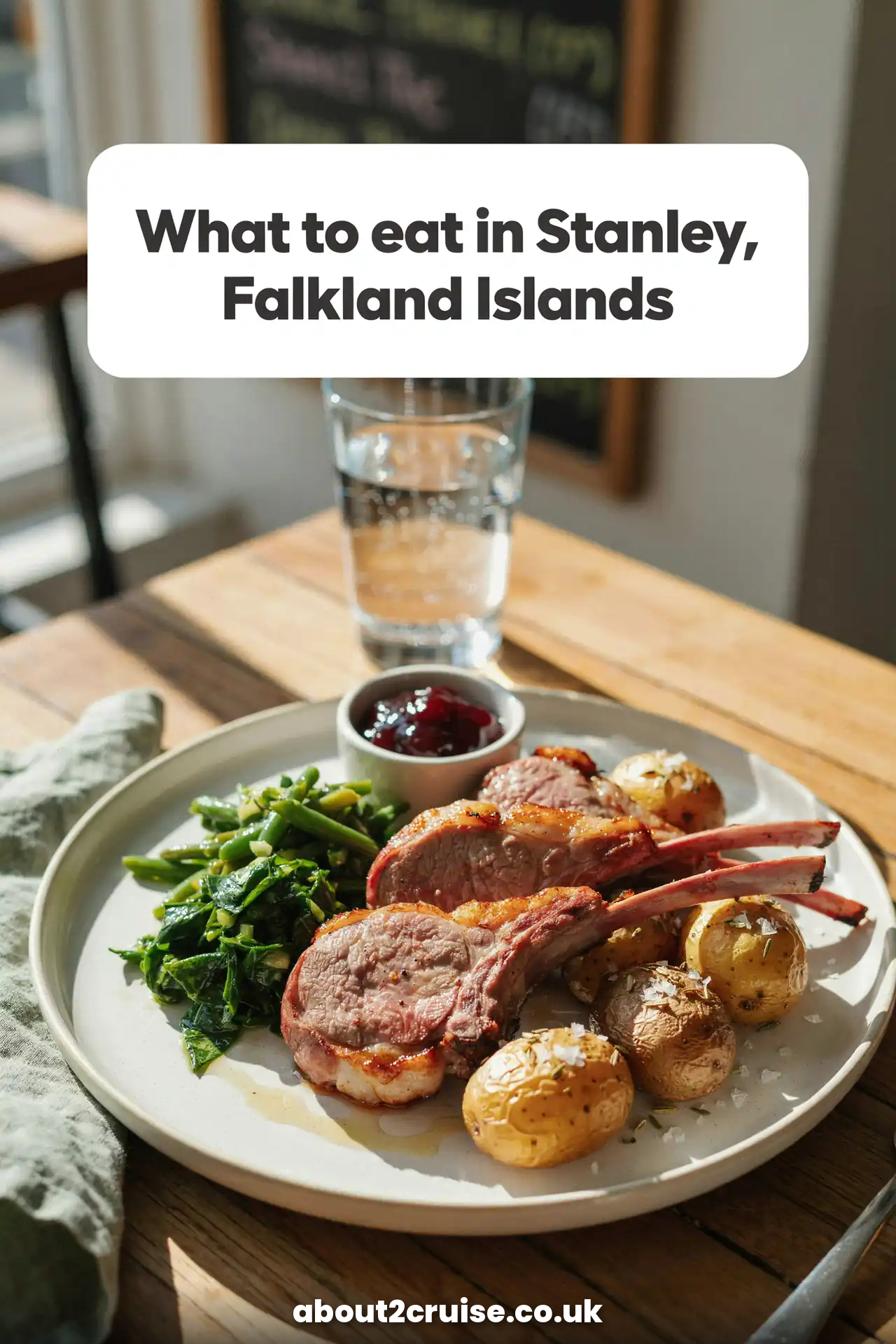
Order Falklands lamb, squid or Patagonian toothfish. Try diddle-dee jam and the mid-morning tea-and-cake ritual called smoko. Most eating places sit on or just off Ross Road along the harbour front. If you want to stay ashore, Stanley has two main hotels, Malvina House and The Waterfront, plus a handful of guesthouses and The Lodges. Both hotels are on Ross Road, near the tender pontoons.
Flying to the Falkland Islands
Yes, you can fly. LATAM operates a weekly Saturday flight from Santiago de Chile via Punta Arenas to Mount Pleasant Airport, returning the same day. Once a month that flight also calls at Rio Gallegos in Argentina. The UK Ministry of Defence runs a fare-paying flight from RAF Brize Norton twice weekly, with a refuelling stop at Ascension Island. Civilian seats are booked through the Falkland Islands Government Office in London.
Mount Pleasant Airport is about 33 miles or 53 km from Stanley, a road journey of roughly 45 to 60 minutes. Buses transfer passengers from the airport to Stanley accommodation. Some expedition itineraries now fly passengers from Santiago straight into the Falklands and begin in Port Stanley.
Expedition Landings Outside Stanley
The outlying islands are the reason expedition cruises exist. Popular landing sites include New Island, Saunders Island, Carcass Island, West Point Island, Sea Lion Island, Bleaker Island and Pebble Island. West Point is privately owned and run as a sheep farm; it was the first Falklands landing for cruise tourists. Saunders combines king, gentoo, rockhopper and Magellanic penguins with black-browed albatross. Sea Lion Island has one small lodge, so visitor numbers stay low and photographers love it.
Access to private land requires permission, and some destinations are only available on a pre-booked tour. There is no single published landing-site list with access conditions, so your ship’s expedition team will decide which sites are open on the day. The Jason Islands, north of the main archipelago, hold more than 210,000 pairs of black-browed albatross but are difficult to reach and rarely visited.
Biosecurity and Wildlife Rules
The Falklands countryside code is strict. Stay at least 6 m from wild animals and colonies. Where avian influenza restrictions are in place, stay at least 10 m from all wildlife and keep out of roped areas. Never feed, touch or block animals’ routes to the sea. Photograph low and slowly, turn the flash off and do not use a selfie stick to get closer.
On some landings you’ll clean boots in a Virkon footbath and check pockets, velcro and bag creases for soil or plant material. Whalebones, skulls and eggs must stay on the island. Access to private land requires permission. Recreational drones are not allowed in Antarctic coastal areas by IAATO members.
Weather, Sea Conditions and Tender Risk
The Falklands are cool, windy and changeable. Stanley averages about 12–13°C by day in January and 5°C by day in July. January is the wettest month, with around 72 mm over roughly 12 rain days. Wind averages about 18 mph all year, mostly from the west. Several seasons can pass in one day, and the sun is strong even when it feels cold.
Sea conditions matter because the islands are exposed. The Drake Passage crossing is about two days each way. From the Falklands to South Georgia, allow two full sea days. Around Stanley, the harbour closes to cruise vessels and tenders when the wind reaches a sustained 30 knots and is rising. All tender operations are suspended when visibility falls below 0.1 nautical mile. A Stanley call is never guaranteed, even if the ship reaches the islands.
Packing for a Falkland Islands Cruise
Pack in layers. Bring a waterproof and windproof jacket and trousers, a warm fleece or jumper, base thermal layers, hat, gloves and a scarf. For Zodiac landings, you need tall rubber boots supplied by many expedition operators, plus waterproof trousers. Cotton next to the skin is a mistake: choose quick-drying synthetic or merino base layers.
Strong walking shoes or boots are essential for anything outside Stanley. Volunteer Point and battlefield hikes are uneven, peaty and sometimes muddy. Bring sunscreen, sunglasses, lip balm and enough prescription medicine for the entire voyage plus delays. A small dry bag protects cameras and spare layers on Zodiac rides.
Photography Gear and Wildlife Photography
Photograph low to the ground, move slowly and quietly, turn the flash off and stay on the outside of colonies. Do not use a selfie stick to get closer. A zoom lens helps with albatross on cliffs and penguins on beaches, but even a phone camera works at Volunteer Point if you move carefully.

Strong photographic spots on a port day include Gypsy Cove for Magellanic penguins, Volunteer Point for king penguins between white sand and a lagoon, and the Stanley waterfront for the cathedral, Whalebone Arch, Lady Elizabeth wreck and war memorials. Sea Lion Island is the best expedition landing for elephant seal beaches and walkable coastline.
Fitness, Mobility and Shore Excursion Difficulty
Expedition cruises are active. You step from a Zodiac into shallow water or onto a rocky beach, walk on uneven ground and ride in small boats in swell. Some landings are wet. If you have limited mobility, ask the operator before booking because wheelchair provision on Zodiac landings is rarely documented.
On a Stanley port day, Volunteer Point is rated challenging and not wheelchair accessible: expect around 0.3 miles of uneven peaty moorland from the parking area to the colony and up to 1.5 miles of walking over sand and grass. The Mt William hike is rated challenging over 3.25 miles of uneven, slippery and steep ground. The sea kayak journey requires some fitness but no previous experience.
Money, Connectivity and Safety
The Falkland Islands pound is at parity with sterling and both circulate freely. Major retailers in Stanley take cards and sterling, but cards are not widely accepted outside Stanley. Carry cash in pounds sterling or US dollars. US dollars and euros are accepted by many shops, restaurants and accommodation providers, but check before buying.
There is only one ATM on the islands, at the petrol station. If it’s down, use Standard Chartered in Stanley or cashback at a grocery shop. Falkland Islands notes can be difficult to exchange back in the UK, so spend them before leaving.
Sure provides 4G in Stanley and Mount Pleasant and patchier coverage elsewhere. A pay-as-you-go SIM costs £30 from retailers in Stanley and at the airport. The Jetty Visitor Centre has Wi-Fi. Crime is low, but unexploded ordnance from 1982 can still be found on battlefields and beaches: do not touch it, mark the area and call 999. You need a permit to photograph Mount Pleasant Airport because it is a military site.
Visas, Permits, Insurance and Medical Evacuation
No visa is needed for the Falklands. Permission to stay one month is granted on arrival, and your passport must be valid for the duration of your stay. If you travel via Chile, you must meet Chile’s entry requirements.
You need comprehensive travel and medical insurance including at least US$2 million of evacuation cover. UK residents get free hospital and medical treatment under a reciprocal healthcare agreement, but medical evacuation is not covered. The minimum cost of a medevac flight to mainland South America is about US$34,000, commercial flights operate only on Saturdays, and aeromedical evacuation can take days to arrange.
If your cruise also calls at South Georgia, every visitor needs a South Georgia visitor permit. It costs £250 per person, must be applied and paid for at least eight days before arrival, includes a £50 late fee if missed, and is valid for 40 days. Expedition operators normally buy permits in bulk for passengers. Cruise passengers arriving by sea also pay a Falklands passenger tax of £50, reduced to £25 when at least US$15 per passenger has been paid for a visit to privately owned land or Camp.
What Falklands Cruise Fares Include and What They Cost
Expedition fares generally include the voyage, landing excursions by Zodiac, expedition guides, meals and often loaned rubber boots. Mainstream cruise fares include the ship, meals and entertainment, but shore excursions such as Volunteer Point cost extra.
As a guide:
- HX’s 22-night In-depth Antarctica, Falklands and South Georgia expedition from Santiago is priced from about £14,329 per person.
- Ponant’s 17–18 night Falklands voyages from Ushuaia start from around €17,220 per person.
- A no-fly P&O Aurora 75-night Southampton round trip including Stanley is priced from about £7,019 per person.
- A Princess Southampton to Santiago sailing via Stanley starts around £3,749 per person.
Add to your budget for the Falklands passenger tax, any South Georgia permit, travel insurance with polar evacuation cover, and optional excursions. Volunteer Point costs roughly US$338 to US$400. Battlefield tours run from about US$175. Sea kayaking costs from £300 per adult.
Falklands, South Georgia and Antarctica Itinerary Options
The classic expedition route sails from Ushuaia, Punta Arenas or Montevideo to the Antarctic Peninsula, often adding the Falklands and South Georgia. HX’s Fram, for example, runs New Island, Saunders Island and Port Stanley, then spends four days in South Georgia before the Antarctic Peninsula across 22 nights.
From the UK, joining a no-fly expedition on P&O or Princess is the simplest route to Antarctica without flying. From Australia, the Ross Sea voyages depart Hobart, Lyttelton or Bluff. Fly-cruise options skip the Drake Passage by chartering from Punta Arenas or Puerto Williams to King George Island. Read our Antarctic Cruise Destinations Guide, South Georgia Island Cruise Guide and Ross Sea Antarctica Cruise Guide for detailed route advice.
Falkland Islands Cruise FAQs
Are the Falkland Islands the same as Shetland?
No. Shetland is a Scottish archipelago of about 100 islands off mainland Scotland. The Falklands are a British Overseas Territory in the South Atlantic, about 400 km off Tierra del Fuego. Some readers confuse the two because both have remote British island communities and cruise ports.
Will my ship definitely make the Stanley call?
Not always. Tenders are suspended when the wind reaches a sustained 30 knots and is rising, or when visibility falls below 0.1 nautical mile. No official cancellation rate is published, but isolated South Atlantic calls can be missed. Build flexibility into your expectations.
Can I book a Volunteer Point tour independently?
Yes, but advance booking is essential. The drive is 80 km each way, mostly off-road, and local 4×4 vehicle capacity is limited. Independent day trips run from about US$398 per person. Cruise lines also sell the tour, often for US$338–350.
Do I need a visa for South Georgia if my cruise calls there?
Yes. Every visitor needs a South Georgia visitor permit. Expedition operators normally arrange it, but it costs £250 per person and must be applied for at least eight days before arrival. Check exactly what your cruise line includes.
Can I use my debit card in Stanley and get cash?
Yes, major retailers take cards and sterling, but there is only one ATM on the islands. Carry some Falkland Islands pounds, sterling or US dollars, especially if you plan to leave Stanley. Cards are not widely accepted outside town.
Is there Wi-Fi or phone signal ashore?
Yes. The Jetty Visitor Centre has Wi-Fi. Sure provides 4G in Stanley and Mount Pleasant, with patchier coverage elsewhere. A pay-as-you-go SIM costs £30 from retailers in Stanley and at the airport.
Can I fly to the Falkland Islands and join a cruise there?
Yes. LATAM flies weekly from Santiago via Punta Arenas, and the UK Ministry of Defence runs flights from RAF Brize Norton. Some expedition itineraries begin in Stanley with passengers flying in from Santiago. If you join there, plan for the airport transfer of about 45–60 minutes.
Last Updated: 18 November 2026