
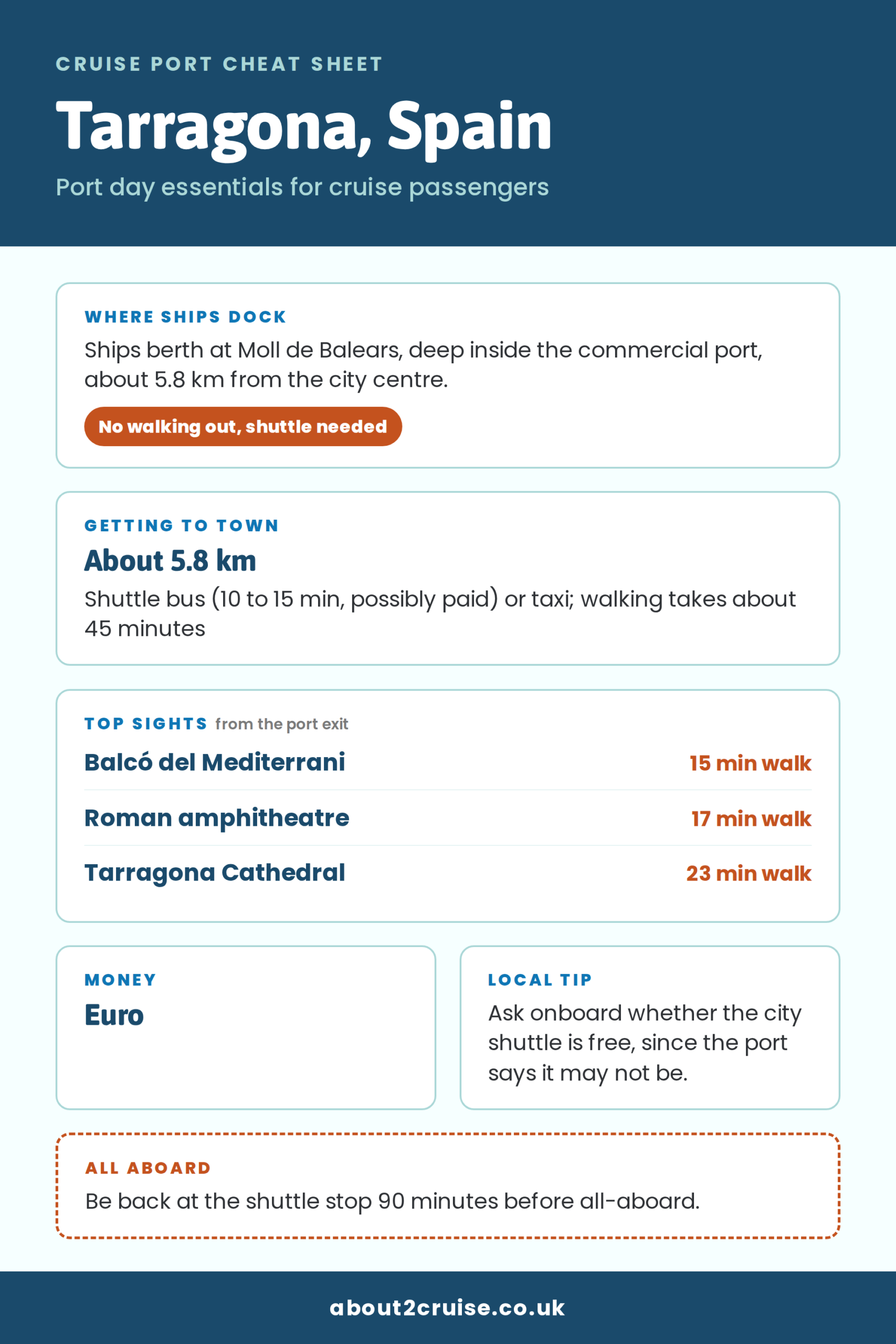
Tarragona cruise ships dock at Moll de Balears, a terminal deep inside the commercial port about 5.8 km from the city centre. A shuttle bus covers that stretch in 10 to 15 minutes, taxis wait outside the terminal, and walking out through the working port isn’t worth the time. With a day ashore, head for the Roman amphitheatre, the circus beneath the old town and the Balcó del Mediterrani above the sea.
Tarragona cruise port: Moll de Balears, three berths and one terminal
Every cruise ship at Tarragona ties up at Moll de Balears, out in the commercial port, and the terminal building stands on the quay itself. One air-conditioned building of 2,200 m², with tourist information, Wi-Fi, a cafeteria, a taxi rank, an ATM and wheelchairs you request through your ship. No stairs anywhere, so it’s step-free from the door.
Three berths serve the terminal: Llevant Breakwater, which takes the largest ships with no length limit, plus Balears Exterior and Balears Interior, where the inner berth caps vessels at 230 m. Which one you get is decided by the ship and the day, and it changes the length of your walk.
When a ship berths at the Llevant breakwater, the Escullera road opens to buses and taxis and the area is policed.
Smaller ships of up to 140 m can berth at Marina Port Tarraco, the marina in front of the Moll de Costa promenade, which puts you much closer to the city end of the port.
Security screening is compulsory for everyone entering the terminal, and only passengers get past it, so say your goodbyes at the port gate rather than at the door. The port operates 24 hours a day, all year.
Tarragona cruise port map
The map shows Tarragona and the places worth seeing. Tap a pin for directions.
- TarragonaTown centre
- Avinguda de Catalunya (shuttle stop)Shuttle stop
- Moll de Costa 7 (meeting point)Meeting point
- Tarragona RENFE stationTrain station
- Balcó del MediterraniClifftop viewpoint
- Platja del MiracleBeach
- El Serrallo fishing quarterFishing quarter
- Central MarketMarket
Tarragona cruise port to city centre: shuttle, taxi or a 45-minute walk
The terminal operator measures it as 5.8 km from the port to the centre of Tarragona, and the awkward stretch is the first one. The terminal sits roughly 4 km inside the port boundary, down a working commercial road with nothing to look at and nowhere to walk but the roadside. Which is why almost nobody walks out.
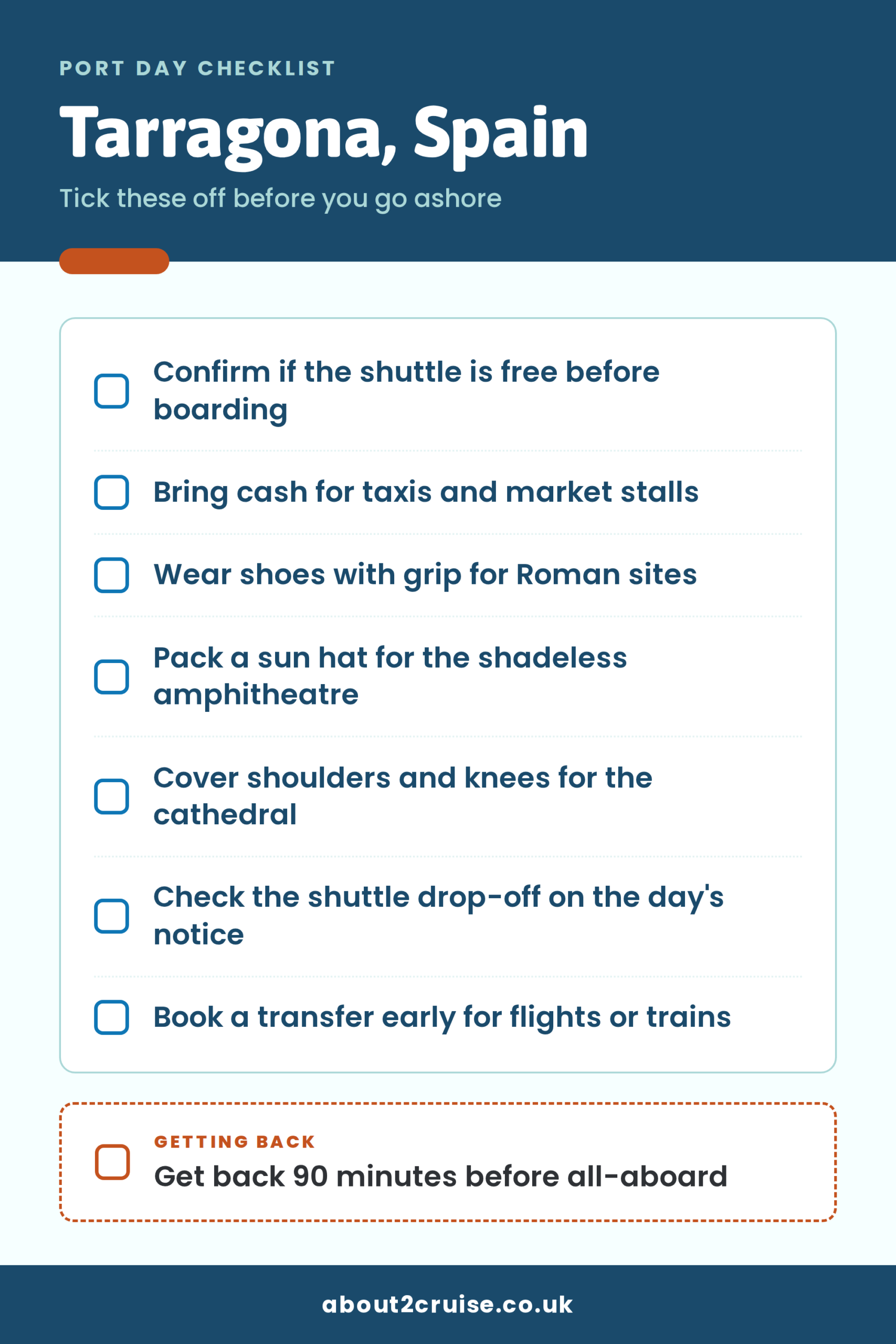
A shuttle bus runs into the city, offered on request from the cruise line with coaches of 55 to 71 seats, and the ride takes 10 to 15 minutes. Don’t assume it’s free: the port describes it as possibly subject to payment, and no price is published, so ask on board before you rely on it.
Where the bus drops you has moved around. Older port plans name Via Augusta, in front of Parc de la Reconciliació, with a second stop on Avinguda Catalunya in front of Camp de Mart when the ship carries more than 3,000 passengers.
The stop now sits at the top of Avinguda de Catalunya, by the Portal del Roser and Camp de Mart. Go by the notice your ship puts out that morning, not by a printout from home.
The city meets you at the other end. Tarragona places tourist informers at the cruise drop-offs and hands out a printed list of ten essential visits in six languages. Expect a queue at the busiest moments: a big ship can put up to 15 coaches on the road at once, with only two or three at each drop-off at any one time.
Taxis wait at the terminal, but they thin out at peak periods and waits happen. If a fixed time matters, for a flight or a booked tour, arrange a transfer before you sail. No city bus serves the terminal itself; the nearest stop is more than 4 km away, in the city.
If you do walk, allow about 45 minutes from the terminal to the centre along the harbour promenade. Once you’re past the port gate, the Balcó del Mediterrani is about 15 minutes on foot, the Roman amphitheatre and the old town about 17, the cathedral about 23 and Platja del Miracle about 19.
Inside the city, walking works for one planned route rather than aimless wandering. The old town is built in terraces above the harbour, so climb once and come down gradually. A public lift near the station saves the steep 10-minute walk up into the upper town, and it’s charged.

Tarragona cruise port meeting point: Moll de Costa 7, not the terminal
The meeting point is at Moll de Costa 7, on the city side of the port, and it isn’t the cruise terminal at Moll de Balears. Arriving by private car, you get sent here and shuttled to the ship during boarding hours.
If you’re sailing with MSC and arriving by taxi, you can go straight to the terminal with your documents out at the entrance control; with other lines, check this with your cruise line first.
Private cars can’t drive onto the quay. Long-stay parking is at the Port Tarraco public car park, and you take the transfer bus from the meeting area. Two car parks sit near the meeting point itself.
Keep the two shuttles apart in your head. The city shuttle is for sightseeing; the meeting-point shuttle moves embarking passengers and their bags to the ship.
Sailing with a line other than MSC? Confirm with the line which one applies to you.
Roman Tarragona in a port day: amphitheatre, circus and cathedral
The city’s Roman remains are a UNESCO World Heritage site, and they sit close together in the old town above the harbour. The standard independent route runs amphitheatre, circus and Praetorium, old town, cathedral, then the Balcó del Mediterrani, and the MHT combined ticket is worth buying at the first Roman site you reach.
Timing matters more than tactics. Be back at the shuttle stop 90 minutes before all-aboard, and leave the Part Alta an hour before that.
The Roman amphitheatre, 17 minutes from the port exit
The amphitheatre sits on the slope between the old town and the sea, and it’s the sight most passengers come for. There’s almost no shade, so go early if the day allows, and accept that conservation work can close parts of the site without much warning.
The Roman circus and Praetorium under the modern streets
The circus and Praetorium are vaulted passages running beneath the modern city, reached by stairs and dim in places. That’s a harder visit underfoot than a museum, with narrow passages and uneven floors, so shoes with grip beat sandals.
Tarragona Cathedral at the top of the old town
The cathedral is about 23 minutes on foot from the port exit, at the highest point of the old town, and its hours shift with the season. Services take precedence over visitors, so build in some slack, and dress respectfully: shoulders and knees covered is the safe rule.
Balcó del Mediterrani, free and open at the end of Rambla Nova
The Balcó del Mediterrani is the city’s clifftop viewpoint at the end of Rambla Nova, about 15 minutes from the port exit, free and always open, looking over the coast and Platja del Miracle below. On a short call it’s the easiest thing to do well.
Staying in Tarragona or going to Barcelona for the day
Barcelona is about an hour up the coast, and some passengers treat a Tarragona call as a way to reach it. For a few hours ashore that doesn’t work: you’d spend a large slice of the call on the road.
The Port of Tarragona’s own passenger surveys back staying put, with 95.1% saying their call met or exceeded expectations and the city visit rated 8.9 out of 10. The region beyond the city adds the Poblet monastery, the Ebro Delta biosphere reserve and PortAventura.
If you’re sailing from Barcelona rather than calling there, sort out the terminal early, because the ships are spread across a long waterfront and the layout of Barcelona’s seven cruise terminals decides how long your transfer takes.
Spain’s Mediterranean coast holds plenty of other calls, and if Valencia is on your itinerary the Valencia cruise port guide covers how that port works, while the Mediterranean cruise ports in Spain guide does the same for the rest.
If a night or two in Barcelona is part of the plan, there are strong day trips from Barcelona that fill a spare day before or after the sailing. And if your dates are still open, the Western Mediterranean cruise ports hub sets the region’s calls out side by side.
Money in Tarragona: currency, cards and cash
Tarragona uses the euro. Cards are widely accepted in shops and restaurants, and contactless works for most purchases, but carry some cash for taxis, market stalls and tips.
There’s an ATM in the terminal, though it’s not always reliable, so withdraw more in town if you’re not sure. Taxis are metered, but don’t assume you can pay by card, so keep cash for the fare and the small port departure charge added on top. Use a bank or an official exchange office, not a street money changer. There’s no sign dollars are accepted anywhere, so stick to euros.
Is Tarragona safe for cruise passengers?
Tarragona is a safe, easy port for cruise passengers. The main risk is pickpockets, not anything more serious.
Local police run a plain-clothes operation against pickpocket gangs who come in for the cruise season. They work the Rambla Nova, the Balcó del Mediterrani, the amphitheatre lift and the train and bus stations. They’ll distract you or stage a stain on your clothes, so keep bags closed and valuables out of sight in crowds. Police officers will only ask to see ID, never your wallet. Only use licensed taxis. No part of the city is flagged as an area to avoid.
Where to eat near Tarragona cruise port
The best eating near Tarragona cruise port is in the old town and the El Serrallo fishing quarter, both a short walk from where the shuttle drops you, with the Central Market in between for grazing. The city’s own cruise leaflet points passengers at the market, El Serrallo and the Balcó del Mediterrani among its ten essential visits.
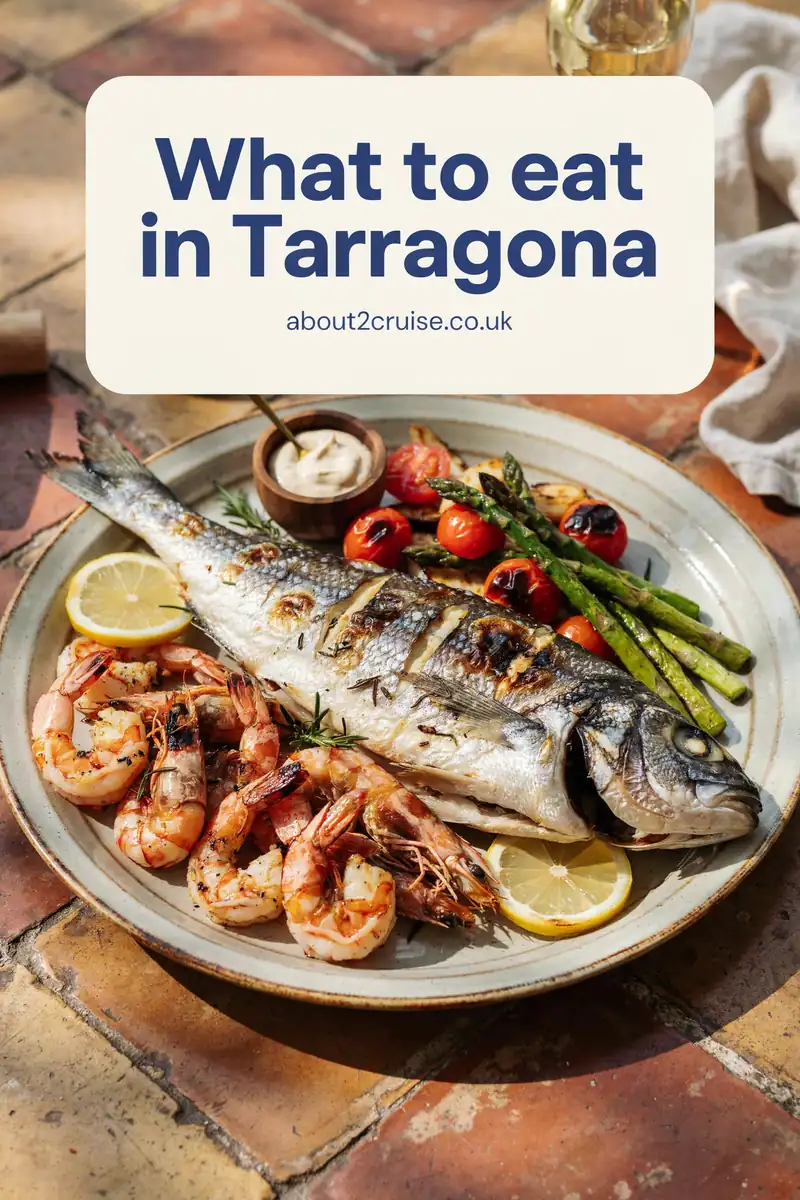
- Fish and seafood in El Serrallo. The fishing quarter below the old town is where the day’s catch sets the menu; walk down towards the harbour and look for a full room.
- Market food at the Central Market. Tarragona’s market is the place to put together a light lunch from what the stalls are selling rather than sit down to a set menu.
- Wines from DO Priorat and DO Montsant. The port promotes the region on its wines, and these two denominations are the names to look for on a wine list.
- Cava. Catalan sparkling wine turns up everywhere in the city, including the restaurant strip along the Moll de Costa waterfront by Marina Port Tarraco.
Weather in Tarragona for a cruise port day
Ships call between April and November. For most of that season you’ll get warm, dry days, though September and October are noticeably wetter and muggier than midsummer.
July and August are the hottest months, with daytime highs in the high 20s and little rain. September and October get the most rain of the season. Autumn can also bring sudden, heavy downpours, called a DANA locally, so check the forecast nearer your call rather than packing for one date now. Humidity builds through summer and peaks in August. That matters on the climb up to the old town. Wind is rarely a problem.
What to wear in Tarragona: outfit ideas for a port day
Wear for a city built on slopes. The upper town is terraced with sustained gradients, and the route to the beach involves a steep pedestrian bridge, so one climb and a gradual descent beats going up and down all day.


For the cathedral and other religious buildings, cover shoulders and knees. For the Roman sites, wear shoes with grip: ancient surfaces, gravel, steps and dim passages are what you get, and a few blister plasters in the day bag earn their place after a morning on the terraces.
Sun cover is not optional at the amphitheatre, which has almost no shade, and a refillable bottle matters more than a spare layer. For more inspiration, see these casual cruise outfit ideas for women and cruise outfit ideas for men.
Best photo spots in Tarragona
The best photo spots in Tarragona are all within a walk of the shuttle drop-off: the Balcó del Mediterrani for the coast, the amphitheatre for Roman stone above the sea, Platja del Miracle for the beach, and the El Serrallo quarter with the Central Market for everyday city life.
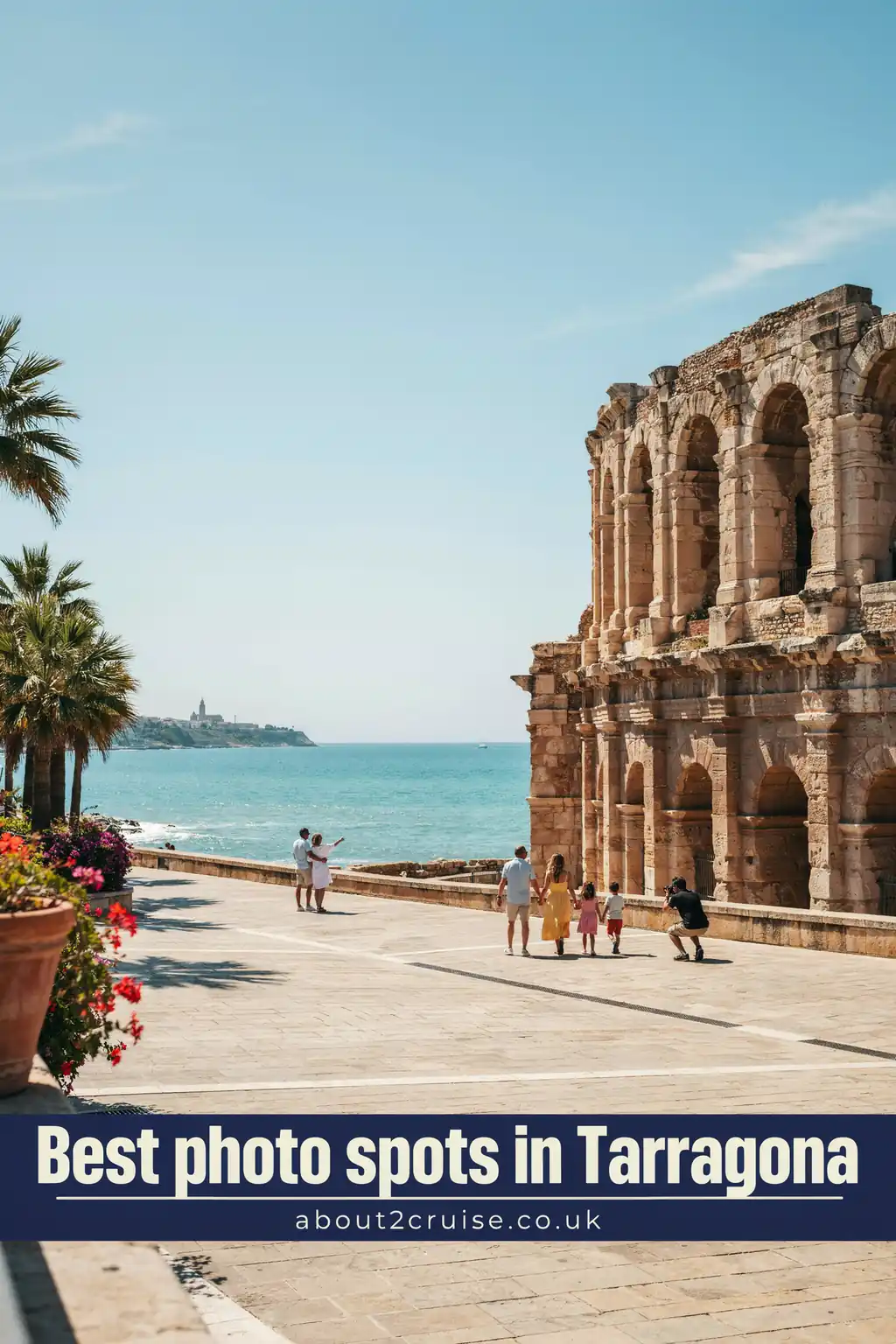
- Balcó del Mediterrani. A clifftop platform at the end of Rambla Nova looking down the coast and over Platja del Miracle, free and open whenever you get there.
- The Roman amphitheatre. Terraced above the sea; go early for cleaner light and less heat.
- Platja del Miracle. The city beach, about 19 minutes from the port exit, good for a frame that puts sand and city in the same shot.
- El Serrallo and the Central Market. Colour, produce and harbour life, and a reminder you’re in a working city rather than a resort.
Getting to Tarragona cruise port by train, coach and plane
Tarragona’s urban RENFE station is a 7 to 12-minute walk from the Moll de Costa welcome area. Either way it’s a walk with bags, not a taxi ride. The bus station is about 19 minutes on foot from the same point.
High-speed trains don’t stop at the city station. They use Camp de Tarragona, about 10 km outside the city and 25 minutes from the port by road, so a high-speed ticket means planning the taxi leg as well.
Reus Airport is 18 km away, about 15 minutes by road, and a taxi straight to the terminal is the simplest option. Barcelona Airport is 94 km and roughly 55 minutes; from there, take the high-speed train to Camp de Tarragona and a taxi, or a regular train into Tarragona city.
There’s no airport shuttle from the terminal. The only shuttles are the city service and the meeting-point transfer, so if a flight or a timed train matters, book a private transfer before you travel.
Parking at Tarragona cruise port
You arrange parking at Tarragona through your cruise booking rather than turning up and hoping, and the port lists two car parks near the meeting point at Moll de Costa 7.
Marina Port Tarraco is the closest car park to the terminal, with 24-hour surveillance, video monitoring and EV charging, and it’s the pricier of the two. Parking La Pedrera is the cheaper choice, open 24/7, taking card, cash or app payment through Via-T or Telpark, with accessible spaces, and about a 10-minute walk from the cruise port.
No cruise long-stay tariff is published for either, so check the current rate when you book. An hourly marina rate isn’t what a week costs.
If someone is driving you to the ship, they can’t drive onto the quay. Private cars park long-stay at the Port Tarraco public car park and passengers take the transfer bus from the meeting area.
Luggage storage at Tarragona cruise port
The terminal keeps no bags. Lost property goes through terminal staff and your cruise line, and there’s no left-luggage desk inside the building, which matters if you’re off the ship early with a late flight or arriving the night before a sailing.
At Tarragona’s city station, plan on there being nothing. A left-luggage office gets listed among the station’s facilities, but you won’t find an office or on-site lockers you can count on. Assume nothing and you won’t be caught out.
The dependable option is third-party bag storage sold from shops near the station, including a point at Carrer d’Orosi 8 a few minutes from the platforms, and you can find a place to leave your bags in Tarragona before you travel.
And check which station you’re heading for: high-speed, Euromed and Trenhotel trains use Camp de Tarragona, 10 km out, not the city station.
How to spend a port day in Tarragona
A port day in Tarragona works best spent in the city itself: the Roman sites and the Balcó del Mediterrani fill the hours without the long detour to Barcelona.
Before you sail
- Check with your cruise line about shuttle cost and timing, since none is published.
- Book a private transfer ahead if a flight or train depends on timing.
- Plan to buy the MHT combined ticket at your first Roman site visited.
Short port day: under 6 hours
- On dockingShuttle bus or taxi into townCheck if freeThe terminal is deep in the port, so take the cruise shuttle or a taxi from the rank outside; ask onboard if the shuttle costs anything.
- +20 minBalcó del MediterraniA short walk from the city shuttle drop-off to this clifftop viewpoint over the coast and Platja del Miracle.
- +50 minRoman amphitheatreWalk down toward the sea to the amphitheatre; there's almost no shade, so keep water handy.
- +1 hr 30 minLunch in the old townTry seafoodHead into El Serrallo for fresh seafood, or build a light lunch from the stalls at the Central Market.
- +2 hr 15 minRoman circus and PraetoriumExplore the vaulted passages beneath the modern streets; stairs and dim light call for grippy shoes.
- +3 hrTarragona CathedralCover shouldersAt the top of the old town; services take priority over visits, so allow some slack in your timing.
- All-aboard minus 90 minBack at the shuttle stopCoaches queue at busy times, so leave margin; a taxi is the backup if the shuttle is full.
The time on the map is the whole walk, every stop added together.
Open this walking route in Google Maps
If plans change: If the amphitheatre is partly closed for conservation work, spend extra time at the Balcó del Mediterrani or the Central Market instead.
Long port day: 8 hours or more
- On dockingShuttle bus into the cityCheck if freeAsk onboard whether the city shuttle is free, since the port says it may be chargeable; a taxi waits outside too.
- +20 minBalcó del MediterraniFrom the drop-off, walk to this clifftop viewpoint over the coast and Platja del Miracle.
- +1 hrAmphitheatre and Roman circusGrippy shoesSee the amphitheatre above the sea, then the vaulted circus and Praetorium beneath the streets nearby.
- +2 hr 15 minLunch in El SerralloTry seafoodWalk down to the fishing quarter for the day's catch, a short stroll from the old town.
- +3 hr 30 minTarragona CathedralCover shouldersClimb to the top of the old town; check opening times, since services can close it to visitors.
- +5 hr 30 minPlatja del Miracle and Central MarketWalk down to the beach, then loop back past the Central Market before heading for the shuttle.
- All-aboard minus 90 minBack at the shuttle stopCoaches queue at busy times; if two leave without you, take a taxi back to the terminal.
The time on the map is the whole walk, every stop added together.
Open this walking route in Google Maps
If plans change: If the cathedral or Roman sites are closed for works, swap in more time at the Balcó del Mediterrani, Platja del Miracle or the Central Market.
Tarragona cruise port FAQs
Where do cruise ships dock in Tarragona?
Cruise ships dock at Moll de Balears, the cruise terminal inside Tarragona’s commercial port, about 5.8 km from the city centre. Ships berth at Llevant Breakwater, Balears Exterior or Balears Interior, and vessels up to 140 m can use Marina Port Tarraco by the Moll de Costa promenade.
Do any cruise lines start and finish at Tarragona?
Yes. MSC uses Tarragona as a base port with weekly Friday turnaround calls through the season, and the port handles around 80 calls a season from about 40 different ships, AIDA Cruises among them.
Is Uber available in Tarragona?
Uber and Bolt both operate in the city but are thinner on the ground than taxis, so agree the fare or check the meter. The terminal has a taxi rank, and availability tightens at peak times.
What is the address of Tarragona cruise terminal?
Moll de Balears s/n, Port de Tarragona. Satnav will get you to the port, but private cars can’t drive onto the quay, so carry on to the meeting point at Moll de Costa 7 instead.
Last Updated: 13 November 2026