
Miyakojima is an Okinawan cruise call where the draw is the water, not the port. Ships dock at Hirara Port, about 1.2km from Hirara town and a short taxi ride from Yonaha Maehama, Sunayama Beach and Irabu Ohashi. There are no trains and too few taxis for busy ship days, so pre-book transport or join an excursion. Aim to be back 90 minutes before all-aboard.


What Miyakojima Is Known For (And Why Cruisers Get Off the Ship)
Miyakojima is part of Okinawa Prefecture, roughly 300 km south-west of Okinawa’s main island and 130 km east-north-east of Ishigaki. The main island covers 204.6 km², is flat coral limestone, and most of its 55,000 residents live around Hirara, where the cruise port sits. Pronounce it Mee-yah-koh-jee-mah, or simply Miyako.
The island sells itself on Miyako Blue, that exceptionally clear blue water. The main reasons cruisers get off the ship:
- Yonaha Maehama: a 7km arc of white sand, shallow and calm, often ranked among Japan’s best beaches.
- Sunayama Beach: a small cove you reach over a sand dune, with a natural rock arch that’s the island’s signature photo.
- Irabu Ohashi: the 3,540m toll-free bridge to Irabu Island, the longest toll-free bridge in Japan.
- Sea turtles: Aragusuku/Shinjo Beach on the east coast has guided turtle-snorkelling with very high encounter rates.
- Higashi-Hennazaki: a 2km cape at the island’s east tip, a national Place of Scenic Beauty.
- Food: Miyako soba, Miyako mango, yukishio snow salt, and sata andagi doughnuts.
One naming trap: Miyako also belongs to Miyako City and Miyako Port in Iwate Prefecture, north-east Japan. This page is about the Okinawan island. Mykonos in Greece is something else entirely.
Where Your Ship Actually Docks in Miyakojima
Cruise ships dock at Hirara Port Cruise Berth on the seaward side of the north breakwater in Hirara’s Urasoe district. Port address: 2-43 Hirara Nishinakasone, Miyakojima City, Okinawa 906-0006. Port position: 24°48’N, 125°16’E. Port enquiries: Port and Harbor Division, City of Miyakojima, +81 980-72-4876.
On a cruise day, two places matter: the berth where your ship ties up, and the Hirara Marine Terminal at 108-11 Hirara Shimozato, about 1 km away. The terminal is used as the passenger/overflow facility on ship days. From the passenger terminal, the walkable town centre of Hirara is about 15 minutes away, the public market about 20 minutes, and Painagama Beach about 15 minutes.
Walking on port roads themselves is not allowed. A free berth-to-terminal shuttle moves everyone between the ship and the passenger area inside the port.
Miyakojima cruise port map
The map shows Miyakojima and the places worth seeing. Tap a pin for directions.
- MiyakojimaTown centre
- Miyako ShrineShinto shrine
- Painagama BeachBeach
- Sunayama BeachBeach
- Yonaha MaehamaSwimming beach
- Irabu OhashiBridge
- Aragusuku BeachSnorkelling beach
- Yukishio MuseumSalt museum
Hirara Port Facilities, Tenders, and the Shuttle Reality
The dedicated cruise berth can take ships up to 220,000 GT. It has 420m of total mooring length, a 240m quay wall with six mooring dolphins, and 10.5–12m of water. The terminal next to it includes a 1,500 m² immigration/customs/quarantine building and a 300 m² tourist-information building.
On ship days you’ll find toilets, immigration, customs, a tourist desk, and a taxi pool of roughly 15–20 cars. There’s no ATM, exchange, shop, or vending machine inside the terminal. Wi-Fi at the cruise berth isn’t reliably available; the national terminal inventory lists it as “to be prepared.” The separate Hirara Marine Terminal, open 09:00–22:00, has free Wi-Fi, toilets, a bus terminal, taxi rank, ferry desk for Tarama, and 123 parking spaces.
Tender vs alongside: Most large Asian ships and most current calls berth alongside at the dedicated cruise berth, but some cruise-line pages still say the ship anchors offshore and tenders. Your ship’s daily programme is the only thing that settles it for your call. If plans change, there’s no official English notice from the city or port, so watch the daily sheet and announcements.
Shuttle reality: The only shuttle that’s not optional is the free port shuttle between the berth and passenger terminal inside the port. Some ships may run a shuttle into town, but don’t count on it. There’s also a paid cruise-day shopping loop from the terminal to Don Quijote, San-A Miyako City, and AEON Town, with roughly 20 departures per call at a flat ¥500 adult / ¥250 child. Taxis at the terminal can be scarce, one large call reported no waiting taxis and a cancelled shopping shuttle, so plan around pre-booked transport or a walkable backup.
Return buffer: Aim to be inside the terminal gate 60 minutes before departure on a big-ship day, and back at the ship 90 minutes early if you can. From beaches or Irabu, allow at least 90 minutes; from Hirara town, allow 45.
How to Get Around Miyakojima Without Getting Stranded
There are no trains. Your options are taxi, bus, rental car, e-bike, or tour.
- Taxi: Flagfall ¥500 for the first 1,136m, then ¥100 every 463m, with a 20% surcharge between 22:00 and 05:00. Rough fares from Hirara town: Sunayama ¥1,200–1,500, Yonaha Maehama ¥2,000–2,500. But the island only has about 15 taxi companies and roughly 190 vehicles total. Uber Taxi and DiDi operate. Pre-book the return leg when you arrive, not when you want to leave.
- Charter taxi: About ¥12,000–16,000 for a four-hour loop, or ¥3,000–4,000 an hour. This is the most reliable way to see Yonaha Maehama, Irabu Bridge, and a food stop without worrying about scarce cabs.
- Bus: The Maehama line to Yonaha Maehama costs ¥550 one way and takes 25–30 minutes, but only runs every 50–60 minutes. Workable if you’re patient and check the return time carefully.
- Rental car: Compact from ¥6,000/day, 8-seat wagon from ¥9,000. You need a 1949-version international driving permit plus your UK licence. Several firms offer berth pickup or a shuttle every 30 minutes; a few deliver the car to a lot one minute from the port for about ¥2,000 extra.
- E-bike/bicycle: ¥2,000–3,000 a day. Fine for Hirara town and Sunayama, but Yonaha Maehama is about 8km each way and it’s hot. Think carefully before committing on a short call.
If you arrive without a pre-booked ride, do the walkable town loop: Miyako Shrine, the market, Nishizato-dori for Miyako soba, and Painagama Beach. If you want the top beach, book the ship excursion or a charter before you sail. The city’s own reception review flags taxi shortage and inability to handle electronic money as known problems.
Miyakojima Beaches: Yonaha Maehama, Sunayama, Turtles, and the Walkable One
Miyako Blue is the deep, clear water brand. It reads strongest from about 10:00–14:00 in overhead sun with little wind; after heavy rain or on windy days the water turns milky.
Yonaha Maehama: The Best Swimming Beach on Miyakojima
About 20–25 minutes by car/taxi from Hirara Port. A 7km white sand beach with shallow, calm water. Free entry, free parking for about 30 cars, cold showers, and seasonal jellyfish nets. It’s a swimming and lounging beach, not a snorkelling beach. There’s almost no natural shade; bring an umbrella or rent a parasol. Swimming season is April–October. Allow one to 1.5 hours for a look, or two to three if you swim. Best choice for families and the classic Miyako Blue photo.
Sunayama Beach: The Photo Arch (Not a Full Swim)
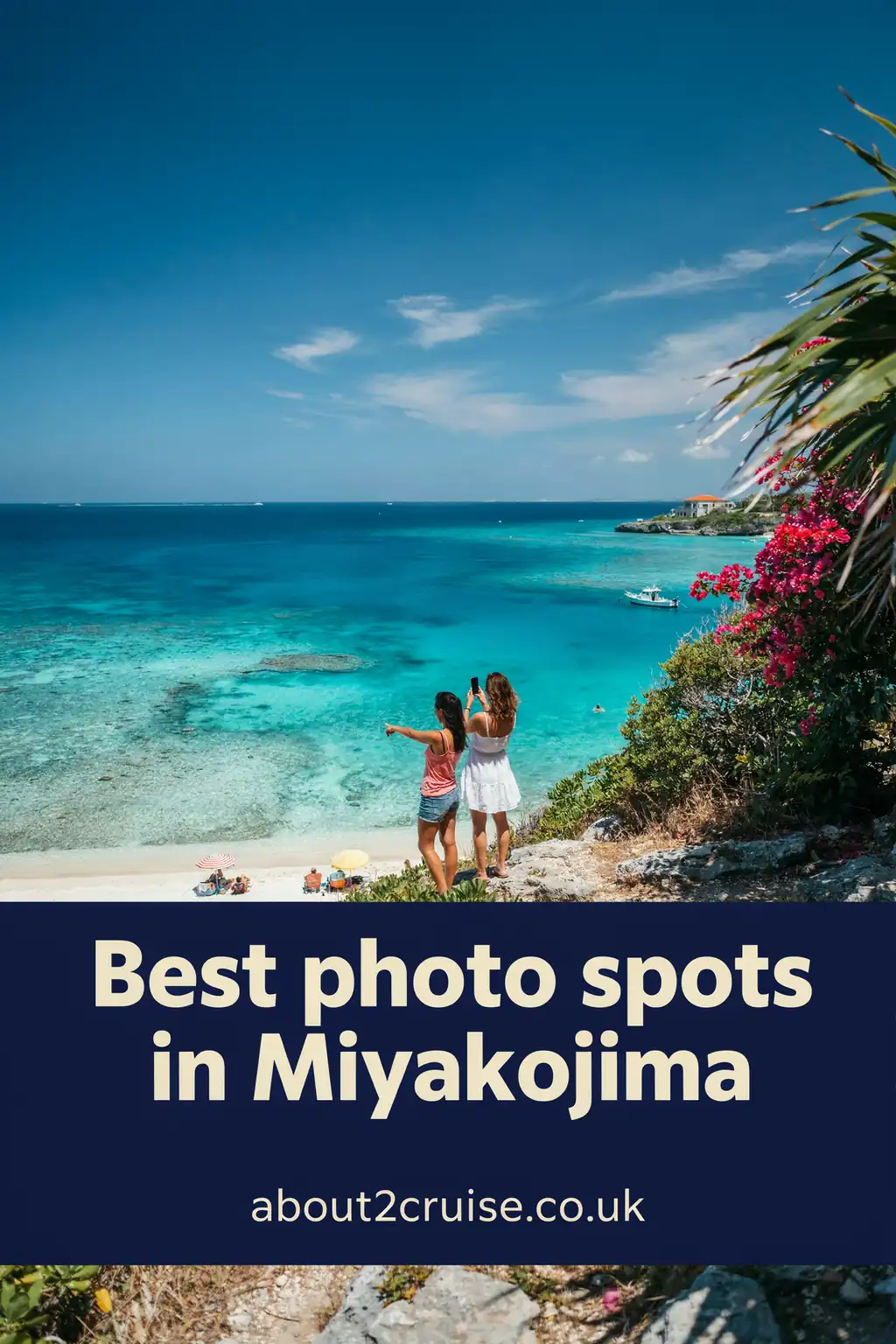
Only 10–15 minutes from Hirara Port. You reach the beach by climbing over a steep dune, wear trainers, not sandals. The natural rock arch is the island’s signature shot. Free parking, toilets, and paid showers, but no shops or restaurants. It’s not an official swimming beach: no lifeguards, no nets, rip currents, and reef close offshore. Some people wade and snorkel, but treat it as a photo stop and a quick paddle. Best light 10:00–14:00 for the blue, early morning to avoid crowds, sunset for shooting through the arch. Don’t stand under the arch; there’s a rockfall hazard and protective net.
Aragusuku / Shinjo Beach: The Turtle Snorkelling Stop
About 25–30 minutes by car from Hirara. This is the island’s turtle-snorkelling hotspot, with operators advertising 99% encounter rates. Free parking for about 30 cars plus a paid car park at ¥2,000/day. Showers ¥100, changing rooms and toilets free. Turtles feed in the shallows on the left as you face the sea. Turtle season runs April–October, best mid-morning. Guided sessions run about 1.5 hours and start around ¥6,000 per person. Book before the cruise; walk-up spots are not guaranteed on a ship day.
Painagama Beach: The Quick Paddle Near the Port
The closest beach to the port and Hirara town, about 15 minutes’ walk from the terminal. Paid showers, toilets, and changing rooms, free access, but no lifeguards and the water offshore is a shipping channel. Good for a quick paddle or sunset, not a full beach day.
Beach safety: Most Miyako beaches have no lifeguards. Box jellyfish season is roughly May–October on beaches without nets; use netted beaches where possible. Coral and shell fragments make water shoes worthwhile. Use reef-safe sunscreen. In winter sea temperatures drop to 20–23°C; you can swim, but a wetsuit helps.
Beyond the Beaches: Irabu Bridge, Higashi-Hennazaki, and Other Photo Stops
Irabu Ohashi: 15–20 minutes from the port, 3,540m, toll-free, and the longest toll-free bridge in Japan. You cannot stop on the bridge; use the free viewpoint car park on the far side. Bridge-only is about 30 minutes; bridge plus Irabu Island 2–3 hours. It can be very windy. You can walk or cycle it, but there’s no dedicated footpath.
Higashi-Hennazaki: About 30–35 minutes from the port. A 2km cape at the island’s east tip, a national Place of Scenic Beauty. Cape entry free, free parking, toilets, and vending machines. From the car park it’s 500–800m on a paved path to the lighthouse, 10–15 minutes each way. The lighthouse costs ¥300 for junior-high age and up, has 97 steps, opens 09:30–12:00 and 13:00–16:30, to 17:00 on weekends and holidays, and closes in bad weather. Budget 30–40 minutes without the lighthouse, about an hour if you climb it. Very strong wind at the tip: wear trainers and bring water.
Other stops: Miyako Shrine above the port (free, open 24 hours), the Miyakojima City Public Market, Yukishio Museum with salt soft-serve, and 17END/Toriike on Shimoji Island if you already have wheels. Photo spots: Sunayama arch, Yonaha Maehama from the waterline, the Irabu viewpoint from morning to noon, and 17END’s white sandbar at low tide.
What to Eat in Miyakojima: Soba, Mango, Snow Salt, and Sata Andagi
The island’s food identity is Miyako soba, Miyako mango, yukishio snow salt, and sata andagi. Miyako soba is flat noodles in a light bonito broth, with pork belly and fish cake hidden under the noodles rather than on top, ¥600–900 a bowl. The best eating and shopping cluster is Nishizato-dori and Shimozato-dori in Hirara, 15–20 minutes’ walk from the terminal. The public market is the island’s kitchen: fish, island tofu, brown sugar, awamori, and a few eateries. Be warned: several market stalls don’t open until around midday, so a 10:00 arrival may find only an ice-cream counter trading. For one-stop souvenir shopping, Shima no Eki Miyako at 870-1 Hirara Kugai is open 07:30–18:00 with mango, yukishio, bread, and a food court. The Yukishio Museum sells salt soft-serve and shows the salt-making process.

Sample Port Day Plans: No Taxi, Half Day, or Full Day
Before you sail
- Book a charter taxi or rental car ahead; the island has only about 190 taxis.
- Book any turtle-snorkel tour before the cruise; walk-up spots are not guaranteed.
- Buy an eSIM before sailing; the cruise berth has no reliable Wi-Fi.
Short port day: under 6 hours
- On dockingTake the free port shuttleNo walking outWalking on port roads is not allowed; the free shuttle takes everyone from the berth to the passenger terminal.
- +15 minTaxi to Sunayama BeachPre-bookIt is 10 to 15 minutes by taxi or charter from the passenger terminal. Book the return leg when you arrive.
- +1 hrSunayama arch and paddleReach the cove over the steep dune. Treat it as a photo stop and shallow paddle, not a full swim; do not stand under the arch.
- +2 hrsIrabu Ohashi viewpointDrive to the free viewpoint car park on the Irabu side; you cannot stop on the bridge. Expect strong wind.
- +2 hrs 45 minLunch on Nishizato-doriTry Miyako sobaReturn to Hirara and order Miyako soba, the island's flat noodles in bonito broth with pork belly.
- +3 hrs 15 minMiyakojima City Public MarketIt is in Hirara, about 20 minutes on foot from the terminal; several stalls do not open until around midday.
- All-aboard minus 1 hrBack at the terminal gateWalk or shuttle back to the berth; aim to be at the gate 60 minutes before departure.
This map shows the taxi ride from the ship. The time is the drive only, not your time ashore.
Open the taxi route in Google Maps
If plans change: If taxis are scarce or the charter falls through, do the walkable town loop: Miyako Shrine, Miyako soba, the public market and Painagama Beach.
Long port day: 8 hours or more
- On dockingTake the free port shuttleNo walking outWalking on port roads is not allowed; the free shuttle moves everyone from the berth to the passenger terminal.
- +15 minTaxi to Yonaha MaehamaPre-bookIt is 20 to 25 minutes by taxi or charter from the passenger terminal. Confirm the full-day charter before leaving.
- +45 minYonaha Maehama swimTwo hours of swimming and Miyako Blue photos. It is the best family beach, with shallow, calm water and seasonal jellyfish nets.
- +2 hrs 45 minIrabu Ohashi viewpointDrive to the free viewpoint car park on the far side. You cannot stop on the bridge; expect strong wind.
- +3 hrs 45 minLunch on Nishizato-doriTry Miyako sobaReturn to Hirara for Miyako soba, flat noodles in a light bonito broth with pork belly, around Nishizato and Shimozato streets.
- +5 hrs 30 minHigashi-Hennazaki capeIt is 30 to 35 minutes by taxi from Hirara. Walk the paved path to the white lighthouse; allow about an hour if you climb the 97 steps.
- All-aboard minus 90 minBack at the terminal gateReturn to the berth by shuttle. Aim to be inside the terminal gate 60 minutes before departure and at the ship 90 minutes early.
This map shows the taxi ride from the ship. The time is the drive only, not your time ashore.
Open the taxi route in Google Maps
If plans change: If the charter cannot be confirmed or the cape feels too tight, keep the day to Yonaha Maehama, the Irabu viewpoint and lunch in Hirara.
No-Wheels Town Loop (2–4 Hours)
Walk or take the port shuttle to the terminal, then walk to Miyako Shrine for the harbour view, down to the public market and Nishizato-dori for Miyako soba, then a quick paddle or shade stop at Painagama Beach. Realistic if you don’t want to rely on taxis.
Chill Half-Day with Wheels (4–5 Hours Ashore)
Taxi or charter straight to Sunayama Beach for the arch and a paddle, 45–60 minutes, then a photo stop at the Irabu Ohashi viewpoint, then back to Hirara for Miyako soba and the market. Return to the ship with the 60-minute gate buffer.
Full Port Day (6–8 Hours Ashore)
Start early at Yonaha Maehama for two hours of swimming and Miyako Blue photos. Drive the Irabu Bridge viewpoint and maybe a quick 17END stop. Lunch of Miyako soba in Hirara, then if time is still good and you have a charter, add Higashi-Hennazaki before returning. This plan works best with a pre-booked charter taxi or rental car because the island’s taxi supply is tight.
For a turtle-snorkelling day, make that the only big activity: book a 1.5-hour guided session at Aragusuku in the morning, then eat in Hirara and keep the afternoon loose.
Weather, Sea Conditions, and Safety in Miyakojima
Miyakojima is subtropical. Summer daily highs are around 30–32°C and humid; winter is mild at 20–22°C highs in January and February. Rain is heavy year-round, about 2,076mm a year, with August and September the wettest. Rainy season runs mid-May to late June; typhoon season runs June to December, peaking July to September. Sea temperatures hit 28–30°C in summer and 20–23°C in winter, so swimming is possible year-round with a wetsuit in the cool months. The harbour’s known operational problem is wind: winter north-east winds have caused ships to wait offshore or skip the call.
Safety notes: Carry your passport at all times in Japan. The UK Foreign Office has no advice against travel to Okinawa, but normal precautions apply and heat stroke is the main summer risk. Tattoos can bar entry to some pools, hot springs, beaches, and gyms; establishments may ask you to cover them. Emergency numbers: police 110, ambulance and fire 119. The Japan Visitor Hotline is +81 50-3816-2787, open 24/7 in English, Chinese, and Korean.
What to wear: shoes for the Sunayama dune, water shoes for coral and shell fragments, and a hat, rash guard, and SPF50+ for the beach. No church or shrine dress code applies at Miyako Shrine.
Money, Internet, and Language at the Cruise Port
Currency is the Japanese yen. Cards are widely accepted in shops and restaurants, but small shops and taxis may be yen-only. Visa, Mastercard, and JCB are most accepted. There is no ATM at the cruise terminal; the nearest reliable route is the Hirara Nishizato post office, about 15 minutes’ walk. Seven Bank ATMs in 7-Elevens and Japan Post ATMs take foreign cards. The Marine Terminal has free Wi-Fi 09:00–22:00, but the cruise berth itself is listed as Wi-Fi “to be prepared”; buy an eSIM before sailing. Tipping is not practised. The tourist desk at the terminal runs in English and Chinese, but English is not widespread in town shops. The city’s reception review notes that some shops and taxis cannot handle electronic money, carry small yen notes.
Which Cruise Ships Stop in Miyakojima?
Miyakojima is a port of call, not an embarkation port. Current and upcoming callers include MSC Bellissima, known as 榮耀號 in Chinese-language searches, on Keelung/Naha loops, StarCruises/StarDream Star Navigator, Norwegian Spirit on longer Japan/Taiwan itineraries, and Regent Seven Seas and Seabourn ships on luxury Japan seasons. The port has welcomed ships up to 220,000 GT, and it consistently ranks among Japan’s top five or six cruise ports by calls.
Hirara had about 52 calls and 134,750 passengers in one recent 12-month period, with 127 calls booked the next. National figures put average passenger spend ashore at around ¥22,000 per port call, and each extra hour in port adds about ¥900. If you’re comparing calls, Miyakojima is a small-island beach day, totally different from big-city Japan ports. For the wider picture, see our Japan Cruise Ports Guide. For city logistics, see Tokyo (Yokohama) Cruise Ship Port and Port of Nagoya.
Naming check: Miyako, Iwate is a different port. Mykonos is in Greece. This page is Okinawa’s Miyakojima.
Getting to Miyakojima by Air or Ferry (If You’re Not on a Cruise)
If you’re flying in before or after a cruise, Miyako Airport (MMY) is about 10 minutes by car from the port. JAL/JTA and ANA fly from Tokyo Haneda (about 3 hours), Osaka (about 2.5 hours), Nagoya Chubu, and Naha (45–50 minutes). The second airport, Shimojishima (SHI), is 25–30 minutes from the port, with Skymark from Haneda, Kobe, Fukuoka, and Naha and Jetstar from Narita. The airport bus to Hirara town costs ¥240 and takes 15–17 minutes, about once an hour. There’s one scheduled ferry: Hirara to Tarama, about 2 hours, departing 09:00, no Sunday sailing, ¥2,510 adult one way. There is no scheduled ferry between Miyako and Ishigaki, use air. No long-stay cruise car park exists at the berth; if you stay pre/post cruise, base in Hirara town.
Where to Stay in Miyakojima Before or After a Cruise
Passengers who fly in usually stay in Hirara because the market, restaurants, bus hub, and Painagama Beach are walkable. Two harbour-facing choices stand out. Hotel Locus, 338-40 Hirara Shimozato, faces Hirara harbour, every room has a harbour view, 2–6 minutes’ walk to Painagama, breakfast about ¥2,200 from 08:00, no shuttle, airport 10–12 minutes. Hotel Art Avenue, 7 Hirara Nishizato, is on the town side facing the port area, breakfast included 07:00–09:30, free parking, 24 rooms. Both sit inside the Nishizato/Shimozato restaurant and shopping grid.
Miyakojima Cruise Port FAQs (Honest Answers)
Is Miyako Island worth visiting on a cruise?
If you want a blue-water beach, a photo arch, and an easy island lunch, yes. If you’re after big-city sightseeing or reliable public transport, it can be frustrating. The top beach is 20–25 minutes away, but taxi supply is limited.
Can I walk from Hirara Port to town or a beach?
From the passenger terminal, yes: about 15 minutes to Hirara centre and Painagama Beach, 20 to the market. From the actual berth, walking on port roads isn’t allowed; use the free port shuttle to the terminal first.
Do cruise ships have free shuttles into town?
Not always. The free shuttle only covers the port area. Some ships run a town shuttle depending on the call, and there’s a paid shopping-centre loop at ¥500. Check on board; don’t assume one exists.
How do I know if my ship docks or tenders?
The daily programme is the final word. Most current cruises berth alongside at the dedicated cruise berth, but some cruise-line websites still say tender. Check the ship’s printed/screen schedule on the morning of the call.
Is there an ATM or currency exchange at the terminal?
No ATM and no exchange at the cruise terminal. The Hirara Nishizato post office is about 15 minutes’ walk. Bring yen, especially for small food stalls and taxis.
Are there luggage lockers at the cruise terminal?
No left luggage at the terminal. The nearest coin lockers are at Miyako Airport, about 10–15 minutes by car. Pack light; this is a walk-off port day.
Is Sunayama Beach safe for swimming?
Not officially. It has no lifeguards, no jellyfish nets, and rip currents. Treat it as a photo stop and shallow paddle, not a full swim. For swimming, choose Yonaha Maehama or use Painagama for a quick dip depending on conditions.
Do I need a passport or visa for Japan?
Your cruise line will handle shore clearance, but you must carry your passport with you when ashore in Japan. Police can ask to see it. Check Japan entry rules for your nationality before sailing.
What’s the difference between Miyako Island and Mykonos?
Miyakojima is a Japanese island in Okinawa Prefecture. Mykonos is a Greek island. They sound similar in English searches but are completely separate destinations. Also note that Miyako City in Iwate, north-east Japan, has its own cruise port, don’t confuse the two.
Is Miyakojima accessible for wheelchair users or limited mobility?
The town is level and the island flat, but the port berth is separate from the terminal by shuttle, Sunayama ends over a dune, and the lighthouse is 97 steps. The terminal has toilets but no full accessibility statement; ask your ship before going ashore.