
When your itinerary says Tokyo, it almost always means Yokohama. Most ships dock at Osanbashi Pier or Daikoku Pier, both about half an hour by train from central Tokyo, and only a smaller number use the Tokyo International Cruise Terminal or the Harumi Passenger Ship Terminal in Tokyo itself. Which one you get varies by sailing, so check your cruise documents early rather than assuming.
Where do cruise ships dock in Tokyo and Yokohama?
Ask what’s in port at Yokohama on any given day and the answer is nearly always one of two piers. Osanbashi Pier, the main international terminal, takes most calls, while Daikoku Pier Cruise Terminal further south handles the biggest ships. Book a Royal Caribbean sailing into Yokohama and there’s a good chance you’ll end up at Daikoku, which was built for mega-ships too tall to clear the Yokohama Bay Bridge. Celebrity Millennium usually docks at Osanbashi too, though it’s used Daikoku on some sailings, so even a ship with a regular pattern can still catch you out.
A real mix up between Osanbashi and Daikoku
One Celebrity Cruises passenger had cruise documents pointing to check in at Osanbashi, while the Yokohama Port Authority’s own schedule had the ship docking at Daikoku Pier, about 1.5 miles away. It’s the kind of mix up that gets reported on cruise forums for good reason, since the two terminals need entirely different transport plans. The fix is simple enough: check your cruise line’s live port notice, or the Yokohama Port Authority schedule, again a day or two before arrival. Don’t just trust the paperwork you got at booking.
As a loose pattern rather than a promise, Holland America’s Westerdam and Noordam have called at Osanbashi, Diamond Princess typically does the same, and Norwegian Cruise Line (NCL) ships such as Norwegian Spirit and Norwegian Sun have used Osanbashi, Daikoku and Shinko on different sailings. Even Celebrity Cruises’ own port information lists both Osanbashi and Daikoku as possible berths for a Tokyo (Yokohama) call, which tells you how much this can move around. Treat all of it as background reading, and confirm with your cruise line close to departure.
Yokohama cruise terminal: Osanbashi, Daikoku and Shinko
Three terminals share cruise duty across Yokohama. Here’s a map of the area, so you can see how the main piers sit relative to each other.
| Terminal | Area | Known for |
|---|---|---|
| Osanbashi Pier | Naka Ward, central Yokohama | Yokohama’s main international terminal, a 400 metre pier with public walkways and gardens, used by most lines by default |
| Daikoku Pier Cruise Terminal | Tsurumi Ward, south of Osanbashi | Purpose built for the biggest ships, since the Yokohama Bay Bridge’s clearance blocks mega-ships from reaching Osanbashi |
| Shinko Pier | Minato Mirai waterfront | A five storey terminal building shared with 25 shops and the InterContinental Yokohama Pier8 hotel, used for smaller or overflow sailings such as NCL’s Norwegian Spirit and Norwegian Sun |
Daikoku Pier cruise terminal: what to expect
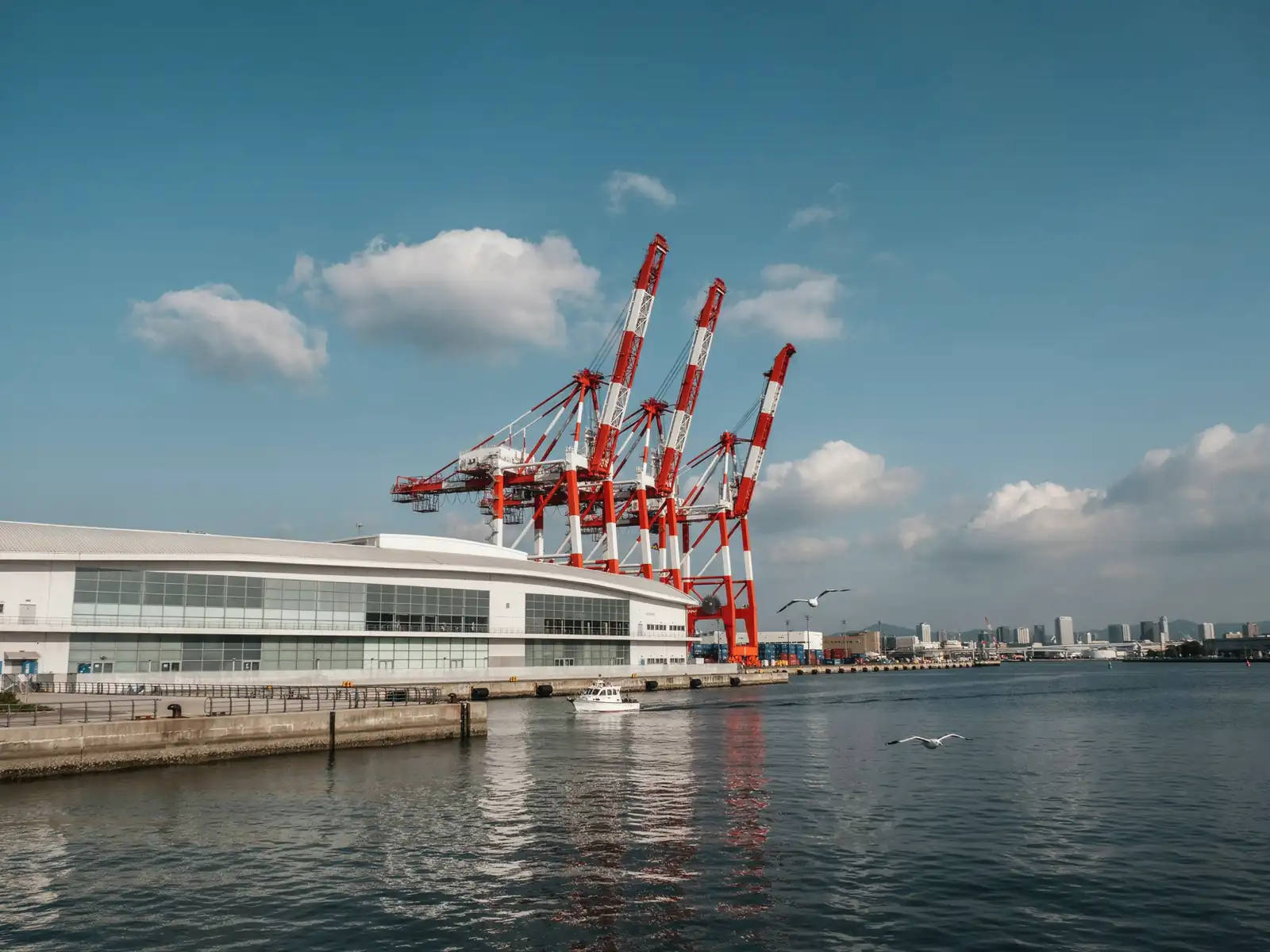
Daikoku Pier Cruise Terminal exists because the Yokohama Bay Bridge simply won’t let some ships through. Its air draft, the clearance height above the water, is 55 metres, and anything taller has to dock here instead. The terminal sits south of Osanbashi in Tsurumi Ward, about 25 minutes by car from Tokyo International Airport (better known as Haneda), and can take ships up to around 220,000 gross tonnage (GT), a measure of a ship’s enclosed volume rather than its weight.
- The terminal building covers around 5,000 square metres and shares the site with converted cargo warehouses, a reminder this was a freight pier long before anyone thought to put passengers on it.
- No train station sits right at the pier itself. The nearest is Motomachi-Chukagai on the Minatomirai Line, about 15 minutes away by car.
- Local buses, route 107 or 109 bound for Skywalk-mae, run from Yokohama Station, but most passengers find a taxi less hassle for a one-off transfer.
- Covered walkways are limited, and passengers have reported getting properly drenched boarding or leaving the ship in wet weather, so keep a packable rain jacket in your daybag rather than buried in your suitcase.
Tokyo cruise port: Harumi and the Tokyo International Cruise Terminal
A Royal Caribbean call to Tokyo proper is rarer than one to Yokohama, but when a ship does dock in central Tokyo, it uses one of two terminals depending on size.
The Tokyo International Cruise Terminal sits in Odaiba, built to give the biggest ships a berth close to the city centre. The Tokyo Port Terminal Corporation runs it on behalf of the Tokyo Metropolitan Government, and the roof terrace gives you skyline views in every direction, though you can’t eat or drink up there. The nearest station is Tokyo International Cruise Terminal Station on the Yurikamome Line, about 8 minutes on foot, or Tokyo Teleport Station on the Rinkai Line, about 15 minutes on foot or 10 minutes by bus.
The Harumi Passenger Ship Terminal, in Chuo City, has taken international cruise ships since the early 1990s, but it sits inland of the Rainbow Bridge, which has a 52 metre clearance, so it’s limited to smaller and mid sized vessels up to around 20,000 GT. It’s recently reopened after a multi year rebuild, with the expedition ship Coral Geographer marking the restart, and the larger ships that used to call here now default to the Tokyo International Cruise Terminal instead.
| Feature | Yokohama | Tokyo |
|---|---|---|
| Ship size | Any size, including the largest ships afloat, via Daikoku Pier | Limited at Harumi by the Rainbow Bridge; larger ships use the Tokyo International Cruise Terminal instead |
| Walkable sights | Osanbashi opens straight onto Yamashita Park and Chinatown | Harumi sits near Toyosu Market and Tsukiji; Odaiba has its own waterfront attractions |
| Airport access | Daikoku is about 25 minutes from Haneda Airport by car | The Tokyo International Cruise Terminal is close to Haneda Airport and linked by the Yurikamome Line |
Yokohama cruise port at a glance
The Port of Yokohama has been Tokyo’s maritime gateway since the mid-19th century, growing over the decades into a major centre for raw silk exports and imported technology. It sits up to 11 nautical miles closer to open water than Tokyo’s own port, which saves ships time and fuel, and hands you more hours ashore as a result.
Yokohama is consistently one of Japan’s busiest cruise ports. It recorded 147 cruise ship calls in the most recent full year of data, putting it fourth nationally behind Hakata, Naha and Nagasaki, according to Nippon.com, citing Japan’s Ministry of Land, Infrastructure, Transport and Tourism. The year before that, Yokohama topped the national list outright, with 171 calls, more than any other Japanese port that year, according to the same source (Nippon.com).
| Key fact | Detail |
|---|---|
| Terminals | Three: Osanbashi, Daikoku and Shinko |
| Main terminal | Osanbashi Pier, a 400 metre pier with public walkways between Minato Mirai and Yamashita Park |
| Oldest pier | Osanbashi, built in the late 19th century |
| Capacity | Osanbashi can berth up to seven cruise liners at once |
How to get from Tokyo to Yokohama cruise terminal
There’s no single direct route, since Tokyo and Yokohama’s cruise terminals don’t sit on the same line, but the connections are straightforward enough once you know them.
- From Shibuya Station, hop on the Tokyu Toyoko Line towards Yokohama, about 25 minutes, then continue onto the Minatomirai Line to Nihon-Odori Station, roughly 7 minutes on foot from Osanbashi.
- From Shinjuku Station, the JR Shonan-Shinjuku Line (Rapid service) gets you to Yokohama Station in around 30 minutes across five stops.
- Arriving by Shinkansen, get off at Shin-Yokohama and change to the JR Yokohama Line, about 15 minutes, or the Yokohama Municipal Subway Blue Line, about 10 minutes, to reach Yokohama Station itself.
- From Yokohama Station, a taxi to Osanbashi or Daikoku costs roughly what you’d pay for a modest meal out, fine for a small group splitting the fare, but confirm which terminal before you set off. They’re several miles apart, and that’s not a mistake you want to make with luggage.
- Flying into Narita International Airport, usually just called Narita, the Narita Express runs straight to Yokohama Station in around 90 minutes, then it’s a short hop on the Minatomirai Line to Nihon-Odori Station.
- There’s no direct train linking the Tokyo International Cruise Terminal with Yokohama. You’ll change at Shimbashi, and the whole thing takes about 51 minutes door to door, so build in extra time if your day involves both.
What’s in port: sightseeing near each terminal
With only a few hours ashore, where your ship docks shapes the whole day more than anything else on this page.
- Osanbashi: step off the ship and you’re straight into Yokohama’s bustle, with Yamashita Park and Chinatown both a short walk from the terminal.
- Tokyo International Cruise Terminal: Odaiba’s skyline, waterfront parks, the Unicorn Gundam statue and a giant Ferris wheel all sit within easy reach on foot or a short bus ride.
- Harumi: Toyosu Market, known for fresh seafood and sushi, sits close by, with Tsukiji and Tsukishima’s monjayaki restaurants both about a 10 minute drive away.
- Daikoku: there’s not much to see around the terminal itself, so plan on heading straight into central Yokohama rather than exploring on foot here.
A reliable pair of walking shoes earns its keep on a day like this, especially if you’re covering Chinatown, Yamashita Park and Minato Mirai in the same few hours.
Multiple ships in port, and a few other practical notes
Osanbashi can berth up to seven cruise liners at once, so a busy day won’t necessarily bump your ship to another terminal. It will, though, mean the pier, Chinatown and Yamashita Park all feel a lot busier with several large ships in together.
Tokyo (Yokohama) often turns up as one stop in a longer Japan itinerary. Our wider Japan cruise ports guide covers the other calls you might see on the same sailing, from Osaka (Kobe) cruise ship port further down the coast to smaller southern stops like the Port of Miyakojima.
Common Questions
Is Yokohama in Tokyo?
No. Yokohama is its own city, about 30 minutes south of central Tokyo by train. Cruise itineraries list the call as Tokyo (Yokohama) simply because most ships dock there rather than in Tokyo proper.
Does Tokyo have its own cruise port?
Yes, it has two. The Tokyo International Cruise Terminal in Odaiba takes the largest ships, and the smaller Harumi Passenger Ship Terminal in central Tokyo handles mid sized and smaller vessels.
Which terminal will my ship use, Osanbashi or Daikoku?
It comes down to ship size and cruise line. Mega-ships too tall for the Yokohama Bay Bridge use Daikoku, while most other ships default to Osanbashi. Confirm with your cruise line close to departure, since it can change.
Is Haneda or Narita Airport closer to the cruise terminals?
Haneda. It’s closer to both Yokohama and Tokyo’s cruise terminals, roughly 20 to 30 minutes away by car or shuttle. Narita is further out and best reached on the Narita Express.
Can I walk into town from the cruise terminal?
From Osanbashi, yes. Chinatown and Yamashita Park are both a short walk away. From Daikoku, no, you’ll need a bus or taxi to reach central Yokohama.
How long does it take to get from central Tokyo to the Yokohama cruise terminal?
Around 25 to 30 minutes by train from Shibuya or Shinjuku to Yokohama Station, then a further walk, bus or taxi to the terminal itself.
Why do some ships dock in Yokohama instead of central Tokyo?
Yokohama sits closer to open water, which saves time and fuel, and Daikoku Pier can take ships too large for the bridges guarding central Tokyo’s waterways.
What’s the quickest way between Tokyo’s cruise terminal and Yokohama?
There’s no direct train. The fastest route changes at Shimbashi and takes about 51 minutes, so allow a full morning if your day needs both.
Why Trust About2Cruise
This guide draws on official port authority information, cruise line port data and verified passenger reports, to explain how Tokyo and Yokohama’s terminals work for someone with just a few hours ashore. We haven’t sailed into either port ourselves, so every detail here has been checked against primary sources rather than assumption. Find out more about how we research and fact check our cruise guides.
Last Updated: 19 October 2026