
Cádiz is one of the easiest cruise calls in Spain. Your ship ties up inside or directly beside the old town, no tenders are used, and the cathedral, market, tapas bars and Torre Tavira are all walkable. This guide covers berths, walking routes, tickets, day trips, food, money and turnaround logistics.
Where You’ll Dock in Cádiz
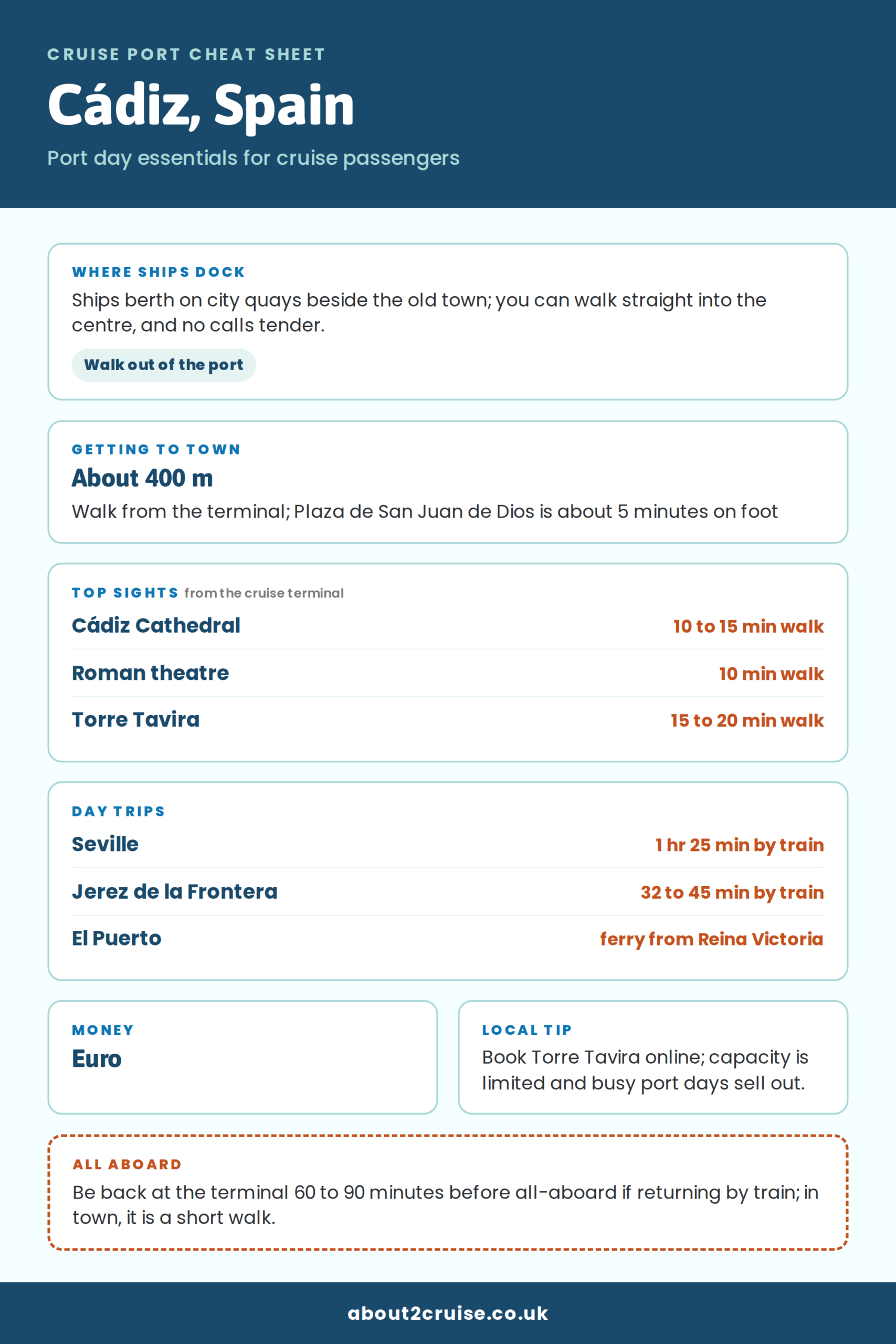
Cádiz doesn’t use a remote industrial terminal. The cruise berths sit right on the edge of the historic centre, so you’re effectively docked in town.
The main cruise passenger terminal is on the Alfonso XIII quay. A second, smaller terminal at the Ciudad quay opens towards Paseo de Canalejas and Plaza de San Juan de Dios.
The larger Alfonso XIII terminal has an open-plan hall, check-in and disembarkation areas, luggage storage, tourist information desks with free city maps, free Wi-Fi, and souvenir and delicatessen shops. Outside you’ll find a taxi rank and coach parking.
On busy days, ships can be split across the Alfonso XIII, Ciudad, Reina Sofía, Reina Victoria and Marqués de Comillas quays. Reina Victoria is also the preferred berth for the small river ship Belle de Cadix, so don’t confuse that with your ocean-cruise quay. Ships in the published Cádiz schedule berth alongside; tendering isn’t part of a normal call.
How to confirm your exact berth: The public port schedule usually lists ships, dates and times, but not the assigned berth. Your cruise line’s daily programme or the port staff at the terminal will tell you which quay you’re on and which pedestrian exit to use. On days with three or more ships, the port spreads arrivals across different quays, so the walk into town may be a few minutes shorter or longer depending on where you end up.
Cádiz cruise port map
Ships dock at Alfonso XIII cruise terminal. From the cruise terminal, Alameda Apodaca is about a 9-minute walk, Plaza de San Juan de Dios about 10 minutes and Torre Tavira about 13 minutes. Tap a pin for directions.
- Alfonso XIII cruise terminalWhere ships dock
- Alameda ApodacaPromenade · About 9 min walk from the cruise terminal
- Plaza de San Juan de DiosMain square · About 10 min walk from the cruise terminal
- Torre TaviraViewpoint tower · About 13 min walk from the cruise terminal
- Cádiz CathedralCathedral · About 14 min walk from the cruise terminal
- Roman theatreAncient theatre · About 14 min walk from the cruise terminal
- Castillo de Santa CatalinaCastle · About 27 min walk from the cruise terminal
- La Caleta beachBeach · About 28 min walk from the cruise terminal
- Mercado Central de AbastosFood market · About 21 km from the cruise terminal
How to Walk from the Ship into the Old Town
You don’t need a ship shuttle in Cádiz. The old town is flat, compact and mostly paved or stone underfoot. The port says the city centre is about five minutes from the passenger terminal. The most useful target is Plaza de San Juan de Dios, the main square by the town hall, which you can reach in about 5–8 minutes on foot.
Useful walking times from the terminal:
- Plaza de San Juan de Dios: 5 minutes
- Cádiz Cathedral: 10–15 minutes
- Roman theatre: 10 minutes
- Torre Tavira: 15–20 minutes
- Castillo de Santa Catalina: 20–25 minutes
- La Caleta beach: 20–25 minutes direct, or up to 35 if you take the sea-wall route
- Cádiz train and bus station: about 15 minutes
The walking route from the Alfonso XIII terminal is straightforward: exit onto Avenida del Puerto and head towards the old town. If you’re at the Ciudad quay terminal, the exit opens more directly towards Paseo de Canalejas and Plaza de San Juan de Dios. There’s a hop-on hop-off bus stop about 50 m from the cruise terminal exit on Avenida del Puerto if you’d prefer an orientation loop before walking.
Getting Around Cádiz
For most cruise passengers, walking is enough. If you want less pavement time, the hop-on hop-off bus is the easiest alternative. Its first stop is on Avenida del Puerto, about 50 m from the cruise terminal exit. The loop takes about 75 minutes, with buses roughly every 30 minutes. Tickets are usually valid for two days, which matters most if you’re on a round-trip from Cádiz or staying overnight.
Taxis wait immediately outside the terminal. Cádiz taxis are metered, and a short hop within the old town should only cost a few euros. The train and bus station is about 900 m from the terminal, so with luggage on a turnaround day a taxi or a 15-minute walk are both realistic.
The old town is mostly flat, but the towers, viewpoints and some castle ramparts involve stairs. If you have limited mobility, aim for the cathedral, Plaza de San Juan de Dios, the market and the Alameda Apodaca promenade rather than Torre Tavira or the upper fortifications.
What to Do on a Cádiz Port Day
Cádiz rewards a slow, unscripted walk. The historic centre is small but dense, and the best port day is a loop from the cruise berth through the old town to La Caleta and back along Campo del Sur.
Before you sail
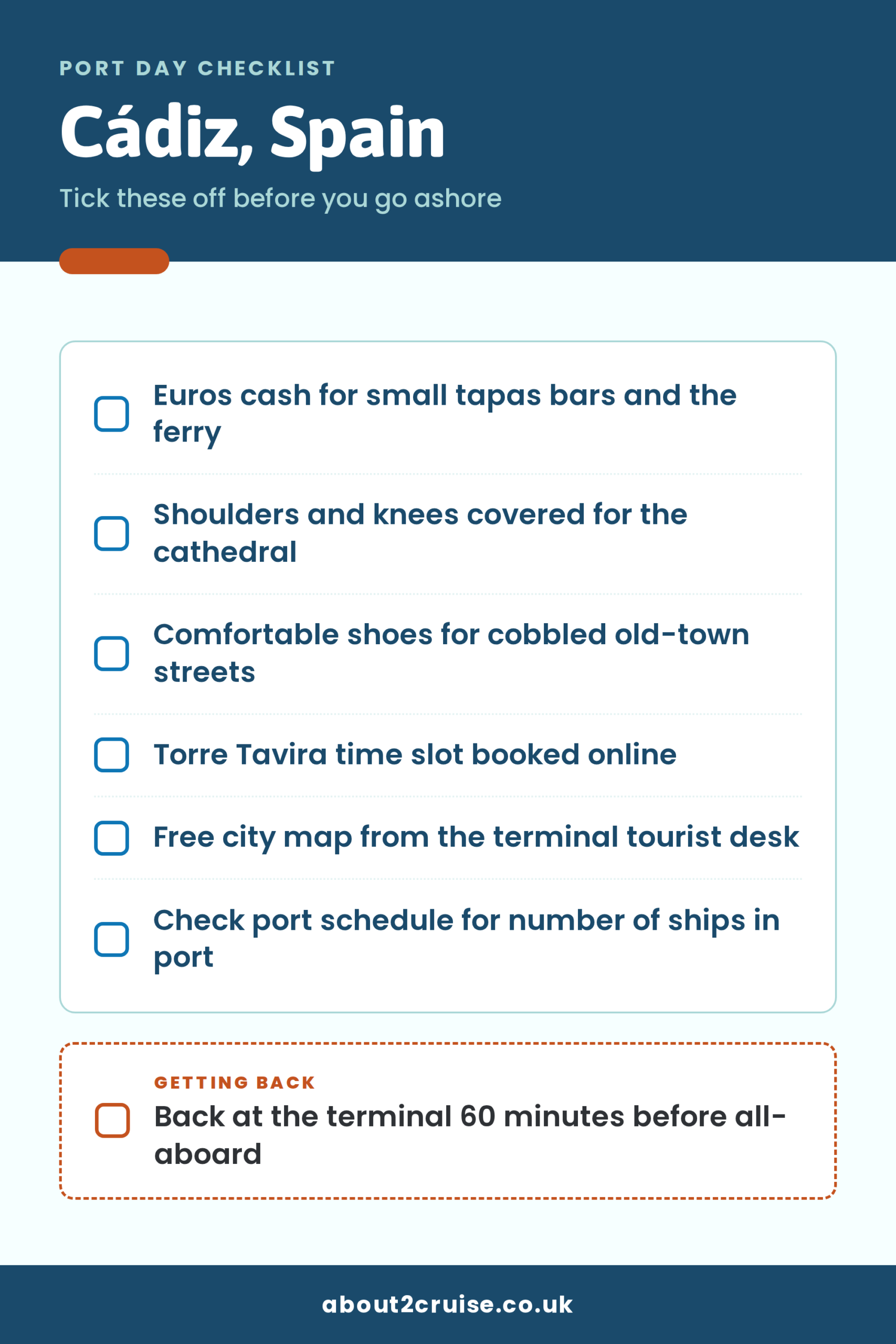
- Book Torre Tavira online; capacity is limited and slots sell out.
- Check Renfe train times for Seville and Jerez before the cruise.
- Check the Port Authority of Cádiz schedule to see how many ships are in that day.
Short port day: under 6 hours
- On dockingWalk to Plaza de San Juan de DiosExit the terminal onto Avenida del Puerto and walk about five minutes to the main square by the town hall.
- +15 minCádiz CathedralA 10 to 15 minute walk from the terminal. The ticket includes the Clock Tower and museum; cover shoulders and knees.
- +45 minRoman theatreA few minutes from the cathedral, free, with entrance at Calle Mesón 11 to 13. Last entry 15 minutes before closing.
- +1 hr 30 minLunch at Mercado CentralTry pescaíto fritoThe market has more than 100 stalls and a gastronomic corner. Order fried fish, tortillitas de camarones or cazón en adobo.
- +2 hrs 45 minLa Caleta and Campo del SurWalk through La Viña to the beach framed by two castles, then return along Campo del Sur for the cathedral view.
- All-aboard minus 1 hrWalk back to the shipIt is about 20 to 25 minutes back to the terminal from La Caleta. Leave time for a last look at the bay.
The time on the map is the whole walk, every stop added together.
Open this walking route in Google Maps
If plans change: If the cathedral queue is long, buy the same ticket at San Felipe Neri or Santa Cueva and return later.
Long port day: 8 hours or more
- On dockingWalk to Plaza de San Juan de DiosExit onto Avenida del Puerto and walk about five minutes to the main square. Pick up a free city map at the terminal first.
- +15 minCádiz CathedralA 10 to 15 minute walk. The ticket covers the Clock Tower and museum; the tower looks down onto the cruise quay.
- +1 hrRoman theatreA short walk from the cathedral. Free entry at Calle Mesón 11 to 13; it is often quiet.
- +1 hr 45 minTorre TaviraBook aheadThe highest point in the old town. Book a time slot online, pay on arrival, and allow 45 minutes for the camera obscura and rooftop.
- +2 hrs 45 minLunch at Mercado CentralTry tortillitasMore than 100 stalls and a gastronomic corner. Pull up at the bar for cheaper tapas than a table.
- +4 hrs 15 minCastillo de Santa CatalinaFree entry, 20 to 25 minutes from the terminal, with sea views over La Caleta.
- +5 hrs 30 minLa Caleta and Campo del SurDrop to the beach for the classic two-castle photo, then return along Campo del Sur for the cathedral silhouette.
The time on the map is the whole walk, every stop added together.
Open this walking route in Google Maps
If plans change: If Torre Tavira is fully booked, use the cathedral Clock Tower for the rooftop view and spend extra time at Castillo de Santa Catalina.
A sensible route is:
- Start at Plaza de San Juan de Dios for the city hall and your bearings.
- Walk through the old town to Cádiz Cathedral. The ticket includes the Clock Tower and museum, and the tower gives a direct view over the cruise quay.
- Drop by the Roman theatre, which is free and often quiet.
- Climb or book Torre Tavira for the camera obscura and rooftop view.
- Wander into La Viña for fried fish and a fino.
- Continue to La Caleta, the small beach framed by two castles.
- Return along Campo del Sur for the cathedral silhouette and Atlantic views.
If you want a shorter version, cut out the Torre Tavira climb and simply walk cathedral, Roman theatre, La Viña and La Caleta. If you want an indoor pause, the Mercado Central de Abastos has more than 100 stalls and a gastronomic corner where you can eat tapas at the market.
Castillo de Santa Catalina is free and sits 20–25 minutes from the terminal. It isn’t a grand multi-hour sight, but it gives a sea-view walk and a quieter break from the old-town lanes. You can combine it with La Caleta, as the castle overlooks the beach.

Tickets, Prices and Opening Times Worth Knowing
Two attractions are worth booking or checking before you walk over: the cathedral and Torre Tavira.
| Attraction | Typical price | Opening time | Good to know |
|---|---|---|---|
| Cádiz Cathedral + Clock Tower + museum | €12 general, €11 over 65s, €10 students 13–25, free under 12 | Mon–Sat 10:00–21:00, Sun 13:30–21:00; last entry 19:00 | Audio visit about 1h30; shoulders and knees must be covered |
| Torre Tavira | €8 adult, €6 reduced | Oct–Apr 10:00–18:00; May–Sep 10:00–20:00; last entry 1 hour before close | Book a time slot online; pay on arrival; visit lasts 45 min |
| Roman theatre | Free | Apr–Sep Mon–Sat 11:00–17:00, Sun 10:00–14:00; Oct–Mar Mon–Sat 10:00–16:30; closed first Mon monthly and public holidays | Last entry 15 min before close; entrance at Calle Mesón 11–13 |
| Castillo de Santa Catalina | Free | Daily roughly 10:00–19:45 | 20–25 min walk from the terminal |
The cathedral ticket can also be bought at Santa Cueva, San Felipe Neri, Capilla del Pópulo and Hospital de Mujeres if the main queue is long. Torre Tavira has limited capacity, so don’t assume you can walk up during a busy port day.
Where to Eat and Drink in Cádiz
Cádiz is a fried-fish and sherry city. The classic order is a mix of small plates: pescaíto frito, tortillitas de camarones, cazón en adobo, puntillitas, atún de almadraba and coquinas. Freidurías selling fried fish to take away are scattered through the old town and La Viña.

For a cruise-day lunch, the easiest move is to walk to the Mercado Central de Abastos and eat at the gastronomic corner, where market tapas are often €2–4 and larger plates €5–8. A menú del día in a neighbourhood restaurant usually runs €8–12. Eating at the bar is cheaper than sitting at a table; many places add a 10–20% table surcharge.
The La Viña quarter, between the centre and La Caleta, is the best area for fried fish with a glass of fino or manzanilla. The shrimp fritters at El Faro are a popular stop, and Casa Manteca in the Corralón de los Carros is known for its chicharrones. Keep a little cash for small tapas bars and any ferry trip to El Puerto de Santa María.
Best Day Trips from Cádiz: Seville, Jerez & El Puerto
For a first call, staying in Cádiz is usually the right choice because the port is so central. But if you have a long day, or if you’ve already visited Cádiz, the train options are good.
- Seville: The train from Cádiz station takes about 1 hour 25 minutes on the faster Alvia or 1 hour 50 on Media Distancia. Booked ahead, a one-way ticket can be around €10, and there are roughly 15 trains a day to Sevilla Santa Justa. You must allow time to get from the ship to Cádiz station, and return at least 60–90 minutes before all-aboard. This trip works best when the ship has a late evening departure and a long stay.
- Jerez de la Frontera: A much lower-risk day trip. Trains take 32–45 minutes and run frequently. Jerez is sherry country, with bodegas, horses and a compact centre.
- El Puerto de Santa María and Rota: Catamarans leave from the Reina Victoria ferry terminal, near the port. This is more of a relaxed lunch or beach option than a full day trip. Keep €10–20 cash for the ferry and small purchases.
Think carefully about rail timings on turnaround or port days, especially during hot weather or if your ship is on a tight schedule.
Turnaround Days: Luggage, Parking, Hotels and Airports
Cádiz is mostly a transit call, but some cruises use it as a start/end point. If Cádiz is your turnaround, you’ll still be in the old town, which makes logistics easy.
Luggage: The Alfonso XIII cruise terminal has a luggage storage area. There are also 24-hour lockers at Calle Lázaro Dou 1, about two minutes from the Cádiz train and bus station, but they are online-booking only. The bus station also has automatic luggage lockers during opening hours, reported at about €5 and located near the toilets.
Parking: There is a guarded 24-hour surface car park beside the terminal at Avenida del Puerto 317, next to the Forus gym inside the port area. Reported pricing has been around €1.21 per hour and €9.68 daily maximum, while local press has quoted a weekend daily rate around €18. For comparison, the station car park has been quoted at €25 a day. Drop-off is at the terminal door on Avenida del Puerto, where the taxi rank and coach parking are.
Hotels: The old town is the best base because the terminal is a 5–10 minute walk away. Hotel Las Cortes de Cádiz on Calle San Francisco 9 is about three minutes from the port. Hotel de Francia y París on Plaza San Francisco is about 500 m from the port and has 24-hour reception and luggage storage. If you prefer sea air, the Parador de Cádiz is about ten minutes from the historic centre and five minutes from La Caleta, but it’s further from the terminal and usually best reached by taxi with luggage.
Airports: Jerez airport is about 40 km from the port, and its train station is roughly 100 m from the terminal. Trains to Cádiz take 45–57 minutes and cost around €3.15 on the Cercanías C-1 or €6.25 on a Renfe service. Seville airport is about 120 km away, so Jerez is the closest airport for most turnarounds. The Cádiz bus station is next to the train station on Plaza de la Hispanidad, and buses to Seville take about 1 hour 45 minutes.
Money, Taxis, Safety and What to Wear
Spain uses the euro. Cards and tap-to-pay are accepted almost everywhere, but keep €10–20 in cash for small tapas bars, market stalls and the ferry to El Puerto. There’s a cash machine on Plaza de San Juan de Dios if you need one immediately after getting off the ship.


Cádiz taxi fares are metered. Expect around €3.63 flag fall and €0.66 per kilometre in the day. At night, on Saturdays, Sundays and holidays, the flag fall rises to about €4.52 and the kilometre rate to €0.78. Short old-town hops should only cost a few euros, but taxis are most useful for station and airport transfers or for returning with shopping.
Safety: Cádiz isn’t a high-risk port, but pickpocketing is the main issue in crowded plazas, the waterfront near La Caleta and on public transport. Use common sense: don’t carry all your cards and cash in one bag, and be wary of distraction techniques. Genuine Spanish police officers will ask for ID, not your wallet. The AlertCops app is the discreet way to report a crime or contact police.
Dress code: Cover shoulders and knees to enter the cathedral. The old town has stone and paved streets, so comfortable shoes are essential. Swimwear belongs on the beach; wearing only a bikini, swimming shorts or being bare-chested in the street or on seafront promenades can be fined in parts of Spain.
Cádiz Weather by Season
Cádiz has a mild winter and hot summer, with the Atlantic keeping summer temperatures a little more bearable than inland Andalusia. January averages around 16.0 °C daily maximum, rising to 18.8 °C in March, 22.1 °C in May, 27.7 °C in July, 27.9 °C in August, 26.3 °C in September, 23.4 °C in October and 19.6 °C in November.
Rain is rare in summer: July averages 0.1 rain day, June 0.9, but October and November average 5.6 and 7.2 rain days. Humidity is typically 68–76% all year. Strong easterly winds are a known feature of the port and can make a bright day feel cooler or become a factor on the sea walls.
In summer, carry water and sun protection. In spring and autumn, a light layer and a collapsible umbrella are useful. In winter, you won’t need heavy cold-weather kit, but a windproof layer is worth packing for the waterfront.
Best Photo Spots Near the Port
Cádiz is photogenic without much effort, but a few spots are worth planning around.

- La Caleta: The classic shot of the little beach framed by the two castles is best 20–30 minutes before sunset, and it fills quickly in high season.
- Campo del Sur: The sea-wall promenade gives the cathedral silhouette, the Atlantic and the breakwater in one frame.
- Cathedral Clock Tower: The Torre del Reloj looks directly down onto your cruise ship, so do this early if you want ship-in-town photos.
- Torre Tavira: The highest point in the old town, with a rooftop terrace and a 360° camera obscura view.
- Alameda Apodaca: The quieter seafront promenade with garden planting, sea views and fewer people.
How to Check Which Ships Are in Cádiz Today
The Port Authority of Cádiz publishes a monthly table of estimated cruise calls that includes the vessel, date, weekday, length, origin, destination, agent and arrival and departure times. That’s the best official starting point for what’s in port today or how many ships will be in Cádiz. However, it doesn’t publish the berth assigned to each ship. Third-party cruise-tracking sites can also show which ships are alongside and recent arrival and departure patterns, with arrivals often clustered between 06:30 and 10:00 and departures between 17:45 and 20:30.
Lines that call regularly include Norwegian, Celebrity, P&O Cruises, MSC, Costa, TUI Cruises, AIDA, Princess, Royal Caribbean, Fred Olsen, Marella, Viking, Silversea, Regent Seven Seas, Ponant, Hapag-Lloyd and Crystal.
If you want to know exactly where your own ship is docked, check the daily programme or ask at the terminal. The public schedule is useful for seeing whether your call will be a one-ship day or a busy multi-ship day.
More Spanish and Nearby Cruise Ports
If you’re comparing Cádiz with other western Mediterranean calls, the Mediterranean cruise ports in Spain guide is a good place to start. For nearby port days, read the Málaga cruise ship port guide, the Gibraltar departure port guide, or the Lisbon cruise ship port guide.
Cádiz Cruise Port FAQ
Is Cádiz flat enough for a pushchair or wheelchair?
The old town is mostly flat, so the main plazas, cathedral approach, market and Alameda are more manageable than many Spanish ports. But Cádiz has stone and paved streets, narrow lanes, and the best viewpoints involve stairs or ramparts. If you use a wheelchair or pushchair, plan around the cathedral, market and seafront rather than Torre Tavira or the castle walls.
What is the nearest beach to the cruise terminal?
La Caleta is the closest beach, about 20–35 minutes on foot depending on your route. It’s a small city beach rather than a long resort beach, framed by the two castles and excellent for photos. If you want more open sand, El Puerto or Rota by ferry is a bigger day out.
Do I need a shore excursion in Cádiz?
No. Cádiz is one port where the independent day is genuinely simple. The old town is walkable, the main sights are close together, and the train station is a short walk if you want to visit Jerez. A shore excursion can be useful if you want a narrated tour or a trip to Seville with a guaranteed return, but it isn’t essential.
What if my ship calls on a Sunday?
The cathedral opens on Sunday from 13:30 to 21:00, and the Roman theatre is open Sunday 10:00–14:00 in summer. Many cafés and tapas bars in the centre stay open, but smaller shops can close. If you want the cathedral, plan your route so you reach it after 13:30, and don’t put your whole day around shopping.
Is there Wi-Fi at the Cádiz cruise terminal?
Yes, the Alfonso XIII cruise terminal offers free Wi-Fi. The smaller Ciudad terminal is also listed as having free Wi-Fi. In town, many cafés and bars will give you a Wi-Fi code if you buy a drink, but the terminal is the easiest place to connect before you set off.