
Tórshavn is one of the world’s smallest capitals and the cruise gateway to the Faroe Islands. Most ships berth on the eastern harbour; if no berth is free, they anchor and tender to a wooden landing stage near the centre. From either point, the turf-roofed government quarter of Tinganes is a short walk or shuttle ride away. Beyond town lies a landscape of sea cliffs, puffin islands and grass-roofed villages.
How You’ll Arrive: Docking, Tendering or the Backup Port
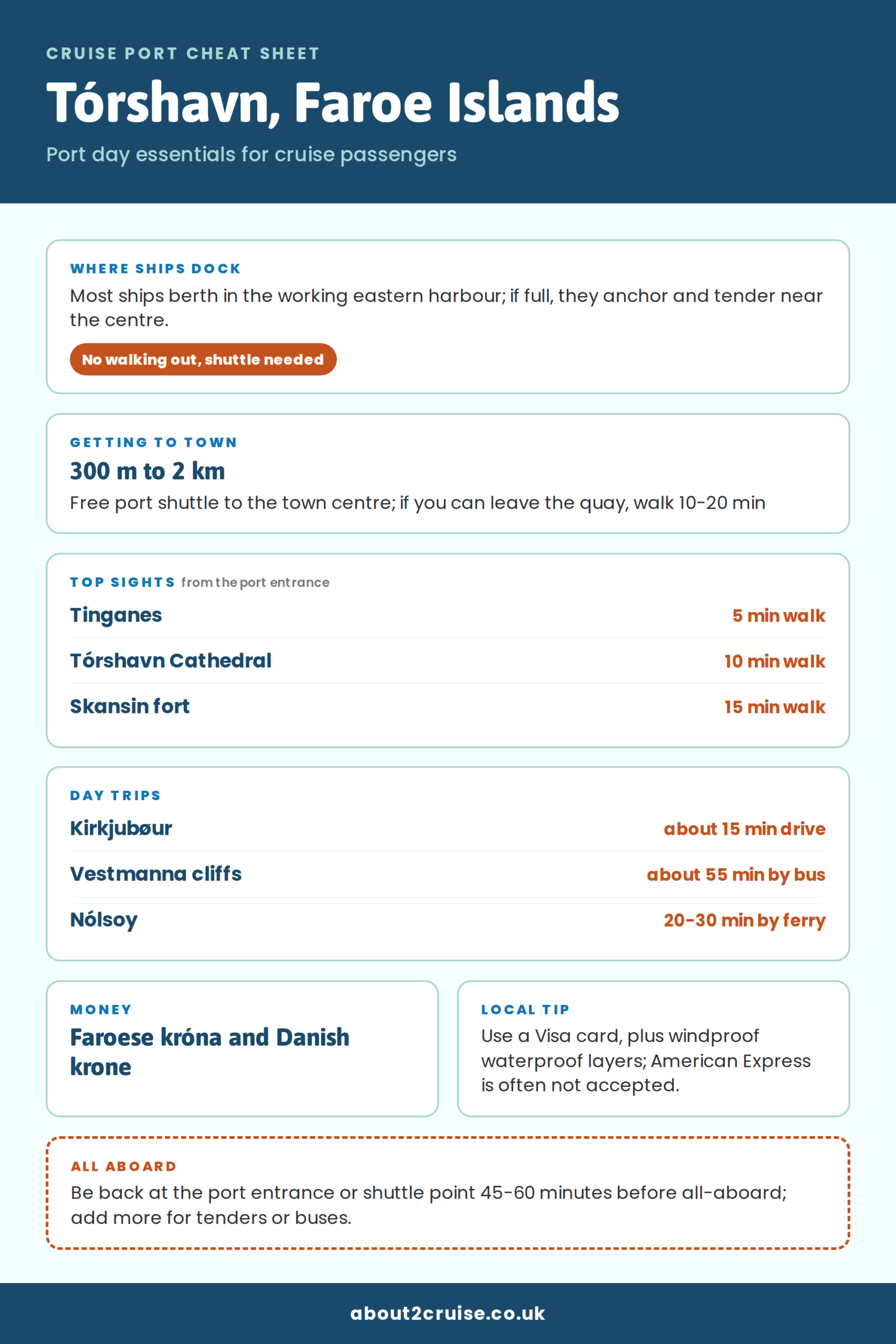
Cruise ships usually dock on the eastern side of Tórshavn’s working harbour. There’s about 1,270 metres of quay here, with water depths between 6.4 and 14.8 metres. Your ship’s daily programme and the port’s own arrivals list are the most reliable sources for the exact quay, because assignments can change right up to arrival. If no berth is available, the ship drops anchor roughly 1.3 nautical miles out and tenders to a wooden landing stage close to the city centre. There are no local shore launches, so the ship uses its own boats. Expect steps and a gangway rather than a flat, level quay.
In the worst case, when neither berthing nor anchoring at Tórshavn is possible, the port uses Kollafjørður about 24km north. The pier there is 560 metres long, and the port authority runs shuttle buses into the capital. That transfer adds real time to both ends of your day, so check your all-aboard time carefully.
The eastern quays sit in an industrial harbour. Independent passengers may be asked to take a port shuttle from the ship side to the port exit or passenger terminal. The port arranges those buses and charges the vessel, not you. In practice, many cruise lines run their own short shuttle to the pleasure harbour, and Visit Tórshavn and the port run a welcome service where those shuttles stop. On big-ship days you’ll also see “Ask Me” staff around the centre. If you’re allowed to walk off the quay, the public harbour edge to Tinganes is roughly 10 to 20 minutes on foot. A few sources put Eystari Kai as close as 300 to 500 metres, flat. The safest plan is to follow your ship’s instructions and allow 10 to 20 minutes for the walk once you’re through the port area.
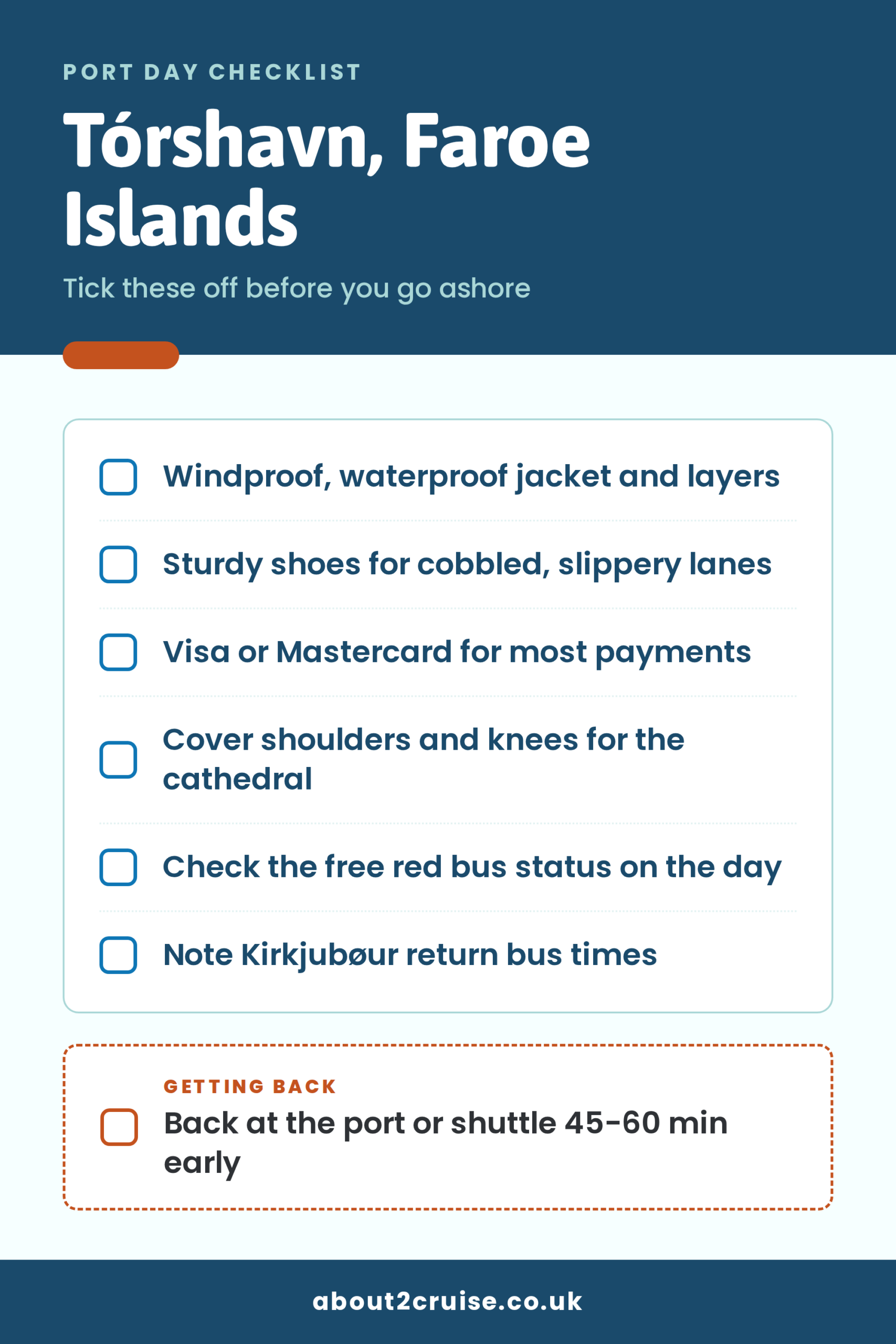
Getting back in time: for a town-only day, aim to be at the port entrance or shuttle point 45 to 60 minutes before all-aboard. Add more time if you’re using a tender, catching an out-of-town bus or the forecast is windy. If missing one bus would make you late, the plan is too fragile.
Tórshavn cruise port map
Ships dock at Eystara Bryggja. From there, Skansin fort is about a 2-minute walk, Tinganes about 6 minutes and Vágsbotnur Old Harbour about 10 minutes. Tap a pin for directions.
- Eystara BryggjaWhere ships dock
- Skansin fortHistoric fort · About 2 min walk from Eystara Bryggja
- Ferry terminal shuttle stopShuttle stop · About 5 min walk from Eystara Bryggja
- TinganesHistoric government quarter · About 6 min walk from Eystara Bryggja
- Vágsbotnur Old HarbourOld harbour · About 10 min walk from Eystara Bryggja
- National GalleryArt gallery · About 26 min walk from Eystara Bryggja
- ReynOld district · About 27 km from Eystara Bryggja
- KirkjubøurHistoric village · About 6 km from Eystara Bryggja
Tinganes: The Viking Parliament You Can Still Walk Through
Tinganes is the flat rocky headland that splits Tórshavn’s two harbours, and it’s the reason the town exists. The Viking ting began meeting here every summer from around 900 AD, making it one of the oldest parliamentary meeting places in the world alongside Tynwald Hill and Þingvellir. The Løgting that grew from it is one of the oldest parliaments still in existence. Today the turf-roofed buildings on Tinganes house the Faroese Home Rule government, and the experience is genuinely unusual: there are no armed guards and you simply walk through.
But this isn’t a museum. The buildings are working government offices, so keep your voice low, don’t peer through windows, and be prepared for the odd politician to walk past you on the way to lunch. The lanes are cobbled, narrow and slippery in rain. Allow about 20 to 30 minutes just to wander through, and have your camera ready. The black-tarred turf roofs are the signature sight.
Just above Tinganes is the old Reyn district of black-tarred, turf-roofed houses, the white 1788 Tórshavn Cathedral, the courthouse Føroya Rættur and the Løgting building. A guided city walk covers Tinganes, Reyn, the cathedral and Skansin in about 1.5 hours over 3km, meeting outside Visit Tórshavn at Steinatún.
Wander the Old Harbour and Grass-Roofed Streets
What surprises many UK cruisers is that Tórshavn doesn’t feel like a polished cruise terminal. You step into a working harbour of fishing vessels, warehouses, cafés and old boathouses. That atmosphere is part of the appeal. Vágsbotnur, the old harbour, is lined with boats and traditional buildings. Once you’re off the ship, the historic heart is minutes away. The lanes behind the harbour on Gongin and around Áarvegur and Niels Finsens gøta are where the small shops and cafés cluster.
Skansin Fort and the Cathedral: History and Your Best Ship Photo
Skansin is a 16th-century fort built against pirate raids and later used as a British base in the Second World War. It’s free to enter and has old cannons and a red-and-white lighthouse. From the ramparts you get the classic photograph of your own ship in the harbour with Tinganes and Nólsoy beyond. The cathedral is the seat of the Bishop of the Faroe Islands. There’s a Sunday service at 11:00 that visitors may join, but don’t photograph people. When visiting churches, keep shoulders and knees covered.
Kirkjubøur: A Medieval Day Trip from Tórshavn
Kirkjubøur is about 15km and a 15-minute drive from Tórshavn, and it’s widely regarded as the most important historical site in the Faroes. Its three monuments sit together: the ruined Magnus Cathedral, the 11th-century St Olav’s Church still in use, and Roykstovan, the log farmhouse that has housed the same family for 17 generations.
You can do Kirkjubøur independently. The free red buses reach it on route 5 on weekdays and route 7 at weekends from Steinatún in Tórshavn. But the village service is far less frequent than city routes, and a Sunday call may need a tour, taxi or a different plan. Check the return timetable before you go. The old walking path between Tórshavn and Kirkjubøur is about 6km and 1 hour 40 minutes, rated medium and muddy in places. The village and ruins are free to walk. Roykstovan’s museum charges and is open Monday to Saturday 09:00 to 17:00 and Sunday 14:00 to 17:00. A taxi sightseeing run costs about DKK 610 per four-passenger car. Ship excursions to Kirkjubøur are offered widely, often combined with a Tinganes walk.
Vestmanna Sea Cliffs: The Easy Bird and Scenery Trip
The Vestmanna cliffs are the most achievable bird and scenery trip from a Tórshavn port day. The 90-minute boat ride sails into grottoes, through narrow sounds and close to cliffs of almost 2,000ft where puffins, guillemots, fulmars and kittiwakes nest. The operator charges DKK 450 for adults and DKK 250 for children aged 2 to 13, with several departures a day from about 1 April to 31 October.
Independently, take the blue SSL bus 100 from Tórshavn to Vestmanna, which takes about 55 minutes. The risk is that the boat can be cancelled on the day after you’ve already made the journey, so check what your fare covers if it doesn’t sail. Dress for cold spray with windproof layers, hat and gloves. The boat is not wheelchair accessible. Ship versions run about 4.5 hours and include the coach drive, priced around £134 or $189 on the lines that sell it.
Saksun, Tjørnuvík and Gjógv: The Classic Village Drive
If you have time for one village route, the classic run links three places. Saksun is a tiny village above a tidal lagoon in a natural mountain amphitheatre. Its heritage farm Dúvugarðar is open 1 May to 30 September, 10:00 to 16:00, and charges DKK 150 with children free. Tjørnuvík has a black beach looking across to the sea stacks Risin and Kellingin. Gjógv on Eysturoy is built around a 200m natural sea gorge and has fewer than 50 residents.
A taxi from Tórshavn to Saksun or Tjørnuvík is quoted at about DKK 1,520 for 2.5 hours, and to Gjógv about DKK 2,420 for 4 hours, per four-passenger car. Most cruise passengers see these as a full-day coach tour because the roads link them cleanly, and the scenery is the point.
Mykines: Planning Around Puffins and Weather
Mykines is the puffin island. The best chance of puffins on land runs from mid-May to the end of August. The ferry to Mykines leaves from Sørvágur, reached by SSL route 36 from Tórshavn in about 45 minutes, and only has a regular connection May to August, with limited service in April and September. Access is controlled: most puffins are in the outfield, which requires a certified guide. The guide fee is DKK 400 if booked on hiking.fo by the day before arrival, or DKK 500 if paid on arrival. Outfield access is limited to 10:00 to 17:00 with a maximum of 200 visitors. The path to the lighthouse on Mykineshólmur is closed May to September for nesting; the guided walk goes to the á Rógvu viewpoint instead. The hiking fee is refunded if the boat cancels for weather.
This is a trip that consumes a full day and can fail at the last minute. For most cruise passengers it’s safer as a ship excursion if offered. A simpler bird-focused outing is Nólsoy, a short foot-passenger ferry from Tórshavn of about 20 to 30 minutes, with birdlife, sheep and no cars.
What to Eat in Tórshavn: Fermented Lamb, Langoustines and Cosy Cafés
Faroese food is built on fishing, sheep farming and fermentation. The word ræst means fermented, and you can try skerpikjøt, ræst fish, ræst lamb, dry fish and fresh seafood such as langoustines. A Michelin-listed restaurant on Gongin serves a set menu built around fermentation and ageing in a turf-roofed house with low ceilings and a shared table. Home-hospitality dinners called heimablídni offer 10 to 12 specialities in a Faroese home, bookable at DKK 790 or DKK 990 all-inclusive per person with a deadline of 19:00 the day before.
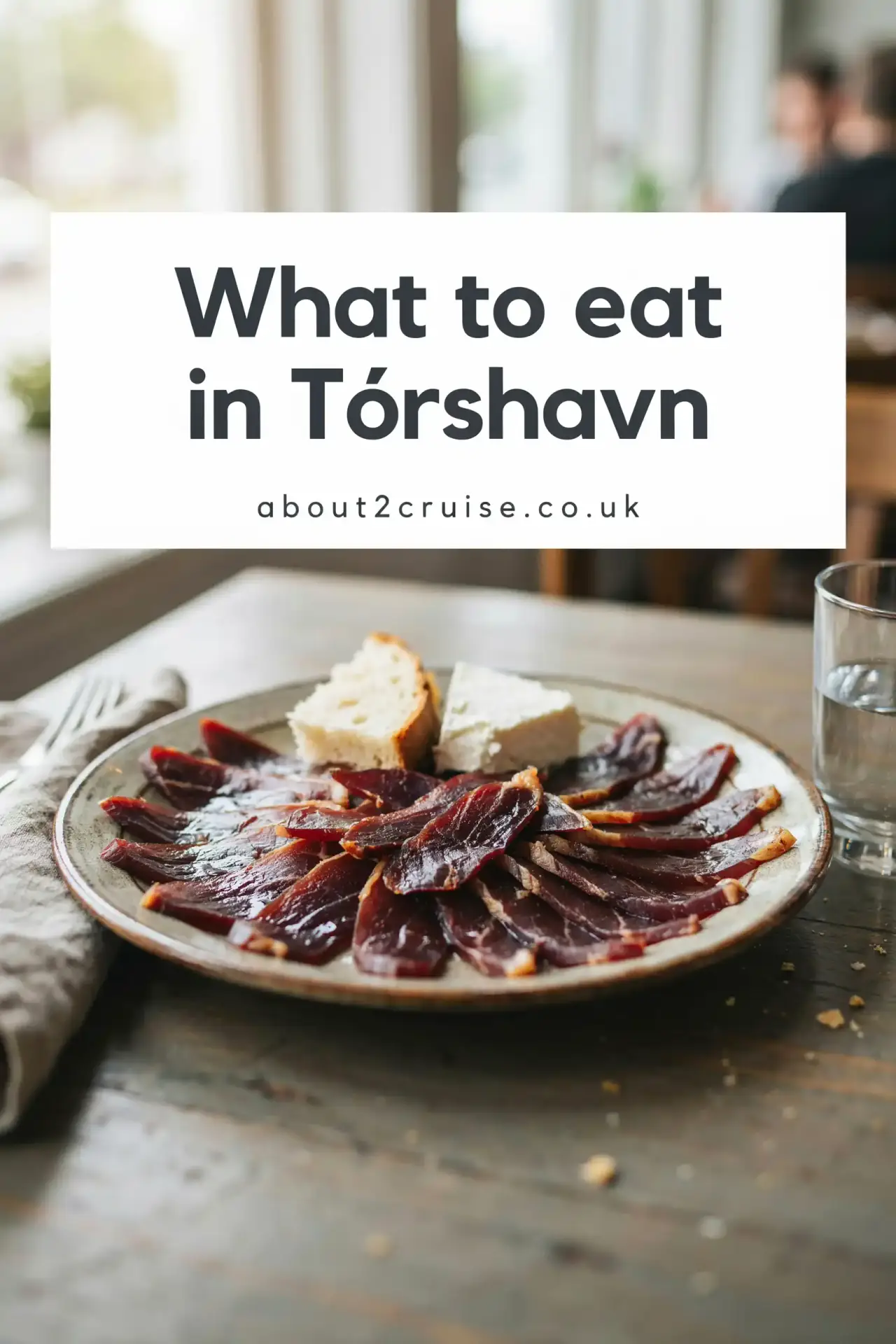
For a lighter port day, the lanes around Gongin and the main shopping streets Niels Finsens gøta and Áarvegur have small cafés. Alcohol is sold only in state Rúsan shops, which is why restaurant and bar prices are what they are. Tap water is clean, so you can refill a bottle without worry.
Shopping in Tórshavn: Knitwear, Design and Faroese Wool
Knitting is a living Faroese tradition, and the most famous shop is Guðrun & Guðrun on Niels Finsens gøta 13, whose hand-knits include the jumpers worn in The Killing. Other names to look for are Navia, Sirri, Jóhanna av Steinum, Einstakt, REKA, Durita Thomsen, Shisa and the yarn and knit boutique Tógvhúsið. Steinprent is the renowned art print workshop, and Visit Tórshavn and Kaffihúsið sell Faroese souvenirs.
Most shops open 10:00 to 18:00 on weekdays and 10:00 to 14:00 on Saturdays. Most close on Sundays. Tax-free shopping is possible on purchases over DKK 300 from shops showing the Tax-Free sign, reclaiming 12 to 18% of the 25% VAT after a service charge. The catch for cruise passengers is that the refund point for sailboat and cruise visitors is in Klaksvík, not Tórshavn, and only refunds by card. Don’t buy whale meat or blubber as a souvenir: it’s illegal to bring whale products into the UK or EU.
Art, Music and the Nordic House: Indoor Culture on a Rainy Day
The National Gallery, Listasavn Føroya, holds the main public collection of Faroese art in the park at Viðarlundin. From 1 May to 31 October it’s open daily 11:00 to 17:00. Adults pay DKK 110, seniors DKK 90, students DKK 30, and under-20s are free. The Nordic House is a cultural centre under a grass-covered roof with concerts, exhibitions and a café. The lobby and café are free, and it’s an easy wet-day stop. Music and chain dancing peak at Ólavsøka, the national day around 28 and 29 July, when the town fills with processions and rowing competitions.
What to Wear in Tórshavn’s Changeable Weather
Tórshavn’s cruise-season weather is cool and changeable rather than hot. Daytime maximums run about 9°C in May, 11°C in June and 12°C in July and August, with rain on most days and 16 to 20 hours of daylight. The real story is wind: a sheltered morning can turn to gusts and sea spray quickly, and fog can arrive fast.


Wear thin wool or fleece under a windproof, waterproof shell, with sturdy shoes or boots with good grip. Jeans are a poor choice in rain. A hood beats an umbrella in the wind. Tinganes and the old lanes are cobbled and slippery when wet; the wider waterfront and shopping streets are flatter. On a boat trip, even a mild day warrants windproof layers, hat and gloves.
Money in the Faroe Islands: Cards, Króna and Cash You Probably Won’t Need
Two currencies circulate at equal value: the Faroese króna and the Danish krone. The Faroes print their own notes but use Danish coins, and Danish notes are accepted everywhere. Most shops, restaurants, taxis, petrol stations and hotels take cards, principally Visa, and also Mastercard, Eurocard, Maestro and JCB. American Express is often not accepted. You don’t need to bring cash; exchanging it is difficult, but there are ATMs beside bank branches if you want kroner. Notes come in 50, 100, 200, 500 and 1,000 krónur, coins in 50 øre and 1, 2, 5, 10 and 20 krónur. A few places in major towns accept foreign currency, but treat euro or US dollar acceptance as a favour, not a rule.
Getting Around Tórshavn: Free Red Buses, Blue Intercity Buses and Taxis
Tórshavn’s red municipal Bussleiðin city and village buses are currently free to use, including for visitors, and are separate from any port shuttle. The central bus hub is Steinatún, a short walk from the harbour. There’s a caveat: the municipality has been working on a paid ticket for visitors, with proposals around DKK 50 for 24 hours, so check the municipality’s own pages or the Visit Tórshavn desk before you rely on it.
The blue SSL intercity buses to places such as Vestmanna, the airport and villages outside town are a separate fare-paying network that takes cards. Taxi BIL quotes around DKK 610 for a Kirkjubøur run, DKK 1,520 for Saksun or Tjørnuvík, and DKK 2,420 for Gjógv for up to four passengers.
Ship Excursions vs Doing Tórshavn on Your Own
In Tórshavn town, the ship excursion adds the guide, not access. Tinganes, Skansin, the cathedral and the old town are free and walkable. Norwegian Cruise Line’s 3-hour “Capital of the Faroes” city tour is sold at $129.99 for adults and $109.99 for children, with about 1.5 miles of walking on uneven cobblestones. HX’s included Tórshavn walking tour runs 2 hours over 1km of paving, cobbles and uneven ground and is not wheelchair accessible. Regent lists a city tour and a Kirkjubøur-and-Tinganes walk among its included excursions and prices the Vestmanna cliffs at $189.
DIY works for Kirkjubøur, Vestmanna and Nólsoy if you have at least six hours and accept that one missed connection ruins the day. Out of town, ship tours make sense when the day is short or the weather is marginal, because the operator works to the ship’s schedule.
Museums and Rainy-Day Alternatives in Tórshavn
The National Museum at Brekkutún 6 in Hoyvík is open daily 10:00 to 17:00 from 1 May to 30 September and Thursday to Sunday 13:00 to 17:00 from 1 October to 30 April. Admission is DKK 90 for adults, DKK 60 for students and pensioners, and free for children 0 to 17. The ticket covers the open-air museum and whaling station for a week. It holds the medieval carved pew-ends from St Olav’s Church in Kirkjubøur plus Viking and whaling material. The National Gallery is the other wet-day standby, and under-20s go free.
For families and rain, the municipal swimming hall Svimjihøllin í Gundadali has a 25m pool, a 50m pool, a children’s pool, hot tubs and a wellness area, running roughly 06:15 to 20:00 on weekdays and 08:00 to 16:00 at weekends. The public library on Niels Finsens gøta has free wifi and public restrooms. Visit Tórshavn’s information desk at Niels Finsens gøta 17 has restrooms, card payment and wheelchair access. May to August it opens Monday to Friday 08:00 to 17:30 and Saturday 09:00 to 16:00, with reduced hours out of season.
Practical Essentials: Toilets, Wi-Fi, Pharmacies and Emergencies
For a port day, the easiest restrooms are at the Visit Tórshavn information desk, the public library and the ferry terminal complex. Free public wifi is available at the public library on Niels Finsens gøta. Tórshavn has two pharmacies. Tjaldurs Apotek is open Monday to Friday 09:00 to 17:30, Saturday 10:00 to 14:00 and Sunday and holidays 14:30 to 15:00. After 16:00, the on-call GP is reached on 1870 at Landssjúkrahúsið in Tórshavn; between 09:00 and 16:00 contact a local GP. The emergency number is 112. The national hospital is at J.C. Svabos gøta 41-49.
You cannot use a GHIC or EHIC in the Faroes, but the UK has a reciprocal arrangement giving British nationals the same treatment as residents. Carry your GHIC or EHIC as proof of identity and still take travel insurance. Denmark does not recognise UK prescriptions, so you may need a local pharmacist and possibly a local GP for medication.
Passport and Entry Rules for UK Cruise Passengers
The Faroes are not in the EU and not in the Schengen Area. British citizens do not need a visa for tourism. You can enter with a passport or a photo national ID card if you are an EU or Schengen citizen. Visitors from outside the EU and Schengen usually need a passport valid for at least three months beyond the planned stay. A Schengen or Danish visa does not get you in; any visa must be issued specifically for the Faroe Islands. Because the EU Entry/Exit System applies when you enter or leave the Schengen area via Denmark or another Schengen country, allow extra time at those borders around the cruise.
Accessibility and Mobility in Tórshavn
A tender call is the biggest accessibility risk, because transfers usually need steps and crew approval based on sea state. The port shuttle’s ability to carry wheelchairs or mobility scooters should be confirmed with your cruise line before the call; the ship controls the gangway and the port controls vehicle movements. Tinganes and Reyn have cobbles, narrow passages, kerbs and slopes that can be tiring or impassable. The broader waterfront and shopping streets are flatter but not consistently kerb-cut. Ship walking tours in Tórshavn are explicitly not wheelchair accessible, and NCL does not recommend its city tour for guests with physical limitations. The National Museum has a lift.
Staying Overnight or Getting to the Faroe Islands
Tórshavn is usually a port of call rather than a cruise turnaround for UK sailings. If you are staying, the centre is compact. Hotel Hafnia on Áarvegur is in the old town. Hotel Brandan on Oknarvegur is a four-star with parking and the airport bus nearby. Hotel Føroyar on Oyggjarvegur is the grass-roofed design hotel above town with a path down to the city. For a ferry departure, staying near Vágsbotnur or the harbour puts you beside both the Norröna berth and the SSL ferry terminal.
To reach the Faroes by sea, the Faroese-owned ferry Norröna runs year-round from Hirtshals in northern Denmark to Tórshavn, taking about 30 hours in summer and longer off-season. In summer it continues north to Seyðisfjörður in Iceland before returning. There is no direct UK ferry route. By air, Vágar Airport is 47km from Tórshavn. SSL bus 300 takes about 50 minutes and accepts cards, while a shared taxi transfer costs about DKK 230 per passenger. If you self-drive, expect subsea tunnel tolls of roughly DKK 100 to 175 a crossing, usually settled through the hire-car company.
Best Photo Spots in and Around Tórshavn
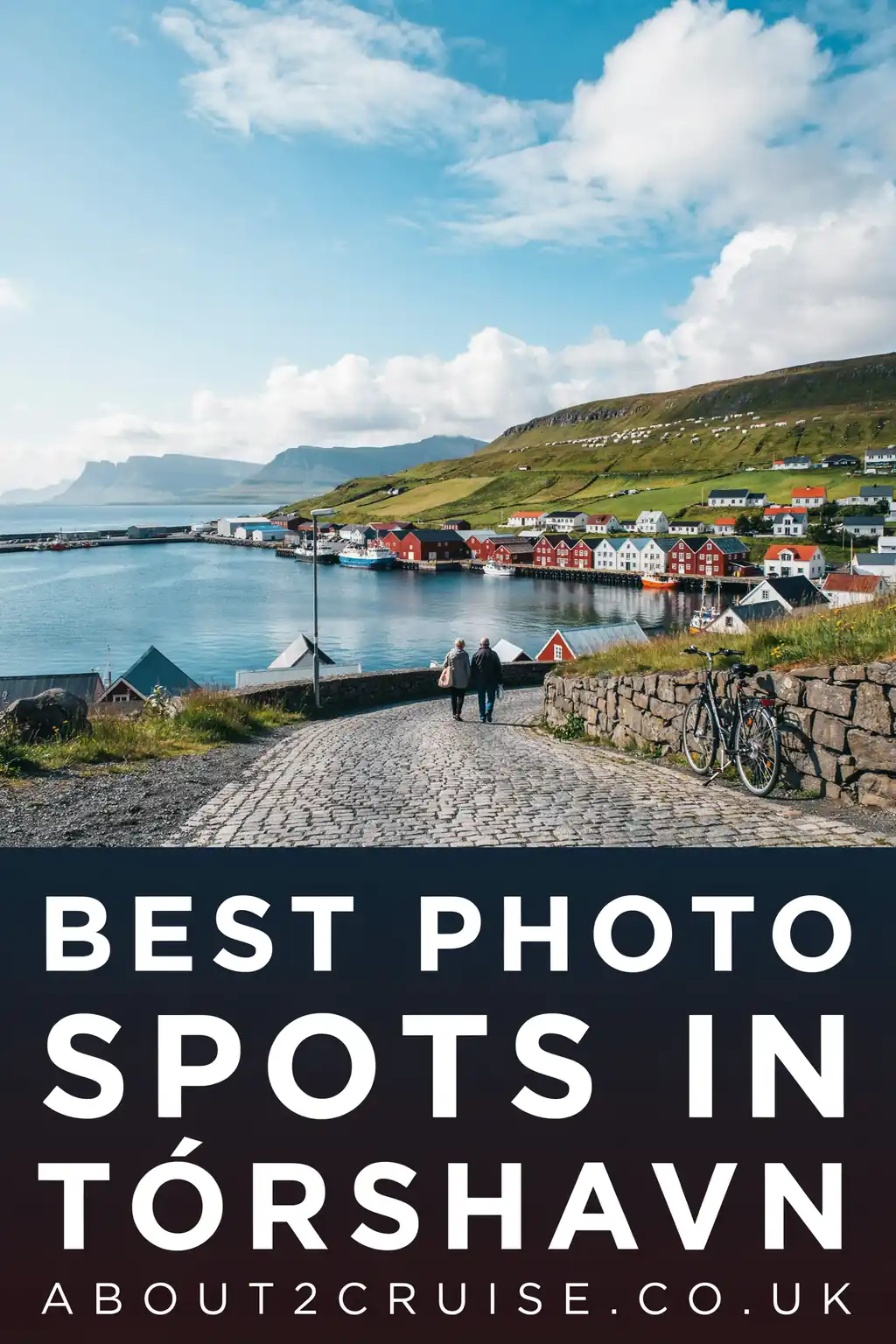
Skansin fort and its lighthouse give the classic shot of your own ship in the harbour with Tinganes and Nólsoy beyond. The Tinganes and Reyn lanes of black-tarred, turf-roofed houses are the town’s signature view, and the light lasts late into the evening in June and July. Kirkjubøur’s ruined cathedral walls with the sea behind is the most photographed historic site in the islands. Saksun’s turf-roofed farm above the tidal lagoon, Tjørnuvík’s black beach with the Risin and Kellingin sea stacks, and Gjógv’s natural gorge are the scenery shots people come for. The ridge road above Tórshavn gives a viewpoint over the whole town and harbour without climbing.
How to spend a port day in Tórshavn
A port day in Tórshavn works best if you pick one: a slow walk through Tinganes and the old harbour, or a bus run to Kirkjubøur’s medieval ruins.
Before you sail
- Check Kirkjubøur route 5 or 7 return times for your day, especially Sundays.
- Book Mykines guide and ferry in advance if you plan that trip.
- Pack windproof waterproof layers and a Visa or Mastercard; Amex is often not accepted.
Short port day: under 6 hours
- On dockingGet from ship to SkansinFollow the port shuttle or walk; Skansin's old fort and lighthouse sit at the harbour edge near the berth.
- +15 minSkansin fort and lighthouseWalk the ramparts free and photograph your ship with Tinganes and Nólsoy beyond.
- +45 minTinganes and ReynWalk to the turf-roofed government quarter, then the black-tarred Reyn lanes above the harbour.
- +1 hr 15 minTórshavn CathedralThe white Lutheran cathedral is a short climb from Tinganes. Cover shoulders and knees inside.
- +1 hr 40 minVágsbotnur old harbourDescend to the working fishing harbour with boats and traditional buildings.
- +2 hrs 10 minLunch near GonginTry ræst fishOrder fresh Faroese seafood, langoustines or fermented ræst fish in the café lanes around Gongin or Niels Finsens gøta.
- +3 hrs 15 minFaroese knitwear and cafésStroll the shopping streets for Faroese wool jumpers, or stop for coffee. The flat waterfront is an easier route if needed.
The time on the map is the whole walk, every stop added together.
Open this walking route in Google Maps
If plans change: If the old town is packed with a large ship, use the flatter waterfront and the National Gallery or Nordic House as your indoor fallback.
Long port day: 8 hours or more
- On dockingGet from ship to SteinatúnFollow the port shuttle or walk into the centre, then walk a few minutes to Steinatún bus terminal.
- +20 minTake the free red bus to KirkjubøurCheck return timesBoard route 5 on weekdays or route 7 at weekends. The village service is infrequent, so check return times before you go.
- +1 hr 10 minKirkjubøur's three monumentsVisit the ruined Magnus Cathedral, St Olav's Church and Roykstovan log farmhouse. The village and ruins are free; Roykstovan museum charges.
- +3 hrsBus back and lunchTry skerpikjøtReturn by the free red bus. For lunch, order skerpikjøt, ræst fish or langoustines in the lanes around Gongin or Niels Finsens gøta.
- +4 hrs 45 minTinganes and ReynWalk through the free turf-roofed government quarter and the black-tarred Reyn lanes above the harbour.
- +5 hrs 30 minSkansin fort viewpointA harbourfront walk to the old fort to photograph your ship, Tinganes and Nólsoy.
- All-aboard minus 45 minBack at the shipReturn to the quay, shuttle point or tender landing. If tendering or windy, allow extra time.
The times on the map are for the whole journey there by train and bus.
Get train and bus times in Google Maps
If plans change: If you miss the Kirkjubøur return bus, call a taxi back or switch to a ship excursion rather than waiting for the next village service.
The Faroe Islands are part of the Kingdom of Denmark, and our Denmark cruise ports guide covers the country’s other cruise calls.
Tórshavn Cruise Day FAQs
Is there anywhere to leave luggage at the port?
No left-luggage facility at the cruise quay, ferry terminal or airport is documented for port-day visitors. Travel light, and if you have a late flight or ferry, confirm with your line or tour operator whether bags can be stored on the coach.
Are the free red buses still free?
Currently yes, but the municipality has discussed introducing a visitors’ ticket, with proposals around DKK 50 for 24 hours. Check the municipality’s own site or the Visit Tórshavn desk on the day.
Can I take a mobility scooter on the port shuttle?
Confirm before the call. The ship controls the gangway and the port controls vehicle movements, and tenders usually require steps with crew approval based on sea state.
Can I buy alcohol on a Sunday?
No. Alcohol is sold only in state Rúsan shops, and shops close on Sundays. Bars and restaurants serve drinks, but prices reflect the monopoly.
What souvenir is banned in the UK?
Whale meat and blubber. It is illegal to bring whale products from the Faroe Islands into the UK or EU. Faroese wool, knitwear and crafts are fine.
Does a Schengen visa cover the Faroes?
No. The Faroes are outside Schengen and the EU, so any visa must be issued specifically for the Faroe Islands. UK citizens do not need one for tourism.
More Northern Cruise Ports to Explore
If you are island-hopping around the North Atlantic, see our Lerwick cruise port guide, Kirkwall cruise port guide and Reykjavik cruise departure port guide, plus our Iceland cruise ship ports guide.
Last Updated: 15 November 2026