
Rio Grande is a working cargo port at the mouth of Lagoa dos Patos in far-southern Brazil, not Rio de Janeiro and not Ilha Grande. Small luxury ships berth at the Porto Novo public quay. A free shuttle or short taxi ride gets you into the compact historic centre, while Cassino’s endless beach, the Molhes da Barra and the Taim wetlands are the out-of-town draws.


Quick Facts for Your Rio Grande Port Stop
| Where you dock | Porto Novo public quay, Port of Rio Grande, alongside: no tender |
| Port to centre | 10–15 minutes by taxi or free shuttle; not walkable |
| Currency | Brazilian real (BRL / R$) |
| Language | Portuguese; bilingual help on call days |
| Best short-call sights | Historic centre, Mercado Público, Oceanographic Museum |
| Best longer-call sights | Cassino, Molhes da Barra, Taim, Pelotas |
| Taxis | Centre about R$30; Cassino about R$80 each way |
| All-aboard | Check the daily programme and gangway time; be back at least 1 hour before departure |
What Is Rio Grande, Brazil? (And Why It’s Not Rio de Janeiro)
Rio Grande is the oldest city in Rio Grande do Sul, Brazil’s southernmost coastal state. The city sits on the Canal do Norte, the channel connecting Lagoa dos Patos to the Atlantic Ocean. It is a genuine port city rather than a purpose-built cruise destination. Ships call because the port gives access to the far-south Atlantic coast, colonial Portuguese architecture, beach culture at Cassino and the wetlands of Taim.
Don’t confuse Rio Grande with Rio de Janeiro, which is about 1,340 km north as the crow flies, or with Ilha Grande, the car-free island in Rio de Janeiro state. Brazil also has the state of Rio Grande do Sul, and Argentina has a separate city called Río Grande in Tierra del Fuego. If a search result shows Mediterranean sailings, it’s almost certainly a mislabelled cruise listing, not this port.

Docking at Porto Novo: What Arrival Looks Like
Your ship ties up alongside at the Porto Novo public quay. There is no dedicated cruise terminal, so expect a working cargo atmosphere, controlled port access and a temporary welcome operation set up for your call. The quay is in the port’s Porto Novo zone, with the historic Porto Velho further along the channel and the Superporto leased terminals nearby.
You usually walk a short distance from the ship to the quayside welcome area, where the city often lays on a craft fair, gaucho music and dance, tourist information and bilingual guides. Port access is controlled under ISPS security rules, so photography in operational port areas can be restricted. Save your first photos for the city centre or the beach, not beside cargo equipment.
Small ships use Rio Grande because they don’t need deep or large cruise berths. Large mass-market ships rarely call here. If you’re on a small expedition or luxury vessel, this will feel like a port call, not a turnaround day.
Rio Grande cruise port map
Ships dock at Porto Novo public quay. Tap a pin for directions.
- Porto Novo public quayWhere ships dock
- Mercado PúblicoPublic market · About 2 km from Porto Novo public quay
- Catedral de São PedroCathedral · About 2 km from Porto Novo public quay
- Praça Xavier FerreiraTown square · About 2 km from Porto Novo public quay
- AlfândegaCustoms house · About 2 km from Porto Novo public quay
- Biblioteca Rio-GrandenseLibrary · About 2 km from Porto Novo public quay
- Museu OceanográficoOceanographic museum · About 3 km from Porto Novo public quay
- Molhes da BarraBreakwater · About 13 km from Porto Novo public quay
- Estátua de IemanjáStatue · About 18 km from Porto Novo public quay
- PelotasCity · About 39 km from Porto Novo public quay
- Ilha dos MarinheirosIsland · About 8 km from Porto Novo public quay
Immigration and Security at the Port
For UK passport holders, Brazil allows visa-free tourism visits of up to 90 days. Your passport should have at least six months remaining. If Rio Grande is your first Brazilian port of call, clearance can be slower than a routine Caribbean call because the authorities may use the stop for customs and immigration formalities. Carry your passport or a clear copy as directed by the ship, and keep your cruise card with you.
Vehicles and drivers entering the port are pre-registered through the port’s Porto Web system and checked at the gate. As a passenger on an organised tour or shuttle, you usually clear the port quickly. Independent taxi drivers will need to meet the port’s access requirements, so it’s easier to use the taxis arranged at the port exit rather than trying to book an unregistered vehicle to the quayside.
There is no public cruise-passenger car park or published left-luggage office at the quay. If your ship is only calling here, luggage is not normally a concern. If you are arriving independently before a cruise or staying after one, arrange luggage storage at your hotel.
How to Get from the Port to the City Centre
Rio Grande’s historic centre is compact and easy to explore on foot once you get there, but the port is not a practical walk. The public quay is in a working port area, and pedestrians are not the priority. The city runs a free shuttle from the quay to the tourist information centre beside the Mercado Público on call days, usually every 30 minutes, and back from the centre every 30 minutes.
If you prefer a taxi, they wait at the port exit. The journey takes about 10–15 minutes and costs roughly R$30 to the centre. Taxis are also the realistic way to reach Cassino, the Oceanographic Museum or the Molhes. Have reais in cash as a backup even if you plan to use a card, because some drivers and small operators are cash only.
Ride-hailing apps operate in Brazil, but UK government travel advice warns about unlicensed drivers posing as app drivers. If you use an app, check the plate and driver photo. Don’t hail taxis in the street, especially after dark.
Rio Grande City Centre: A Self-Guided Walk
The historic centre clusters around Praça Xavier Ferreira and the waterfront. The square has a working English-made fountain, monuments to the city’s founder Silva Paes and to the abolition of slavery, and a good view of the surrounding colonial and neoclassical buildings.
Start at the Catedral de São Pedro, the first Portuguese church built in Rio Grande do Sul. It is a small single-nave church with two towers and a federal heritage listing. The chapel behind it houses a sacred art collection.
Walk to the Mercado Público, the public market. It has around 40 stalls selling fresh fish, shrimp, vegetables from Ilha dos Marinheiros and local crafts. The market is open Monday to Saturday from 07:00 to 19:00 and is closed on Sunday. The fish dock area is busiest and most photogenic in the morning. The tourist information centre sits between the Câmara de Comércio and the Mercado Público, generally open daily from 14:00 to 18:00.
The old Customs House, now used by Receita Federal, is one of the grandest buildings in the centre and houses the city museum. The Biblioteca Rio-Grandense is another historic facade worth a look. Allow an hour to ninety minutes for a relaxed walk, more if you stop in the market or visit the cathedral properly.
Oceanographic Museum and Antarctic Museum
The Museu Oceanográfico Prof. Eliézer de Carvalho Rios is run by the Federal University of Rio Grande. It holds South America’s largest mollusc collection, a fin whale skeleton and excellent displays on the South Atlantic ecosystem. The connected Antarctic Museum covers Brazil’s Antarctic research and is an unusual extra for a city this size.
Entry is free. Opening hours are usually Wednesday to Sunday, 14:00 to 18:00, closed Monday, but hours can change, so check the museum’s own page or ask at the tourist information centre on the day. Accessibility is good for a Brazilian museum: access ramp, adapted route, handrails and adapted toilets are recorded.
The museum is a short taxi ride from the centre. It’s a strong choice on a hot, windy or rainy afternoon because it’s indoors, free and not overcrowded.
Praia do Cassino and Molhes da Barra: Beach Day Options
Praia do Cassino is about 22 km from the city centre. It is recognised by Guinness World Records as the world’s longest continuous beach, running roughly 254 km from the Molhes da Barra towards Chuí on the Uruguayan border. This is the Brazilian far-south Atlantic coast, so expect broad sand, wind, vehicles on the beach and brownish water from lagoon sediment. It is not a calm Caribbean or Mediterranean beach.
The Molhes da Barra are the two stone breakwaters that protect the entrance to Lagoa dos Patos and the port. Since the 1930s, sail carts known as vagonetas have carried visitors out on rails along the breakwater. The trip covers about 4 km of track, lasts around 45 minutes including a photo stop, and costs R$100 per cart for up to five people. The carts are cash in practice. They run daily from 07:30 to 18:00 but stop in rain or very strong wind.
Wear closed shoes with grip for the Molhes; the rocks are slippery and used by anglers. Sea lions often rest on the rocks, especially in cooler months. The beach itself has strong surf and currents, so follow local flags and lifeguards if you swim.
A taxi from the port to Cassino takes about 30 minutes and costs roughly R$80 each way. Public buses also run from the Tamandaré terminal in the centre to Balneário Cassino about every 30 minutes, with a ride time of around 30 minutes and a municipal fare of about R$4.50. If you want independence without a ship excursion, a taxi is the easiest option for a short call.
Taim Ecological Station: Wetlands and Birdwatching
Taim is a federal ecological station of about 33,000 hectares between Rio Grande and Santa Vitória do Palmar, on the BR-471 highway. It is a Ramsar-listed wetland with roughly 250 recorded bird species, capybara and yellow-throated caiman. The road crosses the reserve, so you can see a lot from a vehicle at reduced speed, especially with binoculars.
The reserve’s protected status means independent entry is not open to the public in the way a national park might be. Visitation inside is restricted to research and environmental education, and individual walkers are not admitted. Cruise excursions sometimes market this as a Taim or wetland route, but the practical experience is usually road-side viewing plus stops outside the strict reserve, often combined with other countryside sights.
Taim is about 88 km from Rio Grande, so the drive takes about an hour and a half each way. It only works on a long call of eight hours or more. Book it as a ship excursion or through an authorised guide; don’t try to do it independently by taxi unless you have confirmed the route, timing and return buffer with the driver in advance.
Pelotas Day Trip from Rio Grande: Architecture and Sweets
Pelotas is 47 km from Rio Grande, about an hour by road. It is known as the National Capital of Sweets for its egg-and-sugar confectionery such as camafeu, quindim, bem-casado and papo-de-anjo. The city also has fine 19th-century architecture from the charque boom, when salted beef made the region wealthy.
A Pelotas day trip works on a medium-length call. The drive is straightforward, but you need to leave time to get back through port security. The sweet shops and Mercado Central are the main draw, and the historic streets are pleasant for a short walk. If you have already seen the Rio Grande centre and want a different southern Brazilian town, Pelotas is the best DIY option within an hour.
Ilha dos Marinheiros: A Quiet Lagoon Island
Ilha dos Marinheiros lies in the lagoon about 30 km from the centre or a short boat crossing away. It keeps Portuguese colonial chapels, market gardens and the fortified sweet drink jeropiga, also called jurupiga. Jeropiga is legally recognised as intangible cultural heritage of Rio Grande. If you see it for sale at the Mercado Público or in a shop, it’s one of the best local souvenirs. The island is more seasonal and slower-paced than Cassino, so check access and boat times before making a special trip.
Food, Drink and Gaucho Culture
Shrimp is the local signature. The municipal shrimp season is a big deal, and menus are built around camarão. You will also find crab dishes such as casquinha de siri, fresh fish from the lagoon, and seafood served simply with rice, beans and farofa. The fish stalls around the Mercado Público are the most direct way to see what is landed.

On ship days the quayside welcome area often includes a craft fair, traditionalist gaucho dance groups and chimarrão culture. Gaucho identity is strong here: expect leather, regional dress, folk music and proud local hospitality rather than a packaged cruise-port feel.
Restaurant bills normally carry a 10% service charge that acts as the tip. You don’t need to add more unless service was exceptional. Jeropiga or jurupiga is the local drink to try, but it is sweet and fortified, so taste before buying a bottle.
Money, Cards and Payments in Brazil
Brazil uses the real, written R$. US dollars and euros are generally not accepted, so bring reais or use cards. Visa and Mastercard are widely accepted, and contactless payment is normal in shops, restaurants and hotels. Small vendors, market stalls, taxis and kiosks may be cash or Pix only.
Pix is Brazil’s dominant instant payment system, but it requires a Brazilian account, so most cruise passengers use a mix of cards and cash. ATMs are concentrated in the centre, with Banco do Brasil and Caixa branches near the main streets. UK government travel advice warns about card cloning and dynamic currency conversion; always pay in reais and keep your card in sight.
Carry small notes for taxis, the Mercado Público, the Molhes vagoneta and roadside stops. Tipping outside restaurant service charges is not expected for short services, but rounding up a taxi fare is normal.
Safety Tips for Exploring Rio Grande on Your Own
Rio Grande is not a high-pressure tourist trap, but normal Brazilian city precautions apply. Robberies and pickpocketing are reported in Brazilian cities, especially involving phones. Keep your phone out of sight between late afternoon and evening, carry limited cash, and avoid displaying jewellery or expensive cameras in quiet streets.
Stick to the main streets of the historic centre during the day. The area around the port and fish docks is busy and authentic but less comfortable late in the day. Don’t hail taxis in the street; use the quayside taxi rank, a hotel rank or a ride-hailing app after checking the plate.
Beach safety is real: southern Brazil has strong currents and surf. Swim only where lifeguards are present and follow flags. The Molhes rocks are slippery, and the wind can be surprisingly strong even on a sunny day.
Weather, Seasons and Packing for Rio Grande
Rio Grande has a humid subtropical climate with rain spread across the year. The cruise season is mostly late November to March, when average highs are about 24°C to 27°C. January and February are the warmest and most humid months, with about 10 rain days each and many muggy days. Expect wind all year round, strongest in spring and early summer.
The sea is cool-to-warm, around 24–25°C in January to March, but the water at Cassino is not glassy or calm. Pack light layers, a windproof and waterproof shell, sun hat, high-factor sunscreen and closed shoes with grip. You’ll want the closed shoes for cobbled streets, the Molhes and uneven surfaces. Avoid beachwear in the city centre; this is a working port town, not a resort strip.
Shore-Time Planning and Excursion Timing
Real call windows vary. Some ships arrive early and leave by mid-afternoon; others have longer stays. You may see examples such as 07:00–16:00 or 11:00–20:00, but your ship’s time and schedule are what matter. The all-aboard time is printed in the daily programme and posted at the gangway. As a general rule, be back on board at least one hour before the scheduled departure, and build in an extra 30 minutes for port traffic or a late taxi.
Use these realistic timings:
- Historic centre: 10–15 minutes each way from the port; 1.5–3 hours in town.
- Oceanographic Museum: 15 minutes each way by taxi; allow 1.5–2 hours.
- Cassino and Molhes: 30 minutes each way; allow at least 2.5–3.5 hours.
- Pelotas: 1 hour each way; allow 4–5 hours.
- Taim: 1.5 hours each way; only on a long call of 8+ hours.
Ship excursions are waited for, but independent travellers are not. If you are doing a private taxi or a DIY bus trip, set a firm return time and carry the port address in Portuguese: “Porto Novo, cais público, Porto do Rio Grande”.
DIY vs Organised Shore Excursions in Rio Grande
Rio Grande is a good place to mix both styles. The historic centre is easy to do independently by free shuttle or taxi. The Mercado Público, cathedral and Praça Xavier Ferreira require no guide and no fixed schedule.
An organised tour earns its cost for Cassino and the Molhes, Taim and Pelotas, because you remove transport uncertainty and the operator handles timing. Ship excursions may also include local guides who speak English and know which places are open. If your call is short, a city tour or a Molhes-plus-museum combination is the safest use of time.
For independent exploring, have a printed map or offline map on your phone, write down the ship’s port agent contact and carry small reais notes. Wi-Fi is not reliable enough everywhere to depend on live navigation.
Which Cruise Lines Visit Rio Grande?
Rio Grande is a port of call, not a regular turnaround. Regent Seven Seas, Oceania, Silversea, Phoenix Reisen and Nicko have all called. Oceania’s ships sometimes run Buenos Aires, Montevideo, Punta del Este and Rio Grande before heading up the Brazilian coast to Florianópolis, Itajaí, Santos, Paraty, Ilha Grande and Rio de Janeiro. If you are on a South America voyage, this call usually sits between the Buenos Aires cruise port and Montevideo cruise port leg, or as the first Brazilian stop before Itajaí cruise port and points north.
Typical volume is two to three ships a season, mostly small luxury or expedition vessels, with a few thousand passengers across the season. The port is also used as a supply and technical stop before Uruguay and Argentina, which means some calls may have crew and provisioning activity alongside the passenger welcome.
Finding Your Ship’s Call: Port Schedule and AIS
There is no single public cruise-only timetable for Rio Grande. The port authority publishes a mixed cargo and vessel line-up through its PortoWeb system, and Tecon Rio Grande publishes container-ship schedules. AIS tracking sites list Rio Grande under UN/LOCODE BRRIG, but they will show cargo calls, not passenger calls.
Your cruise line’s itinerary page or your booking confirmation is the reliable source for arrival and departure times. If you want to track your ship on approach, use the vessel’s name in an AIS app and look for Rio Grande, Brazil, not Rio de Janeiro or the Argentine Río Grande.
Connectivity, Language and Wi-Fi
Portuguese is the language. Bilingual guides and interpreters are often at the quay on call days, but once you leave the welcome area English becomes less common. Learn a few Portuguese basics: “obrigado” for thank you, “quanto custa?” for how much, and “onde fica?” for where is.
Free public Wi-Fi has been provided in some central squares such as Praça Tamandaré and Praça Xavier Ferreira. A public coworking space with free Wi-Fi has operated inside the Mercado Público on weekdays. Coverage is not guaranteed, so don’t rely on streaming or live maps. Download offline maps before arrival.
Best Photo Spots in Rio Grande
The best photos are not inside the port. Head for the Molhes da Barra for stone lines running into the Atlantic, the vagoneta rail and sea lions on the rocks. The Estátua de Iemanjá at the entrance to Cassino is the resort’s best-known image. The dunes and ecological boardwalk at Cassino look best at low sun, and the beach faces the Atlantic, so the sun sets behind the dunes rather than into the sea.
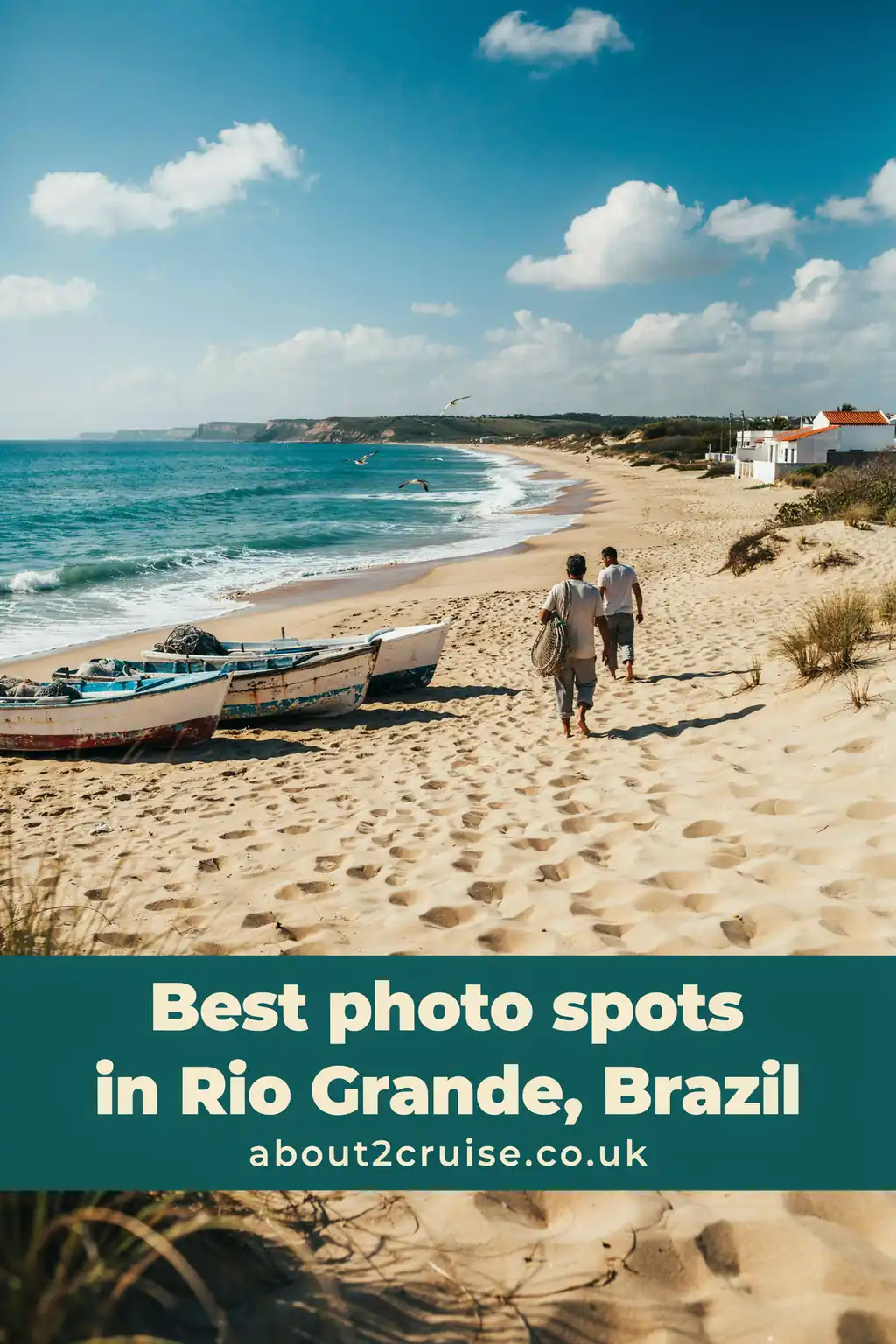
In the centre, photograph the Catedral de São Pedro, the Customs House facade, Praça Xavier Ferreira and the morning fish dock beside the Mercado Público. Golden hour 30–40 minutes before sunset is your best light, but remember to leave enough time to return to the ship.
Where to Stay Before or After a Cruise from Rio Grande
Rio Grande is not a turnaround port yet, so there is no cluster of cruise terminal hotels. If you are arriving before a cruise or staying after one, base yourself in the historic centre, close to the sights and the tourist information point. Hotels such as Laghetto Villa Moura and Hotel Villa Moura sit near Praça Tamandaré, a short walk from the cathedral and about 10–15 minutes by taxi from the Porto Novo quay. Some city hotels offer breakfast, luggage storage and paid parking.
The nearest airport is Pelotas International, about 47 km away. The main international gateway is Salgado Filho Airport in Porto Alegre, about 318 km or four to five hours by road. Coaches from Porto Alegre usually change at Pelotas and take around five hours. Rio Grande has no passenger rail service.
Accessibility and Mobility at the Port and Around Town
The historic centre has cobbled and uneven pavements, so a lightweight wheelchair or walking aid will cope better than large mobility scooters. The Oceanographic Museum complex has an access ramp, adapted route, handrails and adapted toilets, making it the easiest indoor sight. The Molhes vagoneta is a wooden rail cart with a step up and open sides; the rocks are not accessible for wheeled mobility aids. Cassino has firm sand with vehicles driving on it, but no boardwalk over the main beach. Taim is road-based viewing only, with no walking trails open to independent visitors.
If you have mobility needs, choose a ship excursion where the operator can confirm access, or stick to a taxi-based city and museum route. The port itself has no published passenger terminal accessibility details, so ask your cruise line before arrival if you need assistance between ship and shuttle.
How to spend a port day in Rio Grande
A port day in Rio Grande works best if you pick one: the compact historic centre on the free shuttle, or a taxi to Cassino and the Molhes.
Before you sail
- Check Brazil entry rules: UK passports enter visa-free; US, Canada and Australia need an e-visa.
- Confirm your ship's Rio Grande call time with the cruise line; there is no public cruise-only schedule.
- Download offline maps and bring reais; Wi-Fi and card coverage are unreliable outside the centre.
Short port day: under 6 hours
- On dockingTake the free shuttle to the centreNot walkableYou cannot walk out from the Porto Novo cargo quay. The city shuttle runs every 30 minutes to the tourist info centre beside the Mercado Público.
- +15 minCatedral de São PedroWalk to the first Portuguese church built in Rio Grande do Sul. The small single-nave church has two towers and a federal heritage listing.
- +45 minPraça Xavier Ferreira and Customs HouseCross the square with its English-made fountain, then see the neoclassical Alfândega and the Biblioteca Rio-Grandense facade.
- +1 hr 30 minLunch near Mercado PúblicoTry camarãoOrder local shrimp or casquinha de siri around the market. Fresh fish lands at the nearby dock and restaurants build menus around camarão.
- +2 hrs 45 minMercado Público and fish dockBrowse around 40 stalls selling fish, produce and crafts. The fish dock is busiest and most photogenic in the morning.
- All-aboard minus 1 hrReturn shuttle to the shipCatch the shuttle back from the tourist info centre. If two leave without you, take a taxi from the rank.
The times on the map are for the whole journey there by train and bus.
Get train and bus times in Google Maps
If plans change: If the shuttle stops running or the Mercado is closed, take a taxi from the quay to the centre and walk the same loop.
Long port day: 8 hours or more
- On dockingTaxi to Cassino and the MolhesGo earlyA taxi from the quay to Praia do Cassino takes about 30 minutes. Agree the return before leaving.
- +45 minRide the vagoneta on the MolhesCash for the cartThe wooden sail cart runs about 4 km out on rails and takes around 45 minutes. Cash is the norm.
- +1 hr 45 minCassino beach and Iemanjá statueWalk the broad Atlantic beach and see the Estátua de Iemanjá at the resort entrance. Swim only where lifeguards are present.
- +3 hrsTaxi back to the historic centreReturn to the centre in about 30 minutes. Ask for the tourist info centre beside the Mercado Público.
- +3 hrs 45 minLunch near the Mercado PúblicoTry camarãoStop for shrimp or casquinha de siri near the market, or buy fresh fish from a stall and eat at a nearby café.
- +5 hrs 30 minCatedral and historic centre loopWalk the Catedral de São Pedro, Praça Xavier Ferreira and the Customs House facade before heading back.
- All-aboard minus 90 minShuttle or taxi back to the shipReturn to the quay with at least 90 minutes in hand. If the shuttle queue is long, take a taxi from the centre.
This map shows the taxi ride from the ship. The time is the drive only, not your time ashore.
Open the taxi route in Google Maps
If plans change: If the vagoneta is suspended or the queue is long, walk the Cassino beach and dunes instead, then return early and spend the extra time in the historic centre.
Rio Grande Cruise Port FAQs
Is Rio Grande the same as Rio de Janeiro?
No. Rio Grande is in Rio Grande do Sul, Brazil’s southernmost state, about 1,340 km south of Rio de Janeiro. It is a separate port city on Lagoa dos Patos, not the famous Copacabana city.
How do I find the Port of Rio Grande vessel schedule?
There is no clean public cruise-only schedule. The port authority publishes cargo and mixed schedules, but cruise calls are best confirmed through your cruise line or the ship’s AIS tracking. Use the vessel name and look for Rio Grande, Brazil.
Is there a Rio Grande cruise port guide PDF or map?
There is no official English PDF from the port or municipality. You can print this page or use your browser’s print-to-PDF function. For a map pin, search for “Porto Novo, Rio Grande, Brazil” in Google Maps or an offline map app, and save the historic centre and Cassino as separate pins.
Last Updated: 19 November 2026