
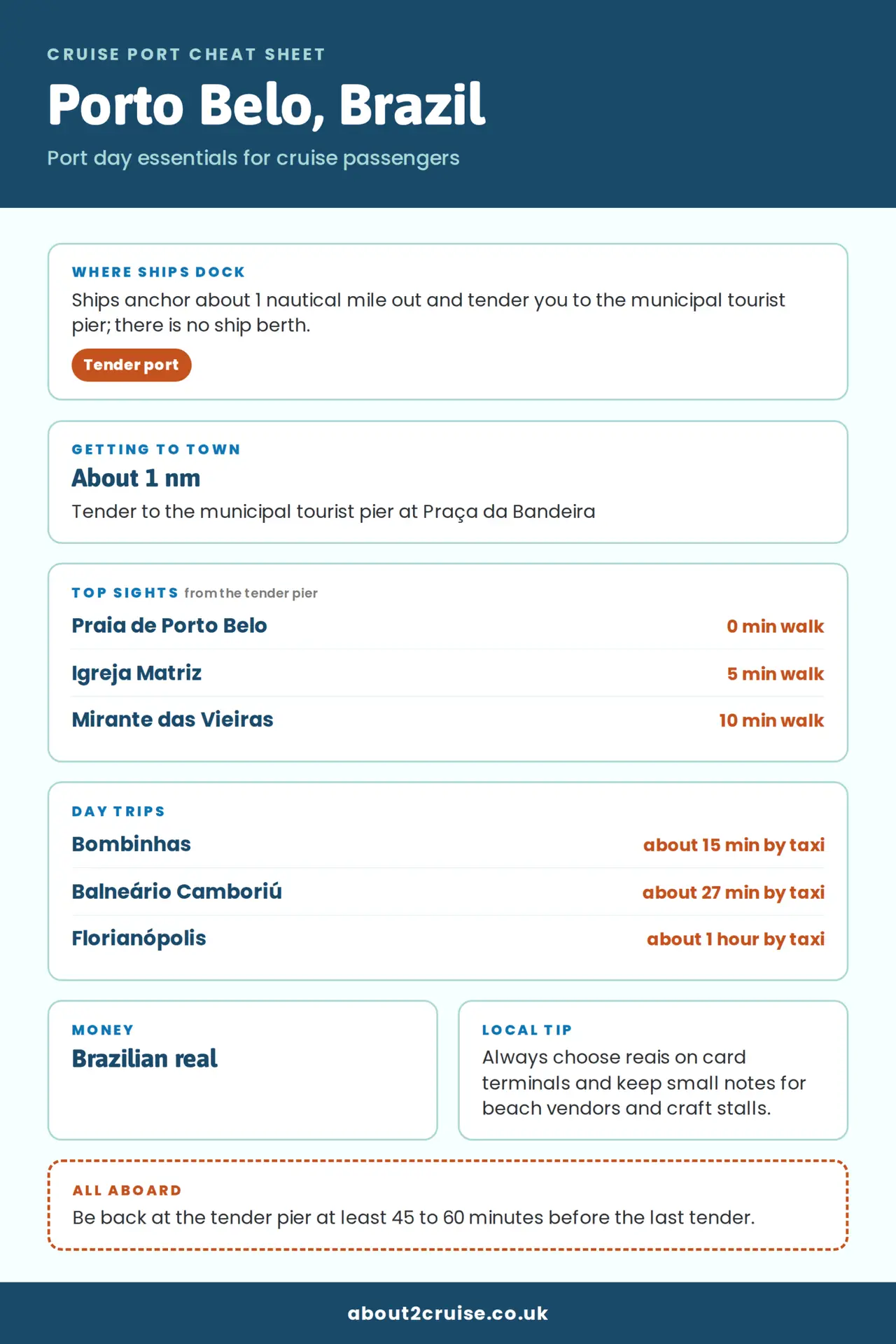
Porto Belo is a tender-only cruise stop on Brazil’s Santa Catarina coast. Ships anchor in the bay and tender you to the municipal tourist pier in the town centre. You can go ashore without an excursion: beaches, boat trips, seafood, shops and taxis sit right at the landing point. Most people split the day between the Ilha de Porto Belo boat crossing, a beach run to Bombinhas and a long seafood lunch.
Going Ashore Independently in Porto Belo
Yes. In Porto Belo, the tender is simply the ship’s transport to shore, it is not part of a shore excursion, and you do not pay separately to use it. Passengers on ship tours normally get the earliest tenders, while independent passengers follow with numbered tender tickets or the cruise line’s app queue.
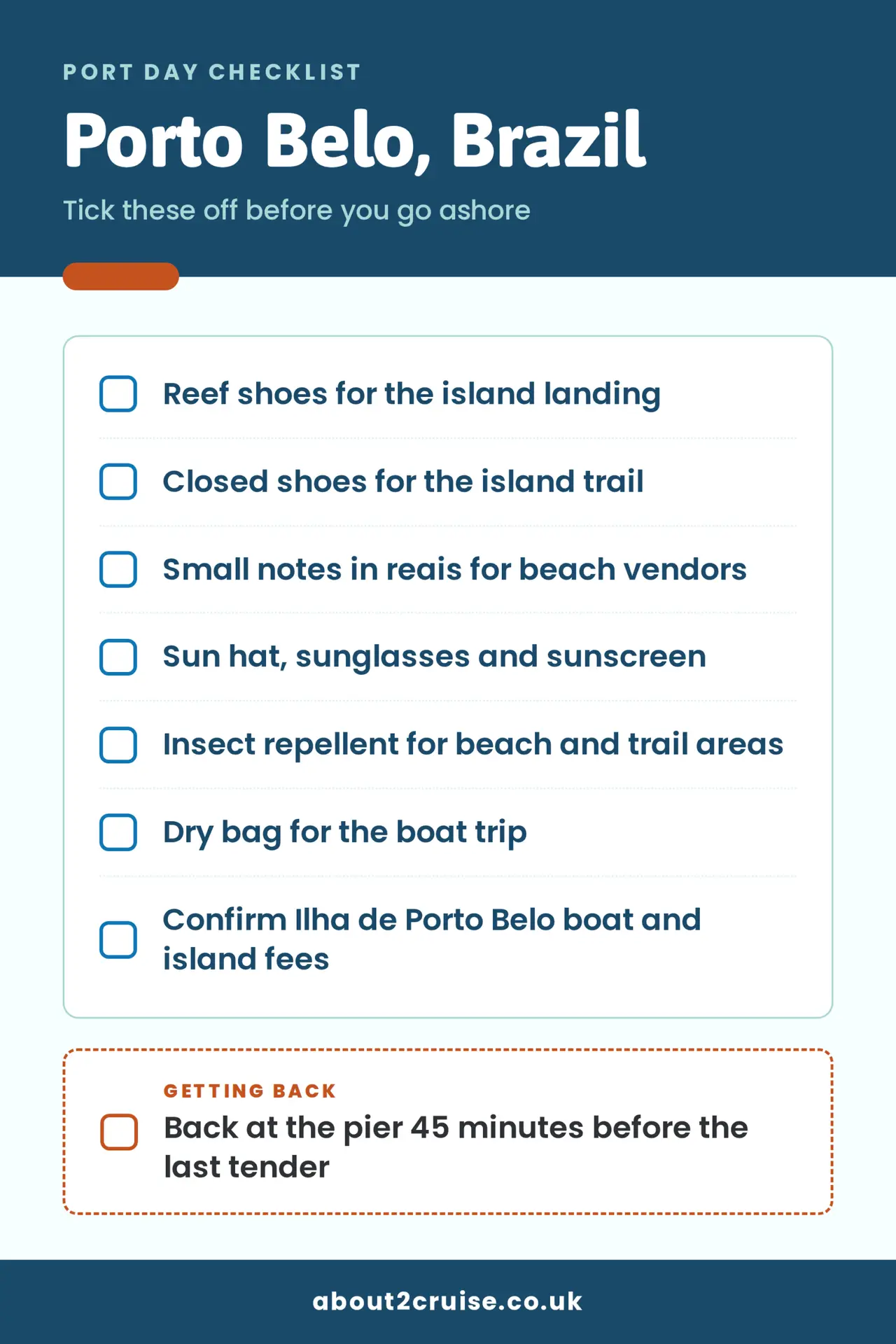
You land at the municipal tourist pier, not inside a restricted port complex, so there is no shuttle bus or excursion ticket needed to reach the town. The one thing to take seriously is the last tender. Note the time on board, set it in your phone, and aim to be back at the pier 45–60 minutes before that. The cruise line’s excursion guarantee only covers the return if an official tour runs late, it has nothing to do with being allowed off the ship.
Porto Belo cruise port map
Tenders bring you ashore at Píer Turístico Municipal de Porto Belo. From the tender pier, Praia de Porto Belo is about a 2-minute walk, Praça da Bandeira about 4 minutes and Igreja Matriz Senhor Bom Jesus dos Aflitos about 17 minutes. Tap a pin for directions.
- Píer Turístico Municipal de Porto BeloWhere tenders land
- Praia de Porto BeloTown beach · About 2 min walk from the tender pier
- Praça da BandeiraTown square · About 4 min walk from the tender pier
- Igreja Matriz Senhor Bom Jesus dos AflitosMain church · About 17 min walk from the tender pier
- Mirante das VieirasLookout point · About 19 min walk from the tender pier
- Ilha de Porto BeloIsland · About 26 min walk from the tender pier
- Enseada EncantadaCoastal promenade · About 30 min walk from the tender pier
- Praia do PerequêTown beach · About 3 km from the tender pier
- Praia do EstaleiroBeach · About 4 km from the tender pier
- Caixa D’AçoSheltered cove · About 4 km from the tender pier
- Praia da SepulturaBeach · About 7 km from the tender pier
Porto Belo Tender Pier: What to Expect at the Landing
Porto Belo has no cruise ship berth. Ships anchor around one nautical mile from shore, and the anchorage can hold up to three cruise ships at once. You step ashore at the Píer Turístico Municipal, also called the IPTur or municipal tourist pier, behind Praça da Bandeira in the centre.
The pier is 184 m long and 5–7 m wide, with a 174 m² passenger terminal and four berths used only for transit passengers. Two berths are tender ramps and two are for schooners. Inside the terminal you’ll find tourist information, public toilets, Wi-Fi in the reception area and security. There is no left-luggage or baggage service, it is arrival and departure only.
The tender ride itself is short. The queue on the ship is usually the slow part. If you want to make an early boat trip, ask guest services about the independent tender ticket process as soon as you board or the night before.

Should You Book a Ship Excursion or Explore Porto Belo on Your Own?
Ship excursions here make the most sense when you are leaving the immediate Porto Belo–Bombinhas area. Typical cruise line programmes head to Balneário Camboriú for the Unipraias cable car and viewpoints, Florianópolis for city sightseeing and lunch, Blumenau for its Germanic heritage centre, or Beto Carrero World for families. Those trips involve long road transfers, and that is where the guaranteed return and early tender priority really matter.
If your plan is just the town, the Ilha de Porto Belo boat crossing or a beach in Bombinhas, an independent day is easy. The tender pier is central, licensed taxis and accredited vans wait on ship days, and local boat operators work from the same waterfront. The main thing that can go wrong is timing, a delayed boat or heavy traffic on the Bombinhas road can eat into your buffer.
Where the Tender Drops You: Walkable Porto Belo from the Pier
Step off the tender and you are already in the most useful part of Porto Belo. Praça da Bandeira is the square by the landing point. Avenida Governador Celso Ramos, the main commercial street, runs one block away with restaurants, shops, a pharmacy and services. Praia de Porto Belo, the town beach, sits right beside the pier and the waterfront promenade.
You can walk to the church square, Igreja Matriz Senhor Bom Jesus dos Aflitos, the Mirante das Vieiras lookout and the Enseada Encantada promenade without any transport.
For a simple port day, the walkable centre is enough: a coffee or beer, a seafood lunch, a stroll along the shore and a browse at the craft fair if a ship is in. If you want a proper beach or snorkelling day, take a taxi or van to Bombinhas, Bombas or one of the more sheltered coves.
What Makes Porto Belo Worth a Cruise Day
Porto Belo is a small Atlantic coastal resort and fishing town in Santa Catarina, part of the Costa Verde e Mar tourism region. It is much quieter than nearby Balneário Camboriú. The draw is a sheltered bay, an easy island crossing, boat trips with swim stops, good seafood and quick access to the beach-and-diving peninsula of Bombinhas. The town has Azorean-Portuguese roots, a modest historic centre and one of the most protected bays on this stretch of coast, which is why the schooner trips work well even with children.
Porto Belo and Bombinhas Beaches: Best Swimming Spots for Cruise Passengers
Porto Belo’s own central beach is convenient, but it is not the best swim spot. Praia de Porto Belo runs right beside the pier and works for a quick paddle, watersports and promenade views rather than a classic beach day.
Praia do Perequê, about 4 km from the centre, is the largest town beach with the best infrastructure. Praia do Estaleiro is smaller and clearer, reached by a 150 m trail from the car park, and good for snorkelling. Caixa D’Aço is a sheltered cove with calm green water and floating restaurants in high season, but parking is very limited, boat access helps.
For many cruise passengers, the stronger beach choice is Bombinhas. It is only about 5 km to Bombas and about 8 km to Bombinhas centre, though the single SC-412 access road can get busy. Bombinhas and Canto Grande face the calmer mar de dentro side and suit families. Sepultura, Lagoinha and Conceição have natural pools and the easiest snorkelling. Quatro Ilhas and Mariscal are the surf beaches.
Bombinhas has 39 beaches in about 35 km², so you can pick a different micro-beach depending on wind and swell. If you travel by road in summer, outside vehicles pay an environmental entry fee: around R$40 for a car, R$80 for a van or microbus and R$200 for a coach, from roughly 15 November to 15 April.
Ilha de Porto Belo Boat Trips and Marine Wildlife
The headline local trip is the crossing to Ilha de Porto Belo, about 900 m offshore. Boats leave from the municipal tourist pier area, and operators sell several lengths of trip. A shorter Caixa D’Aço and island trip can be about 1.5 hours; an Estaleiro and island trip about 2.5 hours; and the longer Bombinhas-with-island trip about 3.5 hours. Published prices in local sales range from about R$80 to R$160 per adult depending on route, with children’s fares and a minimum passenger number.
The pirate-themed schooner runs set departures, has an onboard bar, shade awnings, toilets and a waterslide at the swim stop, and children under six do not pay. These are not ship private charters, they run for general visitors and can sell out on busy days, so book or confirm at the pier as early as possible.
The island itself has a 1.3 km circular trail of medium difficulty with views and rock inscriptions, plus the free Ecomuseu Univali. Landing and trail fees are quoted inconsistently by local sources, so confirm the combined boat, landing and trail price at the pier before you pay. The last boat back from the island is quoted at 16:30 or 17:30 depending on the source and season; never assume a late return. If a strong south wind is blowing, the island crossing may be cancelled.
Marine wildlife is part of the appeal. The protected Arvoredo marine biological reserve lies offshore between Florianópolis and Bombinhas and keeps the broader ecosystem rich. On a boat day you may see turtles, seabirds and clear-water rocky coves. Recreational diving is tightly controlled, but snorkelling and boat swim stops are the easy way in.
Diving and Snorkelling Near Porto Belo and Bombinhas
Bombinhas markets itself as Santa Catarina’s ecological diving capital. The Reserva Biológica Marinha do Arvoredo is a federal no-take reserve, and general visitors are not allowed inside. Licensed dive operators work at the permitted southern end of Ilha do Arvoredo, outside the reserve boundary, usually in depths of about 5–20 m with turtles, reef fish and coral. This is a prebooked activity, not a walk-up pier option, and weather changes the plan quickly.
For a short cruise call, snorkelling is more realistic. Praia da Sepultura in Bombinhas is the easiest beach-entry spot, a small cove reached by a short walk from the parking on Rua Garoupa, with a submerged sculpture on the sandy bottom. If you want a try dive, local operators quote roughly R$495–650 per person depending on whether it includes boat transport, equipment and snorkelling. Visibility is usually best in the warmer months; a south wind can stir up the water within hours.
Where to Eat: Seafood and Local Food in Porto Belo
Porto Belo and the surrounding Santa Catarina coast are serious about seafood. Expect shrimp grilled or in garlic butter, squid, mussels, oysters and the seasonal tainha mullet, especially from May to July. Traditional plates are built around pirão, a stock thickened with cassava flour, and farofa, often made with fish roe. Local restaurant competitions have highlighted grilled tainha with banana farofa, shrimp ravioli, grilled fish with shrimp pirão and cachaça-based desserts.
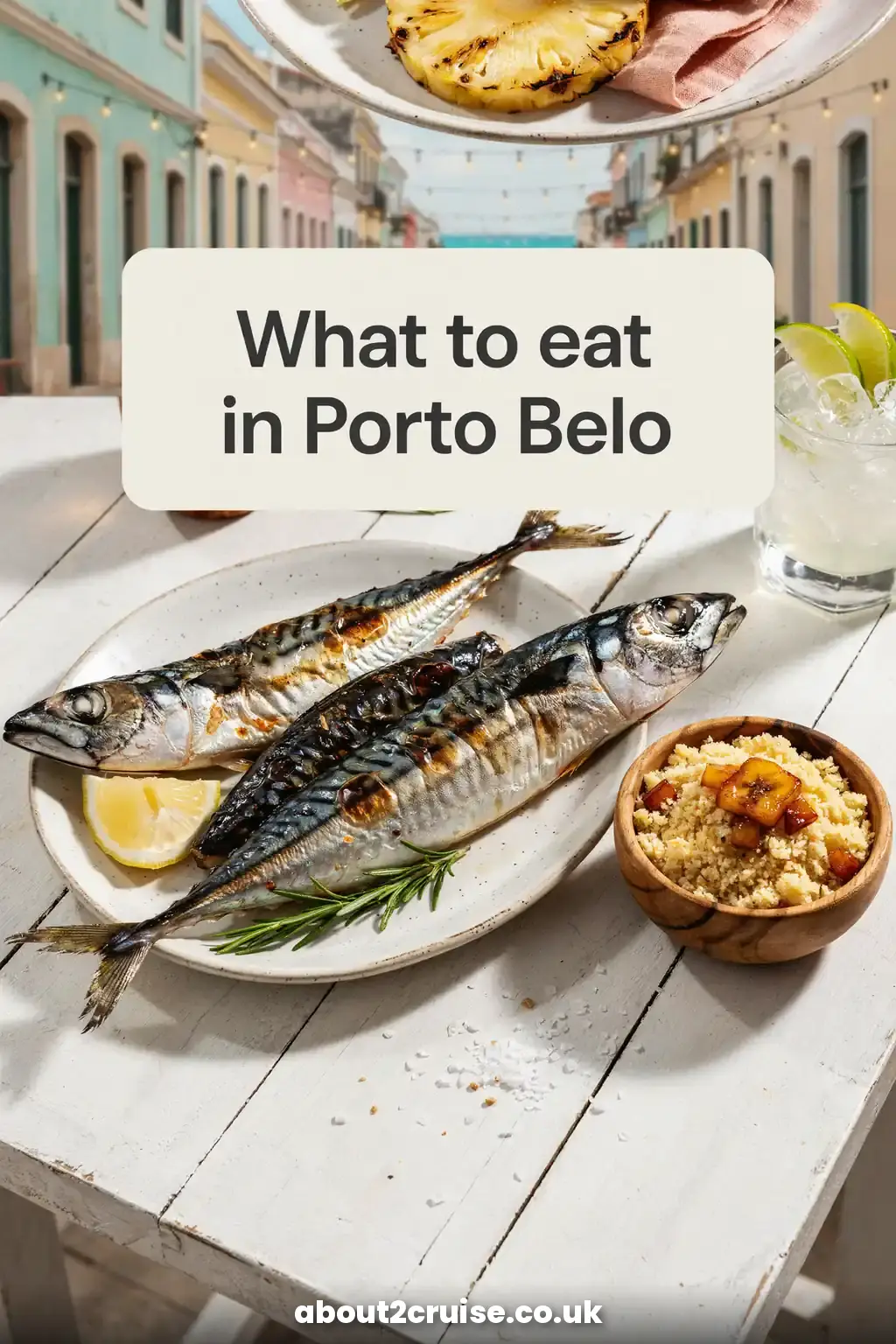
The simplest memorable order is fresh catch of the day, rice, pirão and a caipirinha. The easiest place to eat is along Avenida Governador Celso Ramos, one block from the tender landing, or in the central waterfront area. In season the town runs seafood and risotto events at Praça da Bandeira with a craft fair, but you do not need a festival to eat well. Restaurants cluster in the centre and at Perequê. A 10% service charge is normally added to the bill and serves as the tip.
Getting Around Porto Belo: Taxis, Vans, Ride-Hailing and Key Distances
Licensed Porto Belo taxis and accredited vans are allowed to work directly at the pier on ship days. You can negotiate a van on land beside the pier; the municipality limits the number of accredited vans, but there are usually enough for a normal call. Coaches or minibuses at the pier are generally only for ship-contracted tours. Ride-hailing exists in the region, but availability in Porto Belo itself is thinner than in Itapema or Balneário Camboriú, so do not rely on an app for a tight plan.
Useful road distances are: Bombas about 5 km; Bombinhas about 8 km and roughly 13–15 minutes without traffic; Balneário Camboriú about 26 km and 27 minutes; Florianópolis centre about 66–67 km and about an hour; and Florianópolis airport about 81–82 km and roughly 1 hour 15–20 minutes. Navegantes airport is about 47–50 km. There is no train.
Local buses serve the region, but they are not a good use of a short cruise day unless you know the timetable and stops; a taxi or van is the safer independent option.
If you are heading to Balneário Camboriú, the main sights and cable-car timing are covered in our Balneário Camboriú guide. If your cruise also calls at Itajaí, do not assume the same port-day plan transfers, that port has its own terminal and access.
Porto Belo or Bombinhas: How to Choose on a Short Cruise Stop
Choose Porto Belo if you want the simplest possible day: tender ashore, walk the historic centre and promenade, take a boat trip or island crossing, eat seafood and stay near the pier. Choose Bombinhas if your priority is a better beach, clearer water and snorkelling.
They are not mutually exclusive if your call is long, but trying to do a full island hike and three Bombinhas beaches can become rushed. A realistic independent plan is a morning boat trip or island crossing, lunch in Porto Belo, and then a taxi to one Bombinhas cove if time allows. If the ship arrives late or the last tender is early, pick one base and stay there.
Timing Your Porto Belo Port Day Around Tenders and Boat Schedules
Published Porto Belo calls often run from around 07:00 to 19:00, but there is no universal schedule. Some ships arrive at 08:00 or 09:00, and some departures are 16:00–18:00. The local schooner departures are usually set around 10:00, 11:00, 14:30 and 16:30, so a comfortable independent boat day needs an early tender and a ship departure no earlier than late afternoon.
The last boat back from Ilha de Porto Belo may be 16:30 or 17:30; treat the earlier time as the working one and confirm at the pier. Brazilian restaurant lunches tend to be leisurely, allow at least an hour. If you are going to Balneário Camboriú, the Unipraias cable car normally runs from about 09:00 or 09:30 until 17:30 or 19:00, with final boarding earlier, and it closes in strong rain or wind. Always work backwards from the last tender time announced on your ship, not from the port’s published opening hours.
Weather, Swell and Tender Cancellation Risk in Porto Belo
Porto Belo has a subtropical climate. January averages about 23–27°C with frequent rain; April is milder around 20–25°C; July is cooler at 14–19°C; November returns to 19–24°C. The southern Brazilian rainy season runs roughly November to March.
A cold front with south winds can stir up a 2.0–2.5 m swell and strong gusts along this coast, and that is exactly what can stop tendering. Cruise calls at Porto Belo have been cancelled or diverted because the bay became unsafe for tender boats, even when the town itself looked fine. If the sea is marginal, the captain will prioritise safety, and your port call may be shortened or missed.
Boat trips sometimes run in rain because the vessels have covered areas, but they will not run in rough sea. If the island crossing is cancelled, fall back to the town, a taxi to a sheltered beach or a shopping and outlet day. UV is high in Brazil, and mosquito-borne illnesses are present; use sunscreen and insect repellent.
Money, Cards and Tipping in Porto Belo
The currency is the Brazilian real. Visa and Mastercard are accepted almost everywhere, including small cafés and beach kiosks, and contactless is common. American Express is more hit and miss. Keep some small notes for beach vendors, craft stalls and tips.
When a card terminal offers to charge you in pounds or reais, always choose reais so your own bank sets the exchange rate. Restaurants usually add a 10% service charge; that is the tip, and you do not need to add more unless service was exceptional.
ATMs at bank branches are the most reliable. Banco24Horas machines can charge R$20–35 per withdrawal and may be less friendly to foreign cards. Porto Belo has Banco do Brasil, Bradesco and Caixa branches in town, but do not plan a port day around finding a specific machine; bring a small amount of cash from home or use cards.
Language Tips and Useful Portuguese Phrases for Your Porto Belo Stop
Portuguese is the language, and English is not spoken everywhere. Tour desks and some restaurant staff in tourist-facing spots may have basic English, but a few phrases help and are appreciated. If you speak Spanish, do not assume everyone understands it; some do, but Portuguese is safer.
- Bom dia / Boa tarde: good morning / good afternoon
- Por favor: please
- Obrigado (if you are male) / Obrigada (if you are female): thank you
- Quanto custa?: how much does it cost?
- Onde fica a praia?: where is the beach?
- A que horas sai o barco?: what time does the boat leave?
- A conta, por favor: the bill, please
- Aceita cartão?: do you accept card?
- Não entendi: I didn’t understand
- Pode falar mais devagar?: can you speak more slowly?
- Eu não falo português: I don’t speak Portuguese
Staying Safe on an Independent Day in Porto Belo
Porto Belo does not have a specific Foreign Office regional warning, but the usual Brazil safety rules apply. Use only licensed taxis or accredited vans from the pier; do not hail a taxi in the street. If you use a ride-hailing app, check the plate and driver.
Avoid taking valuables to the beach, do not leave phones or bags unattended on the sand, and do not wander on city beaches after dark. Leave passports and spare cards in your cabin safe; carry only your cruise card, photo ID and the cash or card you need.
The ocean can have strong currents. Follow lifeguard flags and local advice, especially at the surf beaches around Bombinhas. The pier area has access control and port security, and the busiest cruise-day areas are managed, but the town is not a closed resort.
What to Pack for a Porto Belo Beach or Boat Day
For a beach or boat day, pack light clothing, a hat, sunglasses and high-factor sunscreen. Bring reef shoes or sandals with grip for the island landing and rocky sections. If you plan the island trail, closed shoes are better.
A lightweight rain layer is useful, and insect repellent is worth having for beach and trail areas. Take a dry bag or waterproof phone pouch for boat trips, a reusable water bottle, and a small amount of Brazilian cash. If you are swimming, many people bring a quick-dry towel from the ship.
Shore Facilities, Family Activities and Accessibility at the Tender Pier
The passenger terminal at the pier has public toilets, tourist information, Wi-Fi in the shore reception area and security. There is no left luggage and no baggage service. The central waterfront and Praça da Bandeira are flat and easy for most people, but the tender transfer itself is the main accessibility barrier. Cruise lines warn that tenders may be unsuitable for wheelchair users, scooter users or anyone with balance problems because you step across a moving gap or down a gangway.
Families are well served for a beach day. The pirate schooner has shade, toilets and a waterslide at the swim stop, and children under six do not pay. The island trail is not suitable for anyone with reduced mobility, and the Bombinhas peninsula’s best viewpoints usually involve walking or climbing. In Balneário Camboriú the Unipraias cable car is the accessible option if you are heading that way.
Shopping and Souvenirs Near the Porto Belo Cruise Pier
On ship days, a craft fair is usually set up around Praça da Bandeira and the pier reception, selling ceramics, wood carving, paintings, costume jewellery, bobbin lace, local cachaça, biscuits and jams. This is the easiest souvenir stop because it is right at the tender landing.
If you want a more substantial indoor retail fix, Porto Belo Outlet Premium is on the BR-101 at km 159, about 7 km from town, open daily 10:00–22:00 with more than 100 brands and food options. A supermarket and pharmacy sit within about 250 m of the pier for essentials.
Rainy-Day and Bad-Weather Alternatives from Porto Belo
If the weather turns or tendering leaves you with a shorter day, the outlet centre on the BR-101 is the most comfortable indoor option. Bombinhas has small museums, including a marine aquarium museum and a community museum at Engenho do Sertão, but they are not a replacement for the beaches if the sea is rough.
The Ecomuseu Univali on Ilha de Porto Belo is free, but you still need a boat crossing; if the sea is bad enough to cancel boats, scratch that idea. The Unipraias cable car in Balneário Camboriú also closes in strong rain or wind, so it is not a reliable wet-weather fallback.
Great Photo Spots in Porto Belo and Bombinhas
For easy photos, walk from the pier to Praça da Bandeira and the church square. The Igreja Matriz Senhor Bom Jesus dos Aflitos, the little boats in the bay and the Mirante das Vieiras deck make a simple local set. The Enseada Encantada promenade looks across to the island and is the sunset spot if your ship leaves late.

In Bombinhas, the Mirante das Ilhas at Quatro Ilhas and the top of Morro do Macaco give the big peninsula views, and Praia da Sepultura is the classic cove shot between two rocky points.
Is Porto Belo Worth Visiting on a Cruise? A Straight Answer
Yes, if you want an easy, low-pressure beach port rather than a heavy sightseeing day. Porto Belo is not a city packed with monuments. It works because the tender puts you in a walkable town with seafood, a bay, a boat-accessible island and quick road access to the beaches of Bombinhas.
If you want the big-name attraction day, use a ship excursion to Balneário Camboriú, Florianópolis, Blumenau or Beto Carrero World. If you want to come back on board feeling like you had an actual Brazilian beach day, Porto Belo and Bombinhas do that well.
How to spend a port day in Porto Belo
A port day in Porto Belo works best if you pick one: an easy island boat and town day, or a taxi to the beaches at Bombinhas. The tender lands in the centre, so independent plans are simple.
Before you sail
- Book diving or try-dives with a licensed operator before the cruise, as they are not pier walk-ups.
- Check the ship's last tender time and independent tender ticket process as soon as you board.
- Bring small notes in Brazilian reais for beach vendors and craft stalls.
Short port day: under 6 hours
- On dockingTake the tender to the municipal tourist pierTender onlyShips anchor about 1 nautical mile out. Independent passengers can go ashore without an excursion; tour groups leave on the first tenders.
- +15 minBoat crossing to Ilha de Porto BeloConfirm last boatBoats leave from the municipal tourist pier. Confirm combined boat, landing and trail fees at the pier and book early, as trips can sell out.
- +2 hrsWalk the town and church squareBack on shore, walk from Praça da Bandeira to the Igreja Matriz and the waterfront. The centre is flat and easy.
- +2 hrs 45 minSeafood lunch near the waterfrontTry tainha or pirãoOrder grilled tainha with pirão or catch of the day along Avenida Governador Celso Ramos, one block from the pier.
- +3 hrs 30 minCraft fair and town beachShip-day craft stalls set up near Praça da Bandeira. Finish with a paddle or shoreline stroll at Praia de Porto Belo.
- All-aboard minus 1 hrBack at the tender pierTender queues build at the end of the day. If you are not on an early one, do not wait for the last.
The time on the map is the whole walk, every stop added together.
Open this walking route in Google Maps
If plans change: If the island boat is cancelled, walk the Enseada Encantada promenade and take a taxi to Praia do Perequê instead.
Long port day: 8 hours or more
- On dockingTake the tender to the municipal tourist pierTender onlyShips anchor about 1 nautical mile out. Tour groups leave on the first tenders, so independent passengers should get an early slot.
- +15 minTaxi to Praia da SepulturaLicensed taxi onlyUse a licensed Porto Belo taxi or accredited van from the pier. The drive to Praia da Sepultura is about 8 km and roughly 15 minutes.
- +45 minSnorkel at Praia da SepulturaReef shoesThis small cove is the easiest beach-entry snorkel spot, with a submerged sculpture on the sandy bottom. Swim where others are swimming and respect flags.
- +2 hrsTaxi back to Porto Belo centreReturn to Porto Belo by licensed taxi or accredited van. Leave with enough time for lunch and a boat trip later.
- +2 hrs 45 minSeafood lunch near the waterfrontTry tainha or pirãoOrder grilled tainha with pirão or catch of the day along Avenida Governador Celso Ramos, one block from the pier.
- +4 hrsIlha de Porto Belo boat tripConfirm last boatTake the boat crossing from the municipal tourist pier. Confirm the last boat back and the combined fees at the pier before going.
- +5 hrs 30 minCraft fair and Mirante das VieirasBack on shore, browse the craft stalls near Praça da Bandeira and walk the small deck at Mirante das Vieiras for bay views.
This map shows the taxi ride from the ship. The time is the drive only, not your time ashore.
Open the taxi route in Google Maps
If plans change: If the Bombinhas road is too slow or taxis are scarce, stay in Porto Belo and do the island boat trip plus the town viewpoints instead.
Porto Belo Port-Day FAQs: Luggage, Language, Cards, Uber and More
Is there luggage storage at the cruise pier?
No. The terminal handles transit passengers only and there is no documented left-luggage or bag service. If you are not staying overnight, take only what you need ashore.
How widely is English spoken?
You will find some English at tourist desks and larger restaurants, but it is not universal. A few Portuguese phrases and a translation app will make taxis, beach kiosks and small craft stalls much easier.
Do beach kiosks and craft stalls take cards?
Most shops and restaurants do, and contactless card use is common. Small vendors and some beach stalls may prefer cash, so keep small notes in reais if you plan to buy drinks, snacks or crafts.
Is Uber or 99 available at the cruise pier?
Ride-hailing exists in the region, but availability in Porto Belo itself can be thinner than in Balneário Camboriú or Itapema. The reliable port-day option is the licensed taxis and accredited vans waiting at the pier.
Can I visit Florianópolis independently from Porto Belo?
You can, but it is about an hour each way by road, and you would need a very long call and a trustworthy driver. Most cruise passengers heading to Florianópolis do it on a ship-organised tour for the guaranteed return.
Are there lifeguards and safe swimming beaches?
Popular beaches often have lifeguard posts or flag systems in the summer season, but cover is not guaranteed at every cove. Strong currents are a real hazard on surf beaches. Ask locally, swim where others are swimming and respect flag warnings.