
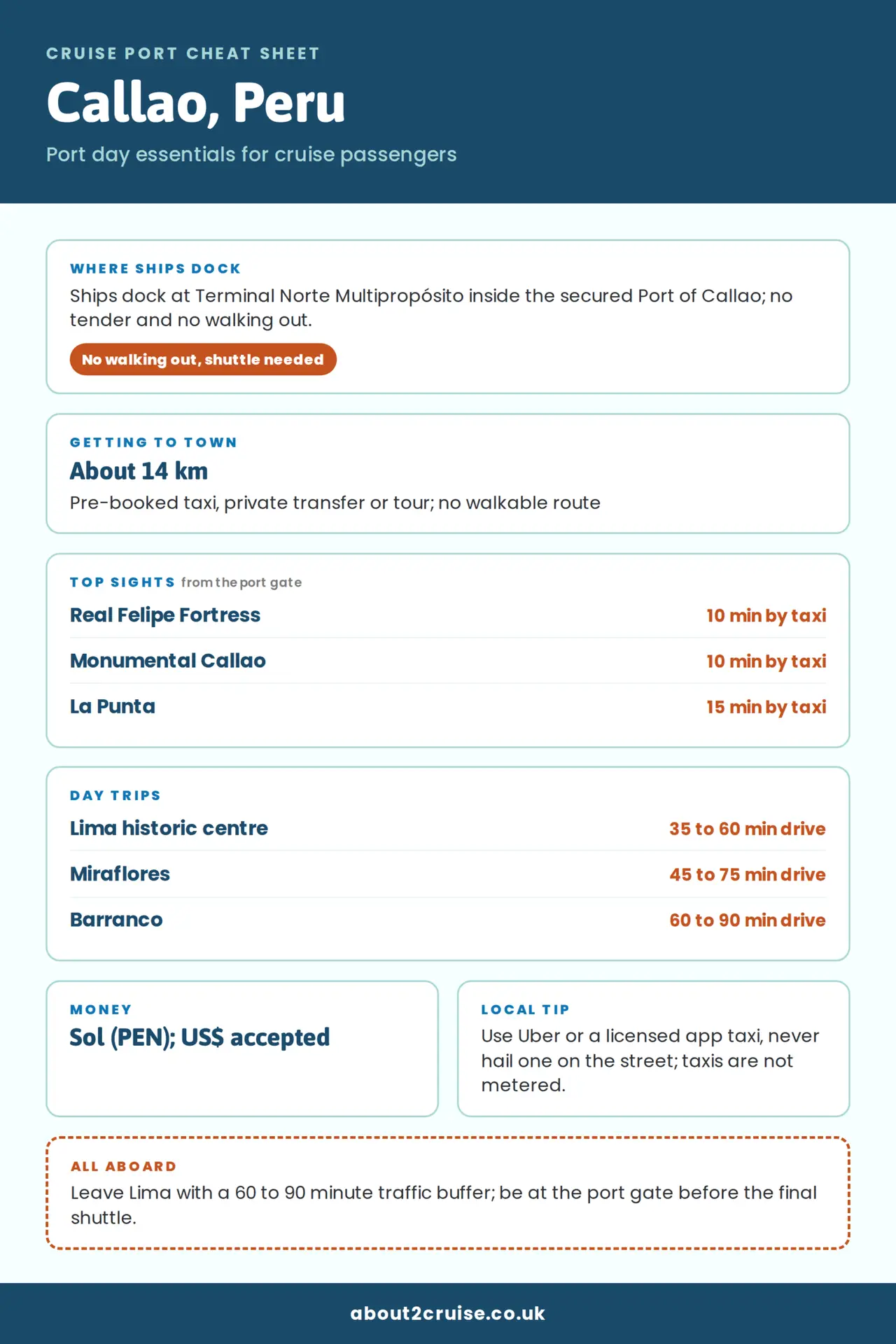
Callao is Lima’s working cruise gateway. Ships dock at the Terminal Norte Multipropósito inside the secured, industrial Port of Callao, roughly 14 km from Lima’s UNESCO-listed historic centre and 20 km from Miraflores. You cannot walk off the quay or out of the port independently. The realistic port day is a pre-arranged transfer or tour, with road times set by Lima’s heavy traffic and a healthy buffer before all-aboard.
Where Your Ship Actually Docks in Callao
Let’s clear up the biggest confusion first: cruise ships do not berth in Lima’s historic centre or in Miraflores. They dock alongside at Terminal Norte Multipropósito, also known as Muelle Norte, inside the Port of Callao. The terminal address is Av. Contralmirante Raygada 111, Callao, and there is no tender: your ship ties up directly at the quay.
The port is an active commercial cargo area and a secure zone. Private vehicles and pedestrians are not allowed to enter freely, and there are no safe pedestrian routes from the quay to the port gate. Passengers are transferred from the ship’s side to a gate or passenger-handling area by shuttle or organised transport. Do not attempt to walk off the ship or through the port.
The cruise terminal itself has limited facilities, so treat it as a transit point rather than a passenger terminal with shops and cafés.
Callao’s cruise season generally runs from October to April, which overlaps with the best time to visit Lima’s coastal districts. The port is also an embarkation and disembarkation point for some South America cruise itineraries, not only a day call.
Callao cruise port map
Ships dock at Terminal Norte Multipropósito. From there, Real Felipe Fortress is about a 27-minute walk. Tap a pin for directions.
- Terminal Norte MultipropósitoWhere ships dock
- Real Felipe FortressHistoric fortress · About 27 min walk from Terminal Norte Multipropósito
- La PuntaSeaside neighbourhood · About 3 km from Terminal Norte Multipropósito
- ChucuitoOld fishermen’s quarter · About 2 km from Terminal Norte Multipropósito
- Plaza Mayor de LimaMain square · About 12 km from Terminal Norte Multipropósito
- Cathedral of LimaCathedral · About 12 km from Terminal Norte Multipropósito
- San Francisco Convent and CatacombsConvent and catacombs · About 13 km from Terminal Norte Multipropósito
- Museo LarcoMuseum · About 8 km from Terminal Norte Multipropósito
- Parque del AmorPark · About 14 km from Terminal Norte Multipropósito
- LarcomarAbout 15 km from Terminal Norte Multipropósito
- Huaca PucllanaAncient sacred site · About 14 km from Terminal Norte Multipropósito
- PachacámacAbout 40 km from Terminal Norte Multipropósito
- Palomino IslandsSea lion islands · About 13 km from Terminal Norte Multipropósito
Can You Walk From the Callao Cruise Port Into Lima?
No. The port is a controlled industrial area with no pedestrian walkways connecting the ship to the outside, and Callao is not a walkable gateway to Lima. Even if you reached the port gate, you’d be standing in a busy working district with no practical pedestrian route to central Lima. The historic centre is about 14 km away, and Miraflores is around 20 km away.
Realistic road transfer times, depending on traffic:
- Callao port to Lima’s historic centre and Plaza Mayor: roughly 35–60 minutes each way.
- Callao port to Miraflores: roughly 45–75 minutes each way.
- Callao port to Barranco: roughly 60–90 minutes each way.
- Callao port to Jorge Chávez International Airport: about 10–15 minutes, often under 5 km.
Callao’s own sights, such as Real Felipe fortress and Monumental Callao, are much closer, around ten minutes by vehicle, but still not safe or practical to reach on foot from the terminal.
Should You Stay in Callao or Head Into Lima?
The biggest decision on a Callao port day is whether to stay close to the ship or commit to Lima’s traffic. Callao is gritty, historic and much closer, but its visitor area is small and rough around the edges. Lima offers the polished coastal districts, the UNESCO historic centre, world-famous restaurants and major museums, but you’ll spend at least 90 minutes to two hours in traffic on a return trip, and you still need a buffer before sailing.
If you want a lower-stress, shorter day with fortresses, painted streets and port-city seafood, base your day in Callao. If it’s your first time in Lima and you want Plaza Mayor, Miraflores or the Larco Museum, go to Lima: but accept the traffic, book a reliable transfer, and build in at least 60–90 minutes of contingency before all-aboard, more on weekdays.
As a rough planning figure, treat a half-day independent visit to Lima as a minimum five-hour window ashore once you leave the port, excluding the ship’s arrival and departure formalities. If your cruise line offers a late stay, a full day is much more comfortable.
How Getting Ashore and Back Really Works
At Callao, the ship and port operator run a shuttle from the ship’s side to the gate or passenger area. Some cruise lines also run a shuttle beyond the gate to Miraflores or a city drop-off, but this is not guaranteed and the exact service varies by line and voyage. Ask at the shore excursion desk or guest relations early in your cruise which Callao transfer is offered: a port-gate shuttle is not the same as a city-centre shuttle.
Taxis are not metered in Lima. Taxis and private cars are not allowed to enter the port freely unless pre-authorised, so your driver or operator will normally meet you outside the port gate or at a designated passenger area. Use a licensed phone or app taxi, a pre-booked private transfer, or a tour operator that includes port pickup. Do not hail street taxis outside the port, and do not accept unsolicited offers from people claiming to be taxi drivers at the gate or airport.
Ride-hailing apps are widely used in Lima and are usually safer than street taxis, but you should still check the driver and vehicle before getting in. Keep doors locked and windows closed in slow-moving traffic, and keep bags out of sight.
Allow serious buffer time returning to the ship. Weekday Lima traffic can be congested, and the ring roads around Callao are used by port trucks. Missing the ship because of traffic is a real risk if you cut return times too fine. For a typical 17:00 all-aboard, a return pickup from Miraflores at 15:00 can feel tight on a bad traffic day, so aim to leave central Lima earlier than you think.
Callao vs. Lima: Gritty Port City or Polished Capital?
Callao is Peru’s largest seaport and the port for Lima. The port city itself has around a million people within greater Lima, which holds about 10.5 million. Callao has a real maritime and colonial identity, but its reputation is rougher than Miraflores or Barranco. The port authority’s own reviews note a lack of passenger infrastructure, signage and facilities around the terminal, and UK travel advice highlights street crime and robbery risk in the wider Lima area.
Lima’s coastal districts, especially Miraflores and Barranco, feel more like the Lima of travel photographs: clifftop parks, ocean views, cafés, restaurants, galleries and boutiques. They are safer and easier for an independent visitor, but they are farther from the ship. The historic centre is architecturally spectacular but can be crowded, and protests or political demonstrations sometimes restrict access around Plaza Mayor.
If you want polished and predictable, head to Miraflores or Barranco. If you want a close, port-specific day with colonial defences and street art, Callao’s compact visitor zone can work well: but you should stay with a guide or organised tour rather than wandering unaccompanied.
What to See in Callao Itself
Callao is not only an industrial tangle. Its historic zone and nearby districts have enough to fill a short, low-traffic port day.
- Real Felipe Fortress: Built from 1747 to a French engineer’s design, this is the army museum and the only surviving Spanish fortress in Peru. Adult entry is about S/12, children 5–12 pay about S/5, and the guided service is included. It opens Monday to Sunday from 09:00 to 16:30, with night tours on Fridays and Saturdays at 18:30. The courtyards are partly accessible, but ramparts, towers and cobbled areas involve stairs.
- Monumental Callao: A private urban-art regeneration project in the Castilla neighbourhood, built around more than 60 painted walls by international street artists, plus galleries, design shops and open studios. Guided tours run Tuesday to Sunday at 12:00 and 15:00, last around 1 hour 30 minutes, and cost about S/50 for foreign tourists, S/25 for locals and S/15 for children aged 6–12. The meeting point is Jr. Constitución 250, Callao.
- La Punta and Chucuito: La Punta has republican-era houses and a naval, maritime feel with pebble beaches and seafood restaurants. Chucuito is the old fishermen’s quarter, with early 1900s houses built by Italian migrants and brightly painted wooden façades. These are photo-friendly but best visited by taxi or organised tour, not on foot from the port.
- Palomino Islands: Half-day boat trips leave from the Plaza Grau pier in Callao, usually around 10:00–10:30 and return around 13:00–14:00. The route passes San Lorenzo, El Frontón and Cavinzas to the Palomino sea-lion colony, with about 40 minutes stopped to swim with sea lions. Expect to pay roughly S/149–S/159 for a yacht trip including wetsuit, life jacket, guide and motion-sickness tablet, plus the separate SERNANP reserve fee. This trip is not suitable for pregnant women or people with back, heart, respiratory or mobility problems, and the water is cold, ranging roughly 7–19°C.
Lima’s UNESCO Historic Centre and Plaza Mayor
Lima’s historic centre is on the UNESCO World Heritage List as a testimony to Spanish colonial urban development in Latin America. The core visit is Plaza Mayor, also called Plaza de Armas, ringed by the Cathedral, the Archbishop’s Palace and the Government Palace. A short walk away is the San Francisco convent and its famous catacombs.
A self-guided loop around the historic centre is about 3 km, roughly 45 minutes of walking, but allow 2.5–3.5 hours in total for entry stops, crossings and crowds. The route is level but the paving is uneven and the streets are busy. The Cathedral of Lima is open Monday to Friday 09:00–20:00, Saturday 10:00–22:00 and Sunday 13:00–19:00. Adult foreign entry is about S/30, and cash or card is accepted. The Cathedral and San Francisco monastery enforce a modest dress code: knees, shoulders and midriffs must be covered, and shorts or capri-length trousers are not permitted. Photography is not allowed inside the Cathedral or San Francisco monastery.
The San Francisco convent and catacombs are ticketed and guided, with a visit lasting around 45 minutes. Adult entry is about S/20, students about S/10 and children about S/5, with daily opening usually 09:00–17:30. Check on the day, as opening hours and ticket prices can shift.
Lima’s Food Scene: Ceviche, Pisco and World-Class Restaurants
Lima is one of the world’s great eating cities and the capital of South American gastronomy. Central, in Barranco, was named the world’s best restaurant by The World’s 50 Best Restaurants, and Maido, Kjolle and Mayta have also featured on the list. Peruvian cuisine was declared Cultural Heritage of the Nation, with ceviche, pisco sour, pisco and pachamanca separately recognised.
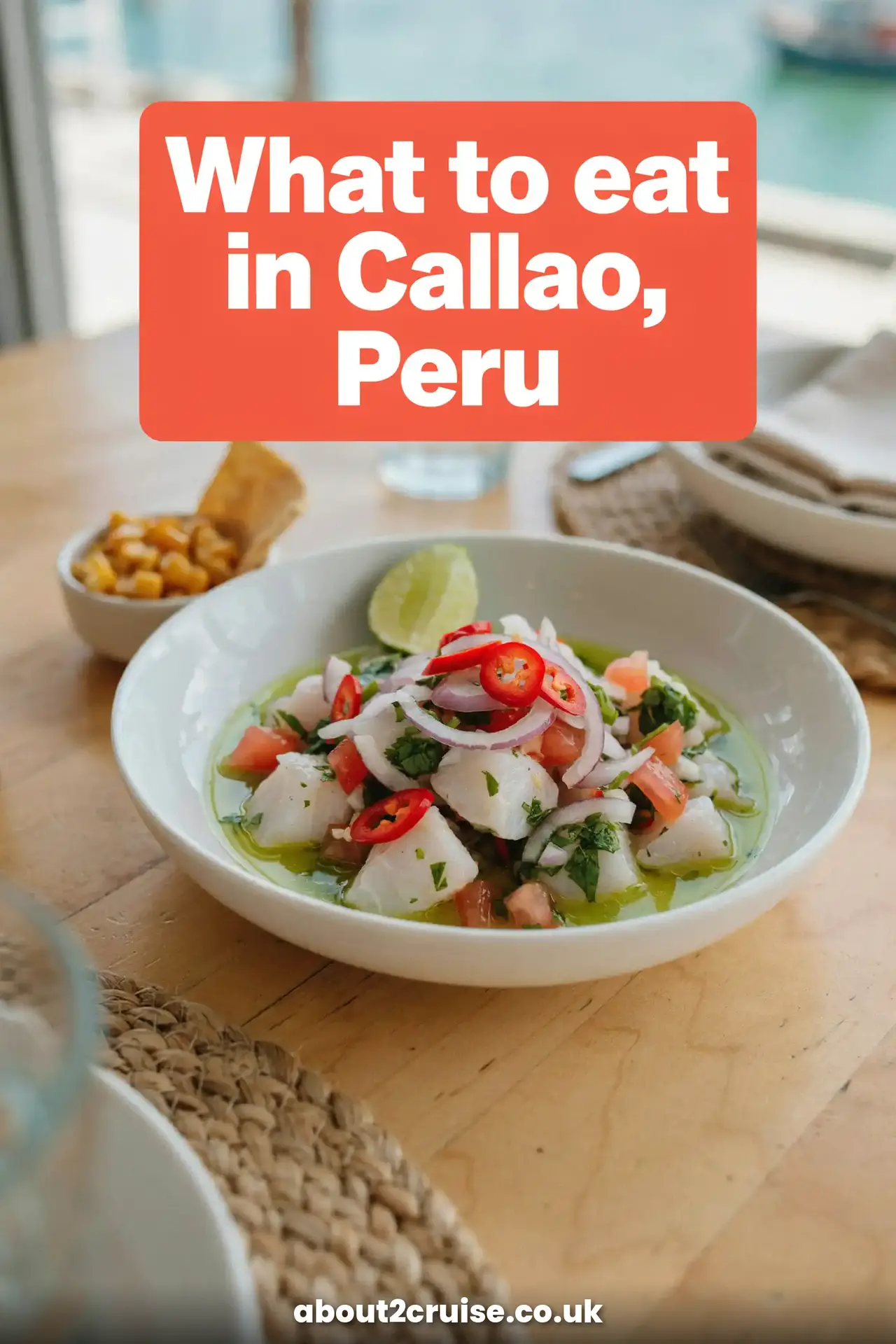
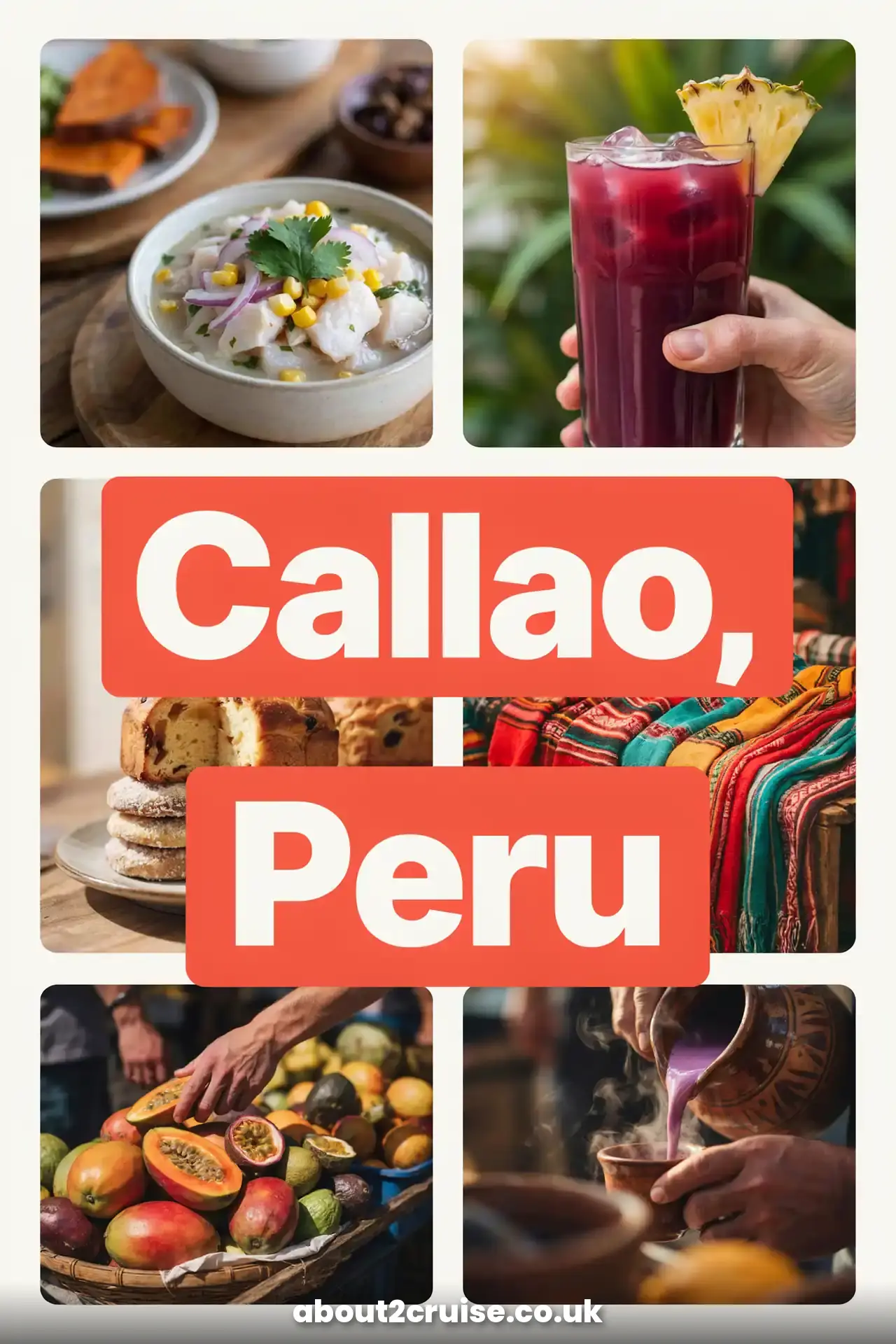
A short port day is not the time to tackle a long tasting menu at Central, but you can still eat well. For a classic Lima food experience, order ceviche with leche de tigre, a pisco sour, causa, jalea mixta or parihuela. Callao itself has a strong seafood tradition shaped by Cantonese, Italian, Mediterranean and French port migration. Its signature dishes include cebiche, leche de tigre, parihuela, choritos a la chalaca and pan con chimbombo. In La Punta, the fried silverside sandwich known as pan con pejerrey is the local snack.
If you are in Miraflores or Barranco, the high-end restaurant cluster is concentrated there, and a cliff-top pisco sour at sunset is one of the easiest Lima pleasures. Keep in mind that top-ranked restaurants need advance reservations, often weeks out, and are not compatible with a tight ship-day timetable unless you have a late departure or an overnight call.
Miraflores and Barranco: Lima’s Coastal Districts
Miraflores is Lima’s most-visited district for foreign and domestic tourists. Its attractions include cliff-top parks, Parque del Amor with the El Beso sculpture, Larcomar shopping centre and the Huaca Pucllana adobe pyramid. The Miraflores clifftop walk runs from Parque Kennedy via Parque del Amor to Larcomar, about 3.5 km and 50–60 minutes of walking. The route is paved but has steep slopes and steps down to the beaches.
Barranco is smaller, more bohemian and full of bars, galleries and cafés. Its centre walk is about 2.5 km, with slopes, steps and uneven surfaces. The Puente de los Suspiros and the Bajada de los Baños are the classic photo stops. If you have time for only one district on a ship day, Miraflores is the easier and more conventional choice; Barranco is better for food, art and a slower wander.
Museums and Ancient Sites: Larco, Pachacamac and Huaca Pucllana
Pre-Columbian Peru is one of Lima’s great cultural assets. The Museo Larco in Pueblo Libre is the best one-stop museum for most cruise passengers. It houses a superb collection of ceramics, gold, silver and textiles, with a free baggage and coat check where suitcases and backpacks must be left, free wheelchairs, ramps, accessible toilets, free Wi-Fi and texts in seven languages. General admission is about S/50 on site or S/45 online, seniors about S/35, and students and ages 9–17 about S/25. The museum is open daily including public holidays from 09:00 to 19:00, and it accepts cards and cash in soles or US dollars. It is roughly 35–50 minutes by taxi from Jorge Chávez airport and from Miraflores.
Pachacámac, south of Lima, is a major pre-Hispanic sanctuary and site museum. General admission is about S/15 for all nationalities, students about S/5 and ages 3–17 about S/1, with 50% off for over-60s, teachers and disabled visitors. It is open Tuesday to Saturday 09:00–17:00, Sunday 09:00–16:00, and closed Mondays. The guided service costs about S/50 for a group of 15–20 people and lasts about 1 hour 30 minutes on top of admission. The Pilgrims’ Route costs about S/20 and is guided only. Pachacámac works better as a half-day plus, but only if you have a long call and a pre-booked driver.
Huaca Pucllana in Miraflores is the easiest archaeology option if you are already in the district. Daytime general admission is about S/15, reduced about S/7.50, and night visits are about S/17. Daytime opening is Wednesday to Monday 09:00–17:00, night visits Wednesday to Sunday 18:45–21:00 by reservation, closed Tuesdays.
What a Realistic Callao Port Day Costs
For budgeting, a basic Callao-pickup Lima city tour including Plaza Mayor, the Cathedral, San Francisco catacombs and Miraflores starts around US$60–65 for roughly 4–4.5 hours. A city tour plus Larco Museum is commonly around US$85 for 6.5 hours, and some cruise-specific tours including catacombs entry sell at about US$99. These are operator prices, not cruise-line prices; ship excursions will usually cost more.
Independent ticket costs, if you arrange your own driver or transfer, stack up roughly as follows: Cathedral about S/30, San Francisco catacombs about S/20, Museo Larco about S/50, Real Felipe about S/12, Monumental Callao tour about S/50, Huaca Pucllana about S/15 and Pachacámac about S/15. A private driver for a half-day or full-day Lima transfer is often the largest independent expense, and taxis are not metered, so agree the fare in advance or use an app.
Ship Excursion, Private Tour or Independent Transfer?
For most first-time visitors, a ship excursion is the low-risk option at Callao. You are collected inside the secured port area or at the organised meeting point, the guide handles traffic and timing, and the ship knows where you are. The downside is cost, fixed group pacing and less freedom at food stops.
A private tour or pre-booked transfer with a licensed operator is more flexible and can be tailored to one or two sights, such as the historic centre plus lunch in Miraflores. Many operators cannot enter the port itself, so they meet passengers outside the port exit or at a nearby shopping centre. Confirm the exact meeting point before you leave the ship.
Fully independent travel by public transport is not practical from the cruise terminal. There is no usable public-transport connection to the berth, and the surrounding area is not where you want to improvise. If you are confident in Latin American cities and speak Spanish, a pre-booked ride-hailing car to Miraflores and back is possible, but you will still need to manage the port gate and buffer time yourself.
Staying Safe in Callao and Lima
UK travel advice warns that street crime including muggings and thefts is a significant problem in Lima, and there have been robberies at gunpoint in tourist areas such as Miraflores and Barranco. There is also a risk of robbery by criminals posing as taxi drivers, especially at Jorge Chávez airport and bus terminals. Use licensed phone or app taxis, do not hail taxis on the street, and use official taxi desks at the airport.
Callao has a higher crime profile than Miraflores or Barranco, especially outside the main visitor zones. The area around the port gate and the terminal approaches has had reported robberies, including by fake taxi drivers. In short: do not walk around the port gate, do not accept random taxi offers, and do not wander in Callao without a guide or organised group. Once in Miraflores or Barranco, stay alert, keep phones and bags close, and avoid quiet side streets after dark.
Do not photograph anything of a military nature anywhere in Peru. It is illegal and can carry a prison sentence of two to five years. In practice, keep your camera away from police and military installations, including around the port and Real Felipe fortress unless you are inside the visitor area.
Money, Cards, Tips, Language and Common Scams
Peru’s local currency is the sol, written S/ or PEN. Notes come in 10, 20, 50, 100 and 200 soles. US dollars are widely exchanged and accepted directly in many tourist establishments, but you will get better everyday prices in soles. ATMs are common in pharmacies, supermarkets and shopping malls. Major museums such as the Cathedral, Larco and Huaca Pucllana take cards; markets and taxis generally want cash.
Service charge is usually included in restaurants and hotels. Rounding up or leaving up to 10% extra is appreciated where service is not included. Counterfeit US and Peruvian banknotes are in circulation, and street money changers have used obsolete currency fraudulently. Change money in banks, hotels or official exchange offices, not on the street.
The local language is Spanish. English is spoken in tourist hotels, upmarket restaurants and guided tours, but less in the port area or ordinary taxis. A few basic phrases help: la cuenta, por favor for the bill, ¿cuánto cuesta? for how much, and no gracias for no thank you. Common scams include overcharging for unbooked taxis, fake tour guides, unsolicited help at ATMs, and switching banknotes or giving change in obsolete currency.
Weather, Packing and Sun Protection
Lima is a desert city with minimal rainfall, but it is often overcast and humid because of the cool Humboldt Current. The cruise season from October to April has daytime highs around 22–27°C and night-time minima around 16–21°C. May to October is the garúa season, with heavy cloud, mist and grey skies. Rain is unlikely for most of the year, but humidity is high, around 77–84%.
Pack sun protection even on cloudy days, a light layer or jacket for changeable coastal weather, and comfortable closed shoes for uneven streets and cobbles. If your itinerary includes Machu Picchu or Cusco before or after the cruise, pack for altitude cold and strong sun separately; Lima and Callao are at sea level.
Check the current El Niño outlook before travel. Heavy rainfall, flooding and landslides have caused disruption on Peru’s northern and central coast during strong El Niño events, and that can affect airport transfers, roads and shore excursion timing in some seasons.
Food and Water Safety Ashore
Diarrhoea from contaminated food or water is common in Peru. Stick to bottled or treated water, avoid ice unless you trust the establishment, and avoid raw unpeeled fruit and street food if you have a sensitive stomach. Busy, well-reviewed restaurants and hotel restaurants are a safer bet than stalls in the port area. Ceviche is a must, but it is a raw fish dish; choose a reputable restaurant rather than a market stall if you want to avoid a bad day at sea.
Tap water in Lima is not considered safe for drinking by most visitors. Use bottled water for drinking and brushing teeth, and do not accept taps refilled from open jugs. Good food hygiene is part of the Lima experience, but common sense reduces the risk.
Shopping and Souvenirs
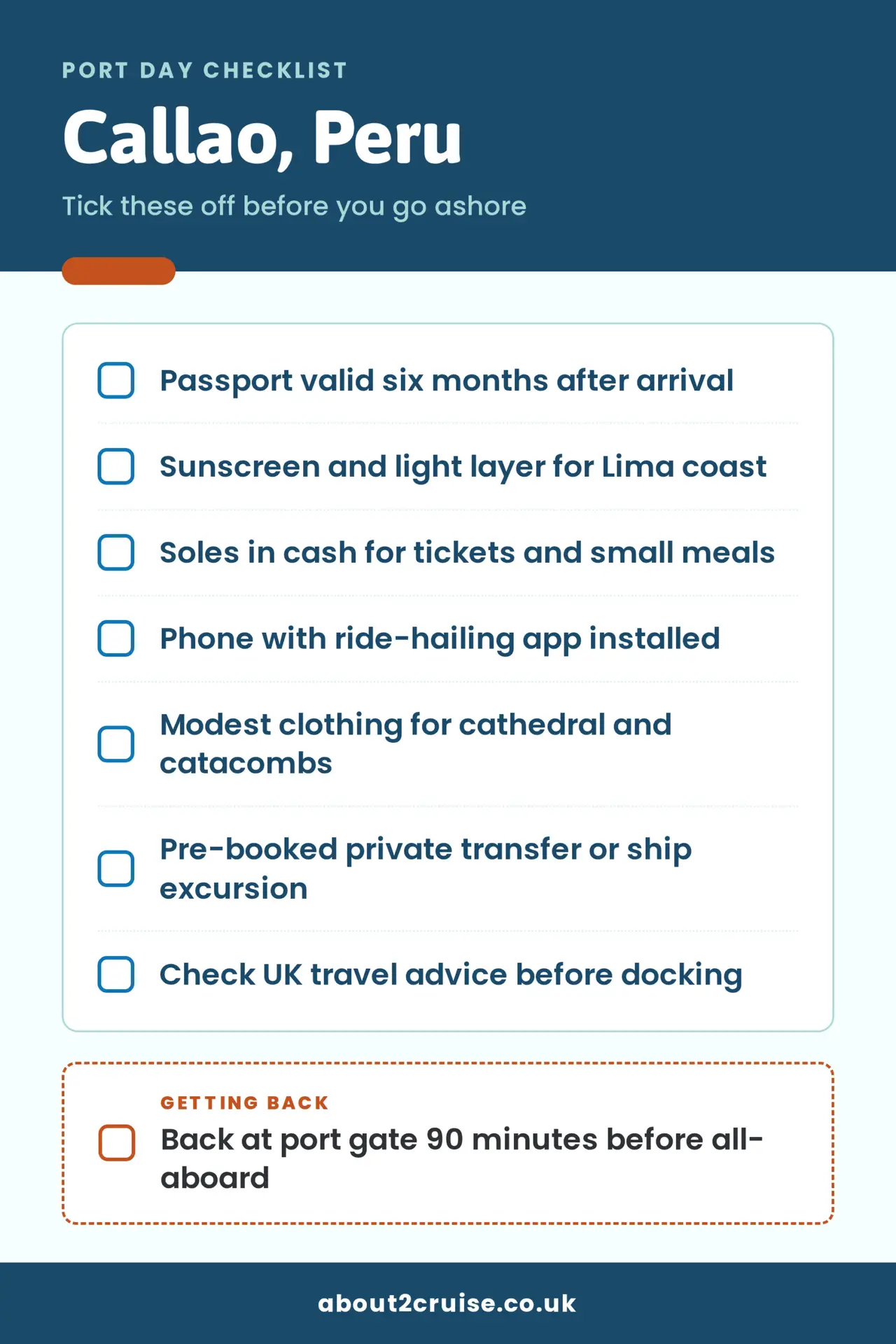
The main souvenir and alpaca crafts cluster is Inka Market at Gonzáles Prada 280 in Miraflores, with neighbouring markets on the same street. Larcomar, at Malecón de la Reserva 610, Miraflores, has 77 shops, restaurants, a cinema and artisan offers on the clifftop. Monumental Callao has design and souvenir shops plus artists’ studios inside the art district, useful if you stay in Callao. Museo Larco has a good shop selling souvenirs, books, jewellery, textiles and replicas.
Do not buy crafts made with wild animal parts, including condor feathers, turtle shell, preserved butterflies or starfish. Bringing them home can lead to prosecution and confiscation at the airport.
Accessibility and Mobility at the Callao Cruise Port
Callao cruise port is not a smooth passenger terminal. The port has no pedestrian walkways, no passenger station, and limited accessible infrastructure, so the movement from ship to shuttle to gate can be uneven and dependent on the line’s arrangements. Passengers with mobility needs should confirm with the cruise line and transfer operator how the vehicle connects to the passenger-handling area at the berth.
In the historic centre, the route is level but on uneven paving with busy crossings. San Francisco and the Cathedral have steps and uneven floors. Museo Larco is the best major cultural stop for accessibility, with free wheelchairs, ramps, accessible toilets and free bag storage. Real Felipe has accessible courtyards but the ramparts, towers and cobbled areas require stairs. If you use a rollator or wheelchair, choose a private vehicle with space and a guide who will not rush the transfer.
Pre- and Post-Cruise Hotels and Airport Transfers
Jorge Chávez International Airport is in Callao, only about 3–5 km from the cruise port. The new terminal is reached via Av. Morales Duárez. There are no high-quality hotels immediately beside the cruise quay, so passengers either stay at an airport hotel or base themselves in Miraflores or Barranco.
Airport hotels are the most practical for a one-night pre-cruise stop because they are close to both the airport and the port. The Wyndham Costa del Sol Lima Airport, the Wyndham Grand Costa Del Sol Lima Airport and the Costa del Sol Wyndham are all listed within about 3.5–5 km of the port. At least one cruise line uses the airport hotel as a key-card pick-up point for embarking guests, with a complimentary shuttle from the hotel to the pier.
Miraflores is the best base if you want restaurants, bars and clifftop walking before or after the cruise. Expect around 45 minutes’ drive from the airport or port to Miraflores, depending on traffic. The JW Marriott Hotel Lima and Miraflores Park, A Belmond Hotel are both on the Malecón de la Reserva cliff, with the Belmond around 15 minutes’ walk from Barranco. If you are staying in Miraflores, the Airport Express Lima bus runs to four Miraflores stops for S/20 per person single or S/15 each for two or more, with the last return from Miraflores around 20:50. For a cruise turnaround, arrange the port transfer separately: there is no seamless rail or Metropolitano connection to the berth.
Immigration, Passports and Entry for UK Travellers
UK passport holders can travel to Peru without a visa for tourism or short visits, normally getting up to 90 days in a 180-day period. Your passport must have an expiry date at least six months after the date you arrive in Peru. Always carry ID in Peru, as police may ask to see it.
Peru uses a virtual Tarjeta Andina de Migración, known as the TAM, rather than printed landing cards. Migration officers board cruise ships to carry out in-situ control at authorised seaports, and passenger data is registered in bulk. This means the landing formalities for cruise passengers are often handled on board, but you should still carry your passport or a copy and your cruise card when going ashore, and check the ship’s instructions.
All passengers connecting or transiting through Lima airport must pay a TUUA airport use fee, which is not included in airline tickets and is payable in advance online or on site. This matters for pre- and post-cruise air travel, not for the Callao port call itself.
Health and Travel Insurance
No malaria risk exists in the city of Lima or the coastal region south of Chiclayo, but bite avoidance is still sensible because of other mosquito-borne diseases. Peru has experienced significant dengue outbreaks, so check current health advice before travel and use repellent. There is no yellow fever risk in Lima itself, but a yellow fever vaccination certificate is required for travellers aged one and over arriving from countries with yellow fever transmission risk.
Altitude sickness is a serious risk only on add-on land trips to Cusco, Machu Picchu, Puno, the Colca Canyon or Kuelap, not in Lima or Callao. Emergency medical number in Peru is 106, with private Lima ambulance services available and payable. Good travel insurance is essential: it should cover medical treatment, hospital admission, cancellation, and missed cruise departure because of flight or traffic disruption.
Can You Do Machu Picchu on a Cruise Day?
No. Machu Picchu is not a port-day trip from Callao. The Lima–Cusco flight takes about 1 hour 20 minutes, the train from Cusco to Machu Picchu Pueblo takes about 3 hours 30 minutes, and the bus from the village to the citadel entrance takes another 25–30 minutes. You would need a full day just to reach the ruins and return to Cusco, plus a flight back to Lima. Entry to the citadel costs about S/152 for a foreign adult on standard circuits, with extra circuits up to S/200 including Huayna Picchu or Machu Picchu mountain, plus a separate SERNANP sanctuary fee of about S/11 for foreign adults.
Do not try to force Machu Picchu into a cruise call. Cruise lines sell it as a multi-night pre- or post-cruise land package, usually through Lima, the Sacred Valley, Machu Picchu and Cusco over several days. If you want to include Machu Picchu, add it before or after the cruise, not on the Callao port day.
Best Ways to Spend a One-Day Lima Cruise Stop
The best one-day choices depend on your energy, traffic tolerance and whether you have been to Lima before. For most first-timers, the strongest single day is the UNESCO historic centre plus a short stop in Miraflores or a visit to the Larco Museum. For food-focused travellers, a seafood lunch and pisco sour in Miraflores or Barranco beats rushing between monuments. For archaeology fans, Museo Larco plus Huaca Pucllana is a compact, high-quality combination without the long drive to Pachacámac.
If you are nervous about traffic or have a short port day, stay in Callao: visit Real Felipe, take the Monumental Callao street-art tour, and eat seafood in La Punta or Chucuito. It is not the postcard Lima, but it is a real port day with far less driving.
How to spend a port day in Callao
A port day in Callao works best if you pick one: stay close to the port for the fortress and street art, or drive into Lima for Plaza Mayor and Miraflores.
Before you sail
- Book a private driver or ship excursion for Callao; do not rely on street taxis.
- Book Museo Larco tickets online if you plan to visit, to save queue time.
- Bring soles in cash for tickets, markets and small restaurants.
Short port day: under 6 hours
- On dockingShip shuttle to the gateDo not walkYou cannot walk off the quay. Take the ship shuttle to the port gate and meet your pre-booked driver or guide.
- +15 minTaxi to Real Felipe FortressPay in solesAbout 10 minutes by taxi from the gate. Entry includes a guided visit.
- +1 hr 15 minMonumental Callao street artCheck tour timesA short drive from the fortress. More than 60 painted walls and galleries; join a 12:00 or 15:00 guided tour if it fits.
- +2 hrs 30 minLunch in La Punta or ChucuitoTry cevicheCallao's seafood restaurants cluster here. Order ceviche, parihuela or a pan con pejerrey.
- +3 hrs 45 minLa Punta seafront and housesWalk the republican-era seafront and pebble beaches with your guide; keep valuables hidden.
- All-aboard minus 1 hrBack at the port gateDrive back to the gate and take the ship shuttle. Traffic near the port can be slow, so do not cut this short.
This map shows the taxi ride from the ship. The time is the drive only, not your time ashore.
Open the taxi route in Google Maps
If plans change: If the Monumental Callao guided tour does not fit your timetable, see the painted walls from the street with your driver and spend longer at La Punta's fish restaurants.
Long port day: 8 hours or more
- On dockingShip shuttle to the gateDo not walkYou cannot walk through the port. Take the ship shuttle to the gate and meet your private driver.
- +15 minDrive to Plaza MayorAvoid street taxisAbout 35 to 60 minutes by private transfer from Callao to Lima's UNESCO-listed historic centre.
- +1 hr 30 minCathedral of LimaCover knees, shouldersOn Plaza Mayor. No shorts or capri trousers, and no photos inside.
- +2 hrs 30 minSan Francisco catacombsGuided entry onlyA short walk from the cathedral. Ticketed 45-minute guided visit; modest dress applies.
- +3 hrs 30 minDrive to Miraflores for lunchTry ceviche and piscoHead to Lima's cliff district for a seafood lunch and a pisco sour; tell the driver Parque Kennedy or Larcomar.
- +5 hrs 30 minMiraflores cliff walk and LarcomarWalk from Parque Kennedy via Parque del Amor to Larcomar, a 3.5 km cliff-top route of 50 to 60 minutes.
- All-aboard minus 90 minDrive back to the portLeave Miraflores with a 60 to 90 minute traffic buffer. Return to the gate and take the ship shuttle.
This map shows the taxi ride from the ship. The time is the drive only, not your time ashore.
Open the taxi route in Google Maps
If plans change: If Plaza Mayor is closed by a protest, head straight to Miraflores for the cliff walk and Larcomar, and try the historic centre on another call if time allows.
Frequently Asked Questions
Is Callao safe for cruise passengers?
Callao is safe enough if you stay with an organised tour, pre-booked transfer or guided walking group and do not wander around the port gate or industrial areas. Do not hail street taxis, do not accept unsolicited offers, and avoid walking alone outside the main visitor zones. Miraflores and Barranco are generally safer and easier for independent sightseeing, but street crime still exists there, so keep valuables hidden and stay aware.
Can you walk from the Callao cruise port to Lima?
No. The port is a secured industrial area with no pedestrian route, and you are shuttled from the ship to the gate. From the gate, Lima’s historic centre is about 14 km away and Miraflores about 20 km away. You need a pre-arranged vehicle or tour.
Do cruise ships dock in Lima or Callao?
Cruise ships dock in Callao, Peru’s main seaport, not in Lima’s city centre. The cruise berth is the Terminal Norte Multipropósito inside the Port of Callao, about 14–20 km from central Lima’s main visitor districts.
How far is Lima airport from the cruise port?
Jorge Chávez International Airport is in Callao, about 3–5 km from the cruise port. The drive normally takes about 10–15 minutes, though roadworks and traffic around the new terminal can add time. Always allow a buffer if you are travelling between a flight and the ship.
Are ship tours the best way to see Lima from Callao?
For most passengers, yes. A ship excursion removes the logistics of the port gate, traffic and all-aboard risk. A private tour is better if you want a custom food stop or fewer crowds, but you must confirm exactly where the guide meets you, because many operators cannot enter the port.
What currency and plugs are used in Peru?
Peru uses the sol, written S/ or PEN. US dollars are widely accepted in tourist areas, but soles are better for small purchases. Electricity is 220 V at 60 Hz, with two-flat-pin or two-round-pin sockets, so UK devices usually need a plug adapter. Many high-end hotels provide 110 V outlets for shavers.
What should I do if I have mobility difficulties on a Callao port day?
Confirm with your cruise line and transfer operator how the vehicle connects to the passenger area at the berth, because the port has no smooth pedestrian station. Museo Larco is the best accessible major attraction. The historic centre is level but has uneven paving and busy crossings, while Real Felipe’s ramparts and many colonial sites require steps.
Do I need a visa for Peru as a UK cruise passenger?
UK citizens do not need a visa for tourism or short visits, normally receiving up to 90 days in a 180-day period. Your passport must have at least six months’ validity after arrival. Check current entry rules before you sail, because rules can change.
Planning a South America Cruise Through Callao
Callao is a natural stop on longer Pacific South America itineraries. If your ship is also calling at Manta in Ecuador, expect a similar pattern of a working port and a shortish transfer into the city, though Manta is a much smaller and simpler operation. On the Chilean side, Arica is a useful desert port stop south of the border, and many voyages connect Callao with Valparaiso (Santiago) as the Chilean turnaround port. For the wider picture, this Callao page sits within our Peru and Ecuador cruise ports guide, which helps you plan the whole coast rather than each call in isolation.