
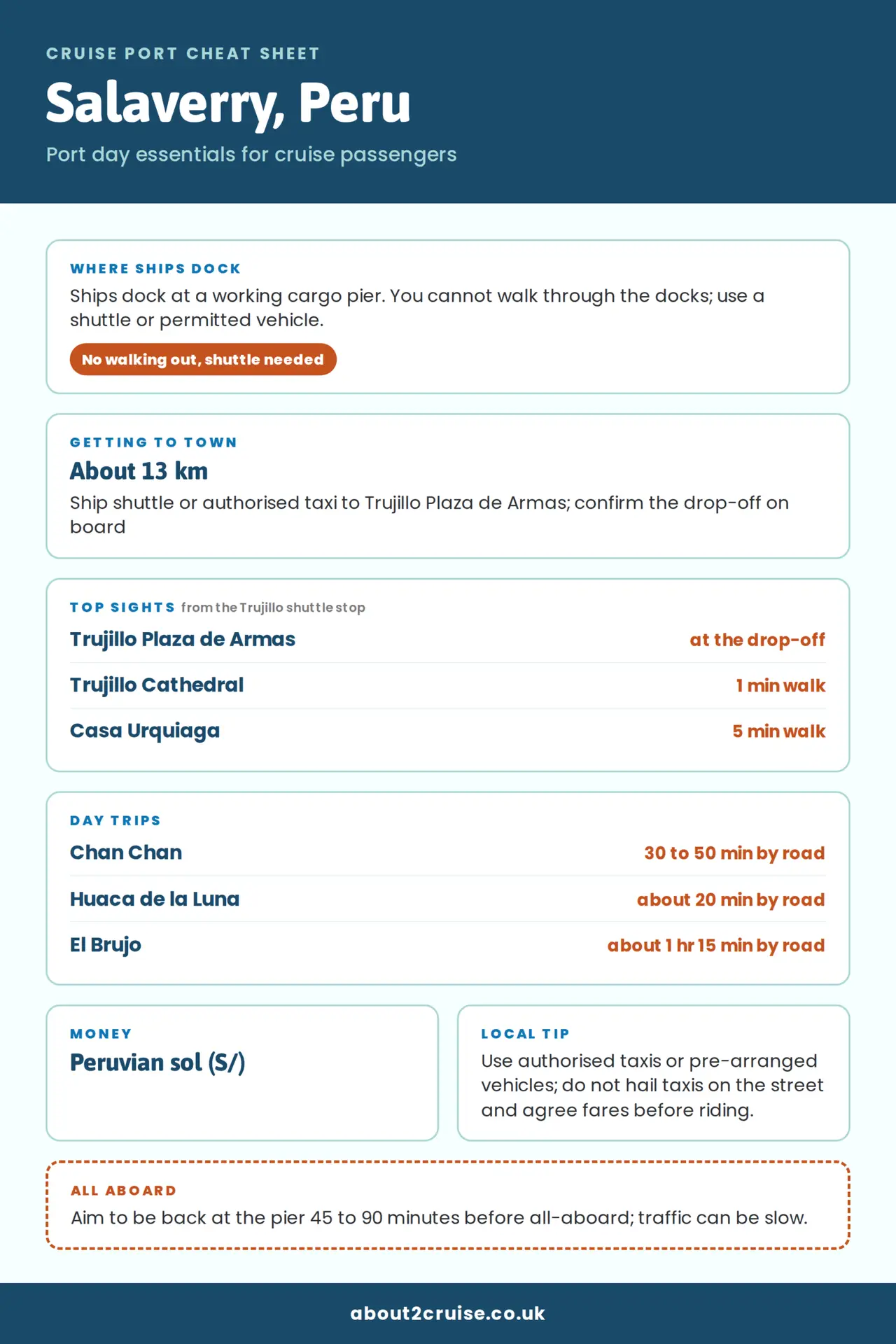
Salaverry is Peru’s industrial cargo port 13–15 km south of Trujillo, and the cruise gateway to Chan Chan, the Moche temples and colonial Trujillo. Ships dock at a commercial pier where passengers cannot walk through the dock area; you move by shuttle, authorised coach or permitted tour vehicle. Most calls are long port days, but timing and the choice between Chan Chan or Huaca de la Luna drive everything.
Why Cruise Ships Stop at Salaverry
Salaverry itself is not the attraction. The reason ships call here is the extraordinary cluster of sites nearby. Chan Chan is the largest adobe city in the Americas and capital of the Chimú kingdom. Huaca de la Luna is a painted Moche ceremonial pyramid. Trujillo is a proud colonial city founded by Francisco Pizarro, and it’s known as the capital of the marinera dance.
In one port day, you can get a rare look at two great pre-Columbian civilisations plus one of northern Peru’s best colonial centres. Trujillo’s Plaza de Armas is one of Peru’s largest and grandest, and its colonial core is compact and walkable. The archaeological stars, though, sit outside the city: Chan Chan lies near Huanchaco to the northwest, while the Huacas de Moche are in the Moche valley to the southwest. Salaverry is simply the working port that makes all of this reachable by ship.
What the Dock Is Really Like
This is a working cargo terminal, not a cruise terminal. Ships berth at the multipurpose commercial piers of Salaverry Terminal Internacional, which runs the Terminal Portuario Multipropósito de Salaverry. The exact berth depends on your ship’s size and the call, and the piers are known as Muelle 1A-1B and 2A-2B.
Because it’s an active cargo port, passengers cannot wander through the dock area. You’ll be moved by shuttle bus, coach or permitted tour vehicle from the ship to a gate, coach park or staging area. The walk from gangway to coach is short, usually 10–200 metres, but that doesn’t mean you can walk into town from the ship. Port security controls access, and private cars or vans need a permit to reach the gangway.
Facilities at the pier are minimal. There are restrooms, taxis and shuttle buses, but no shopping mall, café or proper terminal building. On cruise days, the terminal usually sets up artisan stalls near the pier and welcomes passengers with a marinera performance by a local academy. It’s a genuinely nice arrival moment, but treat the port as a transit point, not a destination.
Authorised taxis wait on the pier, but unofficial taxis also operate in Peru. The port guidance is blunt: use authorised taxis or prearranged vehicles, and don’t accept lifts from informal drivers. If you’ve booked a private shore excursion, confirm that the operator has permission to enter the port area, because not every freelance driver can pick up at the gangway.
Salaverry cruise port map
Ships dock at Salaverry cruise port. Tap a pin for directions.
- Salaverry cruise portWhere ships dock
- Plaza Salaverry (shuttle stop)Shuttle stop · About 3 min walk from Salaverry cruise port
- Trujillo Plaza de ArmasMain square · About 18 km from Salaverry cruise port
- Casa UrquiagaHouse · About 14 km from Salaverry cruise port
- Chan ChanAncient adobe city · About 17 km from Salaverry cruise port
- Huaca de la LunaMoche ceremonial pyramid · About 10 km from Salaverry cruise port
- Huanchaco beachBeach · About 23 km from Salaverry cruise port
- El BrujoArchaeological site · About 14 km from Salaverry cruise port
Do You Dock or Tender? Sea Conditions and the Risk of Missing the Port
Ships normally dock alongside at Salaverry; tendering is rarely needed. That said, this is a Pacific coast port exposed to swell, and the terminal has formal operating limits. Berthing or unberthing may stop when wind exceeds about 17 knots, current reaches 0.35 knots, or swell exceeds 0.9 metres. If the ship cannot berth, it may wait at an anchorage until conditions improve.
The maritime authority can also close the port or specific berths for abnormal swell. Silting in the access channel has previously affected a cruise call because the depth was insufficient, and anomalous swell has even prevented disembarkation in the past. In practice most cruise calls go ahead, but you should treat Salaverry as a port where weather can occasionally alter or cancel the day. Book with operators that offer a refund if the port is closed for sea conditions, and listen to the ship’s announcements rather than assuming the itinerary is guaranteed.
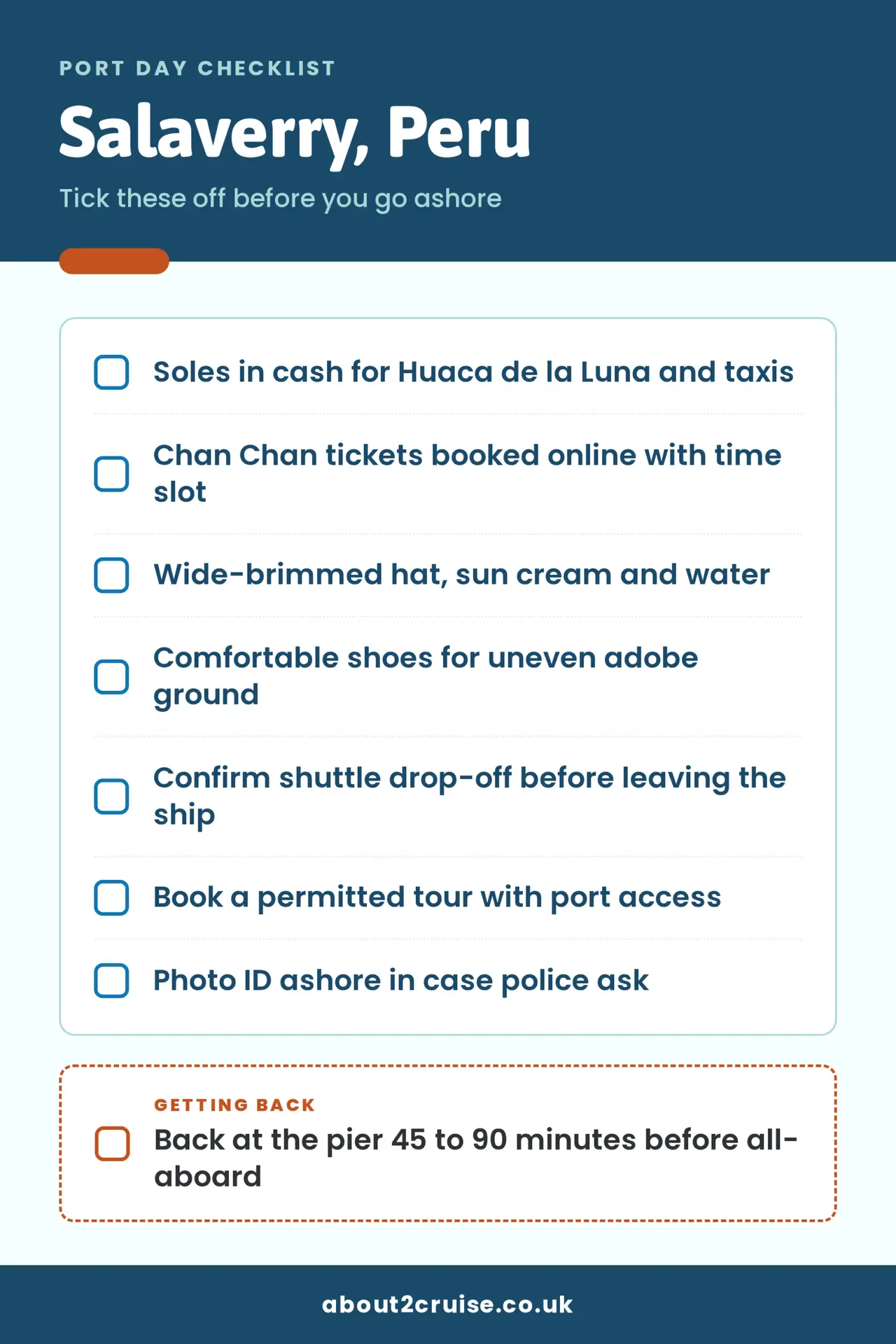
For your return planning, ships normally require you back on board about 30–60 minutes before departure. Independent travellers should add a 45–90 minute buffer on the road back from Trujillo or the sites, because traffic, market activity or a slow tour group can all eat into the afternoon.
How Far Is Everything? Salaverry to Trujillo, Chan Chan and Huaca de la Luna
The key distances look small on a map but can feel longer in traffic. Salaverry to Trujillo’s Plaza de Armas is about 13 km, normally a 25-minute drive. Chan Chan takes roughly 30–50 minutes from the pier depending on route and traffic. Huaca de la Luna is the closest major archaeological site at around 20 minutes from the port. Huanchaco beach is about 12 km west of Trujillo’s centre. El Brujo is much farther north, roughly 60 km from Trujillo and at least 1 hour 15 minutes by road, plus more from the port.
Shuttle arrangements vary by cruise line and sometimes by call. Some ships run coaches into central Trujillo and drop passengers at or near the Plaza de Armas. Others only run a short shuttle to a staging area near the port, sometimes called Plaza Salaverry, where tours connect. Confirm the shuttle plan on board before you commit to a meeting point. The difference matters: one version gives you central Trujillo, the other leaves you closer to the port and still needing a vehicle.
Authorised pier taxis are the simplest independent option if you can find one at the gangway. The most widely quoted pier rate is about US$10 one way to Trujillo centre and roughly US$10 per hour for charter, but consumer listings also quote S/20–50 for the run. Public transport exists from Salaverry town or Avenida España via combis or colectivos, but it’s not recommended for cruise passengers on a tight schedule, and the port guidance specifically steers visitors away from it.
Ship Excursion or Doing It Yourself: Risk, Cost and Return Buffer
A ship excursion removes the biggest Salaverry headache: return timing and the security of a port-authorised vehicle. Holland America, for example, sells a “Trujillo On Your Own” motorcoach transfer from about $49 per person with roughly 3½ hours free in the city. It’s not wheelchair accessible and the line quotes about an hour’s travel each way. Other lines run similar coach transfers or guided tours.
Independent small-group shore excursions are usually priced around US$60–95 for 5–7 hours, often excluding entrance fees. A local operator may quote around US$65 per adult for a small-group tour with guide, air-conditioned vehicle and entrance fees included, while a private full-day vehicle with guide can run to about US$288. Prices vary by group size, whether entrances are included, and whether the operator picks up inside the port or outside the gate.
The DIY risk is mostly about the port. Because Salaverry is a working terminal with restricted access, independent travellers need a permitted taxi or a tour operator with port access. Unofficial taxis can be unsafe, and a driver without a guide is not enough for the archaeological sites. If you choose DIY, arrange a licensed guide and a driver who can meet you at the authorised pickup point, and confirm the ship’s shuttle drop-off before leaving the ship. Don’t plan on public transport unless you have a very long call and can afford a missed connection.
Cancellation terms matter here because the port can close for swell. Some operators state that no-show applies if passengers cannot disembark because of sea conditions, while others offer a full refund only if the port itself closes. Read the terms before paying, and prefer operators who explicitly cover port closure.
Planning Your Day: Half-Day and Full-Day Options
Most cruise passengers can manage one major archaeological site plus a short Trujillo or Huanchaco stop. A common half-day independent plan is Huaca de la Luna first, when the guide groups are running and the sun is less punishing, then Trujillo’s Plaza de Armas and cathedral, then back to the port with a buffer. Chan Chan works similarly, often paired with Huanchaco for a seafood lunch or a quick look at the reed boats.
Before you sail
- Book Chan Chan tickets online with a date and time slot at tuboleto.cultura.pe.
- Confirm the ship's shuttle drop-off and whether private tours can enter the port.
- Carry soles in cash; Huaca de la Luna's ticket office is cash only.
Short port day: under 6 hours
- On dockingTake a permitted taxi or tourNo walking outYou cannot walk through the cargo dock. Authorised taxis wait on the pier; confirm your driver has port access.
- +30 minHuaca de la LunaCash onlyAbout 20 minutes from the pier. Buy the combined ticket with cash at the site museum; the compulsory guided circuit takes about 1.5 hours and has no toilets.
- +2 hrsTrujillo Plaza de ArmasDrive about 15 to 20 minutes into Trujillo. See the Monumento a la Libertad and step inside the cathedral on the square.
- +3 hrs 15 minLunch in central TrujilloTry ceviche or shambarPick a busy place near the Plaza de Armas or Jirón Pizarro. Northern ceviche is best at lunch; shambar is a Monday dish.
- All-aboard minus 1 hrLeave Trujillo for the portAllow 30 to 45 minutes for traffic and port security. If you are delayed, go straight to the pier.
This map shows the taxi ride from the ship. The time is the drive only, not your time ashore.
Open the taxi route in Google Maps
If plans change: If Huaca de la Luna is closed on a Monday, head straight to Trujillo's Plaza de Armas and the Museo de Arqueología, which opens on Monday mornings.
Long port day: 8 hours or more
- On dockingTake a permitted taxi or tourGo earlyYou cannot walk through the cargo dock. Authorised taxis wait on the pier; private tours need port access.
- +30 minHuaca de la LunaCash onlyAbout 20 minutes from the pier. Buy the combined ticket with cash at the site museum; the guided circuit takes about 1.5 hours with no toilets.
- +2 hrs 15 minTrujillo Plaza de Armas and cathedralDrive about 15 to 20 minutes into Trujillo. See the Monumento a la Libertad and the cathedral's gilded altarpiece.
- +2 hrs 45 minLunch in central TrujilloTry ceviche or shambarPick a busy place near the Plaza de Armas or Jirón Pizarro. Northern ceviche is best at lunch; shambar is a Monday dish.
- +3 hrs 45 minChan ChanBook aheadAbout 20 to 30 minutes from Trujillo. Visit the site museum and Nik An walled compound; allow 1.5 to 2 hours.
- +5 hrs 45 minHuanchaco seafrontA 10 minute drive from Chan Chan. See the reed boats and pelicans along the beach before heading back.
- All-aboard minus 90 minLeave Huanchaco for the portAllow 45 minutes for the drive back. If you are not at the port yet, skip any last stop.
This map shows the taxi ride from the ship. The time is the drive only, not your time ashore.
Open the taxi route in Google Maps
If plans change: If Chan Chan is closed, spend the time at Huanchaco and the Museo Cassinelli in Trujillo; if Huaca de la Luna is closed, start with Trujillo's colonial centre.
If you have a full day, a hired driver can combine Huaca de la Luna, central Trujillo and Chan Chan in about 5–6 hours, but that’s a moving day rather than a deep visit. It works best if you accept that Huaca de la Luna and Chan Chan each deserve 1½–2 hours, leaving Trujillo as a shorter photo and refreshment stop. The tighter alternative is to choose one site and do it properly, then use the remaining time for lunch and a calm return.
El Brujo is only worth attempting if you have a very long port day and a private guide. It is open daily, which is useful when other sites are closed, but the distance north makes it a tiring add-on. The Lady of Cao is a unique archaeological highlight, yet the extra travel time means you should not combine it with both Trujillo and Chan Chan in a normal cruise call.
If your ship calls on a Monday, the maths changes sharply: Chan Chan and Huaca de la Luna are closed. That leaves Trujillo’s colonial centre, Huanchaco, Salaverry beach or El Brujo as the main options. Plan Monday calls around the city, markets, cathedral and seaside rather than the two headline archaeological sites.
Chan Chan: The Adobe City You Came to See
Chan Chan is the main reason many cruises call at Salaverry. It’s a UNESCO World Heritage site, the largest mud-built city in the Americas and the capital of the Chimú kingdom. The original city covered about 20 square kilometres, with a monumental core of about 6 square kilometres containing around ten walled palaces. It’s also on UNESCO’s List of World Heritage in Danger because earthen architecture is fragile and the site is under pressure from Trujillo’s growth.
The visitor complex and site museum are open Tuesday to Sunday from 09:00 to 16:00 and closed on Mondays. Adult entry is S/10, with discounts for higher-education students, over-60s, armed forces and school students. Tickets can be bought online with a date and time slot at tuboleto.cultura.pe or at the gate, and the ticket also covers Huaca Esmeralda and Huaca Arco Iris, though either of those can be shut for conservation work.
Only one walled palace compound, Nik An (formerly known as Tschudi), is open to visitors. The main circuit runs from the site museum to Huaca Toledo and then to Nik An, with a newer mirador and the Las Ardillas sector added. Inside Nik An, the adobe walls carry reliefs of fish, sea birds, nets, pelicans and moons, while Las Ardillas has squirrel reliefs. Allow about 1½ hours for the palace plus museum, or closer to 2 hours with a guide. A private bilingual guide at Chan Chan is often quoted from about S/65 per adult for 2½ hours, entrance not included.
Visitor rules are strict because the walls are fragile. Keep to the marked circuit, do not touch walls, benches or platforms, and do not eat along the route. The site is exposed and sunny, so use a wide-brimmed hat, light clothing and water. Walking the adobe circuit is more tiring than it looks, especially in the middle of the day.
Huaca de la Luna: Painted Temples of the Moche
Huaca de la Luna is the painted Moche ceremonial pyramid and, for many travellers, the most visually dramatic stop in the region. Its polychrome murals of the Moche deity Ai-apaec are the headline. The site sits about 8 km south of Trujillo and about 20 minutes from the pier, making it the easiest archaeological giant to reach from a cruise call.
Huaca de la Luna and the on-site Santiago Uceda Castillo museum are open Tuesday to Sunday from 09:00 to 16:00, with the last guided group entering the huaca at 15:30. The ticket is bought at the site museum ticket office and is cash only. Adults pay S/10 for the huaca and S/5 for the museum, so S/15 in total. The Chan Chan ticket does not cover this site: they are different places with different operators.
You cannot walk the circuit independently. A guide is compulsory and included in the ticket, but English-language groups run less frequently than Spanish ones. Ask at the ticket desk for the next English departure. The circuit takes about 1 hour 30 minutes, and there are no toilets on the route, so use the facilities before starting. The neighbouring Huaca del Sol is closed to the public and cannot be climbed; it’s best appreciated from the Huaca de la Luna side and the museum viewpoint.
Because the ticket office takes cash only and cards are not accepted for the huaca, bring small soles. The site is partly open to the sun, and the guided pace can be slow, so carry water and sun protection.
Other Moche Valley Sites: Huaca del Sol and Huaca Arco Iris
Huaca del Sol is the larger adobe platform that dominates the landscape near Huaca de la Luna, but it is unexcavated and closed to visitors. Part of the structure was historically damaged when the Spanish diverted a river through it, and today you see it from a distance. Don’t plan to climb it or buy a separate ticket for it.
Huaca Arco Iris, also called El Dragón, is a Chimú adobe temple in the Trujillo area and is covered by the Chan Chan ticket. It’s worth a brief stop if you are already visiting Chan Chan and want to understand how Chimú ceremonial architecture extended beyond the main city, but check locally whether it is open during your visit because conservation work can close it.
The Moche valley itself is a working agricultural landscape dotted with huacas and small villages, not a single open-air museum. The best way to understand it is with a guide who can point out the relationship between the sites, the river and the modern fields. If you have extra time after Huaca de la Luna, the on-site museum is excellent and often less rushed than the huaca circuit itself.
El Brujo and the Lady of Cao: Worth the Long Drive?
El Brujo is a substantial archaeological complex in the Chicama valley, about 60 km north of Trujillo. Its star is the Museo Cao, which displays the mummified body of the Lady of Cao, a Moche female ruler whose discovery reshaped how historians view Moche power and gender. The complex includes Huaca Prieta, Huaca Cao Viejo and Huaca Cortada.
El Brujo is open daily from 09:00 to 16:00, with adult entry at S/10 and discounts for students, schoolchildren and seniors. No advance booking is required. The fact that it is open daily makes it especially useful on Mondays, when Chan Chan and Huaca de la Luna are closed.
For a cruise passenger, the question is travel time. From the port it’s a long round trip, realistically well over an hour each way once traffic and site access are included. Choose El Brujo only if you have a long call, a private guide or vehicle, and a strong interest in Moche archaeology. If you want the painted temple experience, Huaca de la Luna is closer and more efficient. If you want the mummy and the Chicama valley, El Brujo is a memorable but tiring excursion.
A Walking Route Through Colonial Trujillo
Trujillo’s colonial centre is compact enough for a self-guided walk of about 1.5 km or 45 minutes on paved streets. Start in the Plaza de Armas, one of Peru’s largest main squares, and use the Monumento a la Libertad as your orientation point. The cathedral, officially the Basílica de Santa María, fronts the square, and its gilded churrigueresque high altarpiece is one of only two of its type in Peru.
From the plaza, walk along Jirón Pizarro to see colonial casonas with tall doors and balconies. Casa Urquiaga, also known as Casa Calonge, is a colonial mansion run by the Central Reserve Bank and is free to enter, though a passport may be requested at the door. Plazuela El Recreo and the old city wall gate make a natural extension of the loop.
The cathedral museum charges adults S/5, students S/2 and schoolchildren S/1, and is typically open weekday mornings and Saturday mornings with a midday closure. Check locally for exact hours, because they can change. If you only have 45 minutes in Trujillo, walk the square, step inside the cathedral, photograph the colourful colonial façades and buy a cold drink before heading back to the port.
Trujillo’s Museums: Archaeology, Cassinelli and Ceramics
If you want a museum stop without leaving the city, the Museo de Arqueología, Antropología e Historia of the Universidad Nacional de Trujillo is at Jirón Junín 682 in the Casa Risco. Adults pay S/5, students and schoolchildren S/1. It’s open Monday from 09:00 to 14:00 and Tuesday to Saturday from 09:00 to 16:30, which makes it one of the few cultural options in central Trujillo on a Monday morning.
Museo Cassinelli is a private ceramics collection at Avenida Nicolás de Piérola 607. It’s smaller and quirkier than the university museum, with adults paying S/7 and children S/1, and it closes for a midday break. It’s particularly good for close-up Moche, Chimú and other ceramics, but don’t build a tight schedule around its middle-of-the-day closure.
The phrase “Moche ceramics museum” in some guides is vague. It usually means either the Museo Santiago Uceda Castillo at the Huacas de Moche site or the private Museo Cassinelli in the city. The Chan Chan site museum is separate and focuses on the adobe city’s construction and finds. If ceramics are your priority, Cassinelli and the Huaca de la Luna site museum are the strongest choices.
Markets and Shopping in Trujillo
The port area has almost no shopping, so do your buying in Trujillo or at the pier’s cruise-day artisan stalls. Trujillo is known for leather goods, replica pre-Columbian ceramics and alpaca textiles. In artisan markets, bargaining is expected, while larger fixed-price shops don’t haggle.
Trujillo’s main market is the Mercado Central, with a food hall, cheap set lunches and a fish counter. Mercado La Hermelinda is larger and more chaotic, but it’s not where most cruise passengers need to go. If you want a quick market experience near the centre, the Mercado Central is the practical stop, not a distant or risky detour.
One common guidebook error is to tell visitors to visit San Pedro Market in Trujillo. San Pedro is Cusco’s central market, far away in the Andes and not relevant to a Salaverry port day. The correct Trujillo equivalents are the Mercado Central and Mercado La Hermelinda.
What to Eat in Trujillo and Huanchaco
Northern Peru is one of the country’s great food regions. The dishes to try are northern ceviche, cabrito with beans, shambar, sopa teóloga, arroz con pato and king kong, the layered biscuit-and-manjar sweet. Shambar is a wheat-and-legume stew traditionally eaten on Mondays, and it can sell out by early afternoon.
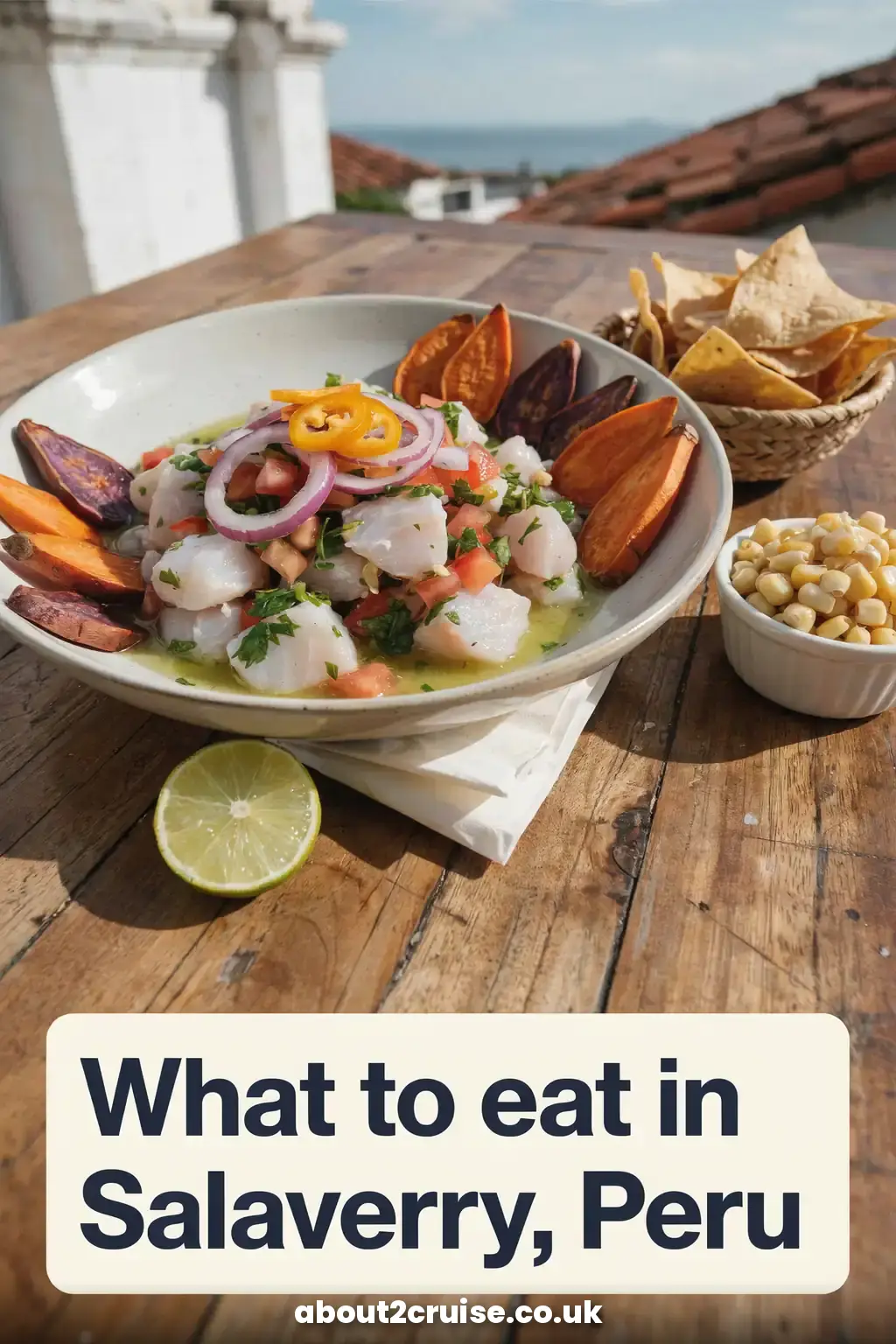
Fish and ceviche are best at lunch, roughly 12:00–15:00, and Huanchaco’s seafront is the classic place to eat the morning catch with a view. If you’re at Huaca de la Luna or Chan Chan, Moche and Huanchaco have picanterías serving chicha de jora, the fermented maize drink also used to marinate cabrito.
A market set lunch costs roughly S/12–18, street food S/5–10, and a mid-range restaurant meal is often under S/60 per person. Hygiene-wise, choose busy places with high turnover, drink bottled or filtered water, and be cautious with uncooked street food. Ice in reputable restaurants is generally safe, but if you’re unsure, skip it. After a hot archaeological morning, a proper sit-down lunch in Huanchaco or Trujillo is one of the best ways to reset before the ship.
Marinera and Paso Horses: A Quick Culture Fix
Trujillo is legally the Capital Nacional de la Marinera, and the dance is woven into the city’s identity. The municipal marinera competition is staged in February at the Coliseo Cerrado Gran Chimú, with warm-up events in Moche, Huanchaco and the Plaza de Armas. You may even see a marinera welcome at the Salaverry pier on cruise days.
Peruvian paso horse displays paired with marinera are a popular short excursion. One format is a 2-hour outing from the Plaza de Armas with a 30–45 minute show at a breeding ranch, where a rider and dancer perform together. This works well for cruise passengers who want a cultural stop without a long archaeological hike. The annual regional paso horse competition also includes a marinera-on-horseback class, a spectacle that feels very northern Peruvian.
If you want a low-effort cultural add-on, look for a short paso horse or marinera show that starts from central Trujillo, rather than trying to squeeze a full folkloric evening into a port day.
Huanchaco, Salaverry Beach and the Coast
Huanchaco is the best-loved beach near Trujillo and an easy cruise-day stop after Chan Chan. It has gentle rolling waves, surf schools, board rental, reed boats and pelicans along the shore. The malecón is lined with seafood restaurants, making it a natural lunch spot. The reed boats stood on end along the sand are most photogenic at dawn and late afternoon, but they’re still a good photo at midday.
Playa Salaverry sits right beside the port town and is about a 15-minute walk from the port perimeter once you’re outside the controlled dock area. It’s a 3 km grey-sand beach with a malecón, a small fish market and seafood restaurants. It’s rated suitable for bathers on cleanliness grounds, but there’s no consistent lifeguard cover and currents near the port are unpredictable. It’s more useful for a quick walk, a photo of fishing boats or a local lunch than for a serious beach day.
Because the Humboldt Current keeps the water cold, around 17–18 °C off Salaverry, even summer swimming is bracing. Surfers wear wetsuits year-round. If your ship calls in the warmest months from December to March, expect better weather but still cool water.
Weather, Packing and Sun Protection
This is a coastal desert climate with very low rainfall. Trujillo’s annual mean temperatures run from about 17–23 °C, and annual precipitation is remarkably low. The warmest, clearest months are December to March, with highs around 25–28 °C and occasional peaks near 30 °C. June to September brings persistent low cloud and garúa drizzle that burns off later, high humidity and the coolest temperatures.
Pack for sun and glare even when the sky looks hazy. The archaeological sites are exposed, and the adobe walls at Chan Chan reflect heat. Use a wide-brimmed hat, sunglasses, strong sun cream and a light long-sleeve layer. Bring water from the ship or a sealed bottle, and use restrooms before entering Huaca de la Luna because there are none on the circuit.
El Niño events can bring heavy rain, flooding and landslides to the northern coast, closing roads or disrupting sites. Check conditions close to your sailing. On a normal dry day, the main challenge is not rain but strong sun and afternoon traffic.
Money, Cards, ATMs and Local Costs
The currency is the Peruvian sol. Cards work in hotels, larger restaurants and agencies, but cash is essential for markets, taxis, tips and small vendors. US dollars are accepted in some tourist businesses, but they’re not everyday currency, and torn or marked notes are often refused. Carry small soles for site entrance fees and drinks.
ATMs are limited near the dock, so withdraw soles in central Trujillo before heading to the sites. BCP has a branch and ATM near the Plaza de Armas at Jirón Pizarro 476 and another on Jirón Gamarra. Huaca de la Luna’s ticket office is cash only, and Chan Chan’s ticket can be bought online or at the gate, but having cash avoids a queue or card problem.
Tipping is about 10% in restaurants, small amounts for guides and drivers, and not expected in taxis. Agree taxi fares before the trip because meters are rare. A market lunch is cheap, but a full private shore excursion can be the main cost of the day, so decide in advance how much you want to spend on transport versus entrance fees and food.
Language and Getting Around Independently
Spanish is the working language, and there is little English outside hotels, tourist services and licensed guides. At Huaca de la Luna the guide is compulsory and included, but English groups are less frequent than Spanish ones, so ask at the ticket desk for the next English departure rather than assuming one will be immediate. Chan Chan is easier with a bilingual guide because the signage helps but doesn’t tell the full story.
Independent navigation works best with a printed or offline map and a clear meeting point. Mobile data can be patchy at the sites, so don’t rely on streaming maps. If you hire a driver separately, the port guidance is clear that a driver alone is not enough for the archaeological experience; arrange a guide as well. A licensed guide can also help you avoid slow queues, understand the chronology and keep the day on schedule.
If you speak little Spanish, book a tour or transfer that includes an English-speaking guide. Central Trujillo is walkable, but the route from a shuttle drop-off to the cathedral can be confusing on a first visit if you’re unsure of street names. Screenshot the map before leaving the ship.
Safety, Health and Staying Aware
Street crime, including muggings and thefts, is a significant problem in Peru’s major cities. The UK Foreign, Commonwealth and Development Office advises against hailing taxis in the street because fake taxi drivers have robbed passengers. Use authorised port taxis, hotel taxis or app-based services, and keep valuables out of sight in central Trujillo.
Protests are unpredictable and have affected La Libertad, with roadblocks and transport disruption. Carry ID because Peruvian police can ask for it, and don’t photograph anything military. Emergency numbers are police 105, fire 116, civil defence 110, SAMU ambulance 106, and the national 911 emergency centre.
English-language medical facilities are concentrated in Lima, but Trujillo has hospitals in the city centre. If you take regular medication, carry it in hand luggage and bring more than you need for the port day. Avoid tap water, use bottled or filtered water, and wash your hands before eating. The biggest practical health risks on a port day are dehydration, sunburn and stomach upset from street food, all of which are manageable with simple precautions.
Accessibility and Mobility at the Sites
Salaverry is a mixed picture for mobility. The gangway-to-coach walk can be as little as 10 metres or as much as 200 metres, and the port itself is a working cargo area rather than a step-free passenger terminal. Some ship transfers, including Holland America’s Trujillo On Your Own, are marked not wheelchair accessible, so check your line’s transfer details before booking.
Chan Chan is the most accessible major archaeological site. The site museum and the Nik An walled compound hold accessibility certificates for reduced mobility, with ramps, accessible toilets and geoblock paths. The museum also has wheelchairs to lend. This makes Chan Chan a better choice than Huaca de la Luna for wheelchair users or passengers with limited mobility.
Huaca de la Luna is far less accessible. Tour operators note that only about 20% of the route is wheelchair or pushchair accessible. The terrain is uneven and the guided circuit involves steps and sandy patches. If mobility is a concern, choose the museum and the viewpoint at Huaca de la Luna, or prioritise Chan Chan and central Trujillo instead.
Huanchaco’s pier is level at the landward end but has planked gaps, and the beach is sand. Central Trujillo’s historic core has paved streets but uneven kerbs in places, so plan a shorter route if you use a chair or walker.
Travelling with Kids
Salaverry and Trujillo can work well for families if you manage the heat and avoid overloading the itinerary. Huanchaco is the easiest child-friendly stop, with gentle rolling waves, surf schools, board rental, reed boats and pelicans. The seafront restaurants are relaxed, and the beach gives children space to move after a long coach ride.
Chan Chan is engaging for school-age children because the adobe walls and reliefs are large and tactile to look at, but the circuit is sunny and there are strict rules about not touching the walls. Keep visits shorter for younger children and bring water, hats and snacks for the ride. Huaca de la Luna’s compulsory guided circuit can feel long for small children, especially where the pace slows for explanations.
Playa Salaverry has a malecón, fishing boats and seafood places, but no consistent lifeguard cover. It’s better for a quick walk or lunch than for swimming. If your family wants a proper beach moment, Huanchaco is the safer and more interesting option.
Surfing, Cycling, Hiking and Photography
Salaverry itself is a surf spot with two main swell windows from December to March and June to August. The water is cold enough that a wetsuit is normal, and because it sits beside an active port, local advice on safe zones matters. Huanchaco is a World Surfing Reserve with beginner-friendly waves and surf schools along the front, making it a better choice for most cruise passengers.
Chan Chan runs a signed bicycle route from the site museum to Nik An, about 1,675 metres, ridden with an accompanying guide. This is a fun way to see the site if you want light activity and have booked it in advance. Don’t assume you can simply rent a bike at the gate and roam independently.
For hiking, the nearest meaningful option is Lomas del Cerro Campana, a private conservation area reached from km 576 of the Panamericana Norte. The lomas season runs roughly June to September, and there is no developed tourist infrastructure. It’s not a standard cruise excursion. Be wary of guides that mention Cerro Verde near Trujillo: the Cerro Verde mine and reserve area are in the Arequipa region, far away and unrelated to a Salaverry port day.
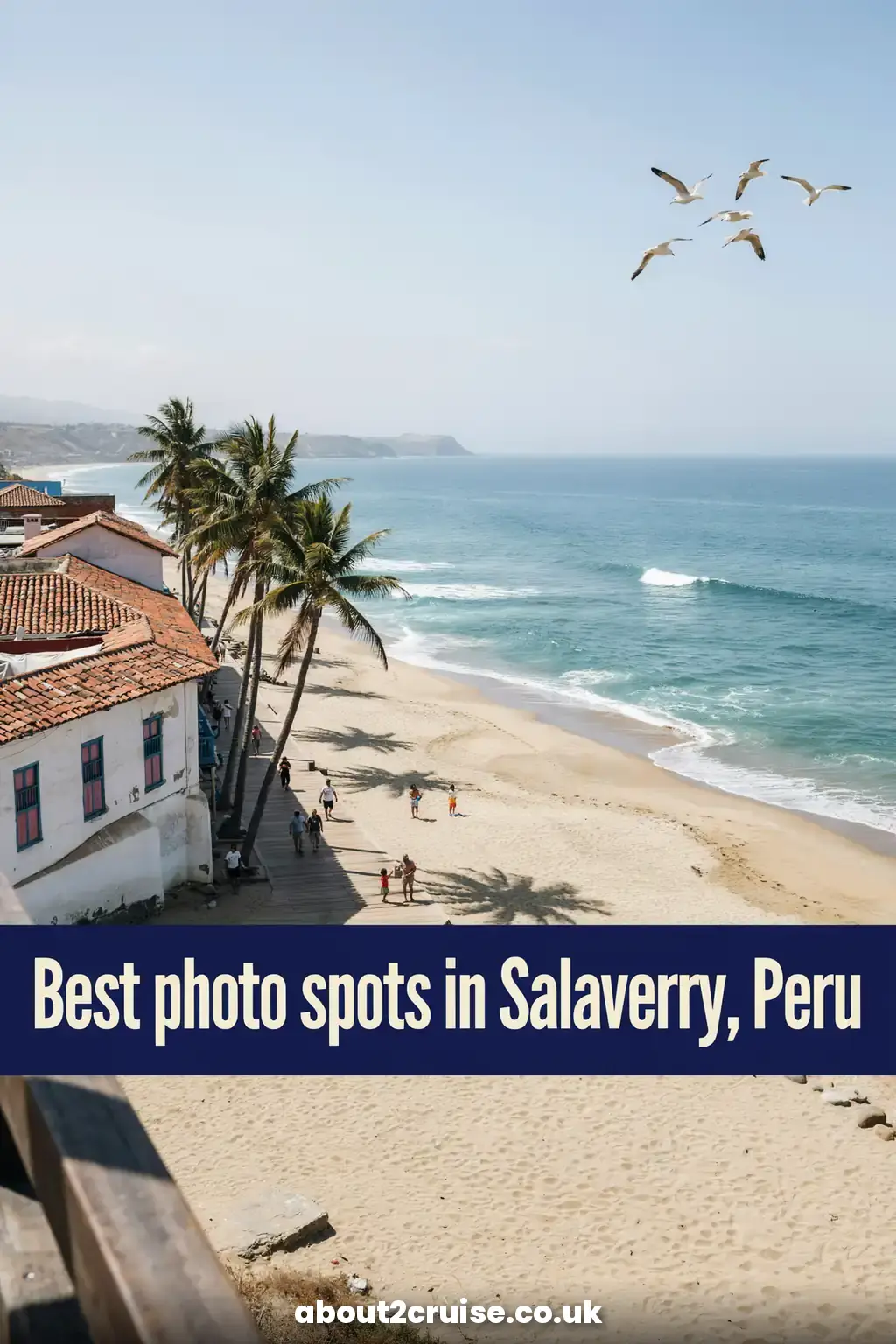
For photographers, the best spots are the reed boats at Huanchaco, the Nik An friezes and mirador at Chan Chan, the colourful colonial façades around Trujillo’s Plaza de Armas, and the fishing boats along Salaverry’s malecón. The Cerro Carreta lighthouse near Salaverry gives a panoramic view over the port and coast. Drone use over archaeological sites and protected areas requires Ministry of Culture permission, and the aviation authority does not authorise flights over urban areas, protected natural areas or restricted zones without exceptional permission. Don’t fly a drone at Chan Chan or the huacas without approval.
How to Visit the Adobe Sites Responsibly
Chan Chan’s earthen walls are maintained against rain, humidity and El Niño by specialist adobe conservation and drainage work. Visitors help by staying on the marked circuit, not touching walls, benches or platforms, and not eating along the route. Keep backpacks away from the walls and don’t pick up loose adobe fragments, even as a souvenir.
Removing archaeological artefacts from Peru is illegal. Wildlife souvenirs such as condor feathers, turtle shell, preserved insects and starfish may not be taken out of the country. Buy replica ceramics and artisan goods from legitimate stalls or shops, not from anyone offering genuine-looking archaeological pieces. Use water refills where possible and take your empty bottles back to the ship, because waste management at exposed sites is limited.
Sustainable tourism here also means supporting licensed guides and local restaurants in Huanchaco, Moche and Trujillo rather than only the ship’s coach. The sites themselves are under pressure, so a little patience with rules and guide instructions goes a long way.
Cruise Lines, Schedules and Tracking Your Ship
Salaverry’s cruise season on the Peruvian coast runs roughly October to April. Call volumes are low, around 8–15 calls per year and about 10,000 passengers over 12 months, so it feels like a smaller port day even when a large ship is in. Typical arrivals are morning, from about 07:00 to 10:00, with departures in the afternoon to early evening, though some calls run late.
Lines that have called at Salaverry include Holland America, Oceania, Crystal, Regent Seven Seas, Seabourn, Hapag-Lloyd, Saga, Ponant and Scenic. The port’s UN/LOCODE for marine tracking and AIS is PESVY, and the time zone is America/Lima, UTC−5. Peru does not observe daylight saving, but always confirm whether the ship stays on local time or ship’s time, because the two can differ.
Use an AIS or marine traffic app to see the berth and the ship’s position, but remember that AIS shows the vessel, not your meeting point. The port has no public cruise berth allocation page, so shuttle and tour meeting details come from the ship, not from the internet.
Nearby Ports and Itinerary Context
Salaverry features on South America and Panama Canal repositioning itineraries between Valparaíso, Callao and Lima, Panama City and Miami. Other Peruvian calls on the same runs often include Callao for Lima, Pisco or Paracas, and Matarani. If your itinerary continues north, our guides to Manta and Guayaquil cover the next major calls, and the Peru and Ecuador cruise ports guide puts the whole coast into context.
Arriving by Air or Land: Pre- and Post-Cruise Info
Most passengers arrive on the ship, but if you’re joining or leaving a cruise in northern Peru, Trujillo’s Capitán FAP Carlos Martínez de Pinillos airport is about 10 km northwest of Trujillo and roughly 30 minutes from the city by taxi. The airport is about 21–26 km from Salaverry. Non-stop flights between Trujillo and Lima take about 1 hour 10 minutes to 1 hour 20 minutes, operated by LATAM and Sky, with several departures a day.
Lima to Trujillo by coach with Cruz del Sur takes from about 9 hours 25 minutes to 11 hours 20 minutes and costs from about S/85 one way, with multiple daily departures from the Lima terminal. There is no passenger rail or ferry service of use to cruise passengers. If you’re travelling overland, allow generous time because road conditions, protests or weather can disrupt the Panamericana Norte.
The port is not set up for turnarounds in the way Callao is, so don’t expect a cruise terminal with baggage halls or check-in desks at Salaverry. It’s almost always a port of call, not an embarkation point.
Where to Stay and What to Do with Luggage
If you stay overnight before or after a cruise, base yourself in Trujillo rather than Salaverry. The port town has no hotel base of any consequence and is not the destination. Costa del Sol Trujillo Centro sits on the Plaza de Armas in a colonial building, with breakfast, parking and 24-hour room service. Wyndham Costa del Sol Trujillo and DoubleTree by Hilton Trujillo are in the Víctor Larco area, with more modern facilities, pools and easier access to Huanchaco.
Every hotel option is a road transfer of roughly 25–40 minutes to the pier, and no hotel is within walking distance of the cruise berth. If you’re staying before a cruise, arrange your port transfer through the hotel or a licensed driver rather than relying on street taxis.
There are no luggage lockers or left-luggage service at the terminal or at Trujillo airport. Third-party bag-storage apps list partner businesses in central Trujillo at roughly US$5–10 per bag per day, but plan carefully because you still need to get to and from the port. The terminal itself has only restrooms, taxis and shuttle space, so don’t arrive with bags expecting storage.

Entry Requirements, Time Zone and Connectivity
British citizens can enter Peru visa-free for tourism, normally for 90 days in a 180-day period, with a passport valid for at least six months after arrival. Arrival by air is registered digitally through the Tarjeta Andina de Migración at international airports, but on a cruise call your ship handles most formalities. Carry photo ID ashore because police can ask for it.
Salaverry and Trujillo are in the America/Lima time zone, UTC−5, with no daylight saving. Before arranging a private tour, confirm whether the ship’s clocks match local time. The ship’s time can be different on repositioning cruises, and every year a few passengers misunderstand a meeting time because of it.
Mobile coverage is generally good in Trujillo and along the main roads, but it can be patchy at the archaeological sites. Download offline maps and tickets before leaving the ship. Many hotels and cafés have Wi-Fi, but don’t rely on a signal at Chan Chan or Huaca de la Luna for route planning.
If the Ship Changes Time in Port or Skips Salaverry
Because Salaverry is an exposed port, the captain may alter arrival, shorten the call or skip the port altogether if swell, wind or channel conditions are unsafe. If the ship changes time in port, the ship’s announcements override any pre-cruise schedule. Set your watch to the ship’s clock and use that for all meeting times, then ask your tour operator to confirm in the same time frame.
If the ship skips Salaverry, private tours are often non-refundable unless the operator expressly covers port closure. Some operators state that a no-show applies if passengers cannot disembark because of sea conditions, while others refund if the port itself closes. Before booking, ask the specific question: what happens if the ship cannot dock? If the answer is vague, book through the cruise line or choose a refundable option.
If you do miss Salaverry, the ship will likely add a sea day or adjust the next call. Don’t plan anything irreplaceable, like a private flight from Trujillo, on a Salaverry port day. For most passengers the correct response is to enjoy the extra rest and rebook for another season.
Misleading Attractions Some Guides Get Wrong
Some top-ranking cruise guides mix up Peru’s geography. The Real Felipe fortress is in Callao, the port of Lima, far south of Trujillo; it’s not a Salaverry excursion. San Pedro Market is in Cusco, not Trujillo. Cerro Verde is an Arequipa-region copper mine and reserve area, not a Trujillo hiking park. If you see these in a Salaverry guide, close the tab.
Trujillo’s main convent and monastery sights are El Carmen, with a large colonial painting collection, and Santa Clara. The church and convent of El Carmen are the architectural set usually visited. The “Moche ceramics museum” in Trujillo is not one single city-centre institution; it usually means the Museo Santiago Uceda Castillo at Huaca de la Luna or the private Museo Cassinelli.
Also be careful with beach claims. Salaverry has a beach beside the port town, but Huanchaco is the famous beach with reed boats and surf schools. Don’t expect the postcard Huanchaco experience at the port beach itself.
Shore Excursion Prices and Booking Tips
Ship excursions from Salaverry are the simplest option and often start around $49–95 per person for transfers or a simple Trujillo tour. Independent small-group tours are commonly US$60–95 for 5–7 hours, usually excluding entrance fees unless stated. Private full-day vehicles with guide can run from about US$288 upward, and a local operator may offer a small-group trip for around US$65 per adult with entrances included.
Booking channels include cruise line shore excursion desks, established local operators, GetYourGuide, Viator, Pelago and KKday. If you book independently, look for operators who explicitly include Salaverry port pickup, not Trujillo hotel pickup. The difference matters because only authorised vehicles can enter the port, and some listings advertise a Trujillo hotel meeting point that doesn’t work for cruise passengers.
Check what is included: entrance fees, guide, water, lunch, and the return-to-ship buffer. A cheap tour that skips entrance fees can cost more on the day than a slightly more expensive tour that includes them. For a port where cash is still needed, all-inclusive tours also reduce the number of small payments you need to manage.
Salaverry Cruise Port FAQ: Quick Answers to Common Questions
Is Salaverry worth getting off the ship?
Yes, for first-time visitors. Chan Chan and Huaca de la Luna are genuinely world-class archaeological sites, and Trujillo’s colonial centre is a pleasant counterpoint. The main reason to stay on board would be if you’ve visited both major sites recently or if you’re physically unable to manage the sun and walking.
Can you walk from Salaverry port to Trujillo or a beach?
Not to Trujillo; it’s 13–15 km. You cannot walk through the cargo dock area, and once outside the gate you’re in the port district rather than the city. Playa Salaverry is roughly a 15-minute walk from the port perimeter, but only after you leave the controlled port zone. Huanchaco and Trujillo require a vehicle.
Which single archaeological site should you choose?
If you can only choose one, pick Chan Chan if you want the famous UNESCO adobe city and an easier surface for walking. Pick Huaca de la Luna if you want the most vivid painted murals and don’t mind a compulsory guided circuit with more steps. Archaeology lovers with a long call can do both, but they should skip a long Trujillo lunch stop.
Are Chan Chan and Huaca de la Luna open every day?
No. Both are open Tuesday to Sunday and closed on Mondays. El Brujo is open daily, which makes it a Monday fallback if you don’t want only Trujillo city.
How much cash do you need?
Bring soles for site entrances and taxis. Huaca de la Luna is cash only, and small vendors may not take cards. Chan Chan can be paid online or at the gate, but cash avoids queues. A reasonable solo day with a shared tour, entrance fees and lunch might require S/100–200 in cash, depending on what’s pre-paid.
Do you need a guide?
At Huaca de la Luna, the guide is compulsory and included. At Chan Chan a guide is strongly recommended for context. In Trujillo you can walk the colonial centre independently, but a guide adds useful historical detail.
Is Spanish necessary?
Not if you book an English-speaking guide or ship excursion. Independent travel with little Spanish is possible but slower, especially at taxis, markets and restaurant ordering. Offline translation helps.
Are taxis safe in Salaverry and Trujillo?
Authorised pier taxis and hotel or app-based taxis are the safer options. Don’t hail taxis on the street and don’t accept rides from informal drivers. Agree the fare before getting in.
What if the ship calls on a Monday?
Chan Chan and Huaca de la Luna are closed. Use Trujillo’s colonial centre, the university archaeology museum on Monday morning, Huanchaco or El Brujo. If you want a pre-Columbian site, El Brujo’s daily opening makes it the best Monday archaeological option, but it’s a long drive.
Can you do Chan Chan and Huaca de la Luna in one day?
Yes, with a private vehicle and a full port day. The sequence matters: Huaca de la Luna first, then Trujillo for a short stop, then Chan Chan, or the reverse depending on closing times. Expect about 5–6 hours of moving and visiting, with limited time for a leisurely lunch.
Quick Reference and Emergency Contacts
Police 105, fire 116, civil defence 110, SAMU ambulance 106, national emergency centre 911. The port’s UN/LOCODE is PESVY and the time zone is America/Lima, UTC−5. Chan Chan and Huaca de la Luna are closed Mondays. Huaca de la Luna takes cash only. The ship is the final authority on shuttle plans, all-aboard time and sea conditions.