
Puerto Bolívar is the working banana and shrimp export port for Machala, Ecuador’s banana capital. Cruise ships dock at a fenced commercial terminal about 7–8 km from the city centre, not tender. The port is industrial rather than a polished cruise terminal, so most visitors choose an organised excursion or a taxi from the gate. Allow a return buffer and check current safety advice.


What Puerto Bolívar and Machala Are Known For
Machala calls itself the Banana Capital of the World, and Puerto Bolívar is the reason that title exists. This isn’t a purpose-built cruise destination. It’s a genuinely working port, and it feels completely different from bigger cruise gateways like Guayaquil or Manta. Most of the cargo moving through here is bananas, with shrimp, cacao, coffee, minerals, and containers mixed in. Around 95% of El Oro province’s banana production ships out through Puerto Bolívar, which makes this one of the world’s great agricultural working ports.
The port sits on the Jambelí archipelago at the mouth of the Santa Rosa estuary: a landscape of mangroves, tidal channels, shrimp farms, and small-scale fishing. Machala is the provincial capital of El Oro and the commercial hub connected to the port. For cruisers, the draw isn’t a polished waterfront or a museum quarter. It’s a chance to see a real banana-export economy, a hot provincial city, and the mangrove-and-beach world of southern Ecuador’s coast. You can read more about how this port fits into the region in our guide to Ecuador and Peru’s cruise ports.
Where Cruise Ships Dock: Berth, Terminal, and Tender Status
You’ll dock here: there are no tenders. Puerto Bolívar is a deep-water commercial terminal with a 920-metre berthing line. Cruise ships have come alongside at Muelle 1 of the Terminal Marítimo, a cargo concession operated by Yilportecu under Autoridad Portuaria de Puerto Bolívar. The quay has a finger pier, a marginal jetty, and extra berths, with drafts around 12.5 m. It’s a fenced working cargo site of about 72 hectares, so don’t expect a cruise village.
When you arrive, local officials usually set up a practical welcome. Migration, public health, and El Oro’s tourism chamber are at the berth, and on some calls the port authority arranges music, dance, crafts, and food. You disembark by gangway onto the commercial dock, then follow the marked passenger route. Stay out of cargo zones. There’s no full cruise terminal with lounges, shops, and taxi marshals. The separate cabotage/tourist pier next door is used for passenger boats to Jambelí and nearby islands.
The Puerto Bolívar Malecón and the old cabotage pier sit just outside the port gates, a short walk from the terminal perimeter. That’s the easiest place to step out, eat seafood, and get your bearings. The Antiguo Muelle de Cabotaje is a century-old pier with heritage status and a marine museum, but the museum has been under restoration and isn’t reliably open.
Puerto Bolívar cruise port map
Ships dock at Puerto Bolívar cruise port. From the terminal gate, Machala main market is about a 4-minute walk and Puerto Bolívar Malecón about 8 minutes. Tap a pin for directions.
- Puerto Bolívar cruise portWhere ships dock
- Machala main marketFood market · About 4 min walk from the terminal gate
- Puerto Bolívar MalecónWaterfront promenade · About 8 min walk from the terminal gate
- Parque Juan MontalvoPark · About 5 km from the terminal gate
- Cathedral of MachalaCathedral · About 4 km from the terminal gate
- Paseo de la MercedWalkway · About 5 km from the terminal gate
- Jambelí islandBeach island · About 8 km from the terminal gate
- Santa Clara islandIsland wildlife refuge · About 50 km from the terminal gate
- Buenaventura reserveNature reserve · About 50 km from the terminal gate
Puerto Bolívar Cruise Ship Schedule and Typical Calls
Puerto Bolívar gets a small number of calls, mostly from expedition and long-haul luxury ships rather than big resort vessels. Hurtigruten’s Fram, Roald Amundsen, and Fridtjof Nansen have called here, as have Silversea’s Silver Moon and Silver Explorer, Seabourn Quest, Nicko Cruises’ Vasco da Gama, and Swan Hellenic’s SH Vega. Some seasons have calls clustered in October, November, and January, but this isn’t a heavily scheduled year-round cruise port. It’s normal for only a handful of ships to appear in a twelve-month window, often carrying a few hundred passengers.
The practical takeaway is that the infrastructure isn’t scaled for a 3,000-passenger ship. If your ship is calling here, you’re likely on a smaller vessel with a longer port day. Always check your own itinerary and shore excursion list for the exact call time, because third-party schedules can lag or conflict.
How to Get from the Port to Machala
Machala city centre is about 7–8 km from the berth, typically 15–20 minutes by road. The Puerto Bolívar Malecón is just outside the port gates, but the city centre isn’t a practical walk through an industrial highway area, especially in heat and humidity.
There’s no rail link from Puerto Bolívar to Machala. The old railway heritage in Machala, including the Plaza Ferroviaria and restored locomotive, is local history rather than transport you can use.
Free cruise shuttles are the big unanswered question here. There’s no official port-authority or cruise-line page confirming a guaranteed free shuttle from the ship to Machala on every call. Some third-party guides say shuttle provision varies by ship, and some ships arrange transport to the Malecón or into the city. The safest assumption is that a shuttle may be provided, but you shouldn’t bank on it. Check with your cruise line before the call, or have a private transfer or taxi plan ready.
Taxis wait at the terminal exit and are the standard independent option. Published guide figures for the run into Machala vary from about $3–5 to $5–10, so the correct cruise-day approach is to confirm the fare before getting in. Use small US dollar bills and try to avoid paying with large notes. If you want more certainty, arrange a private driver or guide in advance; plantation and city tours often work better this way because you need a vehicle for the day.
Local buses connect Puerto Bolívar and Machala cheaply, with one route quoted at around 32 minutes from the muelle. They aren’t aimed at cruise passengers, can be hot and crowded, and aren’t the best use of limited port time. Ride-hailing apps are listed as operating in Machala, but availability at a cargo gate isn’t guaranteed.
Port security and restricted-area rules matter here. Don’t wander into the cargo concession, container stacks, or truck lanes. The port is handling bananas, cold storage, containers, and bulk cargo, so industrial vehicles are moving. Use the passenger route, keep your cruise card and photo ID accessible, and expect a security check when re-entering the port area.
Getting Back to the Ship on Time
This is a port where an independent day plan needs a time buffer. Aim to be back at the terminal at least 60–90 minutes before the all-aboard time, especially if you’ve gone to Jambelí or into rural banana country. Taxis in Machala are generally available, but you need to allow for traffic, rain, a shortage of taxis at a beach return point, or a boat that leaves slightly late. If you take a public boat to Jambelí, don’t trust the last return exactly at 18:00 as your safety net. Bad weather, tidal conditions, or holiday crowding can slow things down.
Ship-organised excursions carry the usual advantage here: they are scheduled around the ship’s departure. If you go independently, build your day backwards. Work out the latest safe departure from Machala or Jambelí, then subtract generous transfer time. This isn’t the port for a relaxed “one more drink” approach when you’re 30 minutes away from the gangway.
Banana Plantation and Packing-Plant Experiences Near Machala
The banana plantation visit is the signature excursion for this port. Farms lie outside the city, and the best practical way to see one is with a ship-sold tour or a pre-booked local guide with a driver. You typically see planting and harvesting, washing, packing, and boxing, and you finish with a tasting. Some ship excursions use a family estate where a women’s artisan project makes products from banana by-products. A typical ship-sold banana plantation and tasting tour lasts about 4.5 hours and can cost from around $250 per person. Independent city-and-plantation tours run about 3–5 hours, but are generally not suitable for wheelchair users or people with mobility impairments.
If you want to visit a plantation independently, don’t expect to hail a taxi and ask for “a banana farm” from the port gate. You need a pre-arranged driver or guide who knows which farms accept visitors and has a fixed route. The half-day version works because the port day is usually long enough for a plantation plus a short city stop. Bring a hat, water, reef-safe sunscreen, and comfortable shoes. Shade can be limited, and the heat is real.
Machala City Sights, Markets, and Local Culture
Machala is a provincial working capital, not a restored colonial highlight. Its centre has Parque Juan Montalvo, a green square with fountains, and the Cathedral of Machala, an active place of worship that has been rebuilt several times on its current site. Next to the cathedral, Paseo de la Merced is a walkway with an artificial stream and fish, busy with local families in the evening. The Monumento al Bananero, a bronze of a plantation worker shouldering a bunch of bananas, stands on the roundabout at the city entrance opposite Paseo Shopping. It’s a photo stop rather than a destination, but it tells you exactly what the city sees as its identity.
The main municipal market is the place to see fruit, vegetable, and seafood produce on a wet-market scale. The Casa de la Cultura holds a small archaeological and palaeontological museum. Craft stalls and small artisan displays cluster around Zoila Ugarte park. This isn’t a long, polished sightseeing day, but it gives you a direct look at the commercial heart of Ecuador’s banana country.
Jambelí Island Beaches and Mangrove Boat Trips
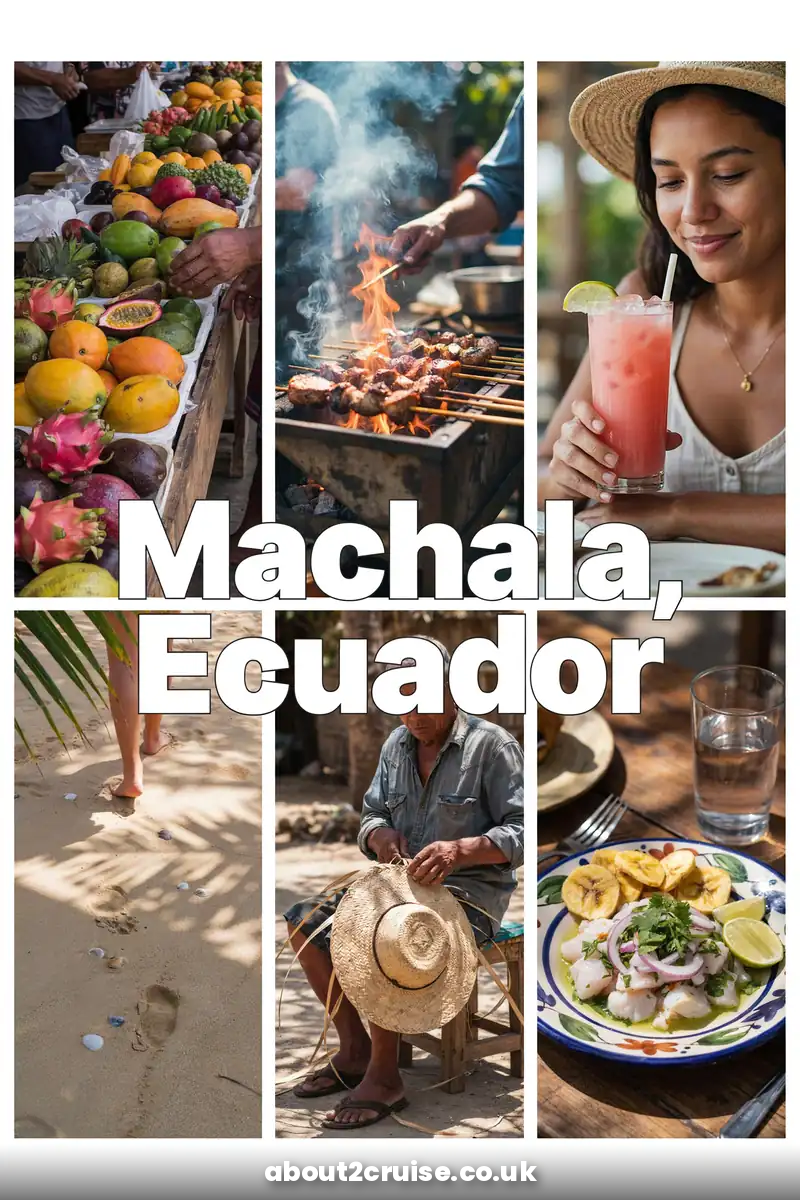
Jambelí is the classic beach escape from Puerto Bolívar. Public boats leave from the cabotage pier beside the terminal, taking about 25–30 minutes through mangrove channels to reach the island. Fares are commonly quoted at around $5 return, with departures from early morning and the last return around 18:00, roughly hourly. That sounds simple, but this is a domestic beach destination rather than a resort. The beach is long, hard-packed, and grey-sand, backed by simple ceviche shacks. It’s crowded on weekends and public holidays, and almost empty on ordinary weekdays.
For a cruise day, Jambelí can work as a half-day independent trip if your ship docks early and you monitor the boat timing carefully. Bring cash, sunscreen, insect repellent, and enough Spanish to confirm the return boat. The boat ride itself through the mangroves is part of the experience. Isla del Amor is a shorter boat trip, about five minutes from Puerto Bolívar, and is known for nesting seabirds. If you want a mangrove-and-beach feel without committing to Jambelí’s boat frequency, this can be a lighter option, though it is much smaller.
Wildlife, Birdwatching, and Estuary Landscapes Around Puerto Bolívar
The estuary and mangroves around Puerto Bolívar are rich birding country. The Huaylá and Santa Rosa estuaries are the channels used by birding boats, and even the ride to Jambelí can produce herons, frigatebirds, and mangrove-edge birds. Isla del Amor is used by nesting seabirds and is easy to add to a port day.
The serious wildlife destination is Santa Clara, or Isla del Muerto, a wildlife refuge about 43 km west of Puerto Bolívar. It holds some of the largest seabird colonies on Ecuador’s continental coast: frigatebirds, blue-footed boobies, and pelicans in large numbers, plus sea lions. It’s a Ramsar site, but there are no tourist facilities. The boat trip takes 1.5–2 hours each way, so this is a full-day commitment. Landing is by small boat at low tide, and visits are weather- and tide-dependent. This isn’t a casual half-day add-on from a cruise call unless your ship offers it as an organised excursion or you have a very long port stay.
Humpback whales are watched around Santa Clara and the Jambelí channel between about July and September. Local operators sell trips, but timing and reliability matter. If you’re on a cruise call in those months, check whether your ship offers a whale-and-wildlife excursion rather than trying to arrange a fast independent trip from the cargo gate.
A different birding option is the Buenaventura reserve in the cloud forest above Piñas, about 45–60 minutes from Machala. It has more than 320 bird species and dozens of hummingbird species, with feeders and trails. It’s a full-day excursion by road, but it can be excellent for birders who want a contrast to the hot coast.
Ecuadorian Coastal Seafood and Local Food to Try
The local food is the best reason to linger on the Puerto Bolívar Malecón. Try concha prieta, the black clam, either raw in ceviche or grilled as conchas asadas. Ceviche de camarón, arroz marinero, parihuela, camarones reventados, and crab are all typical of El Oro. Green plantain shows up everywhere as tigrillo, green plantain with egg and cheese, or bolón de verde. Fried corvina with menestra and patacones is a simple port lunch, ideally with a cold national beer or fruit juice.
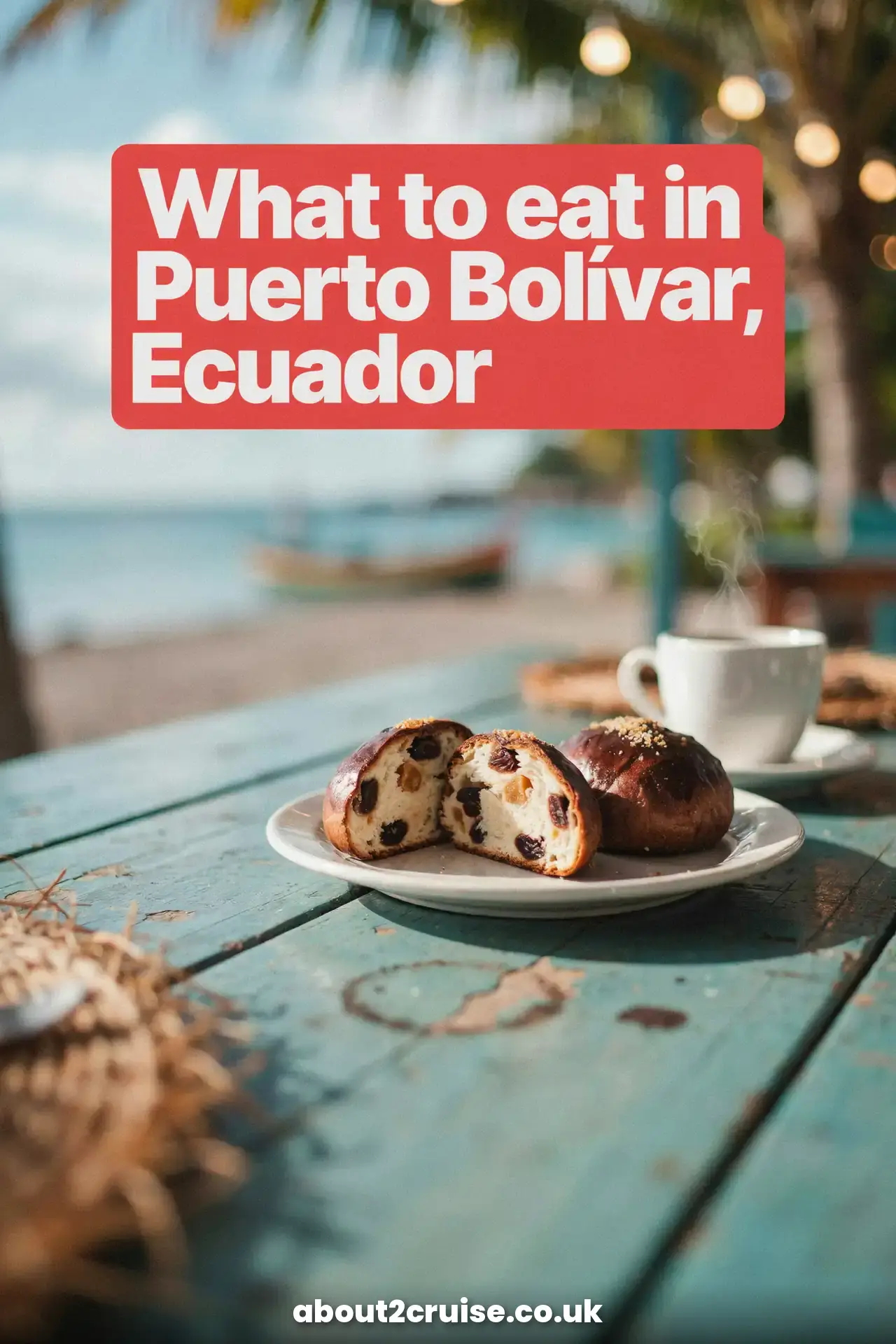
The seafood shacks and picanterías are clustered along the Malecón near the corner of Av. Malecón and Av. Olmedo, only minutes from the berth. That makes the port itself a better dining stop than you might expect for a working cargo area. In Machala, the main market is the place to see produce and local breakfast culture. Eat where it’s busy, choose high-turnover stalls, and drink bottled or filtered water. If you’re cautious about raw seafood, grilled and cooked dishes are widely available, but a well-run ceviche stall in a busy local market is part of the coastal experience.
Shopping in Machala for Coffee, Cacao, and Local Crafts
This isn’t a large souvenir port, but the useful buys are coffee, Arriba cacao or chocolate, and tagua-nut crafts. The craft stalls around Zoila Ugarte park in Machala are the usual stop for small artisan pieces. The main market is better for seeing and buying coffee or cacao in local packaging. Paseo Shopping Machala is the modern mall used as a tour drop-off point, useful if you need air conditioning, a pharmacy, or a reliable ATM.
Don’t expect a cruise-terminal craft market. You need enough Spanish for simple transactions, small US dollar notes, and realistic expectations. Prices are modest, but quality varies. If you’re buying cacao or coffee, ask for locally produced Orense or southern Ecuadorian products, because this is one of the country’s great agricultural regions.
Weather, Heat, and Rainy-Season Planning in Machala
Machala is warm all year. The mean temperature is around 26°C, with typical daily values between about 21.5°C and 31.1°C. March and April are the warmest months. The wet season runs roughly January to May, with April and May often the wettest. July and August are the driest, but the coastal dry season can bring overcast garúa skies and high humidity. Relative humidity runs about 65–85%, so it often feels heavier than the temperature suggests. El Niño years can bring heavy rain and flooding to the area.
The practical planning point is that rain doesn’t cancel most shore excursions here, but it does make unpaved areas or boat landings messier. If you’re visiting Jambelí or a rural plantation, a light rain jacket or poncho is useful in the wet season. Sun protection matters even on overcast days.
What to Wear and Pack for a Puerto Bolívar Cruise Day
Lightweight, breathable clothing works best. For plantation and city visits, long trousers and long sleeves help against sun and insects, and a standard city tour involves about 1 km of flat walking. Bring comfortable walking shoes, a hat, sunglasses, a reusable water bottle, and reef-safe sunscreen. Mosquito repellent is advised for Jambelí and mangrove days. For boat trips, pack a dry bag, water shoes or sandals that can get wet, a towel, and small cash for food and boat fares. A rain jacket or poncho is useful in the January-to-May wet season.


Dress modestly if you enter the cathedral or other active religious sites. Avoid flashing jewellery, smart watches, or large cameras in crowded areas. A cheap watch or phone for time checks is safer than pulling out a tablet on the Malecón.
Money, Cash, ATMs, and Tipping in Ecuador
Ecuador uses the US dollar as its legal currency, plus Ecuadorian centavo coins. You don’t need a currency exchange if you arrive with US dollars, but you do need small bills. Vendors, taxi drivers, and small restaurants can struggle to change $20 and $50 notes, so keep $1, $5, and $10 bills available. Credit cards are generally accepted in cities, including malls and larger hotels, but cash is essential for Jambelí boats, beach shacks, market stalls, and taxis.
Use ATMs inside banks or shopping centres rather than street machines, and avoid withdrawing large amounts after dark. In Ecuador, police suggest not making large cash withdrawals alone and can provide an escort on 911 if needed. Tipping isn’t as formalised as in North America, but rounding up taxi fares, leaving 10% in restaurants, and tipping private guides or drivers for good service are all reasonable. For a ship excursion, follow your cruise line’s guidance.
Language, English Availability, and Useful Spanish Phrases
Spanish is the working language ashore. English is spoken mainly in tourist-focused settings and on ship excursions with an English-speaking guide. Independent travel is easier with basic Spanish. Useful phrases include: “¿Cuánto cuesta?” for how much, “Quiero ir a Machala” for I want to go to Machala, “¿A qué hora regresa el último bote a Puerto Bolívar?” for what time the last boat returns, “¿Dónde está el taxi?” for where the taxi is, “La cuenta, por favor” for the bill, and “No entiendo” for I don’t understand. If you’re visiting a beach or using a local taxi, “¿Me puede llevar a Puerto Bolívar?” is useful for getting back to the port.
Is Puerto Bolívar Safe? Safety and Security Advice
This is the most important planning section for Puerto Bolívar. The UK Foreign, Commonwealth & Development Office currently advises against all but essential travel to El Oro province, including the coastal area around Machala and Puerto Bolívar, because of gang-related violence linked to drug trafficking. Tourists are not usually targeted, but incidents can happen and visitors can be caught up in them. This is a working port in an area with a serious security warning, so you should check current FCDO advice before you book and before your call.
If you do go ashore, the practical rules are simple. Take a ship excursion or a vetted local guide, stay in a group, avoid walking alone or at night, don’t wear jewellery or carry more cash than needed, and carry a colour copy of your passport and entry stamp. Book taxis through a hotel or a radio-dispatched service rather than hailing them on the street, because express kidnappings in Ecuador have often involved people who got into street taxis. Avoid road travel after dark. Beaches can have strong and rapidly changing currents, and warning flags are not always present, so take local advice before swimming. The emergency number is 911.
At the port itself, stay on the passenger route. The cargo gates, truck queues, and dock edges are not places for independent wandering. The Malecón immediately outside the port is generally used by local families and seafood diners, but it is still part of a high-caution region. Keep your phone charged, don’t rely on unknown ride-hailing drivers, and have a fixed plan for getting back.
Health, Medical Facilities, Insect Precautions, and Sun Protection
Routine recommendations for Ecuador include hepatitis A and tetanus. Yellow fever vaccination is not recommended for El Oro, and malaria risk is low below 1,500 m, but mosquito-borne diseases such as dengue, chikungunya, and Zika do occur in the country. Bite avoidance matters day and night, especially around mangroves and beaches. Use effective insect repellent, cover up at dawn and dusk, and reapply sunscreen after sweating or boat spray.
Machala’s main public hospital is Hospital General Teófilo Dávila, with a 24-hour emergency department, laboratory, and transfusion services. For anything more serious, the ship is your first medical contact while you’re on a cruise call. There are no vaccination requirements to enter Ecuador for most travellers. Drink bottled or treated water, choose busy food stalls, and peel fruit yourself. If you get a stomach upset, dehydration is the main risk. Oral rehydration salts are useful to bring in your day bag.
Internet, Mobile Coverage, and Connectivity at Puerto Bolívar
Mobile coverage in Machala should work for basic calls and data, but the port perimeter and cargo gate can be less reliable. Don’t depend on a ride-hailing app appearing at the exact moment you arrive. Download offline maps and your cruise line’s contact information before you leave the ship. If you need data, an eSIM or international plan with a local operator is more useful than hoping for public Wi-Fi at the berth. Many small cafés and restaurants on the Malecón may not have reliable Wi-Fi for tourists, so treat connectivity as a bonus, not a plan.
Accessibility and Limited-Mobility Considerations
Puerto Bolívar is a cargo port, so the berth and gangway experience may involve steps, uneven surfaces, and a working industrial environment. The standard Machala city tour is not wheelchair accessible, even though it involves around 1 km on flat ground. The ship-sold banana plantation tour and independent plantation tours are also listed as unsuitable for wheelchair users and people with mobility impairments. Jambelí boat boarding can be physically awkward, and Santa Clara has no tourist facilities at all.
If you have limited mobility, the most realistic options are a ship-organised excursion with clear accessibility advice, a private car with a driver for a scenic drive, or a short careful walk to the Malecón. Confirm step-free access and vehicle suitability before booking. Don’t assume accessible taxis or step-free boarding will be available at the port.
Local Events, Festivals, and Cultural Etiquette
Machala’s patron saint festival for the Virgen de la Merced falls on 24 September, with religious acts and the World Banana Queen contest. The city’s World Banana Fair takes place around the same date. Jambelí fills with domestic tourists at Carnival and Easter, when boats run continuously and the beach is crowded. The cathedral is an active place of worship, so dress respectfully and keep noise down. Ask before photographing people in markets or craft stalls, and be patient. Machala is not a heavily touristic city, so polite Spanish and a greeting go further than in more polished cruise ports.
Nearby Attractions Beyond Machala
If you have a long port day or are considering an overnight, the wider region has more depth. Santa Rosa, about 28 km from Machala, is the local transport and administrative hub near the coast, with the domestic airport for flights to Quito. Zaruma, the old gold-mining town in the hills, is about 92–104 km and roughly two hours from Machala. It’s a beautiful colonial-era highland town, but the drive makes it a full-day commitment, best with a private guide. Buenaventura cloud forest reserve is closer, at 45–60 minutes from Machala, and is a strong birding day. The Peru border at Huaquillas is about 70 km away, but it’s not a typical cruise-day excursion given time, traffic, and regional security considerations.
Before and After Your Cruise Call
Puerto Bolívar is a call port, not a turnaround port. There’s no documented long-stay cruise parking or left-luggage office at the commercial terminal or cabotage pier. If you’re staying overnight, Machala hotels are the nearest practical base. Oro Verde Machala and REEC Machala by Oro Verde Hotels are both about 8.8 km and 12–13 minutes’ drive from Puerto Bolívar. The nearest airport is Santa Rosa, around 28 km from Machala, with domestic flights. The main international gateway is Guayaquil, about 185 km and roughly 2h40 by road. If you’re using Guayaquil before or after this call, Guayaquil has its own cruise-port guide. For central-coast calls, Manta is a very different, more established cruise gateway.
How to spend a port day in Puerto Bolívar
A port day in Puerto Bolívar works best if you pick one: a slow Malecón and Isla del Amor morning, or a Machala city and banana plantation day by private driver.
Before you sail
- Check current FCDO advice for El Oro before you book and before the call.
- Pre-book a vetted driver or guide for a banana plantation or city tour.
- Carry small US dollar bills; taxis and market stalls struggle with large notes.
Short port day: under 6 hours
- On dockingWalk to the MalecónUse passenger routeFive minutes outside the terminal gate on the port side. Stay on the passenger route and clear of cargo lanes.
- +15 minAntiguo Muelle de CabotajeMuseum may be closedThe century-old heritage pier is a short walk along the water. Its marine museum has been in restoration and may be closed.
- +45 minBoat to Isla del AmorCash for the boatAbout five minutes each way from the cabotage pier. Look for nesting seabirds and confirm the return time before you go.
- +1 hr 30 minBirdwatching on the MalecónScan the estuary for herons, frigatebirds and mangrove-edge birds after returning from Isla del Amor.
- +2 hr 30 minLunch on the MalecónTry concha prietaSeafood shacks near Av. Malecón and Av. Olmedo serve black-clam ceviche, grilled conchas and fresh shrimp.
- +3 hr 30 minFruit juice on the MalecónA cold juice or beer at a seafront table is a relaxed finish before the short walk back.
- All-aboard minus 90 minBack at the terminal gateAllow time for the short walk from the Malecón and a security check before all-aboard.
The time on the map is the whole walk, every stop added together.
Open this walking route in Google Maps
If plans change: If Isla del Amor boats are not running, stay on the Malecón for lunch and birdwatching and taxi into Machala instead.
Long port day: 8 hours or more
- On dockingTake a pre-booked driver to MachalaPre-bookUse a vetted driver or taxi arranged ahead; don't hail taxis on the street. Agree the fare and have small bills.
- +30 minParque Juan Montalvo and cathedral15 to 20 minutes after leaving the port, start in the central square with fountains, then step inside the active cathedral.
- +1 hr 30 minMachala main marketCoffee and cacaoSee fruit, vegetables and seafood at the municipal market. Pick up Orense coffee and Arriba cacao if you plan to buy.
- +2 hr 30 minLunch near the marketTry ceviche de camarónShrimp ceviche, arroz marinero or fried corvina with patacones are solid coastal choices in the busy streets around the market.
- +3 hr 30 minDrive to a banana plantationPre-arranged visitFarms lie outside the city. Go with your pre-booked driver or guide; don't expect to find a walk-in finca from the port gate.
- +4 hr 30 minBanana plantation tourSee planting and harvesting, then washing, packing and boxing, and finish with a tasting. Shade is limited, so wear a hat and sunscreen.
- +5 hr 30 minReturn to the terminalDrive back to Puerto Bolívar, roughly 30 to 45 minutes depending on the farm. Stop in Machala only if time allows.
This map shows the taxi ride from the ship. The time is the drive only, not your time ashore.
Open the taxi route in Google Maps
If plans change: If the plantation visit falls through, use the extra time in Machala: market, cathedral and craft stalls fill a morning, then head back with a wide buffer.
Common Cruise Questions About Puerto Bolívar
Is Puerto Bolívar safe for cruise passengers?
It’s a working port in El Oro province, which is under a UK FCDO warning against all but essential travel because of gang-related violence. Tourists are not usually specifically targeted, but the safest approach is to take a ship excursion or a vetted private guide, stay in a group, and avoid independent wandering.
Can you walk from Puerto Bolívar cruise port to Machala?
Not realistically. The port perimeter leads to the Malecón, which you can walk along for a short seafood stop, but Machala city centre is about 7–8 km away. The route is hot, industrial, and not designed for pedestrians. Take a taxi or arranged transfer.
Do cruise ships have free shuttles from Puerto Bolívar to Machala?
There is no official confirmation of a guaranteed free shuttle on every call. Some ships may provide transport to the Malecón or into Machala, but provision varies. Check with your cruise line and have a taxi or private transfer as a backup.
Is Puerto Bolívar a tender port?
No. Ships dock at the commercial terminal. You go ashore by gangway onto the quay, then move through the fenced cargo area. The Jambelí and island trips use separate passenger boats from the cabotage pier.
What are the best beaches and mangrove trips from Puerto Bolívar for a cruise day?
Jambelí is the main beach trip, about 25–30 minutes by public boat from the cabotage pier. Isla del Amor is a shorter mangrove-and-seabird option. Santa Clara is the wildlife highlight, but it’s a full-day boat trip with no facilities and works best as a ship excursion.
Is Puerto Bolívar-Machala worth getting off the ship for?
Yes, if you want to see a genuine working banana port, visit a plantation, eat excellent coastal seafood, or ride a small boat through mangroves. It’s not a polished cruise destination, and it’s best experienced with an organised tour or a clear independent plan.