
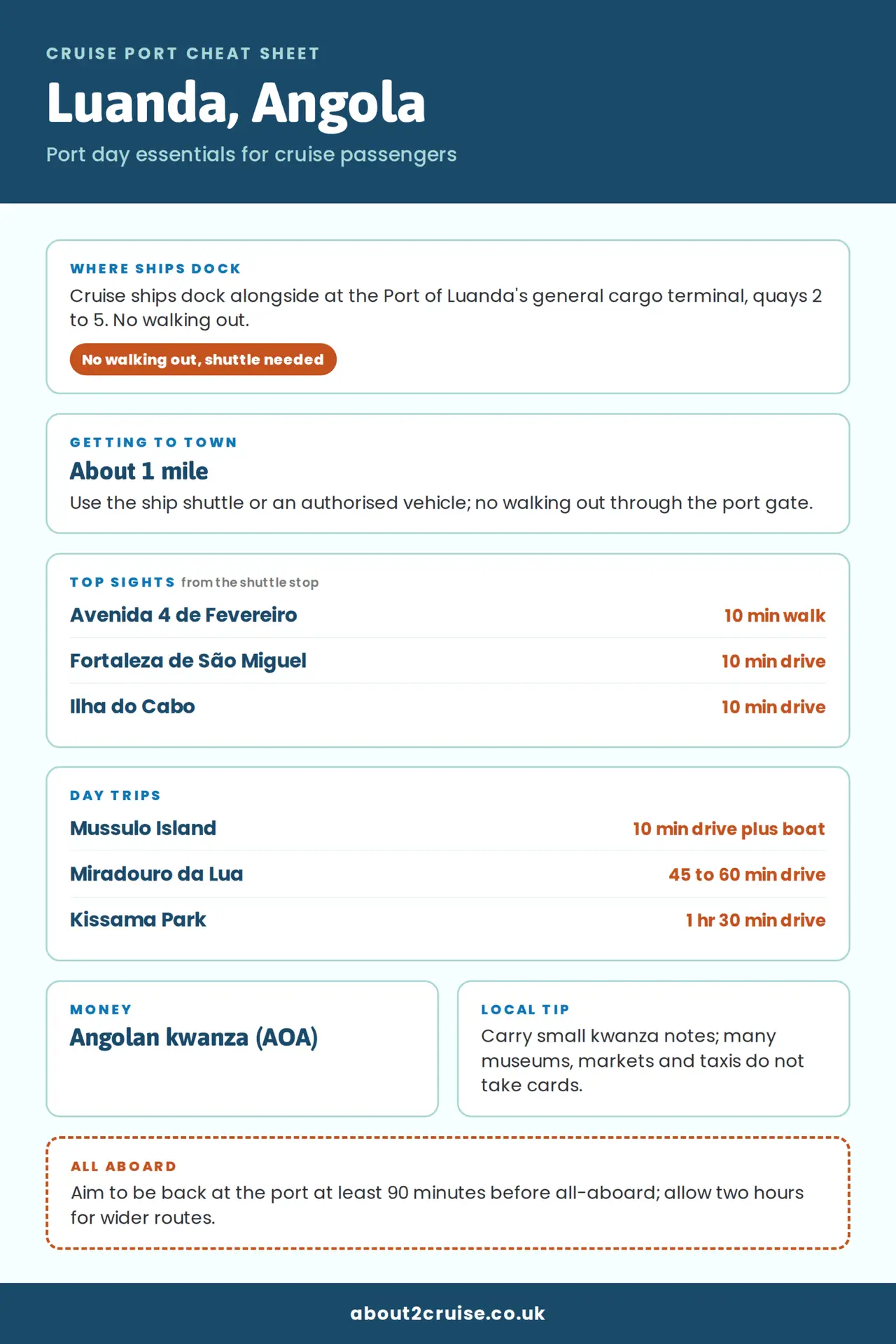
Luanda is a working commercial port in Angola, not a tender port. Cruise ships dock alongside at the general cargo terminal. You cannot walk through the port gates; use the ship’s shuttle, a private tour or an authorised vehicle. The city rewards planning: Portuguese colonial landmarks, bayfront views, beach escapes and serious safety, visa and cash preparation.
What is Luanda actually like?
Angola produces around 1.1 million barrels of oil a day and is sub-Saharan Africa’s second-largest oil producer after Nigeria. Luanda spent years at the top of expat cost-of-living rankings, and it still has a reputation for expensive hotels and restaurants. It has dropped to roughly 26th place, but it remains pricey for visitors.
About a third of Angola’s population lives in Luanda, much of it in the musseques, the informal settlements behind the bayfront towers. The city is the world’s most populous Portuguese-speaking capital. On a port day you’ll notice the contrast immediately: glass towers and pastel colonial facades along the Marginal, with the rest of the city stretching far behind them.
Do cruise ships dock or tender in Luanda?
Cruise ships berth at the Port of Luanda’s general cargo terminal, usually at quays 2 to 5. The port’s UN/LOCODE is AOLAD. That’s the code you’ll see on AIS tracking sites and cruise paperwork. The old city airport code LAD is not the port code.
The port sits inside a natural bay sheltered by Ilha do Cabo. Passenger clearance happens at the Terminal de Passageiros, but the cruise berth itself is a working cargo area. Don’t expect a glossy cruise terminal. There may be a basic passenger facility, shops and toilets, but the area mainly handles the Luanda–Soyo–Cabinda catamaran ferries. Current cruise calls dock alongside, not by tender.
Because this is a secure commercial port, passengers are not allowed to walk through the gates. Use the ship’s shuttle, an excursion coach or a pre-arranged vehicle with port access. If you’re meeting a private driver, confirm in advance that they can enter the secure zone.
Luanda cruise port map
Ships dock at Luanda cruise port. Tap a pin for directions.
- Luanda cruise portWhere ships dock
- Fortaleza de São MiguelFortress and military museum · About 6 km from Luanda cruise port
- Agostinho Neto MemorialPresidential memorial · About 38 km from Luanda cruise port
- Avenida 4 de FevereiroBayfront avenue · About 4 km from Luanda cruise port
- Palácio de FerroHistoric iron palace · About 5 km from Luanda cruise port
- Shopping FortalezaShopping mall · About 6 km from Luanda cruise port
- Ilha do CaboBeach peninsula · About 5 km from Luanda cruise port
- Miradouro da LuaViewpoint · About 52 km from Luanda cruise port
- Museu da MoedaCurrency museum · About 5 km from Luanda cruise port
- National Museum of SlaverySlavery museum · About 26 km from Luanda cruise port
Do you need a visa for Luanda on a cruise?
British citizens do not need a visa for tourism in Angola for stays of up to 30 days per entry, up to 90 days per year, under the current visa exemption. Your passport must have at least six months’ validity beyond arrival and at least two blank pages. Other nationalities should check Angola’s eVisa or visa rules before the cruise.
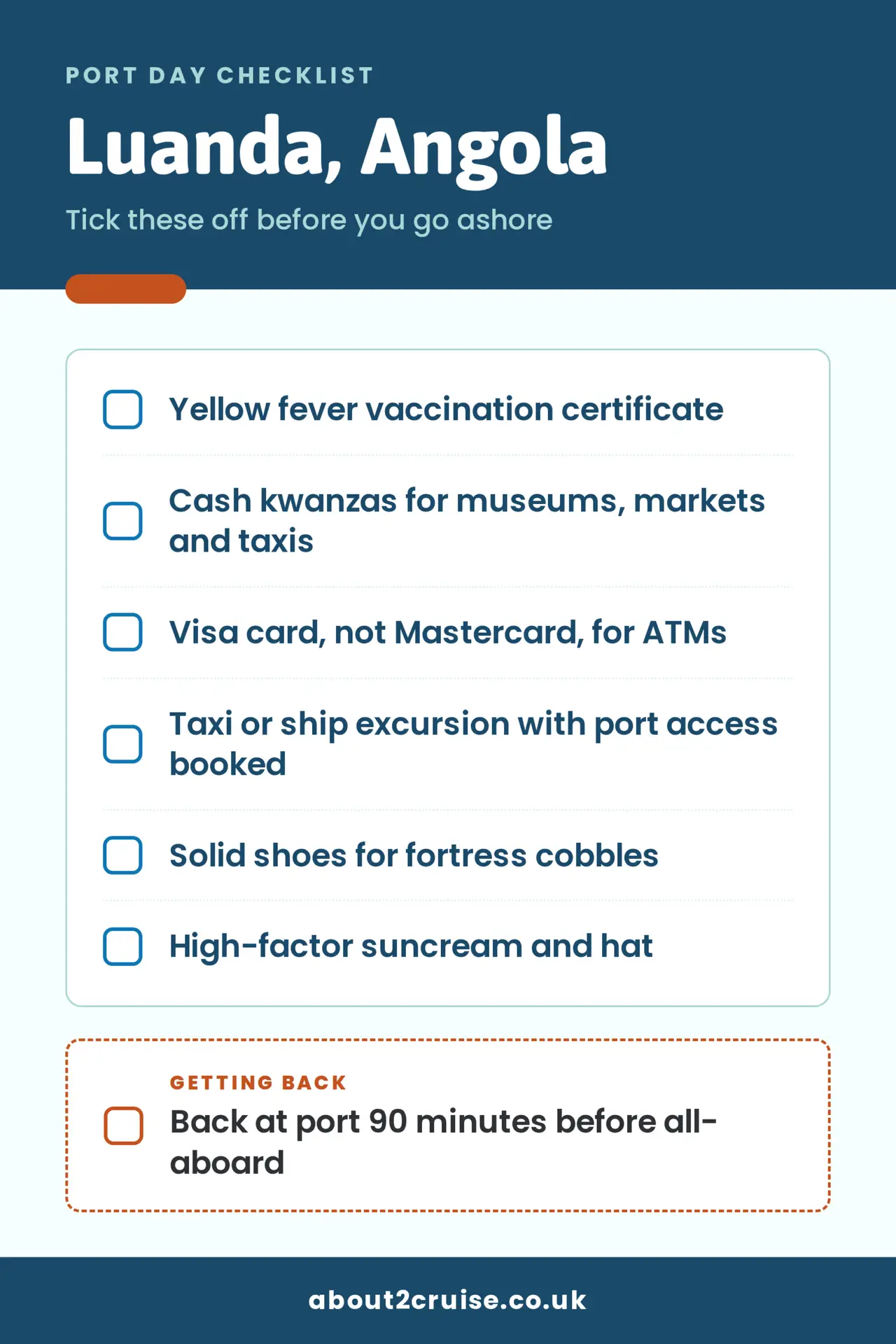
Angola enforces a yellow fever vaccination certificate for all arrivals aged nine months and over. The vaccine must be given at least 10 days before travel. Carry the original certificate, not just a photo on your phone.
You must declare cash or travellers cheques worth US$5,000 or more on entry. You cannot take out more than US$5,000 in foreign currency, plus up to 50,000 kwanzas. Overstaying carries a fine of 15,000 kwanzas a day, and you may not be allowed to leave until it is paid.
For cruise calls, clearance is usually handled through the ship with the migration service and fiscal police. Carry your passport or a certified copy of the photo page when ashore. You can be fined for not having ID.
Getting from the ship into Luanda
The cruise berth is central on the bay, but the exit is not pedestrian-friendly. Avenida 4 de Fevereiro is about 10–15 minutes on foot beyond the port gate, and central Luanda begins roughly a mile from the berth. However, walking out through the port gates is not permitted on most calls. The practical rule is simple: use the ship’s shuttle, an official excursion or an authorised pickup.
Some cruise lines run a complimentary continuous shuttle between the ship and the city centre when the ship is not docked within walking distance. Luanda usually qualifies. Confirm the drop-off point and last shuttle time before leaving the ship.
Taxis in Luanda are unmetered. Agree the fare before getting in. A short city ride is around 4,500 kwanzas, roughly US$5. The dominant ride-hailing app is Yango. Uber no longer operates in Angola. App prices are estimates, not fixed quotes, and some drivers request more than the app fare. The official guidance is to pay only the in-app amount and avoid street minibuses.
A private car with driver for the day typically costs US$100–150. A seven-hour city tour with port pickup and museum tickets is often sold from around EUR 65 per person. This is the most reliable way to keep a fixed return-to-ship margin.
Luanda traffic peaks from 07:00–10:00 and 16:00–20:00. A 4–5 km trip can take more than an hour. Finish a city circuit at least 90 minutes before all-aboard, and two hours for a wider route such as the Miradouro da Lua.
Money, cards and cash in Luanda
Angola’s currency is the kwanza (AOA). The central bank reference rate is around 912–913 kwanzas to the US dollar. Hotels, shopping centres and modern restaurants accept cards, but small museums, markets, taxis and many local eateries need cash kwanzas.
ATMs on the Multicaixa network are common in central Luanda, but they can reject foreign cards, run out of cash at weekends and cap withdrawals at around 50,000–100,000 kwanzas a day. Visa is generally more reliable than Mastercard, and BFA machines are the most dependable for foreign cards. Banks and ATMs cluster in the Baixa along Avenida 4 de Fevereiro.
Avoid street money-changing. The informal kingila market can quote a rate more than 20% above the official one, but it is not a safe or recommended place for a visitor. Change money at banks or withdraw from ATMs in monitored locations, and be careful after withdrawing cash. People are followed after leaving banks.
For a port day, carry small kwanza notes for entry fees, drinks and market purchases. US dollars are not widely accepted in small shops or taxis.
Is Luanda safe for cruise passengers?
Luanda has a high level of crime, some of it violent. The practical guidance is blunt: do not walk around Luanda alone or after dark, do not walk between bars and restaurants on the Ilha do Cabo, avoid crowded markets and large gatherings, and keep phones and jewellery out of sight.
The UK travel advice specifically says to avoid walking around Luanda, especially after dark, and to hand over money and valuables immediately if confronted. Theft from stationary or slow-moving cars is common downtown, so keep doors locked and windows closed, and do not respond if someone signals you to pull over.
Public gatherings and protests can turn violent with little notice. Carry ID at all times. A certified copy of your passport photo page is enough, and no ID can mean an on-the-spot fine of 15,000 kwanzas.
For a cruise passenger, the safest approach is a ship excursion, a vetted private guide or a shared city tour with an authorised vehicle. Independent wandering is possible only in very controlled central areas, and the best advice is not to try it if you are not confident in the city.
How to see Luanda in one day
Yes, a port day can work if you treat Luanda as a loop: fortress viewpoint, bayfront Marginal, Agostinho Neto Memorial, a seafood lunch on Ilha do Cabo, then a craft market or mall before returning to the ship. Distances are short. Traffic is the constraint.
Before you sail
- Book a ship excursion or private car with port access before sailing; authorised vehicles are required.
- Check yellow fever vaccination certificate and passport validity, six months and two blank pages.
- Carry a certified copy of your passport photo page as ID ashore.
Short port day: under 6 hours
- On dockingTake the ship shuttleNo walking outPassengers cannot walk through the port gates. The shuttle or an authorised pickup is the only way out.
- +30 minFortaleza de São MiguelCash entryA 10 minute drive from the city centre. The military museum has bay views, azulejo panels and cobbled courtyards.
- +1 hr 15 minMarginal and old BaixaDrive or walk along Avenida 4 de Fevereiro to see colonial facades, the Palácio de Ferro and the Eu Amo Luanda sign.
- +2 hrsAgostinho Neto MemorialAsk before photosA 10 minute drive. Walk the esplanade free; the crypt is usually open on weekday mornings only.
- +2 hrs 45 minLunch on Ilha do CaboTry grilled fishAbout 10 minutes by car. The beachfront is the place for grilled fish and prawns, or muamba de galinha.
- +4 hrsShopping FortalezaThe air-conditioned waterfront mall is about 2.1 km from the berth, good for supplies and souvenirs.
- All-aboard minus 1 hrBack at the shuttle stopReturn shuttles get busy. If you are with a private driver, keep the same margin for traffic.
This map shows the taxi ride from the ship. The time is the drive only, not your time ashore.
Open the taxi route in Google Maps
If plans change: If the fortress is closed or entry is blocked, swap in the Currency Museum and the Marginal photo stops, then continue to lunch on Ilha do Cabo.
Long port day: 8 hours or more
- On dockingMeet your driverPort accessBook a private car or ship excursion before you sail. The driver must have permission to enter the secure port.
- +30 minFortaleza de São MiguelCash entryA 10 minute drive. See the bay panorama, military vehicles and azulejo panels. Wear solid shoes for cobbles.
- +1 hr 15 minMarginal and old BaixaDrive along Avenida 4 de Fevereiro for the colonial facades, Palácio de Ferro and the Eu Amo Luanda sign.
- +2 hrsAgostinho Neto MemorialAsk before photosA 10 minute drive. The esplanade is free; keep lenses off uniformed guards.
- +2 hrs 45 minLunch on Ilha do CaboTry grilled fishBeachfront grilled fish and prawns or muamba de galinha. Loungers are usually rented through a beach club.
- +4 hrsDrive to Benfica crafts marketCash onlyThe Kifica market in Benfica is the main place for Thinker statuettes and Mwana Pwo masks. Bargain in kwanzas; no card machines.
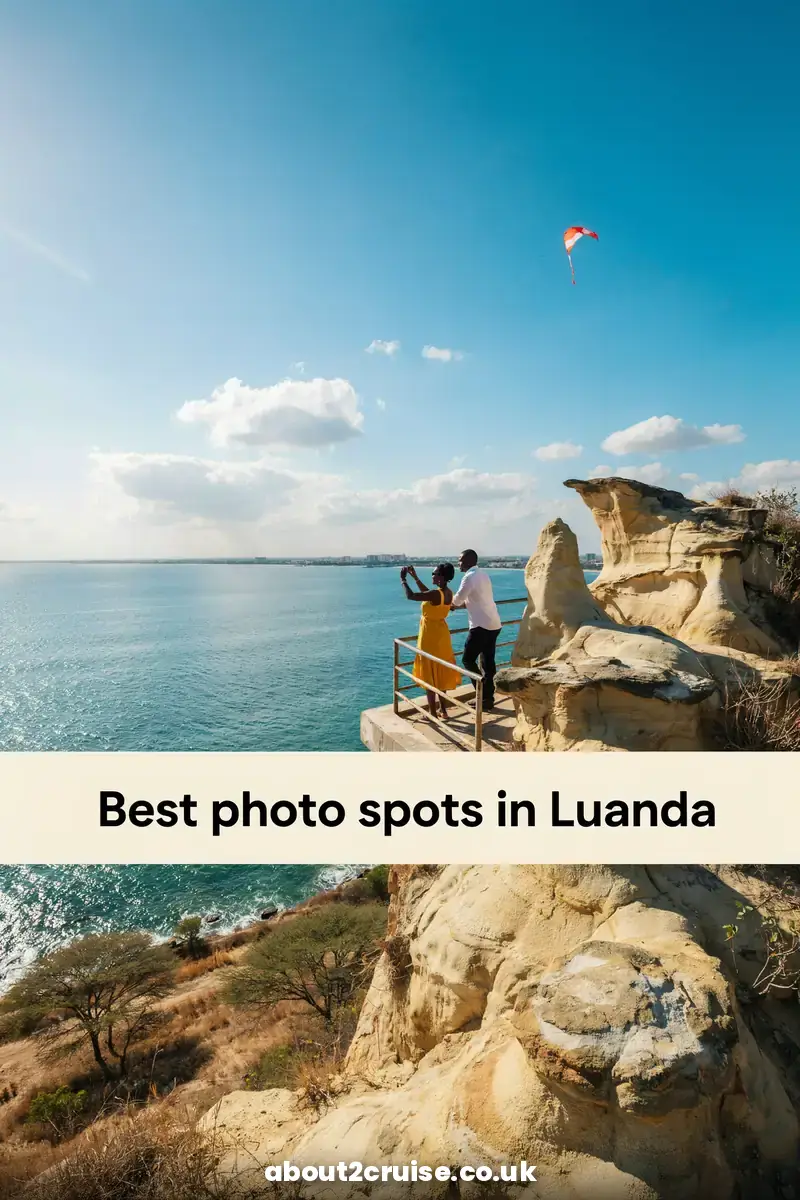
- +5 hrs 30 minMiradouro da Lua viewpointDrive south on the EN-100 for 45 to 60 minutes, then walk the uneven cliff path for long shadows.
This map shows the taxi ride from the ship. The time is the drive only, not your time ashore.
Open the taxi route in Google Maps
If plans change: If the south coast road is too slow or the driver will not go, switch to beach time on Ilha do Cabo and then Shopping Fortaleza.
A realistic independent or guided loop starts at Fortaleza de São Miguel for the bay panorama, then drops to the Baixa and Avenida 4 de Fevereiro for the colonial facades and the waterfront sign. Stop at the Agostinho Neto Memorial on the esplanade, then drive along the Marginal to the Ilha do Cabo for grilled fish. Finish at Shopping Fortaleza, the waterfront mall, which is about 2.1 km from the berth.
If you only do one thing, make it the fortress and the Marginal. If you want a beach escape, the Ilha do Cabo is about 10 minutes by car and has beach clubs, loungers and restaurants. Ship excursions also run to Mussulo Island and Ilha de Luanda.
Fortaleza de São Miguel and the Military Museum
São Miguel was the first defensive structure built in Luanda and Angola, begun by governor Paulo Dias de Novais. It is now the National Museum of Military History, with vehicles, artillery and azulejo panels, and it gives the classic view over the bay and the Ilha do Cabo.
It is about 2.7 km from the berth, roughly a 9-minute drive. Access is still controlled by the military, so expect security checks. Opening hours are not firmly fixed: published times range from 08:00–16:00 to 08:30–17:30, with Monday often closed or protocol-only. Foreign visitors pay a few hundred kwanzas in cash. Cards may not be accepted at the gate.
The approach and courtyards are cobbled, with stone steps, so wear solid shoes. Do not photograph guards or security installations.
Agostinho Neto Memorial
The memorial is a 120 m rocket-shaped monument on the Praia do Bispo esplanade, with gardens and reflecting pools. It holds the tomb of Angola’s first president, Agostinho Neto. The esplanade can be walked for free. The crypt below is usually open on weekday mornings only, with listed hours around 08:00–16:00.
It is about 3.5 km from the berth, roughly a 10-minute drive. Soldiers guard the perimeter. Ask before photographing, and keep the lens off uniformed personnel.
The Marginal and the old colonial Baixa
Avenida 4 de Fevereiro, known as the Marginal, runs for several kilometres around the bay with gardens, cycle paths and skyline views. It is Luanda’s evening gathering place and sunset spot. The Baixa, or lower town, mixes pastel colonial buildings with new towers. Look for the Palácio de Ferro, a restored 19th-century prefabricated iron building often linked to Eiffel’s workshop.
The waterfront has an Eu Amo Luanda sign used as a photo stop. Shopping Fortaleza, a large air-conditioned mall, is about 2.1 km from the berth and is the easy option for supplies, souvenirs and air conditioning in the heat.
The old city is the one stretch where short, escorted walks are practical. Even there, keep your phone and camera discreet and avoid crowds.
Ilha do Cabo and Mussulo beach escapes
Ilha do Cabo is the narrow sandy peninsula across the bay, about 4 km from the berth and roughly a 10-minute drive. It is lined with beach clubs, seafood restaurants and lounge bars, and is busiest on Fridays and Saturdays. Sun loungers and umbrellas are usually rented through a beach club with a food and drink minimum.
Mussulo is a larger island-lagoon system reached by boat from the Ilha or the Kapossoca embarkation point. It is quieter, with calmer water and higher-end resorts. Ship excursions include a Mussulo Island and boat cruise and a beach escape to Ilha de Luanda.
Swimwear belongs on the beach, not in town. Topless sunbathing is not usual, and many bars and clubs turn away shorts and flip-flops later in the evening.
Markets and souvenir shopping in Luanda
The Benfica crafts market, known locally as Kifica, is in the Benfica neighbourhood south of the city. It has around 700 sellers and thousands of pieces daily, including signature Thinker statuettes, animal carvings, Mwana Pwo masks, paintings and textiles. Bargaining is expected, and cash kwanzas is the rule. There are no card machines.
A smaller curated art market on Ilha de Luanda sells local artists’ work and is less overwhelming than the main markets. For an air-conditioned alternative, Shopping Fortaleza on the waterfront is the practical stop near the berth.
Do not buy ivory. Purchases are prosecuted and carry prison sentences or fines.
Angolan-Portuguese food and local music
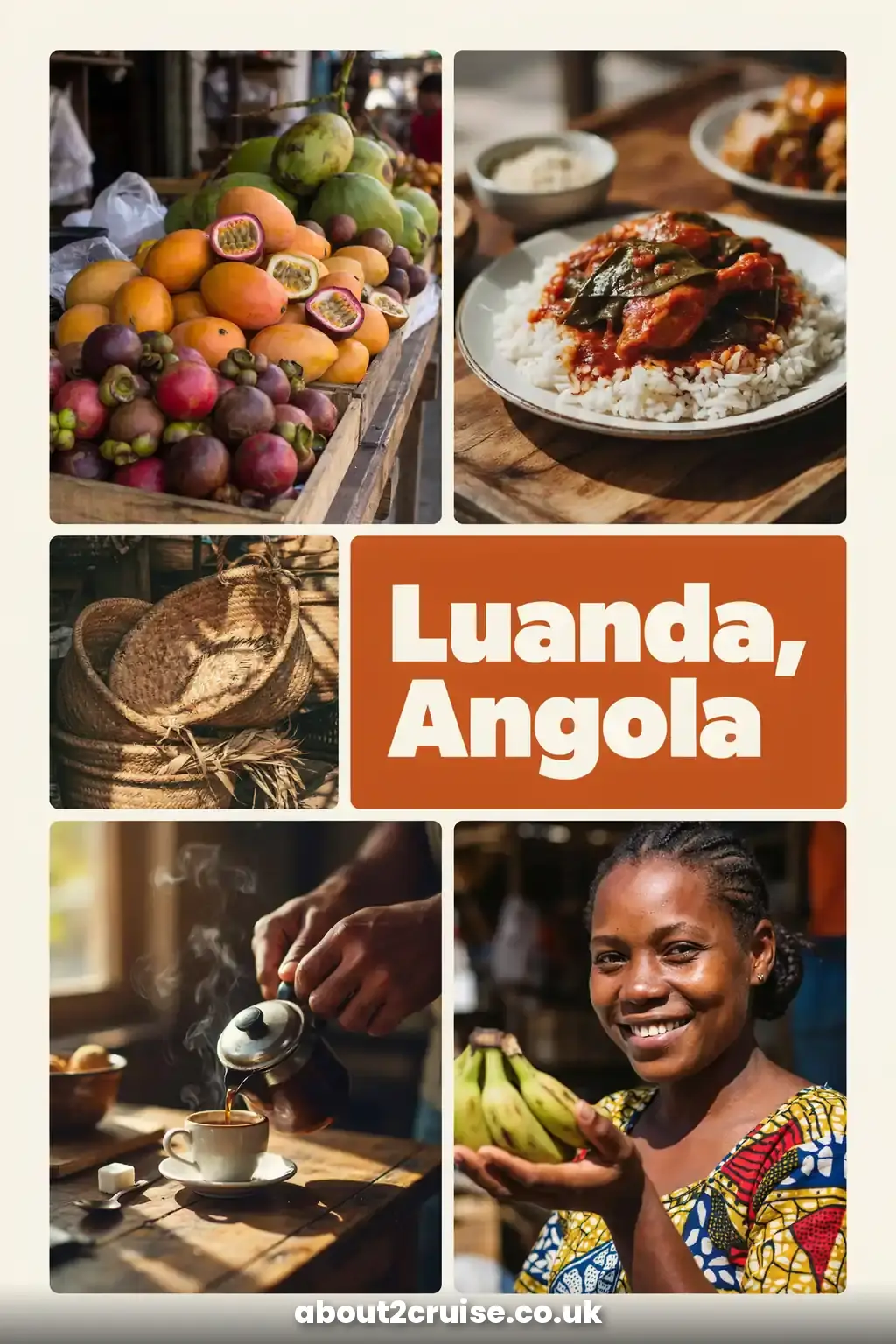
Luanda’s food is the strongest part of a port day. The national dish is muamba de galinha, chicken stewed with palm oil, okra and garlic, served with funge or rice. Calulu layers dried fish with fresh fish, onion, tomato, okra and sweet potato leaves. Mufete de kacusso is grilled tilapia with palm-oil beans and cooked cassava.
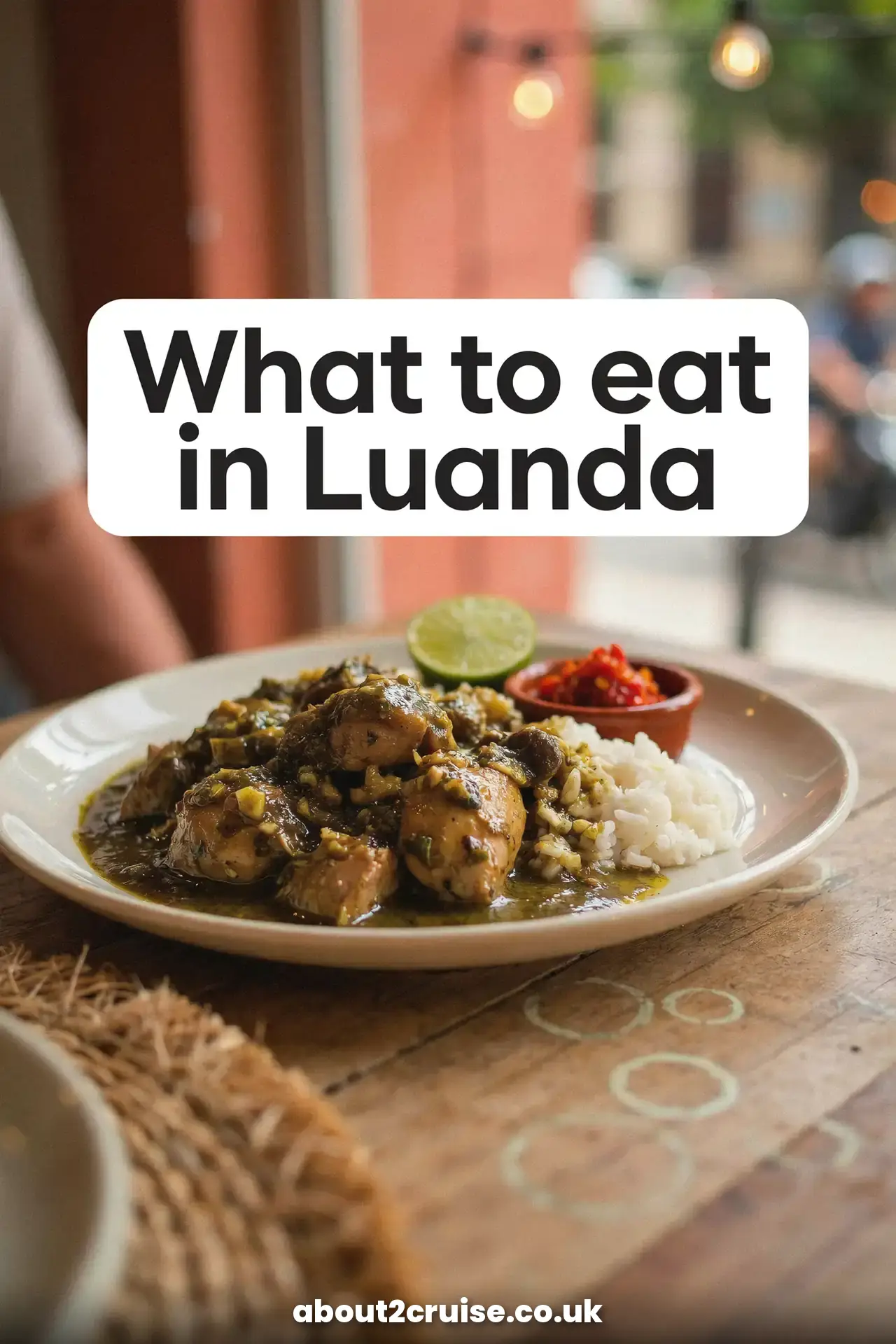
The Ilha do Cabo beachfront is the place for grilled fish and prawns. A main course at a good Ilha seafood restaurant runs roughly US$30–60. The Marginal and Miramar have skyline-view dining, while Baixa cafés and pastry shops are good for coffee and snacks.
Lunch is taken roughly 12:30–15:00 and dinner 19:30–22:30. If you are docked overnight, Ilha restaurants stay open very late. For eating near the port on a tight schedule, Hotel Presidente Luanda is directly opposite the port on Largo 4 de Fevereiro, about 500 m away, and is the most convenient sit-down option.
Semba, kizomba and Luanda Carnival
Semba developed in Angola’s coastal centres, especially Luanda and Benguela, and remains the music of the sea and social gatherings. Kizomba emerged in Angola in the late 1970s and 1980s as a slower fusion of semba and Antillean zouk. The word means party in Kimbundu.
Luanda’s carnival parades run over three days on the Nova Marginal before Lent, with children’s, class B and class A parades at 17:00, followed by street carnival in the neighbourhoods. The main parade draws huge crowds and the avenue is closed to traffic for days. If your cruise falls during Carnival, expect heavy logistics and plan through the ship.
Live semba and kizomba are played in rooftop lounges and clubs on Ilha do Cabo and in Maianga, strongest Thursday to Saturday.
Weather, health and what to pack
Luanda is hot year-round. Daytime highs range from about 24°C in July and August to 31°C in February, March and April. Nights only drop to 19–25°C. The cool, dry season, called cacimbo, runs roughly May to September and is the most comfortable time to walk the city. June to August averages 0 mm of rain.
Rain falls almost entirely from November to April. April averages 145 mm over about nine rain days and March 120 mm over seven. Humidity is high from November to May and much lower from June to September. UV is extreme, 11+, for most of the year, so wear high-factor suncream, a hat and sunglasses.
Sea temperature ranges from about 20°C in July–August to 28°C in March. The best light for photography is early morning or the last one to two hours before sunset.
Health precautions for Luanda
Malaria is a risk in Angola year-round, including Luanda, and antimalarial medication is recommended. You also need a yellow fever vaccination certificate. Other risks include dengue, Zika and cholera. Tap water and ice are not considered safe. Drink sealed bottled water and avoid ice of unknown origin, including in hotels.
Do not swim in fresh, unchlorinated water because of schistosomiasis risk. Private clinics in Luanda are competent but charge high fees in advance. Healthcare outside Luanda is very limited. The emergency number is 112.
Language, photography and local etiquette
Portuguese is the official language. English is limited outside hotels, tour guiding and better restaurants. Greetings matter. Use Olá for hello, Bom dia for good morning, Boa tarde for good afternoon, Obrigado if you are male and Obrigada if you are female for thank you, Por favor for please, and Quanto custa? for how much?
Many semba songs and everyday expressions use Kimbundu, the predominant local language of the Luanda region alongside Portuguese. A few words in Portuguese go a long way, and the effort helps with guards, drivers and market sellers.
Do not use cameras or binoculars near government buildings. Taking photographs in the streets can draw attention, and cameras may be confiscated. At the Agostinho Neto memorial, ask the guards before photographing and keep the lens off uniformed personnel.
Dress modestly away from beaches. Shorts and T-shirts are fine for sightseeing, but swimwear belongs on the Ilha. The fortress has cobbles and stone stairs, the old town has uneven pavements, and the Ilha has sand.
Internet, SIM cards and staying connected in Luanda
Luanda has 4G mobile coverage in the central basin and around the bay. Unitel and Africell are the main networks. To buy a local SIM or eSIM, you need your passport. SIM cards are sold at the airport and at operator shops and shopping centres in the city, not reliably from a kiosk at the cruise terminal.
If you are only in port for a day, an international roaming package or a data-only travel eSIM is usually the easiest option. Free Wi-Fi is unreliable at monuments and markets, but shopping malls and better hotels such as Hotel Presidente and EPIC SANA have guest Wi-Fi. Do not wave your phone in crowded markets or on the street.
Accessibility at Luanda cruise port
Luanda is an alongside berth, which avoids a tender, but the gangway, cargo-terminal surface, coach steps and attraction entrances are separate barriers. Ask about the gangway arrangement and an accessible authorised vehicle before sailing.
The fortress approach, ramps, cobbles and interior thresholds need a specific accessibility check. The Miradouro da Lua cliff path is uneven and unsuitable for wheelchair users. If you use a wheelchair or have limited mobility, a ship excursion with a modern coach is the safest choice. Do not assume independent transfers can enter the secure port area or provide an accessible vehicle.
Which cruise ships call at Luanda?
Ships recorded at Luanda include Nicko Cruises’ Vasco da Gama, Silversea’s Silver Dawn and Silver Wind, Regent Seven Seas’ Seven Seas Mariner, Oceania’s Nautica, expedition ship SH Diana, Viking Sky and ms Europa 2. In-port calls are short, often roughly 07:00–17:00 or 08:00–19:00.
Luanda usually appears on repositioning voyages between southern Africa and West Africa. A typical run pairs Luanda with Walvis Bay and Cape Town to the south and São Tomé, Praia, Banjul or Tema to the north. Longer West African sailings continue to Dakar and Abidjan before turning towards Europe or the Mediterranean.
The port can handle two cruise ships at once at quays 2 to 5, but it is a commercial port, not a purpose-built cruise terminal. Angola is developing dedicated cruise infrastructure at Luanda, Lobito and Namibe, with a government target of at least 58 cruise calls and 80,000 cruise tourists by 2027.
Other ports near Luanda
Within Angola, the plausible cruise ports are Luanda, Lobito, Namibe and, rarely, Cabinda. Lobito lies about 400 km south of Luanda on a sheltered bay behind the Restinga sandspit, with Benguela about 30 km further south. Namibe and Pointe-Noire are the other nearby calls on these regional routes, and the infrastructure is commercial rather than passenger-oriented.
If your cruise is continuing along the coast, the next confirmed call is often Lobito or Walvis Bay rather than a port within a short day-trip distance of Luanda. No ferry or day trip to another Angolan cruise port is realistic during a port day.
Luanda cruise FAQs
What is the port code for Luanda, Angola?
AOLAD. That is the UN/LOCODE used by cruise paperwork, AIS tracking and carrier schedules. The old city airport code LAD is not the port code.
Do cruise ships actually call at Luanda?
Yes. Expedition ships, luxury lines and some larger ships call at the Port of Luanda’s general cargo terminal, docking alongside at quays 2 to 5. It is not currently a tender port.
Can you walk from the cruise ship into Luanda?
No. The berth is inside a secure commercial port, and passengers are not allowed to walk out through the gates. Use the ship’s shuttle, an excursion coach or an authorised private vehicle.
Is a visa needed for Luanda on a cruise?
UK citizens do not need a tourist visa for up to 30 days per entry. You still need a passport valid for at least six months after arrival, two blank pages and a yellow fever vaccination certificate.
How much are taxis in Luanda?
A short city ride is about 4,500 kwanzas, around US$5. Taxis are unmetered, so agree the fare first. Yango is the main ride-hailing app, but drivers sometimes ask for more than the in-app price. A private car with driver for the day is usually US$100–150.
What can you do in Luanda in one day?
Fortaleza de São Miguel, the Marginal and old Baixa, the Agostinho Neto Memorial, lunch on Ilha do Cabo, then Shopping Fortaleza before returning. If you want a beach, Mussulo or Ilha do Cabo are the typical ship excursions.
Where can I eat and drink near the cruise port?
Hotel Presidente Luanda is directly opposite the port on Largo 4 de Fevereiro. The Ilha do Cabo beachfront restaurants are about 10 minutes by car and are the best seafood option. Shopping Fortaleza also has reliable café and food-court choices.
Is Luanda safe for cruise passengers?
Luanda has a high level of crime, some violent. The safest option is a ship excursion or vetted private guide with an authorised vehicle. Avoid walking around the city, especially after dark, and do not wander independently in markets or between bars on Ilha do Cabo.
Can I use US dollars or euros in Luanda?
Not reliably. Hotels and large restaurants may quote in US dollars, but small shops, markets, taxis and museum gates want kwanzas. Carry small kwanza notes and use cards only at hotels, malls and modern restaurants.
Is there left luggage at the cruise terminal?
There is no confirmed left-luggage facility at the cruise terminal. If you need storage, ask your ship or use a hotel day-use booking. Do not leave bags with informal port helpers.
Can I get a local SIM card near the port?
There is no reliable SIM kiosk at the cruise terminal. Unitel and Africell shops in the Baixa or shopping centres can set you up with a passport, but for a one-day call an eSIM or roaming package is easier.