
Port Hedland is a raw, working iron-ore port rather than a beach resort. Cruise ships berth alongside in a security-regulated industrial harbour, passengers are taken into town by mandatory coach, and the main attraction is the port itself: giant bulk carriers, long ore trains, salt stacks, harbour tours and ship-watching. Book tours early and dress for heat.
Port Hedland at a Glance: Iron Ore, Salt and Shipping
Port Hedland is Australia’s largest bulk export port and, by tonnage, the largest bulk export port in the world. In the most recent full financial year, the wider Pilbara Ports group handled 804.1 million tonnes of imports and exports, and Port Hedland alone accounted for 580.4 million tonnes. About 81 per cent of Australia’s iron ore trade and roughly 43 per cent of global seaborne iron ore moves through this harbour.
What you see from the ship is not a harbour made for tourists. It is a continuous logistics machine: iron ore from Pilbara mines arrives by rail, is stockpiled and loaded onto Capesize bulk carriers, while salt, manganese, copper concentrates, livestock and spodumene move through the same system. The shipping channel is about 22 nautical miles long, with minimum depths around 14.9 metres, and the port handles vessels up to 340 metres in length and 60 metres in beam. Tides are significant, which is why ship movements are tightly scheduled.
The town sits on an island roughly 12 kilometres long and 1.5 kilometres wide, connected to the mainland by a two-lane causeway. The traditional owners are the Kariyarra people, and the local name for the area is Marapikurrinya, a reference to the hand-shaped tidal creeks.
On a Western Australia coast itinerary, Port Hedland often sits alongside Broome, Exmouth and Geraldton, but this is the industrial working-port day, not a resort or reef stop. For planning those calls together, see our guide to Western Australia’s cruise ports.
Is Port Hedland the Busiest Port in Australia?
Yes. If you are measuring bulk export tonnage, Port Hedland is not only the busiest port in Australia, it is the world’s largest bulk export port. It was the first Australian port to pass 100 million tonnes in a financial year, and it now routinely moves well over 500 million tonnes a year. The scale is why the horizon off the town is often full of anchored or queued bulk carriers.
That does not mean it is the country’s busiest container or passenger port. Its fame is specific: iron ore, salt and bulk commodities. When a cruise ship calls, you become a very small visitor inside one of the world’s great heavy-industry harbours.
What Is There to Do in Port Hedland, and Is It Worth Visiting?
Honestly, Port Hedland is not a classic cruise destination. The shopping is limited, the climate is harsh, and there is no resort beach next to the pier. It is a town of about 16,000 people, with the main centre around Wedge Street and The Esplanade in the West End, and the bigger residential and retail area in South Hedland 13 kilometres inland.
It is worth getting off if you are interested in one thing: seeing a mega-port in operation. That could mean a harbour launch tour, watching ore trains and ships from Redbank Bridge or Marapikurrinya Park, visiting the local museum or Aboriginal art centre, or doing a salt industry tour. Passengers who expect a beach or boutique port often find it disappointing; passengers who like industrial scenery, shipping and Pilbara history tend to find it genuinely interesting.
The town is flat and easy to walk in the West End, but it is very spread out and short on shade once you go beyond the immediate port foreshore.
Where Your Ship Docks in Port Hedland: Berth, Tender and Terminal
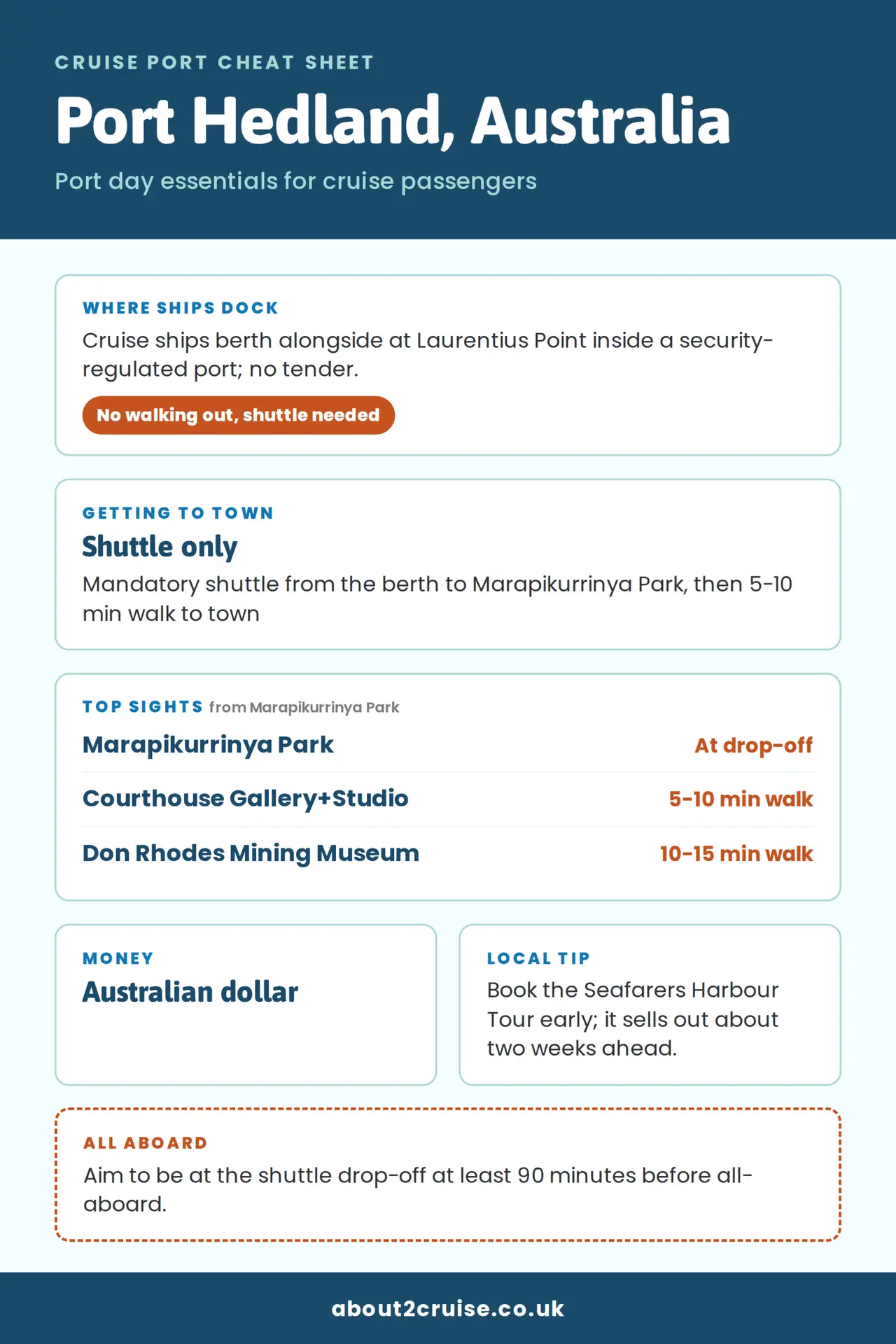
Cruise ships berth alongside at the public jetty at Laurentius Point, at the western end of the historic West End. There is no tender operation and no dedicated cruise terminal. The public berths used for passenger calls are PH1 and PH2, and they are designated biosecurity entry points for commercial passenger vessels. Facilities on the pier are usually temporary: security tents, information desks and the coach loading area.
This is a day-call port, not a luggage turnaround. Vessels may moor and passengers may go ashore for the day, but passenger baggage is not generally unloaded here.
Expect a steep gangway. Passenger reviews have specifically flagged that the gangplank can be challenging for people with limited mobility. There is no passenger terminal building, so there are no left-luggage facilities, no arrivals hall and no air-conditioned lounge at the berth.
The most important rule is that you cannot walk through the port. The entire Port of Port Hedland is a security-regulated site. There is no pedestrian access on cruise days, and all passenger movement between the ship and town is by coach. Buses are staged close to the berth, and Pilbara Ports staff or port watchmen control access at PH1 and PH2.
Port Hedland cruise port map
Ships dock at Laurentius Point cruise berth. From Marapikurrinya Park, Port Hedland Visitor Centre is about a 3-minute walk and Dalgety House Museum about 5 minutes. Tap a pin for directions.
- Laurentius Point cruise berthWhere ships dock
- Marapikurrinya Park shuttle drop-offPark · About 2 min walk from Marapikurrinya Park
- Port Hedland Visitor CentreVisitor centre · About 3 min walk from Marapikurrinya Park
- Dalgety House MuseumLocal history museum · About 5 min walk from Marapikurrinya Park
- Port Hedland Seafarers CentreSeafarers centre · About 8 min walk from Laurentius Point cruise berth
- BHP Billiton Nelson Point OperationsIron ore plant · About 26 min walk from Laurentius Point cruise berth
- Koombana LookoutLookout · About 4 km from Marapikurrinya Park
- Cemetery Beach ParkBeach park · About 3 km from Marapikurrinya Park
- Don Rhodes Mining MuseumMining museum · About 3 km from Laurentius Point cruise berth
- Pretty PoolAbout 7 km from Laurentius Point cruise berth
- Spinifex Hill StudiosAboriginal art centre · About 4 km from Laurentius Point cruise berth
- Port Hedland Yacht ClubYacht club · About 4 km from Laurentius Point cruise berth
Getting from the Ship into Town
Once you leave the ship, you board a mandatory shuttle bus. The primary drop-off is Marapikurrinya Park at 4 Richardson Street, right beside the inner harbour and the Esplanade. Volunteers often meet cruise passengers with maps and cold bottled water. From the Marapikurrinya Park drop-off, it is about a 5–10 minute walk to the Port Hedland Visitor Centre, Courthouse Gallery and the start of the heritage trail.
Some cruise shuttles have also run a later stop at the Boulevard Shopping Centre in Port Hedland, where Woolworths is located, but route details can vary by ship and by day. Confirm the shuttle route, last return time and whether it is complimentary before you leave the ship.
Taxis are limited and do not generally line up at the port gate. Hedland Taxis, South Hedland Taxis and OzTaxis take phone bookings, and H-Ride is the local app-based rideshare. Public buses are part of the TransRegional network; route 870 links Port Hedland and South Hedland, and fares are paid in cash to the driver.
There is no single official cruise terminal map, but the two useful self-guided maps are the Visitor Centre Cultural and Heritage Trail guide and the free PUBLIC Street Art map. Both are available from the Visitor Centre or Courthouse Gallery. A shipping-movements board outside the Visitor Centre tells you when big vessels are expected to move, so you can time your ship-watching.
Port Security and What to Bring Ashore
Treat the port as a live industrial site. Anyone without an MSIC or port induction is classed as a visitor and must be escorted or travelling in an authorised coach. Do not try to wander away from the marked passenger route. Photography and video inside Pilbara Ports’ controlled areas require approval, and recreational drones are banned in port landside areas. If you fly a drone within 5.5 kilometres of the Eastern Harbour or within port limits, it must be cleared with Port Hedland VTS.
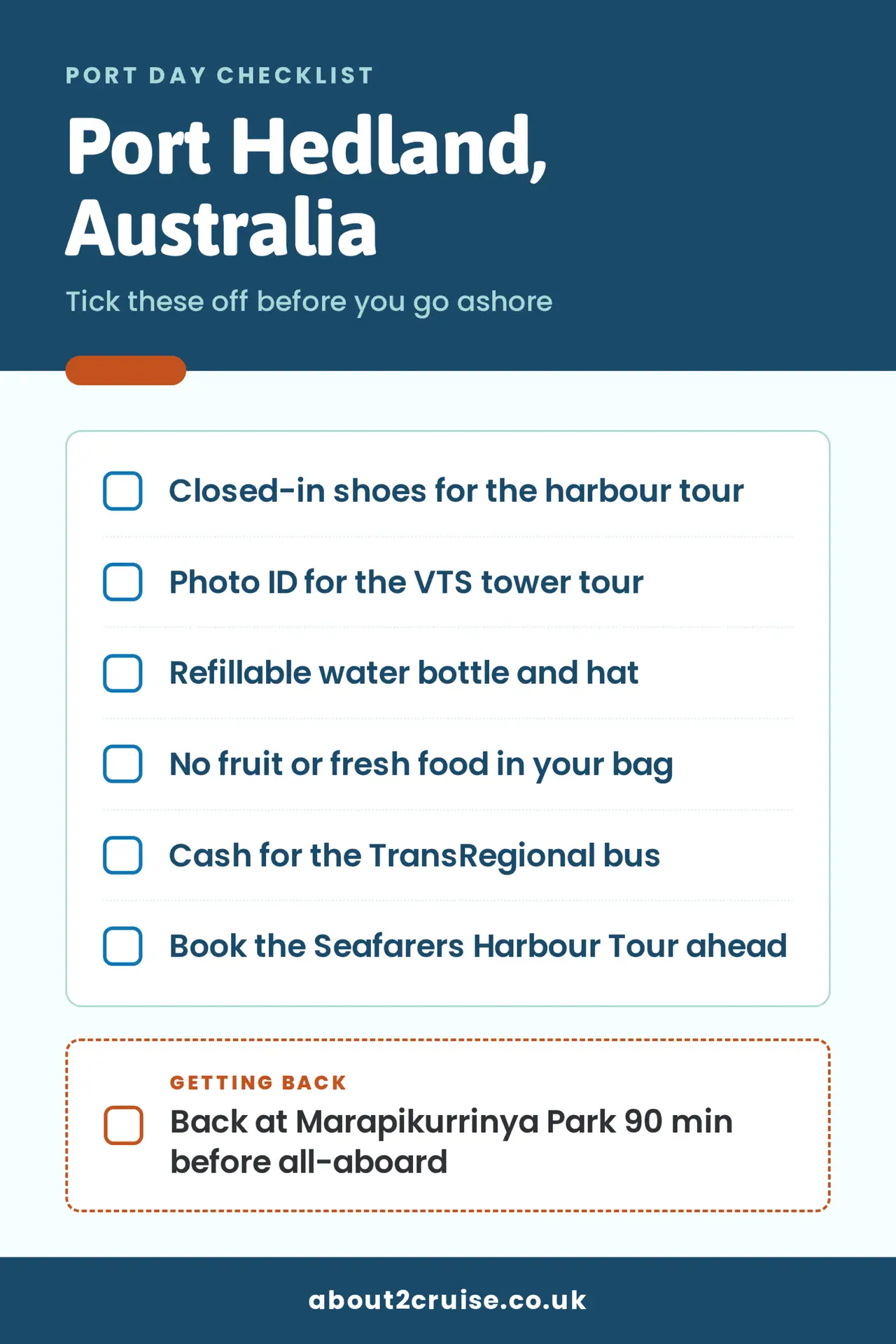
Carry photo identification for land-based tours such as the VTS tower visit. Keep your ship card with you at all times for reboarding. Australian biosecurity rules apply when you go ashore: fresh food, fruit, plant material and animal products from the ship must be declared or disposed of before you leave the port. Do not pack a banana or apple from the buffet into your day bag.
Best Port Hedland Shore Excursions to Book Early
Port Hedland has a small tour market, and the best tours sell out well before a big cruise call. The Visitor Centre reports that the main harbour tour is regularly booked out about two weeks in advance. If you want to do a harbour launch or industrial tour, book before you sail or as soon as bookings open on the ship.
- Seafarers Harbour Tour. This is the must-do if you want to see the working port from the water. It lasts about two hours and includes a 45-minute presentation at the Seafarers Centre, a bus to the commercial jetty and roughly 45 minutes on a launch past the port’s 19 berths. Current prices are around $80 per adult, $40 per child, $70 for seniors and $200 for a family of four. Closed-in shoes are required; thongs and sandals are not allowed, skirts or dresses are not recommended, and children must be at least 80 centimetres tall for a lifejacket. Weekday tours usually run 9am–11am, with weekend tours around 12.30pm–2.30pm.
- VTS Tower Tour. A one-hour visit to the vessel traffic services tower, including about 40 minutes in the Kariyarra Room on the fifth floor. It costs around $50. Photo ID is required, and the dress code is smart casual: no thongs, sandals or singlets.
- Ship Visit Tour. By arrangement only, this takes you onto a Capesize ore carrier. It is for adults and teenagers and requires good mobility: you may need to climb a gangway of about 60 continuous steps.
- Twilight Industry Tour. A 1.5–2 hour air-conditioned bus tour past the Dampier Salt site to Finucane Island, with a complimentary sundowner at sunset. Prices start from about $75.
- Salt Industry Tour. A 90-minute tour into the Rio Tinto Dampier Salt operation, including the production area and salt stack. Prices range from roughly $25 to $50 per person.
- Dalgety House Museum. A volunteer-run local history museum at the corner of Wedge and Anderson Streets. Entry is about $3. It is small and does not cater for people with access needs.
- Turtle-nesting tours. Flatback turtles nest from October to January and hatch from December to March. Guided evening turtle-watching tours are run by Care for Hedland, which manages the local monitoring programme.
Older guides sometimes mention a BHP Nelson Point iron-ore plant tour. Current visitor-centre reporting focuses on the harbour, salt, twilight, town/step-on and turtle tours, so check what is actually operating for your call before relying on an old itinerary.
Free Ways to See Port Hedland and the West End
If you do not have a tour booked, you can still have a good port-focused day without spending much.
- Marapikurrinya Park is the classic ship-watching spot. From the Esplanade at the end of Wedge or Richardson Street you can watch enormous bulk carriers move through the narrow channel, often surprisingly close to shore.
- Redbank Bridge Lookout is the vantage point for the iron-ore trains, which can be up to 2.8 kilometres long. Park on the southern side of the bridge off Wilson Street and aim for sunrise or sunset.
- Koombana Lookout, off McGregor Street, looks out over the ships waiting offshore. It is especially good at sunset.
- Cemetery Beach Park has lookouts over the water, and green turtles can be spotted year-round. Flatback turtles are seasonal.
- The public jetty is a local fishing spot and another way to see the harbour from the town side.
- Don Rhodes Mining Museum is an open-air park on Wilson Street with mining machinery, railway locomotives and a monument to the town’s Torres Strait Islander residents.
- The West End heritage and street-art walk takes you past old buildings, laneways and murals. Pick up the PUBLIC Street Art map from the Visitor Centre or Courthouse Gallery.
- Courthouse Gallery+Studio at 16 Edgar Street is open Tuesday to Friday 9am–4pm and Saturday 9am–12pm. It has changing exhibitions, working artists and a shop selling local art, homewares and books.
- Spinifex Hill Studios in South Hedland is the town’s only Aboriginal art centre. You can watch artists at work and buy work directly. It needs transport from the port.
- Staircase to the Moon is a full-moon event between March and October. The best viewing point is the deck near the caravan park on Goode Street.
Food, Drink and Shopping Near the Shuttle Stop
Most cruise passengers stay in the West End, and that is where the easiest food and drink is. Cafés and eateries cluster on and around Wedge Street and The Esplanade, within a short walk of Marapikurrinya Park. The historic pub on The Esplanade does counter lunches. A general store called The Emporium at 2–4 The Esplanade is crammed with everything from food to hardware and is an experience in itself.
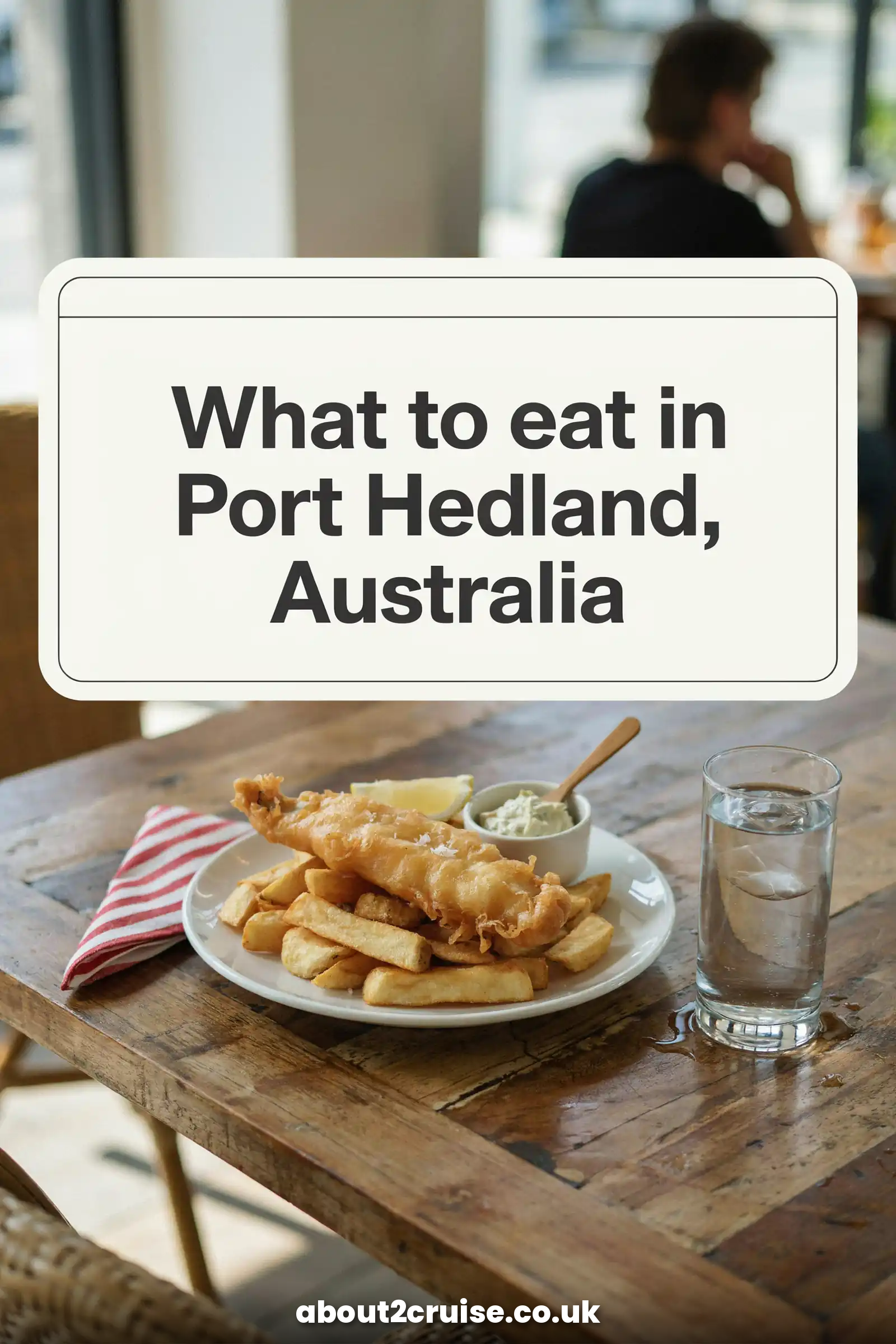
Local seafood is the thing to try: fish and chips, prawns, squid and catch-of-the-day. Fish caught in the area include barramundi, mangrove jack, mackerel, red emperor and coral trout. Several venues have opened in the West End serving fish and chips, and the Visitor Centre can point you to what is open on the day.
Shopping in Port Hedland is limited. Woolworths is at the Boulevard Shopping Centre on Anderson Street/McGregor Street. For souvenirs, the Visitor Centre sells locally made gifts, books and iron-ore samples. The Courthouse Gallery and Spinifex Hill Studios sell local art, and market stalls sometimes appear at Marapikurrinya Park on cruise days.
Weather, Cyclones and the Best Time to Cruise into Port Hedland
Port Hedland has a Pilbara climate, not a southern Australia climate. Daytime maximums average around 36°C from October to April, and January, March and December all average maximums of about 36.4–36.8°C. The record high at the airport is 49°C. The town averages about 142 days a year at 35°C or hotter and more than 31 days a year at 40°C or hotter. Nights stay warm in summer, often around 25°C.
The wet season runs roughly November to April, with cyclones, localised flooding and high humidity. Most rain falls between January and March. The dry season from May to November is more comfortable, with lower humidity, cooler nights and little rain. Cruise ships have called during the summer months, so do not assume a call will be mild. Check the forecast, not the season name.
Tides are a practical issue for ships. Spring tide ranges average around 5.4 metres, and the port uses tidal scheduling windows and an under-keel clearance system. The largest ships may be restricted to daylight berthing or sailing, which can affect your sail-in and sailaway timing. If your ship is arriving or departing late, it may genuinely be because of tide, not a missed schedule.
Money, Time and Visitor Information
Australia uses the Australian dollar. Cards and contactless payment are standard at tour desks, cafés and shops. Displayed prices include 10% GST, and tipping is not expected. The one place you may need cash is the TransRegional bus, where fares are paid to the driver. ATMs are available in town and at the Boulevard Shopping Centre; bank branches cluster on Wedge Street.
Western Australia runs on Australian Western Standard Time, UTC+8, all year with no daylight saving.
The Port Hedland Visitor Centre is at 13 Wedge Street, in the West End. It is open Monday to Friday 9am–5pm and weekends 9am–3pm. It has free Wi-Fi, public toilets, heritage and street-art maps, tide times, shipping movements and local bookings. Mobile coverage generally works in town, but can become patchy on remote roads or sites outside the main centres.
What to Wear and Pack for a Pilbara Port Day
Plan for heat, sun and industrial safety. Bring sunscreen, sunglasses, a hat that will not blow off in the harbour wind, and a refillable water bottle. Lightweight loose clothing works for the town, but several tours have strict dress rules.


Close-toe shoes or enclosed shoes are essential for the Seafarers Harbour Tour, Salt Industry Tour and ship-visit tour. Thongs, sandals and flip-flops are not accepted on the harbour or tower tours. For the VTS Tower Tour and ship-visit tour, long pants, enclosed shoes and no singlets are expected. If you plan to walk on the reef or rock platform at low tide, wear suitable footwear; at Pretty Pool, swimmers are warned to wear shoes to protect against stonefish.
Carry photo ID, your ship card, a credit or debit card for tours, and a small amount of cash if you think you might use the public bus. Do not carry fresh fruit or other biosecurity-risk food from the ship.
Safety, Heat and Industrial-Port Warnings
Port Hedland is not dangerous if you follow the rules, but it is a hot, heavy-industry town with specific risks.
- Heat and hydration are the biggest risks. Heat exhaustion can happen quickly when you combine high temperatures with walking and sun exposure.
- Dust is part of the landscape. The red Pilbara dust gets onto clothes, shoes and camera gear. If you have asthma or dust sensitivity, take your medication and consider limiting time near stockpiles or windy industrial viewpoints.
- Water and swimming: rip currents are the main swimming hazard. Swimmers at Pretty Pool are warned to wear shoes because of stonefish. Check local advice before swimming, and do not swim in the harbour or port areas.
- Security: the port is security regulated. Stay inside the marked passenger route, follow staff instructions, and do not climb fences or wander toward haul roads or rail lines.
- Petty crime is low but basic precautions are sensible: keep bags attended and valuables out of sight in the town centre.
- Wildlife: Australia has dangerous wildlife, but the more realistic issues here are heat, sun and marine hazards rather than snakes or spiders. Still, pay attention to local warning signs.
Accessibility at the Cruise Berth and Around Town
The berth has no terminal building, so accessibility at the ship end starts with the gangway. Passenger accounts have flagged that the gangway can be steep, and there is no published step-free routing from the gangway to the coach. If you have limited mobility, ask the ship’s shore excursion team or the gangway staff before walking down.
The Visitor Centre at 13 Wedge Street is wheelchair accessible and has accessible toilets and parking. The West End town centre is flat and walkable, but shade is limited and distances can be uncomfortable in the heat. The mandatory shuttle is the practical way in and out; check whether the coach can accommodate a wheelchair or scooter before you leave the ship.
Not all tours are accessible. The Seafarers ship visit requires climbing about 60 steps and good mobility. The harbour tour uses a launch and jetty, and closed shoes are required. Dalgety House does not cater for people with access needs. If you have mobility concerns, contact the Seafarers Centre before booking the harbour tour.
Port Hedland Cruise Schedule and Realistic Expectations
Port Hedland does not publish a simple year-round public cruise calendar in the way some tourist ports do. Calls are irregular, often tied to Australian circumnavigation or repositioning itineraries, and local operators report that a single large ship can bring more than 4,000 passengers and crew. The port has previously adjusted cruise fees to attract calls, and Pilbara Ports describes cruise shipping as part of its trade diversification.
Royal Caribbean has produced Port Hedland shore-excursion material, and Cruise & Maritime Voyages has called in the past. Some cruise retailers list no scheduled visits at any given time, so do not worry if you cannot find your call on a third-party schedule. Confirm your berth, shuttle and tour arrangements through your cruise line.
Reviews of Port Hedland are polarised. Some passengers find it hot, dusty and limited. Others love the chance to see the largest bulk export port in Australia at work, with friendly volunteers, market stalls and a harbour tour as a highlight. Set your expectation around a working port, not a leisure destination, and you are less likely to be disappointed.
Staying in Port Hedland Before or After Your Cruise
Most cruise passengers visit for the day, but a few people join or leave a cruise itinerary here. If you need a hotel, book early: accommodation is tight because of the resources workforce. Hotels in or near the West End include The Esplanade Hotel on Anderson Street, Hospitality Inn Port Hedland overlooking the water, and ibis Styles Port Hedland. None are a long taxi ride from the cruise berth.
Port Hedland International Airport is about 9–10 kilometres, or roughly 7 minutes, from town. Qantas and Virgin Australia fly direct between Perth and Port Hedland, and there are also direct Brisbane and Bali links depending on the season. There is no public transport to the airport. Use a taxi, H-Ride rideshare or accommodation-arranged coach. A taxi from the airport to town is roughly 15 minutes and in the region of $30–50.
By road, Perth is about 1,800 kilometres away, so driving is a long two-day trip with an overnight stop such as Carnarvon. Integrity Coach Lines runs between Perth and Port Hedland and sets down at the Visitor Centre on Wedge Street. If you are joining a cruise, double-check whether the line will handle baggage, because Port Hedland is not a passenger-baggage turnaround point.
How to spend a port day in Port Hedland
A port day in Port Hedland works best if you pick one: a free West End ship-watching walk, or a longer day that adds more lookouts and galleries. Book any tour early and treat the day as a look inside a working mega-port.
Before you sail
- Book the Seafarers Harbour Tour before you sail; it sells out about two weeks ahead.
- Book the VTS Tower Tour if you want it; photo ID is required on the day.
- Confirm the shuttle is complimentary and note the last return time before boarding.
Short port day: under 6 hours
- On dockingTake the mandatory shuttleNo pedestrian accessNo walking through the port. Coaches run from Laurentius Point to Marapikurrinya Park.
- +15 minMarapikurrinya ParkWatch bulk carriers move through the narrow channel from the drop-off.
- +45 minVisitor Centre and West End walkA 5-10 minute walk from the park. Pick up the heritage trail and street-art maps.
- +1 hr 30 minLunch in the West EndTry local seafoodFish and chips, prawns or squid at cafes around Wedge Street and The Esplanade.
- +2 hrs 30 minDon Rhodes Mining MuseumWalk to Wilson Street to see open-air mining machinery and railway locomotives.
- +3 hrs 45 minRedbank Bridge LookoutA short walk from the museum. Watch iron-ore trains up to 2.8 km long.
- All-aboard minus 1 hrBack at Marapikurrinya ParkReturn shuttle from the park. Confirm the last shuttle time before leaving the ship.
The time on the map is the whole walk, every stop added together.
Open this walking route in Google Maps
If plans change: If the Visitor Centre is closed, the Courthouse Gallery and the street-art walk still work within a few minutes of the shuttle stop.
Long port day: 8 hours or more
- On dockingTake the mandatory shuttleNo pedestrian accessCoaches run from Laurentius Point to Marapikurrinya Park. You cannot walk through the port.
- +15 minMarapikurrinya ParkWatch bulk carriers move through the narrow channel from the drop-off.
- +45 minVisitor Centre and Courthouse GalleryA 5-10 minute walk. Pick up the heritage trail and street-art maps.
- +2 hrs 15 minLunch in the West EndTry local seafoodFish and chips, prawns or squid at cafes around Wedge Street and The Esplanade.
- +3 hrs 15 minDon Rhodes Mining MuseumWalk to Wilson Street to see mining machinery and railway locomotives.
- +4 hrsRedbank Bridge LookoutA short walk from the museum. Watch iron-ore trains up to 2.8 km long.
- +5 hrs 30 minKoombana LookoutWalk off McGregor Street for views over ships waiting offshore.
The time on the map is the whole walk, every stop added together.
Open this walking route in Google Maps
If plans change: If a sight is closed or the walk feels too long, skip Koombana and return to the West End cafés and Marapikurrinya Park.
Frequently Asked Questions
Can I walk from the cruise ship into Port Hedland?
No. The whole port is security regulated, and there is no pedestrian access on cruise days. You must take the mandatory shuttle or an organised coach from the berth into town.
Do cruise ships dock or tender at Port Hedland?
They dock alongside at the public jetty at Laurentius Point. There is no tender operation. The berth is inside the security-controlled port, and you board a coach directly.
How far is Port Hedland town centre from the cruise berth?
You cannot walk the distance because the port is restricted. The shuttle takes you to Marapikurrinya Park, and from there the Visitor Centre and West End shops are a five-to-ten-minute walk.
Is the shuttle bus free?
The shuttle is mandatory, and most cruise lines treat it as part of the port call. Confirm on board whether it is complimentary for your sailing, as arrangements can vary.
Are there taxis or rideshare at the Port Hedland cruise berth?
There is no formal taxi rank at the berth. Taxis and H-Ride are available locally, but you usually need to book by phone or app.
What can I do in Port Hedland in one day?
The most popular options are the Seafarers Harbour Tour, a twilight or salt industry tour, ship-watching from Marapikurrinya Park, the Redbank Bridge train lookout, Don Rhodes Mining Museum, the West End street-art walk and the local galleries.
Is Port Hedland worth a visit?
If you like shipping, heavy industry and Pilbara history, yes. If you want a beach-resort port with shopping and snorkelling, it may not be for you. The key is to book a harbour or industry tour and treat the day as a look inside a working mega-port.
Is it safe to swim at Port Hedland?
Swimming is not recommended in the harbour or port areas. At any beach, check marine-stinger, stonefish and rip-current warnings before you swim, and wear appropriate footwear if walking on rock platforms.