
Ayia Napa is not a conventional cruise port. Most cruise passengers arrive overland from Limassol or Larnaca; some ships anchor off Ayia Napa Marina and tender guests ashore. Once there, the draw is simple: white beaches, sea caves, boat trips, an old monastery and, later, the club scene. For other stops, see our eastern Mediterranean cruise ports guide.
So, is Ayia Napa actually a cruise port?
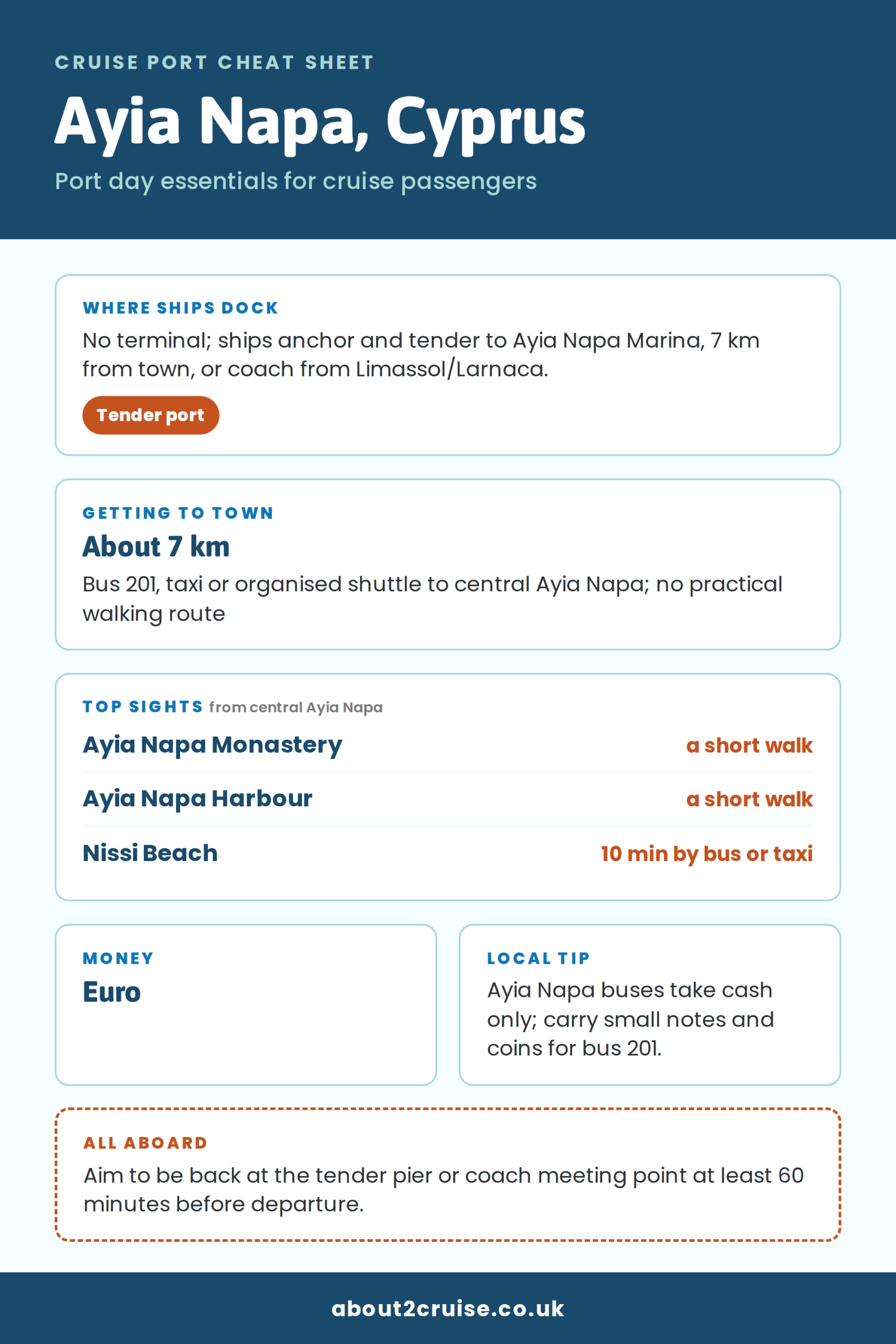
No, not in the usual sense. There’s no cruise terminal, no baggage hall and no alongside quay for big ships. Ships that do call at Ayia Napa anchor offshore and bring passengers in by tender to Ayia Napa Marina, roughly 7 km west of the town centre. The marina has a cruise-passenger lounge used on ship calls, but it isn’t a year-round cruise facility. In practice, many itineraries that say “Ayia Napa” actually dock in Limassol or Larnaca and bring you here by coach.
If your ship is actually berthed in Limassol, see our Limassol cruise port guide. If your Cyprus call is Paphos, that’s a separate west-coast port; see our Paphos cruise port guide.
For a Turkish cruise port where ships dock at the harbour, see our Alanya cruise port guide.
To compare docks, tenders and shuttles across Greece, Turkey, Cyprus and the Adriatic, see our Eastern Mediterranean cruise ports guide.
Ayia Napa cruise port map
Tenders bring you ashore at Ayia Napa Marina. Tap a pin for directions.
- Ayia Napa MarinaWhere tenders land
- Ayia Napa MonasteryMonastery · About 5 km from Ayia Napa Marina
- Ayia Napa HarbourFishing harbour · About 5 km from Ayia Napa Marina
- Nissi BeachBeach · About 2 km from Ayia Napa Marina
- Cape GrecoHeadland · About 13 km from Ayia Napa Marina
- Love BridgeNatural rock arch · About 12 km from Ayia Napa Marina
- Konnos BaySmall cove · About 11 km from Ayia Napa Marina
- Fig Tree BaySandy cove · About 11 km from Ayia Napa Marina
What it’s like arriving by tender at Ayia Napa Marina
The tender landing is at Ayia Napa Marina, not the small fishing harbour in town. The marina is about 7 km from central Ayia Napa, so don’t think of this as a walk-off port. On larger ship calls, passengers are usually funnelled onto shuttle buses and coaches to Ayia Napa, Protaras, Larnaca and other sites, while some simply stay at the marina’s commercial village.
The marina has restaurants, a supermarket, a pharmacy, an ATM and Wi-Fi, plus a multi-storey car park. It’s the nearest thing to port facilities you’ll find, but there’s no published left-luggage office and no guaranteed public all-day taxi rank. Tender timings, last tender and any shuttle frequency are specific to your sailing; your ship will publish them on board. Don’t rely on a fixed bus or taxi schedule for the return.
Bus route 201, the West Circle, links central Ayia Napa, Nissi Avenue, Nissi Beach, Makronissos, the waterpark and Ayia Napa Marina. Buses run roughly every two hours in daytime. A daytime adult single costs €2, a night single €3, and a day pass is €6. Drivers take cash only, so carry coins or small notes.
Getting to Ayia Napa from Limassol or Larnaca
Most cruise passengers reach Ayia Napa on an organised excursion or private transfer, because the two cruise ports with alongside berths aren’t close. Limassol is about 110 km away, roughly 1 hour 20 minutes by road. Larnaca is around 46–56 km away depending on whether you start at the port or airport, usually about 40–50 minutes. There is no passenger railway in Cyprus, so your choices are coach, private tour or taxi.
If your ship is in Limassol, a day trip to Ayia Napa is possible, but it’s a long day across the island. Ship excursions may combine Ayia Napa with other stops. If your ship is in Larnaca, Ayia Napa is a comfortable independent day out by taxi or arranged tour, but still allow a solid buffer for the drive back.
For Paphos, our Paphos cruise port guide covers the tender landing, old town access and bus, taxi and walk options.
If Limassol is your arrival port, our Limassol cruise port guide covers the terminal, Old Town transfers and shore options.
Ship excursion or independent day?
If you’re arriving from Limassol, the ship’s excursion is often the least stressful option because the distance is large and the return runs on ship time. If you’re tendering at Ayia Napa Marina, independent travel is more realistic, but because calls are rare and unpredictable there’s no dependable public shuttle, no tourist office at the landing and no long-established taxi rank. Arrange a private transfer or taxi, confirm the price before getting in, and keep a photo of the ship’s port-agent number.
No cruise line publishes its Ayia Napa tour meeting points or return buffers online because calls are irregular. What is known is that organised visits can fan out to Nissi Beach, the monastery, Cape Greco, Protaras, Larnaca and the Avgorou botanical garden. On board, treat all times as hard, especially if your day ends with a coach back to Limassol.
Nissi Beach and the white-sand coves
Nissi Beach is the postcard beach of Ayia Napa: fine golden sand, a shallow sheltered bay, a natural sand lane out to a small islet and a big Blue Flag resort beach. It sits about 3.5 km west of the centre. Expect toilets, changing rooms, sunbeds, umbrellas, water sports, beach bars and lifeguards from April to October. The water is usually calm and shallow, which makes it a safe first choice for a cruise beach day, but it gets very busy in summer.
Ayia Napa’s beach strip also includes Nissi Bay, Vathia Gonia, Landa, Makronissos, Glyki Nero and Konnos. Landa and Makronissos are the most accessible, with floating wheelchairs; Vathia Gonia has a Seatrac rail. Sunbed and umbrella prices change, but in recent seasons two sunbeds plus an umbrella at Ayia Napa municipal beaches have been around €10, with sunbeds alone about €3.50 and umbrellas about €3. Carry a little cash for the beach attendant.
For a cruise day, Nissi is the easiest big beach from central Ayia Napa. If you want fewer crowds and are already moving towards Protaras, Konnos Bay is a beautiful small cove near Cape Greco. There are no cafes inside Cape Greco itself, so take food and water if you plan to combine the two.
Nissi Beach or Fig Tree Bay?
Fig Tree Bay is in Protaras, not Ayia Napa. It’s a lovely sandy cove with an islet acting as a natural breakwater, so the water is usually even calmer than Nissi. It has toilets, showers, sunbeds, water sports and a lifeguard chair that helps disabled visitors into the sea. The downside for a cruise day is distance: you need a taxi, bus or excursion to get there from Ayia Napa. Nissi is more convenient if you’re based in Ayia Napa itself; Fig Tree Bay can be the better choice if your ship’s excursion already heads to Protaras.
If you’re deciding with only a few hours, Nissi wins on convenience and facilities. If you have a longer excursion or a private driver and want a slightly softer, more family-oriented beach, Fig Tree Bay is a strong alternative. Both are Blue Flag beaches with lifeguards in season.
Cape Greco and the sea caves
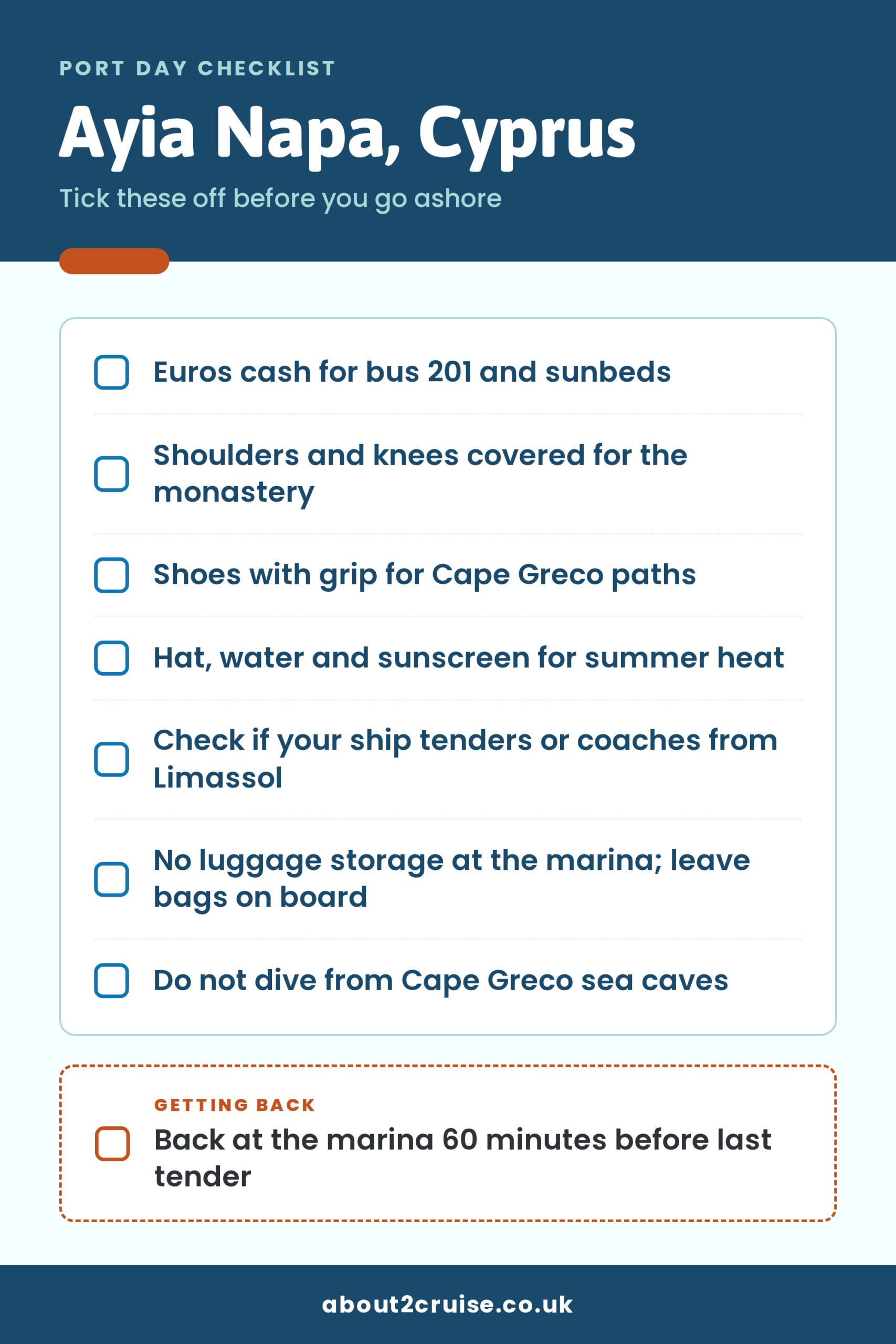
Cape Greco is the wild green headland between Ayia Napa and Protaras. It’s a national forest park and Natura 2000 site, so the appeal is cliffs, sea caves, rock arches, the lighthouse and clear water rather than sand. The paths are rocky and uneven, with almost no shade, so wear shoes with grip, take water and avoid the midday sun.
The sea caves are one of the main photo stops, but they are now fenced in places because of rock instability and a history of serious cliff-diving accidents. People sometimes bypass the fences, but that doesn’t make it safe. Obey the signs and don’t jump. There are no cafes or shops inside the park; the nearest food is at Konnos Bay.
Cape Greco works best as a drive-and-stop excursion, not a long hike in summer. A taxi or organised tour can take you to the lighthouse, Kamara tou Koraka and the sea caves in a couple of hours. If you’re using the bus, route 201 only covers the western side, not the full Cape Greco headland.
Love Bridge and the coastal walks
Kamara tou Koraka, better known as the Love Bridge, is a natural rock arch on the coast road towards Cape Greco. It’s free to visit and has no fixed opening hours. The spot is famous for photos and for a short walk along the low cliff top, but the ground is rocky and exposed. Wear proper footwear and don’t stand near the edge; the sea can throw waves over the rocks.
There are coastal walking paths around the headland, but in high summer they’re better early or late. There is almost no shade, so a hat, water and sunscreen are essential. If you’re visiting on a cruise day, treat this as a short photo stop, not a full hiking excursion.
Ayia Napa Monastery and the old town
In the middle of the party town, Ayia Napa Monastery is a genuinely peaceful old Venetian-era monastery built around a rock-cut cave church. Entry is free through the south gate off the central square. Opening hours vary by season: in summer it has been open until around 20:00 on weekdays and from 11:00 at weekends; in winter it may close at 15:00 and shut on weekends. Shoulders and knees should be covered, and swimwear is not appropriate. Wraps are usually available at the entrance.
The monastery is a short walk from the main square and the harbour. Around it, the old village lanes are filled with tavernas, souvenir shops and cafes. This is the easiest cultural stop in Ayia Napa and a good place to cool down for half an hour between beach and boat trip.
The harbour, fishing boats and boat trips
The fishing harbour is not where cruise tenders land, but it’s the centre of boat-trip daydreams. The promenade is flat and paved, with two lighthouses, fish tavernas and cafes around the water. This is where you can join sightseeing boats to the sea caves, Cape Greco and the Blue Lagoon.
The most commonly mentioned day boat is the Aphrodite II, which leaves Ayia Napa harbour around 09:30 and returns around 14:15, boarding from 08:30. It includes two swim stops, lunch, sunbeds and snorkelling gear, with adult fares around €50 and children roughly €25. There’s a refundable deposit for snorkelling equipment, and optional bus transfer can be added. It is not wheelchair accessible. The big caveat for cruise passengers is the timetable: if your ship arrives later or you have an early last tender, the 14:15 return is too risky or simply unavailable. Check your onboard schedule before booking.
Other boats run from the harbour, but in a cruise port context the safest booking is one made through the ship or one with a guaranteed return time that leaves you at least two hours before your last tender or coach. Don’t book a boat that returns close to your all-aboard.
Nightlife and the club scene
Ayia Napa is famous for clubbing. The main club strip is around Nissi Avenue and the square, roughly 400 m from the square and about 900 m from the harbour. Clubs typically open around 23:00 or midnight and run until 06:00 or 07:00, with door charges often somewhere around €10–20. During the day and early evening the area is quiet; the action starts late.
For cruise passengers, the timing problem is obvious. If your ship leaves in the evening or you have a long coach back to Limassol, you won’t experience the clubs. If you’re on an overnight call or unusually late departure, it’s possible, but keep a clear head: Cyprus has strict zero-tolerance drug laws, and drink spiking is flagged as a risk. Buy your own drinks, keep them in sight and don’t leave your group. The emergency number is 112.
Timing your beach day around tender times and sea conditions
If you’re arriving by tender, the sea is part of your transport system. High winds or swell can slow tender operations or stop them completely. Don’t cut your beach time so finely that you rely on the last possible tender. Aim to be back at the marina well before the published last tender, and check the onboard app or gangway board before you leave in the morning.
If you’re arriving overland from Larnaca or Limassol, the same rule applies to road traffic and coach queues. Give yourself at least an hour of buffer on short Larnaca trips and much more from Limassol. Traffic on a summer weekend can be slow along the coastal road.
Keeping cool and sun-safe in high summer
Summer daytime highs in Ayia Napa are typically around 30–33°C, and the sun is intense. The sea temperature reaches about 27–28°C, which sounds lovely but won’t cool you as much as you expect. Use high-factor sunscreen, reapply after swimming, wear a hat, and drink water steadily. Seek shade between midday and about 15:00.
If you’re walking around Cape Greco or waiting on a hot marina, a small bottle of water is not enough. There is little shade at the sea caves and coastal paths. Heat exhaustion can ruin a cruise day quickly, so take it more seriously than at home.
Marina facilities: toilets, cafes and waiting areas
At Ayia Napa Marina, the commercial village gives you a comfortable waiting area with cafes, restaurants, a supermarket, a pharmacy, an ATM and toilets. It’s not a traditional terminal, so don’t expect a baggage desk, cruise check-in or shore-excursion desk. The marina also has Wi-Fi in its commercial village and crew lounge.
Once you move into central Ayia Napa, the harbour promenade and town centre are flat and paved, with cafes and tavernas everywhere. Public toilets are easier at beaches and larger cafes than on the open coastal paths.
Money, cards, ATMs and tipping
Cyprus uses the euro. Major cards are accepted in restaurants, hotels and shops, but buses and some beach sunbed attendants are cash only. ATMs are widespread, including at the marina, but don’t rely on the first one working. Withdraw enough euros for bus fares, small cafe stops and sunbeds.
Tipping is not as institutionalised as in the US. In restaurants, a few euros or around 5–10% is appreciated for good service. Taxi drivers and boat crews don’t require large tips, but rounding up is normal.
Language, time zone and plugs
Greek and Turkish are the official languages of Cyprus, and English is widely spoken in Ayia Napa, especially in tourist areas. Local time is GMT+2, moving to GMT+3 in summer. Electricity is 230V with type G three-square-pin sockets, so UK plugs fit without an adaptor.
Mobile signal, roaming and Wi-Fi
Since Brexit, some UK mobile providers treat Cyprus as an EU roaming destination with daily charges or data caps, but others don’t. Check your provider before you go. If you want to avoid roaming, use Wi-Fi at the marina, cafes or bars. For a long independent day, consider an eSIM or a day pass from your provider, because you may want maps, taxi apps and messaging.
Weather, sea temperature and best months
Ayia Napa has hot, dry summers and mild winters. The best beach months are May to early October, with July and August the hottest and busiest. In June and September the weather is usually still excellent and the beaches are less crowded. Rain in July and August is unusual. Winter daytime highs are around 16–18°C, and the sea drops to about 17–18°C, so it’s not a beach destination in winter, and many seasonal businesses are quieter.
For cruise calls, the shoulder months can be the sweet spot: warm enough for swimming in May–June and September–October, but less brutal than peak summer and with longer sightseeing comfort.
Luggage, beach gear and changing rooms
There is no published left-luggage service at Ayia Napa Marina, the fishing harbour or the tender landing. If you’re on a ship call, leave bulky bags on board. Bring only a beach bag or day pack. For beach days, a quick-dry towel, swimwear, sunscreen and a change of clothes are enough. Nissi and the main beaches have changing rooms and toilets; smaller coves may not.
If you’re travelling from a Larnaca or Limassol ship on an independent day trip, the same applies: never drag suitcase-sized luggage to a beach or club. There is no cruise terminal storage.
Swimming, cliffs and water sports safety
Swim only on approved beaches and respect warning flags. There can be strong waves and currents, especially around rocky headlands. Lifeguards are present on the main beaches from April to October, but they’re not everywhere. At Cape Greco, don’t dive from the sea caves or rock arches; the rocks are unstable and accidents have been serious.
If you use water sports, choose licensed operators and never hand over your passport as a deposit. Jet skis, parasailing and boat trips are common, but check the operator has insurance and a clear safety briefing. Emergency services can be reached on 112.
Shopping, souvenirs and local food near the port
The main square district and Nissi Avenue are the shopping and eating heart of Ayia Napa. You’ll find souvenirs, beachwear, local olive oil, honey, halloumi and carob products. The harbour is ringed with fish tavernas and cafes, so a seafood lunch near the water is an easy addition to a boat trip.
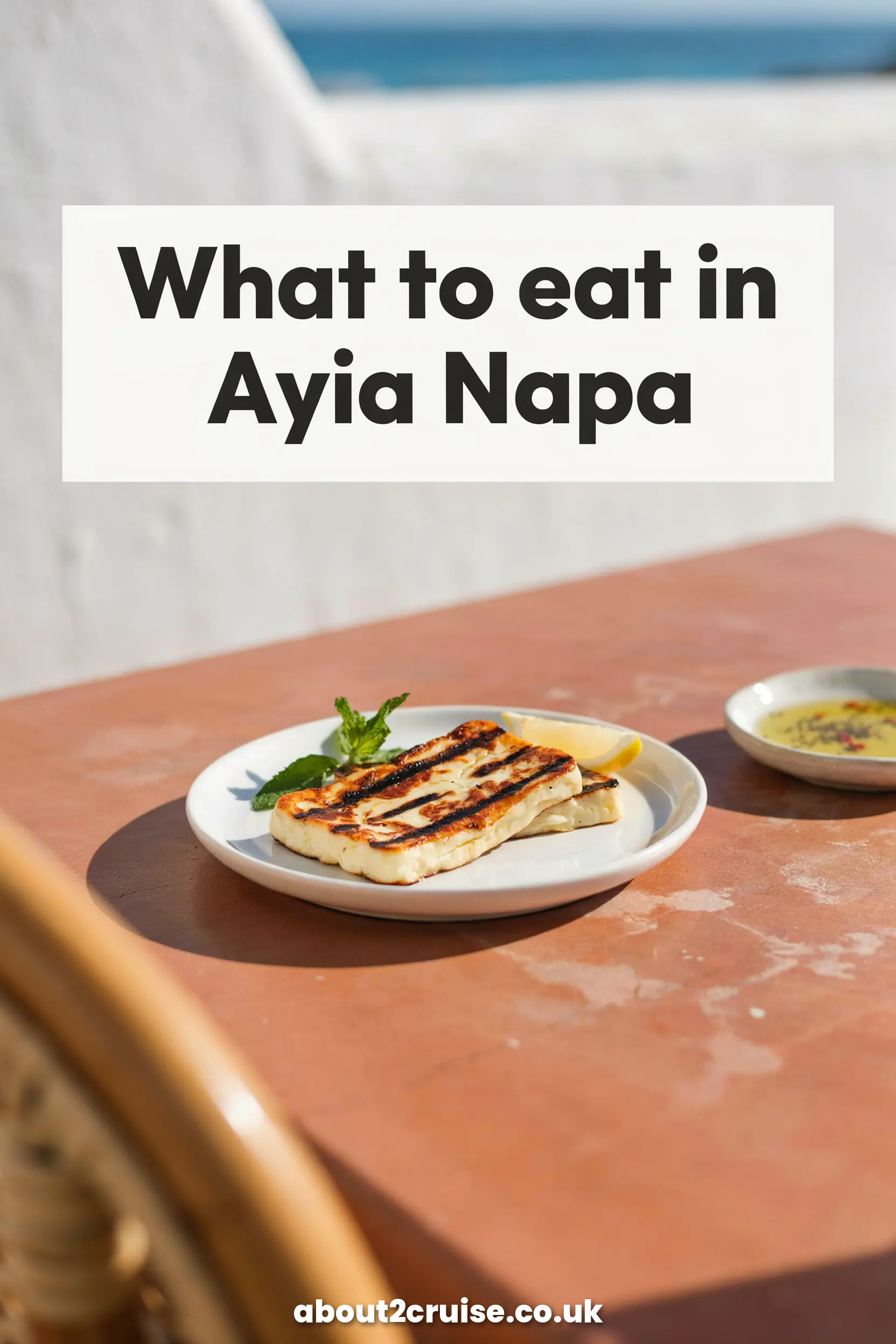
Cypriot food to try includes grilled or fried halloumi, souvlaki, sheftalia, souvla, kleftiko and a full meze spread. If you only have one meal, a good taverna meze is the most efficient way to taste several dishes at once.
Accessibility and mobility
Ayia Napa is a mix of easy and difficult. The town centre and harbour promenade are flat and paved. The monastery is central and easier to reach than the beaches. The marina commercial village is modern and step-free. The challenge is transport: the tender landing is 7 km from town, and tenders themselves may be impossible for some wheelchair users depending on the ship, platform, sea state and equipment. Confirm tender accessibility with your cruise line before booking.
For beaches, Landa and Makronissos have floating wheelchairs, and Vathia Gonia has a Seatrac rail. These are operated with lifeguards and are free to use, but availability can vary. Fig Tree Bay also has a floating chair used by lifeguards. If you or someone in your group has limited mobility, choose one of these accessible beaches and plan taxi transfers rather than relying on buses with steps.
Cruise tour meeting points and return buffers
Because Ayia Napa calls are irregular, cruise lines don’t publish a standard meeting point or return buffer. On a ship excursion, the meeting point will be in your onboard programme or instructions, often at the marina gates, a lounge or directly at the tender gangway. The guide will carry a sign. Independent travellers should take a note of the port agent’s phone number, screenshot the marina location, and allow more time than you think you need.
A good rule of thumb: be back at the tender pier or coach meeting point at least 60 minutes before the last scheduled departure. If the route involves the Limassol motorway, make that much earlier. Missing a tender is bad; missing a coach to Limassol is worse because the next port may be another country.
How to spend a port day in Ayia Napa
A port day in Ayia Napa works best if you pick one: a slow beach-and-monastery day around the harbour, or a longer loop to Cape Greco and back via Nissi Beach.
Before you sail
- Check if your ship tenders to Ayia Napa Marina or coaches from Limassol or Larnaca.
- Book a taxi or private transfer for the return from the marina; buses are infrequent.
- Bring euros cash for buses, sunbeds and small cafes.
Short port day: under 6 hours
- On dockingTender to Ayia Napa MarinaNo walking outShips anchor off the marina; sea conditions can slow tender boarding. The marina is 7 km from town.
- +30 minBus 201 or taxi to central Ayia NapaCash for the busThe marina is 7 km from town. Bus 201 runs roughly every two hours and takes cash only; a taxi is quicker.
- +1 hrAyia Napa MonasteryCover upA short walk from the central square. Free entry through the south gate; cover shoulders and knees.
- +1 hr 30 minLunch at the harbourTry halloumiFlat promenade ringed with fish tavernas. Order grilled halloumi and a seafood meze.
- +2 hrs 45 minNissi Beach on the way backCash for sunbedsNissi Beach is west of town, on the return to the marina. Swim, or rent sunbeds and an umbrella from the attendant.
- All-aboard minus 1 hrBack at Ayia Napa MarinaWatch tender timeReturn by bus 201 or taxi. Leave Nissi Beach in good time; tender queues and coach boarding can be slow.
This map shows the taxi ride from the ship. The time is the drive only, not your time ashore.
Open the taxi route in Google Maps
If plans change: If bus 201 is missed, take a taxi from the marina. If you are running late, skip Nissi and go straight back to the tender.
Long port day: 8 hours or more
- On dockingTender to Ayia Napa MarinaTender onlyShips anchor off the marina; sea conditions can slow tender boarding. The marina is 7 km from town.
- +30 minBus 201 or taxi to Nissi BeachCash for bus 201Nissi Beach is on the way to town from the marina. Take bus 201 or a taxi and spend the morning swimming.
- +1 hrNissi Beach swimCash for sunbedsBlue Flag beach with lifeguards from April to October, toilets, changing rooms and sunbeds. Cash for the attendant.
- +3 hrsTaxi to central Ayia NapaNo walking routeContinue east to the central square. The town centre is flat and easy to walk.
- +3 hrs 30 minAyia Napa MonasteryCover upA short walk from the square. Free entry through the south gate; cover shoulders and knees.
- +4 hrs 15 minLunch at the harbourTry mezeFish tavernas line the harbour. Try grilled halloumi, souvlaki or a full meze.
- +5 hrs 30 minCape Greco photo stopRocky pathsTaxi to the lighthouse and sea caves. Stay behind the fences and do not dive; no cafes in the park.
This map shows the taxi ride from the ship. The time is the drive only, not your time ashore.
Open the taxi route in Google Maps
If plans change: If the sea caves fenced area is shut, swap Cape Greco for the Sculpture Park or extra time at Nissi Beach.
FAQs
Is Ayia Napa a tender port?
Yes, for ships that actually call at Ayia Napa. They anchor offshore and use tenders to Ayia Napa Marina, about 7 km from town. But many itineraries visit Ayia Napa as a coach excursion from Limassol or Larnaca instead.
Can you walk from the cruise ship to Ayia Napa beaches?
Not from the tender landing. The marina is about 7 km from central Ayia Napa and the nearest big beach, and there is no practical walking route. You need a shuttle, bus, taxi or tour.
How far is Ayia Napa from Larnaca cruise port?
Around 46–56 km by road, usually about 40–50 minutes. From Limassol it is about 110 km, roughly 1 hour 20 minutes.
What is the best beach near Ayia Napa cruise port?
Nissi Beach is the easiest big beach from Ayia Napa, with excellent facilities and lifeguards in season. If you’re already heading east, Fig Tree Bay or Konnos Bay are good alternatives.
Is Ayia Napa safe for cruise passengers?
Yes for most visitors, but use normal resort-town awareness. Drink spiking is a known risk in nightlife areas, and the summer heat can catch people out. Stick to licensed taxis and water-sports operators, and don’t cliff-dive at Cape Greco.
What can you do in Ayia Napa in one day?
A good one-day plan is the monastery, then Nissi Beach or a boat trip, then a seafood lunch near the harbour, with Cape Greco as a short photo stop if you have a car or taxi. In summer, the beach and a swim are usually the right priority.
Do buses in Ayia Napa take cards?
No. Ayia Napa local buses take cash only. Carry €2 coins or small notes for a single daytime fare, or €6 for a day pass if you plan to move around.
Will my UK phone work and will my UK plug fit?
Yes, UK plugs fit without an adaptor. Mobile roaming depends on your provider, so check before you travel; Wi-Fi is available at the marina and in cafes.