
Djibouti is a working commercial port at the Horn of Africa where the Red Sea meets the Gulf of Aden. Cruise ships berth in the commercial Port de Djibouti, not a dedicated resort terminal. You need a visa, you cannot walk through the working dock, and the best shore days are built around Lake Assal, whale sharks in season, or a short city walk.
Why Cruise Ships Stop in Djibouti
Djibouti appears on cruise itineraries mostly because of where it sits. It guards the southern entrance to the Red Sea and the Bab el-Mandeb, a strait only about 30 km from Yemen at its narrowest. For over a century, this has made it a refuelling, shipping, and naval crossroads. It also handles sea trade for Ethiopia and still hosts France’s last permanent military base in Africa, which gives the city an unusual mix of French, Issa, Afar, Somali, Yemeni, and Arab influences.
For cruise passengers, the draw isn’t one blockbuster attraction but a cluster of extreme landscapes within reach of a port day. You can visit Lac Assal, Africa’s lowest point, search for whale sharks in the Gulf of Tadjoura between mid-October and March, or grab a boat to Moucha Island’s coral beaches. There’s also a compact colonial centre you can explore on foot in two or three hours. Geologically, this is the Afar triple junction, where three tectonic plates pull apart, so salt flats, lava fields, hot springs, and limestone chimneys are all part of the scenery.
If your cruise is sailing between the Red Sea and the Indian Ocean, Djibouti often appears on the same long-haul routes as Jeddah, Aqaba, and Salalah. For a wider look at the region, see our guide to East Africa’s cruise ports.
Where Ships Dock and How You Actually Get Ashore
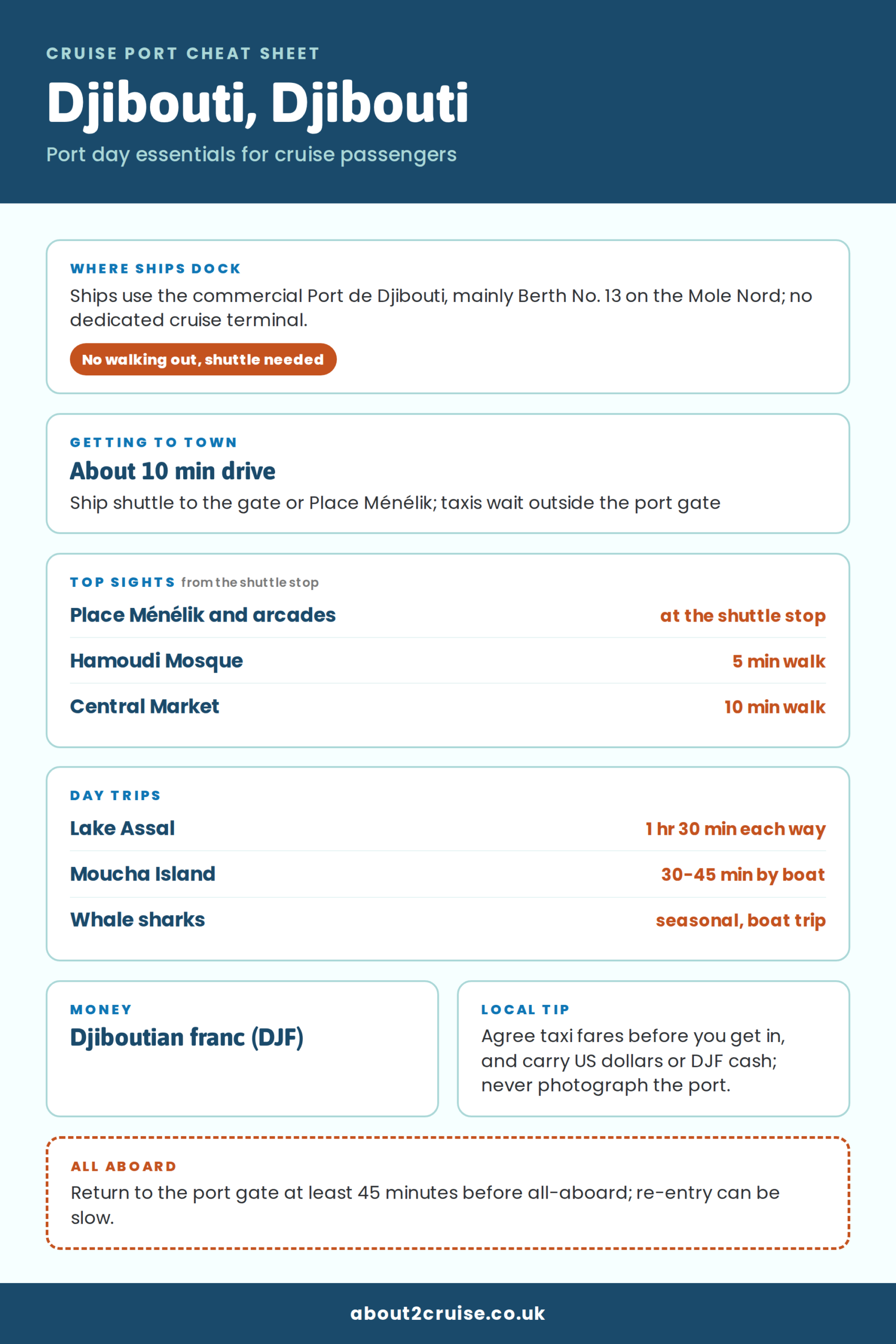
Most ships use the commercial Port de Djibouti. The main cruise berth is Berth No. 13 on the north side of Mole Nord, around 210 metres long with about 9.5 metres of water alongside. There’s no dedicated cruise terminal, no air-conditioned arrivals hall, and no left-luggage desk. The vast majority of ships dock, but smaller expedition vessels and superyachts may clear elsewhere, such as L’Escale marina, so check your ship’s daily programme for the exact berth.
The port is a closed working area. You won’t be allowed to wander from the gangway through the container stacks into town. Most ships arrange a shuttle to the port gate or the Place Ménélik area, about ten minutes’ drive from the berth, but the arrangements vary by cruise line and even by call. Treat the onboard briefing as the final word: confirm where you’ll be dropped off, where the return pickup is, and whether you need a landing card or group escort.
Taxis wait outside the port gate. A short ride from the port to the centre usually costs around 500–1,000 DJF, depending on which gate you exit and how far you go. Djibouti’s taxis are green and white and generally unmetered, so agree on a fare before you get in. US dollars are widely accepted, but small Djiboutian franc notes are more useful for short trips. If you’ve booked an independent guide or 4×4, tell them you’re arriving on a cruise ship at the commercial port; they’ll normally meet you outside the gate rather than inside the restricted area.
Don’t plan to walk from the ship into town, even if it looks close on a map. The port is fenced, active, and controlled, so use the shuttle or an authorised pickup.

Djibouti cruise port map
Ships dock at Berth No. 13, Port de Djibouti. Tap a pin for directions.
- Berth No. 13, Port de DjiboutiWhere ships dock
- Place Ménélik (shuttle stop)Shuttle stop · About 2 km from Berth No. 13, Port de Djibouti
- Place Ménélik and arcadesSquare with arcades · About 2 km from Berth No. 13, Port de Djibouti
- Place Mahmoud HarbiPublic square · About 2 km from Berth No. 13, Port de Djibouti
- Moucha IslandIsland · About 15 km from Berth No. 13, Port de Djibouti
- Our Lady of the Good Shepherd CathedralCathedral · About 2 km from Berth No. 13, Port de Djibouti
- Old Railway StationHistoric railway station · About 2 km from Berth No. 13, Port de Djibouti
- Lake AssalSalt lake · About 79 km from Berth No. 13, Port de Djibouti
- Day Forest National ParkNational park · About 54 km from Berth No. 13, Port de Djibouti
- Arta BeachBeach · About 34 km from Berth No. 13, Port de Djibouti
Visa Rules for Cruise Passengers Visiting Djibouti
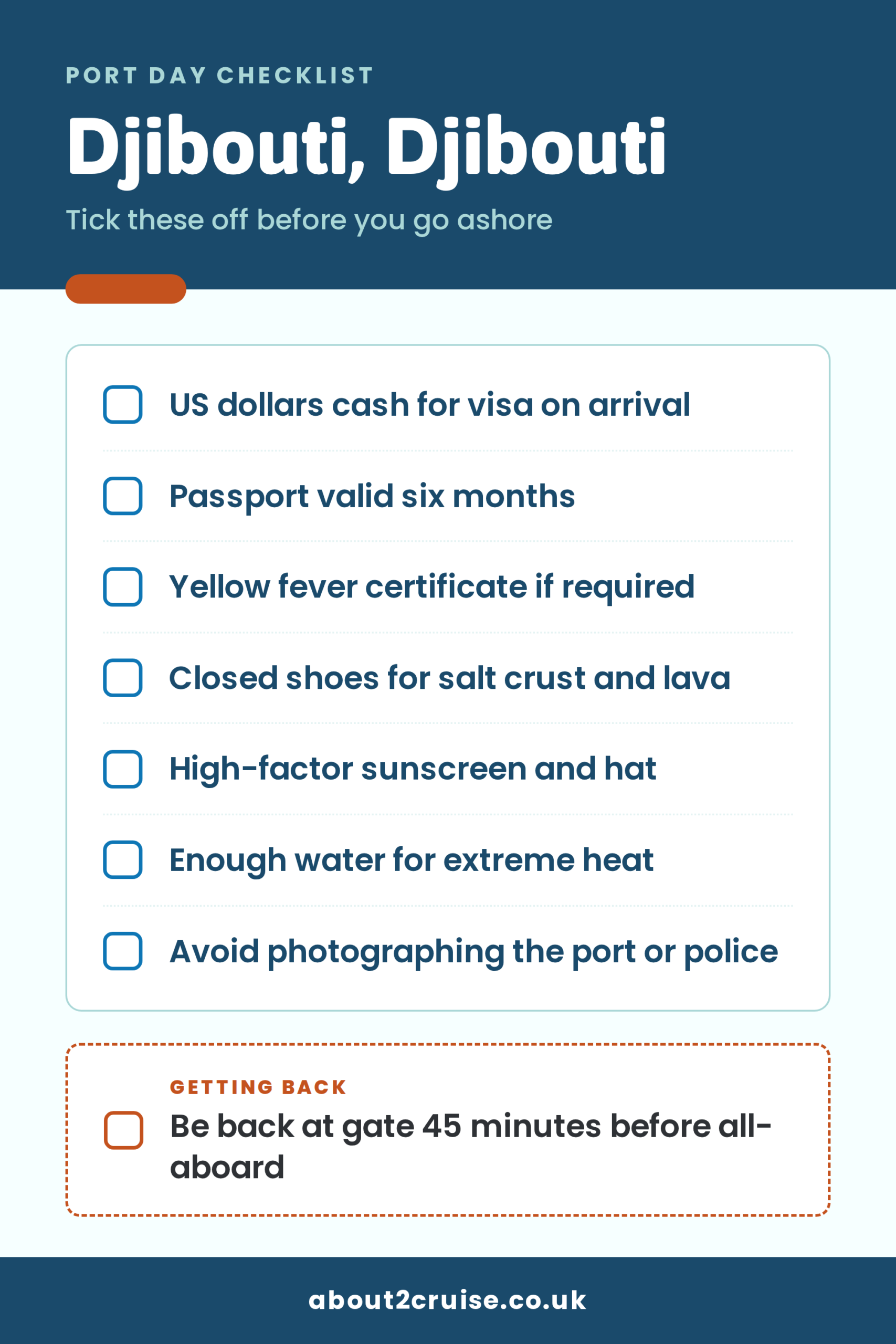
Djibouti requires a visa for entry, and that includes cruise passengers coming ashore for just a few hours. Most international passport holders, including UK citizens, need a passport valid for at least six months beyond arrival. You can apply through the official e-visa portal before travel or pay for a tourist visa on arrival in cash; US dollars are the safest currency.
The visa on arrival fee is often quoted at about US$90, but it can change, so carry extra small USD notes and don’t rely on card payment at immigration. The e-visa system asks for transport details, accommodation, and sometimes a host or invitation letter, which is awkward if you’re sleeping on the ship. That doesn’t mean the visa requirement disappears. If your cruise line is handling group shore clearance, it will usually tell you exactly what paperwork to bring. Otherwise, carry an approved e-visa or cash for the visa on arrival, plus proof of your onward voyage and your ship’s landing information. Don’t assume the ship can waive Djibouti’s visa.
Immigration at the port can be slow, especially when a ship is processed as a group. Keep your passport, visa, landing card, and yellow fever certificate, if required, on you, not in a bag left on the ship or in a taxi. A yellow fever vaccination certificate is required if you’re arriving from a yellow fever transmission-risk country.
Cash, Cards, and Paying for Things Ashore
The local currency is the Djiboutian franc, written DJF. It’s pegged to the US dollar at 177.721 DJF to 1 USD, which makes mental conversion easy if you think in dollars. Credit and debit cards are not widely accepted outside hotels and a few larger venues, and where cards do work it’s often Visa rather than Mastercard. Some businesses add a 5% card commission, so ask before paying.
The port area has no reliable ATM or bureau de change for arriving passengers. Djibouti City has ATMs, mainly around Place Ménélik, Boulevard de la République, and near the big seafront hotels, but terminals can reject foreign cards or run out of cash. Bring enough US dollars or euros for the day, and change only what you need. Taxis, market stalls, café lunches, island boat trips, and tips are all easier in cash.
If you pay in US dollars, expect change in Djiboutian francs and agree on the exchange rate or round figure before handing over money. Small denominations are strongly preferred.
Staying Safe and Following Photography Rules
A daytime visit to central Djibouti City is generally manageable if you stay alert, but this isn’t a destination where you should be casual about security. The UK FCDO’s strongest warnings are for border areas and roads in the far north, not the capital, but it still warns that terrorist attacks are likely, particularly in crowded places frequented by foreigners such as transport hubs, hotels, restaurants, and shopping areas. Petty crime happens too, so avoid walking alone late at night and keep cameras, phones, and passports out of sight.
Photography rules are unusually strict. Do not photograph the port, naval vessels, military facilities, police, airports, public buildings, or bridges. Equipment can be confiscated and people can be arrested. In markets, ask before photographing people. The safest approach is to keep your camera in a bag until you’re somewhere clearly tourist-focused, such as a lake viewpoint or island beach.
Public drunkenness is treated seriously and can carry a two-year prison sentence even though alcohol is legal. During Ramadan, don’t eat, drink, smoke, or chew gum in public during daylight. Same-sex couples showing affection in public could attract the attention of the authorities. If you visit a mosque or the market, cover your shoulders and knees, and take shoes off if entering the mosque.
Weather, Heat, and What to Pack for a Djibouti Port Day
Djibouti is hot and humid for most of the year. The cooler season runs from October to April, with daytime highs in Djibouti City around 29°C in January and February and 31–33°C in March, April, October, and November. From May to October the heat is extreme, with July and August averaging 41°C, and inland spots like Lake Assal are far hotter. Rain is rare all year.
The sea stays warm, roughly 26–31°C, which is great for snorkelling and whale-shark trips. On land, the biggest risk to your port day is the combination of heat, humidity, and reflected sun from salt or pale stone. Wear light, loose, modest clothing, use high-factor sunscreen, and bring a wide-brimmed hat and sunglasses. Closed shoes or sturdy sandals are better than flip-flops for Lake Assal’s salt crust, lava fields, and uneven city pavements. Carry more water than you think you need and start drinking before you feel thirsty.
Health, Water, and Medical Help
Malaria is transmitted all year and throughout the country, including Djibouti City, with the most dangerous P. falciparum form dominant. Anti-mosquito measures and chemoprophylaxis are recommended both for the city and for day trips. Dengue is also present, so daytime bite prevention matters, not just dusk protection. Use a DEET-based repellent and consider wearing long sleeves and trousers during dusk and evening.
There’s no reliable official guarantee on tap water safety, so stick to bottled or otherwise sealed water and avoid ice in places you can’t verify. Medical facilities in Djibouti are limited. You need adequate travel insurance including medical repatriation, and you should carry any personal medication. Ambulance numbers are 21 35 09 62 or 21 35 27 12; police is 17 and fire is 18. If you join a ship excursion, tell the guide about allergies, mobility issues, or diabetes well before you leave.
Walking Around Djibouti City: Colonial Centre, Mosque, and Market
The city is best seen on foot. The natural starting point is Place du 27 Juin, often called Place Ménélik, where the shuttle usually drops passengers. Around the square you’ll find whitewashed arcaded buildings from the French colonial era, cafés serving espresso and cardamom coffee, and the beginning of the European Quarter. From here it’s an easy loop to Place Mahmoud Harbi, the Hamoudi Mosque, and the Central Market.
Allow two to three hours for the centre, plus transfers. The Central Market is at its best early, roughly 06:00 to 11:00, when the fish, spice, date, and produce stalls are fullest. Walk slowly, keep your valuables in front of you, and ask before taking photos. A good photo angle is from the south-west corner of Place Ménélik looking towards the Hamoudi Mosque minaret. The Corniche and seafront promenade are also worth a short look at sunset if your ship’s timing allows, but always work backwards from the all-aboard time.
This is the easiest independent port day: you’re close to the shuttle, there are police and offices around, and you can retreat to the ship quickly if the heat becomes too much. You don’t need a guide to see the architecture and market, though a local guide can help with French, Arabic, Afar, or Somali and will keep the pace sensible.
Lake Assal: Africa’s Lowest Point
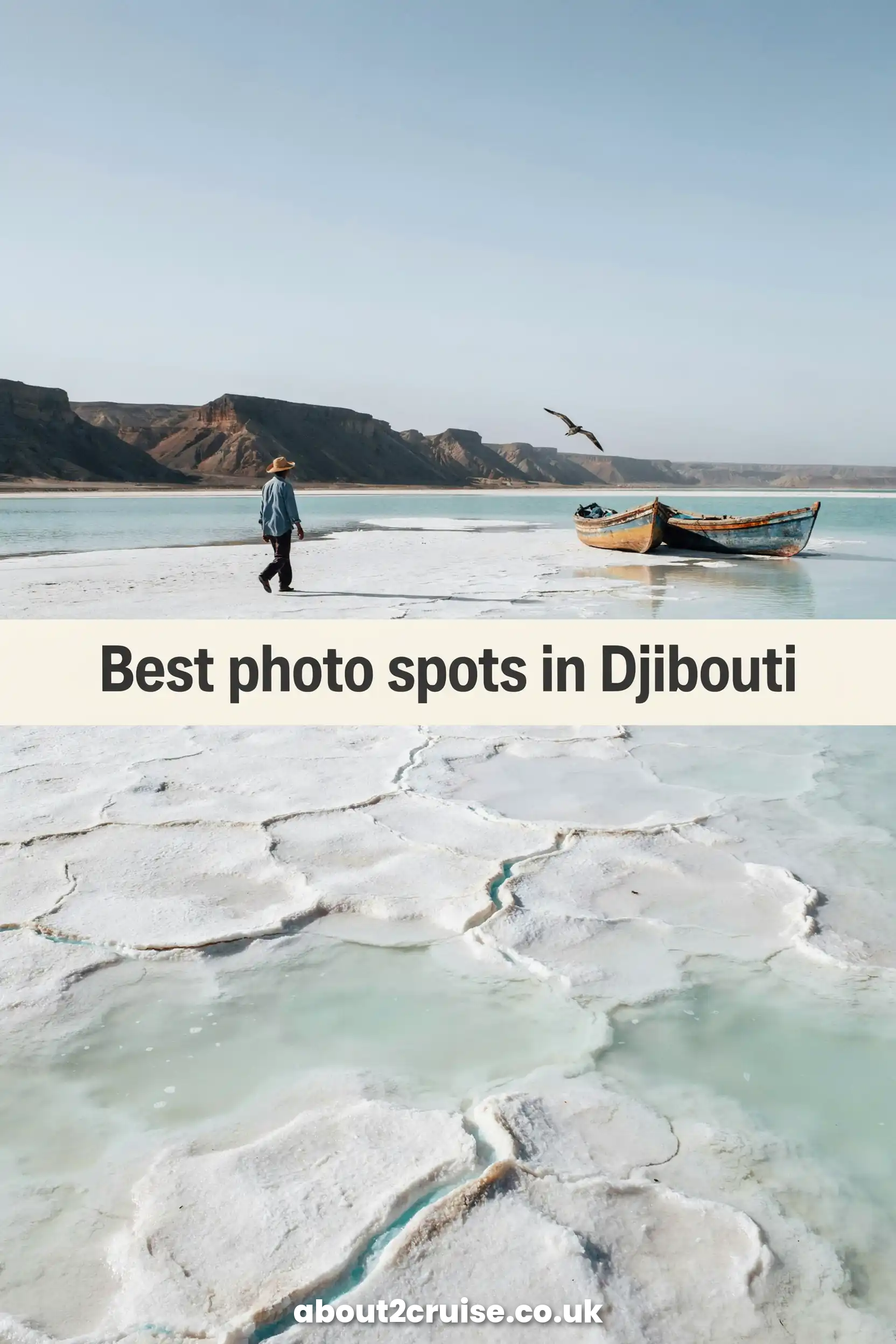
Lake Assal is the headline inland excursion. It sits just under 157 metres below sea level, making it the lowest point in Africa, and it’s one of the saltiest bodies of water on earth, with a salinity of about 348 g/l. The landscape is a blinding white salt crust backed by dark volcanic rock, with hot springs and salt pans around the shore. The scenery is stark, photogenic, and genuinely otherworldly.
The lake is about an hour and a half by road from Djibouti City each way, so a realistic return trip is five to seven hours. The road is paved, but once you step off it you’re on salt and volcanic rubble, and midday temperatures in the depression can exceed 50°C. This is not a casual independent taxi trip. Take an organised excursion, carry at least two litres of water per person, wear closed shoes, and protect your camera from fine salt and glare.
If your call is short, Lake Assal may be too tight. Treat it as a full-day activity and only book it when the ship’s time in port gives you a clear buffer of at least an hour before all-aboard. Ask the guide for the exact return-to-ship timing before you leave.
Whale Shark Snorkelling in the Gulf of Tadjoura
Djibouti is one of the world’s most reliable places to snorkel with juvenile whale sharks, but only in season. The regulated season around Arta Bay in the Gulf of Tadjoura runs from mid-October to March, with the best odds usually between November and February. Most of the sharks are 3–5 metre juveniles, though larger animals are seen.
Whale-shark access is tightly controlled. Only a limited number of licensed boats are allowed into the contact zone each day, and only on certain days of the week. Boats take turns near the sharks, and swimmers must stay at least 3 metres from the head and 4 metres from the tail. Touching, chasing, feeding, or riding the sharks is banned. That’s good for the animals, but it means you can’t simply turn up and hire any boat on the morning.
Book through a licensed operator or the ship’s excursion, and expect a fast, physical snorkel in deep water. You need to be comfortable swimming in open water and getting back onto a boat without a ladder. If you’re visiting outside the whale-shark season, don’t book this trip; choose Moucha Island or a city day instead.
Moucha Island, Beaches, and Snorkelling Day Trips
Moucha and nearby Maskali are the easy island escape from Djibouti City. The crossing takes about 30 to 45 minutes by boat, and the islands offer pale beaches, mangroves, shallow reefs, and calm snorkelling. It’s the best choice when whale sharks aren’t in season or when you want a less demanding day than the desert.
Day boats run from the port/marina area or from the pontoon at the Kempinski hotel, usually with morning and afternoon departures. Bring swimwear on under light clothing, reef-safe sunscreen, water, a hat, and enough cash for the boat and any snorkel-gear rental. There’s little shade or infrastructure on the beach, so plan it as a half-day rather than a full resort day unless the ship offers a supported excursion.
Longer Desert Trips: Lake Abbe and Day Forest
Lake Abbe is the most dramatic landscape in Djibouti: limestone chimneys, hot springs, flamingos, and harsh Afar Desert scenery. But it sits about 195 km from the city and is normally run as a two-day, one-night trip. It doesn’t fit a standard cruise call, so keep it for a pre- or post-cruise extension.
Day Forest National Park in the Goda Mountains is a full-day possibility. At around 1,500 metres, the air is noticeably cooler than the coast, and the park protects giant acacias, junipers, and wild olives, along with baboons and the Djibouti francolin, the country’s only endemic bird. The drive is long and winding, so it only works when your ship has a genuinely long port day and you’re on an organised excursion. The Ardoukoba volcano and the Deimbiyo canyon, between the Goubet and Lake Assal, also appear on some cruise excursions and give a closer look at the Afar Rift’s volcanic geology.
What to Eat in Djibouti
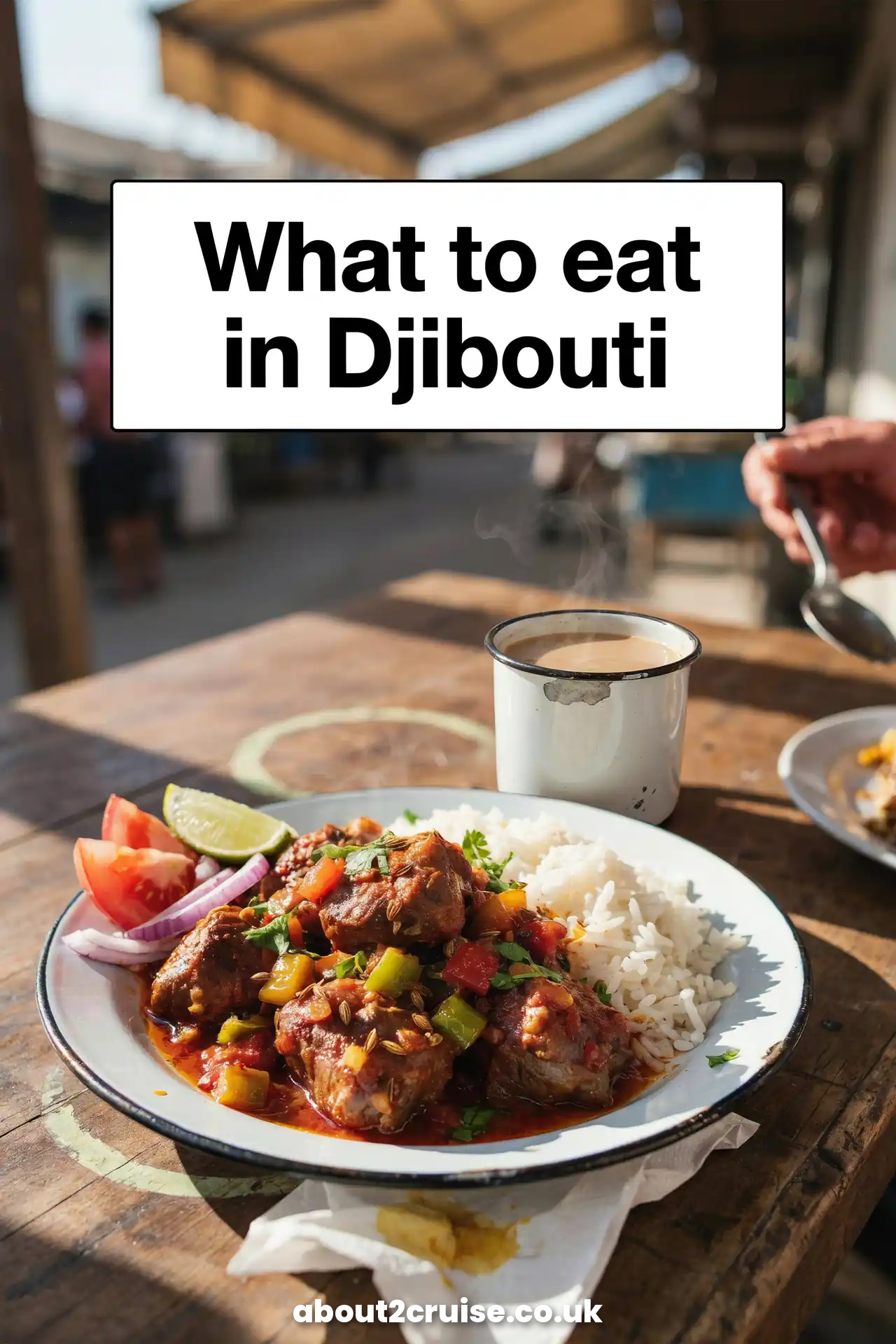
Djibouti’s most famous dish is Yemeni-style baked fish, locally called moukbasa. The fish is split, salted, brushed with red pepper paste, and cooked in a tandoor-style oven, then eaten with flatbread and a sweet banana or date paste. A plate usually costs around 1,000 DJF. Other everyday dishes include skoudehkaris, a spiced rice with goat or camel, fah-fah, a spicy soup, and lahoh, a spongy flatbread.
Around Place Ménélik and the European Quarter you’ll find cafés doing French pastries, espresso, and spiced tea. Around the Central Market, small grill counters and tea stands are more local and busy at midday. Food hygiene varies, so choose busy places where turnover is high, avoid raw or unpeeled produce unless it’s from a reliable kitchen, and drink only bottled or otherwise sealed drinks. Vegetarian food is available but more limited; rice, beans, flatbread, and fruit are usually the fallback.
Ship Excursions vs Going Independent
For Lake Assal, whale sharks, desert transfers, and any trip with a hard return deadline, an organised excursion is the sensible choice. The distances are long, the heat is extreme, and the port isn’t set up for late independent returns. A ship-organised tour also solves the problem of whether a vehicle can enter the port or meet you at the right gate.
The city centre is the exception. If your ship runs a shuttle to Place Ménélik, you can walk the colonial quarter, mosque, and market independently, come back for lunch, and return to the ship at a time you control. Taxis are useful for the gate-to-centre link, but for longer trips negotiate the whole hire and agree whether the driver waits, in which currency, and for how long.
On every independent plan, add a 30 to 45-minute buffer before the ship’s final all-aboard. Traffic in Djibouti is not predictable, the port gate can slow down re-entry, and there’s no dedicated passenger terminal to run through at the last moment.
Souvenirs and Market Bargaining
Djibouti isn’t a polished souvenir-shopping port. The Central Market is the main place to browse spices, dates, textiles, everyday household goods, and local foods, and the surrounding streets have smaller stalls. Bargaining is normal in markets, but keep it respectful; the point is a fair price, not the lowest possible quote.
Carry small Djiboutian francs or US dollars, and don’t expect widespread card acceptance. Ask permission before photographing stallholders, and keep your bag and phone in front of you in crowded aisles. If you want a specific souvenir such as woven basketry or spices, shop early in the day when the market is active and before the worst heat.
Phone, Time Zone, and Emergency Numbers
Djibouti is GMT+3 all year and doesn’t use daylight saving. Ship time may differ, so always confirm the all-aboard time against local time as soon as you go ashore. The country code is +253, and mobile numbers typically start with 77. A local Djibouti Telecom/Evatis SIM costs around 1,000 DJF with a passport, and 4G is available, but for a short port call most cruisers rely on ship Wi-Fi or a café/hotel connection.
English isn’t widely spoken by drivers and market stallholders. French and Arabic are the main languages, with Afar and Somali also spoken. Learn a few phrases or carry written place names. Key numbers: police 17, fire 18, central police station 21 35 38 91, gendarmerie 21 35 10 03, ambulance 21 35 09 62 or 21 35 27 12.
Accessibility in Djibouti Port
Djibouti’s port is a working cargo berth, not a passenger terminal. There’s no dedicated accessible route, terminal seating, air-conditioned waiting area, or guaranteed step-free transfer from ship to gate. The city centre is flat but pavements are uneven, shade is limited, and few people walk in the middle of the day. Lake Assal and desert trips involve 4x4s, salt crust, volcanic rock, and extreme heat. Wheelchair users or passengers with limited mobility should arrange a private adapted tour in advance and confirm transfers directly with the shore excursion team before arrival. This is not a port where you can assume last-minute accessible transport.
How to spend a port day in Djibouti
A port day in Djibouti works best if you pick one: a short city walk, or a long Lake Assal excursion with a late city lunch.
Before you sail
- Confirm the shuttle drop-off and return pickup with your cruise line, as there is no dedicated terminal.
- Arrange your Djibouti visa in advance or carry US dollars cash for the visa on arrival.
- Book Lake Assal or whale-shark tours through a licensed operator; whale-shark permits are limited.
Short port day: under 6 hours
- On dockingTake the ship shuttle to Place MénélikNo walking outThe port is closed. The shuttle runs about 10 minutes to Place Ménélik; confirm pickup point.
- +15 minPlace Ménélik and the arcadesStart in the French colonial square and European Quarter arcades, close to the shuttle stop.
- +45 minHamoudi MosqueCover upA short walk from the square. Cover shoulders and knees, and remove shoes if entering.
- +1 hr 30 minLunch near Central MarketTry baked fishTry Yemeni-style baked fish (moukbasa) or skoudehkaris at busy cafés around the market.
- +2 hrs 45 minCentral Market stallsWalk the spice, date and produce stalls; keep valuables in front and ask before photos.
- All-aboard minus 1 hrBack at the shuttle stopReturn shuttles and port re-entry can be slow; aim to be at the pickup point early.
The time on the map is the whole walk, every stop added together.
Open this walking route in Google Maps
If plans change: If the market is quiet or closed when you arrive, walk the Corniche instead and have coffee in the European Quarter.
Long port day: 8 hours or more
- On dockingClear immigration and meet your rideVisa readyKeep your passport, visa, landing card and cash ready; immigration can be slow.
- +30 minDrive to Lake AssalBooked 4×4About 90 minutes each way by 4×4. Carry at least two litres of water per person.
- +2 hrsLake Assal salt flatsClosed shoesWalk the salt crust, salt pans and hot springs at the lowest point in Africa; closed shoes.
- +3 hrsReturn drive to Djibouti CityAllow about 90 minutes back and confirm the exact return time with your driver.
- +4 hrs 30 minLunch near Central MarketTry baked fishTry Yemeni-style baked fish (moukbasa) or skoudehkaris at busy local cafés near the market.
- +5 hrs 30 minHamoudi MosqueA short walk from the market. Cover shoulders and knees; remove shoes if entering.
- All-aboard minus 1 hrBack at the shuttle stopPort re-entry can be slow; aim to be at the pickup point early.
This map shows the taxi ride from the ship. The time is the drive only, not your time ashore.
Open the taxi route in Google Maps
If plans change: If the Lake Assal excursion is cancelled or delayed, fall back to a Moucha Island boat trip or the city walk and let the ship's shore desk help rebook.
Common Questions About a Djibouti Cruise Stop
Do cruise ships actually call at Djibouti?
Yes, but not in the same way as Mediterranean or Caribbean mass-market lines. Most calls are by small luxury ships, expedition vessels, tall ships, or larger ships on Suez Canal and Indian Ocean repositioning voyages. A call can be a short six-hour technical stop or a longer expedition day.
Can you walk from the Djibouti cruise port?
No, not through the working port itself. The port is a restricted area, so you’ll need the ship’s shuttle or an authorised pickup to the gate or Place Ménélik. From there the centre is walkable.
Is Djibouti safe for cruise passengers?
Central Djibouti City is generally manageable on a daytime visit with sensible precautions, but the UK FCDO warns that terrorist attacks are likely and that petty crime occurs. The strongest travel warnings are for border regions, not the capital. Book desert trips through a licensed operator or the ship, and follow photography rules.
What can you do in Djibouti on a cruise stop?
The three realistic options are a city walk through the colonial centre and Central Market, a full-day excursion to Lake Assal, or a seasonal whale-shark snorkel in the Gulf of Tadjoura. Moucha Island is the beach/snorkelling fallback, and Day Forest works on a long day.
What is the best Djibouti shore excursion for first-time cruise passengers?
For most first-time visitors, Lake Assal is the strongest single sight because it’s unique and geographically significant. If your call is between mid-October and March and you’re a confident open-water snorkeller, the whale-shark trip is the alternative most people remember longest.
Do I need a visa if I stay on a ship excursion?
Yes, Djibouti’s visa requirement still applies. Some cruise lines arrange group shore clearance and will tell you what to carry; otherwise bring an approved e-visa or cash in US dollars for the visa on arrival. Don’t assume you’re exempt because you’re with a ship tour.
What currency should I bring?
US dollars in small notes are the most useful backup, but Djiboutian francs are better for taxis, markets, and small cafés. Cards are unreliable, and the port has no dependable ATM or exchange office.
What if my call falls during Ramadan?
You can still go ashore, but avoid eating, drinking, smoking, or chewing gum in public during daylight. Dress more conservatively, expect some cafés and lunch stops to be closed or limited, and plan your water and food around the ship or a private tour. It can be a quieter, interesting time to see the city, but you need to be disciplined about your energy in the heat.
Is there a cruise terminal with facilities?
No. There’s no dedicated cruise terminal, no passenger lounge, no left-luggage desk, and no official cruise car park. Treat the ship as your facilities, toilet, and air-conditioning, and come ashore with everything you need for the day.