
The Venice cruise terminal sits on the industrial edge of the lagoon, which means you’re perfectly positioned to skip the Rialto Bridge mayhem and head straight to two of the area’s most charming islands. Murano and Burano make for an excellent port day if you want something slower-paced than the main event but still distinctly Venetian. You’ll see glass-blowing demos, technicolor houses that look like a paint swatch exploded, and canals without the shoulder-to-shoulder tourist gridlock.
Getting to both islands in a single port day is entirely doable, but you need to be realistic about timing and what’s actually worth your limited hours. The vaporetto system is straightforward once you understand the routes, though it’s slower than you’d hope. Tourist traps lurk around every glass furnace and lace shop, but with a bit of planning you can sidestep the worst of them and still have a genuinely lovely day on the water.
Want to know more about your arrival and the Venice cruise terminal layout and services before you start planning island-hopping? That guide covers everything from where your ship docks to how the port shuttle works.
Getting from Venice Cruise Port to Murano & Burano
You have three main options for reaching the islands from the cruise terminal, and your choice depends mostly on budget and how much you value time over money.
Alilaguna Orange Line (Direct to Murano)
This is the smartest route if Murano is your first stop. The Alilaguna orange line runs directly from the cruise terminal to Murano Colonna, cutting out the need to go into Venice at all. The boats leave roughly every hour, the trip takes about 30 minutes, and a single ticket costs around 8 euros. You can buy tickets at the Alilaguna desk right at the terminal or online in advance, though there’s rarely a queue issue at the cruise port departure point. This route also stops at Murano Museo and Murano Faro if you want to explore different parts of the island.
Public Vaporetto (ACTV)
If you’re headed to Venice first or want the most flexible option, the public ACTV vaporetto system connects everything. From the cruise terminal, you’d typically take line 4.1 or 5.1 toward Fondamente Nove (the main northern dock in Venice), then switch to line 12 for Murano and Burano. A 24-hour unlimited ACTV pass costs about 25 euros and covers all vaporetto lines including the route to St Mark’s Square from the cruise port, which is handy if you’re planning to see Venice proper as well. Single vaporetto tickets run around 9.50 euros each way, so the day pass pays for itself quickly if you’re doing multiple hops.
Water Taxi
Private water taxis offer speed and convenience but at eye-watering cost. Expect to pay 100-150 euros for a direct ride to Murano or Burano from the terminal, and that’s for the boat not per person. If you’re traveling as a group of four or more and really pressed for time, splitting a water taxi starts to make sense. Otherwise, it’s a luxury that doesn’t add much value when the public boats are perfectly reliable. You can read more about the cost comparison between water taxis and vaporettos if you’re weighing up your options.
Which Route Should You Actually Use?
For most cruise passengers doing both islands in one day, the best sequence is: Alilaguna orange line from cruise terminal to Murano, wander Murano for 90 minutes to two hours, then catch ACTV line 12 from Murano to Burano, spend a couple of hours there, and return via line 12 to Fondamente Nove, then take line 4.1 or 5.1 back to the cruise terminal. Buy the 24-hour ACTV pass when you’re ready to leave Murano, since the Alilaguna and ACTV are separate systems.
Realistic Timing for a Two-Island Day
Cruise port days run on tight schedules, so here’s what the clock actually looks like if you’re attempting both Murano and Burano without the stress of sprinting back to the ship.
| Activity | Time Needed | Notes |
|---|---|---|
| Cruise terminal to Murano (Alilaguna) | 30-40 minutes | Add 15 minutes for queuing and boarding |
| Murano visit | 1.5 – 2 hours | Glass demo, quick wander, coffee break |
| Murano to Burano (line 12) | 40-45 minutes | Can be longer if you miss a boat |
| Burano visit | 2 – 2.5 hours | Enough to explore, eat, and take photos |
| Burano to Fondamente Nove (line 12) | 40 minutes | Sometimes stops at Mazzorbo or Torcello |
| Fondamente Nove to cruise terminal | 30-40 minutes | Via line 4.1 or 5.1 |
| Total minimum | 6.5 – 7 hours | With no delays or missed connections |
If your ship docks at 8am and has an all-aboard time of 5pm, you’re cutting it close but manageable. Build in at least 30-45 minutes of buffer time because vaporetto schedules slip, especially in summer when boats are rammed with tourists. Missing your ship because you were waiting for a delayed vaporetto on Burano is not the story you want to tell.
Families doing Mediterranean family cruises should factor in extra time for toilet breaks, snack stops, and the inevitable “I’m tired, carry me” moments. Burano’s colorful houses are genuinely fun for kids to photograph, but the vaporetto rides can feel long for little ones.
What’s Actually Worth Seeing on Murano
Murano is famous for glass, and every second shopfront wants to sell you a chandelier or a clown figurine. Here’s what deserves your time and what you can safely ignore.
Glass Demonstrations
The free glass-blowing demonstrations are genuinely interesting if you’ve never seen one. A master craftsman will heat a blob of molten glass and shape it into a horse or vase in about five minutes, and it’s legitimately impressive. The catch? You’re then herded into a showroom where prices start at 50 euros for a small bowl and climb into the thousands for anything remotely elaborate. The sales pressure can be intense, with staff hovering and pushing “special today only” discounts that are neither special nor today only.
Tip: Watch the demo, say thank you, and leave without guilt. You’re not obliged to buy anything just because you watched someone do their job.
Smaller Studios and Workshops
The real charm of Murano is in the quieter canals where working artisans have small studios with pieces in progress scattered around. These spots don’t usually do the big showy demos, but you can often watch people actually working rather than performing. Prices are still high because quality Murano glass is expensive to produce, but you’re more likely to find one-off pieces and less likely to encounter the hard sell.
Museo del Vetro (Glass Museum)
This museum traces the history of Venetian glassmaking from Roman times to the present, with some genuinely stunning historical pieces. It costs about 12 euros and takes 45 minutes to an hour to see properly. If you’re really into decorative arts or want to understand why Murano glass became such a big deal, it’s worth the stop. If you’re just here for the vibes and the canals, you can skip it without missing much.
The Canals and Churches
Murano has lovely quiet canals away from the main Fondamenta dei Vetrai drag, and the Chiesa di Santa Maria e San Donato is a 12th-century beauty with Byzantine mosaics and a genuinely peaceful interior. Admission is free, and it’s a nice break from the relentless glass commerce. The island is small enough that you can wander the back streets in 30 minutes and stumble on picturesque corners without a tour group in sight.
What’s Actually Worth Seeing on Burano
Burano is smaller and simpler than Murano, which is part of its appeal. The main attraction is the island itself – those absurdly colorful houses that look like a child’s drawing but somehow work in real life.
The Colored Houses
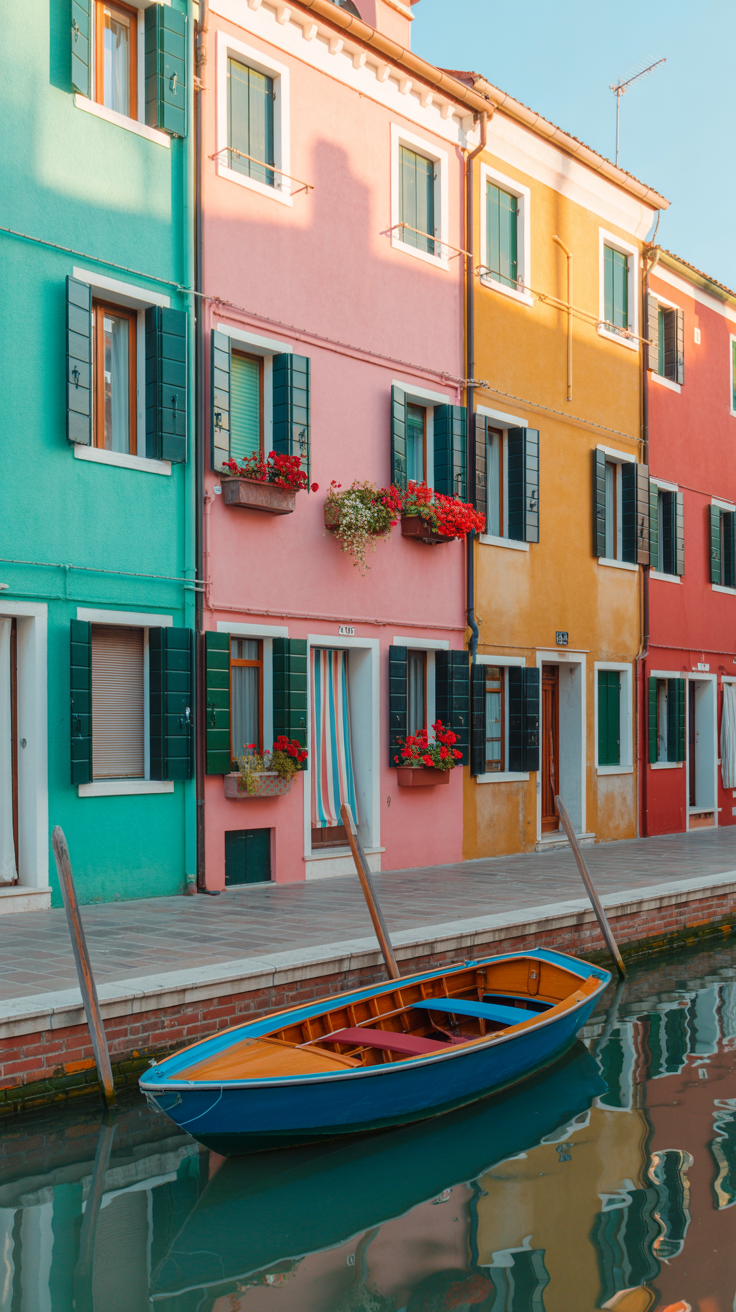
Every building in Burano is painted a different bright color, and the effect is genuinely delightful rather than gimmicky. The traditional story is that fishermen painted their houses in bold shades so they could spot home through the lagoon fog, though that might be tourist-board mythology. Either way, it’s endlessly photogenic. The best photos come from the side canals rather than the main drags, where you can frame a bright pink house against a turquoise one with a little bridge in between.
Instagram trap alert: Everyone takes the exact same photo from the same bridge. Wander two minutes in any direction and you’ll find better shots without strangers’ elbows in your frame.
Lace Shops (and Why Most Are a Waste)
Burano is historically famous for lace-making, and the island is littered with shops selling lace tablecloths, doilies, and handkerchiefs. Here’s the uncomfortable truth: the vast majority of “Burano lace” for sale is mass-produced in China and imported. Real handmade Burano lace costs hundreds or thousands of euros because it takes weeks to produce a single piece. If you see a lace tablecloth for 30 euros, it’s not handmade and it’s not local. A few shops still sell genuine articles, but you’ll know from the price tag and the lack of forty identical pieces stacked on a shelf.
Museo del Merletto (Lace Museum)
The lace museum is small and costs about 5 euros. It explains the history and technique of Burano lace-making, and there are some genuinely intricate historical pieces on display. If you’re interested in textile arts, it’s a quick and worthwhile stop. If you’re not, the 20 minutes it takes to walk through won’t change your life. The demonstrations of traditional lace-making techniques happen sporadically and aren’t always running, so don’t plan your visit around seeing one unless you’ve checked ahead.
The Bell Tower
Burano’s leaning bell tower is visible from most of the island and makes for a good photo backdrop. You can’t climb it, so that’s one decision made for you. The church it belongs to, San Martino, is fine but unremarkable inside unless you’re a church completist.
Local Bakeries and Bussolai Cookies
Burano’s traditional biscuit is the bussolai – a buttery, S-shaped cookie that’s not too sweet and perfect with coffee. Several bakeries around the main square sell them, and they’re much better than the vacuum-packed tourist versions. A bag costs a few euros and makes a legitimately good edible souvenir. The same bakeries often sell other pastries and small pizzas if you need a snack to tide you over.
Tourist Traps You Can Safely Skip
Both islands have perfected the art of separating tourists from their money, but some traps are easier to avoid than others.
The “Free” Glass Factory Tours
These are marketing exercises disguised as cultural experiences. You’ll be shown the demo, given a glass of prosecco, and then led into a showroom where a salesperson will follow you around explaining why this particular glass fish is a bargain at 200 euros. The glass itself is often decent quality, but you’re paying a significant markup for the captive-audience sales environment. If you genuinely want to buy Murano glass, do it after you’ve seen a few shops and have a sense of prices.
Overpriced Lace “Handmade Here”
As mentioned, most lace for sale on Burano is imported. Shops that shout “handmade” and “traditional” are often the worst offenders. Real Burano lace comes with certificates of authenticity and prices that reflect weeks of skilled labor. If you’re spending less than 100 euros on a lace item, you’re not buying the real thing, and that’s fine as long as you know what you’re getting.
Touristy Restaurants on the Main Squares
The restaurants directly on the main squares of both islands charge premium prices for mediocre food because they have the view and the foot traffic. A plate of pasta that costs 12 euros in Venice proper will run you 20 euros on Burano’s Piazza Galuppi, and it won’t taste better. Walk two minutes off the main drag and you’ll find smaller places with better food and lower prices. Better yet, pack a sandwich and save your euros for dinner back on the ship or in Venice proper.
Glass Jewelry at Every Stall
The colorful glass bead necklaces and bracelets sold from stalls and small shops on both islands are mass-produced and not particularly special. They’re fine as cheap souvenirs if you want something to bring home, but don’t convince yourself you’re buying artisan craftwork. You can find the exact same items in Venice’s tourist shops and probably on Amazon.
Practical Tips for a Smooth Island Day
- Start early. The first Alilaguna boats leave around 8-8:30am, and the islands are far quieter before 11am when the day-trip crowds arrive from Venice.
- Bring snacks and water. Food options on both islands are limited and overpriced. A bottle of water costs 4 euros on Burano versus 1 euro from a supermarket in Venice. A collapsible water bottle is perfect for saving space in your day bag while staying hydrated.
- Wear comfortable shoes. Both islands are small but entirely pedestrian, with cobblestones, bridges, and uneven surfaces. Your feet will thank you for skipping the cute sandals. A good pair of comfortable walking shoes makes all the difference when you’re covering several islands in one day.
- Check vaporetto schedules. The line 12 between Murano and Burano runs roughly every 30 minutes, but gaps can be longer in early morning or late afternoon. Miss one boat and you’ve added 30-40 minutes to your day.
- Keep your phone charged. You’ll want it for photos, maps, and checking vaporetto times. Both islands have limited cafés where you could sit and charge, so bring a portable power bank if your battery life is dodgy. The portable charger with built-in cables is especially handy so you’re not fumbling with extra cords.
- Don’t buy glass on Murano if you’re going back to Venice. Anything you buy has to be carried for the rest of the day. If you see something you love, take a business card and come back another day, or arrange shipping (which most shops offer, for a fee).
- Skip Torcello unless you have extra time. Torcello is another lagoon island with a famous Byzantine cathedral, but it’s very quiet and adds another 10-15 minutes by vaporetto. On a tight port day, it’s one island too many.
- Watch the time obsessively. Port days have no flexibility. Set alarms, build in buffer time, and leave Burano earlier than you think you need to. The consequences of missing the ship are expensive and stressful.
- Protect your belongings. Crowded vaporettos are pickpocket territory. An anti-theft backpack or secure crossbody bag gives you peace of mind when you’re squeezed into boats with other tourists.
- Pack smart. Use compression packing cubes to organize your day bag efficiently, especially if you’re bringing layers for changing weather. A lightweight rain jacket takes up minimal space and saves the day if the weather turns.
- Organize your electronics. Keep your charging cables, adapters, and headphones tidy with a travel cable organizer so you’re not digging through your bag every time you need something.
- Layer appropriately. Venice in spring and fall can be chilly in the morning and warm by afternoon, especially on the water. A packable lightweight jacket is easy to stuff in your bag when you don’t need it.
Murano or Burano: If You Can Only Do One
If your port day is short or you’d rather spend more time in Venice itself, picking just one island is a smart move.
Choose Murano if: You’re interested in the craft and history of glassmaking, you want something closer to the cruise terminal (easier logistics), or you prefer a slightly larger island with more variety in what you can see and do.
Choose Burano if: You want picture-perfect colorful streets and a slower, more relaxed vibe. Burano is more photogenic and has a stronger “charming Italian island” feel, but it’s smaller and further away, so it takes more time to reach and leaves less room for error on the return trip.
For most people on Mediterranean cruises, Burano edges out Murano on pure charm, but Murano is the practical choice if you’re nervous about timing or want something quick and easy from the cruise port.
Extend Your Stay in Venice
If your Mediterranean cruise starts or ends in Venice, adding a night or two before or after your sailing lets you see the islands without the pressure of ship departure times hanging over you. You can take your time on Burano, have a proper lunch, maybe even visit Torcello, and return to Venice in the early evening without checking your watch every ten minutes.
Hotels in Venice range from budget spots in Mestre (the mainland district with easy transport links) to luxury properties right on the Grand Canal. Accommodation on the islands themselves is limited and tends to be pricey, but staying in Venice proper or even near the airport gives you flexibility for early flights or late-night arrivals. An extra day also lets you see Venice’s quieter neighborhoods like Cannaregio or Dorsoduro, which are far more pleasant than the Rialto-San Marco tourist corridor and give you a better sense of what the city actually feels like when it’s not overwhelmed by day-trippers. Pack a compact travel steamer to refresh your clothes after unpacking, and use a hanging toiletry organizer to maximize space in typically small European hotel bathrooms.
Personal Experience
We had about eight hours between our cruise docking and the all-aboard time, so we decided to tackle both Murano and Burano instead of fighting the crowds in Venice proper. From the cruise terminal, we grabbed the Alilaguna orange line straight to Murano Colonna – way easier than dragging ourselves into Venice first. The glass factories were interesting enough, though we quickly learned that the “free demonstrations” always end with aggressive sales pitches for wildly overpriced pieces. We poked our heads into one showroom, admired the chandeliers, and kept moving. The real gem was just wandering the quieter canals away from the main drag and ducking into the smaller studios where artisans were actually working, not performing.
From Murano, we caught the number 12 vaporetto to Burano, which took about 40 minutes – plenty of time to rest our feet and snack on the sandwiches we’d wisely packed. Burano completely won us over with those ridiculously colorful houses that somehow don’t look tacky in person. We skipped the lace museum since we were on a tight schedule, and honestly, the lace shops all sell mostly mass-produced stuff from China anyway. Instead, we just wandered the streets, grabbed some bussolai cookies from a local bakery, and soaked it all in. We were back at the ship with an hour to spare, sunburned and happy, spending maybe 30 euros total on transport and snacks. Perfect port day without the Venice chaos.
Common Questions & FAQ
Can I do Murano, Burano, and Venice in one port day?
Technically yes, but you’ll be rushing everywhere and won’t enjoy any of it properly. If you have a full eight-hour port day and strong nerves, you could do a quick hour on Murano, two hours on Burano, and a couple of hours in Venice, but the vaporetto timing would need to work perfectly and you’d have no buffer for delays. Most people find that two destinations is the sensible limit for a relaxed port day without the stress.
Is the Alilaguna orange line included in the ACTV day pass?
No, Alilaguna and ACTV are separate companies with separate tickets. An ACTV day pass covers all the public vaporetto lines including line 12 to Murano and Burano, but not the Alilaguna airport and cruise terminal boats. If you take the Alilaguna from the cruise port to Murano, you’ll need to buy that ticket separately, then buy an ACTV pass or single tickets for the rest of your island hopping.
Are Murano and Burano suitable for people with mobility issues?
Both islands are tricky for wheelchairs or anyone who struggles with stairs and uneven surfaces. The vaporettos have steps and narrow doorways, and the islands themselves are full of bridges with steps, cobblestones, and no lifts. Murano is slightly easier because it’s larger and has more flat walking routes, but Burano’s charm involves crossing lots of small bridges. If you have limited mobility, a private water taxi can get you closer to flat areas, but neither island is particularly accessible.
What time should I leave Burano to be safe for a 5pm ship departure?
Aim to catch a vaporetto off Burano no later than 2pm. That gives you 40 minutes to Fondamente Nove, another 40 minutes back to the cruise terminal, plus buffer time for missed connections or delays. You’ll be back at the port by 4pm with an hour to spare, which is tight but manageable. Leaving any later is gambling with your cruise, and the odds aren’t in your favor.
Can I get Murano glass shipped home instead of carrying it?
Yes, most of the established glass shops and factories offer international shipping, though it’s not cheap. Expect to pay 30-50 euros or more for shipping depending on the size and weight of your purchase, and allow several weeks for delivery. Make sure the shop packs items properly with insurance – Murano glass is fragile and shipping damage is common. Get a receipt and tracking information before you leave the shop.
Is the food on Burano worth eating or should I pack lunch?
The food on Burano is fine but overpriced because it’s a small tourist island with a captive market. A simple pasta dish will cost 18-25 euros in most restaurants on the main square, and quality varies wildly. If you’re on a budget or short on time, pack a sandwich and snacks from Venice. If you want the experience of eating on the island, the smaller spots off the main square offer better value and often better food, though you’re still paying a premium compared to Venice or the mainland.
Do I need to book anything in advance for Murano and Burano?
No, both islands are entirely accessible without advance bookings. The vaporetto tickets can be bought on the day, the glass demos are walk-in, and there are no timed entry requirements for anything. The only exception would be if you wanted to book a private glass-blowing workshop or a guided tour, but most cruise passengers just turn up and wander. The flexibility is one of the best parts of an island day trip.
Are there toilets on Murano and Burano?
Yes, but they’re not abundant. Both islands have public toilets near the main vaporetto stops, usually costing 1-1.50 euros. Many cafés and restaurants will let you use their facilities if you buy a coffee or a drink, which is often a better option than hunting for the public ones. The vaporettos themselves do not have toilets, so sort yourself out before boarding for the 40-minute ride.