
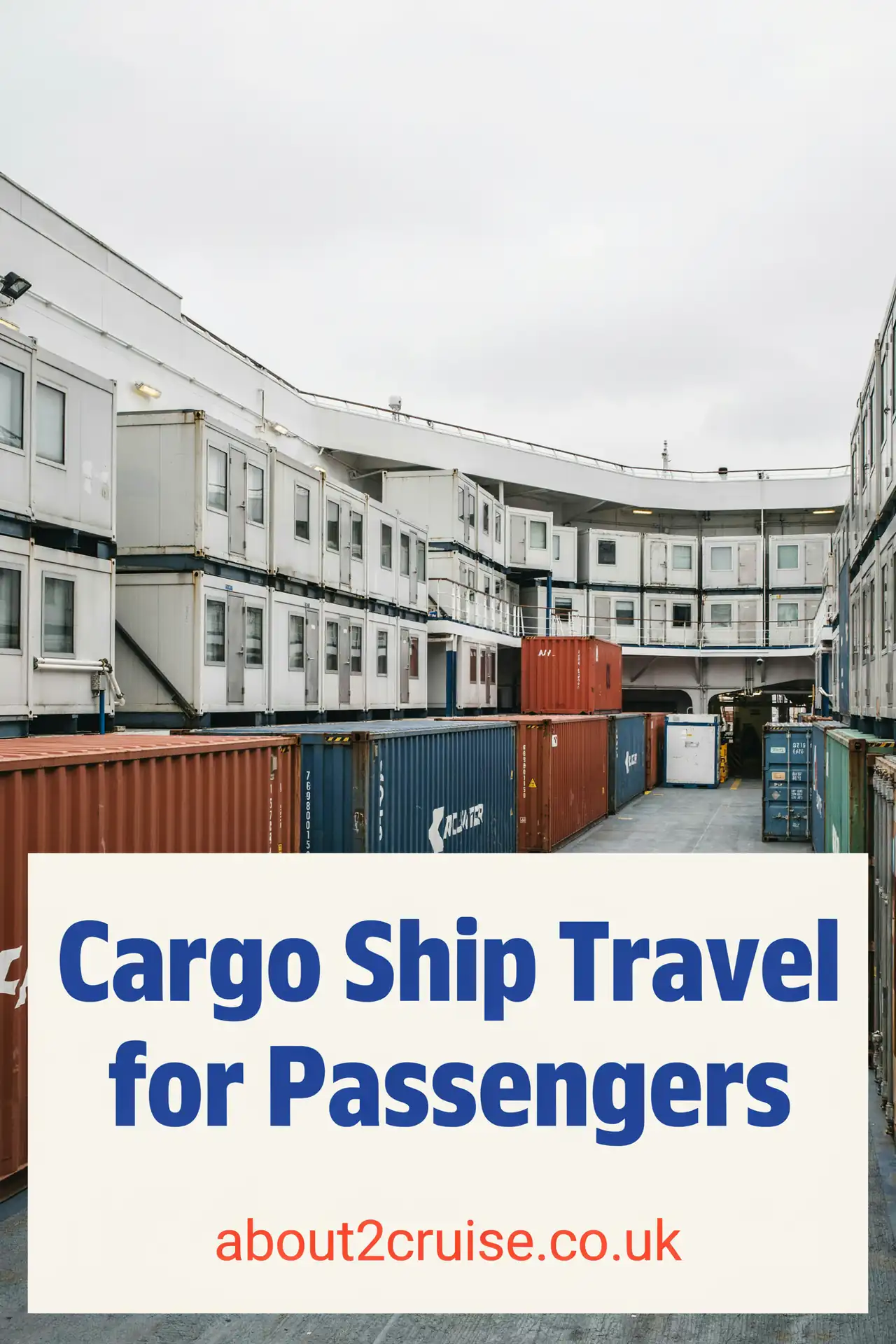
Cargo ship travel exists, just not in the shape most people imagine. You book a cabin through a specialist agent, sail on a working ship with a handful of other passengers, and pick from a much shorter list of routes than the guidebooks suggest: short European and Baltic loops, Europe to South Africa, French Polynesia and a few coastal runs.
What a cargo ship passage is, and who it does not suit
You’re a passenger on a working ship, in a cabin the line doesn’t need for crew. International safety rules call any vessel with more than twelve passengers a passenger ship, so cargo ships selling berths stay just under that line. Most have room for four to six passengers, some for eight in four cabins, and a few bigger passenger-freighters carry many more.
The ship runs its commercial route. It won’t wait for you, divert for a photo or put on a show. Shore leave is down to the captain, granted where it’s safe and fits around cargo work, and it isn’t guaranteed.
There’s no doctor aboard. The crew are first-aid trained and the ship carries the medical kit the rules require, and not much beyond it.
Filming is tightly restricted for crew privacy and port security, and usually refused. Anything you take is for your own use.
It suits people who can amuse themselves, who don’t need a programme, and who can lose a few days at either end without it costing them. The agent is blunt about the other side: if you have fixed-date commitments, this isn’t for you, and cancellation insurance is strongly recommended in case a voyage is delayed or changed.
Passengers are mostly mature travellers, and about half travel alone. There’s no cabaret and no deck chairs.
Cargo ship cruising versus a cruise ship: the differences that decide it
The gap isn’t about comfort. On a cruise ship the itinerary is the product.
On a cargo ship the cargo is the product, and you’re in a spare cabin. What you give up isn’t small, and the key differences between freighter travel and cruise ships come down to one question: do you want a holiday or a passage?
| Cargo ship | Cruise ship | |
|---|---|---|
| Passengers aboard | Usually four to twelve | Hundreds to several thousand |
| Cabin | Outside room with window, en suite shower, desk | Inside cabin up to suite, balcony common |
| Meals | Three a day at fixed times, taken with the officers | Set or flexible dining, several venues |
| Evenings | No entertainment programme | Shows, bars, music |
| Medical | No doctor, first-aid-trained crew | Medical centre with staff |
| Ports | Cargo operations, times set by the ship | Published itinerary, shore excursions |
| Typical length | One to six weeks | Three nights to a fortnight |
| Daily rate | Comparable to a mid-range cruise, meals included | Wide range, extras often charged |
The daily rate often looks similar to or below a cruise and includes meals, but nothing else comes with it: no entertainment, no excursions, none of the things a cruise bundles in.
The environmental argument is subtler than it looks. The ship sails its cargo route whether or not you’re in the spare cabin, and that’s where the case for freighter ships as a more sustainable way to travel comes from.
Which cargo ship voyages still take passengers
Most of the routes that made freighter travel famous are closed. Transatlantic crossings, transpacific voyages, Europe to Australia and New Zealand, Europe to South America, Suez and Panama Canal transits, round the world voyages, and anything to, from or within Asia or Oceania can’t currently be booked with any shipowner or agent. A transatlantic passage would take eight to twelve days each way if you could get one.
What’s left is a short and shifting list. Routes open and close with the charter market, so the popular freighter travel routes and destinations change from season to season.
- Short European, Mediterranean and Baltic sailings, from a handful of nights to about ten. These are the standard first trip.
- Classic coastal voyages on the historic vessel Nordstjernen in the North Sea, the Baltic and the British Isles.
- Europe to South Africa, where northbound is the likelier direction to find space, and the waiting list is long.
- French Polynesia, on a twelve-day Papeete round trip to the Marquesas and Tuamotus, with roughly twenty to twenty-five sailings a year, meals and scheduled guided excursions included in the fare.
- The St Lawrence River run between Rimouski and Blanc-Sablon, April to January, with 63 cabins and meals plus sightseeing at some ports in the fare. Waiting lists are long and there has been nothing for several seasons.
- Five-night British Columbia inland waterway voyages, currently waitlisted.
- From the UK, a round trip of about ten nights out of Hull on coastal feeder container ships.
The agent selling most of these is taking bookings for the current season only while keeping future options under review, and deep-sea intercontinental voyages aren’t possible, with a few exceptions.
Two of the largest container lines have stopped carrying passengers altogether, and the trade has shrunk. Even so, short European, South African and Polynesian passages are still being sold.
The lesson is the same either way: a route in a book or a forum thread doesn’t mean it can be booked. Ask about a specific sailing before you build anything around it.
Where you join the ship: Hull, Antwerp and the continental ports
Hull is the only UK departure in the current listings, a round trip of about ten nights on coastal feeder container ships. London Gateway, Southampton, Felixstowe, Tilbury and Liverpool turn up in older route lists, but no current agent listing shows passenger berths at any of them. Treat that list as unconfirmed, and ask before you plan around it.
Continental starts widen the choice: Antwerp in Belgium, Terneuzen in the Netherlands, and Kotka, Hanko and Tornio in Finland, plus Cape Town and Papeete further out.
Antwerp is the easiest of these from the UK. Eurostar gets you from London to Brussels in about two hours, then it’s about forty minutes by train to Antwerp Centraal, then a taxi, because public transport doesn’t reach most of the terminals.
These are working industrial terminals, not passenger terminals. Container ships use terminals on both banks, including the Deurganck dock, and ro-ro ships have their own dedicated terminals. You show your passport and booking at the gate, and someone walks you to the ship.
The feeder vessels on the Antwerp run always use the same terminal, and you can park a car there free for the length of the voyage. Departures are weekly, usually on Fridays, returning on Saturdays.
If you’re arriving by train instead, stay near Antwerp Centraal the night before and take a taxi down to the gate. That’s the one part of the trip worth paying for.
The real total cost of travelling on a cargo ship
The daily rate on a cargo ship is broadly in line with a mid-range cruise, and on some routes it undercuts it. Meals are in that figure. Port taxes and the mandatory deviation insurance come on top, and so do the medical certificate, the specialist insurance, the transfer at each end and probably a hotel the night before.
Then look at the length. A week-long European loop can come in under a cruise of the same length. A month-long ocean passage, which is what most of the long routes amount to, usually costs more than a one or two week cruise, and it’s almost never cheaper than flying to the same place.
Solo travellers get the better end of this: a single cabin rarely costs more than ten to fifteen per cent above the per-person rate, against the fifty to a hundred per cent supplement a cruise line might charge.
There’s no tipping culture and no daily gratuity, and very little to spend once you’re aboard. Last-minute passages on ships with no fixed route have been sold cheaply, but they’re rare and you can’t plan around one.
If you were hoping cargo ship travel would be cheap, it isn’t. It’s not a budget substitute for a flight, and the daily rate is the least of it.
What the fare covers and what it does not
The fare covers the cabin, three meals a day, and access to the officers’ lounge and dining areas. Some ships add a bar, pool, gym and lift.
Alcohol is the surprise. A cargo ship is a place of work, so drink generally isn’t available aboard, and you may not bring it on for private consumption.
Wi-Fi is usually there and usually charged, and the ship’s business always comes first. Where there’s none, email and calls go by satellite.
Laundry, cabin cleaning and anything ashore aren’t part of a standard freighter fare. On a passenger-cargo vessel such as Aranui 5, shore excursions and meals are explicitly in the fare, which is one reason that ship behaves differently from a working freighter.
Booking a passage: agents, deposits and how far ahead
You can’t book passage on a cargo ship through a normal ticket site. You go through a specialist agent that holds the shipping lines’ passenger tariffs, or in a few cases direct with the operator. How much paperwork you want to handle yourself is the whole choice between an agency and booking direct with the shipping line.
For UK readers the main one is Cargo Ship Voyages, the trading name of Seabreaks Ltd in Cowes on the Isle of Wight. It’s sold these passages for over thirty years and is a Travel Trust Association member. It takes enquiries by email first at info@cargoshipvoyages.com, runs a part-time office on +44 (0)1983 303314, and sees personal callers by appointment only.
Every agent works from the same shipping company tariffs, so shopping around gets you nothing except slower replies. Don’t set several agents on the same search. Conditions of carriage are set by each shipowner and aren’t negotiable, and conditional bookings aren’t accepted.
The pattern is the same everywhere: pick a route and a two- to three-week departure window, ask an agent what’s available, pay a deposit to hold the cabin, then send a medical certificate, insurance details and a passport copy, and confirm the boarding time a few days before sailing.
Deposits are typically around a quarter of the fare, with the balance due between 45 and 95 days before departure depending on the line. Cancellation is expensive and stepped: a quarter of the passage price up to 90 days before departure, half between 89 and 30 days, three quarters between 29 and 7 days, and 95 per cent later or on a no-show.
One French operator is harsher still, keeping the deposit more than 60 days out, half between 59 and 30 days, and everything within 30 days.
The line can move things on you as well. Charter contracts can be cancelled or changed at short notice depending on cargo volume, and an early booking may have to be rebooked onto another sailing.
Book as early as you can, because capacity is tiny and demand is not. Europe to South Africa is heavily booked, the St Lawrence has had nothing for several seasons, and the British Columbia vessel is fully booked, with only a few cabins at the edges of the following season.
Who is allowed to sail: age, mobility and the medical certificate
Age limits are set by each shipowner and vary. One UK agent’s general rule is over 16 at the bottom and 78 at the top, meaning up to your 79th birthday, though rules differ by line and one vessel has no upper age limit at all.
A German agent gives 78; a French operator sets 77 with a medical certificate and bars under-16s. Coastal feeder container ships on the UK round trip take passengers up to 70 on the return.
Under-18s are generally not carried at all, given the safety regime and the workplace environment.
You must be able to climb the gangway and the internal stairs unaided, with your own bags. Wheelchairs aren’t permitted and there are no adapted cabins. If you’ve been refused air travel, you’re very unlikely to meet the fitness requirement.
The French operator also refuses pregnant women and anyone with reduced mobility or equipment such as oxygen, and requires all external medical devices and implants to be declared.
A medical certificate is standard. For passengers of 65 and over it must be dated no earlier than 30 days before departure, and from 70 at the time of booking. Some lines want one from every passenger, at booking and again within 45 days of sailing, and their own doctor decides fitness.
Carry enough medication for the entire voyage and hand the prescription to the captain when you board. No pets of any kind are carried.
Insurance and visas the shipping line will not sail without
Deviation insurance is mandatory for every person on board, and the agent arranges it automatically. It covers the ship’s costs if it has to divert for your illness, injury or death. It doesn’t cover your treatment or your transport home, and the charge scales with the length and route of the voyage.
Separately you need international travel health insurance that includes repatriation and a 24-hour hotline. Without the full documentation the line can’t issue travel documents, which means you don’t board.
Ordinary holiday policies often exclude cargo ships or non-passenger vessels, and some cap the age of the traveller. Check the wording rather than assuming your annual policy covers it.
Your passport must be valid for at least six months from the start of the voyage, and you need a copy of your visa plus an onward or return ticket. Yellow fever vaccination is mandatory on Panama and Suez routes, and is required to enter South Africa by sea even when arriving directly.
You hand your passport and documents to the captain when you board, and the captain may refuse boarding if any required document is missing. A missing visa for one intermediate port means staying aboard while the ship is alongside. The UK agent offers visa advice, worldwide travel insurance, flights, transfers and airport hotels as part of its service.
Schedule risk: three days of delay per week of travel
Allow roughly three days of delay for every week you’re travelling. Until about a week before the estimated departure you won’t be given an exact boarding time, and the agent accepts no liability for schedule changes.
Book flights and onward travel late and on flexible or refundable terms. Ships sail early as well as late: a vessel can leave five days ahead of the published date and then change route.
Keep the vessel’s mobile number and the port agent’s details, so you know the last sailing time if the ship leaves the berth sooner than expected.
For the same reason, don’t attach a fixed-date commitment to the far end of the voyage, and don’t treat the advertised arrival date as the date you’ll be flying home.
What the days aboard look like
Meals are fixed and early, typically around 07:30, 12:00 and 17:30, taken in the officers’ mess. A pantry is available for snacks between meals.
Cabins are outside rooms with a window, en suite shower and desk. Shared spaces on a cargo ship come down to an officers’ lounge and dining room, with a bar, pool, gym or lift on some vessels. Most have a sauna.
Bridge visits are usually allowed at the captain’s discretion. There’s a safety drill covering lifeboats, alarms and off-limits areas, and on deck you follow safety instructions and wear the helmet and apron provided.
Beyond that there’s no programme, and the rhythm of daily life aboard a cargo ship is something you either settle into by the second week or you don’t. Bring your own entertainment.
Arrival day is busy with crew changes, caterers, agents and authorities, so the captain may not be free to welcome you or show you around.
Port calls are cargo operations, not port days
Time in port is usually about 8 to 12 hours, though it can run to two or three days in rare cases. There’s generally enough time for a look ashore, and the captain, crew or port agent will suggest what to see.
Shore leave is at the captain’s discretion, granted where it’s safe and fits around cargo work, and it isn’t guaranteed. On Aranui 5, shore time averages three to five hours per call, tied to loading and unloading.
Berths are industrial and often well away from town. Expect to need a taxi, and expect the ship to sail without you if you’re late.
Packing for weeks at sea rather than a holiday
The luggage allowance runs from 20kg to 100kg per person depending on the line. You carry it aboard yourself, up the gangway and the stairs, and store it in your cabin. There are no porters, and commercial or household goods aren’t permitted.
Pack layers, because the North Sea and the Atlantic can be cold even in summer, and take a good supply of seasickness remedies. Take books or an e-reader loaded before you sail, because there’s no library and no programme beyond the odd safety drill.
Carry all your medication for the whole voyage, plus a travel medical kit for the basics, since there’s no pharmacy once you’re aboard. Take US dollars or euros for the ship’s shop and for port days.
Bicycles can be carried on some services but e-bikes aren’t permitted. Some operators won’t board you with cold or flu symptoms.
Choosing a first cargo ship voyage
Choose the route first, not the ship, because the choice is narrow and the vessel follows from it. Short European, Mediterranean and Baltic loops are the standard test run, and they’re the easiest way to find out whether three weeks of this is a treat or a sentence.
Know which type you’re booking. A passenger-cargo vessel behaves like a small expedition cruise; a classic freighter gives you a cabin among the crew and nothing else.
One-way and round-trip passages are both sold, and some routes allow segments. Ask the same four questions every time: where exactly you get on and off, the cabin type, how far ahead the sailing date is confirmed, and what happens to your fare if the route changes.
The length is the real commitment, not the price. A first-timer who books the longest available passage as a trial has either found their thing for six weeks or is stuck at sea with it.
Travelling by cargo ship for free, or working your passage
You can’t work your passage under any circumstances. Crew are trained to a high standard for the safety of the vessel, the cargo and the passengers, and working a passage is only open to credentialed mariners, under rules that have become more onerous.
There are no cheap cabins and no last-minute bargains, and you can’t bring your own food for a reduced fare. Anyone offering a free crossing in exchange for work isn’t offering something the lines permit.
When the cargo route you wanted is not running
One-off cruise ship voyages cover some of the stretches of ocean the freighter routes used to, and they’re a reasonable substitute while the cargo options stay closed. The major cruise lines usually require you to book through an agent in your country of residence, which rules out booking direct from the UK on some of them.
Decide what you were after. If it was the sea days and the quiet, a long cruise with few ports gets you most of the way there. If it was the working ship, the industrial berths and the officers’ mess, nothing else does it.
Cargo ship travel FAQs
Do cargo ships take passengers?
Cargo ships do take passengers, though only a handful of them. Vessels that sell paying berths stay under the twelve-passenger limit that would class them as passenger ships, which is why most have room for four to six people and some for eight in four cabins.
Can you book a one-way passage on a cargo ship?
You can book a one-way passage on a cargo ship, and round-trip passages are sold too. Some routes allow you to join or leave the ship partway through a voyage. One-way is the harder half to find on the long routes.
Can you take a car on a cargo ship?
You can take a car on some cargo ship routes and not on others. Vehicles are booked separately from the passenger berth, so ask when you enquire. Bicycles can be carried on some services but e-bikes aren’t permitted.
How do you pay for a cargo ship passage?
Cargo ship fares are invoiced in euros. US dollars and pounds are accepted, with the prevailing exchange rate applied to the deposit and again to the balance when each is paid.
Do cargo ships carry pets?
Cargo ships don’t carry pets of any kind. There are no exceptions for passengers.
Last Updated: 14 November 2026