
Gustavia is a tender-only cruise port on St Barthélemy, the French Caribbean island nicknamed the Caribbean’s French Riviera. Ships anchor in the horseshoe harbour and tender guests into the centre of Gustavia, within walking distance of designer boutiques, red-roofed Swedish-era streets, superyachts and Shell Beach. Small, expensive and easy on foot, it rewards cruisers who plan around Sunday closures, lunch hours and tender timing.
What’s It Like to Cruise to St Barts?
St Barthélemy is a French overseas collectivity, and Gustavia is its capital. The island has long been marketed as the Caribbean’s French Riviera: a small, dry, chic island with red-roofed Swedish-French townhouses, duty-free luxury shopping, and one of the Caribbean’s best superyacht harbours. It deliberately limits cruise access to ships of 1,200 passengers or fewer, which keeps a port day here more like a yachtie stopover than a mass-market turnaround.
Superyacht spotting is part of the show. Gustavia harbour takes visiting yachts stern-to along the capitainerie quays up to about 60 metres, with larger yachts anchored in the outer roads. The harbour fills with some of the world’s largest yachts over New Year, and throughout the season you can expect a genuine Riviera-style parade of tenders, gleam and crew activity. Billionaires and celebrities come for privacy, polished infrastructure and reliable winter sunshine, but the port day itself is low-key: you simply step ashore into it.
Geographically, this is not a western Caribbean port. St Barthélemy sits in the Leeward Islands, a different arc from Cozumel, Jamaica or Grand Cayman, but it often appears on eastern Caribbean and yacht-like itineraries.
Where Cruise Ships Anchor and How Tendering Works
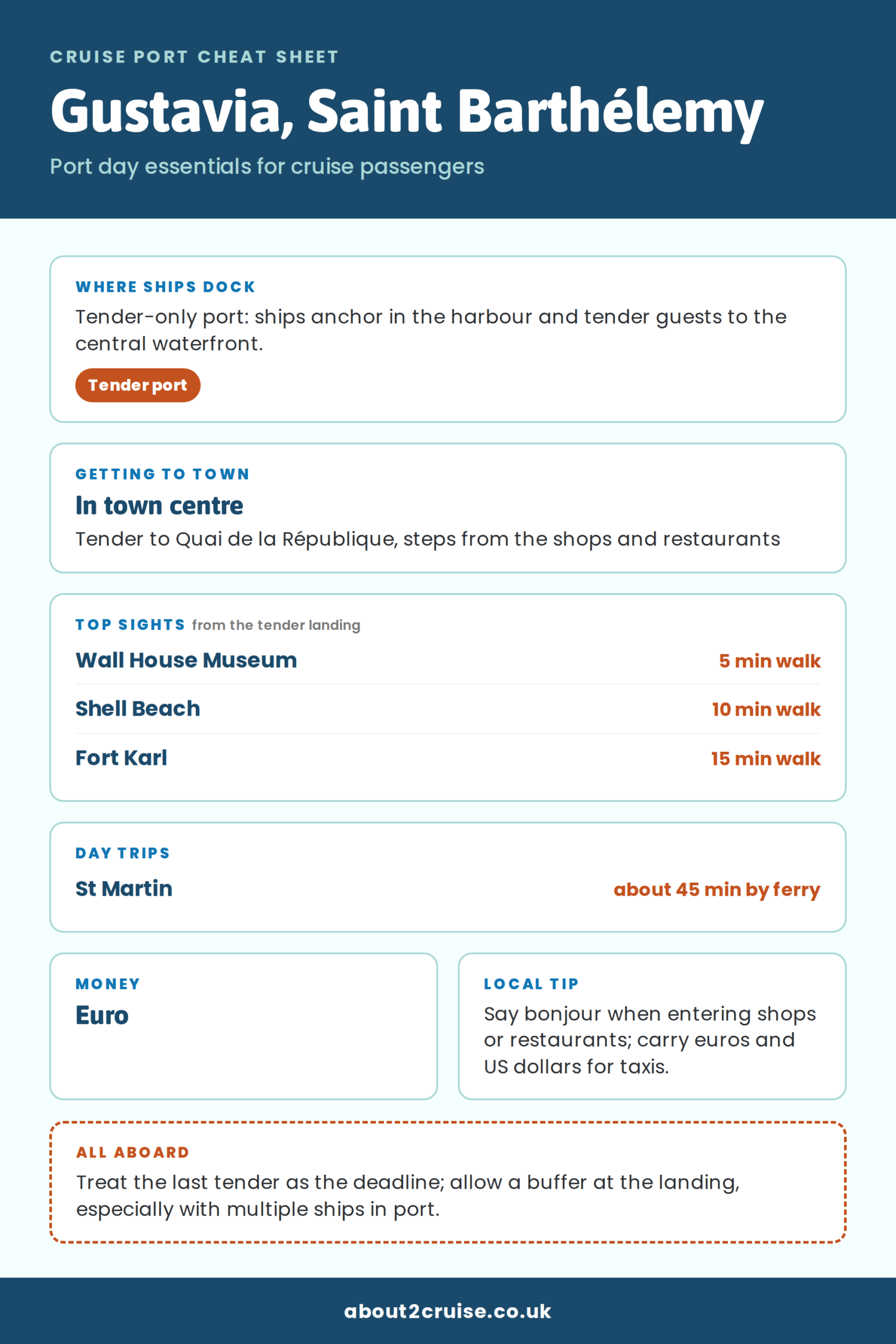
There is no cruise pier at Gustavia. Every cruise call is an anchor-and-tender stop. Ships lie in the harbour or outer roads, and the crew runs tenders to the central waterfront. The island caps cruise ships at a maximum of 1,200 passengers, and published calls are overwhelmingly small-to-midsize luxury or expedition vessels. The tender landing is not a terminal; you step off in the middle of town, usually within a few minutes’ walk of the shops and restaurants.
The outer anchorage is open to west and north-west swell, so the ride can be choppy, and the port can be cancelled if the swell is too big. Always treat the last tender time as a separate deadline from the advertised sailing time. Ask on board what buffer they want, then add a little extra for the queue, especially in the afternoon when everyone returns at once.
Inside Port de Gustavia: Marina, Ferry Terminal and the Capitainerie
Port de Gustavia is the official harbour area run by the Collectivité. It has two main personalities: a marina, or port de plaisance, for visiting yachts and a commercial/ferry side. The gare maritime, the passenger ferry terminal, sits at the entrance to Gustavia. It is not a cruise terminal; cruise tenders and ferry departures are separate operations.
The marina has about 300 berths, roughly 30 of which are for visiting boats, plus 200 moorings. The inner quays take vessels up to about 60 metres, with approach depths around 8 metres and basin depths around 5 metres. Larger yachts and deep-draught vessels anchor outside in 12–20 metres; that is also where the largest superyachts lie during high season.
If you need the harbour office while ashore, the capitainerie is open every day 07:00–18:00, monitors VHF channel 12, and can be reached on +590 590 27 66 97. The Port de Gustavia address is Capitainerie du Port de Gustavia, BP 695, Gustavia, 97099 Saint-Barthélemy cedex. There is no cruise passenger parking at the port, and the marina’s published tariffs are for boats, not cars.
Gustavia cruise port map
Tenders bring you ashore at Quai de la République (tender landing). From the tender landing, Wall House Museum is about a 4-minute walk, St Bartholomew’s Anglican Church about 5 minutes and Fort Gustav and lighthouse about 8 minutes. Tap a pin for directions.
- Quai de la République (tender landing)Where tenders land
- Wall House MuseumMuseum · About 4 min walk from the tender landing
- St Bartholomew’s Anglican ChurchAnglican church · About 5 min walk from the tender landing
- Fort Gustav and lighthouseFort and lighthouse · About 8 min walk from the tender landing
- Fort KarlFort · About 9 min walk from the tender landing
- Shell BeachBeach · About 10 min walk from the tender landing
- Our Lady of the AssumptionCatholic church · About 3 km from the tender landing
- Saline BeachBeach · About 3 km from the tender landing
- Gouverneur BeachBeach · About 2 km from the tender landing
- Colombier BeachBeach · About 3 km from the tender landing
Finding Your Way Around Gustavia on Foot
Gustavia is built around a horseshoe-shaped harbour on the west coast. The town is only about 3.4 km² with roughly 2,300 residents, and the central harbour front is level and easy to walk. From the tender landing, the natural route is along the harbour edge on Quai de la République, past the Anglican church, towards Shell Beach. The side streets climb steeply, and the fort paths are short but uphill.
The main shopping and dining streets are all close to the water: rue de la République, rue du Général de Gaulle, rue du Roi Oscar II, rue de la France and rue du Bord de Mer. At the harbour entrance is the ferry terminal; Wall House and the library sit on the Pointe at one end, Fort Gustav and the lighthouse rise on the north side, and Fort Karl sits on the hill above Shell Beach to the south.
If you stay on the harbour edge, you do not need a taxi. If you want Saline, Gouverneur, Flamands or Colombier, you need wheels or a boat.
A Little Swedish-French History You Can Walk To
Gustavia is named for King Gustav III of Sweden. Before the Swedish period it was called Le Carénage. Sweden took control in the late 18th century, then sold the island back to France in 1878. The Swedish layer is still visible in the town’s red-roofed harbour warehouses, three former forts, a Swedish clock tower and bilingual street names.
For a cruise stop, the easiest historical sights are free and close. Fort Karl sits 29 metres above the town on the hill above Shell Beach; the short climb gives you harbour and red-roof views. Fort Gustav and the Gustavia lighthouse on the north side of the harbour have cannons, a guardhouse and a wide harbour panorama. Wall House, the territorial museum on the Pointe, is free, closed on Sunday, and closed for a midday break on other days; allow about an hour.
Two churches face the harbour and are easy to pass on a walk: the Roman Catholic Our Lady of the Assumption from 1829 and the Anglican St Bartholomew’s from 1855. On a normal port day you can comfortably slot in Fort Karl or Wall House, not both at a rush.
Beaches Near the Cruise Tender: Shell Beach and Beyond
Shell Beach, also called Anse de Grand Galet, is the only beach within walking distance of the tender. It is about 10–15 minutes on foot from the harbour front, partly uphill on the way back. The “beach” is made of shells rather than sand, so water shoes or sandals with good soles make it far more pleasant. It is the best no-taxi swim you can fit inside a normal port day, and the sunset view looks out towards St Eustatius and Saba.
Saline, Gouverneur and Colombier require transport. Saline has a car park followed by a five-minute walk over a dune, no facilities and no shade. Gouverneur is reached down a steep road from Lurin, has no shops or beach club, and limited parking in high season. Colombier has no road; you either hike 20–30 minutes or go by boat, but it sits inside the marine reserve and is the best snorkelling on the island. Saline and Gouverneur are unpatrolled Atlantic beaches with swell; treat them with respect.
For a first port call, Shell Beach is the efficient answer. For Saline or Gouverneur, pre-book a taxi return or take a ship excursion so you are not stranded when the afternoon tender queue builds.
Where to Shop in Gustavia Without Wasting Time
St Barts is a duty-free port with no VAT. The real savings are on watches, fine jewellery, designer fashion, perfume and spirits; savings on everyday goods are negligible. The luxury streets are within a few minutes of the tender: rue de la République, rue du Général de Gaulle, rue du Roi Oscar II, rue de la France and rue du Bord de Mer.
Global names in Gustavia include Hermès, Louis Vuitton, Dior, Cartier, Bulgari, Prada, Valentino, Ralph Lauren, Rolex, Patek Philippe and Richard Mille. Local names worth knowing include Fabienne Miot and Kalinas & Tainos for jewellery, and Poupette and Lolita Jaca for island fashion. For crafts, look for braided latanier-palm hats and baskets from Corossol sold along the Gustavia harbour quay.
Opening hours matter more here than at most cruise ports. Boutiques usually open around 09:00–10:00, close for a long lunch until about 14:00–15:00, then reopen until around 19:00. Nearly everything is shut on Sunday, so a Sunday call is not a shopping day; it is a beach, viewpoint and lunch day. Some shops may ask for a passport for high-value duty-free paperwork, so carry photo ID.
What to Eat and Drink on a St Barts Port Day
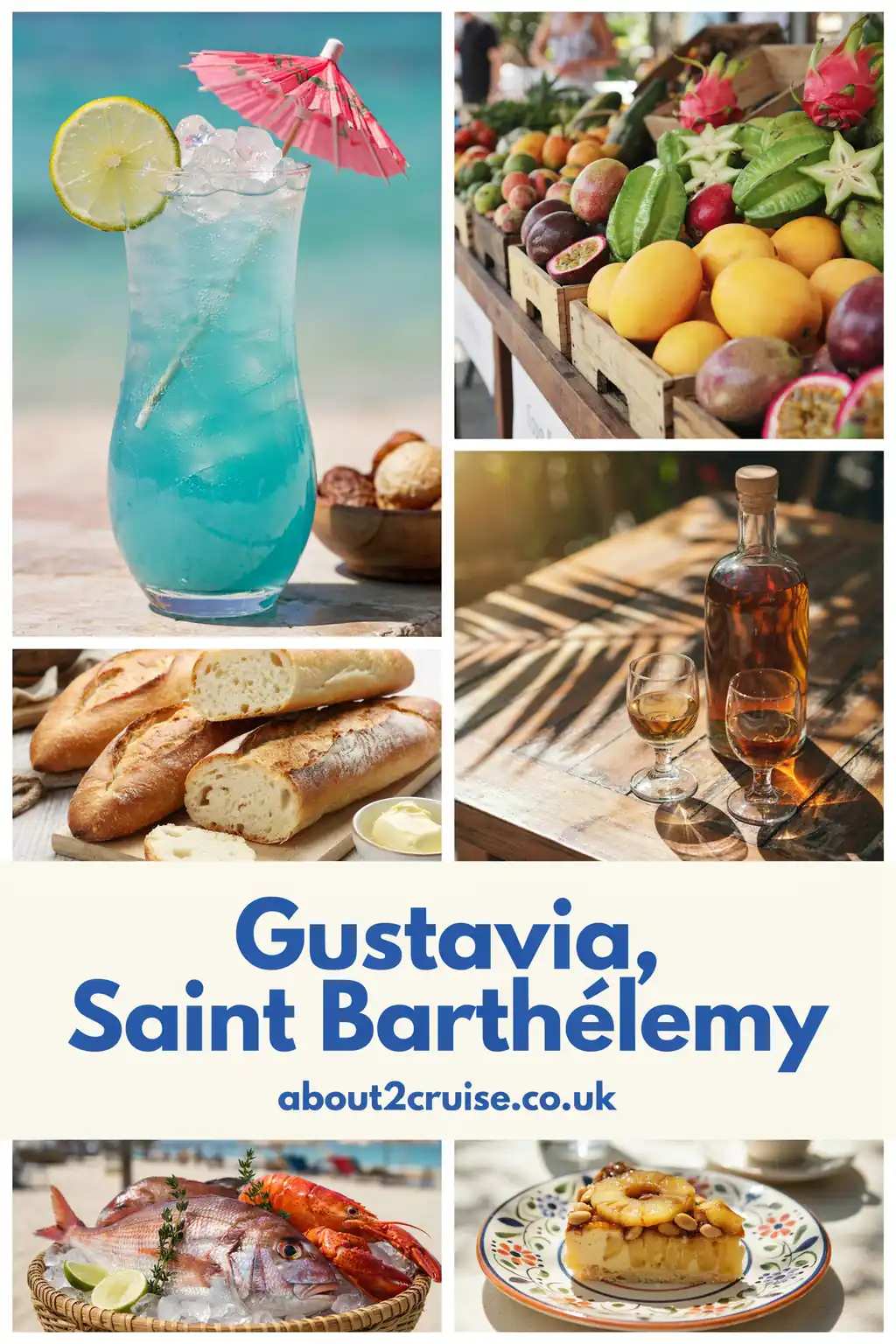
St Barts food is French-Caribbean rather than generic beach-bar fare. Try accras de morue, salt-cod fritters usually served as a Creole starter; boudin créole, a spiced island sausage; colombo, the Tamil-influenced curry of chicken, goat or fish; and langouste grillée or court-bouillon de poisson for seafood. For something sweet, flan coco, banana tart and vieux rhum sorbet are common. Drinks are ti-punch or planteur if you want the full French West Indies experience.
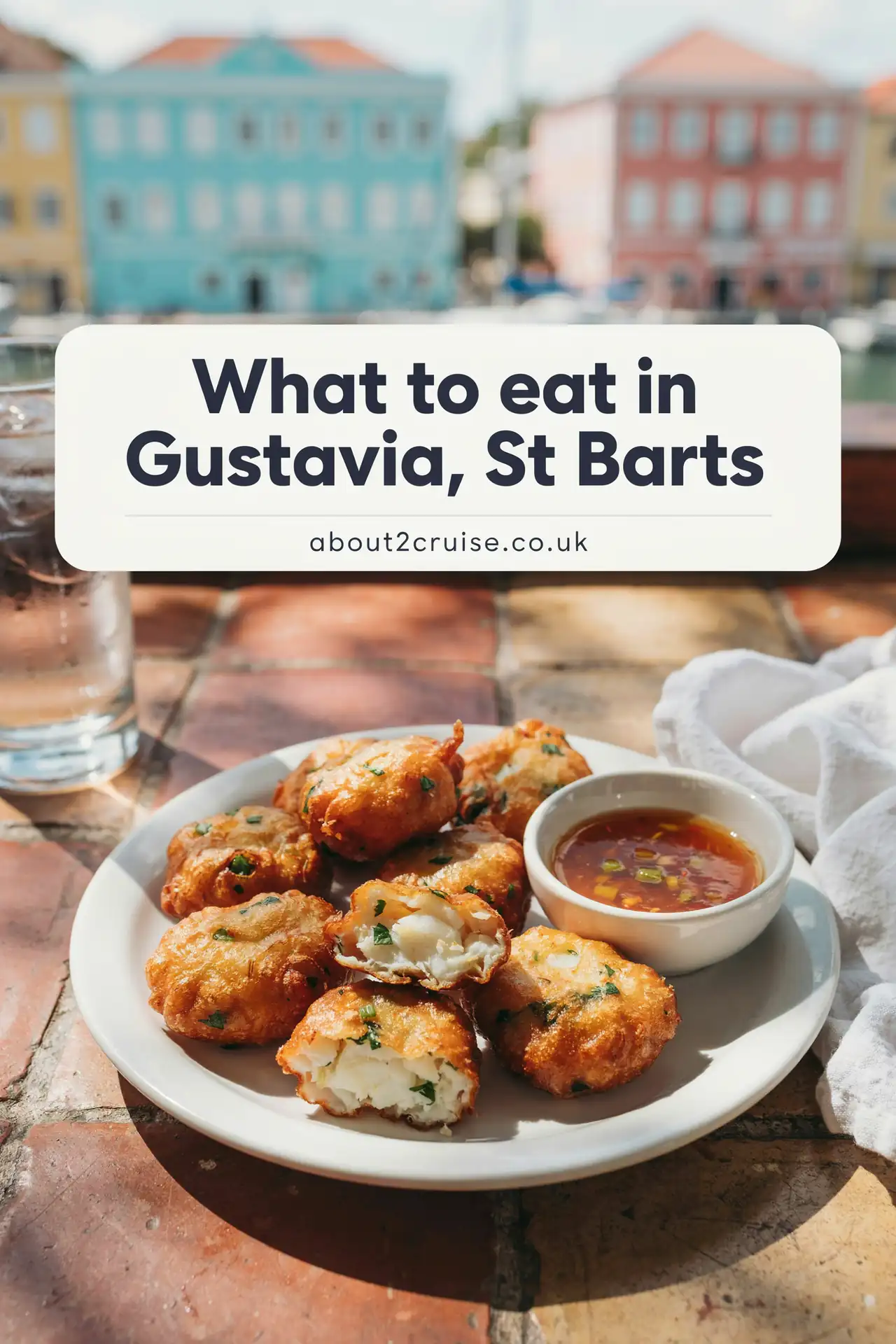
The densest cluster of restaurants, snack bars and bakeries is around Quai de la République, rue du Général de Gaulle and rue du Roi Oscar II, so you can eat almost on the tender doorstep. Be prepared for the prices: a bottle of water at a café can run €6 or more, and cocktails €18–25. Lunch reservations matter in high season, and beach clubs or top tables book out. If you want a long, slow lunch, reserve before the ship arrives; if you want to keep moving, grab a bakery or snack-bar option.
Getting Around the Island: Taxis, Ti Bus and Car Rental
There is no ride-hailing on St Barts. Taxis run on fixed route fares set by the Collectivité, not meters, and you should confirm the price before boarding. Example published fares from Gustavia include Saint-Jean €40, Saline €60, Gouverneur €50, Flamands €60, Colombier €60, Grand Cul-de-Sac €70, Toiny €80 and airport–Gustavia €40. A short move within the same area, such as Gustavia to Shell Beach, is around €30. Fares are per vehicle, not per person.
Taxi supply is limited and the rank near the tender gets busy on ship days. The return leg matters more than the outbound, so pre-book or share a taxi. There is also a public shuttle, the Ti Bus SBH, running between Saint-Jean and Gustavia; it is much cheaper than a taxi and has stops including the airport and opposite the gare maritime. No left luggage is advertised at the gare maritime or in central Gustavia, so keep valuables in your day bag.
Car and scooter rental desks sit along the Gustavia harbour front, but central parking is scarce and roads are narrow, steep and often congested. Driving is on the right, French rules apply, and a UK licence is accepted. Unless you specifically want to explore several beaches independently, a taxi or ship excursion is usually the lower-friction port-day choice.
Taking the Ferry from Gustavia to St Martin
St Barts lies about 35 km south-east of St Martin/Sint Maarten. Ferries leave from the gare maritime in Gustavia. Voyager runs to Marigot in about 60 minutes and Oyster Pond in about 30 minutes, while Great Bay Express runs to Philipsburg in about 45 minutes. In season there can be more than 40 sailings a week, but schedules are seasonal.
Check-in opens about an hour before departure and closes 15–20 minutes before. You need a passport even though both islands are French or part of the same island group. The crossing is open ocean and can be rough for people prone to motion sickness. Fares are roughly €37–38 one way on Voyager; Great Bay Express typically sells in US dollars. A typical Great Bay schedule from Philipsburg has departures Monday–Saturday at 07:15, 09:45 and 17:30, and Sunday at 09:45 and 17:30; return sailings from Gustavia leave Monday–Saturday at 08:30, 12:00 and 16:15, and Sunday at 12:00 and 16:15. Always check current timetables. For a normal cruise call, the ferry is not a day-trip option unless your ship is overnighting; it matters more for pre/post stays or if you need a fallback after missing the ship.
If your itinerary also includes St Martin, see our Marigot, Saint Martin Cruise Ship Port guide.
Money, Cards and What Things Actually Cost
The official currency is the euro. US dollars are accepted almost everywhere and treated as a second currency, but change may come in euros. Cards are widely accepted in shops and restaurants; carry cash for taxis, small snack bars and tips. Gustavia has French bank branches, ATMs and a money exchange. Taxi fares are per vehicle, not per person, and there is no luggage supplement.
Language Tips and Local Etiquette
French is the official language, and English is widely and routinely spoken in shops, restaurants and hotels. Still, say “bonjour” when you enter a shop or restaurant; it is expected, and launching straight into a request marks you out. Beachwear belongs on the beach. In town, especially in boutiques and churches, cover up a little more than you would at the pool or on Shell Beach.
Passports, ID and Entry Requirements
St Barthélemy is a French overseas collectivity, separate from St Martin. For British citizens, the passport needs at least three months’ validity beyond the planned departure date, and visa-free visits are allowed for up to three months. A yellow fever vaccination certificate is required if you arrive from a country with transmission risk.
French law requires you to be able to prove your identity when asked, so carry a passport, photocard driving licence or other government photo ID ashore. For a routine cruise call, follow the ship’s ID instructions, but do not assume a cruise card alone will satisfy every local request. If you take the ferry to St Martin, you need a passport.
Time Zone, Weather and the Best Months to Visit
Gustavia is on Atlantic Standard Time, UTC−04:00, with no daylight saving change. There are two main seasons: a drier, slightly cooler carême from January to April, and a wetter, hotter hivernage from June to November. Hurricane season runs June to November. Daytime highs average around 28.5°C in January, rising to about 31.7°C in September; sea temperatures stay between 26°C and 29°C year-round.
Rain is possible in any month but peaks in October and November. The December–January Christmas winds can make the anchorage and tender ride choppy, and the outer anchorage is exposed to west and north-west swell. The most reliable months for calm port days and dry weather are typically February–April, but cruise calls happen year-round.
Which Cruise Lines Actually Call at Gustavia?
Yes, cruise ships do go to St Barts, but not the largest mega-ships. The published Gustavia schedule is dominated by small and mid-size luxury lines. You will typically see Windstar, SeaDream, Oceania, Silversea, Regent Seven Seas, Crystal, Azamara, Star Clippers, Ponant, Explora Journeys, Emerald Cruises, Hapag-Lloyd and The Ritz-Carlton Yacht Collection. Specific ships have included Wind Surf and Star Pride; SeaDream I and II; Oceania Vista, Allura and Marina; Silver Shadow, Silver Spirit and Silver Ray; Regent Grandeur and Splendor; Crystal Symphony; Azamara Journey; Star Flyer; Le Ponant and Le Bougainville; Explora I and Explora III; Emerald Azzurra and Sakara; ms Europa; and Ritz-Carlton’s Ilma.
Royal Caribbean International and Celebrity Cruises ships do not currently appear in the published Gustavia schedules. Royal Caribbean Group’s presence is through Silversea and the Ritz-Carlton Yacht Collection, and Princess does not call here either. Gustavia is a port of call only; no ship starts or ends a cruise there in the published schedules. Some lines, including SeaDream and Windstar, sell overnight calls in Gustavia, which gives you the rare chance to see the harbour after the shops close and the town lights come on.
Because of the 1,200-passenger cap and the tender-only setup, the port day here is quieter than St Maarten or Antigua. If your ship is over the cap and on an itinerary that says it calls at St Barts, that is highly unusual; the line would need specific local approval.
How to Plan a Short Port Day in Gustavia
If your port call is a typical 08:00–18:00 day, this order works well. Tender ashore early, before independent excursions and ship groups clog the landing. Walk the harbour front to Fort Karl or Shell Beach while the light is good and the streets are quiet. Do your shopping after 10:00 when boutiques open. Take lunch around 12:30 or 13:00, then use the early afternoon for Wall House or a swim at Shell Beach. Be back at the tender landing with a buffer before the last tender, especially if more than one ship is in port.
If your call falls on a Sunday, shopping is largely off the table. Use the day for Shell Beach, Fort Karl, a long lunch and harbour photography. If you are on an overnight call, book dinner and enjoy Gustavia when the day boats have gone. If you want Saline or Gouverneur, make that your one big move of the day and pre-book the taxi return.
Safety and Practical Warnings
St Barts has low crime, but take the usual precautions: avoid isolated areas and unpatrolled beaches after dark, do not flash large amounts of cash or expensive watches, and keep an eye on belongings at beach bars. The most serious visitor risk is drowning, especially at Atlantic-facing beaches like Saline and Gouverneur, which have no facilities and can have strong swell. Shell Beach is closer and calmer for a quick swim but still behaves like a coastal beach, not a pool.
The main cruise-specific risk is weather. Tender operations can be cancelled in swell or high wind, and that sometimes means the whole port call is dropped. Treat the last tender as absolute. If you miss the ship, the ship will not wait for independent passengers; the next realistic connection is the ferry or a flight via St Martin, which is expensive and inconvenient. Current ferries leave from Gustavia, but frequencies are seasonal and not designed for stranded passengers.
Accessibility and Mobility Notes
Tendering is the main challenge. Boarding a tender involves steps and may be impossible with high swell; the ship decides whether assistance is safe. The harbour front in Gustavia is level and walkable, but Fort Karl, Fort Gustav and Shell Beach involve slopes or steps. Some upscale hotels keep beach wheelchairs, but that is not a port service. If you have reduced mobility, plan for a harbour-front shopping or lunch day rather than the forts or Saline.
What to Wear and Pack for Gustavia
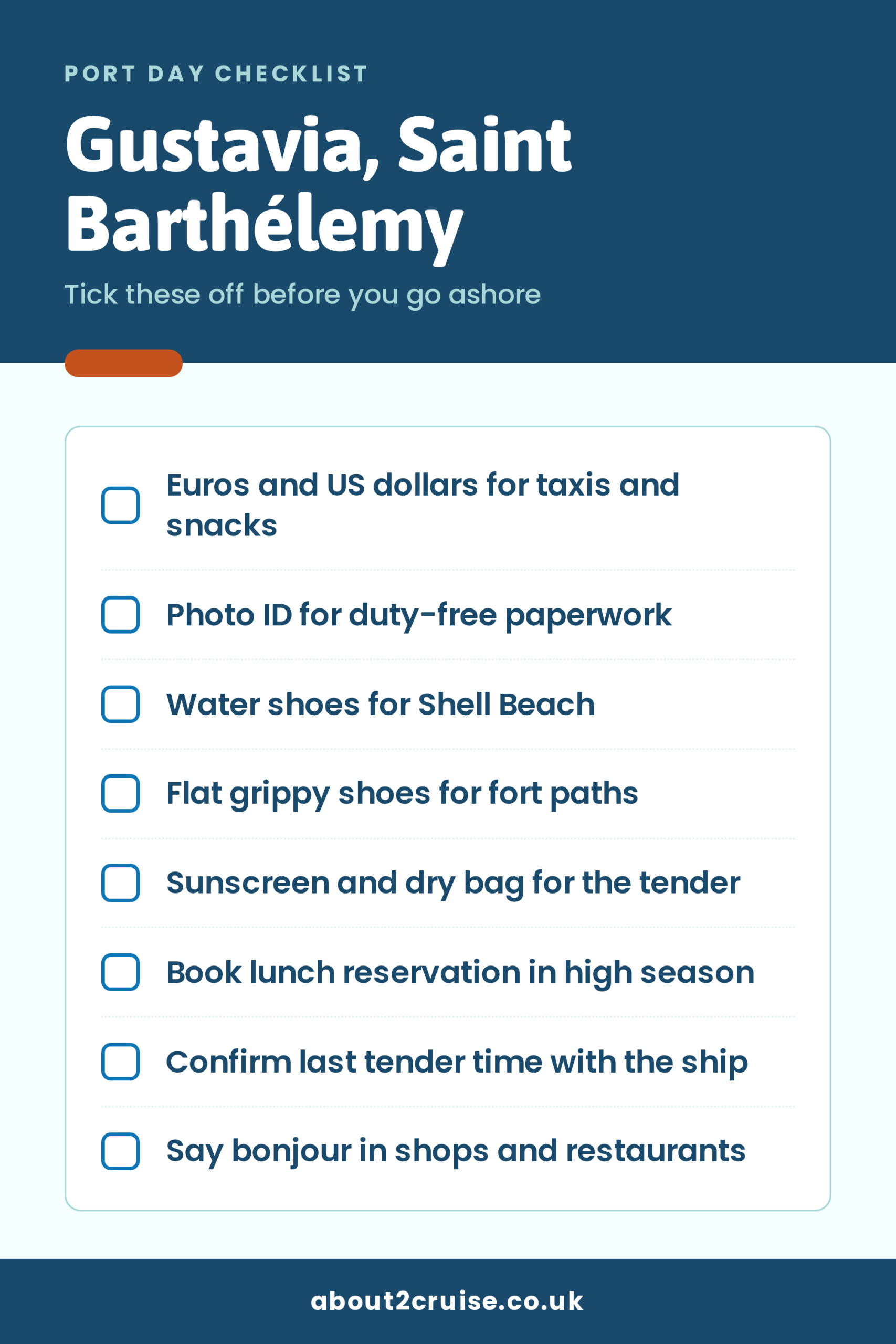
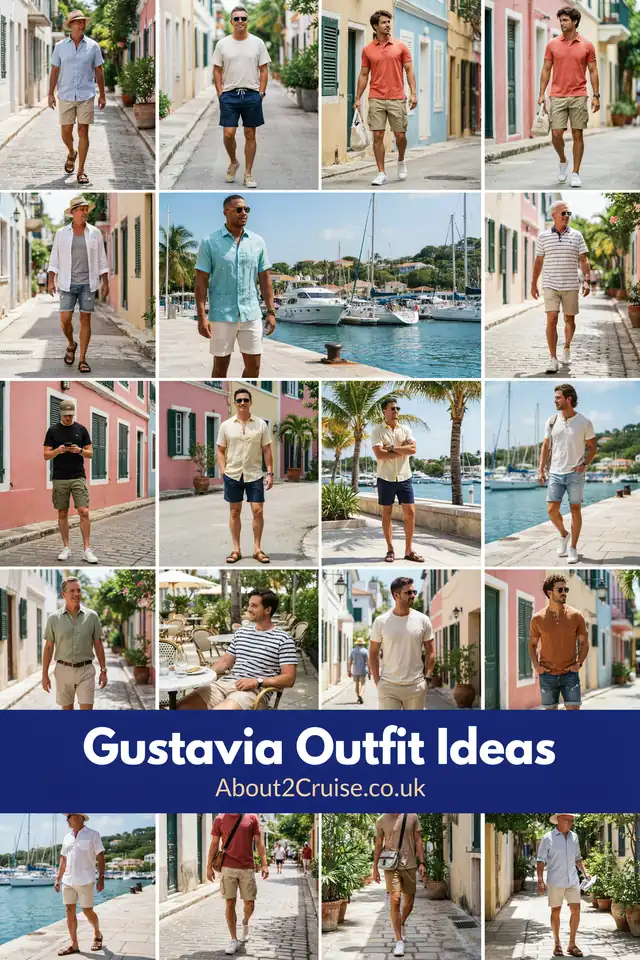
Dress in resort casual. The harbour front is level, but side streets and fort paths are steep, uneven and sometimes cobbled, so flat shoes with grip beat wedges or smooth soles. Bring a small dry bag or backpack for the tender, water shoes for Shell Beach, sunscreen, sunglasses, and enough cash in euros or US dollars for taxis and small purchases. Carry photo ID, and if you plan high-value duty-free shopping, have your passport with you.

The Best Photo Spots and Viewpoints in Gustavia
Fort Karl, directly above Shell Beach, gives the best all-in-one Gustavia photograph: the harbour, red roofs, boats and Shell Beach from about 29 metres up. Golden hour before sunset is the best light. Fort Gustav and the Gustavia lighthouse on the north side of the harbour deliver cannons, a guardhouse and a wide harbour panorama. Shell Beach itself is a classic sunset point looking towards St Eustatius and Saba.
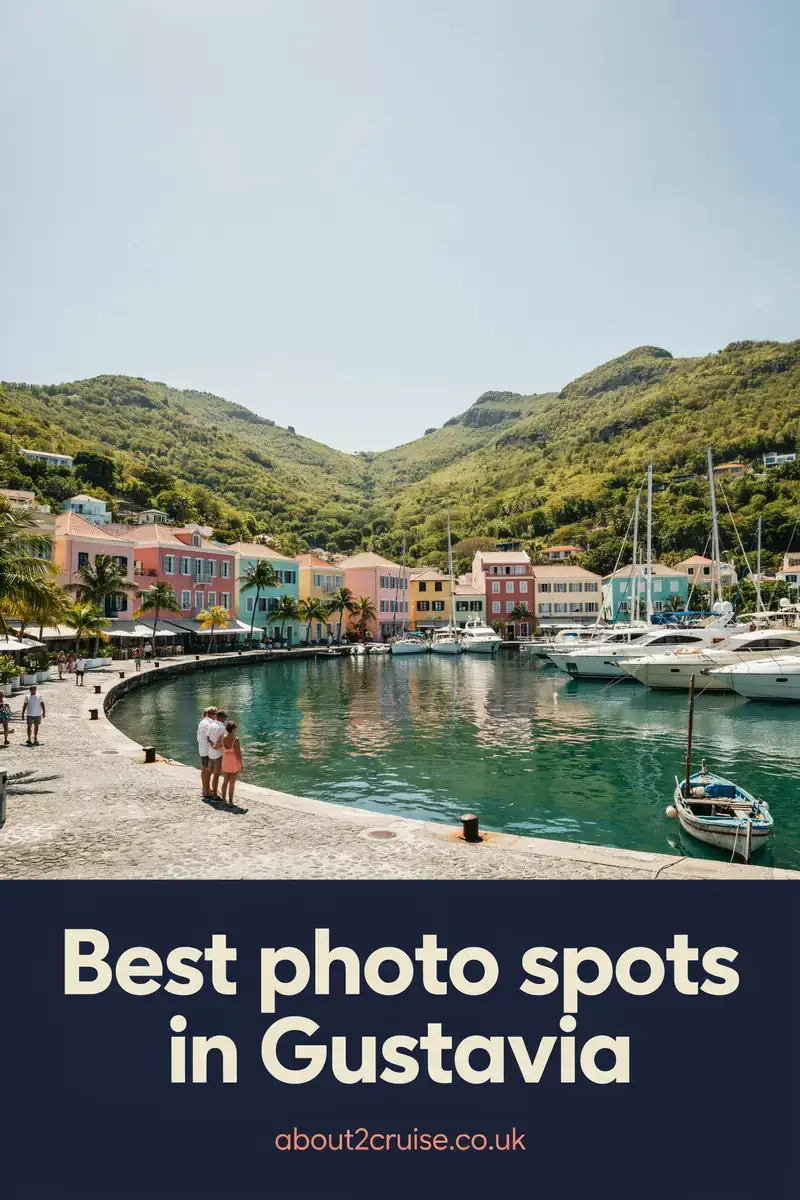
If you go further, Gouverneur photographs best in early morning or late afternoon when the light is softer and the beach emptier. St Jean is famous for planes landing over the beach; the view from the Col de la Tourmente lookout or from St Jean beach is strongest from morning to early afternoon. On a standard port day, however, Fort Karl and Shell Beach are the easiest high-yield spots.
Where to Stay Before or After a Cruise
Gustavia is not a cruise turnaround port, so most cruisers who stay are adding an island stay before or after a San Juan or St Maarten cruise. If you want walkability, the harbour-front choice is the small Sunset Hotel at 15 rue de la République, facing the harbour near the ferry terminal; it has 10 rooms and is a 15-minute walk from Shell Beach. For something higher up and far more luxurious, Hôtel Barrière Le Carl Gustaf, Fouquet’s Saint-Barth, on rue des Normands has 21 suites above town, with steep but short walking access down to the harbour. Many visitors prefer St Jean for the beach; it is about 10 minutes by taxi from Gustavia and around €40 by the fixed fare grid.
Rates are high year-round, and December to April sells out. If you are simply looking for a port-day stay near the tender, you do not need a hotel; you need tender timing, not accommodation.
More Leeward Islands Cruise Port Guides
Gustavia is part of the Leeward Islands chain. For help with nearby or return-to-ship ports, see our Leeward Islands Cruise Ship Port Guide, Port of Charlestown, Saint Kitts and Nevis, and Marigot, Saint Martin Cruise Ship Port guide.
How to spend a port day in Gustavia
A port day in Gustavia works best if you pick one: a walkable harbour, fort and Shell Beach loop, or a taxi run to Saline for a quieter beach.
Before you sail
- Book lunch reservations for high season, especially beach clubs and top tables.
- Book a ship excursion or private taxi if you want Saline, Gouverneur or Colombier.
- Check Sunday and lunch boutique closures against your call date.
Short port day: under 6 hours
- On dockingTender ashore earlyBeat the queueStep off on Quai de la République, not a terminal. Confirm the last tender time with the crew.
- +15 minWalk the harbour frontFollow Quai de la République past St Bartholomew's Anglican Church towards Shell Beach. The waterfront is level.
- +30 minSwim at Shell BeachWear water shoesTen to fifteen minutes on foot from the landing, partly uphill on the way back. The beach is shells, not sand.
- +1 hr 15 minClimb to Fort KarlA short steep path above Shell Beach leads to the fort and a 29 metre harbour viewpoint.
- +2 hr 15 minLunch near the harbourTry accrasOrder accras de morue, boudin créole or grilled langouste from the Quai de la République restaurant cluster.
- +3 hr 30 minDuty-free shoppingClosed SundayBrowse rue de la République, rue du Général de Gaulle and rue du Roi Oscar II for watches, jewellery and French fashion.
- All-aboard minus 1 hrBack at the tender landingAfternoon tenders get busy. Head back with a buffer, even if you have to skip a last shop.
The time on the map is the whole walk, every stop added together.
Open this walking route in Google Maps
If plans change: If Shell Beach is overcrowded, do Fort Karl first and return to the beach after lunch.
Long port day: 8 hours or more
- On dockingTender ashore, taxi to SalineConfirm fixed fareTaxis are at the pier rank with fixed route fares. Agree the price before boarding; the return leg is the one to pre-book.
- +30 minSaline BeachThe taxi drops at the car park, then it is about five minutes over a dune. No facilities, no shade and Atlantic swell.
- +2 hr 30 minTaxi to Shell BeachPre-book returnPre-book the return or share a taxi back; ask the driver to drop you at Shell Beach to avoid walking into town twice.
- +3 hrShell BeachRelax on the shell beach and enjoy the view towards St Eustatius and Saba. Water shoes help.
- +4 hrLunch near the harbourTry langousteBack on the harbour front, order grilled langouste or court-bouillon de poisson near Quai de la République.
- +5 hr 30 minDuty-free shoppingIf not Sunday, browse the boutiques on rue de la République and rue du Général de Gaulle.
- All-aboard minus 1 hrBack at the tender landingAllow time for the afternoon tender queue, especially if more than one ship is in port.
This map shows the taxi ride from the ship. The time is the drive only, not your time ashore.
Open the taxi route in Google Maps
If plans change: If taxis for Saline are all taken, stay in Gustavia and follow the short port day plan on foot.
Gustavia Cruise Port FAQ
Is Gustavia in St Martin?
No. St Barthélemy is a separate French overseas collectivity about 35 km south-east of St Martin/Sint Maarten. It is not part of the island of St Martin and has its own government, capital and entry rules.
Is St Barts worth visiting on a cruise?
Yes, if you want a polished, walkable taste of the French Caribbean rather than a busy excursion day. It is best for shopping, harbour scenery, French-Caribbean food and Shell Beach. If you want shipwrecks, big beaches or family attractions, another island may suit better.
Why do billionaires go to St Barts?
St Barts offers privacy, high-end infrastructure, duty-free luxury shopping, reliable winter sunshine and a superyacht-friendly harbour. It does not have a mass-cruise or high-rise feel, and the island actively limits visitor volume.
Do I need a passport for a cruise call at Gustavia?
Follow your ship’s instructions, but carry photo ID. French law requires you to prove identity ashore, and if you take the ferry to St Martin or make a duty-free purchase requiring documentation, a passport is the standard proof.
Can I walk to Shell Beach from the cruise tender?
Yes. Shell Beach is about 10–15 minutes on foot from the harbour front, partly uphill on the way back. Wear water shoes because the beach is made of shells rather than sand.
Last Updated: 16 November 2026