
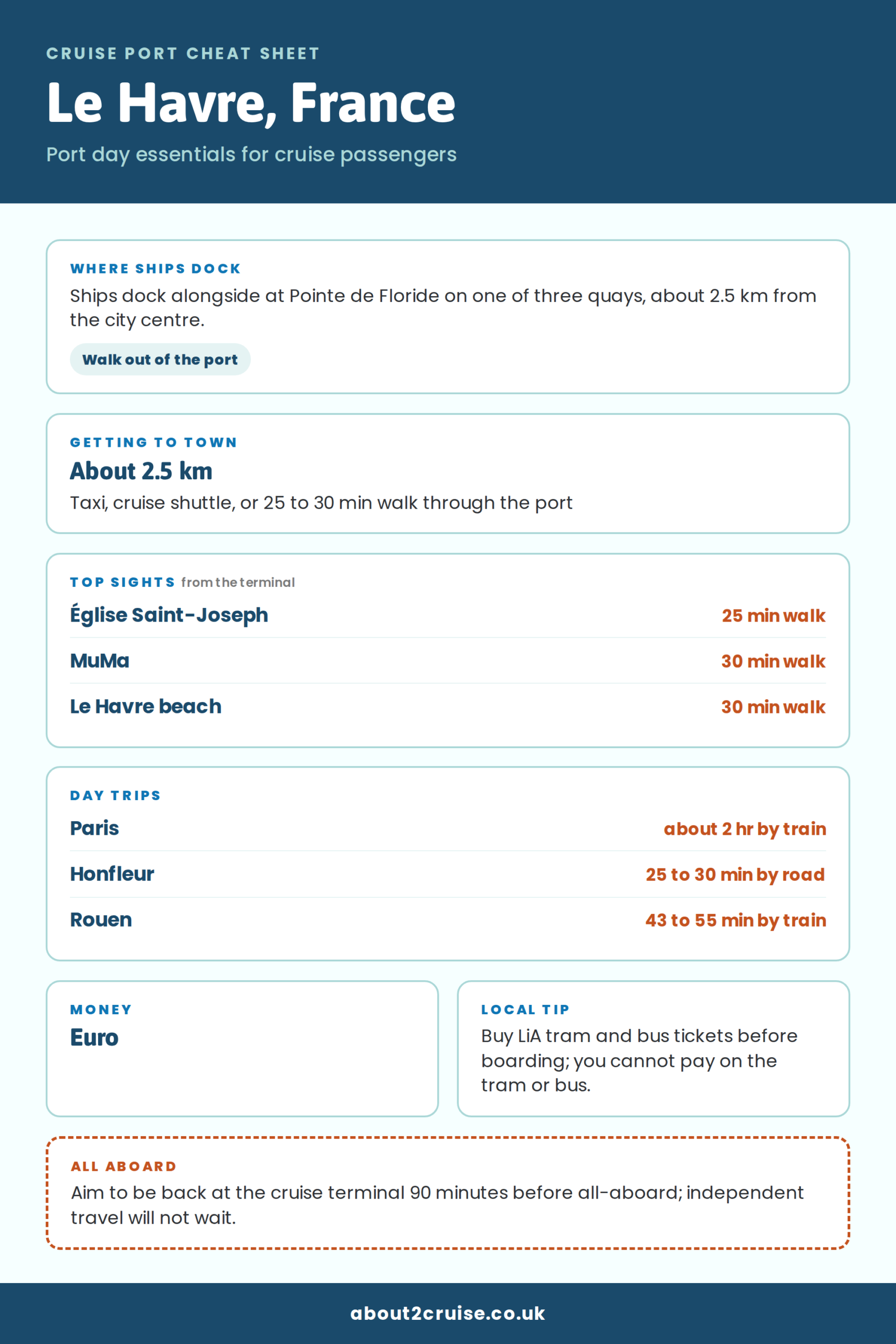
Le Havre is a working Normandy port, not a Paris terminal. Cruise ships dock at Pointe de Floride about 2.5 km from the city centre and roughly 193–210 km from central Paris. Paris day trips are possible with careful timing or a ship excursion, but many cruisers choose Honfleur, Étretat or Normandy instead.
Le Havre at a Glance: A Normandy Port, Not a Paris Terminal
Le Havre sits in Normandy, northern France, on the English Channel at the mouth of the Seine. It is not in Paris. The port calls itself the “Ocean Port of Paris” because it’s the closest deep-water cruise port to the capital, but the two places are about 193–210 km apart by road and roughly two hours apart by direct train.
Your ship calls here because Le Havre has deep-water quays that can handle very large cruise ships, good turnaround facilities and easy motorway links to Paris, Normandy and the Seine valley. It’s also France’s leading container port and a major North European logistics hub, so expect a serious working harbour rather than a resort marina. The city itself was almost entirely rebuilt after WWII and is now UNESCO-listed for its remarkable post-war architecture.
Le Havre cruise port map
Ships dock at Quai Roger Meunier. From the terminal, Maison de l’Armateur is about a 10-minute walk, MuMa about 10 minutes and Les Halles Centrales about 17 minutes. Tap a pin for directions.
- Quai Roger MeunierWhere ships dock
- Quai Pierre CalletWhere ships dock
- Quai Joannès CouvertWhere ships dock
- MuMaModern art museum · About 10 min walk from the terminal
- Maison de l’ArmateurShipowner’s house museum · About 10 min walk from the terminal
- Les Halles CentralesCovered market · About 17 min walk from the terminal
- Église Saint-JosephChurch · About 20 min walk from the terminal
- Place de l’Hôtel de VilleTown hall square · About 21 min walk from the terminal
- Gare du HavreTrain station · About 28 min walk from the terminal
Is There a Cruise Port in Paris?
Mainstream cruise ships cannot reach Paris itself. Paris is inland, almost 200 km from the open sea. Small river cruise vessels and boutique ships can sail up the Seine and tie up near the Eiffel Tower, but oceangoing ships use Le Havre, Rouen or sometimes Honfleur.
When an itinerary says “Paris (Le Havre)”, read it as: you will dock in Le Havre and Paris is at the end of a two-hour transfer. The nearest major cruise port to Paris is Le Havre. Rouen is closer by rail for smaller ships that can reach it, but most large-ship itineraries use Le Havre.
Le Havre Cruise Terminal: Berths, Address and Facilities
Berths and address
All cruise ships berth at Pointe de Floride, a purpose-built cruise complex in the Port of Le Havre. Ships are not assigned to one single building; they dock alongside one of three named quays.
- Quay Roger Meunier: main terminal quay, roughly 470 m usable length.
- Quay Pierre Callet: around 600 m quay length; shore power is already live here.
- Quay Joannès Couvert: around 500 m quay length.
Port address to use for navigation: Quai Roger Meunier, 76059 Le Havre, France.
GPS for arrival by car: approximately 49.4815° N, 0.1056° E. Follow green “car-ferries” signs, then “Terminal Croisière”.
UN-LOCODE: FRLEH
Pilotage is compulsory. Published berth limits are a maximum ship length of 480 m and maximum draught of 10.5 m. The tidal range can be up to 11.5 m, which is why the gangway can be steep. The terminal only opens on ship-call days.
Facilities inside the terminal
- Tourist information point with maps
- Check-in counters, baggage scanner, baggage control and storage area
- Customs and border police office
- Lounge, shop, toilets and an ATM
- Free wifi and a defibrillator
- Car and bicycle hire desks
- Taxi rank and pick-up point for shuttles
The complex is being redeveloped in stages. Shore power is already available at Quay Pierre Callet and is being extended. New terminal buildings and longer 22-metre gangways are improving the experience, but you are still essentially walking through an active port zone.
Arriving in Le Havre: No Tender, But You’ll Need a Short Ride or Walk
Le Havre is not a tender port. Cruise ships tie up alongside at Pointe de Floride. The tidal range is wide, so the gangway can be steep at low water. Staff assist passengers with reduced mobility, but if you’re unsteady, don’t be a hero on the gangway, ask for help and allow a little extra time.
The terminal is about 2.5 km from the centre and train station. The flat walk takes around 25–30 minutes, but the route passes through a working port environment. There is heavy vehicle traffic, so use the marked authorised passenger exit and keep your head up.
The easiest options are:
- Taxi: about €10–12 from the terminal to the station or city centre. Taxis queue on ship days but can be busy for Paris or long excursions.
- Cruise shuttle: many lines run a shuttle to Place Auguste Perret or the city centre. Depending on the line, this is usually free or charged to your onboard account.
- Local tram/bus: LiA single ticket €1.80, 24-hour ticket €4.50, funicular €0.50. Buy from stop machines or by SMS, you cannot buy on the tram.
| Connection | Distance / time | Typical cost |
|---|---|---|
| Terminal to city centre / station | 2.5 km, 25–30 min walk | Foot free; taxi €10–12 |
| Terminal to Gare du Havre | 2.5 km | Taxi €10–12; bus/tram €1.80 |
| Le Havre to Paris Saint-Lazare | Direct train 2h05–2h20 | From €17 advance; €35–75 walk-up |
| Le Havre to Paris by road | 193–210 km, about 2h–2h20 | Private transfer from around €468 sedan |
| Le Havre to Honfleur | 24 km, 25–30 min | Taxi or regional bus |
| Le Havre to Étretat | 27–28 km, about 30 min | Taxi or excursion |
| Le Havre to Rouen | 70–72 km; train 43–55 min | Train fare varies; check SNCF |
| Le Havre to Omaha Beach | 125–144 km, 1h30–1h45 each way | Private tour or ship excursion |
| Le Havre to Mont Saint-Michel | 216 km, about 2h30 each way | Ship excursion or private tour |
How to Get from Le Havre Cruise Port to Paris
There are three realistic ways to make the journey: direct train, coach/bus, or car/private transfer. All of them eat a minimum of about five hours return travel. Add the 2.5 km transfer from the quay to Gare du Havre and you need to plan carefully against your all-aboard time.
By train: the fastest independent option
Trains run direct from Gare du Havre to Paris Saint-Lazare. The fastest are about 2h05; average services are around 2h19. There are roughly 17 direct trains a day, with the first around 05:23 and the last around 20:09. Book at sncf-connect.com. Advance fares can be as low as €17 one way; walk-up fares are usually €35–75.
Gare du Havre is 2.5 km from the terminal. Take a taxi if you are tight on time. On arrival at Saint-Lazare, the Eiffel Tower is a short Métro or taxi ride away.
By coach
FlixBus and BlaBlaCar Bus run from Le Havre bus station, next to the railway station, to Paris. Journey times are around 2h15–3h15 depending on the stop and traffic. Fares can be as low as €8–16, but schedules are less frequent than trains and less forgiving for cruise deadlines.
By private transfer or car
A pre-booked private transfer is the most door-to-door option. The road distance to central Paris is around 210 km and typically takes 2h20. A sedan starts around €468, a van around €713 for a group. Car rental is available at or near the terminal, but you’ll also pay motorway tolls on the A13 and Pont de Normandie.
Ship excursion or independent?
If Paris is your absolute priority, the ship’s own “Paris on your own” or guided excursion is the least stressful choice. The ship waits for its official excursions if there is a delay. On independent travel, the ship is not obliged to wait, and you could be stranded. Build in a cushion of at least 60–90 minutes beyond the last train or transfer.
Can You Actually Visit Paris in One Port Day?
Yes, but only on a long call. If your ship is in port from around 07:00 to 19:00 or later, a Paris day is possible: train about 2h, arrive Saint-Lazare around 10:00, see the Eiffel Tower from Trocadéro, take a Seine walk or quick loop, then leave Paris by 15:00–16:00 to be back with margin. If your call is shorter, or your ship departs before 18:00, Paris is too rushed to be enjoyable.
Before committing to Paris, ask what you want from the day. Paris gives you a highlight reel and a lot of motorway or train time. Honfleur, Rouen or Étretat give you a slower, less crowded Normandy day and far lower risk of a late return.
The Eiffel Tower is about 193 km from Le Havre by road. Lift tickets cost around €23.50 for the second floor, €36.70 to the summit by lift, and €14.80 for stairs to the second floor. The tower is open roughly 09:30–23:45, longer in summer. There is no left luggage at the tower and large bags are refused. If you plan to go up, pre-book a timed ticket or you may lose an hour or more in the queue.
What to Do in Le Havre: Architecture, Art and the Beach
Le Havre is a strange and memorable city. It was almost completely destroyed in the Second World War and rebuilt between 1945 and the 1960s to Auguste Perret’s master plan. The result is a disciplined grid of reinforced-concrete buildings, wide boulevards and a colour scheme that is instantly recognisable once you start looking. UNESCO listed the city in 2005.
Before you sail
- Book SNCF train tickets in advance for Paris or Rouen.
- Book a timed Eiffel Tower lift ticket if Paris is on your plan.
- Pre-book a Paris ship excursion if you cannot risk a late return.
Short port day: under 6 hours
- On dockingWalk or take a taxi to the city centreFollow marked routeThe flat walk is about 25 to 30 minutes through the port. Taxis and shuttles are quicker.
- +30 minÉglise Saint-JosephFree entry, open daily 10:00 to 18:00. The concrete lantern tower glows with stained glass inside.
- +1 hrPlace de l'Hôtel de Ville and Perret gridWalk the UNESCO-listed reinforced-concrete grid around the town hall and avenue Foch.
- +1 hr 45 minLunch near Les Halles or Saint-FrançoisTry fruits de merOrder a plateau de fruits de mer or a Normand cheese plate in the market quarter.
- +3 hrsMuMaSeafront modern art museum with Boudin and Dufy. Closed Mondays.
- All-aboard minus 1 hrBack at the cruise terminalWalk back or take a taxi. Keep to the marked pedestrian route through the port.
The time on the map is the whole walk, every stop added together.
Open this walking route in Google Maps
If plans change: If St Joseph's is closed for a service, walk the Perret grid first and add Le Havre beach or the Hanging Gardens before MuMa.
Long port day: 8 hours or more
- On dockingTaxi to Gare du HavreGo earlyThe station is 2.5 km from the terminal. A taxi is the fastest option.
- +30 minTrain to Rouen Rive DroiteBook aheadDirect trains take about 43 to 55 minutes. Book return tickets before the cruise.
- +1 hr 30 minRue du Gros-Horloge and cathedralWalk the pedestrian street to the cathedral. Free entry, with shorter winter hours and Monday morning closures.
- +2 hr 30 minPlace du Vieux-Marché and Sainte-Jeanne-d'ArcSee the square where Joan of Arc was burned and the modern church. Both are free.
- +3 hr 45 minLunch around Place du Vieux-MarchéTry Norman cheesesChoose a café around the square and order a Normand cheese plate or seafood lunch.
- +5 hr 30 minWalk the half-timbered old townWander the medieval streets, then make your way back to the station for the return train.
- All-aboard minus 90 minBack at the Le Havre terminalLeave the station by taxi or allow 30 minutes to walk back to the terminal.
The times on the map are for the whole journey there by train and bus.
Get train and bus times in Google Maps
If plans change: If trains to Rouen are cancelled or badly delayed, stay in Le Havre and do the local Perret and seafront route instead.
UNESCO-listed Perret architecture
Start around Place de l’Hôtel de Ville and avenue Foch. The Hôtel de Ville tower and the spire of St Joseph’s church anchor the city’s major axis. The “Perret show flat” on Place de l’Hôtel de Ville recreates life in a rebuilt 1950s apartment. There is no single viewpoint that explains the whole plan; the joy is walking the grid and seeing the concrete, columns and modular rhythm close up.
If you prefer a historic house, Maison de l’Armateur, an 18th-century shipowner’s house-museum at 3 quai de l’Île, is one of the few pre-war buildings to survive. Entry is around €5–7 and free for under-25s.
Église Saint-Joseph
St Joseph’s is the city’s icon: a tall concrete lantern tower that glows with stained glass inside. Entry is free. It is normally open daily from 10:00 to 18:00, but closes to visitors during services. This is the single sight you should not miss in Le Havre.
MuMa and Impressionism
Le Havre is where Claude Monet painted Impression, Sunrise in 1872, the canvas that gave Impressionism its name. He painted it from a hotel room overlooking the port. The original painting is in the Musée Marmottan Monet in Paris, but the MuMa: Musée d’art moderne André Malraux sits on the seafront just a few hundred metres from the scene. Its collection includes Boudin, Dufy and other artists of the Seine estuary.
It is open Tuesday–Friday 11:00–18:00, Saturday–Sunday 11:00–19:00, closed Monday. Admission is €10 full / €6 reduced in high season, and €5 / €3 in low season. Under-26s, students and everyone on the first Saturday of the month get in free.
Hanging Gardens and the beach
Les Jardins Suspendus are set in the old Fort de Sainte-Adresse. Entry is free. They open 09:00–20:00 April–October and 09:00–17:00 November–March, with sweeping views over the sea, the port and the lower city.
Le Havre beach is a 2 km sand-and-pebble beach with a 4 km promenade. It is free and great for a low-key afternoon, especially after a long ship day.
Free things to do in Le Havre
- St Joseph’s church
- Hanging Gardens
- Le Havre beach and promenade
- MuMa on the first Saturday of the month, or for under-26s/students
- Walking the UNESCO Perret grid around Place de l’Hôtel de Ville and avenue Foch
- Looking at the fishing boats and old port around the Saint-François district

Honfleur from Le Havre: The Easiest Half-Day Trip
Honfleur is only 24 km from Le Havre, about 25–30 minutes by road. It is the standout choice for a relaxed independent day. The Vieux Bassin, with its tall slate-fronted houses and bobbing boats, is one of Normandy’s most photographed scenes. St Catherine’s church, built by shipwrights, is France’s largest timber-built church and free to enter.
If you arrive by car or taxi, ask to be dropped near the old port. Coach parking is around 15 minutes’ walk away at the Carnot car park. Go early before the coach groups if you want photographs without crowds. For more structure, the Eugène Boudin Museum covers the painters who worked along this stretch of the Seine estuary.
See our full Honfleur Cruise Ship Port guide for detailed route and planning tips.
Étretat and the Alabaster Coast: Cliffs, Arches and a Bracing Walk
Étretat is about 27–28 km from Le Havre and about 30 minutes by road. The headline sights are the white chalk cliffs, the Falaise d’Aval arch and the needle-like Aiguille. The beach, cliff paths and viewpoints are free. The arches are best lit in the morning.
The cliff paths are chalk, steep in places and unfenced along long stretches. Wear shoes with grip, keep away from the edge, never descend under the arches, and check tide times before you go. The Jardins d’Étretat are the only major ticketed part. The village itself is small and busy, so it pairs well with a drive along the Alabaster Coast or a stop in Fécamp.
Rouen from Le Havre: Half-Timbered Streets and Joan of Arc History
Rouen is about 70–72 km from Le Havre. Direct trains take 43–55 minutes, making it one of the easiest independent day trips by rail. The city has a walkable medieval centre with half-timbered buildings, the Gros-Horloge clock, the cathedral and Place du Vieux-Marché, where Joan of Arc was burned.
Rouen cathedral is free and usually open around 09:00–19:00 April–October, with shorter hours in winter and Monday morning closures. The Gros-Horloge ticket costs around €7.70 and is closed on Mondays. The modern Église Sainte-Jeanne-d’Arc on Place du Vieux-Marché is free. Rouen is a sensible alternative to Paris if you want a French city but fewer travel hours.
Normandy D-Day Beaches from Le Havre: A Full-Day Commitment
Le Havre is on the eastern side of Normandy, so the D-Day sites are a substantial drive. Omaha Beach and the Normandy American Cemetery at Colleville-sur-Mer are about 125–144 km from the port, roughly 1h30–1h45 each way. A typical ship excursion runs about eight hours with terminal pickup.
The Normandy American Cemetery is free, no booking is needed, and it is open daily 09:00–17:00 with last admission at 16:30. Free English-language guided tours usually run at 11:00 and 14:00. This is one destination where a ship excursion or private guide genuinely adds value because the sites are spread out and you need orientation.
Mont Saint-Michel: Dramatic, But a Very Long Day
Mont Saint-Michel is about 216 km from Le Havre, around 2h30 by road each way. That is five hours of driving before you have parked, taken the shuttle or causeway walk, and climbed to the abbey. It is best done as a ship excursion or private tour with guaranteed timing.
The village is free and does not need a ticket; the abbey costs about €16 adult April–September and €13 October–March. Under-18s and EU 18–25s are free. The abbey is open roughly 09:00–19:00 May–August and 09:30–18:00 September–April.
This is not a casual half-day. Only choose it if your ship has a very long call or the line offers it as an official excursion.
Seine Estuary, Harbour Boat Trips and Ferries
The Port of Le Havre is the largest container port in France, and a harbour boat tour is one of the most unexpected things you can do from the city. Vedettes Baie de Seine runs a 1h30 harbour tour from the marina at 125 boulevard Clemenceau, choosing either the Port 2000 deep-water container area or the historic inner harbour depending on traffic.
Tickets are about €17 adults, €14 students, €13 children, €55 family, and under-4s are free. Boats run March–November, usually from about 10:00 to 17:00. The company also runs summer estuary crossings to Trouville for around €25 adult.
Le Havre has deep transatlantic and ferry history. The great liner Normandie made her maiden voyage from here to New York. Today Brittany Ferries links Le Havre with Portsmouth in about 5h30–6h30 on the Commodore Clipper. That is useful for UK passengers joining or leaving a cruise, but the ferry terminal and cruise terminal are separate parts of the port.
Normandy Food, Markets and Café Culture
Normandy food is rich and seafood-forward. Look for a plateau de fruits de mer with oysters, whelks, grey shrimp and scallops; marmite dieppoise seafood stew; Camembert, Livarot, Pont-l’Évêque and Neufchâtel cheeses; tarte normande; and local cider or calvados.
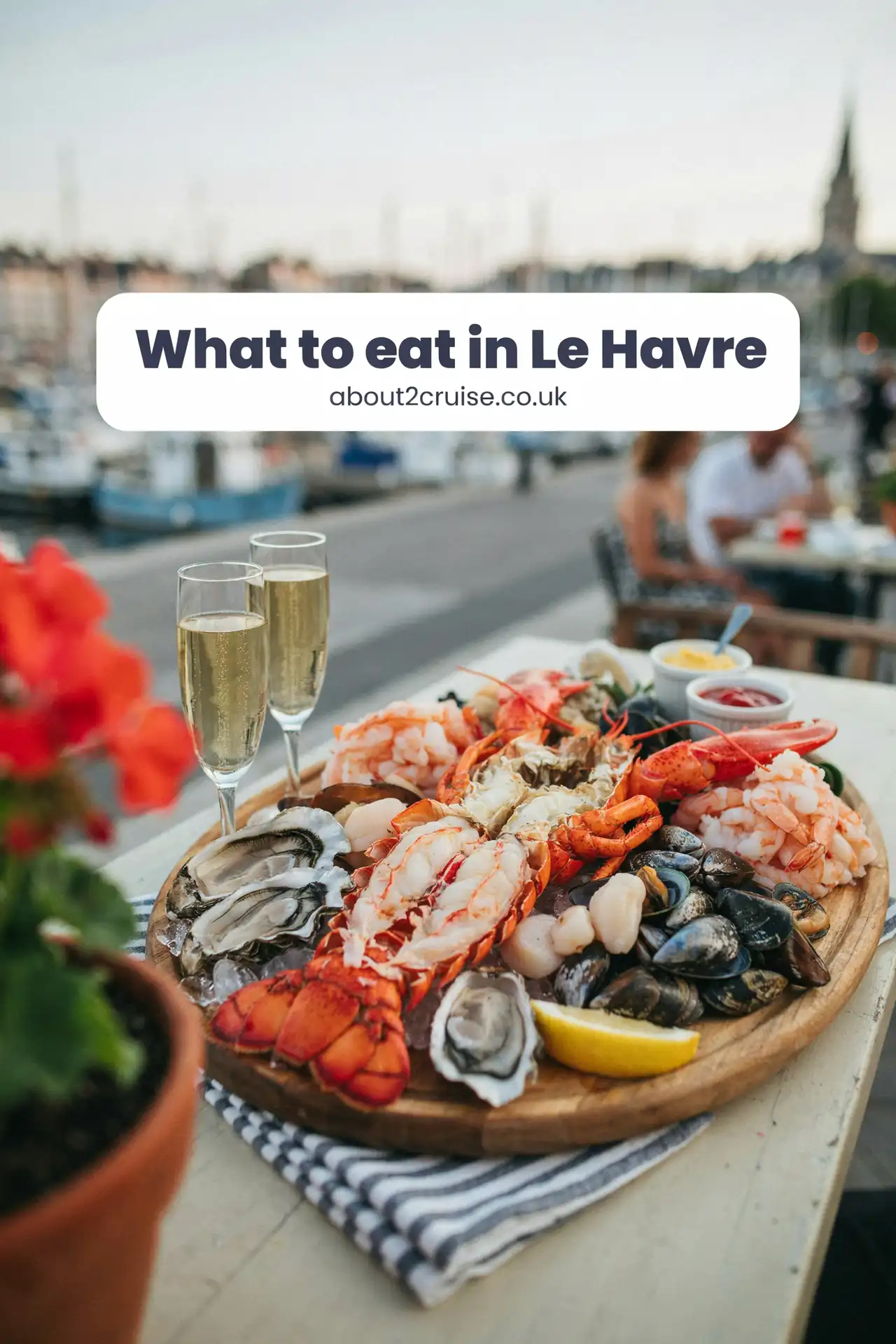
In Le Havre, the Les Halles Centrales market is the place to see local produce and seafood. The Saint-François district has crêperies and small Norman restaurants. Le Bouchon Normand at 77 rue Louis Brindeau is a reliable bistro near the market quarter. Les Docks Vauban, the converted dock shopping centre, is near the tram and useful for a quick café stop or shopping.
Money, Language and Practicalities
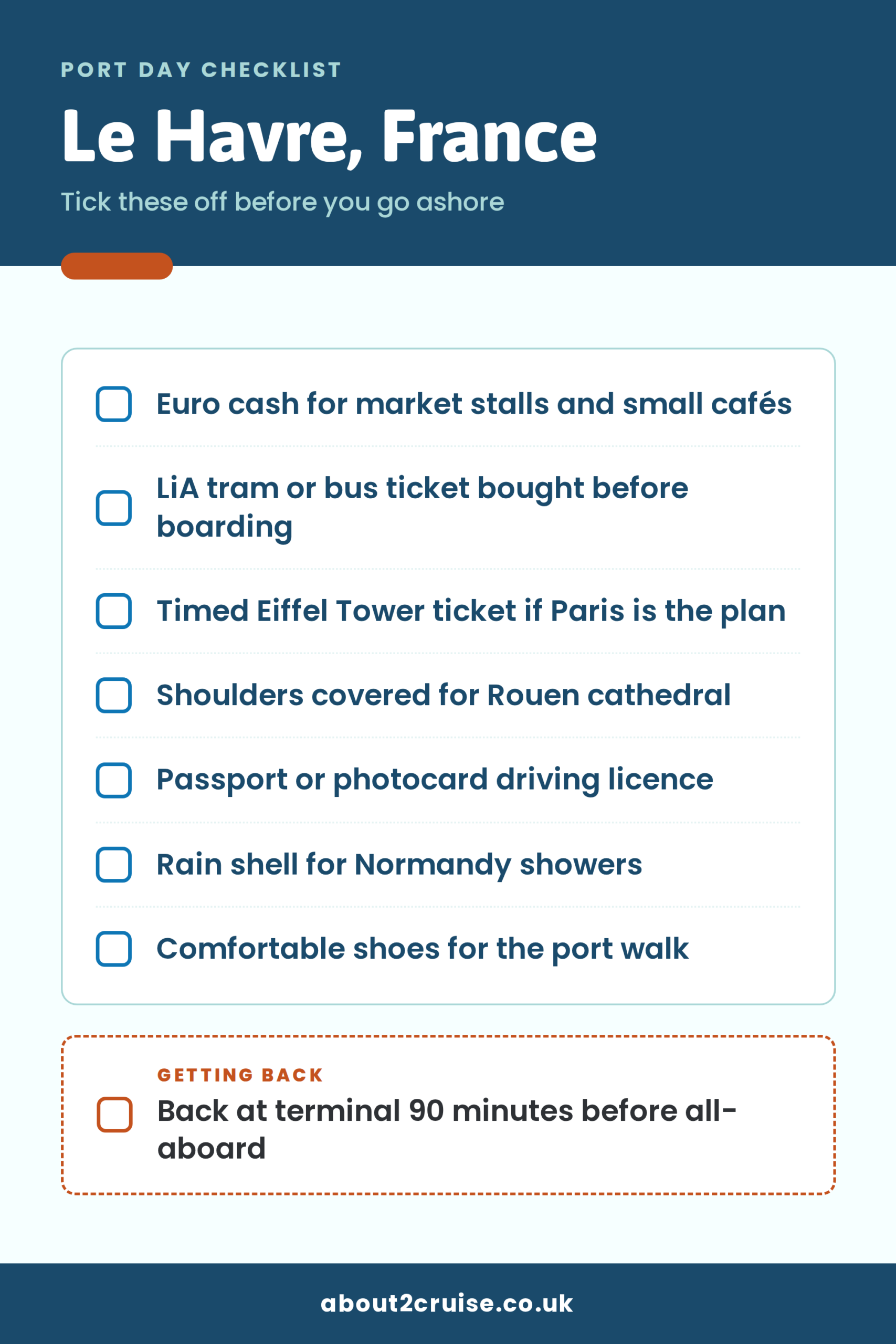
France uses the euro. Visa and Mastercard are accepted almost everywhere; American Express less often. Contactless card payments are capped at €50 per transaction; above that you generally enter a PIN. Keep some cash for market stalls, small bakeries, public toilets and tips.
Restaurant service is included by law, so tipping is just rounding up or adding a few euros. The language is French, but the tourist office and main visitor businesses work in English. Carry a passport or photocard driving licence; you are required to be able to prove identity in France. ATMs are easy to find in central Le Havre, including Crédit Agricole, BNP Paribas and Société Générale.
Weather and What to Pack
Le Havre has a temperate maritime climate. It can rain in any month and the coast is exposed. Summer daytime highs are usually around 22°C, while spring and autumn sit closer to 10–16°C. The sea is usually 8–18°C depending on the season.
Pack a rain shell, a warm layer, comfortable walking shoes and sun protection for the reflection off the water. The beach is mostly large pebbles with sand at low tide, so beach shoes help if you want to paddle.
Accessibility and Mobility at the Terminal
The gangway at Le Havre can be long and steep because of the tidal range. Cruise staff assist passengers with reduced mobility, but if you are unsteady, mention this to the crew before your port day.
The local LiA trams and buses are low-floor. MuMa is accessible with ramps and lifts, and disabled visitors plus one companion enter free. Not everything is easy: the Eiffel Tower summit and stairs are not suitable for limited mobility, and the Étretat cliff paths are naturally uneven and exposed.
Safety and Security in Le Havre and France
France’s national terror threat level remains high, and official UK advice is to remain vigilant in transport hubs, shopping centres, places of worship and crowded areas. Pickpockets operate in gangs at mainline stations and on public transport, so keep valuables in separate pockets and stay alert around ATMs.
Industrial action and demonstrations can disrupt trains and roads with little notice. Around Le Havre port, the main practical risk is the working port itself: stick to marked passenger routes and do not wander between lorries and container stacks.
Hotels, Parking and Car Hire Near the Cruise Terminal
The terminal has no hotels. Most cruisers stay in the rebuilt centre or near the station. Good options include:
- Ibis Styles Le Havre Centre Auguste Perret at 121 rue de Paris, about 0.8 km from the terminal.
- Mercure Le Havre Centre Bassin du Commerce on Chaussée Georges Pompidou, about 1.2 km.
- Hilton Garden Inn Le Havre Centre on the seafront at 128 boulevard Clemenceau.
- Novotel Le Havre Centre Gare near the station.
Independent stays include Hôtel Carmin and Best Western ARThotel.
If you are driving to join a cruise, the official recommended long-stay car park is Vauban car park at Quai Frissard, about 2.5 km from the terminal. Tariffs are approximately €25 for 7 days, €49 for 14 days and €59 for a month. Maximum height is 2.00 m. Book online in advance through the Effia parking site. There is no hotel-style meet-and-greet at the terminal; allow time to park, transfer and be processed.
Car hire is listed as a terminal facility, and the agencies cluster around the station, about 2 km away. You will need a credit card, and motorway tolls apply on the A13 and Pont de Normandie. The A131 out of Le Havre is free.
Le Havre Cruise Port Schedule and Live Planning
Le Havre has a year-round cruise season, with calls restarting in early January. Typical port-day windows are around 07:00–19:00 or 08:00–20:00, though some lines run overnights. The exact berth for your ship is not published in advance, so terminal maps can show all three quays but cannot tell you which one your vessel will use.
Check the live Le Havre schedule on Cruisemapper or Haropa Port’s cruise calls page before your cruise.
Le Havre Cruise Port FAQs
Is Le Havre the same as Paris cruise port?
No. Le Havre is a port in Normandy about 193–210 km from Paris. Itineraries often call it “Paris (Le Havre)”, but there is no large-ship cruise terminal in Paris itself.
Is Le Havre a tender port?
No. Ships dock alongside at Pointe de Floride, though the tidal range can make the gangway steep.
Can I walk from Le Havre cruise port to the city centre?
Yes. It is about 2.5 km and takes 25–30 minutes on flat ground, but the route passes through a working port area. A taxi or shuttle is more comfortable if you are carrying anything or have mobility concerns.
How far is the Le Havre cruise port from the train station?
Gare du Havre is 2.5 km from the terminal. A taxi takes around 10 minutes and costs about €10–12.
Will the ship wait for me if I travel to Paris independently?
No. Only official ship excursions have any guarantee that the ship waits. If you travel independently, leave a large buffer and always have a backup plan.
How long is the ferry crossing from Portsmouth to Le Havre?
The Brittany Ferries Commodore Clipper crossing is usually about 5h30–6h30. The ferry terminal is separate from the cruise terminal.
Is there luggage storage at Le Havre cruise terminal?
Yes, the terminal has a baggage control and storage area for cruise passengers. If you need city luggage storage outside the terminal, check with the tourist office or a third-party left-luggage service.
Do I need euros in Le Havre?
Cards are widely accepted, but carry some euro cash for market stalls, small bakeries, lockers and tips.
Related Cruise Port Guides
If you are planning a northern France itinerary, compare Le Havre with the nearby Seine estuary call: Honfleur Cruise Ship Port. For a broader route perspective, see our Northern France Cruise Ship Port Guide. If your cruise continues south or west, you may also need the Port of Nantes (Saint-Nazaire) guide.
Across the Channel, Portsmouth is a frequent next or previous call on itineraries between the UK and northern France.
Across the Channel, on the Belgian North Sea coast, Zeebrugge (Bruges) is often a next or previous call for cruises to and from Le Havre.
Further up the coast, Dunkerque lies on the North Sea and often appears as the next call on Channel itineraries.
Last Updated: 14 November 2026