
The best months to sail from Southampton are late May to early July and September. The North Sea and the Bay of Biscay are at their calmest, the Norwegian fjords and the Mediterranean are both in season, and fares sit below the July and August peak. Pack layers rather than one heavy coat, whichever month you pick.
What ‘best’ means when you sail from Southampton
The hottest month and the best-value month aren’t the same thing, and they pull in opposite directions. July and August are the yearly peak for price and for port crowds on the Norwegian run. May and late September undercut them, and the temperature difference is small while the difference in how busy the ports feel is not.
Winter isn’t a dead season out of Southampton. It’s Christmas markets, the northern lights and winter sun down to the Canaries, with keener prices and cosier ships.
You pay for it in daylight and sea state. A December or early January departure from a UK port gets around eight hours of light at best, and the far northern ports get less than that.
The month also decides which routes exist at all. Fjord sailings run from mid-April to September, the northern lights are only a realistic target from late September, and a winter fjord departure is an aurora trip rather than a scenery-first holiday.
Southampton’s cruise season, month by month
Eleven months of trade-offs in one table. The temperatures are long-term averages for Southampton measured at Mayflower Park, set next to what each month does to price, crowds and routes.
| Month | Typical high and low | Sea state and daylight | Crowds, price and what sails |
|---|---|---|---|
| February | 7°C / 1°C | Roughest North Sea and Biscay; around 10 hours of light | Half-term pricing; winter sun and northern lights itineraries |
| March | 9°C / 2°C | Unsettled, with 8 air frost days; about 12 hours of light | Winter sun and city breaks; the fjord season has not opened yet |
| April | 12°C / 4°C | Improving; about 14 hours of light | Fjords open from mid-April; Easter demand |
| May | 16°C / 6°C | Calmest stretch begins; about 16 hours of light | Quieter and cheaper than summer; snow on the peaks, waterfalls full |
| June | 19°C / 9°C | Calmest open water and the lightest winds of the year, around 10.6 mph | The all-round best month for the fjords |
| July | 22°C / 12°C | 205 hours of sunshine, the year’s highest | Peak fares and peak crowds; midnight sun from mid-May to mid-July |
| August | 22°C / 12°C | Warmest sea of the year, around 17°C | School holidays, highest prices, busiest ports |
| September | 19°C / 10°C | Still good for the Channel and the eastern Atlantic | The turning point: quieter, cheaper, autumn colour, aurora from late September |
| October | 15°C / 8°C | Briskening, with 12 rain days | Late-season value; half-term |
| November | 11°C / 4°C | Roughest window opens, with 13 rain days | Christmas market cruises from late November; lowest fares |
| December | 7°C / 2°C | Roughest; about eight hours of light and 10 air frost days | Markets, winter sun, long voyages |
January is the windiest month of the year, around 14.7 mph on average, with about nine hours of daylight, and it’s when the long winter voyages leave.
Sunshine and sea temperature follow the same curve. July gets 205 hours of sun, December gets 47. The sea peaks near 17°C in August and sits around 8°C in February, which is why a winter sea day on deck is a short visit rather than an afternoon.

The Southampton legs: the Channel, the North Sea and the Bay of Biscay
Every no-fly itinerary out of Southampton starts and ends with water that isn’t the destination, and those days decide how the week feels. A Norwegian fjords cruise gives you two North Sea days each way from Southampton. The fjord water itself is near-flat in every month, and all the motion is in the crossing.
The Bay of Biscay is the other one, and no route avoids it. Any Southampton sailing to the Mediterranean, Portugal or the Canaries spends about a day each way between the Channel and the Iberian coast, and it eases after Cape Finisterre. Captains adjust course and timing, but the thing you can control is when you sail, not whether you cross.
Pack for the legs as well as the postcard. The first and last day or two are cooler than the destination and often the lumpiest. A case built only for hot ports leaves you cold on deck.
Sea state by season, and why no month is a guarantee
Open water in the North Sea and the Bay of Biscay is calmest from June to August and roughest from December to February. September is the pivot: still good for the Channel, Biscay and the eastern Atlantic, before the risk windows of late October to November and late January to March.
None of that is a guarantee. Seas can be rough in any month, they’re only predictable a few days out, and a ship doesn’t only sail where it will be calm.
The open Atlantic runs to a different clock. Cunard’s guidance for a transatlantic says storms are more likely from early June to late November, most active from mid-August to mid-October, and the calmest odds come between December and May. Both patterns are true of different water: a December day in Biscay and a December crossing are not the same problem.
Mass helps. Ship size is what you want in a seaway on a shoulder-month crossing, and Cunard calls Queen Mary 2 the last ocean liner, built for the smoothest sail possible in rough seas.
Cabin position and a seasickness plan that works
Midship and low is the rule for the crossing days, around deck five if the deck plan allows it, and if you can’t get midship, aft beats forward. A balcony earns its money in sheltered fjord water, but the cabin’s position is what matters on the open-sea days.
The catch is availability. Midship cabins go first, so a late bargain on a Canaries round trip costs you the choice of cabin rather than the price.
On the medication front, hyoscine hydrobromide 300 microgram tablets are taken at least 30 minutes before travel, one every six hours with a maximum of three doses in 24 hours, and half or one tablet every six hours from age 11. Kwells 300 microgram tablets can be taken up to 30 minutes before travelling or when the nausea starts.
A Scopoderm patch goes on hairless skin behind one ear five to six hours before you sail, lasts about 72 hours, and isn’t recommended under 10.
Ginger, crystallised or in tablets, is a reasonable first line, and lying down for a couple of hours sorts out a lot of people. If it kicks off on board, the ship’s doctor can give an injection, so pack the tablets before you sail and add them to the rest of your cruise medication and first aid essentials.
Matching the route to the month
Pick the month that suits the route you want, because the season decides which of these exist at all.
- Norwegian fjords: mainstream from mid-April to September. May and early June bring snow on the peaks, full waterfalls and lower prices. July and August are the warmest, busiest and most expensive. September is quieter, with autumn colour and a slim chance of an early aurora.
- Northern lights: a realistic target from late September onwards, and impossible in high summer because the daylight never really ends.
- Canaries winter sun: a few cooler sea days at each end bracket genuinely pleasant weather, so pack a fleece for the first days and sunscreen by the time you reach Tenerife.
- Christmas markets: late November and December, with German, Dutch, Belgian and Scandinavian markets walkable from the ship.
- Autumn fjords: September and October bring the colour, more rain and brisker wind on deck.
- Mediterranean: the Biscay crossing is charged in both directions whatever month you sail, so pick the month for the heat and the crowds you want rather than hoping for a shorter run.
Which ships and lines are in Southampton in which months
The date decides the ship, not the other way round. Some lines keep hulls in Southampton all year and others arrive for a five or six month season, so picking July over May can change the ship, the itinerary and the price at the same time.
P&O keeps six ships in Southampton year round: Arcadia, Arvia, Aurora, Britannia, Iona and Ventura, with Iona and Arvia carrying about 5,200 guests each and Arcadia and Aurora adults only. Cunard keeps Queen Anne, Queen Mary 2 and Queen Victoria here, with Queen Mary 2 on the transatlantic schedule, and Fred. Olsen’s Balmoral and Borealis sail year round too.
Seasonal deployment is where the month bites. Celebrity Apex comes back for a third consecutive summer season from May, with 16 round-trip voyages between May and October of 7 to 14 nights covering the Norwegian fjords and Arctic Circle, the Canaries and Portugal, the Mediterranean and one 13-night Scandinavia and Baltics departure, including nine separate Norway sailings.
The season opens with an eight-night fjords run to Bergen, Geiranger and Olden, and the last Southampton departure is a 13-night one-way repositioning to Port Canaveral. The others follow the same rhythm: MSC Virtuosa in summer and Preziosa in winter, Royal Caribbean and NCL through the summer, AIDA in the shoulder months.
Berths are allocated up to two years ahead, which is why the same ships turn up at the same terminals, and why a sailing you’re looking at now already has a berth number attached.
Winter is a different product rather than no product. Queen Mary 2’s 108-night world voyage leaves Southampton in January and gets back at the end of April, 30 ports with sectors bookable from five nights, opening with a transatlantic to New York and then the Caribbean, a Panama Canal transit, the Americas west coast, Pacific islands, New Zealand, Australia, Asia, Africa, the Canaries and Spain.
The price and crowd calendar
July and August are the yearly peak for price and port crowds on the fjords run, and May and September undercut them. If you’re comparing cruises from Southampton on price alone, you’re usually comparing a peak week with a shoulder week.
Booking timing is separate from sailing timing. P&O opens its summer programmes roughly two years ahead, with pre-registration, then general sale, then an early-booking discount window on Select Price fares. Third and fourth guest offers land on selected off-peak Southampton sailings, and low-deposit campaigns come round through the year on chosen dates.
Short trips fill the shoulder weeks. Three-night and seven-night cruise breaks to northern France, Belgium and the Netherlands sit alongside the 14-night Mediterranean and Atlantic Islands trips, and they’re there to fill the weeks either side of the school holidays.
What late booking costs you is choice rather than price: the midship, low cabins are the ones already gone.
How far ahead to book, and when the balance falls due
Programmes open around two years ahead: pre-registration first, then general sale, then the early-booking window while the discount applies.
The balance date has moved. P&O, Cunard and Princess now ask for the balance 120 days before departure on newer bookings, where earlier bookings keep the 90-day rule, so check the date on your own confirmation rather than assuming.
How much of your cruise is sea days
A seven-night Mediterranean cruise from Southampton typically gives you four ports and three sea days, because two of those days are the Channel and Biscay legs. That’s the arithmetic to do before you compare a no-fly fortnight with a fly-cruise week.
- Three nights to northern France, Belgium or the Netherlands: one Channel crossing each way and no Biscay.
- Seven nights: often four ports and three sea days.
- Fourteen nights in the Mediterranean: count the sea days at each end before you compare, because the destination days are fewer than the nights.
- Nineteen nights: a Southampton round trip can spend two sea days before its first port, Cadiz on day four, and five sea days across the middle.
- Thirteen nights to Port Canaveral: a transatlantic in its own right, not a port-heavy holiday.
- Eight nights to New York: Queen Mary 2’s one-way crossing, which is the whole trip rather than the way to somewhere else.
What a no-fly sailing from Southampton really buys you
No baggage weight stress, no airport, and your own car or a coach from the door. On P&O’s Southampton sailings there’s no luggage limit beyond 23 kg per case and what fits in the cabin, full-size toiletries are allowed, and bags go from the terminal drop-off to your cabin door.
The 23 kg matters because it’s enforced: a heavier case means being called back to the terminal to repack, and it can hold up disembarkation. Coach transfers are tighter still, at two medium cases of 23 kg each plus hand luggage per guest, so weigh up the coach before you book it. Bags can also be sent ahead from home to the ship up to 96 hours before departure.
The trade-off the lines themselves state is extra sea days and cooler departures. That’s the price of the convenience, so decide you’re happy with it before you book, not on day two of the North Sea.
What to pack for a Southampton cruise: the three-layer core
Build the case around three layers: a base layer that wicks, a mid layer that insulates and a waterproof shell. The month decides how heavy each one is, not whether you need them. Norwegian weather can deliver sun, rain, fog and even snow in a single summer day.
- April to early June, fjords: snow still on the peaks, cold on deck, mild in port. Base layer, fleece, shell, hat and gloves for the sea days.
- July and August: sun cream, swimwear and sunglasses, plus a light layer for the North Sea days, where wind on deck catches people out.
- September and October: a proper waterproof shell, brisker wind on deck and layers that dry overnight.
- Winter: warm, breathable layers for wind on deck and cold ports, without a case of bulky items that never leaves the cabin.
Pack so each piece works with at least two others. The case that fails is the one packed for a single kind of weather, and packing cubes that compress a week of layers do the rest when you’re fitting four kinds of weather into one case.
Keep a first-day kit in your hand luggage: passport, toiletries, sun cream, a change of clothing, swimwear and flip-flops. Suitcases can take hours to reach the cabin, and there are no liquid restrictions in hand luggage on a no-fly holiday. The small things people forget are on the complete Southampton cruise packing checklist.
Formal nights: how many, what to wear, what to hire
Formal nights are the bulkiest thing in the case, so count them before you pack. On P&O, Arvia and Iona hold one formal night on cruises of 2 to 10 nights, two on 11 to 14 and three on 15 to 19.
Arcadia, Aurora, Azura, Britannia and Ventura hold one on 1 to 6 nights, two on 7 to 10, three on 11 to 13 and four on 14 to 19.
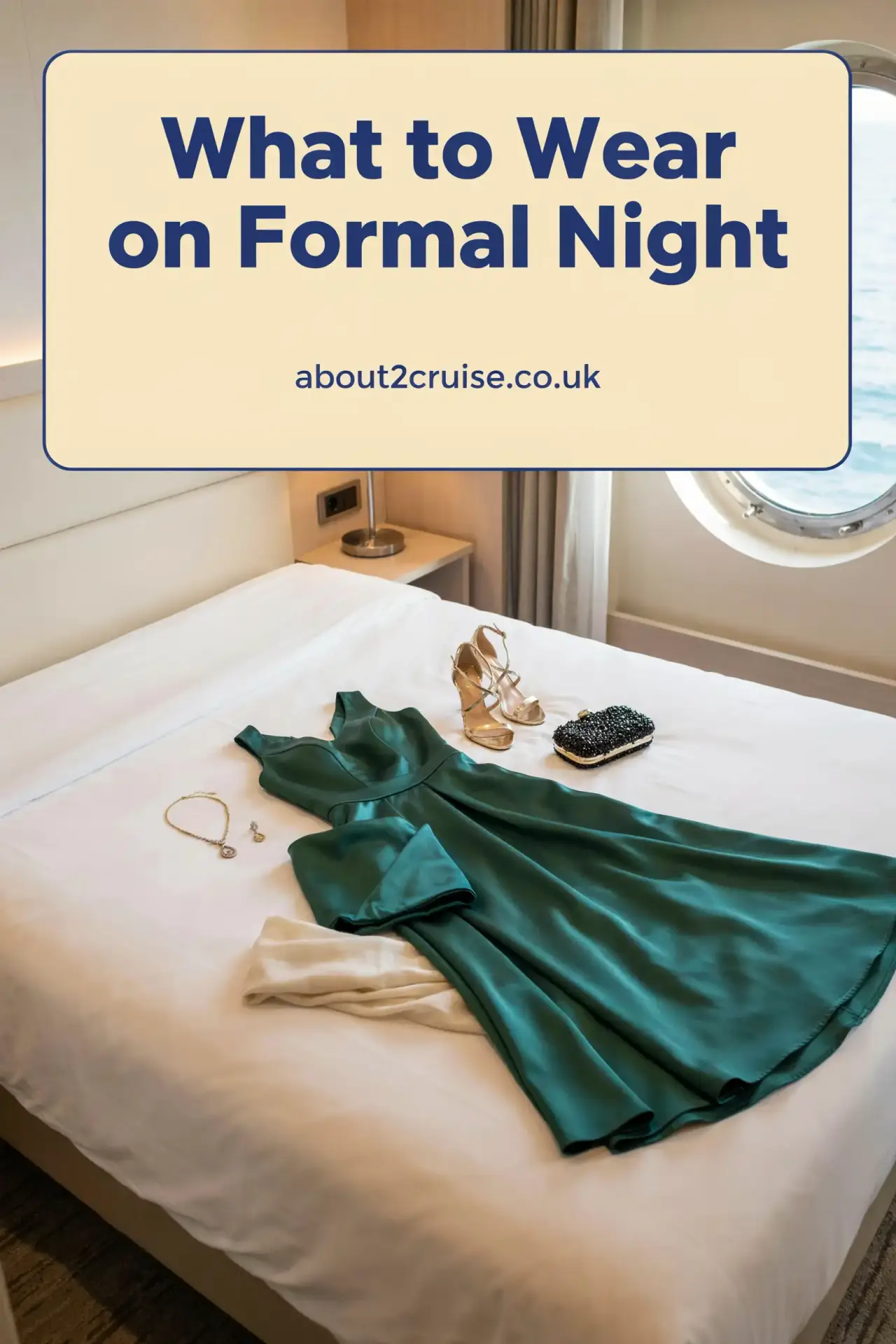

The dress code is a dinner jacket or tuxedo ideally, with a dark suit and tie acceptable, and gowns or cocktail dresses. No denim on Celebration Nights outside the always-casual venues, and tailored shorts only in the listed casual venues.
Codes don’t apply to under-18s. There’s no formalwear hire on board, so the jacket is either packed or borrowed.
Always-casual venues on formal nights are the buffet, 6th Street Diner, Keel and Cow, The Glass House and The Beach House, which is the answer when the case is already full. Formal nights are never on the first or last night and are usually sea days, though weather can move them. Cunard’s formal evenings are themed gala nights, with special menus, decorations, music and dancing.
Plan the outfits around the count and rewear: cruise formal night outfits that work twice beat three that work once.
What not to pack, and what the cabin already has
Alcohol is limited to one litre of wine or champagne per adult, luggage is screened, and anything over the limit is taken off you when you board and returned at the end of the cruise.
Anything with a heating element is prohibited: immersion heaters, flat irons, water heaters, coffee machines, hot plates and kettles. So are aerosols other than personal deodorant, lighter fluid, most batteries beyond small camera and medical ones, balloons, and fancy dress carrying offensive language or images.
Items can be confiscated for good and you aren’t guaranteed to get them back. Hair styling tools, straighteners included, are allowed, but extension leads are commonly confiscated.
Plugs catch people out as well, so check the cruise ship power outlets and adapter guide before you pack the chargers. The cabin already has White Company toiletries, and if you’re unsure whether something will get through, what not to pack under cruise security rules covers the grey areas.
Boarding day at Southampton: terminals, dock gates and drop-off
Southampton has five passenger terminals in two dock zones, and the zone matters more than the terminal. Eastern Docks sit behind Dock Gate 4: QEII at Berth 38/39 and Ocean at Berth 46/47. Western Docks sit behind Dock Gate 10: Mayflower at Berth 106, City at Berth 101 and Horizon at Berth 102.
Line by line, P&O’s Britannia, Iona and Arvia sail from Ocean Terminal, Berth 46, alongside AIDA. Mayflower, Berth 106, handles Ventura, Aurora and Arcadia, and Cunard and Fred. Olsen have both used it.
QEII is the Cunard terminal and Queen Mary 2’s regular berth. Horizon, Berth 102, is the main Royal Caribbean, Celebrity and MSC terminal, with NCL, Regent and Oceania calling. City, Berth 101, has taken Fred. Olsen, Royal Caribbean, Celebrity, Disney and Saga.
Berths are allocated per sailing rather than per line, so the same ship can use a different terminal on a different date. Check the e-ticket before you set off, and treat any older line-to-terminal list as a hint rather than a fact. For picking a hotel or a car park on the right side of the water, a guide to all five Southampton cruise terminals sets out each one.
The friction point is the drive between the two zones. Getting from Dock Gate 4 to Dock Gate 10 means going back out through the town: 10 to 15 minutes when it’s quiet, 25 to 30 minutes on a peak turnaround Saturday. Find your dock gate on the paperwork before you leave, and add half an hour to the satnav on a summer Saturday.
On the day, cars and taxis are directed to a drop-off lane, bags go to the luggage drop zone, and porters are about; your cases arrive outside the cabin. Print the luggage labels before you arrive and tag every bag, because every one has to be labelled. Coach passengers move their own bags to the drop-off zone.
Parking at Southampton cruise port
Parking at the port itself means ABParking, which is owned and run by the port and sits inside the port estate, two to three minutes’ walk from City and Horizon. Keys stay with you, the car parks are Park Mark accredited, and Blue Badge bays have to be pre-booked.
Long-stay parking inside the port must be pre-booked: each terminal has only a drop-off area and a short-stay car park, so turning up on the day isn’t a plan.
CPS is the other in-port operator, for P&O, Cunard and Princess, and its bookings close 35 days before sailing. Neither operator publishes a fixed tariff; both quote per cruise from the ship, dates and terminal. Book through the official ABParking site at abparking.co.uk, and check the current rate when you book.
Off-site meet-and-greet approved by the port drops you about 20 yards from the terminal and is quoted per cruise, working out from around £17 a day; you can book up to 6pm the day before sailing. The cheapest option is often the council’s long-stay car parks in the city, at about £5 a day after the first 24 hours with a taxi to the terminal on top: Bedford Place, Eastgate Street and Grosvenor Square all work. Check the current rate when you book.
Spaces sell out in summer and prices rise as the car parks fill, so booking three months out is usually cheaper than three weeks out. If someone is driving you, the drop-off lane is where you want to be dropped, not the car park.
Luggage storage at Southampton cruise port
All five Southampton cruise terminals have secure stores on site, which is what you want if you are off the ship in the morning and your train is not until the afternoon. If you would rather leave the bags in the city while you walk the walls or get lunch, you can book luggage storage near the terminal and travel light for a few hours.
When to cruise from Southampton FAQs
What is the current cruise schedule for the Port of Southampton?
The port publishes a live schedule of ship movements by berth, which is the only reliable way to confirm your terminal. Ships usually arrive between 04:30 and 08:00 and leave between 16:30 and 22:00.
What time do passengers get off the ship at Southampton?
You are called off in groups from about 07:00, and the car parks are busiest between 08:00 and 09:30, so book onward travel for mid-morning rather than first thing.
Can I walk from Southampton Central station to the cruise terminal?
City is 0.6 miles and about 15 minutes on the flat, and Horizon is around half a mile and 12 minutes. Mayflower and Ocean are about 1.5 miles and QEII is 2.5 miles, so take a taxi for those.
Do all five Southampton cruise terminals have a taxi rank?
Every one of them has a taxi rank directly outside the terminal building, so you never have to walk into town with a case. A taxi to Southampton Central takes 5 to 10 minutes from any of the five.
Last Updated: 14 November 2026