
Ibiza cruise ships usually dock at the Botafoc berths, 3 km from the old town. Walk the harbour road in 35–40 minutes or take a taxi, bus or water-bus to Dalt Vila, the walled UNESCO World Heritage site. Allow two to three hours inside for cobbled lanes, bastions, viewpoints and the cathedral, then head back 45 minutes before all-aboard.
Ibiza Town or Ibiza Old Town? What You’re Actually Visiting
Ibiza Town and Ibiza Old Town sound like two different places, but they’re not. The city itself is Eivissa in Catalan and Ibiza in Spanish. The old town is Dalt Vila, the walled upper town on the hill above the harbour. Dalt Vila literally means “upper town” in Catalan. The lower districts at the foot of the walls, La Marina, Sa Penya, and Es Soto, are part of the historic core and the UNESCO area too, but when locals say “the old town,” they usually mean the walled citadel itself. The port is Port d’Eivissa. The quay area around the old harbour is La Marina, and Sa Penya is the narrow, lively neighbourhood wedged between the walls and the water.
The whole ensemble, Dalt Vila, the lower historic quarters, the Phoenician ruins of Sa Caleta, the Puig des Molins necropolis, and the Posidonia seagrass meadows, was inscribed as “Ibiza, Biodiversity and Culture” in 1999. Dalt Vila itself is the showpiece: a Renaissance fortress with streets that still follow the medieval layout, built over layers left by Phoenicians, Carthaginians, Romans, Byzantines, Arabs, and Christian Catalans. For a cruise passenger with a few hours ashore, that’s the place to aim for.
Where Do Cruise Ships Dock in Ibiza?
Most cruise ships dock on the Botafoc side of the bay, across the water from the old town. The port authority sends cruise traffic to the Botafoc pontoons, the Botafoc sea-wall dock, and the adjacent quay. The quays around the old harbour are mostly used by regular ferries to Mallorca, Denia, and Barcelona. The port plans for around 205 cruise calls a year, with one or two ships on most days and three-ship days kept limited. Arrivals are staggered from 11:30 onwards, and disembarkation is capped at 3,000 passengers an hour: the most the Botafoc maritime station and local transport can handle without everything grinding to a halt.
The catch is that no official ship-by-ship berth allocation is published, so you cannot check in advance whether your vessel will be at Botafoc or at the smaller inner quay below Dalt Vila. If you do get the inner quay, the old town gate is only a five-to-ten-minute walk away. Treat that as a bonus. Plan for Botafoc and you’re prepared either way. Before you step off, it helps to know what the terminal facilities offer, because the Botafoc maritime station is where you’ll find the tourist desk, taxis, and your starting point for every route into town.
How to Get from the Cruise Port to Ibiza Old Town
From Botafoc it’s roughly 3 km around the bay to the foot of Dalt Vila. The route is flat and almost entirely unshaded, so give it 35–40 minutes on foot in normal conditions. In July and August that walk can feel much longer, and the return leg in the afternoon sun is harder. Don’t plan to walk it both ways unless you’re comfortable with heat and carry plenty of water.
Luckily, there are easier options. The UE9 city bus runs from es Botafoc to Port Vell all year. The journey takes about 23 minutes once you’re on board and at the stop, and a single ticket costs €1.70 by card or QR code, or €2.40 in cash. A water-bus also crosses the harbour from the Botafoc side to the town quay in a few minutes. On cruise days the port authority adds extra boats, and the service is designed to move more than 600 passengers an hour to the historic centre. The water-bus fare and exact timetable aren’t reliably published, so ask at the terminal when you arrive. Taxis wait outside the maritime station. The meter starts at €4.35, runs at €1.32 per km by day and €1.60 per km at night or on holidays, and there’s a €2.15 supplement for journeys starting or ending at the port. A taxi into town takes 10–15 minutes and drops you either at the old town gate or at the foot of the hill. For a full breakdown of every option, see our transport guide.
If you prefer to keep things simple, the walk, the bus, and the taxi all end at the same place: the Portal de ses Taules, the main gate into Dalt Vila.
Entering Dalt Vila: Gates, Cobbles, and the Uphill Walk
The Portal de ses Taules is the main entrance to Dalt Vila and the one most visitors remember. It’s a Renaissance arch flanked by two Roman statues, with a drawbridge over the moat and the coat of arms of Philip II above the arch. The name itself is a clue to how the gate worked: ses Taules means “the planks,” the wooden boards that once served as the drawbridge. Inside the gate you step into the Pati d’Armes, a courtyard of ten round arches, and from there the lanes of the old town climb steeply towards the cathedral.
Dalt Vila sits on a hill, and almost every route through it slopes. The surface is cobbled: polished, uneven, and slippery after rain or in smooth-soled shoes. Several shortcuts between levels are staircases. There are two other entrances: the Portal Nou on the east side, reached by a long flight of stairs, and the sa Portella gate further up. The Portal de ses Taules route avoids the longest stair sections until you’re already inside, which is why it’s the default. Comfortable shoes are essential; don’t try this in heels or flip-flops. Good quality walking shoes are the single most important thing you can bring. If mobility is a concern, the UE8 city bus climbs into the enclosure on some runs, and the Parador hotel offers public lift access from Camí del Calvari: but the citadel is fundamentally a place of slopes, steps, and cobbles. Our wheelchair accessibility guide covers what can and cannot be done inside the walls.
From the Portal de ses Taules to the cathedral square is about 500 m of slope and cobbles: roughly 10 minutes at an easy pace if you don’t stop for photos. Most people stop a lot. Budget double that for your first visit.
A Walking Route That Works for a Cruise Day
There’s a town council route through Dalt Vila that works well on a cruise schedule because it chains the highlights into a logical loop and a downhill return. Here’s the version to follow.
Start at Plaça de Vila, just inside the portal. The square is lined with cafés and restaurants, which makes it a good spot for coffee before the climb or a pause on the way down. Then take Carrer de Santa Creu and Carrer de Sant Antoni up to Plaça del Sol, then the long staircase of Carrer des Portal Nou. At Carrer de Sant Josep you pass two square towers that survive from the medieval wall, and just beyond is l’Hospitalet, a small 16th-century church. Continue along Carrer de Joan Roman to Sant Cristòfol, then up to the chapel of Sant Ciriac and the Museu Puget. From here the route passes the medieval sa Portella gate and the Madina Yabisa interpretation centre, which explains Eivissa’s Islamic past. End at the cathedral square, Plaça de la Catedral, the highest point in the enclosure and the best viewpoint. From there, descend past Can Botino, the Dominican convent, and the Santo Domingo church, through the sa Carrossa gardens, and back out towards the port side. The descent through the southern bastions is quieter than the main gate route and much easier on the legs.
With this loop, a realistic in-town walking allowance is about two hours at a good pace with viewpoint stops. Add a third or fourth hour if you plan to go inside the museums and the cathedral. That leaves room for lunch, a swim if you want one, and a relaxed return to the ship.
Walls, Bastions, and the Best Viewpoints in Dalt Vila
The fortifications are what make Dalt Vila famous. Built between 1554 and 1585 by Italian engineers Giovanni Battista Calvi and Jacobo Paleazzo Fratin, they became a model for bastioned fortresses across the Spanish empire in the Americas. The best way to appreciate the walls is to walk the circuit, not just push straight up to the cathedral. The Baluard de Santa Llúcia, one of the largest bastions, has an esplanade overlooking La Marina and the port: a natural spot for your first panorama photo. The Baluard de Sant Pere covers the west side and has a ditch and casemates you can walk through, plus an interpretation centre explaining how the Renaissance fortification was built. Behind the cathedral, beside the Santa Tecla bastion, the wall merges into the cliff above the sea, one of the most dramatic spots in the citadel.
The Plaza de la Catedral itself is the finest viewpoint in the enclosure. From the walls you can see the harbour, La Marina, the Botafoc berths across the bay, and on clear days the coast towards Santa Eulària. Late-afternoon light turns the stone golden and makes the harbour look its best for photographs. If you want the views without a crowd, aim to be up here after about 16:00, when many ship excursions have already left. The Portal de ses Taules approach, with its Roman statues, drawbridge, and Philip II shield, is the photo most cruise passengers take before they even enter the walls. A compact lightweight tripod helps for a stable shot of the harbour panorama or the bastions in evening light, but hand-held shots are fine for most visits.
The Cathedral and the Historic Sights Around It
At the top of Dalt Vila, the cathedral was built after the Catalan conquest of 1235 on the site of the old mosque, then rebuilt in Baroque style. It became a cathedral in 1782 when the diocese of Ibiza was created, and it remains an active place of worship, not just a museum piece. That means two practical things: cover your shoulders and knees inside, and be discreet with photography during services. The cathedral anchors the upper town, but the historical interest is spread through the lanes. The Casa de la Cúria, a 13th-century building near the top that once held the island’s first courts, now houses the Madina Yabisa interpretation centre on Muslim Eivissa. The castle and Almudaina complex beside the cathedral is now the Parador hotel: you can admire it from outside, but the interior is for guests, and access conditions for non-residents remain unsettled.
If you’ve already seen some of the island’s other UNESCO-listed sights, this is the part of your day that completes the picture. For a broader look at how Dalt Vila fits with the Phoenician sites and the rest of the inscription, see our one-day UNESCO sites guide.
Museums and Indoor Stops Worth Your Time
Dalt Vila has three free art museums, MACE, Museu Puget, and Casa Broner, that share one timetable and close on Mondays and public holidays. From April to June and in September they are open Tuesday to Sunday 10:00–14:00, with Tuesday to Friday afternoons 17:00–20:00. In July and August the afternoon opening extends to 21:00. From October to March they open Tuesday to Friday 10:00–16:30 and weekends 10:00–14:00. The MACE occupies a 17th-century building inside the walls and holds a permanent collection of artists linked to Ibiza plus temporary exhibitions. The Museu Puget displays around 130 paintings by Narcís Puget Viñas and Narcís Puget Riquer in a noble house on Carrer de Sant Ciriac whose oldest parts may date to the 15th century. Casa Broner, on the wall side, is an architect-designed house-museum worth a look if you’re interested in mid-century design.
The Dalt Vila archaeology museum is recorded as temporarily closed, so don’t plan your day around it. The Puig des Molins monographic museum, on the west side of the city, covers the vast Phoenician-Punic necropolis: almost 3,500 hypogea across 50,000 square metres, the most important in the Mediterranean. That site sits slightly outside the old town walls and is reachable on foot from the city centre after you leave the citadel.
Free Walking Tours in Ibiza: What to Know Before You Book
Free walking tours in Ibiza Town are the most practical way to understand Dalt Vila if you want context rather than just views. The main English-language free tour runs 2 hours 15 minutes, covers about 3.1 km, and meets at the statue on the pedestrian Vara de Rey. It’s free to join with a donation expected at the end, but you need to book and the group is capped at 30 people. The organisers warn that the route isn’t suitable for pushchairs or wheelchairs, the cobbles are slippery, and heels and flip-flops are a bad idea. A Spanish-language equivalent covers the same route with Ibiza Free Tours, also meeting beside the Vara de Rey monument, with a suggested contribution of €15–€50 per person in cash. A separate Civitatis free tour of Ibiza Town lasts 2 hours 30 minutes, also meets at Vara de Rey square, isn’t wheelchair accessible, and doesn’t accept groups larger than six. The city council runs its own guided heritage itineraries in Dalt Vila on selected Saturday and Sunday mornings, but not in summer, booked by phone on +34 971 39 23 90 or by email at madinayabisa@eivissa.es. If that sounds like a lot of organising, the simplest option is to walk the council’s published route on your own with a map. If you’d rather have a guide without the uncertainty, check what’s bookable direct on Shore Excursions in Ibiza: guided walks, sightseeing tours, and harbour trips often fill up in peak season.
Maps, Offline Navigation, and Not Getting Lost
There’s no official offline map app for Dalt Vila, which many cruise passengers notice. What does exist is a downloadable Dalt Vila route leaflet from the island council’s tourism site, listing 11 numbered stops from the Portal de ses Taules to the Puig des Molins necropolis. It’s a PDF, so download it before you leave the ship or on port-day Wi-Fi. The council’s tourist offices also hand out free paper maps, heritage leaflets, and museum information: the La Cúria office on Plaça de la Catedral is open year-round, and the island council’s tourist desk inside the Botafoc maritime station opens Monday to Friday 09:00–19:00, Saturday 09:00–14:00, and on Sundays and holidays only when ships are in.
For live navigation, Google Maps and Maps.me both have Dalt Vila’s lanes mapped well enough, but GPS can drift in the narrow streets. Save an offline map of Ibiza Town before you go ashore, and bring a portable phone charger: the climb, the heat, and constant photo-taking drain a battery faster than you expect. If you get lost inside the walls, just head upwards; the cathedral square is the natural landmark, and from there any descending lane leads back towards the port side.
Where to Eat, Drink, and Sit in the Shade in Ibiza Old Town
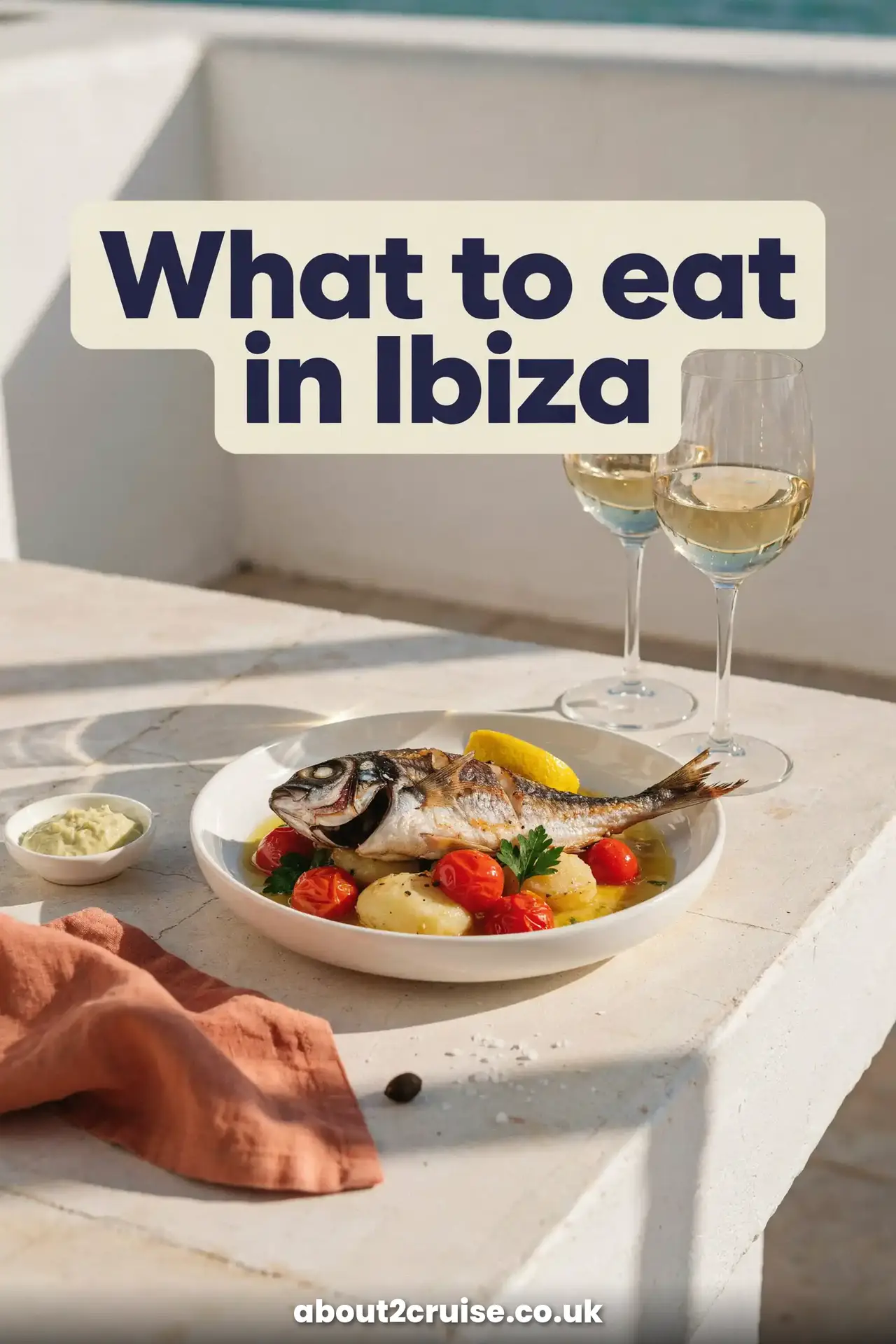
Dalt Vila won’t leave you hungry. Plaça de Vila, just inside the gate, is lined with restaurants and cafés and is the natural stop for tapas or a drink after the climb. The old lower quarters, La Marina and Sa Penya, are even more packed with bars and restaurants, from simple Ibizan cooking to tourist menus. If you get the chance, order island food rather than a generic menu. Bullit de peix is fish stew served with potatoes and aioli, followed by rice cooked in the fish broth. Sofrit pagès is a slow meat and potato stew. Borrida de ratjada is ray in an almond sauce. For something sweet, flaó is the local peppermint-spiked cheesecake, and greixonera is a pudding made from leftover ensaïmada. Finish with hierbas ibicencas, the aniseed herbal liqueur with protected geographical indication. For a wider list of places to eat near the berth and the old town, start with our restaurants near the cruise port page.
Two practical warnings. First, there’s no bar, café, or shop on the cathedral square itself, so carry water for the top section of the walk. Second, public toilets inside the walls are scarce: most visitors use a café stop or the seasonal facilities at es Soto below the walls. Bring a refillable water bottle and top it up before you start the climb; you’ll be glad of it by the time you reach the top.
Shopping and Local Markets Near the Cruise Port
The streets around La Marina and Dalt Vila are full of small independent boutiques selling clothes, ceramics, and jewellery rather than big brands. Vara de Rey and the streets behind it are where the Adlib fashion houses and better-known Spanish chains cluster; the Passeig de Vara de Rey itself is pedestrianised and lined with pavement cafés. For a proper market, the Mercat Vell by the drawbridge has been selling fruit, vegetables, and flowers from the same building since 1872, Monday to Saturday 07:00–14:00. In the evening, the Mercat des Port sets up every day from April to October on the old-port promenade, with stalls appearing around 17:00 selling handmade jewellery, leather, bags, and the white Ibiza dresses that have become the island’s signature. To understand what’s worth buying and what’s purely tourist stock, see our local markets guide.
Beaches and a Quick Swim Close to Ibiza Town
Ibiza Town has three beaches within reach of the old town. The nearest and most practical for a cruise-day swim is ses Figueretes, a 450 m urban beach walkable from the centre and sheltered from strong winds, with the Passeig de Ses Pitiüses promenade running alongside. Talamanca, on the Botafoc side, is the largest in the municipality at 900 m long and 30 m wide: shallow, sheltered, and backed by a wooden boardwalk that makes it accessible for disabled visitors. You can reach it by boat from the port to Marina Botafoc. If you’re feeling ambitious, there’s a marked open-water swimming channel running 650 m from es Soto to ses Figueretes, 50 m wide, open from 1 April to 30 October. For a proper beach comparison and how to reach each one with limited time, read our nearby beaches guide. If you have a full day and want something memorable, the day trip to Formentera is one of the best uses of a long call in Ibiza.
Language, Greetings, and Local Names
The Balearic Islands have two official languages, Catalan and Spanish. Ibiza’s own variety of Catalan is eivissenc: locally, people use the “salty article” es and sa before nouns, which is why you see names like Es Vedrà and Ses Salines all over the island. Almost every place has two names: Eivissa/Ibiza, Sant Antoni/San Antonio. You may need to try both spellings when searching for information. The words that’ll make your day smoother are easy: “bon dia” for hello or good morning, “gràcies” for thank you, and “bon profit” for enjoy your meal. Most people in the port and old town speak enough English and Spanish to help a cruise passenger, but a greeting in Catalan goes a long way. For the full picture on currency, cards, and tipping, our money and currency guide covers it before you set foot ashore.
Heat, Comfort, and Safety on a Cruise Day in Ibiza
Ibiza in the cruise season is hot. Average daytime highs run 27–30°C from June to September, with very little rain. The old town uphill is exposed, shade is limited, and the only water points of note are the cafés and restaurants near the gates. The cathedral square has no facilities, which catches people out. Public toilets inside the walls are thin on the ground; the six seasonal cubicles at es Soto, below the walls, open daily 10:00–20:00, and two are adapted for accessibility. Plan your toilet and water stops around Plaça de Vila or La Marina before the climb. Loose, breathable clothing works better than denim. The sun is strongest between 13:00 and 16:00, so doing the walls before noon or after four is the sensible approach in July and August. For seasonal planning, see our weather guide.
Street crime is the main risk, not violent crime. Pickpockets and distraction thieves work in teams, especially when people are handling money, maps, or luggage. Keep your phone and wallet zipped, front-pocket everything, and be alert in crowded areas like the bus stop at the Botafoc station and the lower shopping streets. You must carry photo ID if asked by police, who can hold you until identity is confirmed. If you’re a victim of crime, the Spanish police and Civil Guard run the ALERT COPS app for discreet reporting. And remember that some Spanish areas fine people for being in the street in swimwear alone, so keep a cover-up on for the walk between beach and old town.
Getting Back to the Ship Without Stress
The all-aboard time is posted at the gangway and in the ship’s daily programme, and it’s earlier than departure: sometimes by an hour or more. Treat that time, not the sailing time, as your deadline. From the old town back to Botafoc, the walk is the same 35–40 minutes, only now in afternoon heat. A taxi takes 10–15 minutes on the meter. The water-bus takes just a few minutes across the bay, but check when the last one leaves. The UE9 bus runs to es Botafoc all year, but don’t rely on one specific departure; treat it as one of several options and always have a fallback. At the very least, aim to be back at the Botafoc maritime station 45 minutes before all-aboard. That gives you margin for a missed bus, a taxi queue, or a slow line at the gangway. If you’re deciding between a ship tour and going it alone, our shore excursions comparison walks you through the timing trade-offs. And if Ibiza is one call among several on your Spanish Mediterranean itinerary, the same discipline, know your berth, know your route back, watch the all-aboard time, applies at every stop.
Frequently Asked Questions About Visiting Ibiza on a Cruise
Is there a quieter, non-party part of Ibiza?
Yes, and Dalt Vila is the clearest example. The island’s tourism board actively promotes a family and heritage product, including four heritage itineraries covering coastal defences, rural traditions, society, and archaeology. City officials describe Dalt Vila visitors as being there for culture and family tourism far more than nightlife. The party strip is San Antonio and the clubs around Platja d’en Bossa and Marina Botafoc: the old town is a different Ibiza entirely.
Do I need to book a free walking tour in advance, or can I just turn up?
Book in advance. The main English-language free tour is limited to 30 people and requires booking. On busy cruise days it regularly fills up. Don’t assume you can join on the day.
How do I find out which berth my ship is at?
You generally cannot in advance. The port authority publishes the names of the Botafoc areas used for cruise traffic, but not a ship-by-ship allocation. Check with the ship’s crew or the daily programme on the morning of arrival, or ask at the terminal once ashore.
Can I walk inside the Parador if I’m not staying there?
Not reliably. The castle and Almudaina complex is a hotel, and while its public pedestrian access includes a lift from Camí del Calvari, the interior is for guests. The position and exterior views from outside the walls are what you can visit.
How difficult is the climb to the cathedral?
It’s not a mountain, but it’s an unrelenting slope on cobbles. From the gate to the cathedral is about 500 m and 10 minutes at an easy pace, but the heat, the stops, and the uneven surface make it feel longer. If you have mobility concerns, use the UE8 bus or the Parador lift where possible; otherwise plan a slower pace and take the downhill return past the Dominican convent.