
Hebridean Island Cruises is a tiny two-ship Scottish line best known for Hebridean Princess, a 48-guest former ferry with a royal connection, and Lord of the Highlands, a 38-guest vessel built for the Caledonian Canal. Fares include meals, drinks, excursions, transfers and tips. It is country-house-style cruising, not a big-ship experience.
What’s Hebridean Island Cruises Really Like?
Hebridean Island Cruises is a small-ship Scottish cruise line with a very specific identity: luxurious but not flashy, traditional without being stuffy, and entirely built around close-up cruising of the Scottish islands. The line’s registered office is at Kintail House, Carleton New Road, Skipton BD23 2DE, but the ships spend their lives on the west coast of Scotland and beyond.
The line is most famous for Hebridean Princess, once a Caledonian MacBrayne car ferry called MV Columba. She was converted into a luxury cruise ship and now carries just 48 guests with 38 crew: a ratio that explains the attentive service passengers rave about. The second ship, Lord of the Highlands, is purpose-built to fit the narrow locks of the Caledonian Canal and carries 38 guests.
Queen Elizabeth II chartered Hebridean Princess twice for private family holidays around the Scottish islands: the first for her 80th birthday, the second a family holiday reported at around £200,000. That royal connection remains a key part of the line’s identity.
This is not a mainstream small ship cruising product with casinos and production shows. It is quiet, social, outdoorsy and unashamedly British. About 64% of guests are returning customers. The line won Cruise Critic’s Best for Solo Travellers (Luxury) award: a genuine reflection of how it treats single passengers.
Two Small Ships, Two Different Styles
Choosing between Hebridean Princess and Lord of the Highlands is not just about size. They offer different experiences.
- Hebridean Princess: 48 guests, 38 crew, 2,112 gross tons, five passenger decks, fully stabilised, British flag and British officers. Began life as a Caledonian MacBrayne car ferry. Has 28 individually designed cabins, eight of them for solo travellers. Carries five small boats for tendering to remote landings.
- Lord of the Highlands: 38 guests, 19 cabins over two decks, 45 metres, 745 gross tons, all cabins outside-facing. One suite, four cabins with small private balconies. The largest vessel that fits the Caledonian Canal’s locks (maximum width 35 ft). Sails in daylight only and moors alongside overnight, so no tendering is required.
Hebridean Princess feels like a floating country-house hotel with the patina of a well-loved old vessel. Lord of the Highlands is more intimate and more active, with an average guest age around 65 plus: younger than Hebridean Princess, where the average is 75 plus.
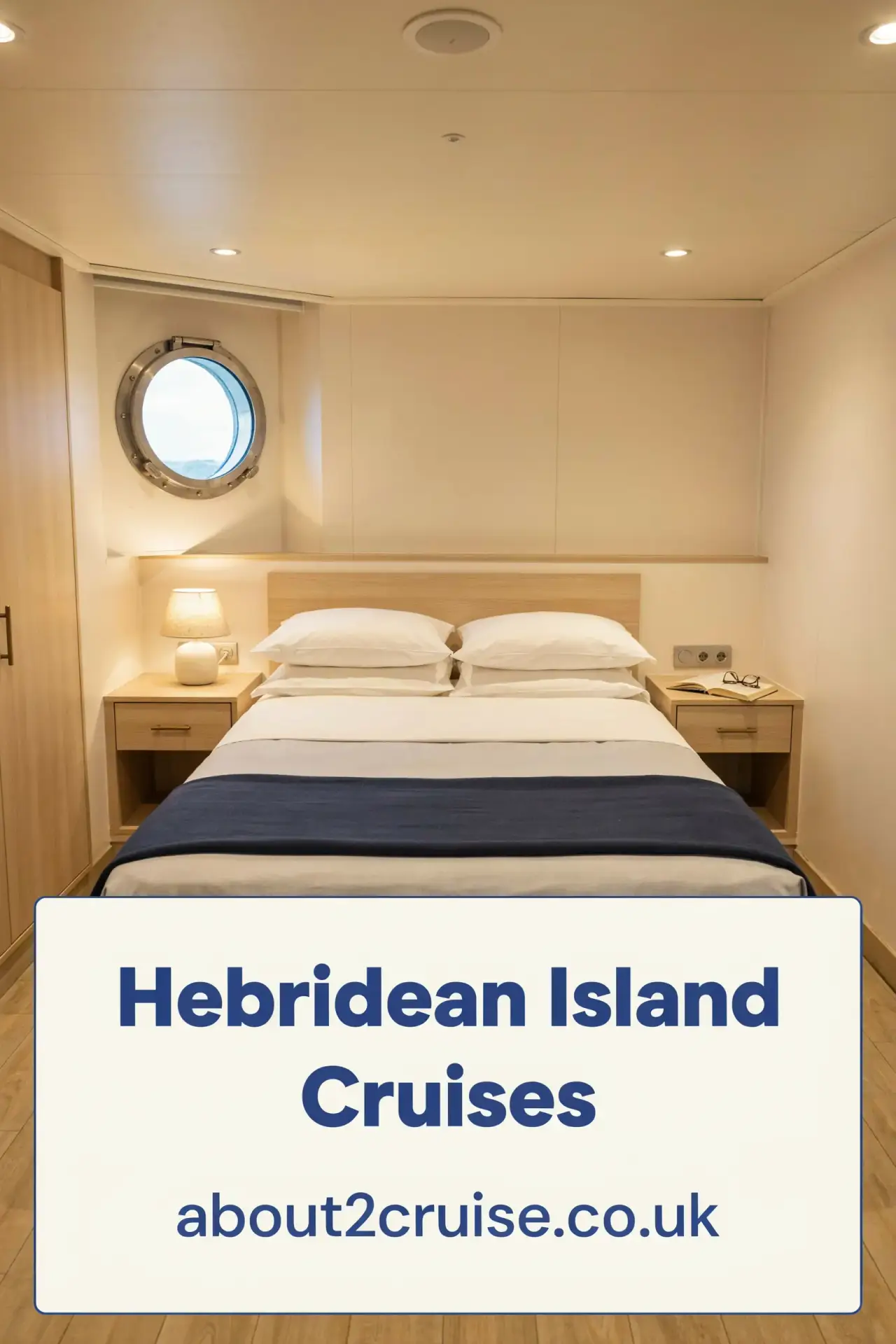
Hebridean Princess Cabins: Best Choices and Ones to Skip
Every cabin on Hebridean Princess is en-suite, so the old worry about sharing a bathroom does not apply. But cabin choice matters a lot, because the difference between the best and worst categories is stark.
The ship has 28 individually designed cabins ranging from 15.0 sq m to 31.6 sq m of private floor space. The categories break down like this:
- Category A (suite): Isle of Arran: the largest cabin, with a separate day room and a bathroom with bath and separate walk-in shower.
- Category B (balcony): Isle of Berneray, Isle of Bute.
- Category C (balcony): Isle of Barra, Isle of Benbecula.
- Category D: Isle of Coll, Isle of Colonsay, Isle of Iona, Isle of Staffa.
- Category E: Isle of Danna.
- Category F: Duart Castle, Kinloch Castle, Torosay Castle.
- Category G: Ardvreck Castle, Lews Castle, Isle of Muck, Isle of Raasay.
- Category H (inside): Loch Crinan, Loch Harport, Loch Torridon.
Solo cabins are Category K (Loch Scresort), Category J (Sound of Mull, Sound of Islay, Sound of Jura, Sound of Sleat) and Category I (Isle of Canna, Isle of Eigg, Isle of Rum).
The cabins to avoid are the four Category H insides and the single Category K cabin. They sit clustered together below the Waterfront Deck and near the engine, with no windows or portholes: fresh air comes only from the ship’s forced-air ventilation system. Cruise Critic reviewers repeatedly mention noise and vibration in this area, and the line itself warns that smaller ships have some vibration when main engines are running. If you are a light sleeper or value natural daylight, pay the premium for a higher category.
Facilities vary between cabins. Some have a full-size bath with shower, others a bath with shower over, others a walk-in shower only. Most have picture windows or opening portholes. The four balcony cabins are the most sought-after for fresh air and private outside space.
Accessibility note: there are no accessible cabins, no lift, and every cabin has a raised lip around the door. Door widths are no more than 70 cm. If you use a wheelchair or have significant mobility issues, read the accessibility section below carefully before booking.
Lord of the Highlands Cabins and Daily Comforts
Lord of the Highlands has 19 cabins over two decks. All are outside-facing, which is good news. The less good news for couples: nearly all cabins have fixed twin beds: only the suite has a king-size double. If you are a couple and do not want separate beds, you need to book the suite or ask very specifically about alternatives.
Cabin sizes start at 129 sq ft on Deck 1, rising to 161 sq ft on Deck 2, with the suite at 256 sq ft. Four cabins have small private balconies. All cabins include USB ports, a safe, hairdryer, TV, mini fridge, tea and coffee making facilities and Molton Brown toiletries.
The public areas are compact and sociable. Meals are served in the Caledonian Restaurant in a single sitting. There is a lounge and bar, plus open deck areas for watching the Caledonian Canal lock transits and island scenery. The ship is less plush than Hebridean Princess, but reviewers describe it as comfortable, clean and well-run.
One big practical advantage: Lord of the Highlands sails only in daylight and moors alongside overnight. There is no tendering. If you are nervous about clambering into small boats, this ship removes that anxiety entirely.
What the All-Inclusive Fare Actually Includes
Both ships operate a genuinely all-inclusive model, but the details matter.
Included on Hebridean Princess:
- All meals, including afternoon tea and occasional picnics or deck barbecues
- House wines, spirits, beers, soft drinks, tea and coffee
- A daily wine selection with meals
- Taittinger Champagne by the glass
- All guided tours and visits ashore
- Fishing trips and speedboat rides on request
- Gratuities on board and ashore: the line operates a no-tipping policy
- Port taxes
- Free Wi-Fi and use of the ship’s iPads in the Library
- Standard modern bicycles for going ashore
- An on-board guide on every cruise, plus guest speakers on selected sailings
- Secure car parking and coach transfers at pre-determined times from the local airport or train station
Not included: premium-brand drinks beyond the house range, travel insurance, purchases from the on-board shop (which sells a bespoke range of UK-made gifts), and any medical or repatriation costs.
Lord of the Highlands follows the same inclusions: meals, drinks, guided shore excursions, gratuities, port taxes and transfers.
Because tipping is genuinely unnecessary, you do not need to carry cash for staff. Card payments work for the onboard shop, but there is very little to spend money on once you are aboard.
Dining, Dress Code and a Typical Day
Meals are a highlight. They are served in a single sitting: the Columba Restaurant on Hebridean Princess and the Caledonian Restaurant on Lord of the Highlands. Guideline times are a buffet breakfast from 07:00 to 09:00, lunch from 12:30 to 13:00, and dinner at 19:30.
Most tables seat two, with larger tables of up to eight on request. Solo guests are seated together at a larger table, usually hosted by an officer, unless they ask otherwise: a small detail that makes travelling alone feel less awkward.
Menus are regional and locally sourced, with vegetarian options. The line can cater for most dietary preferences, but strict kosher and some other religious-observance diets cannot be accommodated. It is worth flagging any needs on the Pre-Cruise Questionnaire well before you sail.
Afternoon tea is served in the Tiree Lounge, and in good weather there may be seasonal barbecues on the Skye Deck or picnics ashore. Gala dinners include a Champagne reception in the lounge and a traditional recitation of Burns’ Address to a Haggis: a genuinely memorable evening, even if you have seen it before.
The dress code is smart casual by day and smart dress for gala dinner evenings. There is no pressure to pack formalwear. Breakfast is informal, with fruit, home-baked breads, cooked Scottish dishes and porridge. Complimentary hot drinks are available self-service in the bar for early risers and through the day.
Dinner is usually served at anchor or at berth. Breakfast and lunch often happen while under way, which makes efficient use of daylight for excursions.
Each evening after dinner, the onboard guide gives a talk on the next day’s plans, landings and what to wear. It is a practical, old-fashioned ritual that passengers value.
Life On Board: Quiet, Social and Refreshingly Low-Tech
There is no casino, no theatre, no lift, no formal show programme and no spa. Entertainment is deliberately low-key, built around conversation, guest-speaker talks and occasional local musicians. If your idea of a good evening is a production show and a late-night bar, this is not that product.
What you get instead: a nightly guide talk, a library with iPads, deck space for watching the islands go by, and the kind of casual sociability that only works on a ship with fewer than 50 guests. The average guest age on Hebridean Princess is 75 plus and the crowd is almost exclusively British. About 64% are returning guests, so newcomers often find people who already know the routine.
Hebridean Princess carries five small boats for tendering: 12-seat launches, 12-seat inflatable landing craft and a nine-seat RIB. Buoyancy aids are provided and must be worn in all small-boat operations. Most sailing is scheduled over breakfast and lunch, apart from overnight passages to St Kilda. Lord of the Highlands, by contrast, sails only in daylight and ties up alongside overnight.
Where Hebridean Island Cruises Sail From (and How to Get There)
Where you start depends on the ship and the itinerary.
Hebridean Princess in 2026 departs from Greenock, Oban and Invergordon. The 2027 programme adds Troon and a very special London Tower Bridge departure for the Cities of Canals and Culture sailing to Dover via Bruges, Amsterdam, The Hague, Rotterdam and Dunkirk. Some 2027 cruises also start or end at Leith, Dundee and Liverpool depending on itinerary: always check the specific voyage before booking. For a no-fly cruise from Scotland, Oban and Greenock are the most convenient gateways.
Lord of the Highlands in 2027 departs from Inverness (Muirtown Basin on the Caledonian Canal), Oban and Kyle of Lochalsh.
Coach transfers are included from the nearest airport or train station at pre-determined times. For Hebridean Princess cruises from Oban and Greenock, that means transfers from Glasgow Central railway station and Glasgow International Airport. For Lord of the Highlands Inverness sailings, transfers run from Inverness Airport and Inverness city centre, and complimentary car parking is at Inverness Airport.
Parking: secure car parking is provided for cruises from Oban, Greenock and Inverness. For Greenock-to-Troon sailings, car parking is at Troon with a complimentary transfer to Greenock on embarkation day. The line has not published a per-day parking cost: it is simply included.
Getting to the ports by train: Glasgow Queen Street to Oban takes about 3 hours 7 minutes direct, with up to six trains a day and returns from £38.80. Oban station is on Railway Pier in the harbour area, but it has no left-luggage facility. Glasgow Central to Greenock Central is about 35 minutes with two trains an hour.
Embarkation times are not published online. They are communicated with your cruise documents. Do not assume you can turn up at any time: arrival windows are typically staggered for such small ships.
Pre-Cruise Hotels Near Oban, Greenock and Inverness
If you are starting in Oban, the most convenient hotels are clustered around the harbour:
- Columba Hotel, The Esplanade: directly on North Pier, five minutes on foot from the station and Oban Distillery, with breakfast and limited free parking.
- The Scot, George Street: about a 5-minute walk to North Pier and 10 minutes to the station, with continental breakfast.
- Oban Bay Hotel, Corran Esplanade: waterfront with spa and breakfast.
- Perle Oban Hotel and Spa, Station Square: 24-hour front desk and luggage storage, handy if you arrive early.
For Greenock, the Tontine Hotel at 6 Ardgowan Square is two streets back from the Esplanade and close to Ocean Terminal, with free guest parking, breakfast from 07:30 and luggage storage. Premier Inn Greenock is the budget option near the terminal.
For Lord of the Highlands departures from Inverness, the Kingsmill Hotel doubles as a pre-agreed transfer pick-up point.
Oban fills up fast in summer. Book ahead if your cruise is in May, June, July or August.
Itineraries and Themed Sailings Worth Knowing About
Hebridean Princess runs short cruises of four to nine nights, roughly March to November. The 2026 season had around 70 sailings. The 2027 season opens with about 37 all-inclusive sailings of four to eight nights between March and November.
The core programme is Inner Hebrides and Firth of Clyde itineraries from Oban and Greenock, but the line also reaches the Orkneys, Shetland, Isle of Man, Northern Ireland, and, in 2027, England’s south coast and a return to London Tower Bridge.
Examples from the 2027 calendar:
- On the Trail of Charles Rennie Mackintosh: 4 nights round-trip from Greenock, from £2,380 per person.
- Firth of Clyde Discovery: 7 nights from Greenock, 9–16 March, from £3,536 per person in an inside cabin or £4,956 in a water-view cabin, with a 15% early-booking saving.
- Scotland in Bloom: 7 nights from Oban, 4 May, with gardens as the theme.
- Behind the Lens: Capturing the Hebrides: a specialist photography cruise with Scottish landscape photographer Colin Prior, round-trip from Oban, from £7,570 per person.
- Cities of Canals and Culture: 8 nights from London’s Tower Bridge to Dover via Bruges, Amsterdam, The Hague, Rotterdam and Dunkirk, from £9,590 per person.
Recurring themes include gardens (Scotland in Bloom, Highlands in Bloom), food and whisky (Flavours of the Hebrides with the Hebridean Baker), wildlife (St Kilda Wildlife Adventure, Western Isles Wildlife Expedition), architecture (Charles Rennie Mackintosh, Houses and Castles of the Clyde), walking (Footloose) and photography. Interestingly, despite music being an often-assumed Hebridean theme, there is no music-specific sailing on the 2027 calendar.
On selected sailings the line arranges visits to privately owned castles and gardens with the owners present: the kind of access you simply cannot get on a larger ship.
Your Cheat Sheet to the Hebridean Islands
If your geography is hazy, the Inner Hebrides are the islands close to the mainland west coast. The main ones are Skye, the Small Isles (Canna, Sanday, Rum, Eigg, Muck), Tiree, Mull, Colonsay, Jura, Islay and Coll: plus the smaller gems of Raasay, Staffa and Iona. There are 36 inhabited islands in the group. The Outer Hebrides run further west: Lewis and Harris, North Uist, Benbecula, South Uist and Barra.
Hebridean Island Cruises’ Inner Hebrides programme specifically names Islay, Jura, Raasay, Colonsay, Iona, Lunga (in the Treshnish Isles), Mull and Skye. Broader itineraries add the Orkneys, Shetland, Isle of Man and Northern Ireland.
Some headline sights passengers ask about:
- Iona Abbey: a 5-minute passenger ferry from Fionnphort, then about a 600 m uphill walk of roughly 10 minutes. Open daily 9.30am–5.30pm April to September (Sunday from 12.30pm); October to March Monday–Saturday 10am–4pm, closed Sunday. Adult tickets £10 online or £11 in person. The abbey can close at short notice if ferries are disrupted.
- Staffa and Fingal’s Cave: landing is free for passengers but the vessel pays a National Trust for Scotland landing charge. The cave entrance is narrow with a steep drop beside the path and a railing along the wall. It can get congested. Puffins nest on Staffa’s flat top from late April to early August, with morning landings giving the best odds. No toilets or facilities.
- St Kilda: all vessels pay an NTS landing charge of £8 per person, applied to the vessel. Visitors must come ashore in an open tender during daylight. There are no cafes or shops, a public toilet and drinking tap, no mobile coverage, and drones are banned. Clean boot soles and outer clothing before landing; do not touch birds or feathers.
- Duart Castle on Mull (seat of Clan Maclean): 3 miles from Craignure ferry terminal, no public transport for foot passengers. Open daily April to late October. Adult £13, senior/student £12, child £6, family £34. There are 12 steps to the courtyard and spiral stairs beyond; the castle, tearoom and shop are not wheelchair accessible.
- Islay and Jura: Islay has eleven working distilleries plus one on Jura. From Port Ellen, Laphroaig, Lagavulin and Ardbeg are linked by the 3-mile paved Three Distilleries Pathway, with tours from about £22. Port Ellen Distillery itself is pre-booked only. Note that Port Ellen’s ferry terminal is closed for redevelopment, with CalMac services running via Port Askaig.
- The Caledonian Canal: 62 miles coast to coast, only about a third man-made, linking Loch Linnhe, Loch Lochy, Loch Oich and Loch Ness. The eight locks at Neptune’s Staircase take about 90 minutes to transit and lower the ship 64 ft southbound. This is the signature Lord of the Highlands experience.
Weather, Seasickness and Flexible Itineraries
The west coast of Scotland is beautiful and wet. Oban averages 1,678 mm of rain over about 198 days a year, with summer highs of just 17.9°C in July and 17.8°C in August. May sits at 14.7°C and September at 15.7°C. Sunshine is limited to about 1,212 hours annually.
Seas are usually calmer in summer, and the line notes that most guests handle the motion fine: but everyone reacts differently. Seasickness tablets are available on board, and acupressure wristbands or ginger remedies are suggested alternatives. If you are prone to motion sickness, Lord of the Highlands should be your first choice: its Caledonian Canal and Inner Hebrides routes are mostly sheltered water.
Landings at exposed sites such as Staffa and St Kilda depend entirely on swell and can be cancelled at short notice. The line is explicit that itineraries may change for weather, that the Captain’s decision is final, and that no financial adjustment is made for short-notice changes. If a flexible itinerary would ruin your holiday, think carefully.
Accessibility and Mobility: What You Need to Know
Neither ship has a lift. On Hebridean Princess, some stairways are steep: particularly from the Princess Deck to the Waterfront and Hebridean Decks. The line is frank that the ship is not suitable for guests with severe mobility impairment. Limited-mobility guests can be accommodated only if accompanied by an assisting companion.
Wheelchair users must travel with a fare-paying able-bodied companion. Cabin doors are no wider than 70 cm and entrances have raised coamings. The ship does not carry narrow wheelchairs, so you must check your own chair’s width. Access to the ship is via a lowered stepped gangway or a ramp gangway depending on location.
Shore excursions are a bigger constraint. Many visits require reasonable walking ability, with landing stages, steps, slopes and rough ground. The line reserves the right not to take a guest on a particular visit if it judges it beyond their capability. Tender use requires a certain degree of agility. If in doubt, contact reservations before booking.
Specific sites add further challenges: Duart Castle has 12 steps and spiral stairs; Iona Abbey is a 600 m uphill walk from the ferry; Staffa’s cave path is wet, uneven basalt with a railing and no room for a slip. These are not suitable for anyone with balance or mobility difficulties.
Solo Travellers, Couples and Families
Hebridean Princess is genuinely good for solo travellers. Almost one third of cabins are dedicated solo cabins, and the line won Cruise Critic’s Best for Solo Travellers (Luxury) award. Solos are seated together at dinner, usually hosted by an officer, which removes the awkwardness of eating alone. Single occupancy of a cabin with two or more berths carries a supplement, but the dedicated solo cabins reduce this sting.
On Lord of the Highlands, solo travellers book a Category 1 Deluxe Cabin as a single cabin, with a supplement.
Couples should be aware of the fixed twin issue on Lord of the Highlands: nearly all cabins are twin beds, which is awkward if you want to sleep together. Ask specifically before booking.
Children under 12 cannot be accommodated, so these are adult-oriented but not strictly adults-only ships. If you are looking for a family cruise, this is the wrong product: see our family cruises guide and our piece on large family cruises for suitable alternatives.
Booking Terms, Deposits and Cancellations
Hebridean Island Cruises uses a standard deposit model: 25% of the total fare, or full payment if you book within 17 weeks of departure. The balance must be paid at least 16 weeks before departure, or the line may cancel the booking and apply cancellation charges.
Cancellation charges are steep: loss of deposit after the deposit is paid; 60% of the invoiced charge at 112–60 days before departure; 90% at 59–29 days; 100% at 28 days or fewer. Amendment charges also rise nearer departure. There are no price changes within 30 days of departure.
Money protection: non-ATOL flight-package money is held in a trust account under the Package Travel and Linked Travel Arrangements Regulations 2018. Flight-inclusive packages are sold under the company’s ATOL. For any booking, always check the cruise lines page for general advice on financial protection.
The line urges all guests to take out holiday and cancellation insurance covering the full cost of the booking, travel, transfers and pre-paid extras. It is not optional for practical purposes: remote Scottish island itineraries can change quickly.
Passengers with disabilities or conditions needing assistance must tell the company at enquiry stage and may be asked to complete a questionnaire. Special requests, including dietary needs, go on the Pre-Cruise Questionnaire issued before the cruise.
You can book direct or through specialist agents such as Mundy Cruising, SixStarCruises and Cruise Traveller. These specialists often add value with personal experience of the ships and help with cabin selection and insurance. If you search for ‘Hebridean cruise specialists’, these are the most credible names.
What Does It Cost? Prices, Value and Ways to Save
A Hebridean cruise is not cheap, but the all-inclusive model changes the maths. Consider what a 7-night cruise from Oban includes: all meals, all drinks (including Champagne), every excursion, transfers, parking, tips and Wi-Fi. There is very little to spend once aboard.
Sample 2027 fares to anchor your expectations:
- 4-night Charles Rennie Mackintosh from Greenock: from £2,380 per person.
- 7-night Firth of Clyde Discovery from Greenock (March): from £3,536 per person inside, £4,956 water-view.
- 7-night Scotland in Bloom from Oban (May): Category H £7,430; Category G £10,400; Category F £11,510; Categories C/D/E £14,850; Categories B/A £17,080. Solo cabins: K £10,030, J £13,670, I £15,950.
- 8-night Cities of Canals and Culture (London to Dover): from £9,590 per person.
The biggest saving lever is timing. Early-booking discounts of around 15% run to fixed deadlines: for example, book by 31 July or 31 August for selected 2027 sailings. That can cut more than £1,000 per person off a higher-category cabin. If you know you want a balcony or suite, book early.
Guarantee cabins can be allocated up to arrival at the port, and change requests cannot be accepted once allocated. If you are particular about location, pay for a designated cabin rather than gambling.
For wider strategies on stretching your budget, see our guide on how to save money on your cruise.
Passenger Reviews: The Real Highlights and Gripes
Hebridean Princess holds an overall Cruise Critic rating of 4.0 out of 5 across 23 reviews. The recurring praise is consistent: food described as some of the best at sea, hard-working staff, comfortable cabins with full-size baths, and easy sociability with only 48 passengers. One first-time guest described it as the most civilised way to visit the Inner Hebrides, with courteous and professional staff.
The recurring complaints are also consistent: weather disruption can knock itineraries sideways. One Orkney sailing ended up spending four days in port with all tours by coach after heavy weather. Others cite the cost, large single supplements for non-solo cabins, and a sense that the ship is getting old: dated staff uniforms and a slightly stuffy atmosphere are mentioned. If you want slick, modern luxury, Hebridean Princess may not be for you. If you want old-school comfort with a unique character, it probably is.
Lord of the Highlands reviews echo the positives, excellent for adults wanting history, scenery and a slower pace, and the negatives: fixed twin beds are awkward for couples, and the ship is less plush than Hebridean Princess. It is not suitable for young children or those with reduced mobility.
Alternatives to Hebridean Island Cruises
If Hebridean’s small-ship, all-inclusive model appeals but the price does not, you have options.
Fred. Olsen is the most obvious mainstream comparison. Its smallest ship, Balmoral, carries around 1,275 guests and runs Scottish isles cruises from Rosyth. Fares from January 2026 include house beers, wines, spirits and draught soft drinks with lunch and dinner, plus gratuities and port taxes: but excursions, speciality dining and spa cost extra. It is a much bigger, more traditional cruise experience, not a boutique country-house one. See our cruise lines overview for context.
Oban-based small operators are closer in spirit. Argyll Cruising carries a maximum of 8 guests, with six-night cruises from about £2,225 per person. Hebrides Cruises carries 1–16 guests, with seven-night itineraries from about £2,680 per person. These are more expedition-like and less luxurious, but the access to remote islands can be even better.
The Majestic Line is another small-ship Scottish operator often cited alongside Hebridean in overviews of Scottish island cruising. The National Trust for Scotland owns and charges for landing at St Kilda, Staffa and Canna, but does not operate cruises itself.
If you are considering something completely different: say a Mediterranean cruise or an Arctic or Antarctic polar expedition cruise: it is worth noting that Hebridean occupies a unique niche that few lines match. The closest river-style equivalent is a luxury river cruise, which shares the intimate, slow-travel feel.
Similar-Sounding Ships That Aren’t Hebridean
Hebridean Island Cruises operates exactly two ships: Hebridean Princess and Lord of the Highlands. Several other vessels sound confusingly similar but are not part of this line.
- Hebridean Sky: a 120-guest ship operated by Noble Caledonia. Built as Renaissance VII. Not part of Hebridean Island Cruises.
- Hebridean Spirit: Hebridean Island Cruises’ former second ship. She now sails as Caledonian Sky with Noble Caledonia.
- Lord of the Glens: described in some sources as a third Hebridean ship and in the line’s own award announcement as a sister ship, but not shown in the current website fleet section. If in doubt, check the line’s official fleet page.
- Highland Princess: not a real Hebridean ship.
Princess Cruises is an entirely separate line. Its British Isles itineraries sail from Southampton on ships like Regal Princess (about 3,560 guests) to Greenock, Invergordon and South Queensferry. If you searched ‘Princess British Isles 2026’, you were not looking for Hebridean.
Holland America Line ships, Nieuw Statendam, Noordam and Oosterdam, also have no connection to Hebridean. Caribbean repositioning and big-ship itineraries are simply not part of this product.
Packing and Preparation for the Scottish West Coast
Packing for the west coast of Scotland is about layers and waterproofs. You will be outside a lot, often in drizzle, sometimes in wind. A breathable waterproof outer layer is essential, as are closed walking shoes with grip. For St Kilda, walking shoes or boots with cleaned soles are required: biosecurity rules are strict and you may be asked to clean footwear before landing.
For Staffa, grippy closed shoes are essential on the wet, uneven basalt. Smoking is not permitted inside the cave. For Iona Abbey, you face a 600 m uphill walk on a single-track road. Duart Castle involves steps and a spiral staircase.
Other practical items:
- Binoculars: only a limited number are on board for loan. Wildlife-minded guests should bring their own.
- Camera: obvious for McCaig’s Tower at sunset, Pulpit Hill at sunrise, the Iona crosses and the basalt columns of Fingal’s Cave.
- Daypack: for excursions, water, a spare layer and any medication.
- Smart dress for gala dinners: but not formalwear. A jacket or smart dress is plenty.
- Medication: carry all necessary medical supplies. Ports of call are remote and may lack facilities.
- Photo ID: UK nationals do not need a passport for cruises in UK/Scottish waters, but photographic ID such as a driving licence or bus pass is required to board. Overseas visitors need a UK Electronic Travel Authorisation (£16, valid for two years) and should carry passports for sailings that leave UK waters.
Jobs, Recruitment and Booking Confidence
If you are interested in working for the line, note that crew recruitment for Hebridean Princess is handled only by Northern Marine Manning Services. Deck roles are typically seasonal or rotational contracts, three weeks on and three off, or four on and four off, with UK right-to-work and STCW/ENG1 certification required. The line has warned about hoax emails from a fake ‘Hebridean Recruitment team’; no such department exists.
For passengers, the line’s ATOL and ABTA-backed protections are the main trust signals. If you are booking through a specialist, confirm they hold their own financial protection. Brochures for the 2026 Cruise Directory and 2027 Cruise Collection can be ordered free from the Hebridean Island Cruises website.
Hebridean Island Cruises FAQs
Is a cruise a good way to see Scotland and Ireland?
Yes, especially on a small ship. You unpack once, travel while you sleep or over meals, and reach islands that are tedious to visit by ferry. The trade-off is that weather can disrupt landings, and you see coastlines rather than inland Scotland. For a first-timer, it is an efficient and civilised introduction.
Do I need a passport for a Hebridean cruise?
For sailings in UK/Scottish waters only, UK nationals need photo ID but not a passport. For any itinerary touching Ireland, the Netherlands, Belgium, France or other non-UK destinations, you will need a passport. Overseas visitors always need a UK Electronic Travel Authorisation.
Are Hebridean Island Cruises adult-only?
Not officially, but children under 12 cannot be accommodated. The experience is designed for adults and the average guest age is 65–75 plus.
Can I bring a child under 12?
No. The line explicitly states that children under 12 cannot be accommodated on either ship.
Are drinks really included?
Yes: house wines, spirits, beers, soft drinks, tea, coffee and Taittinger Champagne by the glass. Premium brands are excluded. Gratuities are also included under the no-tipping policy.
Will there be Hebridean Princess cruises in 2026?
Yes. The 2026 season ran from March to November with around 70 sailings from Greenock, Oban and Invergordon. The 2027 season is already on sale from early March to November.
Where is Hebridean Princess right now?
The line does not publish a live position. Third-party AIS ship-tracking sites show her current location if you search the ship name: but nothing official is available on the Hebridean website.
What is the difference between Hebridean Princess and Lord of the Highlands?
Hebridean Princess is larger (48 guests vs 38), plusher, and uses tenders for shore landings. Lord of the Highlands is purpose-built for the Caledonian Canal, sails only in daylight, moors alongside overnight, has no tendering, and has fixed twin beds in most cabins. Hebridean Princess attracts an older crowd; Lord of the Highlands is slightly younger and more active.
Is there Wi-Fi on board?
Yes, free Wi-Fi is included on Hebridean Princess, along with use of the ship’s iPads in the Library. Lord of the Highlands also offers Wi-Fi as part of the all-inclusive package.
Related Guides on About2Cruise
- Small ship cruising: what it is and who it suits
- Cruise lines compared: find your fit
- No-fly cruises from the UK
- How to save money on your cruise
- Family cruises: the complete guide
- Large family cruises guide
- River cruises: what to expect
- Mediterranean cruises guide
- Arctic and Antarctic polar expedition cruises
This guide was written by the Jo Pembroke team at About2Cruise.
Last Updated: 14 November 2026