
Cunard is not all-inclusive. Viking is. If you want grand ballrooms, transatlantic crossings and formal evenings, Cunard wins. If you want shore excursions bundled in and no hidden costs, Viking wins. Both are premium, neither is cheap, and your decision should hinge entirely on how you want to spend your time onboard.
This guide covers what each line includes, how much extra you’ll pay beyond the fare, ship atmosphere and formality levels, itinerary styles, and which line makes sense for your first premium cruise.
What You Get for Your Money: The All-Inclusive Question
Viking’s headline selling point is that most things are included. Cunard’s headline selling point is that you’re sailing on an ocean liner. Those are fundamentally different value propositions.
Viking includes:
- Shore excursions in every port, usually one per day, which alone can save you a significant sum over a week-long cruise
- All gratuities, so no envelope anxiety at the end of your trip
- Beer and wine with lunch and dinner, plus soft drinks throughout the day
- Wi-Fi that works well enough for emails and browsing
- Speciality dining at no extra cost, though the distinction between main and speciality restaurants is minimal on Viking
Cunard includes:
- Your cabin and main dining room meals, which is standard across most cruise lines
- Afternoon tea, which is a proper sit-down affair with finger sandwiches and scones
- Evening entertainment in the Royal Court Theatre, including full-scale productions
- Access to the only kennels at sea on Queen Mary 2, if you’re crossing the Atlantic with a dog
On Cunard, you’ll pay extra for drinks, gratuities, speciality dining, shore excursions and Wi-Fi. The base fare looks lower than Viking, but add those extras and the gap narrows considerably. If you’re comparing like-for-like sailings in the Mediterranean, Viking often comes out cheaper once you account for what’s bundled in. For transatlantic crossings or Cunard’s world voyages, you’re paying for the ship experience itself, not just the destinations.
| What’s Included | Cunard | Viking |
|---|---|---|
| Main dining | Yes | Yes |
| Speciality dining | Extra cost | Included |
| Gratuities | Extra cost | Included |
| Shore excursions | Extra cost | One per port included |
| Beer and wine | Extra cost | Included at meals |
| Wi-Fi | Extra cost | Included |
| Afternoon tea | Included | Not offered |
Ship Size, Atmosphere and Who You’ll Be Sailing With
- Queen Mary 2 carries around 2,700 passengers. Queen Anne, Queen Victoria and Queen Elizabeth each carry between 2,000 and 2,100. Viking’s ocean ships carry 930 passengers. You’ll notice that difference immediately.
- Cunard ships feel like grand hotels at sea. Public rooms are large and formal. There’s a proper ballroom, a two-storey theatre, and multiple lounges designed for different moods. You’ll see people dressed up for dinner most nights, and on Gala evenings (which happen several times per cruise), black tie is common in the main dining room. The Cunard dining room class system still exists: your restaurant and seating time are assigned based on your cabin grade, though this has softened in recent years.
- Viking ships feel like boutique Scandinavian hotels. Public spaces are clean-lined, calm and smaller in scale. There’s no theatre with big production shows, no formal ballroom, and no dress code beyond “smart casual” for dinner. The atmosphere skews older and quieter. You won’t find children’s clubs or family facilities on Viking ocean ships, and you rarely see anyone under 60 onboard. Cunard attracts a broader age range, including families during school holidays, though the average age is still comfortably above 50.
- If you like being surrounded by people, grand spaces and a sense of occasion, Cunard delivers. If you prefer smaller ships, minimal crowds and a more subdued environment, Viking wins. Neither is a party cruise, but Cunard has far more social buzz.
Itineraries: Destination Depth vs Ocean Liner Heritage
- Viking builds itineraries around destinations. Most sailings include overnight stops in key ports, and the included shore excursions are designed to give you genuine access to each place. The line operates over 80 ocean itineraries, covering the Mediterranean, Scandinavia, the Baltic, the Caribbean and beyond. If your priority is seeing places rather than days at sea, Viking’s schedule is hard to beat. The addition of Viking Vesta to the fleet continues this destination-heavy approach.
- Cunard builds itineraries around the ships. Queen Mary 2 exists primarily for transatlantic crossings between Southampton and New York, a seven-night voyage with no port stops. It’s a deliberate throwback to the golden age of ocean liners, and if that appeals to you, nothing else comes close. Queen Mary 2 also offers a full world voyage, departing in early January and returning over 100 nights later. In Queen Anne’s inaugural world voyage departed in January for 109 nights, calling at dozens of ports and offering the option to book segments rather than the full circumnavigation.
- Queen Victoria and Queen Elizabeth focus on regional itineraries, including the Mediterranean, Northern Europe, the Canaries and occasional transatlantic repositioning crossings. These are more conventional cruise itineraries, though still with fewer port-intensive days than Viking. Cunard cruises tend to include more sea days, which suits passengers who want time to settle into the ship’s routines.
- If you want to wake up in a new port most mornings and explore independently or on included excursions, Viking is the better fit. If you want the experience of being at sea, formal evenings, and the romance of a proper ocean crossing, Cunard is unmatched.
Dining: Tradition vs Flexibility
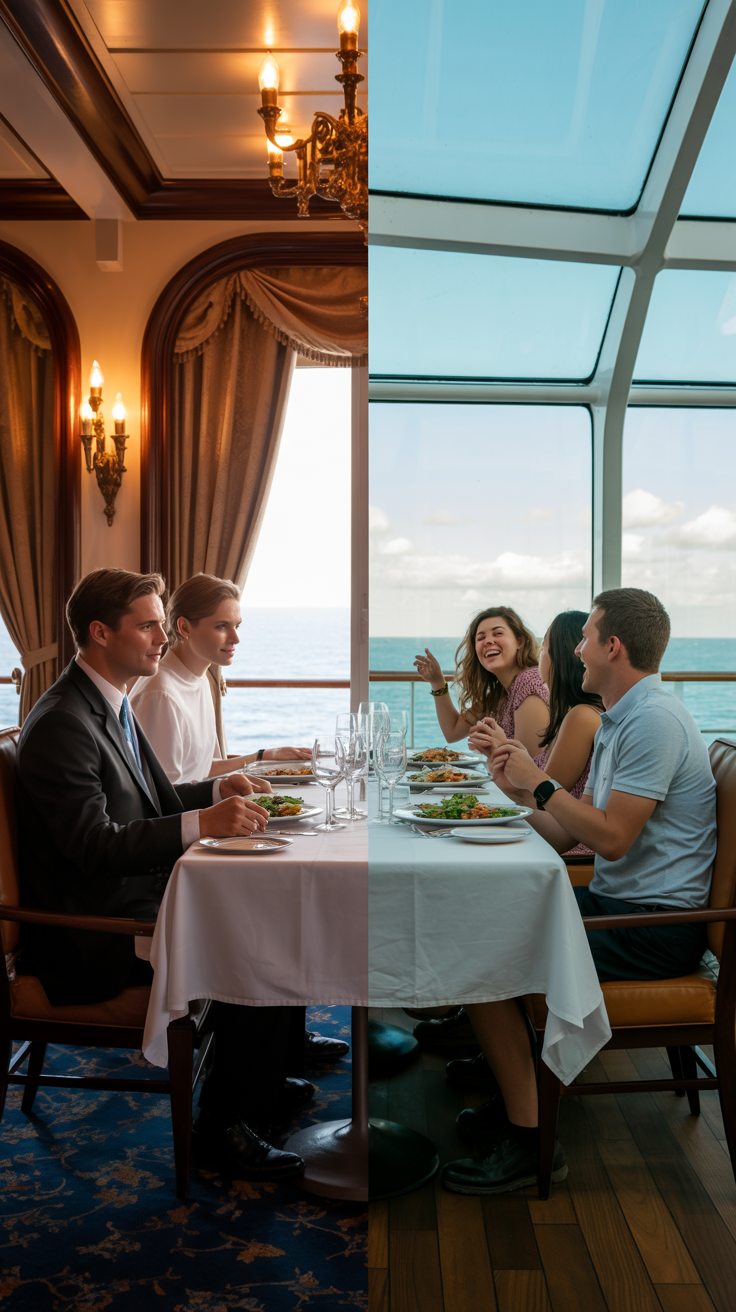
- Cunard operates traditional fixed-seating dining in the main restaurants, with two sittings per evening. Your table, dining time and companions are assigned based on your cabin grade and booking preferences. If you’re in a Britannia-grade cabin (the entry-level category), you’ll dine in the Britannia Restaurant. If you’re in a Princess or Queens Grill suite, you’ll have access to smaller, more exclusive dining rooms with better food and service. It’s a tiered system that feels outdated to some and reassuringly structured to others.
- You can also book the speciality restaurants (including the Verandah on Queen Victoria and Queen Elizabeth, or the Steakhouse at The Verandah on Queen Mary 2 and Queen Anne), but these cost extra. The food in the main dining room is competent but not exciting. The Grills are noticeably better, but you’ll pay a significant premium for a Grill-grade suite.
- Viking offers open-seating dining across all its restaurants, and there’s no division by cabin grade. You can eat in the main restaurant, the Italian restaurant, the chef’s table or Manfredi’s (the Italian option) whenever you like, at whatever time suits you. The quality is consistent across venues, and because it’s all included, you’re not making cost-based decisions about where to eat. The food is well-executed but safe. You won’t have a bad meal, but you won’t have a revelatory one either.
- If you like the routine of fixed dining and don’t mind being seated with strangers, Cunard’s system works well. If you want flexibility and no upcharges for variety, Viking is the easier option.
Formality: Black Tie vs Smart Casual
- Cunard still does formal nights. Gala evenings happen several times per cruise, and the dress code in the main dining room is black tie or evening gown. You’ll see plenty of dinner jackets and cocktail dresses, and while the line no longer enforces the code strictly, you’ll feel underdressed in chinos and a polo shirt. During the day, dress codes are relaxed, but there’s an expectation of smart casual in the evenings, even on non-Gala nights.
- Viking’s dress code is smart casual every night, with no formal evenings. Most passengers wear trousers and a collared shirt or a casual dress. You won’t see black tie, and you won’t feel out of place in standard evening wear. If you actively dislike dressing up, Viking removes that friction entirely.
- This is a dealbreaker question for many people. If you enjoy dressing for dinner and the theatre of formal evenings, Cunard offers something increasingly rare in modern cruising. If you find dress codes irritating or unnecessary, Viking is the comfortable choice.
Comparing Cunard and Viking to Other Premium Lines
If you’re weighing up premium options, it’s worth understanding where Cunard and Viking sit relative to other lines. Cunard and Oceania appeal to different priorities: Oceania focuses on food and destination immersion, while Cunard leans into heritage and formality. Holland America and Cunard share a traditional approach, but Holland America is more relaxed and less formal, with a stronger focus on enrichment programmes. Celebrity Cruises offers modern premium cruising with better food and contemporary design, but without Cunard’s ocean liner heritage or Viking’s all-inclusive pricing.
Viking competes most directly with Oceania on the all-inclusive front, though Oceania’s food is considered superior. For passengers choosing between heritage and convenience, understanding what Viking offers relative to Cunard’s ocean liner experience is essential.
Which Line Makes Sense for Your First Premium Cruise
If you’ve never sailed premium before and you’re trying to decide between these two, start with what you want from the experience.
Choose Cunard if:
- You want a transatlantic crossing on the only ship still doing them regularly as a scheduled service
- You like the idea of formal evenings and dressing up for dinner feels appealing, not annoying
- You value heritage and tradition over modern convenience, and you’re willing to pay extra for drinks and excursions
- You want a larger ship with more public rooms, entertainment options and space to roam
- You’re considering a world voyage or a very long itinerary where the ship itself is part of the appeal
Choose Viking if:
- You want to know the final cost upfront without budgeting for drinks, tips and excursions separately
- You prioritise destinations over sea days and want included excursions in every port
- You prefer smaller ships with fewer passengers and a quieter onboard atmosphere
- You dislike formal dress codes and want to keep evenings relaxed
- You’re sailing as a couple and prefer an adults-only environment with no children onboard
Neither line is better in absolute terms. They solve different problems. Cunard is the choice if you want the ship to be the destination. Viking is the choice if you want the ship to be a comfortable base for exploring ports without constant add-on costs.
Practical Considerations: Cabins, Loyalty Schemes and Booking Windows
- Cunard’s cabins vary significantly by ship. Queen Mary 2’s Britannia cabins are compact and dated, though Grill suites are spacious and well-appointed. Queen Anne has more contemporary cabins with better bathrooms and USB charging points. Queen Elizabeth and Queen Victoria fall somewhere in between, with recent refurbishments improving the public areas more than the cabins themselves.
- Viking’s cabins are uniform across the fleet. Most are veranda cabins with Nordic-inspired décor, underfloor heating in the bathroom and a seating area. They’re not enormous, but they’re well-designed and consistent. If you’ve sailed one Viking ocean ship, you know what to expect on another.
- Cunard’s loyalty programme rewards repeat passengers with onboard credit, priority check-in and access to exclusive events. The benefits are modest until you reach higher tiers, which require many cruises. Viking’s loyalty programme offers similar perks, with discounts on future bookings and complimentary upgrades for repeat guests. Neither programme is particularly generous compared to hotel or airline schemes, but both provide incremental value over time.
- Booking windows differ between the lines. Cunard releases world voyage itineraries roughly two years in advance, and Grill suites sell out quickly. If you’re eyeing a full world voyage or a specific transatlantic crossing, book early. Viking releases ocean itineraries around 18 months ahead, and popular sailings (particularly Baltic and Scandinavia routes) fill early in the booking window. Both lines offer early booking discounts, though Viking’s promotions tend to be more aggressive.
Common Questions
Is Viking more expensive than Cunard?
Not once you add gratuities, drinks and excursions to Cunard’s base fare. Viking’s upfront cost is higher, but the final spend is often comparable or lower, depending on how much you’d typically spend ashore and at the bar.
Can you wear jeans on Cunard?
Yes, during the day and in casual dining venues. In the main dining room at dinner, jeans are discouraged, especially on Gala nights. Smart trousers or chinos are a safer choice.
Does Viking have a dress code for dinner?
Smart casual is the standard. No shorts, no flip-flops, but no need for ties or formal wear. Most passengers dress comfortably without being scruffy.
Are Viking’s included excursions any good?
They’re competent and convenient, but rarely adventurous. Expect coach-based city tours with a local guide. If you want something more active or off the beaten track, you’ll still need to book independently.
Which Cunard ship is the best?
Queen Mary 2 if you want the full ocean liner experience and transatlantic crossings. Queen Anne if you want the newest ship with contemporary design. Queen Victoria and Queen Elizabeth are solid mid-range options for traditional cruising.
Do you need to tip on Viking cruises?
No, gratuities are included. You can leave additional tips if service is exceptional, but there’s no expectation or automatic charge.
Is Cunard worth the extra cost over mainstream lines?
If you value formality, heritage and the specific experience of an ocean liner, yes. If you just want a well-run cruise with good food and destinations, mainstream lines often deliver better value.
Can you drink tap water on Viking ships?
Yes, and it’s filtered and safe throughout the ship. Bottled water is also available at no extra cost.
Which line is better for solo travellers?
Viking has dedicated solo cabins with lower supplements on some ships. Cunard charges full single supplements in most cases, making it significantly more expensive for solo passengers.
Why Trust About2Cruise
We’ve written this guide to help you make an informed choice between two very different premium cruise lines. Here’s why our advice is reliable:
- I’m Jo, and I’ve sailed both lines multiple times, including Cunard’s transatlantic crossing on Queen Mary 2 and Viking’s Mediterranean itineraries, so this comparison draws on firsthand experience.
- We update this guide when either line announces new ships, changes inclusions or adjusts their pricing structure, which happens at least once per year.
- We don’t take commission from cruise lines, so our recommendations aren’t influenced by who pays us the highest referral fee.
You can read more about how we research and update our guides on our about us page.