
Cartagena is one of the easiest cruise calls in Spain. Your ship ties up at the Muelle Alfonso XII quay and the old town starts about 300 metres from the gangway. No tenders, no shuttle, no fuss: just a flat, five-minute walk into a compact city where the Roman Theatre, the castle and the tapas streets are all within reach on foot. You can be back on board fifteen minutes after leaving a café.
Where Your Cruise Ship Docks in Cartagena
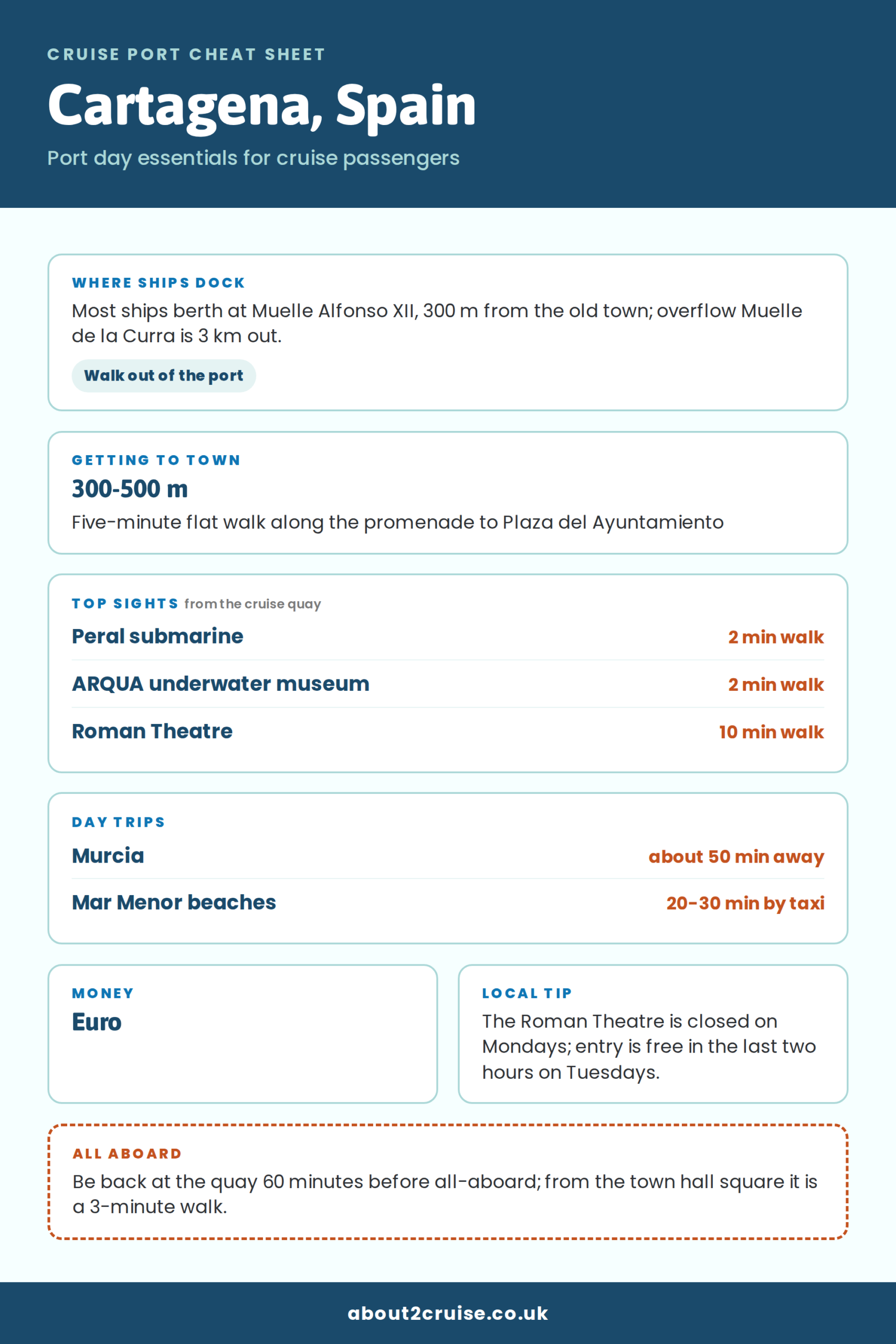
Most cruise ships calling at Cartagena berth at Muelle Alfonso XII, right in the inner harbour and directly in front of the city. The quay is 709 metres long and can handle two ships of up to 300 metres at the same time. Inside the quay, the passenger terminal is called Juan Sebastián Elcano, and it has a taxi rank, coach parking, a tourist information point, shaded rest areas and a children’s play area.
There is normally no tender operation. You walk off the ship onto a flat, paved promenade, and the city is right there.
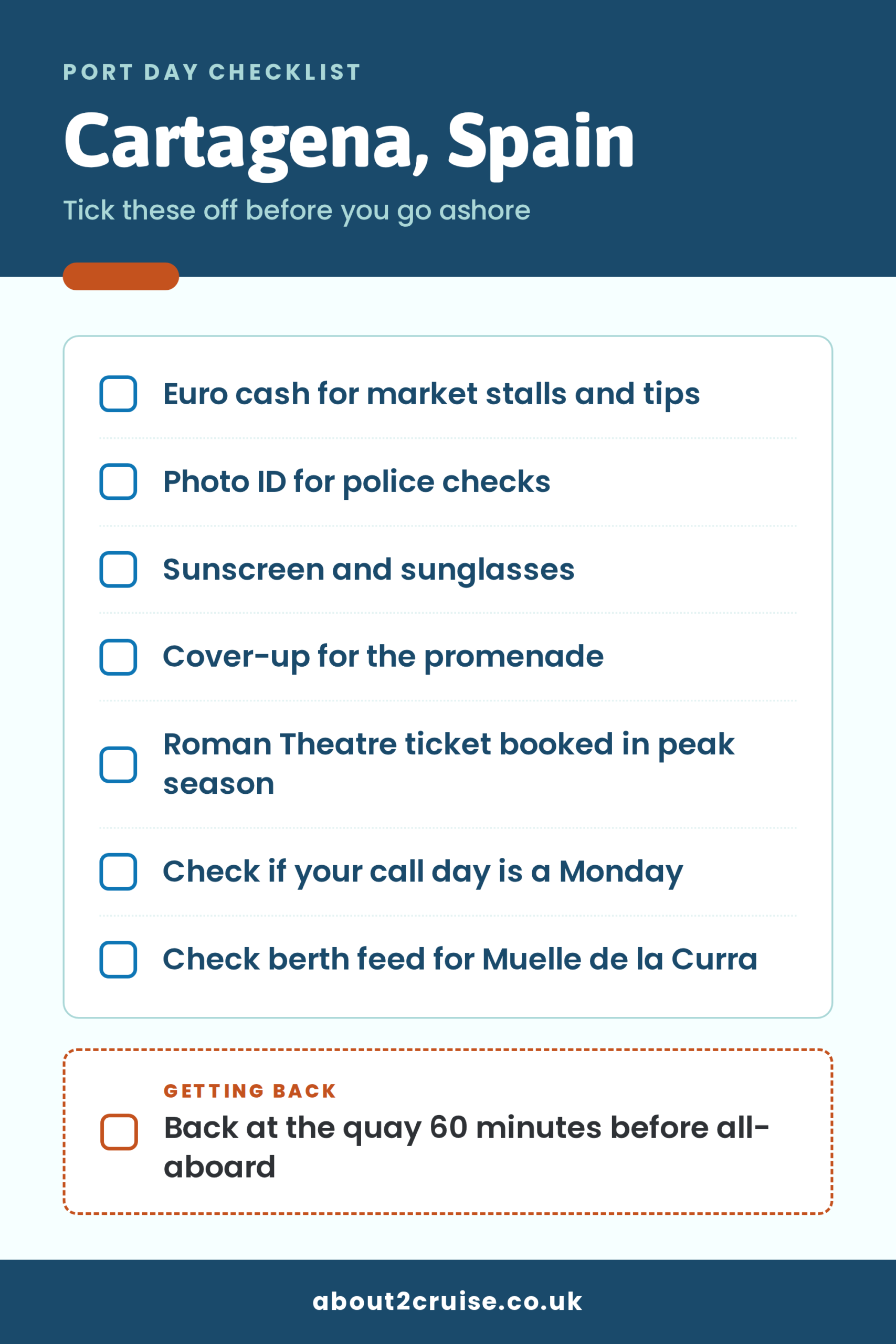
On busy days, when up to five ships are in port, extra vessels may use Muelle de Cruceros, Muelle de San Pedro or Muelle de Santa Lucía. The main overflow berth is Muelle de la Curra, on the far side of the port about 3 km from the centre. If your ship docks there, transport is usually provided to the terminal area, and there is a port walking lane, but the walk takes 35–45 minutes and there isn’t much to see along the way. Check your ship’s daily programme or the port’s public berth-movement feed to see where you’re actually docking.
The port publishes a cruise calendar with ship names, passenger numbers, cruise line and berthing times. You can subscribe to it on your phone or via a web calendar if you want to know how busy your day in Cartagena will be.
Cartagena cruise port map
Ships dock at Muelle Alfonso XII. From the cruise quay, ARQUA underwater museum is about a 2-minute walk, Concepción Castle about 5 minutes and Roman Theatre about 7 minutes. Tap a pin for directions.
- Muelle Alfonso XIIWhere ships dock
- Juan Sebastián Elcano terminalWhere ships dock
- Muelle de Santa LucíaWhere ships dock
- Muelle de la CurraWhere ships dock
- ARQUA underwater museumUnderwater archaeology museum · About 2 min walk from the cruise quay
- Concepción CastleCastle · About 5 min walk from the cruise quay
- Roman TheatreAncient theatre · About 7 min walk from the cruise quay
- Casa de la FortunaRoman house · About 8 min walk from the cruise quay
- Plaza del AyuntamientoTown hall square · About 9 min walk from the cruise quay
- Punic WallAncient wall · About 11 min walk from the cruise quay
- Naval MuseumAbout 12 min walk from the cruise quay
- Peral submarineHistoric submarine · About 17 min walk from the cruise quay
- Cartagena railway stationRailway station · About 29 min walk from the cruise quay
Walking from the Cruise Ship into Cartagena’s Old Town
This is the part that surprises most first-time visitors. From the gangway to the edge of the old town is about 300–500 metres of flat, paved promenade: five to eight minutes at a relaxed pace, smooth enough for wheeled luggage, and with no major roads to cross.
Plaza del Ayuntamiento, the square with the white marble town hall, is about three minutes on foot. The pedestrianised Calle Mayor starts right there, roughly 400 metres from the berth along the waterfront promenade. No shuttle bus into the centre runs from Alfonso XII quay because you simply don’t need one.
The whole historic centre sits within 1 km of the pier, and the walk back from anywhere in the old town takes under fifteen minutes. That makes Cartagena a low-risk port for independent exploring: you can wander at your own pace and still make it back with time to spare. The simple rule is to be back at the quay 60 minutes before all-aboard. From the town hall square that’s about three minutes on foot; from the castle via the panoramic lift, allow 15–20 minutes.
What to See and Do in Cartagena on a Cruise Day
Cartagena packs two and a half millennia of history into a small, walkable centre. The big draw is the Roman Theatre, entered from the pink building on Plaza del Ayuntamiento about ten minutes from the ship. Tickets cost €7 (€6 reduced, free for under-3s), and entry is free in the last two hours before closing on Tuesdays. Note that the theatre is closed on Mondays, which matters if your cruise call falls at the start of the week.
Concepción Castle sits on the hill above the old town. A combined castle and panoramic lift ticket costs €6 (€8 with audio guide). The glass lift climbs 45 metres from Calle Gisbert to the hilltop. You can also buy a lift-only ticket if you just want the viewpoint without going into the castle. Opening hours start at 10:00, with seasonal closing times between 17:30 and 20:00, and last entry is one hour before closing.
The ARQUA national underwater archaeology museum is on Paseo Alfonso XII at number 22: the same promenade as the cruise quay, so it’s a two-minute walk from the ship. Tickets are €3 (€1.50 reduced), and it’s free on Saturdays from 14:00 and on Sundays.
The Naval Museum and the Peral submarine, the first fully electric battery-powered submarine, displayed on the waterfront, are free, with a voluntary contribution requested. The submarine hull makes a great photo foreground against the modern harbour and is a two-minute walk from the ship.
Two smaller Roman sites worth knowing about are the Punic Wall at €4 (€3 reduced) and the Casa de la Fortuna, also €4 (€3 reduced), a Roman house with mosaics that closes at 15:00.
If your ship stays late or you’re joining a cruise here, Murcia, the regional capital, is about 50 minutes away: but most cruise passengers find more than enough to fill a full day in Cartagena itself.
Where to Eat and Drink in Cartagena’s Old Town
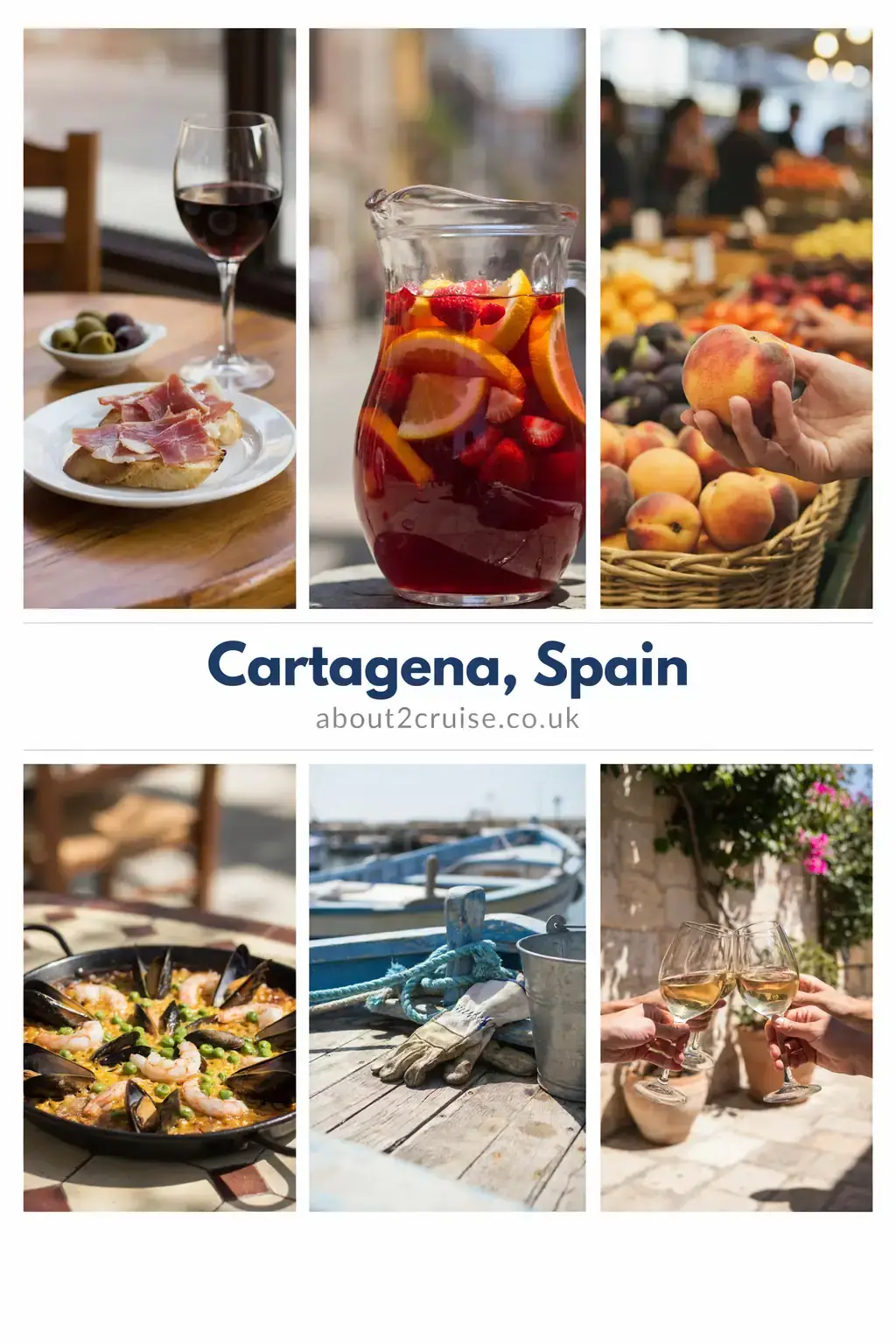
Cartagena’s food scene is exactly what you want after a morning of Roman ruins. The tapas route runs around Calle Mayor, Plaza San Francisco and the streets behind them, all a few minutes from the quay.
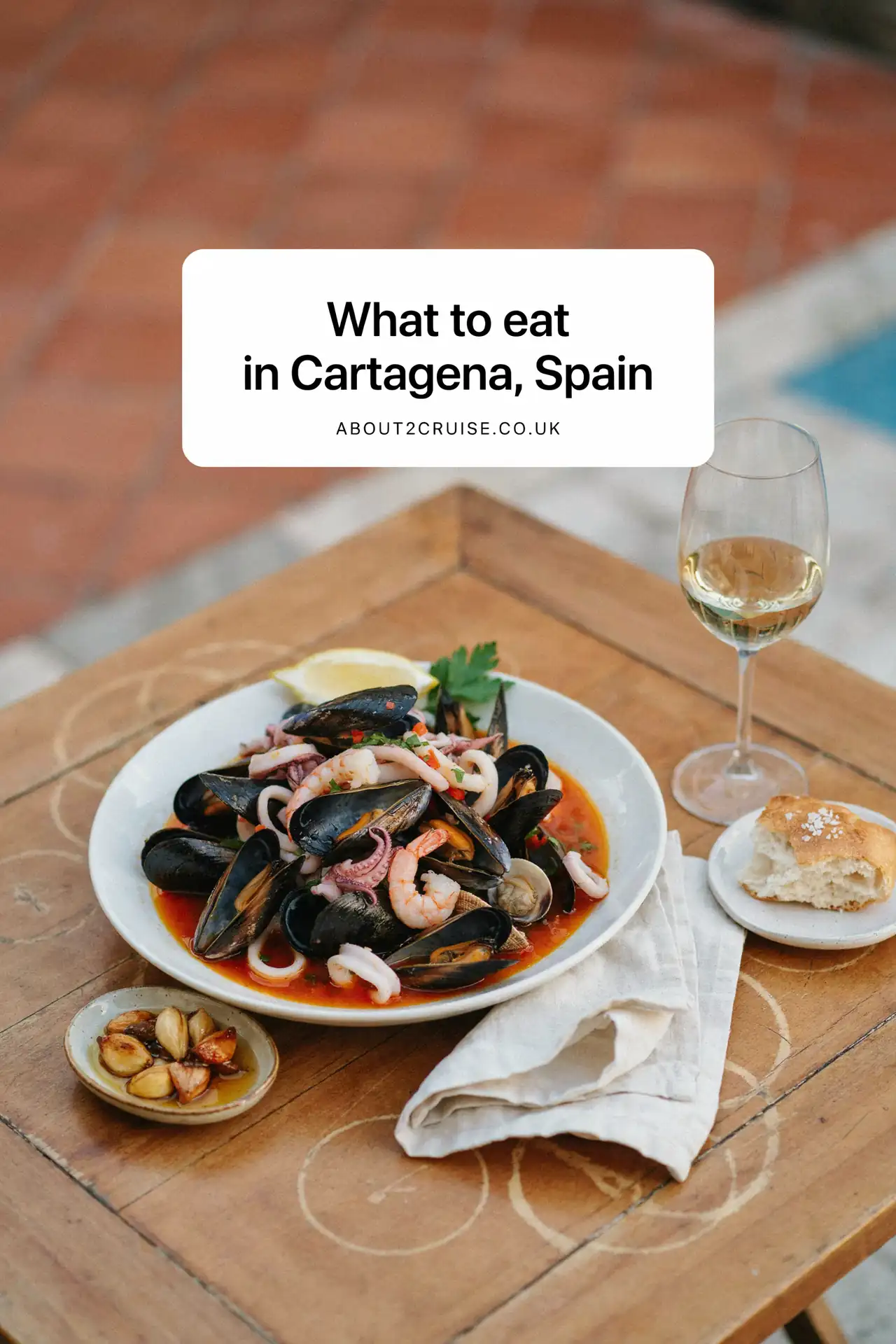
The dish to order is the marinera: a crisp ring-shaped breadstick topped with ensaladilla rusa (Russian salad) and a single anchovy. Order it marinero and the anchovy becomes a boquerón; order it bicicleta and there’s no fish at all. It’s the city’s signature tapa and appears on nearly every counter.
Caldero is the fisherman’s rice of the Mar Menor, cooked in a black iron cauldron with rockfish and ñora pepper broth, served with alioli. Michirones are dried broad beans stewed with chorizo and jamón bone, served in a clay dish. For dessert, paparajotes are lemon leaves dipped in batter, fried and dusted with sugar and cinnamon: eat the batter, not the leaf.
Drink a café asiático: condensed milk, brandy, Licor 43, espresso, cinnamon and lemon peel, layered in its own glass. It’s the local coffee and it’s worth ordering.
The covered market, Mercado de Santa Florentina, is on Calle Juan Fernández, with bars around it doing market breakfasts and cheap mid-morning plates if you want to eat where locals do.
Cartagena Weather and the Best Time to Visit
Cartagena has one of the driest and warmest climates in mainland Spain, with a mean annual rainfall of just 267 mm. Summers are hot: average maxima reach 29.8°C in July and 30.3°C in August, and the muggy season runs from early June to early October, with August averaging nearly 25 muggy days. Winters are mild: January averages 16.5°C and frost has essentially never been recorded.
Rain is rare but most likely in November (43.8 mm on average) and October, while July sees almost none. Sea temperature peaks at about 26°C in August and drops to 14–15°C in February, so swimming from the beach is very much a summer activity.
The windier half of the year runs from late October to late April, peaking in February, while August is the calmest month. One practical note for photographers: Cartagena is intensely bright between 12:00 and 16:00 in summer, which flattens photos. Shoot the old town in the morning, when Calle Mayor is shaded and quiet.
Money and Paying in Cartagena
Spain uses the euro (EUR). Contactless payment is standard at card terminals and ATMs of the main banks, and you’ll have no trouble paying by card at museums, restaurants and shops. It’s still worth carrying a small amount of cash for market stalls, tips and small purchases.
There are 24-hour ATMs in the centre, including on Paseo Alfonso XIII at number 11 and Calle Mayor at number 24, both a short walk from the quay. Banks with counters and ATMs also sit on Plaza San Francisco and Plaza de España.
Safety and Common Sense in Cartagena
Cartagena is a low-risk port for independent touring because the walk back from anywhere in the old town takes under fifteen minutes. That said, street crime is the main risk in Spain, with thieves using distraction techniques and sometimes working in teams. Keep passports, money and belongings secure, particularly around the port, markets and crowded tapas streets.
Thieves sometimes pose as police officers and ask to see a wallet. Genuine police will ask for ID but never for a wallet or purse. You must carry photo ID if asked by police, who may hold you until identity is confirmed: a photocopy or photo of your passport on your phone is a sensible backup, though official guidance says to carry the real thing.
Only use licensed taxis: passengers caught using unlicensed taxi services face fines of up to €600. The emergency number in Spain is 112.
What to Wear in Cartagena
The old town is flat and paved in marble and stone, so comfortable trainers or sensible sandals are fine. The only real climb is the castle hill, and the panoramic lift from Calle Gisbert removes it entirely. Sunscreen and sunglasses are advised, and shade is patchy in the middle of the day.


Bear in mind that in some parts of Spain it is illegal to be in the street wearing only a bikini or swimming shorts, and being bare-chested is also illegal in some areas. Fines can apply on seafront promenades and adjacent streets, so bring a cover-up if you’re heading to or from the beach.
Getting to Cartagena for a Cruise Embarkation or Turnaround
If you’re joining or leaving a ship in Cartagena, getting here is straightforward. Región de Murcia international airport (Corvera, RMU) is 35 km from the port, about 30 minutes by transfer. A taxi from Corvera to Cartagena costs €45–65 and takes 25–35 minutes, with taxis waiting at arrivals. An Interbus service runs from Corvera to Cartagena bus station for about €5–6, but it operates only on limited days, so check the timetable before relying on it. There is no train connection to the airport.
Alicante-Elche airport is about 115 km away, roughly 75 minutes by taxi or hire car, and many cruise lines run transfers from there.
Cartagena railway station is about 1.5 km from the cruise terminal, a short taxi ride or a 15-minute walk along the harbour promenade, with RENFE services from Madrid and Murcia. Local bus stops run along the Muelle Alfonso XII directly opposite the ship, and a single ticket costs about €1.20.
Where to Stay in Cartagena Before or After a Cruise
Most passengers call for the day, but if you’re joining or leaving a ship here, the city centre is only a few minutes’ walk from the terminal. Hotel Cartagena Puerto sits in the historic centre, a short walk from the port and 200 m from the Roman Theatre. Sercotel Alfonso XIII on Paseo Alfonso XIII is a 14–18 minute walk from the port, with breakfast from 07:00, luggage storage, a 24-hour front desk and self-parking at about €16–18 a day. Hotel Los Habaneros is opposite the tourist office and the old city walls, three minutes from the railway and bus stations and about 0.9 km from the port. Sercotel Carlos III is 500 m from the historic centre and about ten minutes’ walk from the train and bus stations.
Luggage Storage in Cartagena
There is no left luggage at the cruise terminal. If you have a late flight or want to explore bag-free, the nearest bookable storage is in the city, from €3.90 per bag per day, including a point at Av. de América 7 by the railway station open 07:00–22:00 weekdays and 09:00–15:00 at weekends. Other storage points are in the old town near the Punic Wall, the Roman Forum museum and Casa de la Fortuna. Hotels in the centre also hold bags for guests: the Sercotel Alfonso XIII and Hotel Los Habaneros both list luggage storage with 24-hour front desks.
Best Photo Spots in Cartagena
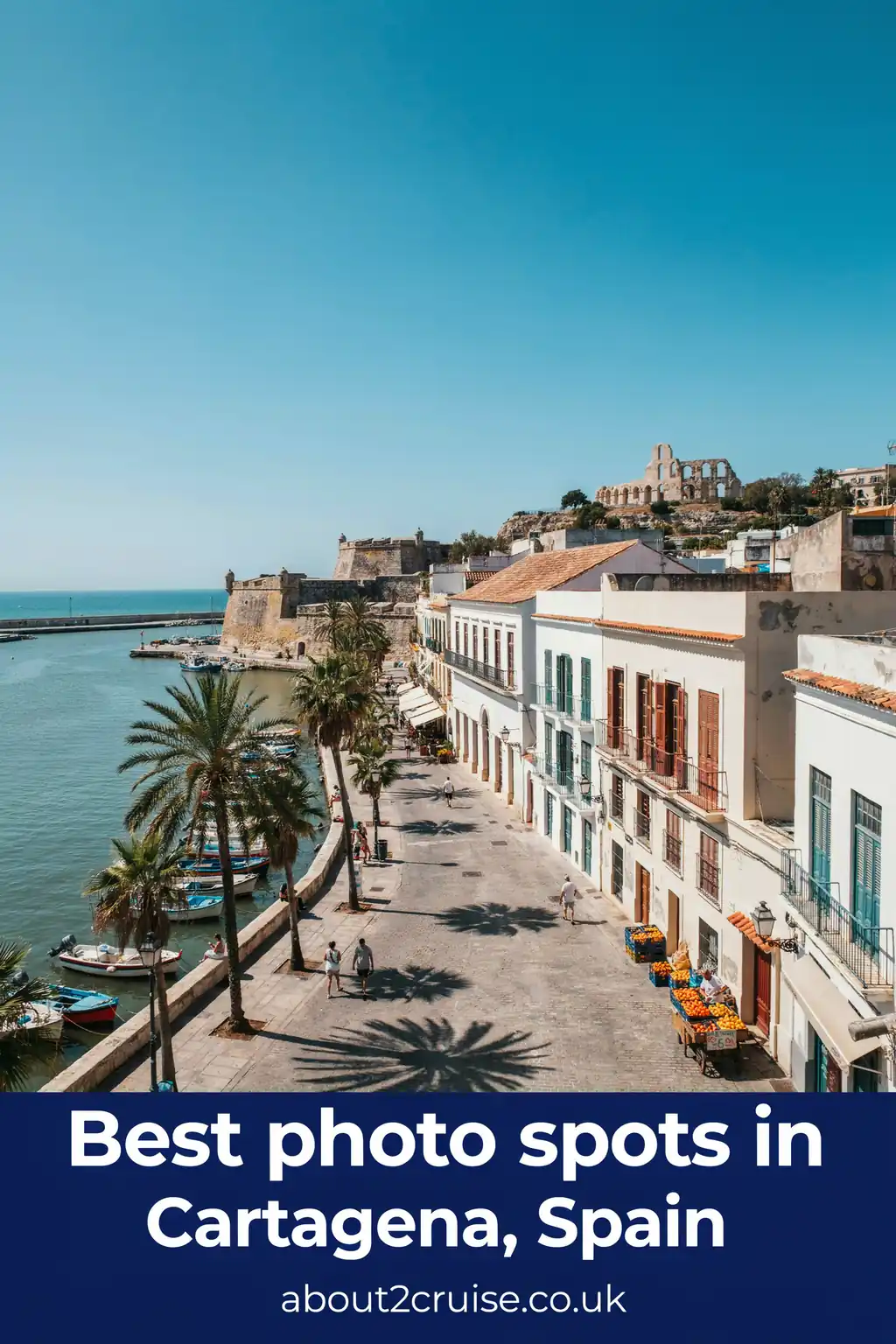
The best single shot in Cartagena is from the Concepción castle terrace, which looks straight down on the harbour, the cruise berth and your own ship. Late morning light is best; by mid-afternoon you’re shooting into the sun. The street above the Roman Theatre gives the whole seating bowl in one frame with no ticket needed. Plaza del Ayuntamiento is the orientation shot where the promenade meets Calle Mayor, with the white marble town hall. The Peral submarine hull makes an unusual foreground against the modern harbour, and the Muralla del Mar sea wall gives low shots along the fortifications: best at the end of the day when the stone goes gold.
More Spanish Cruise Port Guides
Cartagena is one of several Spanish calls you’re likely to make on a western Mediterranean itinerary. Read our other guides: Port of Valencia, Málaga cruise ship port guide and Barcelona port. For a wider view, see our Mediterranean cruise ports guide to Spain.
How to spend a port day in Cartagena
A port day in Cartagena works best on foot: pair the Roman Theatre and castle with a tapas lunch, then decide how much of the seafront you can fit before all-aboard.
Before you sail
- Check the port's daily cruise calendar or berth feed to see where your ship will dock.
- Book Roman Theatre tickets ahead only if your call lands in peak summer with several ships in port.
- Bring euros in cash for market stalls, tips and small purchases.
Short port day: under 6 hours
- On dockingWalk off to the Peral submarine and ARQUANo shuttle neededBoth are on the waterfront promenade about two minutes from the ship. The submarine hull makes a good photo foreground.
- +30 minRoman Theatre via Plaza del AyuntamientoClosed MondaysEnter the museum from the pink building, a ten-minute walk from the quay. Book ahead only in peak summer; otherwise buy at the entrance.
- +1 hr 30 minConcepción Castle via the panoramic liftWalk to Calle Gisbert and take the glass lift 45 metres up for the harbour view. Buy the combined castle and lift ticket at the entrance.
- +3 hrsLunch around Calle MayorOrder a marineraThe tapas route starts on the pedestrian street. Try the marinera, the city's anchovy-topped breadstick, or a caldero rice.
- +4 hrs 30 minCafé asiático near Plaza San FranciscoBreak with the local coffee of condensed milk, brandy, Licor 43 and espresso, served in its own glass.
- All-aboard minus 1 hrWalk back to the shipNever farFrom the castle lift allow 15-20 minutes; from the town hall square it is three minutes. The ship is never far.
The time on the map is the whole walk, every stop added together.
Open this walking route in Google Maps
If plans change: If the Roman Theatre is closed on a Monday, swap it for the Punic Wall and Casa de la Fortuna, which stay open nearby.
Long port day: 8 hours or more
- On dockingWalk off to the Peral submarine and ARQUANo shuttle neededBoth are on the waterfront promenade about two minutes from the ship. The submarine hull makes a good photo foreground.
- +30 minRoman Theatre via Plaza del AyuntamientoClosed MondaysEnter the museum from the pink building, a ten-minute walk from the quay. Book ahead only in peak summer; otherwise buy at the entrance.
- +1 hr 30 minConcepción Castle via the panoramic liftWalk to Calle Gisbert and take the glass lift 45 metres up for the harbour view. Buy the combined castle and lift ticket at the entrance.
- +3 hrsLunch around Calle MayorMarinera or calderoThe tapas route runs through Calle Mayor and Plaza San Francisco. Order a marinera, or caldero for a sit-down rice.
- +4 hrs 30 minCasa de la Fortuna and Punic WallCloses mid-afternoonTwo small Roman sites in the old town with mosaics and the ancient wall. Buy tickets at the entrance.
- +5 hrs 30 minMuralla del Mar and café asiáticoWalk the sea wall as the stone turns gold, then order the local coffee of condensed milk, brandy and espresso.
- All-aboard minus 1 hrWalk back to the shipNever farFrom Muralla del Mar the promenade leads straight to the quay in under fifteen minutes.
The time on the map is the whole walk, every stop added together.
Open this walking route in Google Maps
If plans change: If the panoramic lift to the castle has a long queue, use the lift-only ticket for the viewpoint and skip the interior, or replace it with the Roman Forum museum.
Frequently Asked Questions
Do I Need to Book Roman Theatre Tickets in Advance?
For most days, no: you can walk up and buy at the entrance, and queues move quickly. If you’re visiting in the height of summer or travelling on a ship with several thousand passengers, booking ahead saves waiting time. Remember the theatre is closed on Mondays and free on Tuesdays in the last two hours before closing.
Is Cartagena Accessible for People with Mobility Issues?
Mostly yes. The route from the ship into the old town is flat and paved, and the main shopping street is pedestrianised. The main exception is the castle hill, but the panoramic lift from Calle Gisbert removes the climb entirely. The Roman Theatre museum has step-free access, though some parts of the ancient theatre itself involve steps.
What Language Do People Speak in Cartagena?
Spanish is the first language, and you’ll hear Castilian rather than Catalan. English is widely enough spoken in restaurants, museums and shops that you’ll have no trouble as a day visitor, but a few words of Spanish, hola, gracias, por favor, go a long way and are always appreciated.
Is There a Beach Near the Cruise Port?
Cartagena city itself has a port rather than a beach. The nearest proper beaches are around the Mar Menor, about 20–30 minutes away by taxi, or along the Mediterranean coast towards La Manga. If you want a beach day, a taxi or organised excursion is the easiest way, and the sea is warmest from July to September.
Can I Visit Cartagena with Kids?
Yes. The city is compact, flat and easy for small legs, and the naval museum with the Peral submarine tends to capture children’s attention more than another Roman ruin. The panoramic lift to the castle is an event in itself, and the tapas portions on Calle Mayor are small and shareable, which suits younger eaters.
Is Cartagena the Same as Cartagena de Indias?
No. This Cartagena is in the Murcia region of Spain, on the Mediterranean coast. Cartagena de Indias is in Colombia, on the Caribbean coast. Cruise passengers occasionally confuse the two: this guide is for the Spanish city.
Last Updated: 14 November 2026