
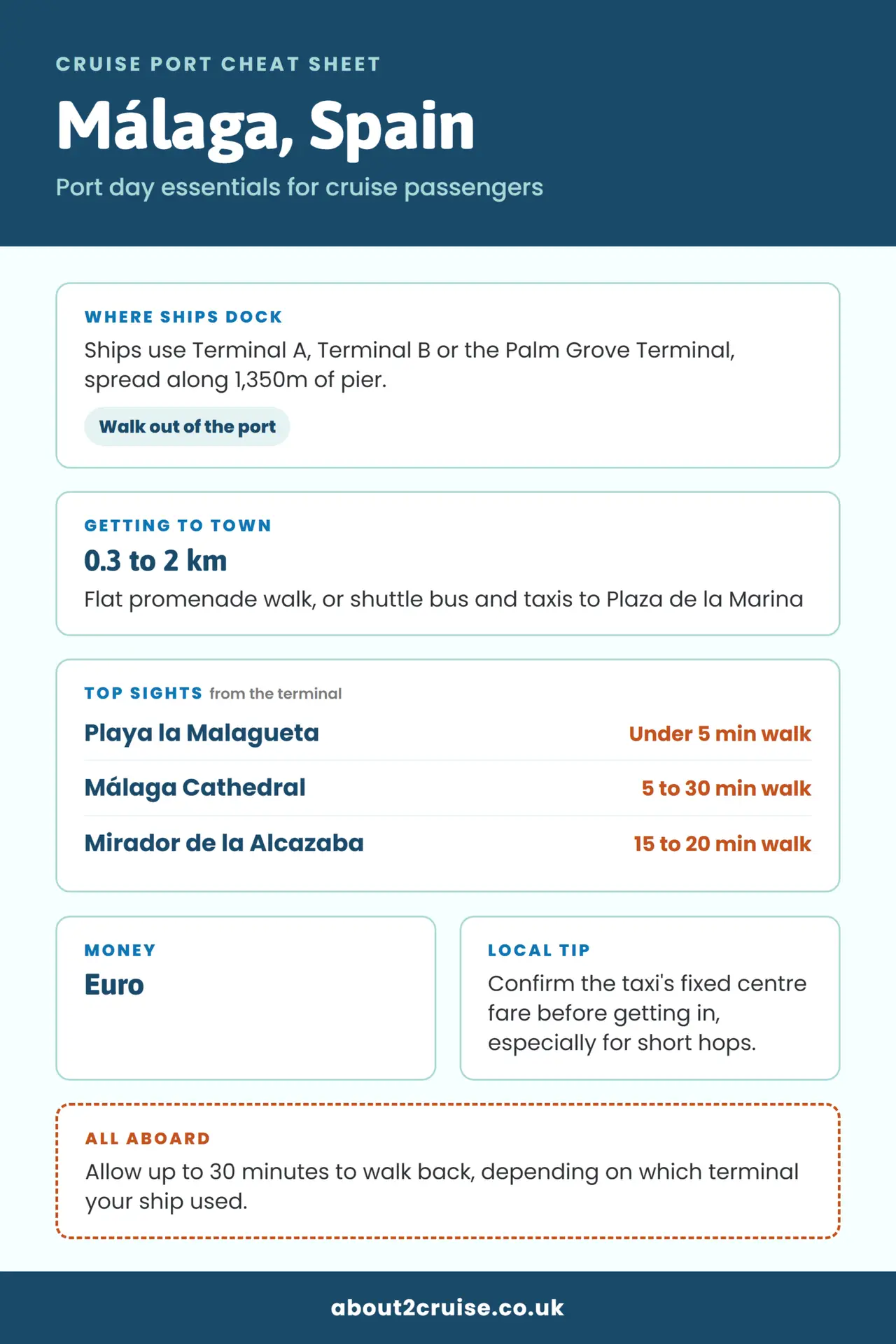
Your ship will dock at one of three Málaga terminals: Terminal A, Terminal B or the Palm Grove Terminal. The old town is a five to thirty minute walk along a flat promenade, with a shuttle bus and taxis on hand too. Málaga Cathedral, the Alcazaba and Playa la Malagueta beach all fit into one port day.
Which terminal will your ship use?
Your ship will use one of three terminals, spread along just over 1,350 metres of pier that’s big enough for ships of any size. Terminal A has two boarding bridges built for the newer, larger ships. Terminal B has a modern boarding bridge too and handles both turnaround and transit calls. The Palm Grove Terminal, also called Pier 2, sits in a garden setting right in the city centre and takes smaller and mid sized ships up to 200 metres.
There’s no published berth schedule, so you can’t check in advance which terminal you’ll land at. Check the ship’s daily programme once you’re aboard instead of planning your morning around a fixed walk time. On days when more than one ship is in, the bigger ones tend to go to Terminal A or Terminal B, and the Palm Grove Terminal closest to the old town gets kept for the smaller ships.
Málaga cruise port map
Ships dock at Málaga cruise port. From the terminal, Playa la Malagueta is about a 20-minute walk, Málaga Cathedral about 27 minutes and Alcazaba de Málaga about 30 minutes. Tap a pin for directions.
- Muelle 2 TerminalWhere ships dock
- Málaga cruise portWhere ships dock
- Playa la MalaguetaBeach · About 20 min walk from the terminal
- Plaza de la Marina (shuttle stop)Shuttle stop · About 23 min walk from the terminal
- Málaga CathedralCathedral · About 27 min walk from the terminal
- Málaga María Zambrano stationTrain station · About 28 min walk from the terminal
- Alcazaba de MálagaFortress · About 30 min walk from the terminal
- Taxi rank at cruise portTaxi rank
- Málaga Bus StationBus station
- Gibralfaro Castle and ViewpointCastle and viewpoint
- Muelle Uno shopping areaShopping area
- Centre Pompidou MálagaArt museum
- Picasso Museum MálagaArt museum
- Picasso Birthplace MuseumMuseum
- Roman Theatre of MálagaAncient ruins
- Calle LariosShopping street
- Atarazanas MarketMarket
- Plaza de la ConstituciónSquare
- Málaga AirportAirport
Walking, shuttle and taxi options into the city
Walking into the centre takes as little as five minutes if you’re at the Palm Grove Terminal, a short stroll from Málaga Cathedral. From the main terminals further along the pier, budget twenty five to thirty minutes instead. Either way it’s flat the whole distance, a waterfront promenade with no climbing until you actually reach the old town.
- A port shuttle bus runs from the terminal to Plaza de la Marina in the city centre. Fares and frequency depend on who’s operating it that day, so check the price board at the terminal rather than guess.
- Taxis queue right outside the piers and terminal building. Confirm the fare before you get in. Some drivers get surprisingly imaginative with the price for a five minute hop to nearby attractions, but there’s a fixed rate into the centre, so ask for that one.
- There’s also a solar powered tourist train between the port and Plaza de la Marina, for a small fare.
- The Málaga Hop-on Hop-off Bus stops right at the terminal entrance too, handy if you’d rather save your legs for later.
Playa la Malagueta: the beach closest to the port
Playa la Malagueta, one of Málaga’s busiest beaches, is under five minutes’ walk from the ship. Head to the lighthouse about 200 metres from the dock instead if you want a quieter stretch of sand. There’s barely any shade on this part of the coast, and what little there is fills up fast, so if you’re planning a swim between sightseeing, pack a tube of reef-safe sunscreen.
Climbing to the Alcazaba and Gibralfaro Viewpoint
Getting up to the Alcazaba fortress means a steep path from street level, though a lift covers half the climb, and the hop-on hop-off bus stops there too if you’d rather skip the walk altogether. The Gibralfaro Viewpoint sits higher still, and the path up is steep in places, steeper again coming down after dark when your knees start taking it personally. Decent grip on your shoes matters more than you’d think. Taxis are the easy way round the climb for either spot.
What to eat in Málaga
The best things to eat in Málaga on a port day are pescaíto frito at the bars near Mercado de Atarazanas, boquerones al limón in old town tapas bars, or sardine espetos by the beach chiringuitos. Short on time? Muelle Uno by the harbour is right by the ship.
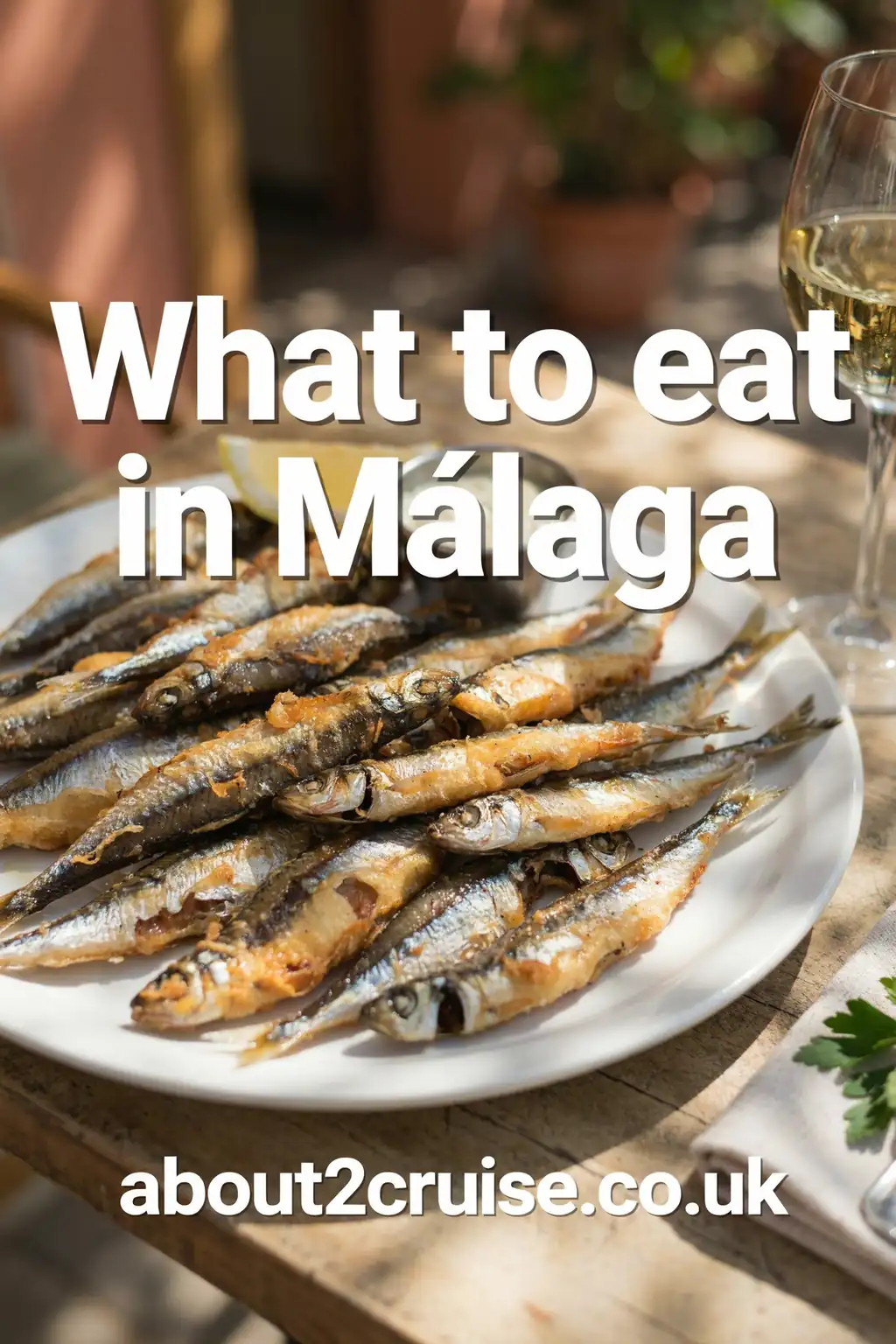
- Pescaíto frito (fritura malagueña) is a mix of deep fried fish and shellfish, including anchovies, cod, squid and red mullet. The bars in and around Mercado de Atarazanas serve it within metres of the fishmongers.
- Boquerones al limón are anchovies marinated in lemon, garlic and parsley, then deep fried in olive oil. You’ll find them at tapas bars all through the old town.
- Espetos, sardines grilled on skewers, taste best eaten by the sea at the chiringuitos along the coast at El Palo and Pedregalejo.
- If time’s tight, Muelle Uno sits right by the harbour and makes an easy meal close to the ship.
Money in Málaga: currency, cards and cash
The currency is the euro, and you can use a card almost everywhere in Málaga, including cafés, shops and attractions.
Carry some cash for small bars, market stalls and tips, because they don’t always have a card machine. Taxis take cards too, but it’s easier with a few euros for the fare. There’s a fixed minimum charge from the cruise terminal, and cash is quicker for that. There are ATMs and a currency exchange desk inside the terminal building if you need either before you head into town. Don’t assume shops or taxis here will take US dollars. Stick to euros.
Is Málaga safe for cruise passengers?
Málaga is a safe, easy port to walk around on your own, and there’s no specific warning against going ashore.
The main thing to watch is pickpocketing in busy spots like Calle Larios, the cathedral square and the Atarazanas market, so keep your bag zipped and where you can see it. Only use official, licensed taxis from the queue at the port. Unlicensed ones can get you a fine as well as a bad fare. Be wary of anyone posing as police and asking to check your wallet. That’s a known scam, and real officers won’t ask. Beyond ordinary city sense, there’s nothing here to put you off a day ashore.
Weather in Málaga for a cruise port day
You’ll get warm, dry weather if you call between April and June, hot and dry through July and August, and milder, wetter weather from September to December.
Spring days usually sit in the low twenties, and by midsummer you’re in the high twenties or low thirties. There’s hardly any rain from June to August. Autumn and winter are cooler, in the mid to high teens. November and December are the wettest months, and you can get the odd sharp downpour, which locals call a DANA. January is the windiest month. Take sun cream and water for a summer call, and a light waterproof from October onwards.
What to wear in Málaga: outfit ideas for a port day
What to wear in Málaga on a port day is something light with a scarf to cover shoulders and knees for the cathedral, plus comfortable, flat walking shoes for the cobbled old town and the climb up to the Gibralfaro Viewpoint.


- Málaga Cathedral requires shoulders and knees covered, and they check at the entrance, so pack a light scarf or layer if you’re dressed for warm weather.
- The steps up the cathedral’s north tower, the path to the Alcazaba and the climb to the Gibralfaro Viewpoint all go better in a pair of comfortable walking shoes than in sandals.
- Old town streets are cobbled in places, so flat, grippy soles beat anything with a heel.
For more inspiration, see these casual cruise outfit ideas for women and cruise outfit ideas for men.
Best photo spots in Málaga
The best photo spots in Málaga on a port day are the Mirador de la Alcazaba above the Roman Theatre, best mid-morning before the crowds build, and the Gibralfaro Viewpoint for a view over the bullring, beach and harbour.

- Mirador de la Alcazaba sits above the Roman Theatre and frames the ruins with the old town stretching out behind. Go between nine and eleven in the morning, before the crowds arrive.
- Gibralfaro Viewpoint gives you the classic Málaga shot: bullring, the curve of the beach, harbour and mountains all in one frame. Best at sunset, and arrive about thirty minutes early for a spot.
- Letras de Málaga, the city’s lettered sign, sits next to the Roman Theatre with the Alcazaba fortress behind it.
- Playa la Malagueta faces roughly east, so the early morning light hits the water at a low angle and turns the sea from grey to gold.
Plenty of cruises pair Málaga with other Spanish calls on the same western Mediterranean itinerary. Our guide to Mediterranean cruise ports in Spain rounds up what to expect at each one.
How to spend a port day in Málaga
A port day in Málaga works best if you pick one: a slow wander between the cathedral, the Alcazaba and the beach, or a longer climb up to Gibralfaro for the sunset view.
Before you sail
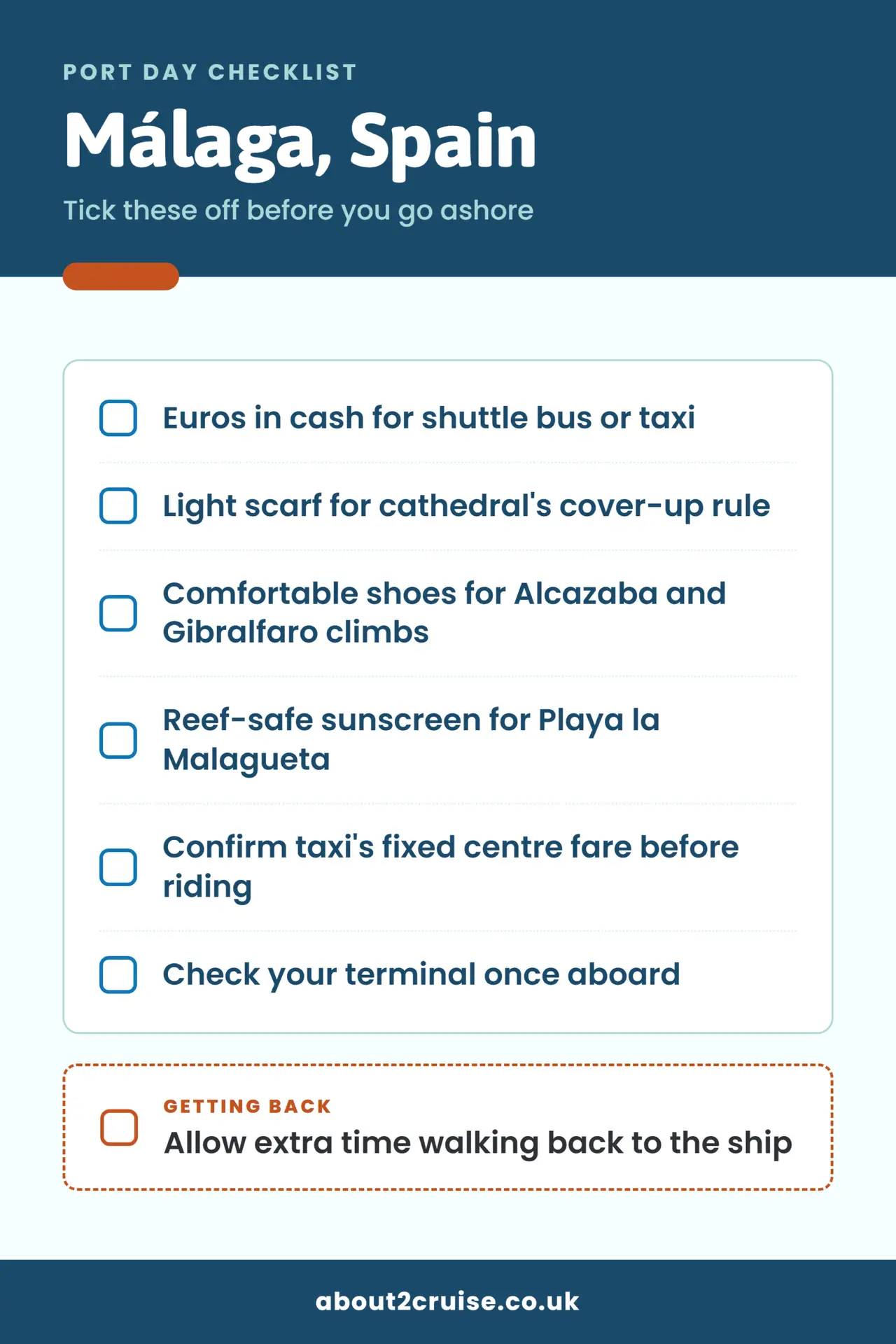
- Check which terminal your ship will use once aboard, as walk times vary.
- Bring euros in cash for the shuttle bus or taxi fare into town.
- Pack a light scarf or cover-up for the cathedral's shoulders and knees rule.
Short port day: under 6 hours
- On dockingWalk or shuttle into townFlat promenadeWalk 5 to 30 minutes along the flat waterfront, or take the shuttle bus to Plaza de la Marina.
- +30 minMálaga CathedralCover shoulders, kneesA short walk from the port. Shoulders and knees must be covered to enter, checked at the door.
- +1 hrMirador de la AlcazabaSteep path, lift halfAbout a 15 to 20 minute walk up a steep path; a lift covers half the climb if you'd rather skip stairs.
- +2 hrsLunch near Atarazanas marketTry pescaíto fritoBars beside the fishmongers serve pescaíto frito, Málaga's deep fried fish and shellfish mix.
- +3 hrsPlaya la MalaguetaA flat 15 minute walk back towards the port. Relax on the sand before heading to the ship.
- All-aboard minus 1 hrBack at the terminalAllow extra time if your ship is berthed at one of the further terminals.
The time on the map is the whole walk, every stop added together.
Open this walking route in Google Maps
If plans change: If the Alcazaba path looks too busy or steep, the hop-on hop-off bus stops right at the fortress gate.
Long port day: 8 hours or more
- On dockingWalk or shuttle into townFlat promenadeWalk 5 to 30 minutes along the flat waterfront, or take the shuttle bus to Plaza de la Marina.
- +30 minMálaga Cathedral and tower climbCover shoulders, kneesAround 200 steps lead to the rooftop walkway, with views over the old town, port and sea.
- +1 hr 30 minClimb to the Alcazaba and Gibralfaro ViewpointSteep in placesA steep path climbs above the Roman Theatre to the Alcazaba, a lift covering half the way, then on to the Gibralfaro Viewpoint for the bullring, beach and harbour view.
- +4 hrsLunch near Atarazanas marketTry pescaíto fritoWalk back down into town; bars beside the market stalls serve Málaga's classic deep fried fish and shellfish mix.
- +5 hrsPlaya la MalaguetaWalk on to the seafront and relax on the busiest of Málaga's beaches.
- +5 hr 45 minWalk to the lighthouseQuieter stretchA short stroll about 200 metres from the dock finds a quieter stretch of sand than the main beach.
- All-aboard minus 90 minBack at the terminalAllow extra walking time if your ship used one of the further terminals from town.
The time on the map is the whole walk, every stop added together.
Open this walking route in Google Maps
If plans change: If you're running short on time, skip Gibralfaro and head straight back to the beach and terminal instead.

If your ship sails Spain’s Mediterranean coast, Almería often appears as the next or previous call, with a hilltop Moorish fortress and a more low-key old town.
On southern Spanish itineraries, Cádiz often appears alongside Málaga, trading the Mediterranean for the Atlantic and a narrower, older city centre.
Cartagena often appears as the next call east along Spain’s Mediterranean coast after Málaga, with a Roman theatre and a sheltered naval harbour.
On Spain’s Mediterranean coast, Motril is a quieter port often paired with Málaga on the same itinerary.
Common Questions
Is there a metro or train station close to the cruise port?
There’s a metro stop close to the port, Atarazanas is the nearest one, and the city’s main train station, Málaga María Zambrano, is also a short distance away, handy mainly for day trips further afield.
Is the Málaga cruise terminal wheelchair accessible?
The Málaga cruise terminal offers wheelchair assistance, lifts and accessible toilets, though accessibility details can vary between the three terminal buildings. The steep paths up to the Alcazaba and the Gibralfaro Viewpoint are a different matter though, and aren’t suitable for anyone with limited mobility.
What facilities are inside the Málaga cruise terminal?
The facilities inside the Málaga cruise terminal include a small shopping mall with duty-free and souvenir shops, a tourist information desk, an ATM, a currency exchange office, public phones and Wi-Fi.
Is Málaga safe for cruise passengers exploring independently?
Málaga is one of the safer, friendlier Spanish cities to walk around alone. Pickpockets do work crowded spots like Calle Larios and the area around the cathedral though, so keep half an eye on your bag there.
How far is Málaga Airport from the cruise port?
Málaga Airport is about eight kilometres from the cruise port, a short taxi ride if you’re arriving or leaving on the day of your cruise.
How many steps lead to the top of Málaga Cathedral’s tower?
Around 200 steps lead to the top of Málaga Cathedral’s tower, broken into manageable sections on the way up, ending on a rooftop walkway with views over the old town, port and sea, which makes a decent excuse to stop and catch your breath.
Last Updated: 11 November 2026