
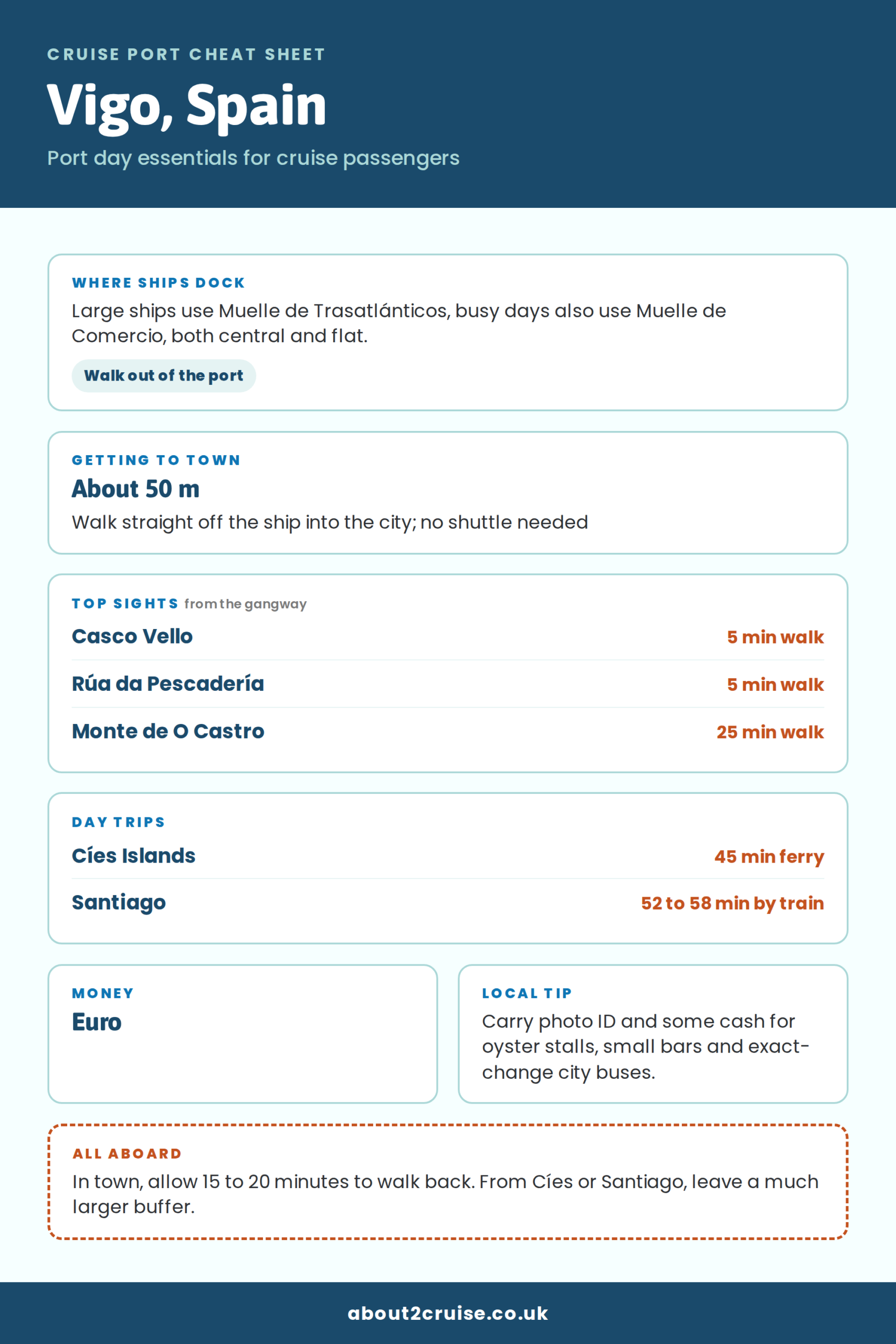
Vigo is one of the easiest Spanish cruise calls. Ships dock on a central, flat waterfront, the old town and oyster street are five minutes from the gangway, and there’s no shuttle. On a short call, eat oysters, climb O Castro and wander the Casco Vello. On a long call, consider the Cíes Islands or Santiago.
Vigo Cruise Port Quick Facts
| Currency | Euro (€) |
| Walk from ship to old town | 5 minutes |
| Main quays | Muelle de Trasatlánticos and Muelle de Comercio |
| Shuttle | None needed |
| Short-call plan | Casco Vello, oyster street, O Castro, waterfront |
| Long-call plan | Cíes Islands ferry or Santiago de Compostela train |
| City bus | €1.63, exact cash, max €10 change |
| Tourist bus | €7.50 adults, 90-minute circuit |
| Cíes ferry | €26.50 adult return, 45 minutes |
| Santiago train | €6–12 single, 52–58 minutes |
Where Do Cruise Ships Dock in Vigo?
Vigo handles cruise ships at two quays on the same central waterfront. The main quay is Muelle de Trasatlánticos, home to the historic Estación Marítima Alberto Durán and the two principal terminals, Vigo Cruise Terminal and Atlantic Vigo Cruise Terminal. It has a long berthing line and handles most megaships. When there are several calls on the same day, the port also works Muelle de Comercio, where the newer El Tinglado del Puerto terminal provides a step-free space. Both are effectively in the city centre.
Cruise lines that call here include P&O Cruises, Royal Caribbean, TUI Cruises, Ambassador, Silversea, Fred Olsen and smaller expedition ships. The port does not publish a permanent public berth allocation, so check your ship’s daily programme or the port information desk for which terminal you’re using. The practical difference is small: both quays sit on the same pedestrian waterfront, and the old town is a five-minute walk from the main terminal, with only a few extra minutes from El Tinglado.
Facilities at the terminals include free Wi-Fi, currency exchange, tourist information desks and the A Laxe shopping centre about 10 metres away. There is no shuttle service because you don’t need one: the city centre is 50 metres from the berth.
Vigo cruise port map
Ships dock at Muelle de Comercio. From there, Rúa da Pescadería is about a 10-minute walk, Casco Vello about 11 minutes and Mercado da Pedra about 11 minutes. Tap a pin for directions.
- Muelle de ComercioWhere ships dock
- Estación Marítima de VigoWhere ships dock
- Rúa da PescaderíaOyster street · About 10 min walk from Muelle de Comercio
- Casco VelloOld town · About 11 min walk from Muelle de Comercio
- Praza da ConstituciónSquare · About 11 min walk from Muelle de Comercio
- Mercado da PedraMarket · About 11 min walk from Muelle de Comercio
- Vigo-Urzáiz stationRailway station · About 17 min walk from Muelle de Comercio
- Praia de SamilBeach · About 6 km from Muelle de Comercio
- Cíes IslandsIsland group · About 16 km from Muelle de Comercio
Getting Around Vigo: Walk, Bus, or Taxi
The whole cruise waterfront is landscaped and pedestrian-friendly. From the gangway you can walk straight into the Casco Vello and the shopping streets. The A Laxe lift shortens the first climb from the waterfront into the upper part of the old town. The streets are cobbled and the city rises, so flat shoes are the sensible choice. The only real gradient of a city day is the climb to Monte de O Castro; you can walk it in about 20 minutes or take a taxi to the top and walk down.
For a wider look at the city, a hop-on hop-off style tourist bus leaves from Cánovas del Castillo beside the maritime station. In summer it runs a 90-minute circuit with four departures daily at 10:00, 12:00, 16:30 and 18:30. Tickets cost €7.50 for adults, €4 for ages 5–14 and are free for under-5s. There’s an audio guide in eight languages, and the route stops at Monte do Castro, Castrelos park and Samil beach.
Ordinary city buses serving the port area include lines A, C1, C3, L5A, L10, L11, L15B, L15C and L28. The cash fare is €1.63, and you need exact money or very close to it because the maximum change accepted is €10. The airport bus also costs €1.63. Taxis are available, but use only licensed taxis. The port area is about 15 minutes on foot from Vigo-Urzáiz railway station and 15 minutes by car from the airport.
Best Things to Do in Vigo on a Short Cruise Call
A short call in Vigo is genuinely easy because the best old-town bites are next to the ship. Walk into the Casco Vello, head for Praza da Constitución and then to Rúa da Pescadería, the oyster street. This is behind the berth, about five minutes from the gangway. At the stalls by the Mercado do Berbés you can eat oysters opened to order for roughly €1 each or buy a dozen for around €8–12. It’s perfectly normal to stand at the stall with a glass of white wine.
Before you sail
- Book Cíes ferry and the free Xunta authorisation as soon as the cruise date is fixed.
- Check the official Cíes access rules; outside summer only guided groups land.
- Book O Castro fortress guided tour by phone or through the Vigo heritage portal.
Short port day: under 6 hours
- On dockingWalk into the Casco VelloNo shuttle neededThe old town is five minutes from the gangway. Wander the lanes to Praza da Constitución.
- +15 minPraza da ConstituciónThe old-town square is the centre of the Casco Vello and a good first stop.
- +30 minRúa da PescaderíaOysters to orderThe oyster street is behind the berth. Eat oysters opened to order by the Mercado do Berbés.
- +1 hrLunch around Mercado da PedraTry pulpo á feiraOrder pulpo á feira or a seafood plate in the old town. Albariño is the local white to go with it.
- +2 hrsMonte de O CastroTaxi up, walk downA 20 minute climb from the old town. The hilltop has the best panorama over the ría, the Cíes islands and the Rande bridge.
- +3 hrs 30 minCable Gardens and waterfrontStroll back down through the park to the Cable Gardens beside the berth.
- All-aboard minus 1 hrBack at the quayThe old town is only a short walk, but security queues can slow you down.
The time on the map is the whole walk, every stop added together.
Open this walking route in Google Maps
If plans change: If the climb to O Castro is too much, take the tourist bus loop from Cánovas del Castillo and stay on for the view.
Long port day: 8 hours or more
- On dockingWalk to the Cíes ferry pierThe Estación Marítima de Vigo is on the same waterfront as the cruise berth, about five minutes on foot.
- +15 minCollect pre-booked ferry ticketsPaper ticketsCollect paper tickets from the operator's stand at least 30 minutes before departure. Show your free Xunta authorisation in summer.
- +45 minBoard the Cíes ferryThe crossing takes about 45 minutes. Bring water and sun protection for the island.
- +1 hr 30 minPraia de Rodas and island pathsWalk from the jetty to Praia de Rodas, then follow island paths into the national park.
- +3 hrs 30 minReturn ferry to VigoHead back to the island jetty in time for the return sailing. Ferries can be full on summer weekends.
- +4 hrs 30 minLunch around Rúa da PescaderíaTry pulpo á feiraBack in Vigo, eat oysters or pulpo á feira in the old town. Albariño is the local white.
- +5 hrs 30 minWaterfront walk and Cable GardensStroll the landscaped quay and the Cable Gardens before reboarding.
The times on the map are for the whole journey there by train and bus.
Get train and bus times in Google Maps
If plans change: If the Cíes ferry is full or the authorisation is unavailable, take the train from Vigo-Urzáiz to Santiago de Compostela instead, or stay in the old town.
After the oysters, wander the lanes, then either walk or ride up to Monte de O Castro for the panorama over the ría, the Cíes islands and the Rande bridge. The hilltop is free and the defensive walls are always open. If you prefer an easy overview, the tourist bus loop covers the same ground without the climb.
A good three-hour port-day plan is: oyster street and old town (45–60 minutes), O Castro viewpoint (45–60 minutes including the walk), and a last seafood or coffee stop by the waterfront. There’s no need to book anything, and you can be back at the ship within minutes.
Cíes Islands from Vigo: Ferry, Tickets, and Is It Worth It?
The Cíes Islands are the headline excursion from Vigo, but they don’t fit every cruise call. The ferry leaves from the Estación Marítima de Vigo on Cánovas del Castillo, the same waterfront as the cruise berths. The crossing takes about 45 minutes each way, and you need several hours on the island to make the trip worthwhile. Allow at least 4–6 hours including ferries. If your all-aboard is mid-afternoon, don’t attempt it.
Adult return tickets cost €26.50, children aged 5–12 pay €12, under-5s go free. An online adult discount of €24 applies outside the busiest dates. Ferry tickets are paper tickets, so collect them from the operator’s stand at the maritime station at least 30 minutes before departure. The ticket office is open daily from 09:00 to 21:00.
In Easter week and from 15 May to 15 September you also need a free Xunta authorisation before you can land. Apply through the official authorisation portal as soon as your cruise date is fixed, up to 90 days ahead. The provisional code is only valid for two hours, so buy the ferry ticket immediately after getting the code. Outside that window, landing is generally restricted to organised guided groups, so check access before relying on the ferry in low season.
Low-season Vigo departures are typically 10:45 and 15:30, with island returns at 13:30 and 17:40. From Easter week and through the summer there are many more sailings, starting from 09:00. Ferries fill quickly on summer weekends, so book early. The star beach is Praia de Rodas, often photographed as one of the best beaches in Spain, and the island is part of the Atlantic Islands of Galicia national park.
Monte de O Castro: Vigo’s Free Hilltop Viewpoint
Monte de O Castro is the city’s free panoramic viewpoint, about 150 metres above sea level. From the old town it’s roughly a 20-minute climb, and from the top you can see the ría, the port, the Cíes islands and the Rande bridge. The area is a public park, and the 17th-century defensive walls are open at all hours.
If you want to go inside the defensive enclosures, underground gallery and powder magazine, free guided tours run Tuesday to Friday at 11:00 and 12:30, Saturday at 16:00, and Sunday at 11:00 with a family session. The site is closed on Mondays. Booking is required on 615 258 531 or through the Vigo heritage booking portal. The hilltop is exposed to wind, and outdoor tours can be suspended in bad weather.
The walk up is the one real gradient in a Vigo city day. If you have mobility concerns or it is very hot, take a taxi up and walk down through the park to the old town.
Santiago de Compostela from Vigo Cruise Port
Santiago de Compostela only makes sense on a long port day, ideally eight to ten hours ashore. The destination is about 52–58 minutes by train from Vigo-Urzáiz station, which is a 15-minute walk from the cruise area. Trains run roughly hourly, and single fares are around €6–12 depending on the service. Use Vigo-Urzáiz, not Vigo-Guixar, for the faster train. Vigo-Guixar trains also reach Santiago but take about 1 hour 20 minutes to 1 hour 35 minutes.
If you prefer an excursion coach, the journey takes about 55 minutes. A private taxi round trip is quoted at €85 or more. The train is usually the best value and most flexible option, but you must leave a solid buffer: walk to the station, buy or collect tickets, take the train, see the cathedral area, and return. If the ship gives you less than eight hours, choose Vigo or the Cíes Islands instead.
Food and Drink in Vigo: Oysters and Galician Seafood
Vigo’s food scene is best experienced on Rúa da Pescadería, the oyster street in the Casco Vello, and around the Mercado da Pedra. Oysters are the iconic snack, sold by the dozen for roughly €8–12 or individually for about €1. Full seafood meals in the area cost around €15–25.
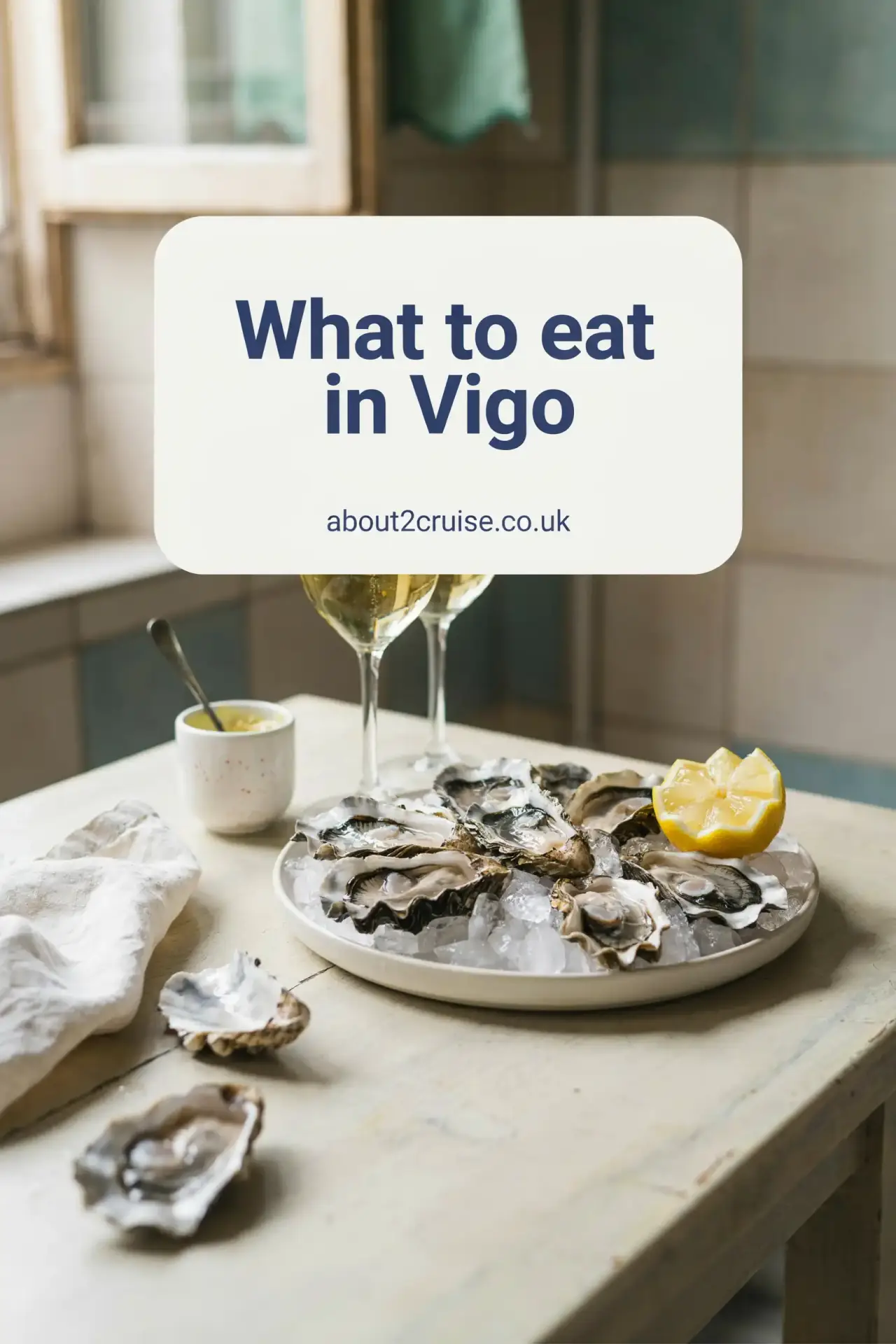
Other local plates to look for are pulpo á feira, percebes, navajas, zamburiñas and empanada gallega. Wash it down with Albariño from the Rías Baixas, Ribeiro for a cheaper Galician white, or Estrella Galicia beer. The A Laxe shopping centre next to the terminals is the easiest option for a quick coffee or supermarket stop.
Practical Information for Vigo Cruise Passengers
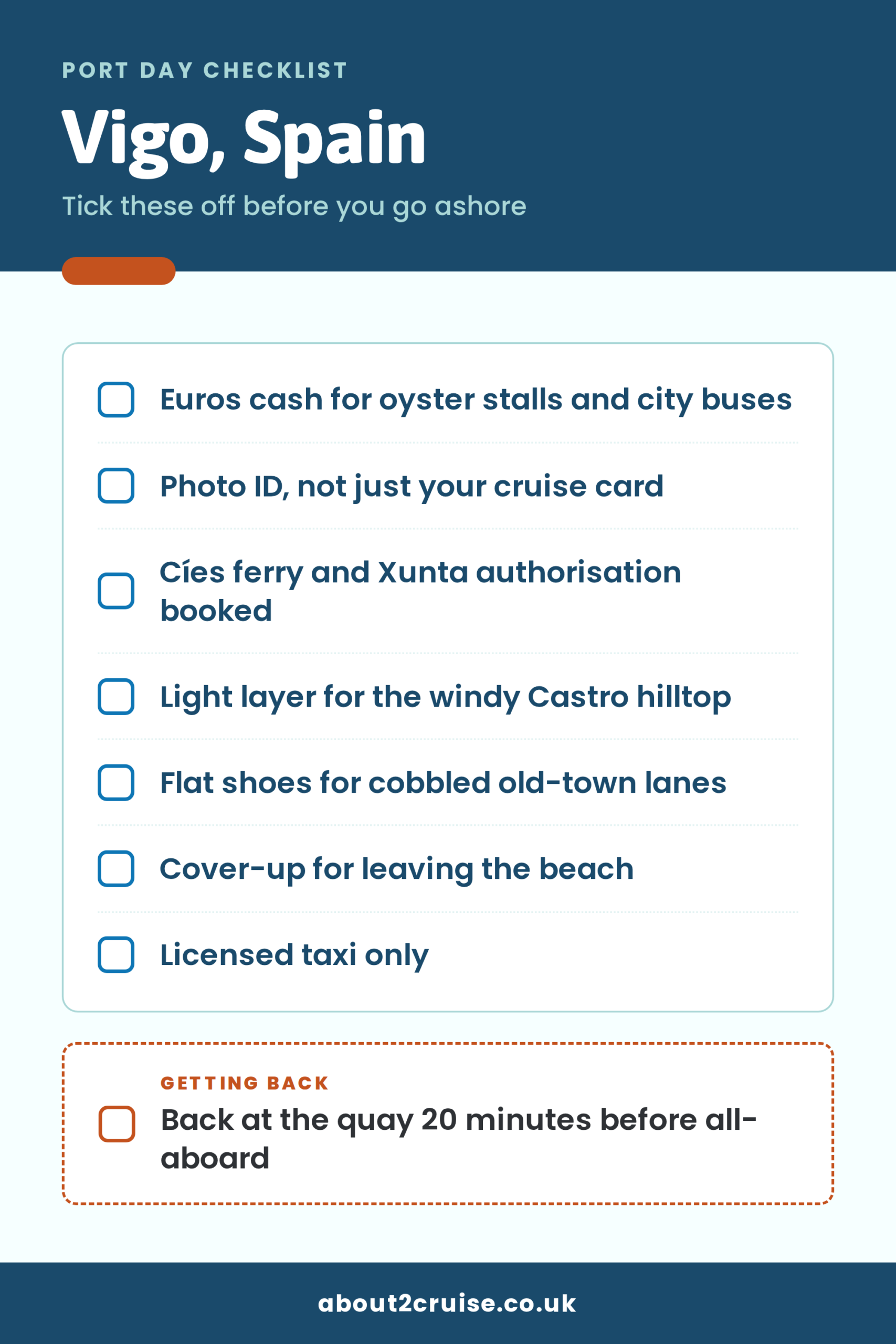
Vigo uses the euro. Cards are widely accepted in shops and restaurants, but carry €20–30 in cash for oyster stalls, small bars and city buses. Bus drivers take cash at the door but ask for exact money and will not give change above €10.
Spanish law requires you to carry photo ID, so take a copy of your passport photo page or your passport, not just the cruise card. Street crime in Spain is mainly distraction theft and teamwork. Keep phones, wallets and bags closed and close to your body. Be wary of anyone posing as a police officer and asking to see your wallet; genuine officers ask for ID, not wallets or purses. Only use licensed taxis, because passengers caught using unlicensed services can face fines.
For swimming, follow beach flag rules. A red flag means do not enter the water, and strong undercurrents are a real risk. Vigo has no hurricane season; the wet season is the Atlantic winter. Long-term averages for the cruise season are roughly 24°C in July and August, 23°C in September, 19°C in October, 15°C in November and 12°C in December. Rain increases sharply from September onwards, and relative humidity is high year-round.
Dress for the street, not the beach. Wearing only swimwear or going bare-chested in the city can lead to fines. Old-town lanes are cobbled, so flat shoes are best. If you are heading to O Castro, take a light layer because the hilltop is exposed to wind.
Luggage, Parking, and Hotels Near Vigo Cruise Port
For transit passengers, the cruise terminals do not offer a walk-up left-luggage locker service. Terminal-side luggage storage is aimed at turnaround days when passengers are boarding or disembarking. The nearest public lockers are run by Vigo Lockers at the Estación Marítima Ría de Vigo on Rúa Cánovas del Castillo, a short walk from the cruise quay. They only offer XL lockers, big enough for about one large case plus a rucksack. Prices are €4 for 2 hours, €8 for 4 hours, €9.24 for 6 hours, €12.96 for 12 hours and €14.90 for 24 hours, with 20% off beyond 48 hours. Book online, by WhatsApp or at the kiosk. That kiosk has paused at end of season before, while a second Vigo Lockers site at Rúa Alfonso XIII 56, near Vialia and Vigo-Urzáiz station, stays open.
If you are driving to Vigo for a cruise, the port mentions long-stay parking for turnaround operations but publishes no standalone cruise car park tariff. Public car parks about five minutes from the terminal include Estación Marítima, A Laxe and Plaza Portugal, roughly €2 per hour or €12–20 per day. On double- and triple-call days book online in advance. A meet-and-greet operator can take your car at the terminal door and park it in a CCTV compound, but booking is required at least 24 hours ahead.
If you are staying before a cruise, the most convenient central hotels are Hotel Bahía de Vigo on Cánovas del Castillo, AC Hotel Palacio Universal next to the port, Hotel Ciudad de Vigo near the Cíes ferry point, and NH Collection Vigo about 400 metres from the port. All are within a short walk of the terminal, the old town and the railway station.
Best Photo Spots in Vigo
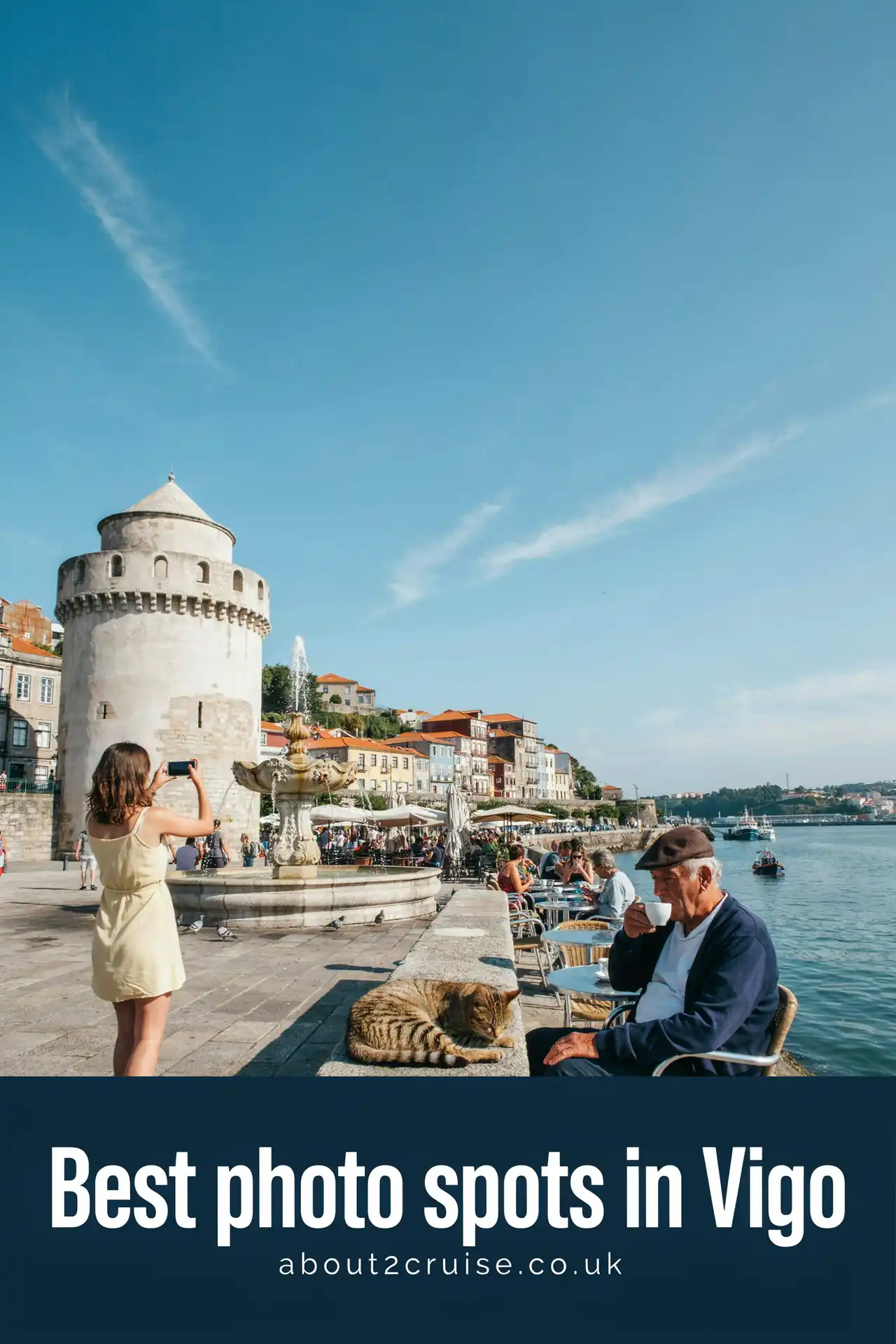
The best panorama is from Monte de O Castro, looking over the ría, the Cíes islands and the Rande bridge. The Cable Gardens on Muelle de Trasatlánticos are right beside the berth and make a good first or last photo. Praia de Samil, the city beach and promenade, is a stop on the tourist bus. If you take the Cíes ferry, Praia de Rodas is the classic beach shot of the ría.
Our Northern Spain cruise ports guide covers this port and the others on Spain’s Atlantic coast.
Vigo Cruise Port FAQs
Is Vigo a tender port?
No. Vigo is an alongside port. Your ship docks at a central quay, and you walk off the gangway into the city. There are no tender tickets or queues.
Which terminal will my ship use?
The port does not publish a permanent public berth plan. Most large cruise ships use Muelle de Trasatlánticos; on busy days some use El Tinglado del Puerto at Muelle de Comercio. Check the daily programme or the port information desk on arrival. Both are on the same central waterfront.
Can I walk to the beach from the ship?
Not really. The main city beach at Samil is several kilometres from the cruise quay, so take the tourist bus, a city bus or a taxi. The waterfront next to the ship is pleasant for a stroll but is not a beach.
What if the weather is wet?
Vigo is an Atlantic city and rain is common outside July and August. The old town is compact and the oyster stalls are partly covered, A Laxe has cafés and shops, and the tourist bus covers ground without much walking. Bring a light rain jacket in spring, autumn and winter.
Do I need to speak Spanish?
No. The cruise area, main sights and many restaurants are used to British passengers. Menus often have English. A few basic Spanish phrases help in smaller bars off the main tourist streets.
Can I use contactless or Apple Pay?
Cards and contactless are widely accepted in shops and restaurants, but carry €20–30 in cash for oyster stalls, small bars and exact-change city buses.
How early should I get back to the ship?
Follow the all-aboard time shown by your ship. If you are in the old town, allow 15–20 minutes to walk back and pass security. If you are returning from Santiago or the Cíes Islands, leave a much larger buffer and do not rely on the last possible ferry or train.
More Atlantic Coast Cruise Port Guides
Vigo often appears on Western France and Atlantic coast itineraries. If you are also calling at Lisbon, read the Lisbon cruise ship port guide. For Porto, see the Porto/Leixões cruise ship port guide. For the wider region, have a look at the Western France Atlantic coast cruise ports guide.
Last Updated: 15 November 2026