
St Peter Port is Guernsey’s compact, hilly capital and a tender port for cruise ships. Large ships anchor offshore; passengers land at Albert Pier, four minutes from town. Castle Cornet, Victor Hugo’s house, WWII occupation sites, cobbled lanes and seafood fill a busy day. Weather and tender timings decide what is realistic.

At a glance
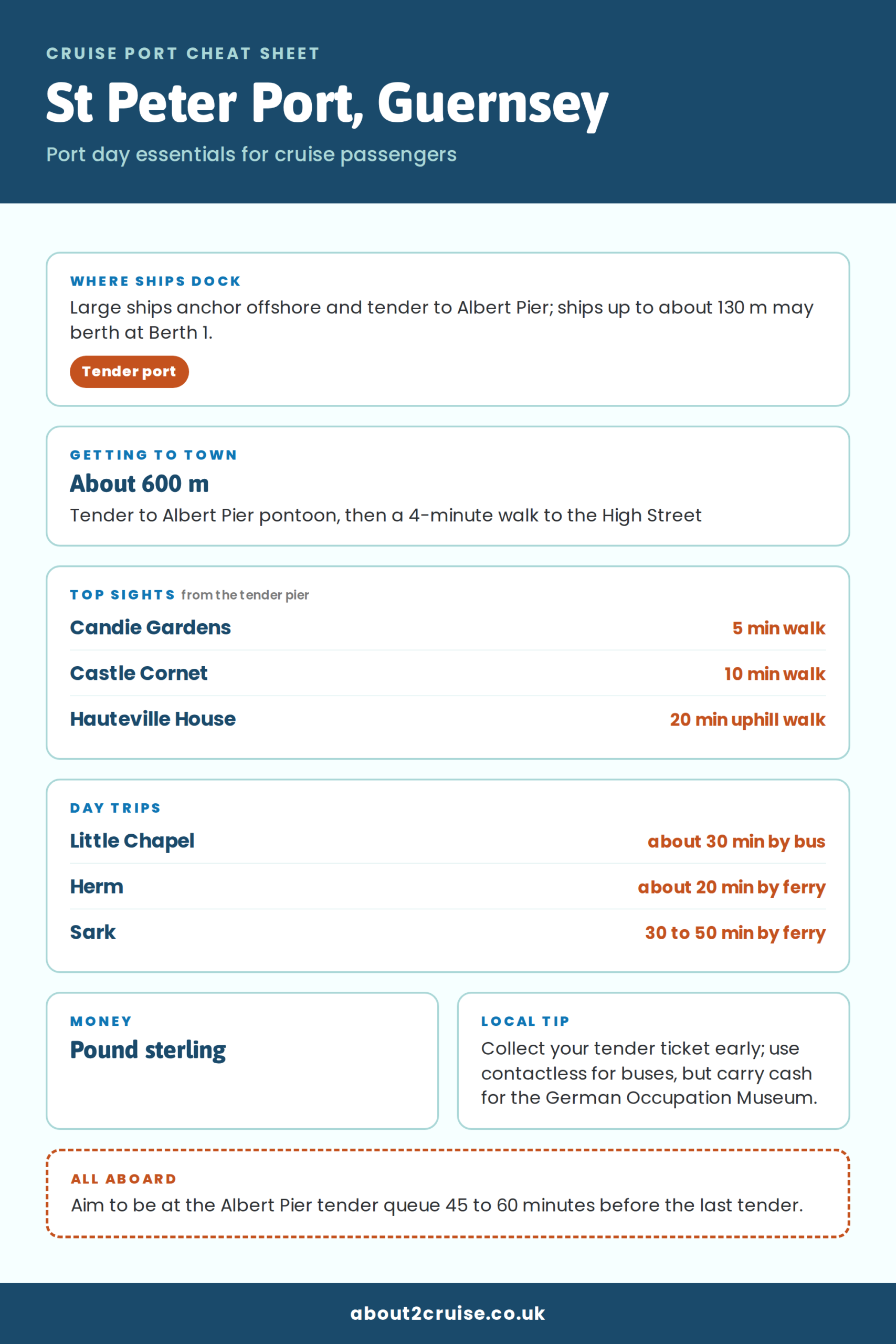
- Tendering: Large ships anchor offshore; the tender crossing usually takes 5–20 minutes, landing at the floating cruise pontoon on Albert Pier. There is no cruise terminal building.
- Location: St Peter Port is the capital of Guernsey, a Crown Dependency. It is not part of the UK, but uses pound sterling and sits in the Common Travel Area.
- Main sights: Castle Cornet, Hauteville House, St Peter Port’s cobbled lanes and Market Square, Candie Gardens, German Occupation Museum, German Underground Hospital, Little Chapel.
- Food: Guernsey gâche, bean jar, crab, lobster, scallops, local dairy ice cream, cream teas.
- Watch out: Castle Cornet has a temporary bridge-replacement closure, the German Occupation Museum is morning-only and cash-only, Sunday trading is thinner, and the town is hilly with cobbles and steps.
St Peter Port cruise port map
Tenders bring you ashore at Albert Pier tender pontoon. From the tender pier, High Street and Market Square is about a 4-minute walk, Hauteville House about 8 minutes and Castle Cornet about 9 minutes. Tap a pin for directions.
- Albert Pier tender pontoonWhere tenders land
- Town Terminus bus stationBus station · About 3 min walk from the tender pier
- High Street and Market SquareShopping area and market · About 4 min walk from the tender pier
- Hauteville HouseHistoric house · About 8 min walk from the tender pier
- Castle CornetCastle · About 9 min walk from the tender pier
- Candie GardensGardens · About 11 min walk from the tender pier
- Guernsey Museum at CandieMuseum · About 12 min walk from the tender pier
- Victoria TowerTower · About 13 min walk from the tender pier
- German Naval Signals HQWWII signals headquarters · About 20 min walk from the tender pier
- German Occupation MuseumMuseum · About 5 km from the tender pier
- German Underground HospitalUnderground hospital · About 3 km from the tender pier
- Little ChapelChapel · About 4 km from the tender pier
- Fermain BayBay · About 2 km from the tender pier
- Cobo BayBay · About 6 km from the tender pier
Is Guernsey part of the UK? The quick version for cruisers
Guernsey is a Crown Dependency, not part of the United Kingdom and not a British Overseas Territory. It sits in the Common Travel Area, uses sterling, and is self-governing in domestic matters while the UK handles defence and international relations.
For cruisers, the practical points are simple. You can usually use UK-style payment and photo ID rules on round-UK or Common Travel Area sailings, but Guernsey is not in the NHS or EHIC scheme, so travel insurance remains essential.
The tender reality: getting ashore at St Peter Port
Large cruise ships cannot berth alongside in St Peter Port. They anchor offshore and passengers come ashore by tender. The tender lands at a dedicated floating cruise pontoon on Albert Pier, roughly 600 metres from the centre of town. The main High Street is about a four-minute walk away.
The pontoon can handle up to four tenders at once, and two ships can run boats simultaneously. A welcome team usually meets passengers on the pier with maps and directions. There is free Wi-Fi around the Albert Pier arrivals area, and a small boutique-bar called Last Stop Shop on the pier sells local gifts and refreshments. Toilets, including an accessible cubicle, are next to the bus terminus, with further facilities on Albert Pier and Crown Pier.
Tender boarding involves a step across from the platform to the boat. In a swell this can be difficult for passengers with limited mobility, so watch the conditions and ask the crew if you are unsure. Mobility equipment can be hired locally in advance through Guernsey Mobility or Guardian Medical Supplies.
Once ashore, follow the signs down the marina side of Albert Pier towards the bus terminus and coach boarding area. If you are on a ship-organised trip to Herm or Sark, your tour tender may depart from the inter-island quay at White Rock instead.
Tender tickets and disembarkation: don’t lose your morning
Guernsey does not publish a single official tender-ticket system because each cruise line runs its own. In practice, ship excursions and high-tier loyalty guests leave first, followed by independent passengers, usually by numbered tender ticket.
Collect your tender ticket early if you want an early shore start. Queues typically thin out after the first 60–90 minutes. If the sea state is marginal, do not assume the advertised tender frequency will hold. Get ashore when you can, and keep an eye on the ship’s daily programme for last tender and all-aboard times.
The tender crossing is short: commonly 5 to 10 minutes in good conditions, sometimes 15–20 minutes if the anchorage is rolling. The bigger risk is the wait to board. Allow that into your morning plan, and never book a fixed-arrival activity too close to the first possible tender.
Castle Cornet: closure update and harbour views
Castle Cornet is the postcard sight of St Peter Port, standing at the harbour mouth on a former tidal island. Walk out along the Castle Emplacement and breakwater from the town waterfront. The castle is over 800 years old and normally houses four museums, historic gardens and the noonday gun, fired at midday by gunners in 19th-century costume.
Important: Castle Cornet is currently closed while the bridge from the Castle Emplacement to the breakwater is replaced. There is no public access, and the noonday gun is not fired while the closure lasts. It is scheduled to reopen in early June, but you must check the official Guernsey Museums page before planning around it. Even while closed, the outside view from the breakwater and waterfront photographs well.
When open, admission is £12 for adults, £3 for children aged 7–17 and students, and free for under-7s. A Discovery Pass costs £24 and gives 12 months’ entry to all four Guernsey Museums sites: Castle Cornet, Guernsey Museum at Candie, Fort Grey and the German Naval Signals HQ. If you plan to visit two museums, the pass can pay for itself.
Allow at least two hours for the castle and try to leave before 16:30. The noonday gun is a good timing anchor: watch the firing and have photo opportunities afterwards.
Victor Hugo’s Hauteville House: book it or skip it?
Victor Hugo lived in exile at Hauteville House, 38 Hauteville, St Peter Port, and wrote Les Misérables, Toilers of the Sea and The Man Who Laughs there. The house is one of the most compelling literary stops in the Channel Islands, but it runs a strict guided-tour system.
The house is open May to September from 10:00 to 16:00, closed Wednesdays. Tours are guided only, with a maximum of 10 people, and last about an hour. Booking is mandatory for everyone, online up to 48 hours before the visit. After that, you can phone or email subject to availability, but do not rely on a walk-in slot on a busy cruise day.
Arrive 15 minutes early to buy your ticket. Entry costs £12 for adults, £10 for concessions, and under-18s plus disabled visitors with a companion go free. Payment on the day is sterling cash or card, but American Express is not accepted and euros are not accepted. The house has five levels with stairs throughout, so it is not a fit for anyone who struggles with steps.
From the harbour, Hauteville House is about a 20-minute uphill walk. If you are booking a tour on a cruise day, choose the latest slot you can realistically make. A slow tender could eat half an hour, and you need time for the hill. If the house slots do not fit, the separate Victor Hugo garden tour or the statue in Candie Gardens are lower-pressure alternatives.
Guernsey’s German occupation sites: what’s actually doable
Guernsey was part of the only British territory occupied by Germany during the Second World War. The Channel Islands were heavily fortified as part of Hitler’s Atlantic Wall, and liberation arrived when HMS Bulldog reached St Peter Port in May 1945. That occupation history is now one of the island’s biggest visitor draws.
The three main occupation sites are the German Occupation Museum near the airport, the German Underground Hospital, and the German Naval Signals HQ at Castle Pier. The binding constraint is the German Occupation Museum: it opens daily 10:00–13:00 with last entry at 12:15, it is morning-only, and it takes cash only: no cards. Adult entry is £10, children £5.
The German Underground Hospital is easier to fit into a port day: open 10:00–16:00 with last admission at 15:00, daily May to September and Friday to Monday in April and October. Adults pay £8, under-15s £4, under-2s free. Allow 30 minutes to an hour. The tunnels are cool and damp year-round, so take a light jacket.
The German Naval Signals HQ costs £5 for adults and £1.50 for children aged 7–17, and is open 10:30–15:00 daily in season. It is closer to town than the other two.
If you want to cover several occupation sites in one call, a ship or local tour is the safest use of your time. A four-hour Occupation Explorer tour costs about £77 and includes the Underground Hospital, Occupation Museum and Pleinmont gun battery. An accredited guide’s island tour also picks up from Albert Pier and includes the Little Chapel, Underground Hospital and Occupation Museum. Ship-run excursions such as “Guernsey’s German Occupation Experience” are longer and include transport, but wheelchair access is limited.
St Peter Port’s old town, High Street and covered market
St Peter Port climbs a hillside in tiers. The waterfront and Esplanade are flat, but the historic heart is full of cobbles, steps and narrow lanes. The main shopping streets are the High Street, Le Pollet, Mill Street and Commercial Arcade, plus the covered Market Buildings in Market Square. Boutique clothing, jewellery, local pottery and gift shops sit alongside cafés and pubs.
The Market Buildings are the day-to-day covered market, with a Co-op Locale store inside. On specific dates the square and Albert Pier host visiting French markets: a Breton market with honey, beer, cheese and crêpes, and a Norman market with crêpes, cider and charcuterie. There is no fixed daily farmers’ market, so if a French market matters to you, check the island events calendar before sailing.
Shops in town generally trade 9:00–17:30 Monday to Saturday. Sunday is thinner: Guernsey restricts Sunday trading, and while some town-centre shops have a cruise-liner Sunday licence and open around 10:00–16:00, not all bother. On a Sunday call, expect fewer shops and cafés, especially outside the main High Street.
Food and drink: what to eat on a Guernsey port day
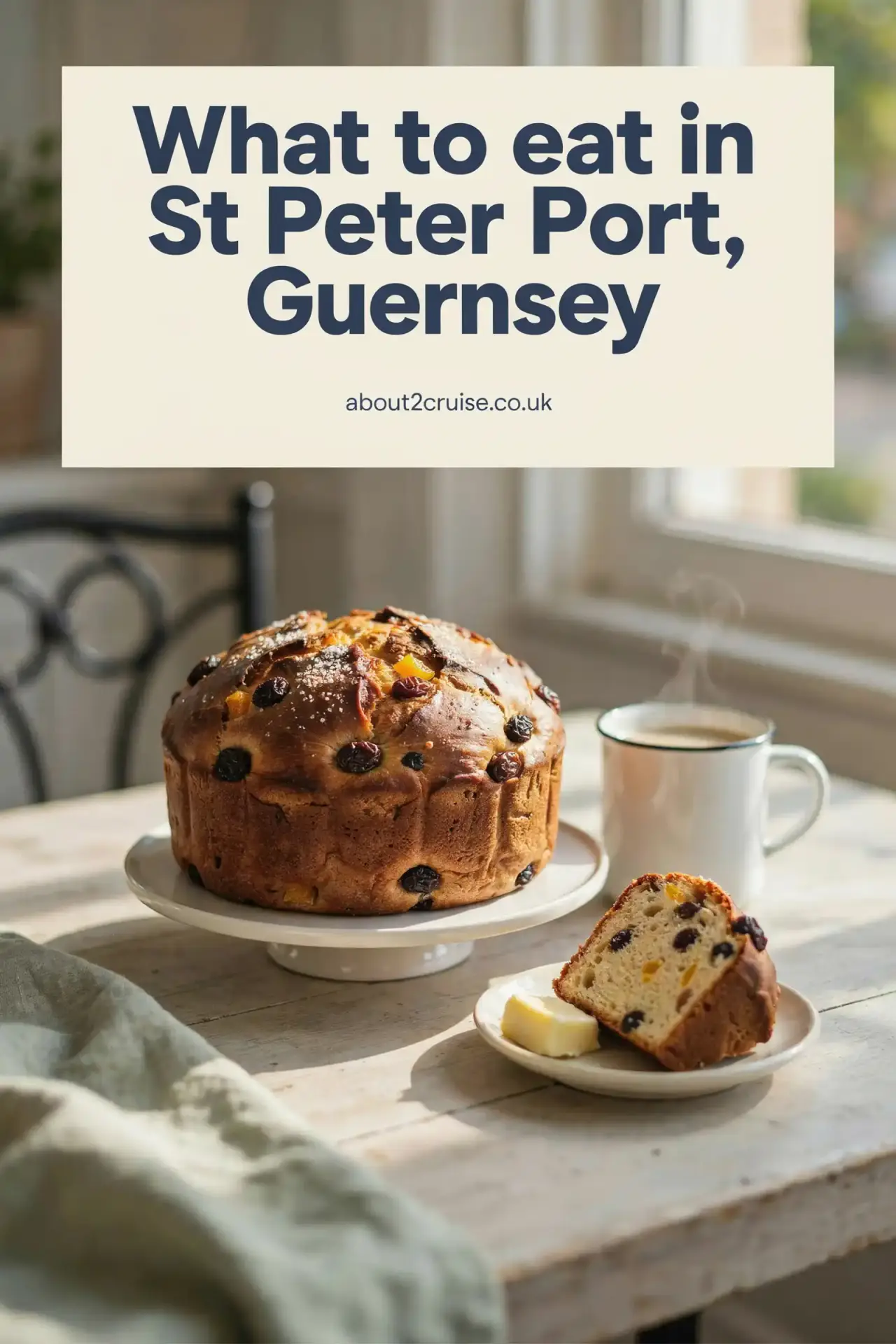
Guernsey’s food identity is local and specific. Try gâche, a fruity bread or tea loaf served with Guernsey butter; bean jar, a slow-cooked ham and haricot bean cassoulet; and local crab, lobster, scallops or brill. Guernsey dairy products, cream, butter and ice cream from local Guernsey cows, are excellent. Ormers are a famous seasonal delicacy harvested January to April, so you may miss them on a summer cruise.
The easiest place to eat without leaving town is the waterfront restaurant strip facing Victoria Marina, or the cafés around High Street and Market Square. For a short port day, order a crab sandwich, a cream tea with Guernsey cream, or a bowl of local seafood chowder. The Last Stop Shop on Albert Pier is handy for a final local snack or bottle before tendering back.
There are no international fast-food chains on the island, so do not expect a familiar burger stop. Most places are independent and many are small; on busy two-ship days, lunch service can slow down. Eat early or late to avoid the midday rush.
Self-guided walking route from Albert Pier
The most efficient DIY route from the Albert Pier tender pontoon is roughly circular. Start by following the marina side of Albert Pier to the bus terminus and Weighbridge roundabout. Then walk the Esplanade along the waterfront towards the Castle Emplacement. If Castle Cornet is open, make that your first stop and take in the noonday gun if the timing works.
After the castle, return along the waterfront and turn up the High Street or Le Pollet. Walk through the covered Market Buildings, then climb towards Candie Gardens for harbour views. Finish at Victoria Tower if you can manage the 99 steps, then drop back downhill to the tender pier.
This loop is roughly 2.5–4 hours with stops. For a shorter version, skip the castle and go straight from the pier to High Street, Market Square, Candie Gardens photos and back. The free Liberation Trail is a 10-stop self-guided route through the town’s occupation and liberation story, and the Visitor Information Centre has maps. A guided town walk runs at 10:30 from outside the Visitor Information Centre, takes about 1.5 hours and costs £10. The Petit Train also leaves from Albert Pier for a 35–40 minute narrated town tour; adult £10, child £5, under-2 free.
Candie Gardens, Guernsey Museum and quick add-ons
Candie Gardens are free and open dawn to dusk, about five minutes’ walk uphill from the centre. They have harbour views and statues of Queen Victoria and Victor Hugo. Some paths are steep. The Guernsey Museum at Candie is open daily 10:00–17:00 in the main season and 10:00–16:00 out of season. Entry is £7 for adults and £2 for children aged 7–17; under-7s go free. Café Victoria, in the Victorian bandstand, serves drinks and snacks; the shop and café can be visited without museum entry.
Victoria Tower is opposite the museum. It is free to enter, but you collect the key from the museum and climb 99 steps to the viewing platform. It gives one of the best panoramic views over St Peter Port. The Channel Islands Liquor Company distillery in the Vivier Bunker on Castle Pier is another compact stop if you want a local gin tasting or food gift.
Beyond town: Little Chapel, Fermain Bay, Herm and Sark
If you want to leave St Peter Port, the Little Chapel is the most famous half-day sight. It is a miniature chapel decorated with shells, pebbles and broken china, free to enter, and relies on donations. It opens about 9:00–16:00 in winter and 9:00–18:00 in summer. It is tiny, holds about eight people at once, and has steps inside and out.
Bus route 71 runs from the Town Terminus via St Andrew’s church and stops a short walk from the Little Chapel. Routes 61 and 71 are the visitor-friendly heritage and countryside routes. A single bus fare is £1.70, paid by contactless card only: the buses do not take cash. A one-day unlimited visitor pass is £10, and a family day pass £20. Round-island routes 91 and 92 require a day pass rather than a single fare.
Taxis are another option. The largest rank is near the Weighbridge, about a 10-minute walk from Albert Pier, and many drivers offer island tours. Use the Guernsey Taxi App for real-time requests. Private vehicle tours cost about £168 per hour for up to 10 people, with a two-hour minimum. A small-group island tour of about 2.5 hours costs around £40 per person.
For coastal views beyond town, Fermain Bay is a secluded pebble bay about an hour’s walk from St Peter Port on the cliff path. Cobo Bay on the west coast is the classic sunset spot, with three restaurants and a tearoom, but it is best left for a taxi or booked tour. Herm is about 20 minutes by ferry and Sark 30–50 minutes; both are car-free and make great full-day escapes if your call is long.
Shore excursion vs DIY in Guernsey
Book a ship excursion or local guide if you want the occupation sites in one run, multiple island stops, or the Little Chapel combined with coastal and WWII sites. Tours get tender priority, and the all-aboard stress is lower. This is the safest choice when the sea state is marginal, because the ship will usually manage or refund excursions if the call is shortened.
Go independent if your day is focused on the town: the castle, Hauteville House, Candie Gardens, High Street and Market Square are all walkable. Buses and taxis can extend a good-weather day to the Little Chapel or a single occupation site, but be strict with timings. The German Occupation Museum’s 13:00 closing time makes it the riskiest DIY add-on.
Half-day plan vs full-day plan
For a half-day or slow-tender call, do the waterfront loop: tender ashore, walk the breakwater for Castle Cornet photos, stroll the High Street and Market Buildings, stop for a crab sandwich or cream tea, then head up to Candie Gardens and Victoria Tower if you have time. You can be back at the tender in three to four comfortable hours.
Before you sail
- Book Hauteville House online early; tours are guided, small and sell out.
- Check Castle Cornet reopening status on the Guernsey Museums website.
- Carry a contactless card for buses and sterling cash for the German Occupation Museum.
Short port day: under 6 hours
- On dockingTake the tender to Albert PierCollect ticket earlyLarge ships anchor offshore; collect your tender ticket early and step across to the boat. The crossing is usually 5 to 10 minutes in calm water.
- +15 minWalk the Castle Cornet breakwaterCheck closureA 10-minute walk along the waterfront. Take the classic harbour photo from the breakwater; if Castle Cornet has reopened, weigh a longer visit against the short day.
- +45 minHigh Street and Market BuildingsWalk back along the Esplanade and head up the High Street or Le Pollet. Browse the covered market and the cobbled lanes.
- +1 hr 30 minLunch near Market SquareTry Guernsey crabOrder local crab, a bowl of seafood chowder, or a cream tea with Guernsey cream in the cafés around Market Square or the waterfront.
- +3 hrsCandie Gardens and Victoria TowerA 5-minute uphill walk from town. The gardens are free with harbour views; climb Victoria Tower's 99 steps if you have the key from the museum.
- All-aboard minus 90 minBack at Albert Pier tender queueWalk downhill to the pier and join the queue. Return earlier if the swell is building or two ships are tendering.
The time on the map is the whole walk, every stop added together.
Open this walking route in Google Maps
If plans change: If Castle Cornet is closed or the Victoria Tower key queue is long, ride the Petit Train instead and spend longer browsing the covered market.
Long port day: 8 hours or more
- On dockingTake the tender to Albert PierGo earlyBe on an early tender; queues thin after the first 60 to 90 minutes. The crossing lands you on Albert Pier, a four-minute walk from town.
- +30 minCastle Cornet if openCheck closureA 10-minute walk along the Castle Emplacement. If open, allow two hours for the four museums and the noonday gun. If closed, take photos and move on.
- +2 hrs 30 minEsplanade and harbour photo stopStroll back along the waterfront from the castle. Pause for the classic view back to Castle Cornet and across to Herm and Sark before heading into the lanes.
- +2 hrs 45 minHigh Street and Market BuildingsWalk back along the waterfront, then up the High Street or Le Pollet. Browse the covered market and independent shops.
- +3 hrs 30 minLunch near Market SquareTry bean jarOrder local crab, Guernsey bean jar, or a cream tea. The waterfront and Market Square cafés are the quickest for a cruise-day lunch.
- +4 hrs 30 minBus to the Little ChapelContactless onlyWalk to the Town Terminus and take bus route 71 towards St Andrew's church. Pay by contactless card or use a day pass.
- +5 hrs 30 minLittle Chapel visitStep off the bus and walk a short way to the tiny chapel decorated with shells and broken china. It holds about eight people and has steps inside.
The times on the map are for the whole journey there by train and bus.
Get train and bus times in Google Maps
If plans change: If the bus to the Little Chapel is full or Castle Cornet is closed, book a local island tour or spend the afternoon at Candie Gardens and the museum.
For a full day, start with the town and Castle Cornet or Hauteville House in the morning, lunch near Market Square, then either bus to the Little Chapel or join a booked afternoon tour. A workable full-day outline is: tender tickets early, Castle Cornet or Hauteville House by 10:30, town lanes and lunch 12:00–13:30, bus/taxi to Little Chapel 13:45–15:15, Candie Gardens on the return around 15:45, and walk to the tender pier by 16:30 if the last tender is 17:30. Adjust to your ship’s times.
Weather, sea state and cancellation risk
St Peter Port is an open anchorage, so the call depends on the sea. If the swell is too big, tenders cannot run safely, and the captain may shorten the day or cancel the call entirely. A small but real proportion of Guernsey calls are lost each season; sometimes the ship arrives and conditions worsen after a few hours.
Summer temperatures average around 14–19°C, with scattered rain days even in July and August. The tidal range is about 10 metres, so the coast looks different every six hours and the tender pontoon can move. Sea temperature peaks around 17°C in August.
Dress in layers, carry a lightweight rain shell, wear shoes that grip on wet cobbles, and take a light jacket if you’re heading underground. If the weather is building, return to the pier earlier than planned. A 45-minute buffer is usually enough in calm weather; in a rising swell, make it 60 minutes or more.
Returning to the ship: last tender and all-aboard buffer
There is no single published rule for how early to be at the tender pier. In practice, end your last sightseeing at the point where you can be standing in the tender queue 45–60 minutes before the last tender. The walk from the High Street or Market Square to Albert Pier is only a few minutes, but the tender queue may be long when two ships are in, and the last tender can be delayed by weather.
Watch the time, not just your watch. If the sea state is getting rougher, the ship may move the last tender earlier. If you are on a DIY bus route, add traffic and a missed-bus margin. A missed tender in Guernsey is not a missed terminal gate; you may be left ashore.
ID and port security: take your cruise card and a photographic ID. You do not normally need a passport for a round-UK or Common Travel Area cruise, but if your ship calls from outside the Common Travel Area, follow the line’s instructions. From 23 April, non-visa nationals arriving direct from outside the Common Travel Area need an Electronic Travel Authorisation. There are no routine immigration controls between Guernsey, the UK, Ireland, Jersey and the Isle of Man.
Money, cards, tax-free shopping and language
Guernsey uses pound sterling, including its own notes and coins. UK and Jersey notes circulate, but Guernsey notes are not accepted in the UK, so spend them or use a card. Major credit cards are widely accepted, and some businesses take euros but give change in sterling. There are ATMs at high-street banks and some supermarkets.
Some key places are cash-only: the German Occupation Museum is card-free, and the Little Chapel depends on donations. Buses are the opposite: contactless cards only, no cash. Pick up local notes only if you have time and want them; otherwise, a card and a small amount of sterling cash cover the day.
There is no VAT and no GST in Guernsey. That makes some goods cheaper than on the UK mainland, but you still have standard UK customs allowances on return. Duty-free limits and the £390 goods allowance apply on commercial air/sea services for travellers aged 17+.
English is the language, though you will hear French-influenced place names like Le Pollet and Hauteville. Local etiquette is simple: queue normally, be patient at tenders and narrow lanes, and respect the hill: locals will not think less of you for pausing at the top of a cobbled street.
Mobility, accessibility and what to wear
St Peter Port is not flat. The waterfront and Esplanade are easy, but the High Street and Le Pollet are cobbled, the hill above town is real, and many historic sights have steps. Hauteville House has stairs on all five levels. Victoria Tower requires 99 steps. Candie Gardens has steep paths. The Little Chapel is very small and has steps. Castle Cornet has a breakwater walk and uneven surfaces.

For anyone with limited mobility, the good options are the waterfront/Esplanade, the Petit Train, the bus tour, or a private taxi tour. The accessible toilet is at Albert Pier, and the tender waiting area has extra shade and cover, but the step from platform to tender can be hard in a swell. If you use a wheelchair or scooter, ask the crew before boarding the tender and keep to the waterfront unless you have a pre-arranged tour.
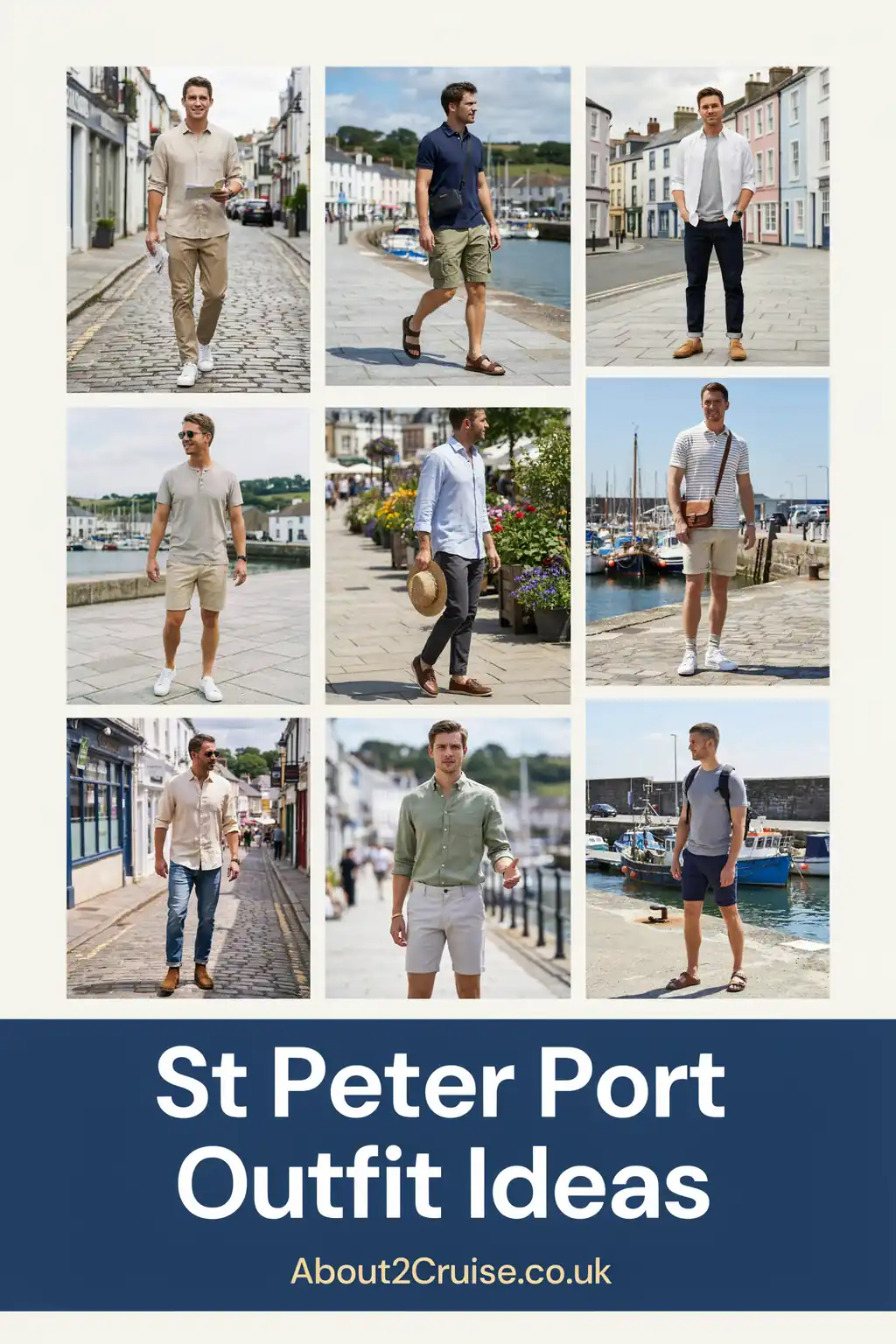
Wear sturdy, non-slip shoes. Bring a lightweight waterproof, a warm layer, and sunglasses or sunscreen in summer. If you are heading into the German Underground Hospital, a light jacket is useful even on a sunny day.
Toilets, Wi-Fi, shelter and rainy-day options
Free public toilets, including accessible facilities, are next to the bus terminus and on Albert Pier and Crown Pier. They are open 24/7. Free Wi-Fi is available around the Albert Pier arrivals area and with many cafés if you buy a drink.
If it rains, the best indoor options are Guernsey Museum at Candie, Hauteville House if booked, the German Occupation Museum or Underground Hospital, and the covered Market Buildings. The cobbles become slippery, so the simplest rainy-day plan is a museum, a long lunch, and the Petit Train if it still runs.
Photo stops in St Peter Port
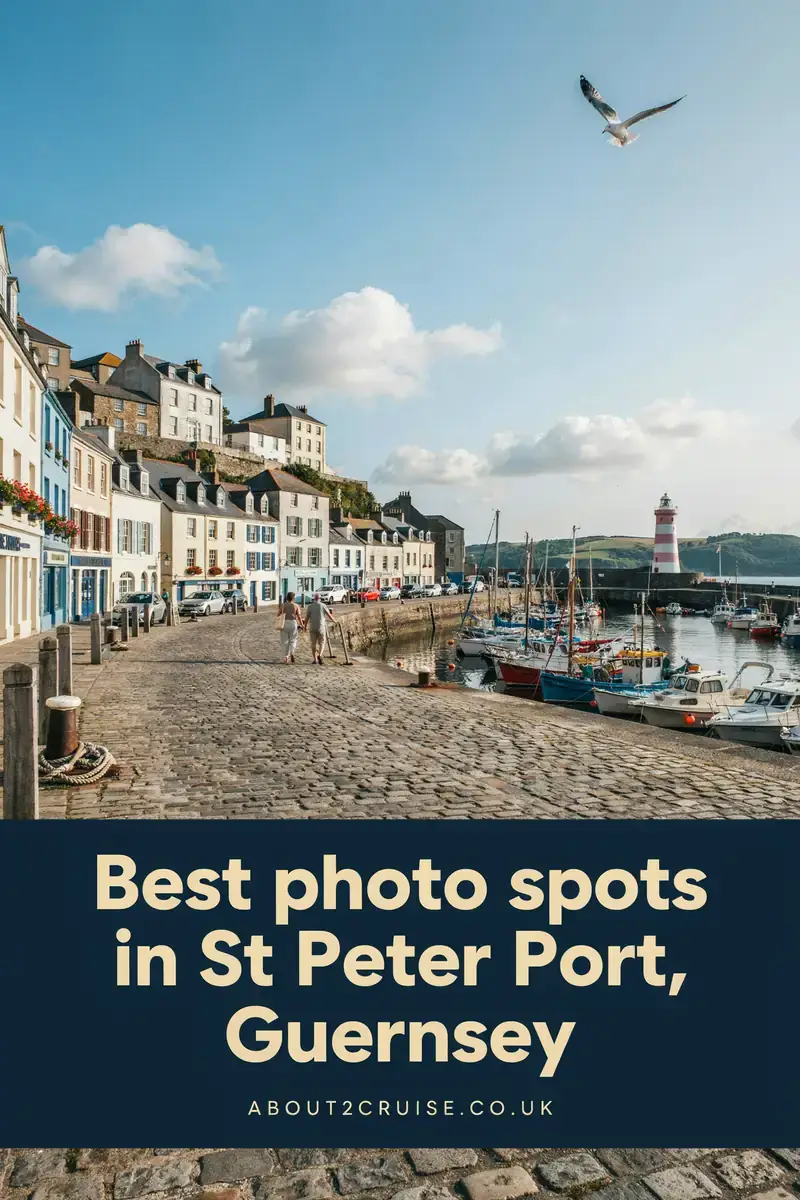
The best harbour and ship view is from the breakwater or Castle Emplacement, looking back at the town and across to Herm and Sark. Victoria Tower gives a higher panoramic view and is free once you have the key. Candie Gardens has statues and wide views over the port. Fermain Bay is a photogenic cliff-path bay about an hour’s walk away. Cobo Bay on the west coast is the sunset classic, but needs transport.
What to skip on a short or slow-tender call
If your call is under six hours or the tender process is delayed, skip the Little Chapel, the German Occupation Museum, Cobo Bay and Herm/Sark. Do not attempt Hauteville House unless you have a confirmed late slot and a comfortable time buffer. If Castle Cornet is closed, photograph it from the breakwater and shift your day to the town, Candie Gardens and a good lunch.
Family-friendly and low-mobility versions of the day
For families, the easiest happy path is the Petit Train from Albert Pier, Castle Cornet when open, the noonday gun, the covered market for snacks, and an ice cream on the waterfront. Older children may enjoy the occupation tunnels and the Victoria Tower climb, but those are colder and steeper than they look.
For low-mobility cruisers, skip the hill and the steps. Walk or take a taxi to the Esplanade, ride the Petit Train if you can manage boarding, and book a private island tour by car if you can secure one. St Peter Port is charming at the waterfront level, so you can still get a real sense of the island without climbing.
Our UK cruise ports of call guide covers the other Channel Islands and UK ports cruise ships call at.
St Peter Port FAQ: quick answers for cruisers
Is St Peter Port in the UK?
No. Guernsey is a self-governing Crown Dependency, not part of the United Kingdom and not a British Overseas Territory. It uses sterling, is in the Common Travel Area, and the UK handles defence and international relations.
Does my ship dock or tender in Guernsey?
Most large cruise ships anchor offshore and tender. Ships up to about 130 metres can sometimes berth alongside at Berth 1, but the normal cruise experience is a short tender ride to the Albert Pier pontoon.
How far is the town from the tender pier?
The main High Street is about a four-minute walk from Albert Pier. The covered market and Visitor Information Centre are slightly further, maybe five to eight minutes on foot.
Is Castle Cornet open?
It is currently closed while the bridge to the breakwater is replaced, with reopening planned for early June. Check the Guernsey Museums website just before your cruise. The outside is still viewable from the waterfront and breakwater.
Can I visit the German Occupation Museum from a cruise ship?
Yes, but it is open 10:00–13:00 daily with last entry at 12:15, takes cash only, and is near the airport. If you are not on a tour, you need to go there first in the morning and use a taxi or pre-planned bus rather than trying to slot it in after lunch.
Does Guernsey accept euros?
Some businesses take euros, but change is usually given in sterling and the rate may not be great. Use a card or sterling cash. The bus network is contactless only and does not take cash.
Is Guernsey tax-free?
There is no VAT or GST on the island. However, standard UK customs allowances still apply when you return, including the £390 goods allowance for travellers on commercial sea and air services.
Is there left luggage at the tender pier?
No. St Peter Port is a port of call, not an embarkation port, so there is no terminal left-luggage service at Albert Pier. The nearest left-luggage desk is at Guernsey Airport.
What should I do if it rains?
Head to Guernsey Museum at Candie, the German Underground Hospital, Hauteville House if booked, or the covered Market Buildings. The town’s cobbles get slick, so stick to indoor stops and leave extra time for the tender queue.
What time should I return to the ship?
Plan to be at the Albert Pier tender queue at least 45–60 minutes before the last tender listed in your ship’s daily programme. In rough weather, return earlier, because the ship may shorten the shore call.
Nearby cruise ports
If your cruise also calls in Normandy or Brittany, compare the day shape with Saint-Malo’s walled city, Cherbourg’s Cité de la Mer and Honfleur’s harbour. Each is a very different French port day but equally easy to overfill.
Read more: Saint-Malo cruise port guide, Cherbourg cruise port guide, Honfleur cruise port guide.
Last Updated: 15 November 2026