
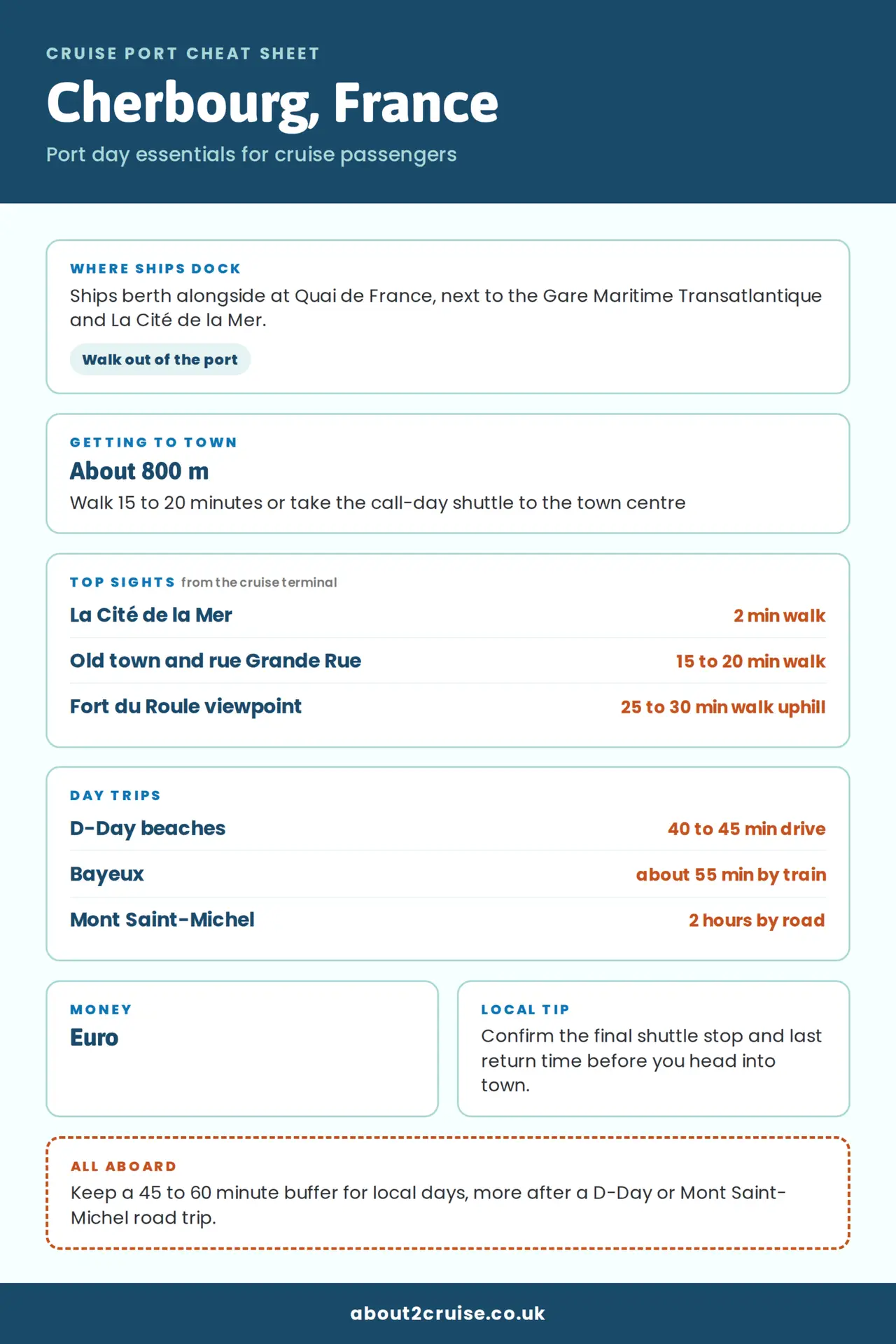
Cherbourg is a walkable deep-water cruise port at the tip of Normandy’s Cotentin peninsula. Ships berth alongside at Quai de France, directly beside the Art Deco Gare Maritime Transatlantique and La Cité de la Mer. The town centre is 10–20 minutes on foot or a short shuttle ride. Most passengers stay local, eat seafood, shop, or run D-Day and Mont Saint-Michel excursions.
Cherbourg at a Glance
Cherbourg is famous for one of the largest artificial harbours in Europe. Massive breakwaters create a calm, deep-water port, which is exactly why Titanic could anchor here in 1912.
The cruise terminal is the 1933 Art Deco Gare Maritime Transatlantique, the last great transatlantic terminal of its kind in Europe. It still dominates the waterfront. Cherbourg was Titanic’s only continental call, a major naval arsenal and liberation port, and the setting for Les Parapluies de Cherbourg: yes, the film that made Cherbourg umbrellas famous far beyond Normandy.
Within Normandy’s cruise geography, Cherbourg is the deep-water Cotentin call, not part of the Seine river cruise corridor. If you’re comparing other ports in the region, see Honfleur and Rouen. For the wider picture, take a look at our guide to Northern France’s cruise ports.
Cruise Terminal vs Ferry Terminal: Don’t Get Them Mixed Up
Cruise ships dock at Quai de France, a 600m alongside berth with depths up to 14m. There’s no tendering in normal operations. You walk straight off the gangway into a covered pedestrian walkway and then into the terminal. The terminal is the Gare Maritime Transatlantique, and it’s close enough to town that most people can walk.
The ferry terminal is a different building entirely. That’s the Gare Maritime Transmanche on Quai de Normandie. Brittany Ferries runs to Portsmouth, and Irish Ferries runs to Dublin and Rosslare; Poole–Cherbourg sailings have ended.
If you’re using sat-nav or asking for directions, say “Terminal Croisière, Quai de France” for the ship, not “Terminal Transmanche.”
Some port summaries list both quays as possible cruise infrastructure, but cruise calls overwhelmingly use Quai de France. Check the daily berth confirmation on board before you leave the ship.

Cherbourg cruise port map
Ships dock at Cruise terminal at Quai de France. From the cruise terminal, La Cité de la Mer is about a 2-minute walk, Port Chantereyne about 7 minutes and Parapluie de Cherbourg factory about 18 minutes. Tap a pin for directions.
- Cruise terminal at Quai de FranceWhere ships dock
- Ferry terminal Gare Maritime TransmancheWhere ships dock
- Gare de CherbourgRailway station · About 2 min walk from the cruise terminal
- La Cité de la MerMaritime museum · About 2 min walk from the cruise terminal
- Port ChantereyneMarina · About 7 min walk from the cruise terminal
- tourist office (shuttle drop-off)Tourist office · About 16 min walk from the cruise terminal
- Parapluie de Cherbourg factoryUmbrella factory · About 18 min walk from the cruise terminal
- Parc Emmanuel LiaisBotanical garden · About 19 min walk from the cruise terminal
- Musée Thomas HenryArt museum · About 20 min walk from the cruise terminal
- Fort du RouleHilltop fort · About 2 km from the cruise terminal
- Nez de JobourgCoastal cliffs · About 23 km from the cruise terminal
- Sainte-Mère-ÉgliseAbout 34 km from the cruise terminal
- Utah BeachBeach · About 41 km from the cruise terminal
- Place du Général de GaulleSquare · About 6 km from the cruise terminal
How to Get from the Ship into Town
The distance depends on where you measure. The port says the town centre is about half a mile away, or 800m. Other walking routes put the central shopping streets at around 1.4km, roughly 20 minutes over flat ground. It’s an easy, paved walk past the marina and along the waterfront. Allow 15–20 minutes.
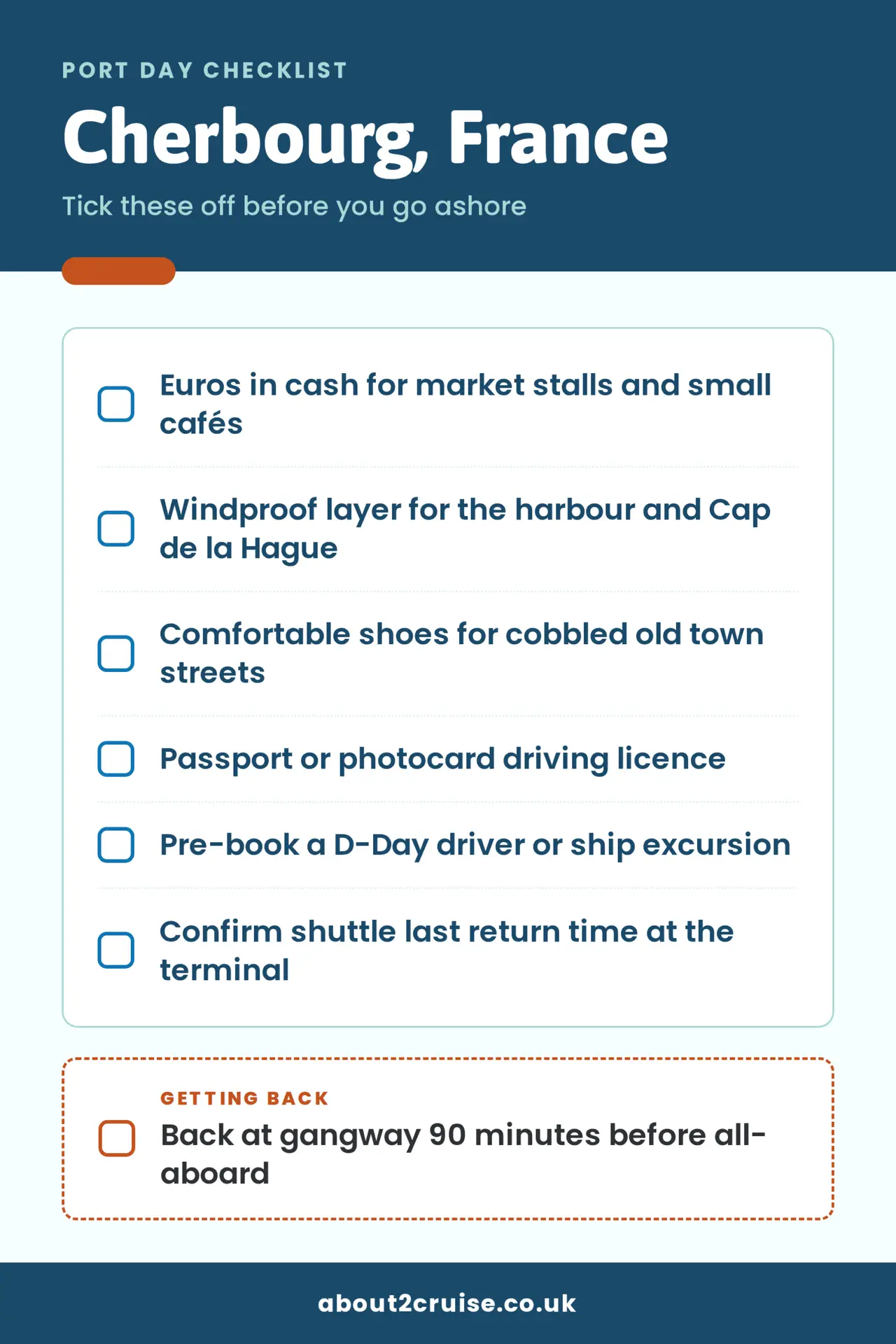
On cruise call days, a shuttle usually connects the terminal with the town centre, often stopping near the tourist office and shopping area. The port confirms shuttles operate, but no fixed timetable or fare is published. Some past seasons have used a €4 all-day ticket with a lunchtime gap. Don’t rely on that without checking at the terminal. Confirm the final shuttle stop and last return time before you walk away.
Taxis aren’t always lined up in large numbers. A terminal-to-centre taxi is estimated at about €8–12, but availability isn’t guaranteed. For out-of-town trips, agree a fixed price including waiting and return before setting off.
Build in a return-to-ship buffer of at least 45–60 minutes for local sightseeing, and much more after a regional road trip. This isn’t the port to roll up at the gangway exactly at all-aboard.
If you are also visiting Guernsey, our St Peter Port cruise port guide covers tender arrangements, Castle Cornet and town plans.
Finding Your Bearings
The mental map is simple. The cruise terminal and La Cité de la Mer sit on the inner harbour. The pedestrian centre, markets and shopping streets lie immediately west and southwest behind the marina. The SNCF station is about 1.6km from La Cité de la Mer, and the old-town streets run between the water and the Bassin du Commerce.
You can pick up a town plan at the tourist office desk inside the terminal. The street layout is compact enough that you can navigate by the harbour and marina as landmarks.
Terminal Facilities You Can Count On
The terminal itself is the Art Deco Gare Maritime Transatlantique, split across two levels with lifts. Published facilities include:
- Customs and police desk
- Cruise-line desk
- Luggage screening
- Short- and long-stay car park
- Hospitality desk
- Gift shop
- La Cité de la Mer ticketing
- Toilets
- Free Wi-Fi
On call days you may also find local exhibitors, temporary exhibitions and volunteer cruise greeters.
The tourist office desk inside the terminal is unusually useful. Staff cover French, English, Spanish, Italian and German, sell Cap Cotentin bus tickets, and run a boutique. There is no left-luggage office at the terminal, so plan to carry anything you need.
A cash point, restaurant and bar are at La Cité de la Mer next door, which is also the easiest place to buy museum tickets before heading into town.
La Cité de la Mer and the Redoutable Submarine
For many cruisers this is the headline sight because it’s directly beside the berth. La Cité de la Mer is a large maritime museum built around the Titanic story, deep-sea exploration and the submarine Le Redoutable, France’s first nuclear-powered ballistic-missile submarine. She is 128m long and carried a crew of 135 on 58 patrols.
Allow at least four hours if you want to see the submarine, the Titanic exhibition, the aquarium and the deep-sea galleries. Tickets cost €21 for adults, €15 for children aged 5–17, and under-5s go free but cannot board the submarine. Last admission is 1.5 hours before closing, and the ticket is valid all day with re-entry.
The submarine route is tight, with low passages and steep ladders in places. It isn’t wheelchair-accessible, and claustrophobic visitors often skip it.
Titanic in Cherbourg: The Exhibition and the Terminal
Cherbourg was Titanic’s only continental call. At 18:35 on 10 April 1912 the ship anchored in the artificial harbour and took on 281 passengers, who were ferried out by the tenders Nomadic and Traffic.
The museum’s permanent Titanic exhibition sits in the original Art Deco Baggage Hall and displays 42 artefacts from the wreck’s debris field.
If you’re visiting on a cruise call, note that the emigration part of the Baggage Hall is sometimes closed, while the Titanic exhibition itself remains open. The building is worth seeing even if you don’t buy a museum ticket. The 1933 Art Deco halls are the last great transatlantic terminal of their kind in Europe.
The Umbrella Trail and the Cherbourg Umbrella Factory
Cherbourg’s umbrella fame comes from Jacques Demy’s 1964 film Les Parapluies de Cherbourg, which won the Palme d’Or and is entirely sung. A 2.9km walking trail links filming locations in the centre, marked by QR-code panels. The famous umbrella shopfront was dressed for filming at 13 rue du Port.
The modern umbrella manufactory is separate and occupies the old Banque de France building at 22 quai Alexandre III. A Cherbourg umbrella involves around 37 manual steps, and the workshop holds a French living-heritage label. Guided tours cost €8 for adults and €4 for children aged 6–18; self-guided visits run more flexibly. Book ahead for groups. The factory is accessible for people with reduced mobility.
Fort du Roule: The Best Harbour View
For the best view over the harbour and a clear introduction to the Battle of Cherbourg, climb or drive to the Musée de la Libération inside Fort du Roule.
The fort was built in the 19th century above the harbour, and the museum has been here since 1954, making it one of the earliest Second World War memorial museums. It covers occupation, the battle to take Cherbourg as the first liberated major port, and reconstruction, before finishing at a panorama over the harbour.
Admission is €5, reduced €3, free for under-26s and free every Wednesday. The climb from town averages an 8.6% gradient over about 1.1km, gaining roughly 93m. It’s steep but manageable on foot. German bunkers and galleries were driven under the fort by forced labour, and some fortifications near the top are accessible.
There is no publicly visitable U-boat bunker in Cherbourg. The submarine on show is the French Le Redoutable at La Cité de la Mer.
Thomas Henry Museum and a Quick Art Fix
For a compact art stop in the centre, the Musée Thomas Henry holds one of Normandy’s stronger provincial collections, with French and European painting from the 15th to the 20th century.
Admission is €6 for adults, free for under-26s and free on Wednesdays. Cruise passengers can sometimes get a reduced €4 rate with the coupon in the port guide.
It’s small enough to visit in under an hour and sits in the same old-town area as the covered passages and the umbrella trail.
Parc Emmanuel Liais
Parc Emmanuel Liais is a free botanical-style city park with mature exotic trees, a tropical greenhouse and quiet paths. It’s open every day of the year and works well as a short break after the old town or before heading back to the ship. Cherbourg’s centre isn’t overflowing with green space, so this is the easiest proper park to reach on foot.
The Harbour, Breakwaters and Best Viewpoints
Cherbourg’s harbour is not a narrow river port. It’s Europe’s largest artificial harbour, protected by dikes that create a huge sheltered roadstead. That’s why Titanic could anchor here, and why the port remains usable around the clock.
The inner Port Chantereyne marina has about 1,800 berths and a line of restaurant terraces facing the water.
The best quick viewpoint is Fort du Roule, 117m above the town, with a 360-degree view over the harbour, bay and Channel.
Further afield, the Nez de Jobourg cliffs on the Cap de la Hague stand 128m above the sea about 30 minutes’ drive west. They are extremely exposed, so bring a windproof layer even in summer. Nearby Goury lighthouse and the tiny port of Port Racine are quieter photo stops.
Seafood, Markets and Norman Food to Try
Cherbourg is a fishing port first, so food is a good use of a port day. Look for Cotentin oysters from Saint-Vaast-la-Hougue, Barfleur mussels, blue lobster, scallops and salmon farmed in the Cherbourg roadstead.
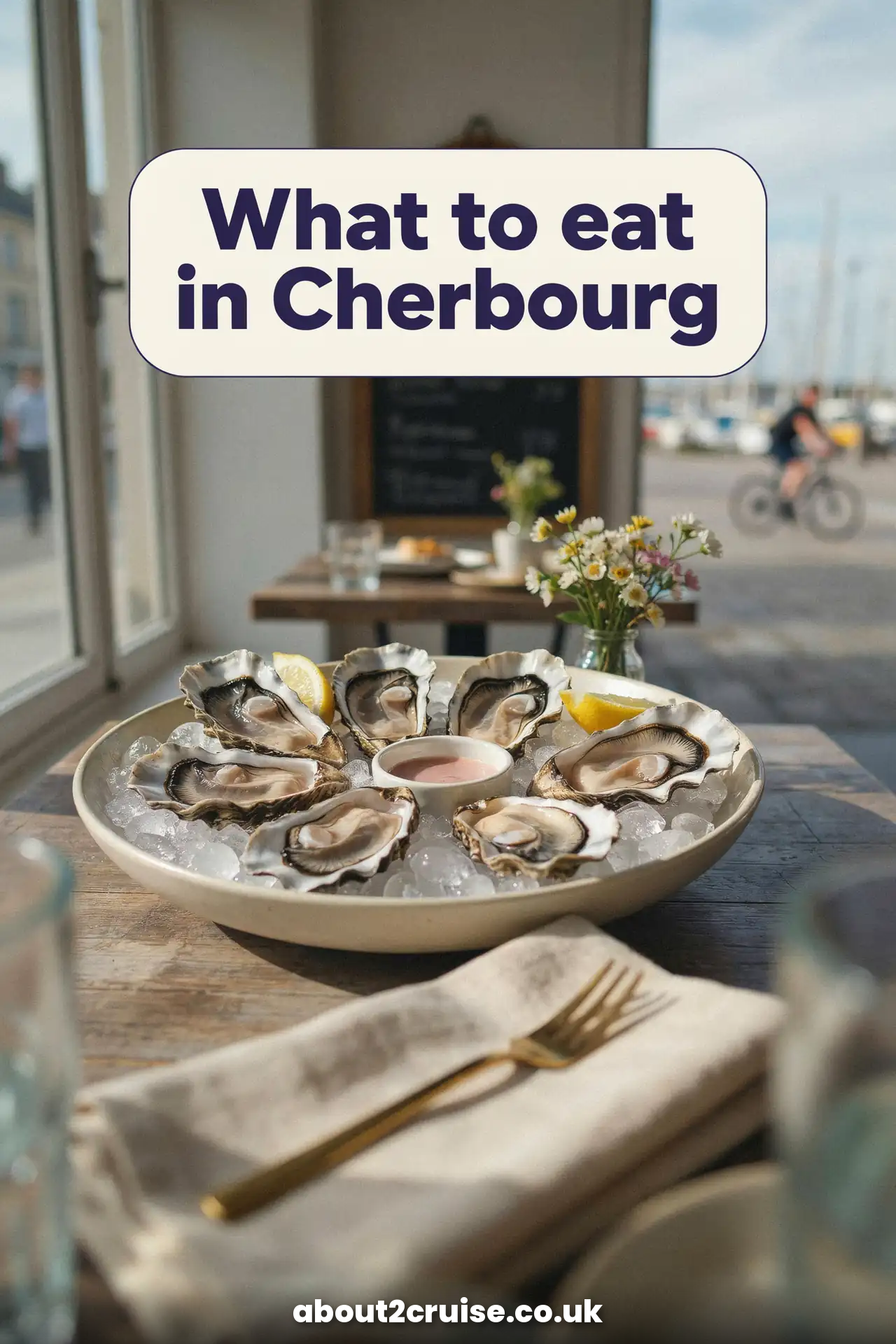
The old-town fishmongers cluster around rue Grande Rue. The marina terraces at Port Chantereyne are better for outside dining than for bargain prices.
The biggest central market is Thursday morning from about 9:00 to 14:00 on place du Général de Gaulle and place Centrale. Saturday is the other main market day, and there’s a Sunday market in Octeville on avenue de Normandie. Expect around 100 traders on the big days.
Norman specialties worth trying include Camembert de Normandie, Livarot, Pont-l’Évêque and Neufchâtel, plus teurgoule rice pudding, tarte normande, gâche and Isigny caramels. For drinks, Cotentin cider holds AOP status, and poiré, pommeau and calvados are easy to find. A trou normand is the local habit of a small calvados between courses.
How to Plan a Cherbourg Port Day
If you stay local, a relaxed day works well. Start at La Cité de la Mer while you’re still beside the ship. Give the submarine and Titanic exhibition 2–4 hours, then walk into the old town for lunch, the umbrella shop and the Thomas Henry Museum or a market. Finish with the Fort du Roule viewpoint before walking back to Quai de France.
A half-day option is the Cap de la Hague loop: Nez de Jobourg, Goury lighthouse and a seafood stop, keeping the afternoon for Cherbourg’s centre. A full day opens up D-Day sites or, if you’re ambitious and time-rich, Mont Saint-Michel.
Shore excursions in this region tend to split between D-Day beaches, Mont Saint-Michel, Bayeux and the Cotentin. D-Day is the most popular from Cherbourg. Because the port sits at the tip of the peninsula, Utah Beach and Sainte-Mère-Église are closer than Omaha.
D-Day Beaches from Cherbourg: What’s Realistic
Cherbourg is the closest cruise port to the western D-Day sector.
Sainte-Mère-Église is about 40–45 minutes by road. Utah Beach is another 15 minutes beyond that. Omaha Beach and the American Cemetery at Colleville-sur-Mer are about 90 minutes away. A thorough D-Day tour needs a full port day. Don’t expect to combine Utah, Omaha and Bayeux comfortably unless you’re on a long call.
The Airborne Museum at Sainte-Mère-Église costs €11.50 for adults and €7.50 for children aged 6–16. The Utah Beach Museum costs €10 for adults and €6.50 for children, with long summer hours.
The sites are dispersed, so public transport isn’t designed around cruise schedules. Organised ship excursions or a pre-booked private driver are the sensible options.
If you go independently, agree the full route and waiting time in advance. Drivers have quoted Utah Beach from around €120 return and Mont Saint-Michel from around €350, but these are not official tariffs. Check whether your ship’s all-aboard time leaves at least a 90-minute buffer after the farthest planned stop.
Bayeux and Mont Saint-Michel from Cherbourg: Can You Do Them?
Mont Saint-Michel is possible from Cherbourg, but it’s a long day. The drive is about 177km and roughly two hours each way. The abbey isn’t at the car park either: allow up to an hour extra each way between the coach park and the mount.
Abbey admission is €16 from April to September and €13 from October to March, free for under-18s and EU citizens aged 18–25. The abbey also offers a reduced €13 rate if you show a La Cité de la Mer ticket. This trip works best as a ship excursion with guaranteed return.
Bayeux is more forgiving. Cherbourg to Bayeux is about 53–55 minutes by direct train or around an hour by road. That said, the famous Bayeux Tapestry museum is closed for renovation, and the tapestry itself has been on loan in London. Check what’s actually showing before buying a day trip. An immersive exhibition in Bayeux charges €7 full and €5.50 reduced, but it isn’t the same as seeing the original.
Trains, Buses and Onward Travel
Cherbourg is the western terminus of the Paris Saint-Lazare line. Direct trains to Paris take about 3h14, with cheap fares from €21 when booked early. Bayeux is about 53–55 minutes by direct train, which makes a semi-independent Bayeux day possible if the timetable matches your port time.
The SNCF station is about 1.6km from La Cité de la Mer and the cruise terminal area.
Local Cap Cotentin buses are cheap: about €1 if bought before boarding, €1.50 on board, or €4 for a 24-hour ticket. Bus line 8 serves a stop about 700m from La Cité de la Mer. For most cruise passengers, the shuttle and walking are more useful than local buses unless you have a specific suburb or museum in mind.
Cherbourg–Maupertus airport lies about 11km east of the centre, roughly 15–20 minutes by road, with a taxi fare around €25–30. It mainly handles business, charter and private flights rather than scheduled services.
If you’re starting or ending a cruise here, several hotels sit near the marina and terminal, including Ambassadeur Hôtel, Hôtel Le Cercle, Mercure Cherbourg Centre Port and Hotel Chantereyne.
If your cruise also calls at Le Havre, our Le Havre cruise port guide compares the options for reaching Paris, Honfleur and Rouen.
If your cruise also calls at Saint-Malo, our Saint-Malo cruise port guide covers the old town, local transport and top sights.
Weather, Tides and What to Wear
Daytime highs in cruise season are mild: around 15°C in May and October, and 18–20°C from June to September. Rain is possible all year, with July the driest month. Wind is the bigger factor around the harbour and west coast. The Cap de la Hague can feel cold even in summer.


Bring a windproof layer and an umbrella: fittingly enough.
The tidal range at the berth is 6.7m, but Cherbourg’s cruise berth is accessible around the clock without tide constraints. The old town has cobbled streets and covered passages, so choose comfortable shoes with grip. For Fort du Roule, treat the climb as a steep walk, not a casual stroll.
Money, Language and Staying Safe
France uses the euro. Cards and contactless are accepted almost everywhere, usually without a PIN under about €50. Cash is still useful at open-air markets, small cafés, bakeries and public toilets. Choose euros rather than your home currency at card terminals and ATMs, and use bank-branch ATMs if possible.
Tipping is light because service is included. Rounding up or leaving a euro or two is normal.
The terminal tourist office desk covers French, English, Spanish, Italian and German, so language is rarely a problem at the port. In town, you’ll get further with a few French pleasantries than switching straight to English, but many restaurant and museum staff see cruise passengers daily.
Standard France travel sense applies. Pickpockets can work in groups and use distraction around tourist attractions and ATMs. Keep valuables in separate bags and carry bags across the body. You must be able to prove identity with a passport or photocard driving licence. Industrial action can disrupt trains and roads at short notice, which is another reason to keep a healthy return buffer.
Accessibility and Mobility
Cherbourg is better than average for a flat waterfront approach. Ships berth alongside, the terminal has lifts, and the route into town is generally paved and level. The main caveats are distance in bad weather and some uneven old-town surfaces.
Inside La Cité de la Mer, lifts serve the upper floors and the Titanic exhibition, and wheelchairs can be borrowed subject to availability. The submarine route itself is not wheelchair-accessible. The umbrella factory is accessible for people with reduced mobility.
No official adapted taxi or wheelchair-accessible shuttle operator is named by the port or tourist office, so if you need adapted transport, arrange it privately before arrival.
Parking, Drop-Off, Webcams and Ship Tracking
If you’re arriving as an independent traveller, the cruise terminal has a short-stay and long-stay car park, but no terminal tariff is published. The car park in front of La Cité de la Mer’s main entrance is free and has coach spaces.
City-centre on-street parking is cheap: €0.60 for the first half hour and a maximum of €0.90 for two hours, free from 12:00–14:00 and after 18:00, and free all day Sundays and public holidays.
For live arrivals, Cherbourg’s port code is FRCER, and you can track ships on the usual AIS sites. A port webcam looks over the harbour from Port Chantereyne, but it doesn’t show the Quai de France cruise berth. The published call schedule is on encotentin.fr. Cherbourg has been expanding to around 74 calls a year at maximum capacity, but no double or triple calls were scheduled in recent seasons.
If you’re meeting a ferry instead, the ferry terminal at Quai de Normandie has free short-stay parking in front of the building and no long-stay car park.
How to spend a port day in Cherbourg
A port day in Cherbourg works best if you pick one: a walkable local loop through La Cité de la Mer, the old town and Fort du Roule, or a pre-booked drive to the D-Day beaches.
Before you sail
- Pre-book a private D-Day driver or ship excursion for the western sector.
- Check whether the Bayeux Tapestry is back in Bayeux before booking a day trip.
- Check French train strikes and industrial action before regional DIY trips.
Short port day: under 6 hours
- On dockingWalk into La Cité de la MerBook online aheadThe museum is beside the terminal. Reserve timed tickets online before the port day to skip the main queue.
- +30 minLe Redoutable submarine and Titanic exhibitionAllow 2 hoursFollow the submarine route and the Titanic Baggage Hall; under-5s cannot board the submarine.
- +2 hrs 30 minUmbrella factory and old town trailQR code panelsWalk 10 minutes to quai Alexandre III, then follow the Les Parapluies de Cherbourg trail into the old town.
- +3 hrs 30 minLunch near Place du Général de GaulleTry Cotentin oystersMarket streets and brasseries serve Cotentin oysters, Barfleur mussels and local cider.
- +4 hrs 15 minFort du Roule viewpointSteep climbClimb from the town side for the harbour panorama; the 8.6% gradient is steep, so pace yourself.
- All-aboard minus 1 hrBack at the cruise terminalWalk back down to the terminal. If time is tight, the town centre is a short taxi ride.
The time on the map is the whole walk, every stop added together.
Open this walking route in Google Maps
If plans change: If La Cité de la Mer is crowded, swap the submarine for the Thomas Henry Museum and Parc Emmanuel Liais before climbing to Fort du Roule.
Long port day: 8 hours or more
- On dockingMeet your pre-booked D-Day driver or coachBook aheadPrivate drivers and ship excursions are the reliable option for dispersed D-Day sites. Meet at the terminal.
- +30 minDrive to Sainte-Mère-ÉgliseAbout 40 to 45 minutes by road. Ask the driver to stop at the Airborne Museum.
- +1 hr 15 minAirborne Museum and churchAllow 75 minutesVisit the airborne exhibits and the church. Pre-book a timed ticket to avoid the queue.
- +2 hrs 45 minDrive to Utah Beach and visit the museumDrive 15 minutes further. The Utah Beach Museum sits right by the shore; allow 90 minutes.
- +4 hrs 15 minLunch at a Cotentin village caféTry moules marinièresStop at a village café for Cotentin mussels, oysters or a galette. Agree the stop with your driver.
- +5 hrs 30 minFinal photo stop at Sainte-Mère-ÉgliseLast photo stopAfter lunch, make one last photo stop at Sainte-Mère-Église church and the airborne sites before the return drive.
- All-aboard minus 90 minBack at the cruise terminalDrive back to Cherbourg and be at the gangway with 90 minutes to spare after the road trip.
This map shows the taxi ride from the ship. The time is the drive only, not your time ashore.
Open the taxi route in Google Maps
If plans change: If the D-Day tour runs late or sites are overcrowded, drop Utah Beach and return with Sainte-Mère-Église only; a ship excursion is the safest fallback.
Cherbourg Cruise Port FAQs
Do cruise ships tender in Cherbourg?
No. Cruise ships berth alongside at Quai de France, so you walk off directly into the terminal.
Is Cherbourg the same as Cherbourg-en-Cotentin?
Yes. Cherbourg-en-Cotentin is the merged municipality. Road signs and maps may use the longer name, but the cruise port and town are the same place.
Is the Titanic exhibition open on cruise ship call days?
Yes. The emigration section of the Baggage Hall may close when ships are in, but the Titanic exhibition remains open.
Can I walk to the old town with a wheelchair or pushchair?
Yes, with care. The waterfront route is mostly paved and flat, but it’s 800m–1.4km depending on where you’re going, and the old town has cobbles and some uneven passages.
Is Mont Saint-Michel realistic from Cherbourg?
Only on a long call and ideally on a ship excursion or pre-booked private trip. The drive is about two hours each way, plus up to an hour each way between the coach park and the mount.
Is the Bayeux Tapestry in Bayeux?
Not at present. The museum is closed for renovation, and the tapestry has been on loan in London. Check locally before planning a Bayeux day trip around it.
Is there left luggage at the cruise terminal?
No. The terminal list does not include left luggage. The nearest documented luggage storage is near the SNCF station, or you may be able to leave bags with a hotel if you are staying.
Do I need euros for the shuttle or small purchases?
Yes. Cards work widely, but small market stalls, bakeries and cafés may prefer cash. Shuttle ticketing has varied by season, so carry enough euro coins and small notes for transport.