
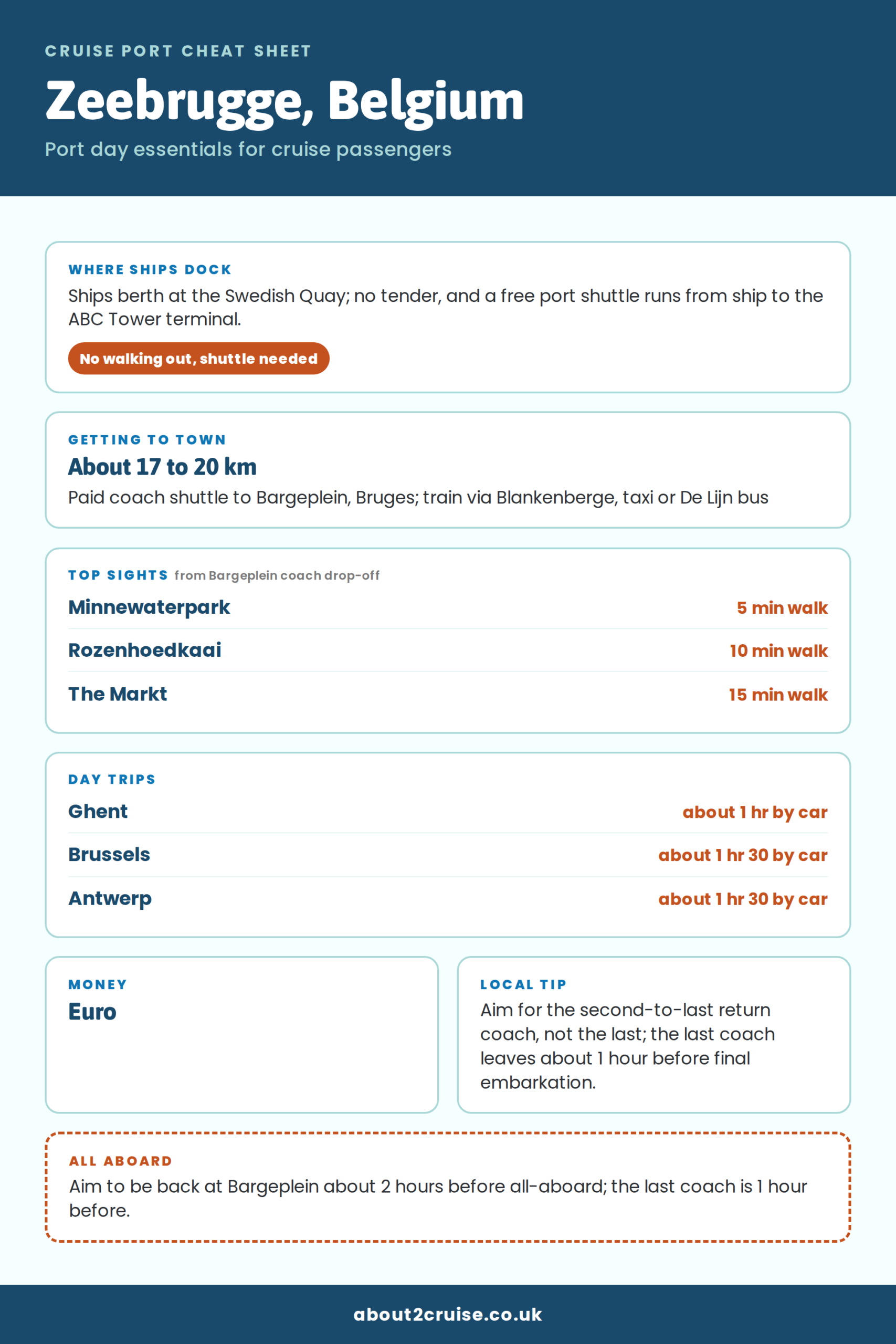
Ships dock at Zeebrugge’s Swedish Quay, 17–20 km from Bruges. The free shuttle only takes you from ship to terminal gate. Onward travel to Bruges is paid: coach, train, taxi or bus. Bruges is a compact UNESCO-listed medieval city of canals, chocolate, beer and the Belfry. Leave a solid return buffer.
Why You’re Really Visiting Bruges, Not Zeebrugge
Zeebrugge is an industrial harbour and ferry port. The place you actually want to see is Bruges, roughly 17–20 km inland. The whole egg-shaped historic centre is a UNESCO World Heritage site, and it packs more medieval atmosphere per square metre than almost anywhere in northern Europe.
Think canals, stepped gables, cobbled squares, the Belfry, horse-drawn carriages, lace shops, chocolate windows and warm brown cafés. For cruise passengers, the headline is simple: even though your ship is berthed at Zeebrugge, you’re really doing a Bruges port day.
Belgium’s food and drink are a major part of the stop. Bruges is known for praline chocolate, Brugse Zot and Straffe Hendrik beer, double-fried frites with mayonnaise, Liège and Brussels waffles, moules-frites, waterzooi and beef stewed in dark beer. You can do all of that in a few hours on foot.
How Far Is Zeebrugge Cruise Port from Bruges?
Zeebrugge cruise terminal to Bruges is about 17–20 km, or roughly 12 miles. By road, the journey should take 20–30 minutes depending on traffic. Coach shuttles from the port to Bruges usually quote 20–30 minutes. The train connection via Blankenberge takes about 11 minutes once you’re on the train, but you also need to get from the ship to the station first.
Don’t confuse Zeebrugge Dorp, the small local village near the port, with Bruges city centre. If you type “Zeebrugge centre” into a map app, you may end up somewhere very different from the Bruges Markt.
Where Ships Dock at Zeebrugge and How to Check Your Berth
There’s no tender at Zeebrugge. Ships tie up at the main cruise berth on the Zweedse Kaai, also called Swedish Quay, quays 702–705 along the Kustlaan before the Pierre Vandamme lock. Up to two cruise ships can dock on the same day.
The terminal building is the ABC Tower on Rederskaai. Its lower two floors handle arrivals and embarkation. Because berth allocation isn’t set months in advance for every line, check the Port of Antwerp-Bruges cruise schedule before you sail.
One quirk worth knowing: the published arrival time is when the ship reaches the pilot station, not when it’s actually alongside. Add roughly 1.5–2 hours before planning anything ashore.
Zeebrugge cruise port map
The map shows Zeebrugge and the places worth seeing. Tap a pin for directions.
- ZeebruggeTown centre
- Swedish Quay (Zweedse Kaai)Where ships dock
- ABC Tower cruise terminalWhere ships dock
- Bruges stationRailway station · About 20 min walk from the town centre
- Zeebrugge-Dorp stationRailway station · About 13 km from the town centre
- Zeebrugge-Strand stationRailway station · About 14 km from the town centre
- MinnewaterparkPark · About 15 min walk from the town centre
- BeguinageReligious community · About 12 min walk from the town centre
- RozenhoedkaaiCanal quay · About 2 min walk from the town centre
- BurgHistoric square · About 4 min walk from the town centre
- Basilica of the Holy BloodBasilica · About 2 min walk from the town centre
- The MarktMarket square · About 3 min walk from the town centre
- Belfry of BrugesBell tower · About 2 min walk from the town centre
- Church of Our LadyChurch · About 5 min walk from the town centre
- De Halve Maan breweryBrewery · About 10 min walk from the town centre
- Bonifacius BridgeBridge · About 4 min walk from the town centre
- Admiral Keyes SquareSquare · About 14 km from the town centre
- LissewegeAbout 10 km from the town centre
- Blankenberge Belgium PierSeaside pier · About 14 km from the town centre
Terminal Facilities and the Free Port Shuttle
Zeebrugge is a working port, so you can’t simply walk from the gangway through the dock area. A free shuttle bus runs between the ship and the cruise terminal. These shuttles are wheelchair accessible. They are not the Bruges shuttle.
The terminal has security screening, border inspection kiosks and a visitors centre. The ABC Tower also has the rooftop restaurant Njord. What you shouldn’t count on is reliable terminal Wi-Fi or a public left-luggage service. Download offline maps before you arrive, and leave large bags on the ship unless you’re ending your cruise here.
Is There a Free Shuttle from Zeebrugge to Bruges?
No. This is the biggest misunderstanding at this port. The only free shuttle is the port shuttle between the ship and the terminal building. All onward travel to Bruges is paid.
There is, however, a well-run independent coach shuttle called Cruise Express. It only operates for cruise ships, not for the regular P&O ferry service. The office is at Rederskaai 47, about 30 metres from the cruise terminal exit. The standard fare is around €15 one way or €30 return per adult, with child fares and free infants aged 0–2.
Coaches leave Zeebrugge every 30 minutes from 08:30 to 12:00 and drop you at Bargeplein, the official coach park in Bruges. From Bargeplein, Minnewater park is about a 5-minute walk and the Markt is roughly 15 minutes on foot.
Return coaches are timed to the ship. The first return coach runs about 4 hours before final embarkation, and the last coach leaves Bruges about 1 hour before final embarkation. Buses run through the afternoon roughly every 30 minutes. Don’t target the last bus as your plan. Aim for at least one or two buses earlier.
Some cruise lines also sell their own “Bruges on your own” transfer, or run a shuttle to Blankenberge station. That may be included or charged depending on your cruise line and fare type. Check with your line before arrival.
Getting from Zeebrugge to Bruges by Train
There are two realistic rail options.
The closest local stations are Zeebrugge-Dorp, served on weekdays, and Zeebrugge-Strand, served on weekends and in July–August. Both are about 2 km from the terminal. From there, direct trains to Bruges take about 15–20 minutes and run roughly hourly. This is workable, but you need a taxi or a long walk to reach the station from the terminal exit.
The more common rail route uses Blankenberge. Many cruise lines run a shuttle to Blankenberge station, which is very close to the drop-off point. Blankenberge to Bruges trains take about 11 minutes and run frequently during the day. A single fare on that leg starts at about €4.
From Bruges station, the Markt is a level 15–20 minute walk, or you can take De Lijn bus 1 or 2.
De Lijn public transport fares are €3 for a single ticket valid for 60 minutes, €9 for a 24-hour day ticket and €22 for a 10-ride card. You can buy on the app, at a ticket machine or use contactless on board.
Taking a Taxi from Zeebrugge Cruise Port to Bruges Markt
A taxi from Zeebrugge to Bruges generally costs about €50–70 one way. The port’s own figures vary between roughly €50 and €60. The journey takes 20–25 minutes.
You’ll find a taxi rank in the car park outside the ABC building. Only use official licensed taxis, and never get into a car that stops to offer you a ride.
For the return, a taxi from Bruges Markt back to the ship will usually cost a similar amount. Have the ship name, berth and port address ready, and don’t leave your return taxi until the last possible moment.
Bus, Tram and Walking Options Near the Port
If you want to use local transport, the Kusttram runs along the Belgian coast and stops at Zeebrugge Kerk. From there you can reach Blankenberge or Knokke easily. De Lijn buses also serve the area.
This isn’t the fastest way to Bruges, but it’s handy if you’re staying on the coast or want to combine Blankenberge with Knokke-Heist.
Walking from the terminal exit to Zeebrugge-Dorp station is about 2 km. It isn’t dangerous, but it’s not a picturesque stroll either: this is an industrial port fringe. With limited port time, a taxi or the cruise-line shuttle to Blankenberge is usually more efficient.
Cost Comparison for Bruges Transfers
| Option | Typical cost | Journey time | Notes |
|---|---|---|---|
| Independent coach shuttle | €30 return per adult | about 30 minutes | Easiest direct Bruges option |
| Train via Blankenberge | about €8–10 return plus cruise-line station transfer | 11-minute train plus transfer | Efficient if your ship runs a station shuttle |
| Local train from Zeebrugge-Dorp/Strand | about €5–7 return | 15–20 minutes on train plus 2 km to station | Hourly, limited service and more hassle |
| Taxi | about €110–140 return per car | 20–30 minutes | Fast, private, good for groups |
| De Lijn bus or Kusttram | €9 day ticket | 45–70 minutes depending on route | Better for coast than central Bruges |
How Much Return Time Should You Allow?
The official coach shuttle runs its last bus back to the ship about one hour before final embarkation. That’s not a plan; that’s a warning. Aim to be back at Bargeplein for an earlier coach, and set a phone alarm.
A safe DIY rule is to leave the Markt about 2 hours before the all-aboard time. That gives you 15 minutes to walk to the coach park or station, 30 minutes of road travel, and time for the port shuttle and security.
If you take the train, don’t rely on the last possible train. A reasonable last-safe train is 2 hours before embarkation. If you’re travelling independently by taxi, you have more flexibility, but you should still be rolling by 90 minutes before all-aboard.
Should You Book a Ship Excursion or Explore Bruges on Your Own?
A ship excursion removes the logistics and the low-level anxiety of returning on time. If you have mobility problems, are travelling with very young children, or simply don’t want to think about transport, it’s worth the extra cost.
But Bruges is unusually well suited to a DIY day. The centre is compact, the directions are simple and the independent shuttle runs on a clear timetable.
First-time visitors with no serious mobility limits usually get more out of a DIY day because you can walk at your own pace, avoid the group bottleneck at the same souvenir stop and eat where you choose. The compromise is usually a cruise-line “Bruges on your own” transfer or the independent coach shuttle, which gives you freedom inside Bruges with a predictable return.
A Simple Bruges Walking Route from the Coach Drop-off
Start at Bargeplein. Walk towards Minnewaterpark and the Lake of Love. This is one of the most peaceful entrances to the city and an excellent first photo stop.
Continue past the Beguinage and into Katelijnestraat. You’ll pass the Church of Our Lady on your right, followed by the Gruuthuse area and the Dijver canal.
Next, turn towards Rozenhoedkaai, the famous canal bend with the Belfry behind it. This is the most photographed corner of Bruges. From there, walk through Blinde-Ezelstraat to Burg, the historic square with the Basilica of the Holy Blood, then into the Markt for the Belfry.
The whole route from Bargeplein to the Markt is only about 2–3 km, but cobbles and stops make it feel longer. Allow at least an hour if you stop for photos.
Good photo stops are Rozenhoedkaai, Bonifacius Bridge, Minnewater and the Markt early in the morning. If possible, visit the Markt before 9am or after the midday coach crush. From about 11:00 to 16:00 in high season, the most photographed spots are busy.
Belfry of Bruges: Tickets, Queues and Timed Entry
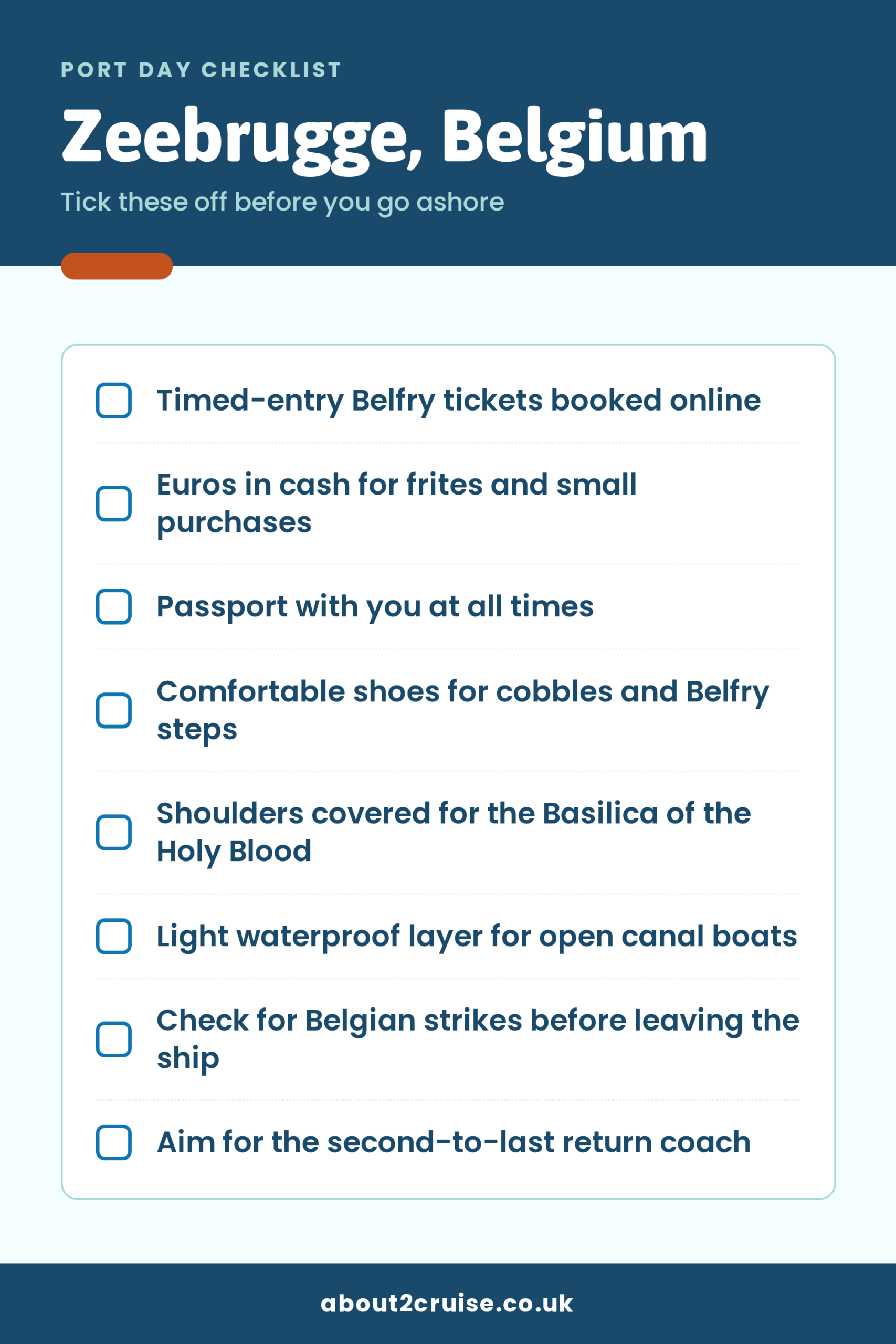
The Belfry is 83 metres high with 366 steps and a 47-bell carillon. It has no lift. Tickets cost €16 for adults, €14 for under-18s and are free for under-7s. Winter weekday prices are slightly lower.
Entry is by timed slot, and you should book online in advance. If you miss your slot, the ticket expires.
It opens from 09:00 to 20:00 in summer and from 10:00 or 09:00 in winter depending on the day. Last entry is one hour before closing. The climb is steep and narrow, and the tower can close in high winds.
If you have limited time, it’s usually better to book an early slot or skip it in favour of a canal boat and a relaxed lunch.
The city carillonneur plays on Wednesdays, Saturdays and Sundays from 11:00 to 12:00, which is a nice moment if you’re below the tower or on the Markt.
Canal Boat Tours in Bruges: The Best 30 Minutes
A canal boat trip is the single best way to see Bruges in a short visit. Boats leave from five jetties: Huidenvettersplein, Rozenhoedkaai, Wollestraat, Nieuwstraat and Katelijnestraat. All operators run the same route, charge the same price and last about 30 minutes.
The fare is around €15 for adults and €9 for children aged 4–11. You can’t book individual tickets online; you pay at the jetty.
Boats run daily from March to October, generally from 10:00 to 18:00. They are open boats, so a light waterproof layer is useful. Queues build fast from mid-morning. The best tactics are to ride before 10:30, at lunchtime, or later in the afternoon.
The boats are not wheelchair accessible and have no luggage space. If you ask one question at the jetty, make it “Which jetty has the shortest queue?” The staff and signs will point you to the nearest alternative jetty.
Chocolate, Beer, Waffles, Frites and Where to Eat
Bruges has a chocolate shop on nearly every central street. You don’t need to plan this part; just look for small artisan windows, not only the big commercial names.
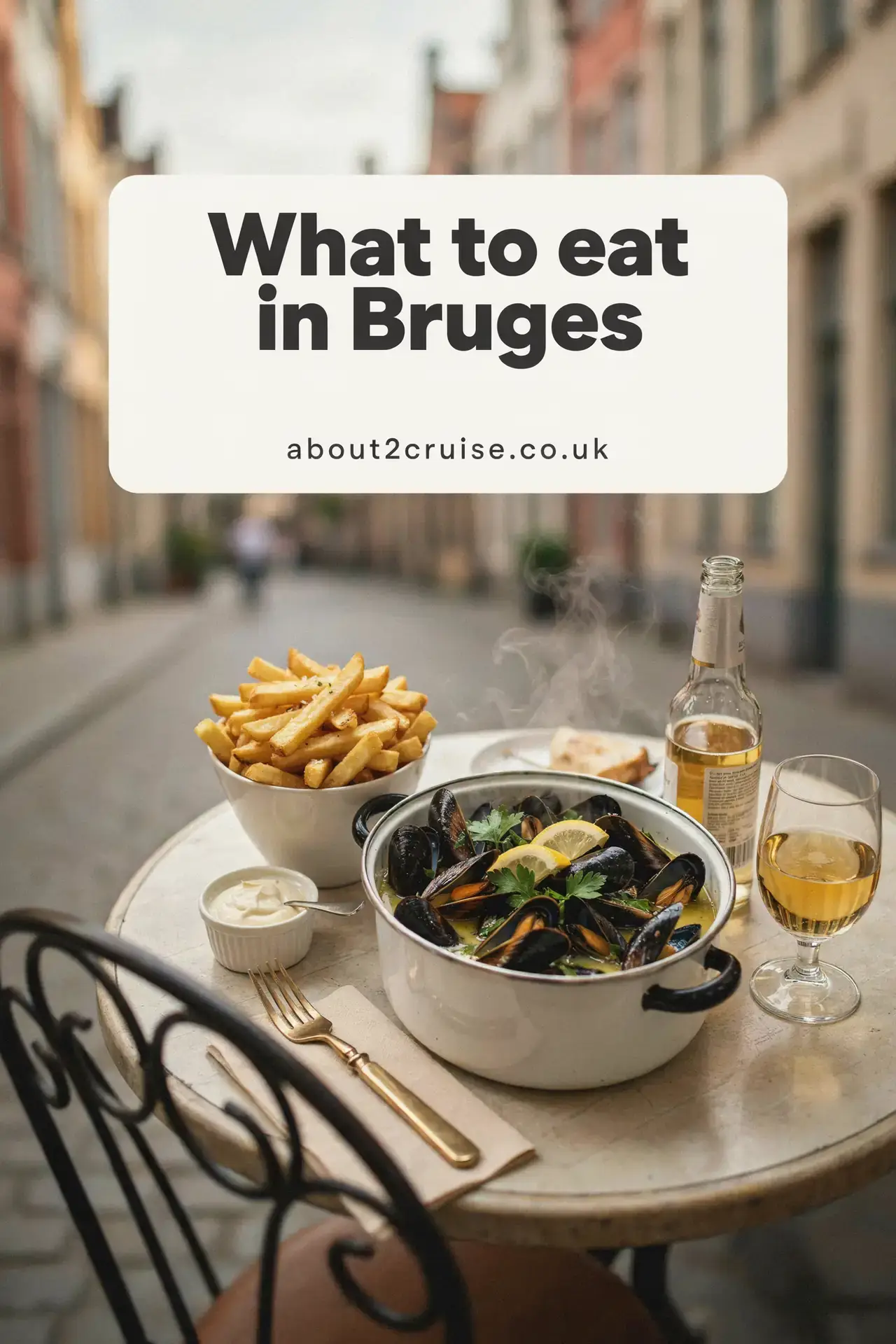
Order frites from a frituur or a fry stand, not as a side dish on a tourist menu. The Markt and Burg are the most atmospheric but most expensive places to eat. For better value, walk about ten minutes to Langestraat or the Sint-Anna district, where residents eat in brown cafés and small bistros.
De Halve Maan brewery on Walplein is the place to taste Brugse Zot and Straffe Hendrik. The standard guided brewery tour is about 45 minutes and costs €16 including one beer, with about 220 steps. The XL tour is 90 minutes with three tastings for €26 on weekends. If you don’t tour, the brewery courtyard is still a good refreshment stop.
Local dishes worth trying include stoofvlees or carbonade flamande, waterzooi, grey-shrimp croquettes and moules-frites. In Zeebrugge itself, the harbour-facing spots are known for shrimp croquettes and simple seafood platters with Belgian beer.
Things to Do in Zeebrugge Itself
If you’ve been to Bruges before, or want a quieter port day, Zeebrugge is more than an industrial gate. The local heritage walk starts and finishes at the cruise terminal and is about 5.8 km long. It’s signposted with metal studs showing a harbour crane.
Before you sail
- Book timed-entry Belfry tickets online before your sailing.
- Check the Port of Antwerp-Bruges cruise schedule for your berth.
- Download offline maps and the free Visit Bruges city map.
Short port day: under 6 hours
- On dockingFree port shuttle, then coach to BrugesNo walking outYou cannot walk through the working port. The free shuttle takes you to the terminal, then board the Cruise Express coach at Rederskaai 47; coaches run every 30 minutes.
- +45 minArrive at Bargeplein, walk to MinnewaterparkThe coach drops at the Bruges coach park. Minnewaterpark and the Lake of Love are a 5-minute walk away.
- +1 hr 15 minWalk via Rozenhoedkaai and Burg to the MarktFollow signs from Minnewater past the Beguinage and Church of Our Lady to Rozenhoedkaai, Burg and the Markt. The Basilica is free.
- +2 hr 30 minLunch away from the MarktTry stoofvleesWalk about ten minutes to Langestraat or Sint-Anna for stoofvlees, frites or grey-shrimp croquettes.
- +3 hr 45 minCanal boat tripNo online bookingBuy a ticket at the jetty; boats run daily and last about 30 minutes. Look for the shortest queue.
- All-aboard minus 1 hrReturn coach from BargepleinAllow 15 minutes from the Markt to the coach park. Target the second-to-last coach, not the final one.
The times on the map are for the whole journey there by train and bus.
Get train and bus times in Google Maps
If plans change: If the coach shuttle is full or cancelled, take a licensed taxi from the terminal to the Markt or use the cruise-line shuttle to Blankenberge station.
Long port day: 8 hours or more
- On dockingFree port shuttle, then coach to BrugesNo walking outYou cannot walk through the working port. Take the free shuttle to the terminal, then the Cruise Express coach at Rederskaai 47; coaches run every 30 minutes.
- +45 minMinnewater, Rozenhoedkaai and BurgThe coach drops at Bargeplein. Walk 5 minutes to Minnewater, then via the Beguinage and Rozenhoedkaai to Burg. The Basilica is free.
- +1 hr 30 minClimb the BelfryBook aheadUse timed-entry Belfry tickets booked online via Musea Brugge before sailing. Missed slots expire; 366 steep steps, no lift.
- +2 hr 45 minLunch away from the MarktTry stoofvleesWalk about ten minutes to Langestraat or Sint-Anna for stoofvlees, frites or grey-shrimp croquettes.
- +3 hr 45 minChurch of Our LadyWalk back towards the centre to see Michelangelo's Madonna and Child. The museum section is ticketed.
- +5 hr 30 minCanal boat tripNo online bookingBuy a ticket at the nearest jetty; all operators run the same 30-minute route. Look for the shortest queue.
- All-aboard minus 90 minReturn coach from BargepleinAllow 10 minutes from the canal jetty to the coach park. Target the second-to-last coach, not the last.
The times on the map are for the whole journey there by train and bus.
Get train and bus times in Google Maps
If plans change: If the Belfry is closed or the queue is too long, swap it for the Church of Our Lady or De Halve Maan. If strikes hit transport, stay local or use a ship excursion.
The route passes the Old Fish Market site, the Fishermen’s Cross, St Donatian’s Church with its First World War cemetery and a harbour viewing point at the foot of the Swedish Quay.
Admiral Keyes Square is the most charming corner of Zeebrugge. The beach is about 3 km from the cruise terminal and has a promenade, restaurants and the Saint George’s Day Walk out along the western breakwater to two viewing platforms. A free multilingual map is available at the cruise terminal.
Lissewege, a whitewashed polder village about 7 km away, is an underrated side trip with a 13th-century canal, a climbable church tower and the Ter Doest abbey barn. A taxi is easiest with limited time, though rail connections can work.

Blankenberge, Knokke and the Coastal Tram
Blankenberge is the classic Belgian seaside option: a wide sandy beach, a long promenade and restaurants. Its Belgium Pier is 350 metres long and the only pier on the Belgian coast.
The Kusttram runs the length of the coast and stops at Zeebrugge Kerk, making it possible to hop from the port area to Blankenberge or Knokke-Heist without going into Bruges.
Knokke-Heist is a more polished resort town with galleries, cafés and a different mood. Lissewege is the best choice if you want something historic but not crowded. These are all good alternatives if your cruise calls often in Bruges or if cobbles and city crowds aren’t for you.
Bruges Itineraries for 4, 6 and 8 Hours in Port
For a four-hour Bruges window, walk from Bargeplein to Minnewater, continue to Rozenhoedkaai, then visit Burg and the Markt. Do one canal boat trip, buy a waffle or frites and return. Don’t attempt the Belfry climb, De Halve Maan tour and a long lunch in that time.
For six hours, add the Belfry with a pre-booked timed ticket, or the Church of Our Lady with Michelangelo’s Madonna and Child, plus a proper lunch away from the Markt. A canal boat still fits.
For eight hours, you can do the full early walking route, the Belfry, a canal boat, the Church of Our Lady or the Basilica of the Holy Blood, De Halve Maan brewery and a relaxed lunch. You’ll still have enough buffer to walk back to Bargeplein without panic. If Bruges feels done, use any spare time for Minnewater, the Beguinage or a quieter aimless canal-side walk.
Cobbles, Weather and What to Wear in Bruges
The historic centre of Bruges is largely cobbled. Some side streets, bridge approaches and quays are uneven. The Markt itself has been relaid flatter, but you’ll still spend much of the day on stone.


Wear comfortable, stable shoes. For the Belfry, there are 366 steep steps and no lift. For De Halve Maan, there are about 220 steps. Sandals and smooth soles are a bad idea.
Bruges has a temperate marine climate with rain possible in every month. Average summer highs are roughly 16–21°C, and humidity sits around 75–77% in the cruise season. The coast at Zeebrugge can feel cooler and windier than the city. Carry a light waterproof layer, even on a sunny morning.
If you plan to enter the Basilica of the Holy Blood, dress modestly: no bare shoulders and nothing very short.
Accessibility at Zeebrugge Port and in Bruges
The free port shuttles between ship and terminal are wheelchair accessible. The independent coach shuttle can stow a wheelchair in the luggage hold, but the passenger must be able to board the coach unaided.
The canal boats and their jetties are not wheelchair accessible. The Stael jetty on Katelijnestraat has the fewest steps, but there are still steps and no ramps.
The Belfry tower is not accessible. The courtyard, exhibition space and adapted toilet are step-free, but the tower itself is stairs only. Bruges’ main central museums, including Groeningemuseum, Historium, Sint-Janshospitaal and Gruuthuse, are generally well adapted with lifts. Disabled parking bays are at the Beguinage and Katelijnestraat. For assisted rail travel in Belgium, book assistance at least three hours ahead.
Bruges is compact, but the combination of cobbles, crowds and distance makes it tougher than it looks for older passengers or anyone with reduced stamina. If that applies to you, a ship excursion or a direct taxi into the centre is the better option.
Money, Cards, Language and Tipping in Belgium
Belgium uses the euro. Cards are widely accepted, and ATMs are common. You can buy De Lijn tickets on board by contactless card, phone or watch, or in advance.
Cash is still useful for street food stands, small purchases, public toilets and tips. US dollars and sterling are not accepted for everyday purchases.
Bruges is in Dutch-speaking Flanders, but English is widely spoken. French will work, but English is perfectly fine for a port day. Tipping isn’t required. Round up the bill in a café if you like, and small tips for guides or taxi drivers are appreciated but optional.
Safety, Crowds and Pickpockets
Bruges isn’t a dangerous city, but it is crowded. Pickpocketing is the main risk, especially around the Markt and on public transport. Keep bags closed and passports secure. Take extra care in railway stations and buses.
You must carry your passport with you in Belgium, so don’t leave it in a bag on the coach.
Only use official licensed taxis. Don’t get into a taxi that stops to offer you a ride. If a taxi approaches you, decline and use the rank or a pre-booked car.
Emergency numbers are 101 for police and 112 for urgent assistance. Belgian strikes can cause sudden travel disruption, so check local news or your cruise line’s port-day notice.
Maps, Apps and Offline Navigation for Your Day
The official Visit Bruges city map is free and available at tourist offices on Stationsplein and at Markt 1. It marks boats, carriages, taxis, lockers, toilets and ATMs.
The Visit Bruges Route App offers mapped walking routes with text, photos and 360-degree images. Download both before you leave the ship, because terminal Wi-Fi isn’t reliable enough to download on the day.
Offline Google Maps or Maps.me with pinned points for Bargeplein, the Markt, Rozenhoedkaai and your cruise terminal will solve most walk-back problems. If you have an international data plan, the De Lijn app is useful for live public transport.
Starting or Ending a Cruise at Zeebrugge: Parking, Hotels and Luggage
Zeebrugge is mainly a transit port, but it also handles turnarounds for small and medium-sized ships and for some larger lines on selected sailings. If you’re starting or ending a cruise here, arrange parking and hotels in advance.
Passengers departing on a cruise from Zeebrugge can use a secure car park next to the ABC terminal. Some lines, such as MSC, run Park & Cruise with the charge added to your onboard account. Third-party guarded cruise car parks nearby are also available, typically around €45–75 per week. Book ahead for summer turnaround days, especially if there’s an MSC or Disney sailing.
Useful hotels include ibis Styles Zeebrugge on Kustlaan, Hotel Atlas near the beach and the cruise port, and Hotel Monaco Zeebrugge Beach. In Bruges, Martin’s Brugge is next to the Belfry and NH Brugge is a converted monastery about ten minutes from the Markt. If you’re staying one night before a cruise, Bruges itself is the better experience, but Zeebrugge hotels are more practical for an early embarkation.
For luggage, Bruges station has lockers opposite the tourist office and the Historium on the Markt has central lockers. The cruise terminal doesn’t reliably publish a left-luggage service, so plan for storage in Bruges rather than at the port.
Quick FAQs About Zeebrugge and Bruges
Is there a free shuttle from Zeebrugge to Bruges?
No. The free shuttle only runs between ship and terminal building. Every onward transfer to Bruges is paid.
Can I walk from the ship to Zeebrugge Dorp or Bruges?
You can walk from the terminal exit to Zeebrugge Dorp, around 2 km, but you can’t walk through the working port from the gangway. Walking to Bruges isn’t realistic: it’s 17–20 km away.
How do I check which berth my ship is using?
Look at the Port of Antwerp-Bruges cruise schedule before sailing. The main berth is the Swedish Quay. Arrival time in the schedule is the pilot station time, so plan ashore for about 1.5–2 hours after that.
Can I leave luggage at the Zeebrugge cruise terminal?
There’s no clearly published public left-luggage service at the ABC Tower. Use luggage lockers at Bruges station or the Historium if you need short-term storage.
Do I need my passport in Bruges?
Yes. You must carry your passport with you in Belgium. Keep it secure and dry.
What if I miss the last shuttle from Bruges?
Get a licensed taxi back to Zeebrugge cruise terminal. Have the ship name and terminal address ready. Expect roughly €50–70 and allow at least 30 minutes. Missing the last coach is avoidable; aim for the second-to-last coach.
Are the canal boats wheelchair accessible?
No. The boats and jetties have steps and no ramps. If you have limited mobility, a walking or taxi-based tour is a better fit.
More European Cruise Port Guides
If your cruise also calls in the Netherlands or northeast France, compare your plans with our Rotterdam cruise port guide, Amsterdam cruise port guide, Le Havre for Paris cruise ship port guide or the wider cruise ports guide.
Ostend is on the same Belgian coast and often appears as the next or previous call on North Sea itineraries that include Zeebrugge.
Last Updated: 23 November 2026