
Ostend is a compact North Sea call where small cruise ships berth beside the railway station, a 10–15 minute walk from the beach and the Belle Époque seafront. The town is genuinely walkable, with art, seafood, wartime history and a wide sandy beach; Bruges is a simple 15-minute train ride away. Bring euros, a rainproof layer and a sensible return buffer.
Ostend’s Belle Époque Seafront: Belgium’s “Queen of the Seaside Resorts”
Ostend still leans into its old nickname. Much of that confidence comes from the Belle Époque era under King Leopold II, and you can see it most clearly along the seafront. The standout is the Royal Galleries, a covered walkway commissioned by Leopold II and now restored as a public promenade. Nearby you’ll pass the Thermae Palace, the Kursaal site and the neo-Gothic St Peter and Paul’s Church, where Queen Louise-Marie’s tomb chapel sits inside.
The church itself is free, but its visitor hours are limited:
- Monday 14:00–16:30
- Tuesday to Saturday 09:30–12:00 and 14:00–16:30
- Sunday 10:00–12:00
Ostend’s royal and celebrity connections make a promenade walk more interesting. Marvin Gaye arrived by boat and lived here for about eighteen months; you’ll find a memorial stone in front of Residence Jane on the Albert I promenade. If you want a deeper music-history detour, a paid documentary walk app covers twelve Marvin Gaye locations around town.
Art in Ostend: James Ensor, Léon Spilliaert and Mu.ZEE
Ostend punches above its weight for art on a port day because the main sights are compact and easy to reach. James Ensor lived and worked at Vlaanderenstraat 29 until his death, and that house is now the James Ensor House with five interactive rooms. It is open Tuesday to Sunday 10:00–18:00, with last entry at 17:00, and closed most Mondays. Tickets are €14 for adults, €6 up to 14, and free under 6. Timed slots are used, so book online if you want a specific time.
Mu.ZEE’s main building in Romestraat is closed for a long renovation, but the collection has moved to the Venetian Galleries on the seafront, corner of Parijsstraat. For cruise visitors that’s convenient: the art is a short walk from the beach and promenade. The galleries are open Tuesday to Sunday 10:00–17:30, closed Mondays, 25 December and 1 January. Tickets are €12 for adults, €3 for ages 13–25, and free under 12. Online booking is strongly recommended. The Venetian Galleries are accessible, and you can reserve a free wheelchair through the museum with advance notice.
If you prefer fresh air, download the Ostend City Walks app and follow the 6.45 km Léon Spilliaert walking route, or look for the hologram installation at the tourist office.
Maritime Ostend: From the Ostend Company to Today’s Fish Stalls
Ostend’s relationship with the sea goes far beyond beach towels. The old Ostend Company was chartered to trade with India and China, bringing tea, silk, porcelain and spices through this port before it was shut down under diplomatic pressure from England and the Dutch. You can get a more hands-on feel for the seafaring era at the Mercator museum ship on Jan Piersplein. The ship is open 10:00–17:00 with last boarding at 16:15 and closed Mondays. Tickets are €7 for adults and €5 for ages 4–11. A word of warning: the gangway has a step and the interior has steep stairs and narrow corridors, so it isn’t suitable for everyone.
For working fishing life, walk to the Vistrap on Visserskaai, where local fishermen sell the day’s catch. It’s one of the most authentic stops in town and a good place to pick up grey shrimps for the local croquettes later.
Ostend’s Wartime History: Fort Napoleon and Atlantikwall Raversyde
Ostend has been fought over for centuries. The Siege of Ostend lasted from July 1601 to September 1604 and was so long and bloody that contemporaries called the town “the new Troy.” Most cruise visitors, however, encounter the military past at two sites: Fort Napoleon and Atlantikwall Raversyde.
Fort Napoleon is a pentagonal fort Napoleon ordered on the east bank of the harbour. It is open daily except Mondays: main season 10:00–18:00, winter 10:00–17:00. Tickets are €11 for adults and €9 for children 6–12. The fort is mostly wheelchair accessible, except the roof and caponnières. To get there, take the free passenger ferry from Visserskaai to Maritiem Plein, then walk about 15 minutes, or ride the Coast Tram to Oosteroever.
Atlantikwall Raversyde is the larger open-air wartime site with preserved German coastal defences. It opens daily except Mondays from mid-March to mid-November, normally 10:30–17:00 on weekdays and 10:30–18:00 at weekends and school holidays. Adults pay €10, ages 6–17 and students 19–26 pay €4, under-6s free. Only the WWI Aachen Battery is wheelchair accessible; the WWII section is not. Take the Coast Tram to Raversijde Provinciedomein and walk about 460 m, or bus 60 to Raversijde Walraversyde.
Street Art in Ostend: The Crystal Ship Trail
Ostend has one of the best street-art scenes on the Belgian coast. The Crystal Ship trail includes more than 70 murals and interventions, split into three walking routes: Belle Epoque and Westerkwartier, Centre, and Oosteroever. The works are visible all year, and the trail starts at Toerisme Oostende on Monacoplein 2. Use the free Ostend City Walks app for routes and GPX tracks, or pick up a printed brochure at the tourist office for €5. This is a particularly good bad-weather plan because you can dip in and out over a couple of hours without committing to a single museum building.
Ostend Beach, Promenade and Breakwater
The Groot Strand runs about 2 km from the Royal Galleries to Zeeheldenplein and is roughly 100 m wide; the whole beach stretches around 7 km. Behind it, the seafront promenade runs more than 4 km with shops, cafés, fish stalls and terraces. It’s flat, paved and easy for a relaxed wander.
For the best sea view, walk out along the Westelijke Strekdam, a breakwater that stretches hundreds of metres into the North Sea from Zeeheldenplein. It’s free, open all year, and has a wide paved path suitable for wheelchairs and pushchairs, though it can close in storms. At the end you’ll find the Wullok sculpture. Back on land, the same square has Arne Quinze’s orange Rock Strangers sculptures.
Lifeguard posts are staffed daily 10:30–18:30 during summer holidays, with reduced cover in June and September. Green flag means swim but not beyond chest depth, yellow means no inflatables and no deeper than waist, and red means no swimming.
Food in Ostend: Shrimp Croquettes, Mussels, Waffles and Belgian Beer
If you try one local dish, make it the Ostend shrimp croquette. The certified version must be made with hand-peeled grey shrimps landed by Ostend coastal fishermen, with at least 30% shrimp in the filling, and produced within 10 km. You can find participating restaurants through the Toerisme Oostende list, but the simplest approach is to eat around the Visserskaai or the seafront promenade. Mussels, fish dishes and croquettes are the standard brasserie offer, while waffles and ice cream appear on seafront café menus. Belgian beer is everywhere; the Langestraat and seafront bars are the easiest places to try a local or Trappist beer.

If you want to buy seafood to eat on the hoof, the Vistrap fish stalls are close to the water and closer still to the port.
Should You Stay in Ostend or Take the Train to Bruges?
The biggest decision on an Ostend port day is whether to stay put or use the call as a gateway to Bruges. Bruges is genuinely easy: direct trains run from Oostende station to Brugge in about 13–15 minutes, roughly every 20 minutes. The added travel time is modest, but you’re trading a relaxed seaside day for a busier medieval day with more walking and more crowds.
Choose Ostend if you want a low-stress day, have already seen Bruges, like street art and seafood, or want a beach and promenade day with no train connection to protect. Choose Bruges if you’ve never seen it and are comfortable managing a short train ride each way. Note that Zeebrugge is the larger cruise gateway for Bruges, so if that’s your next call you may prefer to see Bruges from there instead.
Ostend Cruise Terminal: Docking, Facilities and What to Expect
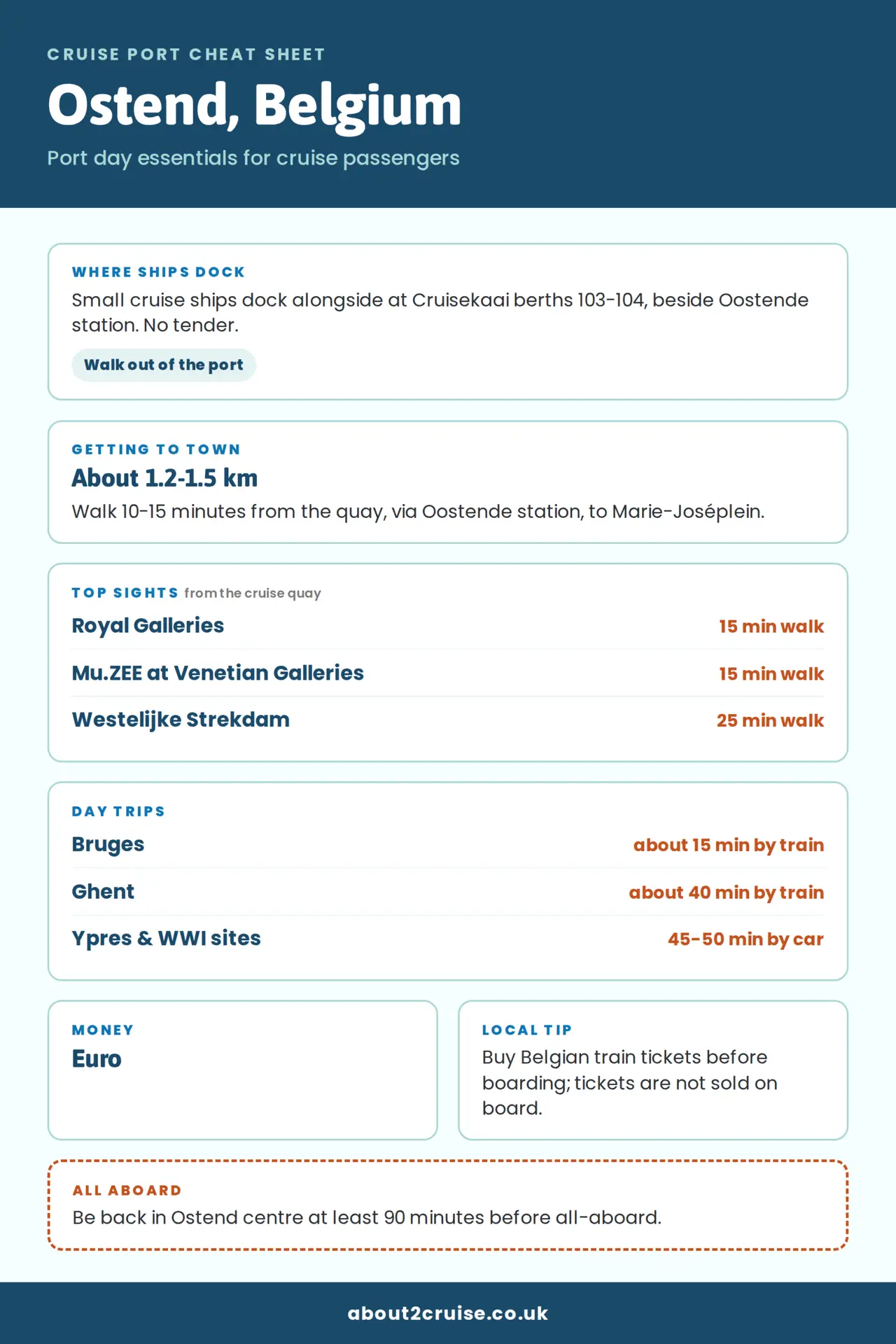
Ostend isn’t a big-ship turnaround port. Only ships up to 200 m can enter, and the port handles a small number of cruises a year, mostly smaller expedition or luxury vessels. Cruise ships dock alongside at the Cruisekaai, normally berths 103–104 on Sir Winston Churchillkaai. The registered terminal address is Natiënkaai 5, immediately beside Oostende railway station. There’s no tender operation; you step ashore directly onto the quay.
Don’t expect a large purpose-built cruise terminal with lounges and shopping. The port area is a working quay with direct access to the station side of the city. Published passenger facilities at the terminal itself are minimal, so treat Oostende station as your practical arrival hall: it has toilets, ticket machines, a taxi rank and luggage lockers. If you need Wi-Fi, plan on a café or mobile data rather than relying on terminal Wi-Fi.
If you’re joining a ship and parking independently, there’s no dedicated port-run cruise car park. The nearest large public underground car park is Zeeparking on Leopold II-laan, opposite Leopold Park. A full day there costs around €30, so pre-booking is wise for longer stays.
Ostend cruise port map
Ships dock at Cruisekaai berths 103-104. From the cruise quay, Vistrap fish stalls is about a 2-minute walk, Visserskaai about 4 minutes and Rock Strangers about 8 minutes. Tap a pin for directions.
- Cruisekaai berths 103-104Where ships dock
- Vistrap fish stallsFish stalls · About 2 min walk from the cruise quay
- VisserskaaiHarbour quay · About 4 min walk from the cruise quay
- Oostende stationRailway station · About 8 min walk from the cruise quay
- Rock StrangersSculptures · About 8 min walk from the cruise quay
- Fort NapoleonPentagonal fort · About 17 min walk from the cruise quay
- Mercator museum shipMuseum ship · About 3 km from the cruise quay
- Atlantikwall RaversydeWartime coastal defences · About 6 km from the cruise quay
- North Sea AquariumAquarium · About 5 km from the cruise quay
- Toerisme OostendeTourist office · About 13 km from the cruise quay
- MarktMarket square · About 21 km from the cruise quay
Getting from the Cruise Quay into Ostend Centre
The walk from Cruisekaai into central Ostend is short and flat. Expect about 10–15 minutes from the quay through the station area to Marie-Joséplein and the start of the shopping streets. Once you’re across the harbour channel, the centre is flat and walkable, and most day visitors don’t need transport at all.
If your berth is less convenient or the weather is poor, official taxis wait at the port and at the station. A taxi between the cruise quay and the station area is typically quoted at around €10–12. The Coast Tram also stops at Oostende station and reaches Marie-Joséplein in one stop; a De Lijn single ticket costs €3 and is valid for one hour. You can pay contactless on board or buy tickets in the app or from a machine.
The free passenger ferry across the harbour is useful for the east side, especially Fort Napoleon. It runs between Visserskaai, near the North Sea Aquarium, and Maritiem Plein on Oosteroever. It takes foot passengers and bikes, is wheelchair accessible, and passengers must disembark after each crossing.
Ostend to Bruges by Train: Times, Tickets and Practical Tips
Oostende station is next to the port, which makes a Bruges day trip unusually easy. Direct trains run to Brugge in about 13–15 minutes, roughly every 20 minutes throughout the day. Belgian domestic tickets are distance-based, so a standard second-class single is usually only a few euros; budget around €10 return to be safe. There’s no advance-purchase discount on domestic Belgian trains, but you must buy before boarding because tickets are no longer sold on board.
Bruges station is a 15–20 minute walk from the Markt. If you want to save your legs, bus lines 1 and 2 run into the centre every few minutes; a De Lijn single costs €3 and can be bought contactless on the bus, at the Lijnwinkel at Stationsplein, or from a machine.
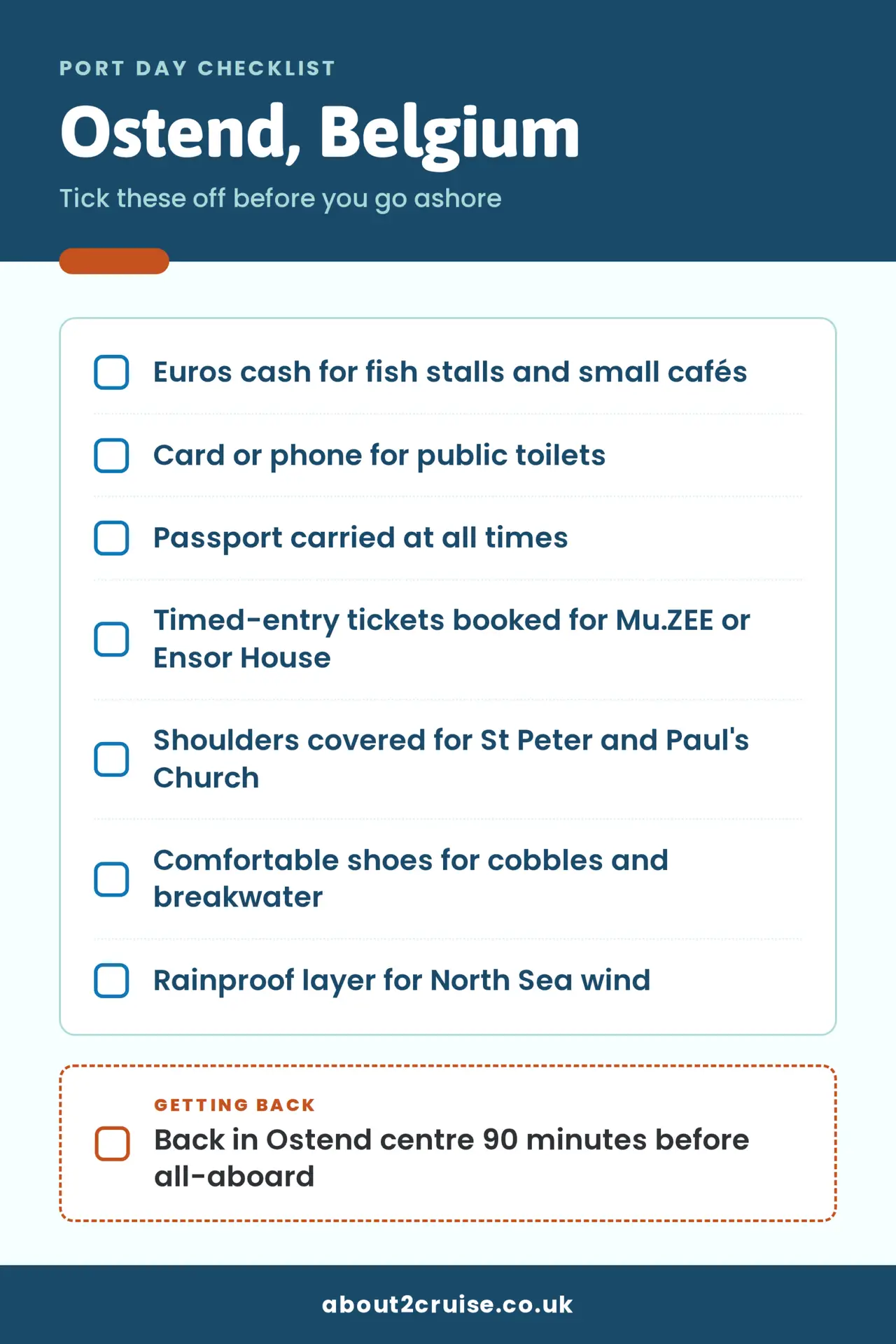
The safest timing rule for an independent Bruges day is to be back in Ostend centre at least 90 minutes before all-aboard, and to take a train out of Bruges no later than two hours before all-aboard. That gives you time for a delayed train, the walk back through the station area and the quay gate. Belgian rail strikes can cause severe disruption, so if you are risk-averse on a short call, a cruise-line shore excursion removes the uncertainty.
Other Day Trips from Ostend: Ghent, Ypres and WWI Sites
Ghent is another realistic independent day from Ostend: direct trains take about 40 minutes, and the old centre is walkable from the station or a short tram ride away. Brussels is possible in about 1h14–1h27 each way, but that’s a long day for a small-ship call.
Ypres and the WWI battlefields are further out, roughly 48–52 km by road and 45–50 minutes by car. Unlike Bruges, this is a day where a pre-booked taxi or a cruise-line excursion makes most sense. If you visit the battlefield areas, stay on footpaths and do not touch anything that looks like an unexploded shell.
A Realistic One-Day Ostend Itinerary from the Cruise Port
Here’s a sensible plan for a ship that is alongside from 08:00 to 18:00, with all-aboard at 17:30.
- 09:00: Walk off the ship, through the station area and towards the promenade.
- 09:30: Coffee or breakfast at a seafront café near the Royal Galleries.
- 10:15: Visit the James Ensor House or the Mu.ZEE collection at the Venetian Galleries.
- 12:15: Walk to the Vistrap and the Visserskaai for a shrimp croquette or mussel lunch.
- 13:15: Walk the seafront promenade out to Zeeheldenplein, see the Rock Strangers, and walk the Westelijke Strekdam if it is open.
- 14:30: Follow part of the Crystal Ship street art trail back towards the centre.
- 15:30: Browse the shopping streets or have a Belgian beer near the casino side of the promenade.
- 16:30: Begin walking back to the ship, allowing time for the quay gate and security.
If you are doing Bruges, reverse the emphasis: take an early train out, see the Markt, Burg and canals, keep your return train early, and leave Ostend itself for another call.
Ostend Weather, Tides and Packing Tips
Ostend has a marine west-coast climate. Summer daytime highs are usually 18–21°C in July and August, 19°C in September and 15°C in October. Nights are cool, and rain is possible in any month, with six to eight rain days a month across the cruise season. The sea is warmest in August at around 19°C, and the wind can make the breakwater and beach feel much cooler. July tends to be the calmest month for wind.
Pack a waterproof outer layer, a warm mid-layer even in summer, comfortable shoes or trainers, and a sun hat. If you plan to swim, bring swimwear and a towel, but pay attention to beach flags and only swim at guarded times. The breakwater can close in strong storm weather, so check conditions before walking out.
Accessibility in Ostend for Cruise Passengers
Central Ostend is flat and suited to slow travellers: the promenade, breakwater and station area are paved, and many beach entrances suit wheelchairs and pushchairs. In summer there’s an accessible beach at Parijsstraat and IJzerstraat with a paved path to the water, assisted accessible toilets and showers, and free beach wheelchairs including an electric one. There is another adapted beach facility at the Diksmuidestraat and Troonstraat car park.
The Coast Tram has a low-floor centre section and space for one wheelchair per vehicle; several stops have raised platforms, and no reservation is needed. The free harbour ferry is wheelchair accessible.
Fort Napoleon is wheelchair and pushchair accessible except for the roof and caponnières, which are stairs only. The Venetian Galleries are accessible and can provide a free wheelchair with notice. The James Ensor House has a wheelchair and lift. The Mercator museum ship is not suitable for limited mobility because of a gangway step, steep stairs and narrow corridors. At Atlantikwall Raversyde, only the WWI section is wheelchair accessible. The Bruges Belfry has 366 steep steps and no lift, so do not plan to climb it as part of an accessible Bruges day.
Money, Cards, Tipping and Language in Ostend
The currency is the euro, and cash is accepted almost everywhere. Major debit and credit cards are widely accepted, but carry a little cash for small fish stalls, markets and pay toilets. Service is included by law in Belgian menu prices, so tipping isn’t mandatory; most people round up in bars and leave 5–10% in restaurants for good service.
Day-to-day English is widely spoken in Ostend’s tourist-facing businesses, but Dutch is the local language. A few basics help: dank u for thank you and alstublieft for please or here you go.
Opening Hours and Closures in Ostend: What to Know Before You Go
Ostend’s museums are generally open on Sunday but closed on Monday, which catches out some cruisers. Key patterns are:
- Mu.ZEE Venetian Galleries: Tuesday to Sunday 10:00–17:30, closed Monday.
- James Ensor House: Tuesday to Sunday 10:00–18:00, last entry 17:00, closed most Mondays.
- Fort Napoleon: daily except Monday; main season 10:00–18:00, winter 10:00–17:00.
- Atlantikwall Raversyde: daily except Monday from mid-March to mid-November.
- Mercator: 10:00–17:00, last boarding 16:15, closed Monday.
- St Peter and Paul’s Church: limited hours, closed to visitors outside the published windows.
Book timed slots online for the James Ensor House and Mu.ZEE; Fort Napoleon also recommends booking because weekend and holiday slots sell out. The tourist office, Toerisme Oostende, is at Monacoplein 2 next to the Kursaal and is open daily, usually 10:00–18:00 in the main season and 10:00–17:30 in winter, closed 25 December and 1 January.
Luggage, Toilets and Practical Facilities at Ostend Port
The most useful facility at Ostend port is the railway station next door. Oostende station has luggage lockers, a taxi rank, ticket machines, a ticket office and paid toilets. The main hall is open daily 04:15–23:15. Locker prices run from €5 for a small locker to €14.50 for XXL, with supplements for extra hours.
Public toilets in Ostend are automated and self-cleaning, open 24/7, accessible for disabled users, and cost €1. They take digital payment only, so have a card or phone handy. Don’t plan on leaving bags at the quay itself; there’s no reliably published terminal-run luggage storage.
Ostend with Kids: Beach, Forts and Street Art
Families can build an easy day around the beach, the breakwater and the free street art. The North Sea Aquarium sits near the Visserskaai ferry pier, so it pairs naturally with the free harbour crossing or a fish-stall lunch. Fort Napoleon works well for children who like forts, while the beach and gentle seafront promenade are the simplest option. The Rock Strangers and Westelijke Strekdam are good for walking off energy. If you board the Mercator, hold younger children’s hands on the gangway and stairs.
Shopping and Local Souvenirs in Ostend
Ostend’s shopping streets run from the station towards the seafront, with the pedestrian-friendly Kapellestraat and Langestraat as the main spines. The seafront promenade itself has shops and food stalls. Good local souvenirs include Belgian chocolate, bottled Belgian beer, sea-salt products, prints from the Crystal Ship street-art trail, and James Ensor or Spilliaert postcards from museum shops. For a working food market rather than a souvenir shop, the Vistrap is the one to find.
Staying Safe in Ostend: Pickpockets, Emergency Numbers and Port Notes
Ostend doesn’t have a major scam pattern aimed at cruise passengers, but standard Belgian city precautions apply. Pickpocketing and distraction theft are most common in crowded areas, around the railway station, on public transport and at busy beach spots. Use only official licensed taxis and don’t get into cars that pull up offering a ride. Carry your passport with you, as Belgian authorities can ask for ID.
Belgium’s national threat level has been set at serious, and strike action can cause travel disruption. Check your ship’s daily programme and local transport news. The general European emergency number is 112; the Belgian police emergency line is 101. If you visit WWI battlefields, stay on footpaths and do not touch any metal object that looks like a shell.
Walking from the Cruise Ship to Ostend Beach
From the Cruisekaai berths, follow the signs towards the station and city centre. You’ll pass Oostende station on Natiënkaai, then come out at Marie-Joséplein. From there, walk straight into the pedestrian shopping street Kapellestraat and continue until you hit the seafront promenade. The total walk is about 1.2–1.5 km and takes 15 minutes at a relaxed pace. Once on the promenade, the beach is directly in front of you, the Royal Galleries stretch to your right, and the Westelijke Strekdam and Rock Strangers are to your left at Zeeheldenplein. The tourist office is slightly inland from the promenade at Monacoplein 2.
What to Do If You Miss the Ship in Ostend
If you miss the ship in Ostend, contact the port agent first; the number is on the daily programme and your cruise ticket documents. Don’t wait only for the ship’s crew to notice. The next scheduled port is often Zeebrugge or Antwerp, and you may be able to catch up by train or taxi. A self-arranged transfer between Belgian ports can easily cost over €150, and premium or small ships generally won’t hold for independent passengers. Travel insurance with missed-port or missed-departure cover is the real safety net here.
Before you sail
- Book timed-entry Mu.ZEE or James Ensor House tickets online; weekends sell out.
- Check for Belgian rail strikes before a Bruges train day.
- Book Bruges Belfry timed-entry tickets if you plan to climb it.
Short port day: under 6 hours
- On dockingWalk to the seafrontNo shuttle neededFrom Cruisekaai, follow signs past Oostende station to Marie-Joséplein, then Kapellestraat to the promenade. About 15 minutes.
- +15 minRoyal GalleriesWalk along the restored covered promenade built for Leopold II and enjoy the North Sea view.
- +45 minMu.ZEE at Venetian GalleriesBook onlineBook Mu.ZEE tickets online ahead; the seafront gallery is small and entry can be busy. See Ensor and Spilliaert.
- +2 hrsLunch at the VisserskaaiTry shrimp croquettesWalk to the fish stalls on Visserskaai and order Ostend shrimp croquettes or mussels from a brasserie near the water.
- +3 hrsWestelijke Strekdam and Rock StrangersWalk the seafront to Zeeheldenplein. See Arne Quinze's Rock Strangers and walk the breakwater if it is open.
- All-aboard minus 1 hrBack at the cruise quayWalk back from the seafront via Kapellestraat to the cruise quay. Allow 15 minutes and time for security.
The time on the map is the whole walk, every stop added together.
Open this walking route in Google Maps
If plans change: If Mu.ZEE or the James Ensor House is closed, follow the free Crystal Ship street-art trail instead, which starts at the tourist office.
Long port day: 8 hours or more
- On dockingTrain to Bruges from Oostende stationBuy before boardingWalk from the quay to the station, buy a return ticket, and board the direct train to Brugge. 13-15 minutes, every 20 minutes.
- +30 minWalk or bus to the MarktContactless on the busFrom Brugge station it is 15-20 minutes on foot to the Markt, or take bus 1 or 2.
- +1 hrMarkt and BurgBook Belfry aheadSee the Markt and the neighbouring Burg. Climb the Belfry only with a timed slot booked ahead; it has 366 steps and no lift.
- +3 hrsLunch near the MarktTry musselsTry mussels with frites or a Belgian waffle in the side streets off the Markt, not on the main square.
- +4 hrs 30 minCanals and BegijnhofWalk the canals south to the Begijnhof, then loop back through the old town.
- +5 hrs 30 minReturn to Brugge stationWalk 15-20 minutes back to the station. Catch a train no later than two hours before all-aboard.
- All-aboard minus 90 minBack at the cruise quayWalk from Oostende station to the ship. If the train is delayed, take a taxi from the station.
The times on the map are for the whole journey there by train and bus.
Get train and bus times in Google Maps
If plans change: If Belgian rail strikes or cancellation disrupt the trains, stay in Ostend and follow the short plan, or book a cruise-line excursion.

Ostend Cruise Port FAQs
Do they speak English and do I need euros in Ostend?
English is widely spoken in shops, restaurants, museums and taxis. You still need euros for small purchases, pay toilets and some market stalls; card works in most formal settings, but a little cash is useful.
Is Ostend worth visiting on a cruise call?
Yes, especially if you prefer a relaxed seaside town to a crowded day-trip destination. It works best as a walkable day of art, seafood, beach and street art. If you’ve never seen Bruges, that remains the stronger one-day classic.
Is the beach close to the cruise port?
Yes. From the normal Cruisekaai berths, the beach is about a 15-minute walk, mostly flat and through the station and shopping area. You don’t need a shuttle or taxi unless mobility is a concern.
Can you walk from the cruise ship into Ostend?
Yes. The port authority describes the cruise quay as having direct access to the city centre. In practice most passengers walk off, pass the station and reach the shopping streets in 10–15 minutes. Confirm your exact berth on the day, because berth assignment can vary.
Is Ostend cruise port accessible for wheelchairs and limited mobility?
The town and seafront are generally manageable for wheelchairs and slow walkers, with flat promenades, an accessible beach section, low-floor trams and an accessible free ferry. The weak points are the Mercator, the WWII section at Raversyde and some older buildings. If you use a wheelchair, plan around the Venetian Galleries, Fort Napoleon’s main level and the promenade.
Last Updated: 23 November 2026