
Anchorage is Alaska’s gateway city, not a conventional cruise turnaround. Almost no cruise ships dock in Anchorage itself; ships marketed as “Anchorage” start or end at Whittier or Seward, roughly 60–120 miles away. Plan transfers, allow buffer, and use Anchorage as a pre- or post-cruise base for mountains, moose, glaciers and Alaska Native culture.
What Anchorage is known for
Anchorage is Alaska’s largest city, and locals sometimes call it the “Big Apple of Alaska.” Around half the state’s population lives here, yet the city feels more like a gateway to wilderness than a metropolis. It sits between Cook Inlet and the Chugach Mountains, so on clear days you get mountain views, moose grazing on city trails, and wild salmon running through Ship Creek in the middle of town.
The experiences cruisers most look forward to are the mountains, glaciers, wildlife, and the sheer scale of the landscape. Anchorage is the ceremonial start of the Iditarod each March, but in cruise season the draws are more likely to be the Tony Knowles Coastal Trail, Turnagain Arm’s bore tide, beluga whales from shore, and the floatplanes buzzing over Lake Hood, the world’s busiest seaplane base. June brings around 22 hours of usable daylight, so even a short pre-cruise stay feels long.
Where your ship actually docks near Anchorage
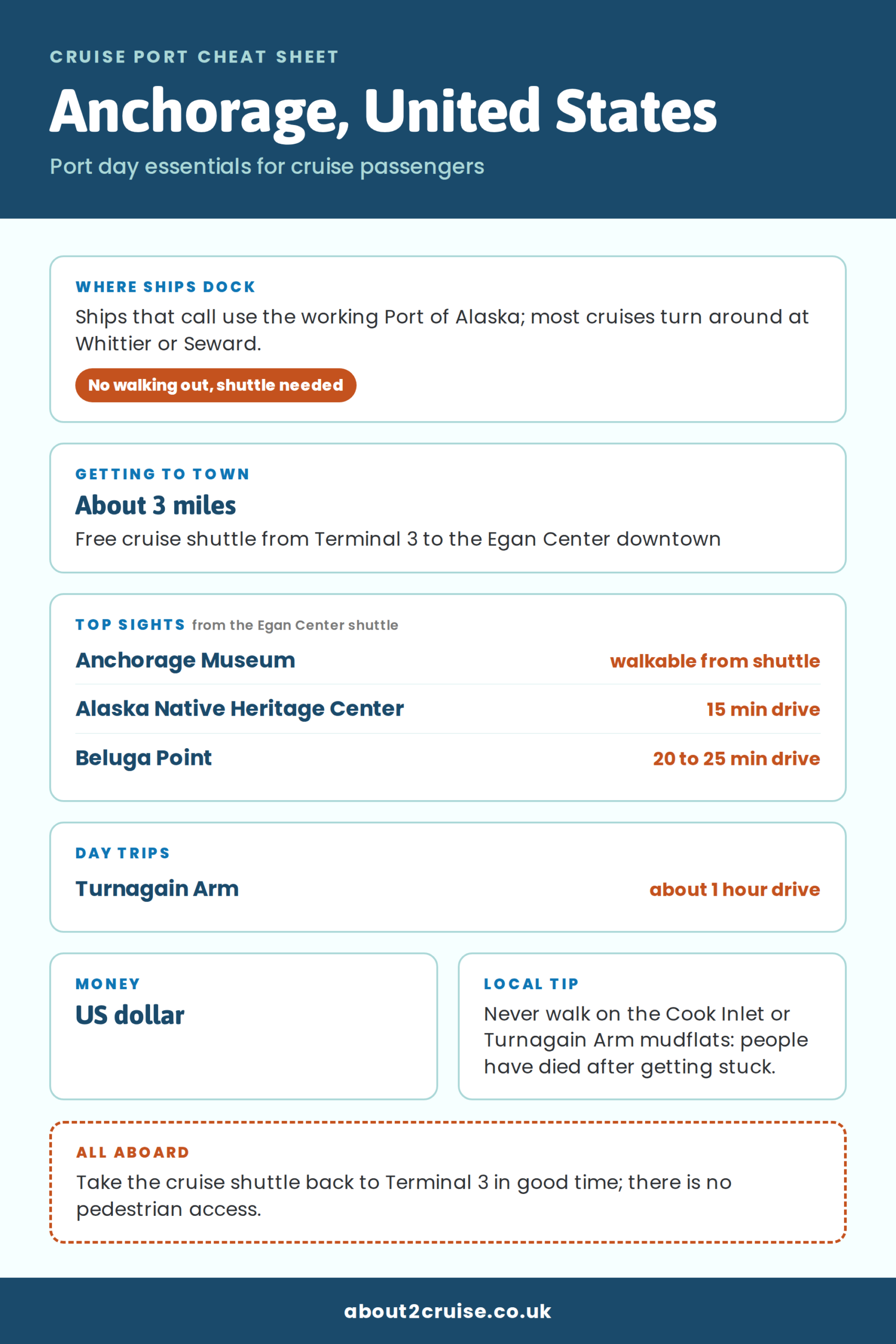
Most cruises marketed as “Anchorage” do not dock in Anchorage. Only about a dozen port-call days a season actually happen at the Port of Alaska, the city’s working cargo terminal about 3 miles north of downtown. Ships that genuinely call there include Holland America Line’s Nieuw Amsterdam, Noordam, and Zaandam, plus occasional small ships such as Seabourn Venture or The World. No cruise starts or ends in Anchorage itself.
Almost everything else marketed with Anchorage as the port actually turns around at one of two real embarkation ports:
- Whittier: about 60 miles southeast, roughly 1.5 hours’ drive plus the one-way Anton Anderson Tunnel. Whittier is the classic Princess and Holland America turnaround, used mainly by lines that want to run cruise trains to Denali in a single day.
- Seward: about 120 miles south, roughly 2.5–3 hours’ drive. Seward is the main Royal Caribbean Group port, with Royal Caribbean International, Celebrity Cruises, and other lines using the purpose-built cruise terminal.
Always check your cruise documents carefully. A schedule may list “Anchorage” as a port call, but your embarkation or disembarkation port will be printed as Whittier or Seward if that is where the ship actually is. One-way, cross-Gulf Alaska itineraries are the format that pairs with these ports. Princess’s seven-night Voyage of the Glaciers, for example, runs Vancouver to Whittier or the reverse, calling at Ketchikan, Juneau, Skagway, and Icy Strait Point, with glacier viewing in Glacier Bay, Hubbard Glacier, or College Fjord.
If you are one of the rare passengers on a ship that actually calls at the Port of Alaska, expect a commercial cargo port, not a cruise terminal. There is no passenger building, no shops, no toilets, no excursion vendors, and no walking from the berth. Cruise lines run a complimentary shuttle from Terminal 3 to the William A. Egan Civic and Convention Center downtown. The shuttle drop has bathrooms and ATMs, and from there the city is walkable. Do not count on walking through the port area: it is prohibited. Port construction can change which terminal is used, so follow the signs and crew instructions on the day.

Anchorage cruise port map
Ships dock at Port of Alaska Terminal 3. Tap a pin for directions.
- Port of Alaska Terminal 3Where ships dock
- Egan Center shuttle dropCity transfer point · About 3 km from Port of Alaska Terminal 3
- Anchorage MuseumMuseum · About 3 km from Port of Alaska Terminal 3
- Ship CreekSalmon creek · About 11 km from Port of Alaska Terminal 3
- Tony Knowles Coastal TrailPaved trail · About 11 km from Port of Alaska Terminal 3
- Alaska Native Heritage CenterNative culture centre · About 9 km from Port of Alaska Terminal 3
- Beluga PointViewpoint · About 28 km from Port of Alaska Terminal 3
- Lake HoodSeaplane base · About 9 km from Port of Alaska Terminal 3
- Earthquake ParkPark · About 7 km from Port of Alaska Terminal 3
- Flattop MountainMountain · About 21 km from Port of Alaska Terminal 3
Anchorage cruise ship schedules: how to check them
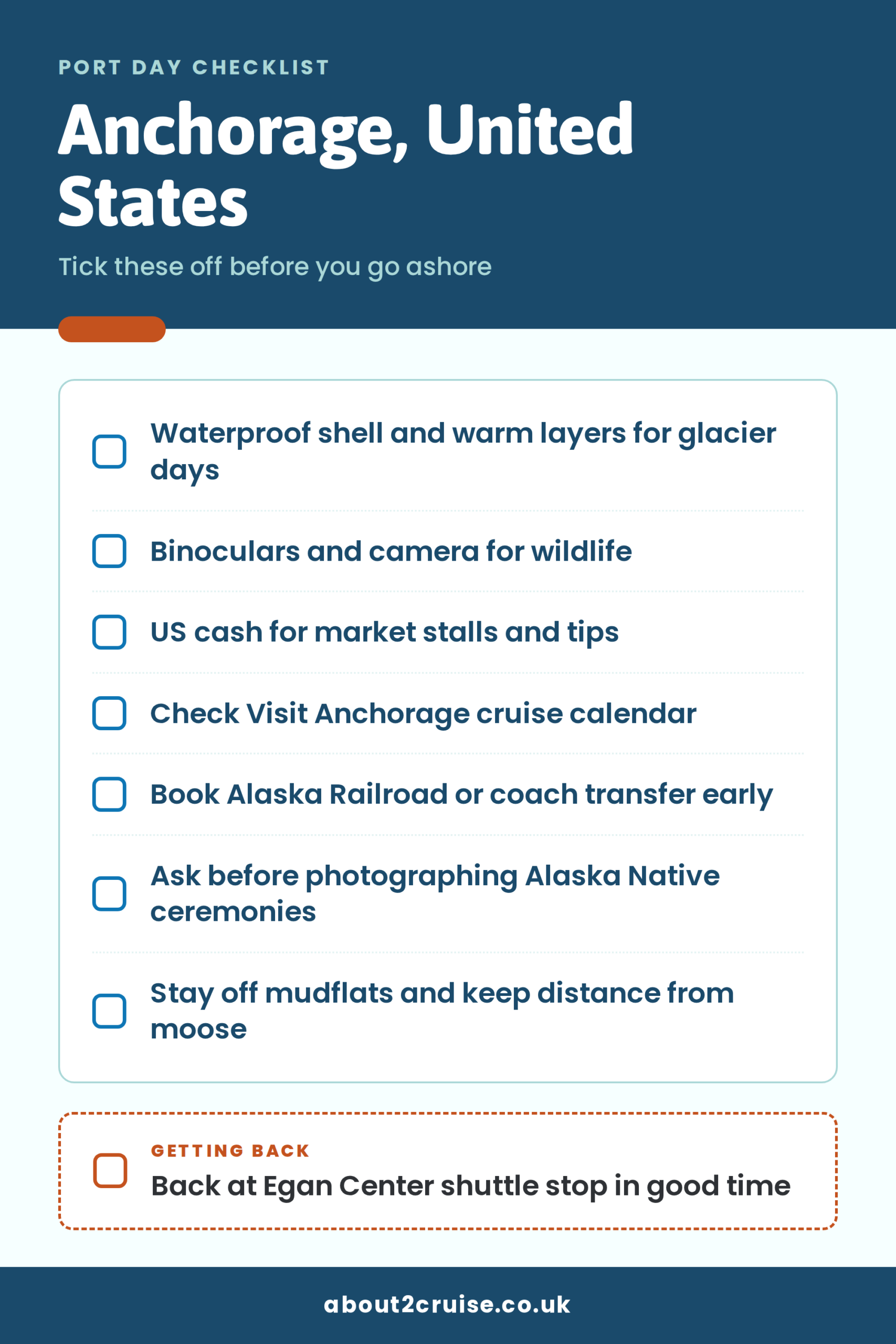
The best single source is Visit Anchorage’s Southcentral Alaska cruise calendar, which covers Anchorage, Whittier, and Seward in one downloadable PDF. It lists the date, port, ship, cruise line, arrival and departure times, and passenger capacity. CLIA also publishes an Alaska port schedule, and the Port of Alaska publishes berth schedules separately. Schedules are preliminary and can change before the season, so check again about two weeks before you travel.
Do not rely on a live ship tracker to plan your embarkation day. A schedule is the source for berthing and disembarkation times. Trackers show the vessel’s position, but deep-ocean positions can lag and do not tell you which dock is being used.
For a 2026 sailing, the Visit Anchorage calendar is still the place to look. It shows calls at Seward from as early as 05:00 and Whittier from 05:00 to 11:30, with most departures between 17:00 and 20:30. The calendar does not always mark which calls are turnarounds, so cross-check your own booking’s port of embarkation or disembarkation.
There is no official map that marks the cruise berth at the Port of Alaska. For practical purposes, use downtown Anchorage’s Egan Center as the ship-to-city transfer point. Visit Anchorage’s maps page and free official guide cover downtown, trails, and road-trip routes, but they do not show the cruise berth. The guide is still worth downloading for the city and trail maps.
Anchorage to Seward: transfers, train, and shuttle options
Seward is about 120–127 miles from Anchorage, a 2.5–3 hour road journey. There is no public passenger ferry between Anchorage and Seward, so your realistic choices are train, motorcoach, shared shuttle, cruise-line transfer, or private sightseeing transfer. Our Seward cruise port guide has the full port picture.
The Alaska Railroad Coastal Classic leaves Anchorage at 06:45 daily in summer and reaches Seward at 11:20, which is too early to connect from a same-morning flight. One-way fares are about $133 in Adventure Class and $277 in GoldStar for an adult. Checked luggage with cruise tags can transfer to the ship on the southbound train, but check with your cruise line so you know it will be accepted.
Coach and shuttle options are cheaper and often more flexible:
- Park Connection motorcoach: $80 adult, $40 child, just under three hours, two departures a day on cruise days.
- Seward Alaska Bus: $69 per person, 2.5–3 hours, with hotel and airport pickup and drop at the cruise terminal.
- Pacific Alaska Tours: $84.53 adult, $41.73 child, picking up at Hotel Captain Cook and the airport.
- Cruise-line transfers run from Anchorage hotels and the airport, with coaches timed to the ship.
Sightseeing transfer tours to Seward start from about $247 per person and normally make stops at places such as the Alaska Wildlife Conservation Center, Portage Valley, and Turnagain Arm viewpoints. Private transfers start from about $767 per party. Do not fly into Alaska on the day your cruise departs. The port is at least 2.5 hours away before any traffic, weather, or photo-stop delays.
Anchorage to Whittier: the tunnel, the train, and timing
Whittier is only about 60 miles from Anchorage, but the Anton Anderson Memorial Tunnel controls when you can arrive. It is a 2.5-mile, one-lane tunnel shared with the railway. In summer, traffic enters Whittier on the half hour and leaves on the hour, roughly from 05:30 to 23:15. The toll for a standard car is $13, charged only on the way into Whittier.
If you are driving or taking a private transfer, allow a minimum of one hour from Anchorage to the tunnel, and 1.5 hours in summer with traffic. Aim to be at the staging area at least 10 minutes before your opening. If you miss your slot, you wait for the next cycle. The return train from Whittier does not leave until 18:45, so most disembarking passengers take a coach or cruise-line transfer rather than the train. Our Whittier cruise port guide covers the terminal, parking, and port-day logistics.
The Alaska Railroad Glacier Discovery is the scenic rail option from Anchorage: it leaves at 09:45 and arrives Whittier at 12:05, with a one-way Adventure Class fare around $119. This works well for a pre-cruise arrival if you are happy to reach the port early. Park Connection runs coaches to Whittier only on cruise ship days, taking about two hours and dropping at the terminal area. Sightseeing transfer tours to Whittier start from about $217 per person and typically take around six hours, with stops and a guaranteed arrival at least three hours before sailing.
Whittier’s main cruise terminal sits on the west side of the harbour beside the railway station. The newer double-berth facility across the harbour has been out of service after a serious fire, so check with your cruise line or transfer provider about exactly where to present yourself.
Getting around Anchorage without a car
Ted Stevens Anchorage International Airport is about five to six miles southwest of downtown. The cheapest transfer is People Mover Route 40, which runs between the airport and downtown along Spenard Road in about 30 minutes. It costs $2 for a single ride or $5 for a day pass, with exact fare accepted, and the stop is outside the South Terminal baggage claim. North Terminal passengers take the free terminal shuttle first. Taxi to downtown is roughly $20–28, and rideshare is about $15–22, taking around 15 minutes.
Downtown Anchorage is compact and walkable. The Anchorage Museum, Ship Creek, the 4th Avenue district, and the start of the Coastal Trail are all reachable on foot from the Egan Center shuttle drop. The Anchorage Trolley offers a one-hour city tour for $25 or a deluxe 1.5-hour tour for $50. Bikes are easy to rent for the Tony Knowles Coastal Trail, an 11-mile flat asphalt route from downtown to Kincaid Park. Cards are accepted almost everywhere, but carry some US cash for market stalls, small vendors, and tips.
Never walk on the Cook Inlet or Turnagain Arm mudflats. People have died after getting stuck in glacial silt and being caught by the incoming tide. Moose are common on urban trails and in parks, and they are large, fast, and best given a wide berth.
Where to stay for a pre- or post-cruise night
Downtown is the practical base for a pre- or post-cruise night. It puts you within walking distance of restaurants, the museum, the Coastal Trail, and the railroad depot, and it is the area served by the Port of Alaska cruise shuttle drop at the Egan Center.
Useful downtown hotels include:
- Hilton Anchorage: 606 rooms, Alaska’s largest hotel, connected to the Egan Convention Center and almost at the shuttle drop.
- Hotel Captain Cook: 547 rooms, four restaurants including the Crow’s Nest with Cook Inlet views, and luggage storage after checkout for cruise guests.
- Marriott Anchorage Downtown: 392 rooms, walking distance to the Anchorage Museum and 5th Avenue Mall.
- Westmark Anchorage: 200 rooms, used for Holland America cruisetours, 200 m from the Egan Center.
- The Wildbirch Hotel: the official Iditarod headquarters, in the downtown Mushing District and about 0.34 km from the Egan Center.
Stay in Midtown or near the airport for cheaper rates and airport convenience, but accept that you will need a car or rideshare for downtown sightseeing.
Anchorage in four hours or less
If you are on a rare Anchorage port call or have a half-day gap before a transfer, take the shuttle or taxi to the Egan Center and stay downtown. The Anchorage Museum is the best single indoor attraction: it tells the story of Alaska and the North, including Indigenous art, history, and science. Summer hours are typically 10:00–18:00 daily, adult admission is $25, and two to three hours is a comfortable visit. Add a walk along Ship Creek to watch anglers, or do a short stretch of the Tony Knowles Coastal Trail. This is all flat, easy, and walkable from the centre.
Anchorage in eight hours or less
With a full day, you have two excellent options. The first is a Turnagain Arm road day: drive or book a tour along the Seward Highway to Beluga Point for bore tide and beluga watching, then continue to the Alaska Wildlife Conservation Center in Portage Valley. The centre is about an hour from Anchorage, covers 200 acres, and costs $30 for a non-resident adult. Allow about an hour each way plus 1.5–2 hours inside.
The second is an Anchorage culture day: visit the Alaska Native Heritage Center in the morning, about 15 minutes’ drive from downtown, then return for the Anchorage Museum in the afternoon. The Heritage Center presents all 11 Alaska Native cultures through life-size village sites, dance performances, and storytelling led by culture bearers. Adult admission is $30, with 50% off after 16:00.
Do not try to add Seward or a Kenai Fjords cruise to an Anchorage port call. Seward is roughly 120 miles and three hours each way, which cannot fit a ship’s limited day in port.
Shore excursions vs. doing it yourself
Downtown Anchorage is a good DIY port. The cruise shuttle drops at the Egan Center, and the museum, 4th Avenue, Ship Creek, and the Coastal Trail are all walkable. Cards work almost everywhere, and ATMs are available at the Egan Center.
For anything beyond the central core, Chugach State Park, Flattop Mountain, the Alaska Wildlife Conservation Center, Portage Valley, or the Alaska Native Heritage Center, you need a vehicle or a booked tour. Local operators run free shuttles from downtown to some outlying attractions, including the Ulu Factory, Alaska Zoo, and Alaska Wild Berry Park, so ask at the visitor information desk before paying for a taxi.
Alaska Railroad from Anchorage: scenic rail for cruisers
The Alaska Railroad is a scenic experience as well as a transfer method. The Coastal Classic to Seward and the Glacier Discovery to Whittier are the two rail routes most relevant to cruise passengers. Both leave from the downtown depot, not the airport, so an airport arrival needs a separate ride into town first. GoldStar dome cars have panoramic upper-level seating, a lift, and accessible restrooms on both levels. The railroad is wheelchair accessible with ramps at every boarding location.
Cruise train services sell out and can overflow onto the Coastal Classic, so book rail as early as you can if you want a specific timed departure. If you are heading to Seward for embarkation, the 06:45 departure is normally the one you want. If you are disembarking in Seward, the 18:00 return train often works, but check it against your flight time from Anchorage the next day.
Glacier days, wildlife watching, flightseeing, and fishing
The big glacier and wildlife day trips do not leave from Anchorage itself. They leave from the port towns. The six-hour Kenai Fjords National Park cruise departs from Seward’s small boat harbour and costs about $215–239 adult and $108 child, with a four-hour option from $149. This only works if you are already in Seward before or after your sailing. From Whittier, the 26 Glacier Cruise runs daily from 12:00 to 17:15 and costs $219 adult, $137 child plus tax and fees. It is wheelchair accessible by ramp and has an accessible restroom. A package with round-trip transport from Anchorage or Girdwood is about $464.
Flightseeing from Anchorage is easy because Lake Hood is right in the city. A 30-minute city flight from Lake Hood is about $175 per person. A three-hour Prince William Sound flight with a remote lake landing is about $625 per person plus tax, and a three-hour Denali flight is around $595. If you want to fish, Ship Creek in downtown Anchorage offers urban salmon fishing from late May through summer, with kings running late May to July and coho from August to mid-September. For serious charters, Seward and Homer are the better bases.
Where to eat and what to try
Anchorage dining is “Alaska casual,” so jeans and a fleece are acceptable even in good restaurants. The must-try list includes wild salmon, king crab, halibut, oysters, reindeer sausage, sourdough pancakes, and birch syrup. Reindeer sausage is the street-food version, sold from downtown carts for roughly $8–12.

4th Avenue downtown is the main strip for bars and brewpubs, and Anchorage has a large microbrewery scene. The Anchorage Market & Festival runs on 3rd Avenue between C and E Streets on Saturdays and Sundays from late May to mid-September, typically 10:00–18:00, with more vendors on Saturdays. Halibut tacos and reindeer fried rice are among the stall foods. For self-catering or vacuum-packed seafood to take on board, New Sagaya and Alaska Seafood Exchange are good stops.
Souvenirs worth buying in Anchorage
The single most famous Alaska souvenir is an ulu knife, the crescent-shaped blade used for generations. Buy one at the Ulu Factory on Ship Creek, where they are made on site, and ship it home rather than packing it, because knives may not be allowed on board. Expect to pay roughly $20–80 depending on size and handle.
Vacuum-packed wild smoked salmon is the easiest edible gift, roughly $15–30 for a 4–6 oz pack. Jade is Alaska’s state gem, and jade carvings and jewellery are widely sold. Birch syrup, local honey, and qiviut knitwear from Oomingmak Musk Ox Producers’ Co-op are all distinctive local buys. For genuine Alaska Native handmade work, look for the state’s Silver Hand seal and buy direct from the artist or a cultural centre. The weekend market is the biggest concentration of local makers and food stalls.
What to pack for an Alaska cruise (and which side of the ship?)
Alaska weather in cruise season is not extreme, but it is changeable. Average daytime highs are about 12°C in May, 16°C in June, 19°C in July, 17°C in August, and 13°C in September. July and August also tend to be the rainiest popular months, so a waterproof hooded shell matters more than a heavy coat. Pack moisture-wicking base layers, a fleece or packable down mid-layer, warm hat and gloves, quick-dry trousers, and waterproof walking shoes or boots with grip for wet gangways and trails. Rain trousers are worth their weight, as are polarised sunglasses, a refillable water bottle, binoculars, a power bank, and spare camera storage. Add insect repellent, high-factor sunscreen for glare off water and ice, a sleep mask for the midnight sun, motion-sickness medication, and any prescription medicines. One smarter outfit is useful if your line has a dress-up night.
It is not cold inside the ship. Public rooms are heated, and many ships have heated indoor pools and covered lounges. The cold is concentrated at the glacier faces, where temperatures can sit in the 30s Fahrenheit and wind off the ice makes open decks feel much colder. Dress for that moment, not for the cabin.
Which side is best depends on direction. Northbound Alaska cruises sail up the coast, so the starboard side faces the land. Southbound cruises are the reverse, with the port side facing the coastline. Ships rotate 360 degrees at glacier faces such as Hubbard Glacier and Dawes Glacier, so both sides get views, and open decks give the same view regardless of cabin side. If you have a choice and a northbound one-way, starboard is the conventional preference; southbound, port is the conventional preference. Do not lose sleep over it.
Alaska Native culture: doing it respectfully
Alaska has 11 distinct Alaska Native cultures and more than 200 federally recognised tribes, each with its own language and traditions. Anchorage’s Alaska Native Heritage Center is the single best place to begin, with life-size village sites, dance performances, and storytelling led by culture bearers. The Anchorage Museum also has outstanding Indigenous art and history galleries.
When visiting any cultural site, ask before photographing people or ceremonies, and treat “no” as a complete answer. Follow the guide’s direction during performances. Choose Alaska Native-owned operators and artists where possible, and be sceptical of mass-produced “Native-inspired” goods. The state’s visitor values ask guests to be thankful, respect residents and the environment, take only what is needed, and keep a good spirit.
Accessibility and mobility in Anchorage
Anchorage is generally more accessible than many wilderness destinations. The Anchorage Museum meets ADA requirements, has a drop-off lane on 7th Avenue, accessible parking in its garage, and free manual wheelchairs at the front desk. The Alaska Railroad is wheelchair accessible with ramps at every boarding location, and the GoldStar dome car has a lift and accessible restrooms on both levels.
The 26 Glacier Cruise from Whittier accommodates wheelchairs by ramp and has an ADA-accessible restroom. Holland America sells a wheelchair-accessible Anchorage museum and city tour using a lift-equipped coach, bookable with an accessibility request. People Mover buses offer discounted fares for disability and senior riders. Downtown pavements are flat, and the Coastal Trail is flat asphalt, so central city days need no special mobility preparation.
Anchorage with kids
Anchorage works well for children, especially on a pre-cruise day. The Alaska Zoo is a manageable stop at $25 per non-resident adult and $12 for ages 3–15, with summer hours until 20:00. The Alaska Aviation Museum on Lake Hood is $23 for a non-resident adult and $11 for ages 3–11. The Imaginarium Discovery Center inside the Anchorage Museum is included with museum admission and is excellent for ages 3 and up.
Ship Creek’s salmon viewing is free and fascinating in season, with kings late May to July and coho August to mid-September. The one-hour Anchorage Trolley tour is an easy way to cover the city with children, and the downtown reindeer sausage carts are usually a hit.
Anchorage prices: a quick budget guide
Budget in US dollars. Cards are accepted almost everywhere, but carry cash for market stalls, small vendors, and tips. Tipping follows US norms of about 15–20% in restaurants, with tips expected for guides and drivers.
- Airport to downtown: $2 by People Mover, about $15–28 by rideshare or taxi.
- Anchorage to Seward: $69–133 per adult depending on bus or train, with sightseeing transfers from $247.
- Anchorage to Whittier: $119 by train, $13 tunnel toll if driving, sightseeing transfers from $217.
- Main sights: Anchorage Museum $25, Alaska Native Heritage Center $30, Alaska Wildlife Conservation Center $30, Alaska Zoo $25, trolley $25.
- Big-ticket days: 26 Glacier Cruise $219, six-hour Kenai Fjords $215–239, flightseeing from $175.
- Parking: airport $13 per day or $78 per week, Park Ride & Fly $9 per day, Whittier parking about $90 for seven days, Seward city parking $15 per day.
Luggage storage and embarkation-day logistics
There are no public lockers at Anchorage’s railroad depot, and the airport left-luggage counter requires a boarding pass or airline ticket, which excludes passengers just off a ship. Full-service Anchorage hotels, including Hotel Captain Cook, Marriott Anchorage Downtown, and La Quinta by Wyndham Anchorage Airport, will usually store bags for guests before check-in and after checkout. Third-party downtown luggage storage is bookable online from about $4.95 per day.
If you book a cruise transfer or sightseeing transfer, your bags travel with you, which solves the storage question. If you are boarding in Seward or Whittier, confirm with your transfer operator whether luggage is tagged and handed over at the port or if you must re-claim it at the terminal. Cruise-line transfers normally handle this, but independent coaches often require you to collect your own bag at the kerb.
For a same-day embarkation from Whittier, aim to reach the tunnel staging area about 1.5 hours before the ship sails, and build in time for the tunnel cycle. For Seward, leave Anchorage no later than late morning for an afternoon or evening departure, and never same-day fly into Alaska on embarkation day.
Related Alaska cruise ports
One-way, cross-Gulf itineraries that use Whittier or Seward as the turnaround also call at the classic Southeast Alaska ports. Ketchikan brings Creek Street and totem poles, Juneau pairs whale watching with Mendenhall Glacier, Skagway is the gold-rush town with the White Pass railway, and a glacier day in Glacier Bay, Hubbard Glacier, or College Fjord is usually the scenic highlight. Sitka appears on some longer itineraries. For planning help, see our full Alaska cruise ports guide.
If you are adding a Southcentral Alaska road trip, Homer is a long but rewarding detour at the end of the Kenai Peninsula. Whittier and Seward remain the practical port links, and both have their own guides linked above.
How to spend a port day in Anchorage
A port day in Anchorage works best if you pick one: a walkable downtown loop around Ship Creek and the Anchorage Museum, or a culture day that combines the Alaska Native Heritage Center with the museum.
Before you sail
- Book the Alaska Railroad or coach transfer from Anchorage to Seward or Whittier as early as possible.
- Check the Visit Anchorage cruise calendar for your ship's actual port and terminal.
- Book a Turnagain Arm sightseeing transfer if you want the wildlife centre and Portage Valley stops.
Short port day: under 6 hours
- On dockingTake the free cruise shuttleNo walking from berthYou cannot walk through the cargo port. The shuttle from Terminal 3 drops you at the William A. Egan Civic and Convention Center downtown.
- +15 minShip CreekWalk to Ship Creek to watch anglers and see salmon in season. Cafes and brewpubs cluster near the rail depot.
- +1 hrLunch near Ship CreekTry reindeer sausageOrder reindeer sausage or wild salmon from a cafe by the creek, then watch the anglers.
- +2 hrs 15 minAnchorage MuseumWalk back toward downtown for two to three hours in Alaska's best indoor collection of art, history and science.
- +4 hrs 15 minTony Knowles Coastal TrailWalk a flat stretch from downtown toward Earthquake Park; watch for moose and, in summer, belugas.
- All-aboard minus 1 hrBack at the Egan Center shuttle stopReturn for the shuttle to Terminal 3. Check your cruise line's last departure time and do not rely on late shuttles.
The time on the map is the whole walk, every stop added together.
Open this walking route in Google Maps
If plans change: If the Anchorage Museum is closed or you need to shorten the day, swap it for more time on the Coastal Trail and Ship Creek.
Long port day: 8 hours or more
- On dockingTake the free cruise shuttleYou cannot walk through the cargo port. The shuttle from Terminal 3 drops you at the William A. Egan Civic and Convention Center downtown.
- +15 minRideshare to the Native Heritage CenterTake a rideshare or taxi to the Alaska Native Heritage Center, about 15 minutes from downtown.
- +30 minAlaska Native Heritage CenterExplore life-size village sites, dance performances and storytelling led by culture bearers representing all Alaska Native cultures.
- +2 hrs 30 minLunch on 4th AvenueTry reindeer sausageTake a rideshare back downtown to the 4th Avenue brewpubs and reindeer sausage carts.
- +3 hrs 45 minAnchorage MuseumWalk a few blocks to the museum for Indigenous art, history and science. Allow two to three hours.
- +5 hrs 45 minTony Knowles Coastal TrailStroll a flat stretch from downtown toward Earthquake Park, watching for moose.
- All-aboard minus 1 hrBack at the Egan Center shuttle stopReturn for the shuttle to Terminal 3 well before the last departure.
This map shows the taxi ride from the ship. The time is the drive only, not your time ashore.
Open the taxi route in Google Maps
If plans change: If you cannot get to the Alaska Native Heritage Center, stay downtown and do the Anchorage Museum, Ship Creek and the Coastal Trail instead.
Common questions about cruising from Anchorage
Do any cruise ships really dock in Anchorage?
Rarely. A handful of port-call days each season use the Port of Alaska, the city’s working cargo port. These are calls, not embarkations or disembarkations. Almost all cruises marketed as “Anchorage” actually start or end at Whittier or Seward.
Can I walk from the Port of Alaska to downtown?
No. The port area is a working cargo terminal and pedestrian access is not allowed. Cruise lines provide a shuttle from the berth to the Egan Center downtown, and from there the city is walkable.
Which is better for an Alaska cruise, Seward or Whittier?
Neither is universally better. Whittier is closer to Anchorage and better for lines running cruise trains to Denali in a single day. Seward has the classic scenic road and is the base for Kenai Fjords National Park. The right choice is usually dictated by which cruise line and itinerary you prefer. Confirm the port on your booking documents.
Is Anchorage in the Mediterranean?
No. This confusion comes from the nautical word “anchorage,” which simply means a sheltered place to drop anchor. Anchorage, Alaska is in Southcentral Alaska on Cook Inlet, and has nothing to do with Mediterranean cruising.
Do I need a car in Anchorage?
Not for downtown. The museum, Ship Creek, 4th Avenue, and the Coastal Trail are walkable, and the airport bus is cheap. You only need a car or booked tour for Flattop Mountain, Portage Valley, the Alaska Wildlife Conservation Center, or the Alaska Native Heritage Center.
Can I do a Kenai Fjords cruise on a same-day Anchorage port call?
No. Seward is about 120 miles and three hours from Anchorage, so a Kenai Fjords glacier and wildlife cruise does not fit a ship’s limited in-port day. Save it for a day when you are actually staying in Seward before or after a one-way sailing.
How long before sailing should I arrive in Whittier?
If you are driving or taking a private transfer, aim to reach the tunnel staging area about 1.5 hours before the ship sails. The tunnel enters Whittier on the half hour, and traffic can back up in summer. Cruise-line transfers and sightseeing tours build in this timing automatically.
Is there luggage storage at Anchorage Airport for cruise passengers?
Not really. The airport left-luggage counter requires a boarding pass or airline ticket, so it is designed for departing air passengers, not cruise passengers just off a ship. Use a hotel luggage hold or book a third-party storage service online if you need a few hours downtown.