
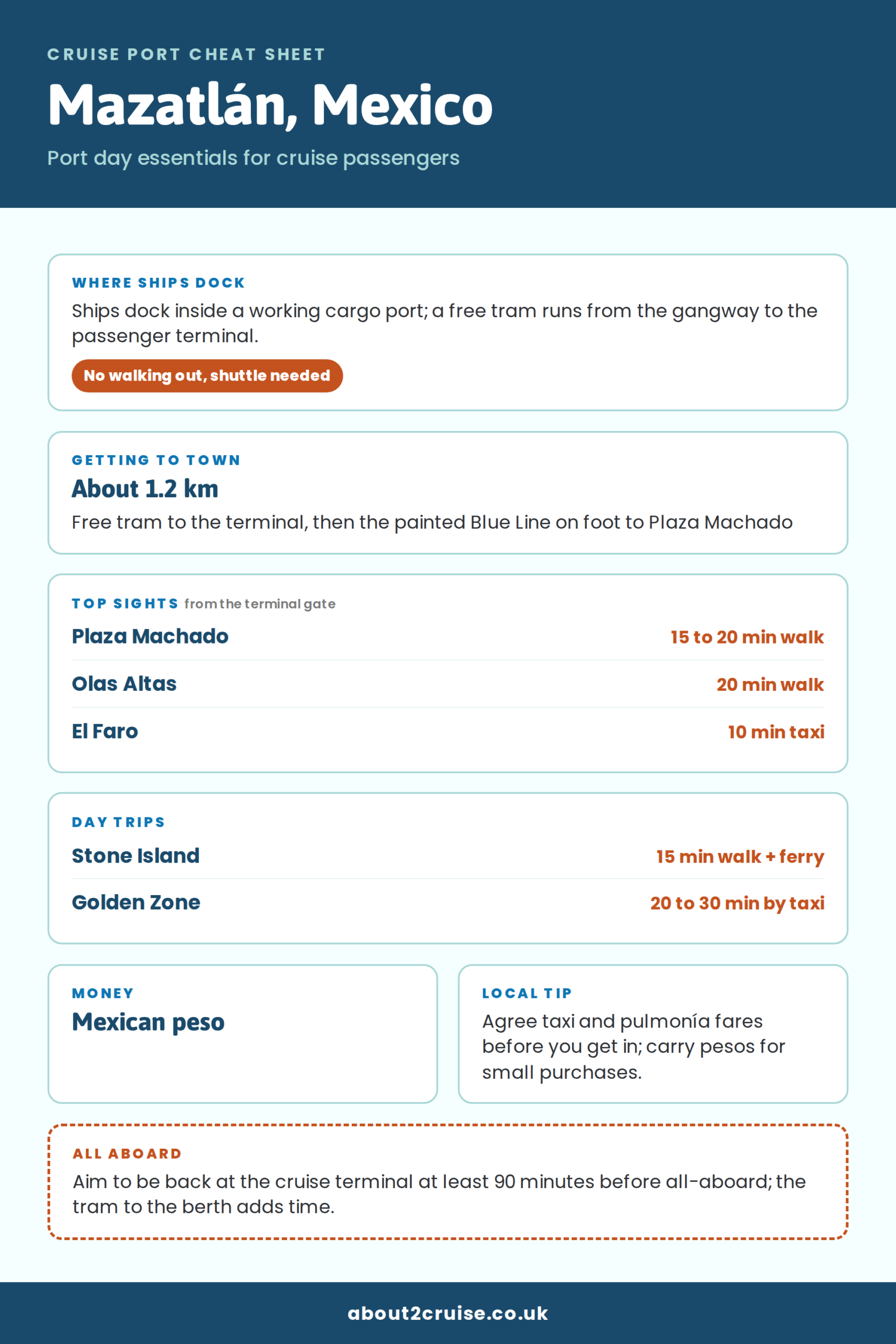
Mazatlán is a docking port, no tender, but you berth inside a working cargo port, so a free tram carries you from ship to terminal. From there, the painted Blue Line leads about 1.2 km into the old town on foot, and a taxi or pulmonía to the Golden Zone costs around US$10. Stone Island, El Faro, the Malecón and fresh seafood are all easy day-out options.
Arriving at the Mazatlán Cruise Port: No Tender, Just a Working Dockside
Mazatlán sees cruise ships dock right alongside, so there’s no tender operation here. What surprises most first-time visitors is the setting: this is a genuine working commercial port, not a purpose-built cruise pier with a polished welcome hall. From the gangway you’ll see containers, cranes and cargo vessels going about their business all around you.
The cruise berth sits at the southern end of the city, roughly 1.2 km from Plaza Machado in the old town, and two cruise ships can be alongside at the same time. Because the berth lies inside a secure port area, you can’t simply walk from the ship to the street. A free tram shuttles passengers between the gangway and the passenger terminal every few minutes, and it’s mandatory for that berth-to-terminal stretch. Do not try to walk across the cargo yard. The tram only covers the short leg inside the port perimeter: it does not take you into town.
The terminal itself is on Avenida Emilio Barragán. Mazatlán is a port of call rather than a turnaround port, so don’t expect airport-style check-in desks or a baggage hall. It’s a functional welcome point for day visitors.
What’s Inside the Cruise Terminal (and What’s Not)
Inside the terminal you’ll find craft and souvenir stalls, a second, quieter crafts market across the road, small shops, a pharmacy, and tour and taxi desks. Outside, under the shade trees, a few tables sell cold beer: a welcome sight after a hot walk around the port. The Pacífico brewery sits right across the street from the terminal entrance, so you can tick off the brewery landmark just by walking out of the port.
There are no ATMs inside the terminal building, so if you need cash, you’ll be doing it in town. Wi-Fi is patchy at best, and there’s no advertised left-luggage service, so plan to carry whatever you take ashore.
Mazatlán cruise port map
Ships dock at Mazatlán cruise terminal. From the terminal gate, Teatro Ángela Peralta is about a 13-minute walk, Isla de la Piedra about 15 minutes and Olas Altas about 17 minutes. Tap a pin for directions.
- Mazatlán cruise terminalWhere ships dock
- Teatro Ángela PeraltaTheatre · About 13 min walk from the terminal gate
- Isla de la PiedraPeninsula beach · About 15 min walk from the terminal gate
- Olas AltasBeach and promenade · About 17 min walk from the terminal gate
- Mercado Pino SuárezCentral market · About 19 min walk from the terminal gate
- Cervecería del PacíficoBrewery · About 22 min walk from the terminal gate
- Glorieta Sánchez TaboadaCliff diving viewpoint · About 28 min walk from the terminal gate
- Malecón de MazatlánSeafront promenade · About 3 km from the terminal gate
- El Faro de MazatlánLighthouse · About 2 km from the terminal gate
- Playa GaviotasBeach · About 6 km from the terminal gate
- Gran Acuario MazatlánAquarium · About 4 km from the terminal gate
- Observatorio 1873Observatory · About 3 km from the terminal gate
Walking into Old Mazatlán Along the Blue Line
The simplest and cheapest way into the historic centre is the painted Blue Line. This marked pedestrian route runs from the cruise terminal to Plaza Machado: about 1.2–1.3 km, or 15–20 minutes on flat ground at an easy pace. In the midday heat, though, it can feel noticeably longer. The route has been extended in places as far as Mercado Pino Suárez, but the main line to the plaza is the standard route every cruise passenger can follow.
On port days, English-speaking volunteers in blue shirts, the Mazatlán Tourist Aide Volunteers, staff the Blue Line and hand out free maps and directions. They have nothing to sell and are there specifically to help cruise visitors, so don’t hesitate to ask for help if you feel unsure.
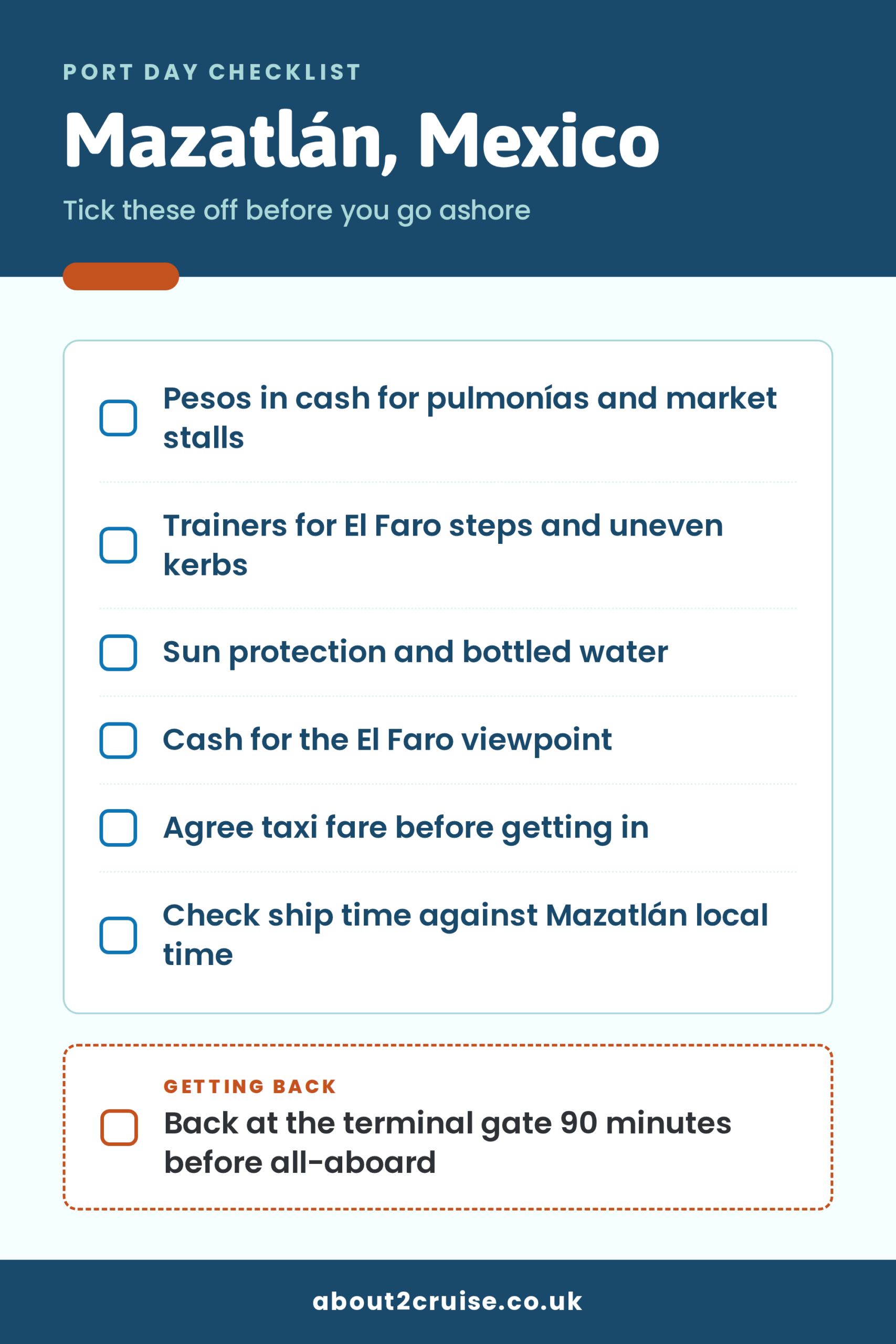
The route isn’t uniformly smooth: parts of it run down the middle of the road, pavements can be uneven, and kerbs are high. Sturdy footwear helps. Stay on the marked route, particularly if you’re walking alone.
Getting Around: Taxis, Pulmonías, Uber and Local Buses
Mazatlán has a transport option you won’t find anywhere else in Mexico: the pulmonía. These open-sided, oversized golf-cart-style taxis are the city’s signature ride. Regular red-and-white taxis, and the green aurigas, are usually a little cheaper. None of them use meters, so agree on the destination, currency, and total price before you get in.
Here’s what to expect for fares:
- Cruise terminal to Old Town or Plaza Machado: roughly US$10 per cab, often a little less in pesos.
- Cruise terminal to the Golden Zone: about US$10 per cab, around 20–30 minutes by road depending on traffic.
- Pulmonía tour: the regulated tourist rate is 500 pesos per hour. Short local hops of a few blocks typically run 70–250 pesos.
Taxis waiting just outside the terminal gate are often cheaper than the ones right at the pier. Uber and DiDi both operate in Mazatlán, so you can book a ride through the app if you have mobile data. Just follow the app’s pickup instructions. Local buses are cheap and frequent on main routes during the day, but they’re not low-floor and can be confusing if you only have a few hours.
Old Town, Plaza Machado and the Historic Centre
The Centro Histórico is a designated national historic zone of 180 blocks packed with 19th- and early-20th-century buildings. At its heart is Plaza Machado, a leafy square laid out in 1837 and ringed with café terraces, galleries and an iron gazebo that still functions as a bandstand. It’s the natural first stop after the Blue Line walk: somewhere to sit, order a cold drink, and get your bearings.
Next to the plaza on Calle Carnaval stands the Teatro Ángela Peralta, a 19th-century national historic monument restored to use as a theatre and cultural venue. The cathedral, the Basílica de la Inmaculada Concepción, occupies a block on the main square, Plaza República, a short walk away.
For cheap local food and a slice of everyday life, head to Mercado Pino Suárez: the cast-iron central market between the cathedral and the waterfront. It’s the best place in the centre for inexpensive seafood and browsing. The upstairs comedores serve some of the best-value lunches in town. On the first and third Friday evenings in season, the Centro Histórico ArtWalk opens galleries and workshops free of charge, with live music in Callejón Liverpool.
The Malecón: A Long, Lovely Walk by the Sea
Mazatlán’s Malecón runs more than 21 km from the old town northwards, making it one of the longest seafront promenades in the world. The oldest stretch is Olas Altas, at the foot of the old town, about four blocks downhill from Plaza Machado. The Malecón is flat, wide and wheelchair-accessible at major crossings, with ramps in the best-maintained stretches. It’s a perfect place for a long, breezy walk with the Pacific on one side and the city on the other.
One of the classic port-day rituals is watching the cliff divers at the Glorieta Sánchez Taboada on Paseo Claussen, between Los Pinos and Olas Altas. Divers launch themselves from rocks about 14 m high. The show is free, though the divers welcome tips. Displays can be suspended when the sea is rough, so don’t bank on a set time.
Olas Altas is also the classic sunset viewpoint. If you have a late departure, finishing here as the sun drops into the Pacific is the best way to end the day.
Best Beaches for a Cruise Day
The city’s beaches are strung along the coast from the old town to the north. Playa Olas Altas is the closest beach to the port and old town. You can reach it on foot by walking the Blue Line to the Centro Histórico and then downhill to the Malecón: but it’s a 20-minute walk, and the Pacific surf here can be heavy.
For a proper swim-and-lounger day, the Golden Zone beaches are the easiest option. Playa Gaviotas, Playa Camarón Sábalo and Playa Sábalo line the hotel strip along Avenida Camarón Sábalo, with loungers, watersports and beach restaurants. Playa Gaviotas was the first beach in Sinaloa certified “Playa Limpia.”
Further out, Playa Cerritos, Playa Brujas and Playa Norte offer more space and less crowd. Be aware that most beaches are unpatrolled, with unpredictable Pacific currents. Follow flags and lifeguard advice, and never swim alone at unmarked surf beaches.
Can you walk from the cruise ship to a beach? Yes, to Olas Altas via the Blue Line and old town, but the better swimming beaches in the Golden Zone are a taxi ride away. For most people, the best beach day is Stone Island, covered next.
Stone Island: An Easy Independent Beach Escape
Stone Island is the classic Mazatlán cruise beach break, and it’s surprisingly easy to do independently. Despite the name, it’s actually a peninsula across the channel from the port: no long water crossing required. From the terminal, turn left and follow Avenida Emilio Barragán to the small jetty. It’s roughly four blocks, then a short dirt track. A yellow ticket booth marks the spot. Small pangas (open boats) shuttle across in 5–10 minutes. Round-trip fares run about 30–55 pesos (around US$2–3), paid in cash on the mainland side.
On the beach, a long line of palapa restaurants offers shaded tables, cold drinks and fresh seafood. Loungers and umbrellas are normally free if you order food and drink: confirm this as you sit down so there are no surprises. It’s a relaxed, low-key beach scene rather than a manicured resort. Return boats thin out later in the day, so head back with daylight to spare and avoid leaving the crossing until the last possible moment.
El Faro Lighthouse: Steps, Sweat and a View Worth It
El Faro sits on Cerro del Crestón, 157 m above the Pacific. The access trail is about 745–750 m long with approximately 336–356 steps, climbing steadily to one of the most photographed viewpoints in the city. The ascent takes about 30–45 minutes at a steady pace. Walking access to the hill is free; the glass viewpoint at the top costs 30 pesos, cash only, with under-4s free.
This is a great port-day workout, but you need to plan around the heat. Normal opening is from around 06:00–06:30 through to about 17:45, with last entry around 17:45. Access closes when the heat index reaches 40°C or in rain and storms: in hot spells that often means closure from late morning until late afternoon. If you want to climb comfortably, go early in the morning, wear trainers or grippy shoes, carry water, and expect no shade. Toilets are only at the bottom of the trail.
Food to Try: Shrimp, Aguachile, Smoked Marlin and Pacífico
Mazatlán is a shrimp and seafood town. Sinaloa leads Mexican shrimp production, and the local coast claims to be the Billfish Capital of the World. The ports and fondas celebrate it. Here’s what to try on a port day:
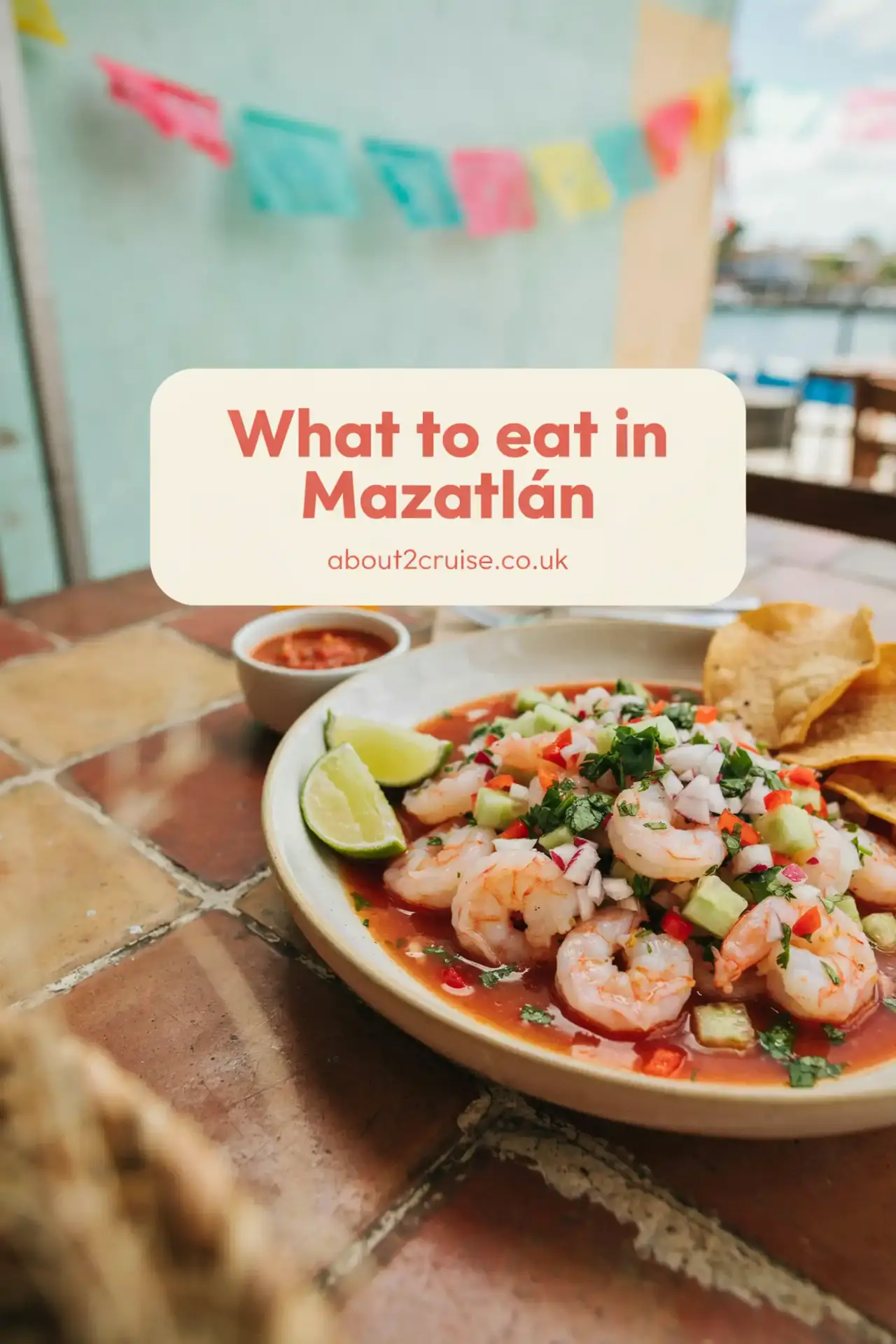
- Aguachile: raw shrimp cured in lime and chilli: Mazatlán’s signature dish. Eat it early in the day; seafood stands do most of their trade at lunch and often close by evening.
- Pescado zarandeado: whole butterflied fish grilled over coals, usually enough for two or three people.
- Coctel de camarón: shrimp cocktail, fresh and cheap.
- Smoked marlin tacos: a Pacific treat worth finding.
Approximate local prices: aguachile 180–350 pesos per portion (160–220 pesos in the market), zarandeado 380–700 pesos for a fish serving two to three, and market lunches 90–150 pesos. The best spots are the fondas and upstairs comedor at Mercado Pino Suárez, the mariscos restaurants along the Malecón and Olas Altas, and the terraces around Plaza Machado.
Cerveza Pacífico is brewed right here in Mazatlán: the brewery was set up by three German brewers, and its label carries an anchor and lifebuoy with Cerro del Crestón. The plant sits across the street from the cruise terminal in the Centro Histórico, so you can see the brewery landmark just by walking out of the port.
Carnival, Sport Fishing and Marinas
If your ship calls in February, you may catch Mazatlán’s International Carnaval: the city’s biggest annual festival and one of the largest in Latin America. It runs over six days with coronations, parades along the Malecón and the Combate Naval at Olas Altas. Crowds are large, and the old town becomes the festival’s beating heart.
Sport fishing is woven into the town’s identity. Fleets work out of Marina El Cid and Marina Mazatlán in the Golden Zone, and from the old port near the lighthouse. Target species include sailfish, striped and blue marlin, dorado and yellowfin tuna. For a cruise passenger, the most practical way to sample this is a half-day charter or a ship excursion: but if you just want the marina atmosphere, a stroll around Marina Mazatlán gives you a taste without committing a whole day.
Money, Tipping and Language Tips
The currency is the Mexican peso. US dollars are widely accepted in tourist areas, but the exchange rate is poor and change comes in pesos. You’re almost always better off using pesos. Cards work in hotels, established restaurants and larger shops, but expect cash for pulmonías, street food, market stalls and public toilets. Toilets often require a 5 or 10 peso coin.
ATMs exist in town, not at the terminal. Use them in daylight, inside shops or malls, withdraw only what you need, and be aware of your surroundings. Restaurant tipping of around 10–15% is the norm. Small notes are useful for drivers, guides and the cliff divers.
Spanish is the official language, but English is widely spoken in tourist areas, at tour desks and in restaurants around the port and Golden Zone. A few phrases of Spanish go a long way in the market and with pulmonía drivers.
Is Mazatlán Safe for Cruise Passengers? What to Know
Sinaloa’s reputation makes many first-time visitors nervous, so let’s put it in context. UK travel advice for Mexico excepts Mazatlán from the wider “all but essential travel” warning that applies to much of Sinaloa: so the city itself sits outside the restricted area. Cruise lines continue to call, and a dedicated inter-agency security protocol is activated for every cruise arrival. The Blue Line route with volunteer aides exists precisely to make the port-to-old-town corridor safe and visible for cruise passengers.
Common-sense precautions still apply. Stay on the marked Blue Line. Use regulated taxis or app-based rides rather than unmarked cars. Keep valuables out of sight, avoid isolated stretches after dark, and use ATMs in daylight inside shops or malls. Street crime and pickpocketing are the main risks in busy areas. For cruise passengers, the most likely issue isn’t violence: it’s being overcharged by an unregulated taxi or missing the ship because you underestimated the return journey.
Weather, Heat and Hurricane Season
Mazatlán has a hot subhumid climate. Average monthly maximum temperatures sit around 28–32°C across the year, with the hottest daytime values in April and May. Humidity is high from May to November, and August is the muggiest month. Sea temperatures range from about 22°C in late winter to 30°C at the end of summer.
Rain is concentrated from June to November, with monthly averages peaking at around 240 mm in July, 211 mm in August and 215 mm in September. The eastern Pacific hurricane season runs from 15 May to 30 November, with peak activity from July to September. Cruises sail year-round on the Mexican Riviera, but if your sailing falls in that window, expect heavy afternoon showers as a possibility and keep an eye on the tropical outlook.
Heat is the other hazard. El Faro closes when the heat index reaches 40°C, typically late morning to late afternoon in hot spells. Whatever your plans, drink more water than you think you need, wear sun protection and take shade seriously in the middle of the day.
Family-Friendly Things to Do in Mazatlán
Mazatlán works well for families. Gran Acuario Mazatlán is Mexico’s largest aquarium, open daily 09:00–18:00 with last tickets at 16:30. Adult tickets are 612 pesos, ages 3–11 pay 498 pesos, under-3s go free, and disabled visitors enter free. It’s a substantial indoor-outdoor attraction that can fill a full port day for younger kids.
Before you sail
- Bring Mexican pesos for pulmonías, market stalls, public toilets and the El Faro viewpoint.
- Check your ship's time policy: Mazatlán stays on Mountain Standard Time with no daylight saving.
- Book a shore excursion if you want sport fishing, an all-inclusive Golden Zone day or kayaking.
Short port day: under 6 hours
- On dockingTake the free port tramNo walking outYou cannot walk across the cargo yard. The free tram runs from ship to terminal, then follow the painted Blue Line towards Plaza Machado.
- +30 minPlaza MachadoA 15 to 20 minute walk from the terminal. The leafy square is ringed with cafés and galleries, with the Teatro Ángela Peralta beside it.
- +1 hr 15 minCathedral and Mercado Pino SuárezWalk a few blocks to the Basílica de la Inmaculada Concepción, then to the cast-iron central market for a look around.
- +1 hr 45 minLunch at Mercado Pino SuárezTry aguachileThe upstairs comedores serve the best-value lunches. Order aguachile or coctel de camarón, Mazatlán's shrimp dishes, and pay in pesos.
- +2 hrs 45 minOlas Altas and the MalecónWalk downhill four blocks to the seafront promenade. Watch the cliff divers from the Glorieta Sánchez Taboada if they are performing.
- All-aboard minus 90 minBack at the terminal gateWalk back up the Blue Line to the terminal, then take the free tram to the berth. Leave time for the queue and the tram.
The time on the map is the whole walk, every stop added together.
Open this walking route in Google Maps
If plans change: If the Blue Line is crowded or the old town feels too busy, take a pulmonía from the terminal to Olas Altas and spend the day on the Malecón instead.
Long port day: 8 hours or more
- On dockingTake the free tram, then taxi to El FaroAgree fare firstRide the tram to the terminal. Take a taxi or pulmonía to the El Faro trailhead, and agree the fare before you get in.
- +15 minClimb El Faro lighthouseCash for viewpointAllow 30 to 45 minutes up the stepped trail. The glass viewpoint at the top is cash only, with no shade on the climb.
- +1 hr 30 minTaxi to Plaza MachadoTake a taxi or pulmonía to Plaza Machado. Explore the square, the Teatro Ángela Peralta and the cafés around it.
- +2 hrs 30 minLunch at Mercado Pino SuárezTry aguachileOrder aguachile or coctel de camarón at the upstairs comedores before the seafood stands close for the day.
- +3 hrs 45 minOlas Altas and the cliff diversWalk downhill to the Malecón. The cliff divers perform from rocks at the Glorieta Sánchez Taboada, free but tips welcome.
- +5 hrs 30 minGolden Zone beachTake a taxi north to Playa Gaviotas or Playa Camarón Sábalo for a final swim and lounger, then be ready to return.
- All-aboard minus 90 minBack at the terminal gateTaxi back to the terminal gate, then ride the free tram to the berth. Allow extra time for the terminal queue.
This map shows the taxi ride from the ship. The time is the drive only, not your time ashore.
Open the taxi route in Google Maps
If plans change: If El Faro is closed or the viewpoint queue is too long, skip it and add the extra time to the Golden Zone beach and the Centro Histórico.
Observatorio 1873, on Cerro del Vigía, offers a funicular ride, a 19th-century museum and a 360° sky bar, plus a zipline (the Farolesa) across the harbour for older kids and adults. Combined tickets with the zipline start around 1,950 pesos.
The cliff divers at the Glorieta Sánchez Taboada are also a hit with children: the spectacle itself is free, and the divers work for tips. Pair it with a walk along the Malecón, an ice cream, and a beach stop in the Golden Zone for a relaxed family day without a big organised tour.
Accessibility and Mobility Ashore
The port trams have ramps that can be deployed for wheelchairs and scooters, and the terminal building has level access and accessible restrooms. That’s the easy part. Once you leave the port, the old town’s cobbled streets and high kerbs are the main barrier: they’re genuinely difficult for wheelchair users and anyone with limited mobility. The Malecón, by contrast, is flat and wide with ramps at major crossings in the maintained sections.
Most pulmonías cannot take a non-folding wheelchair, so plan on using a regular taxi or app-based ride. El Faro is not advised for wheelchair users: the climb is steep, with hundreds of steps and no shade. Gran Acuario Mazatlán, with its modern level access, is the better choice for a fully accessible port-day attraction.
Should You Book a Shore Excursion or Go Independent?
Mazatlán is very doable independently: arguably one of the easiest Mexican Riviera ports for a DIY day. The Blue Line gives you a safe, signposted walking route into the old town for free, Stone Island is a self-service beach break for a couple of dollars of ferry fare, and taxis to the Golden Zone are cheap. You don’t need a ship excursion to have a good day here.
That said, around two-thirds of cruise passengers still buy an organised excursion. A guided trip gets you convenience and buffer: transport taken care of, commentary in English, and a guaranteed return to the ship. That matters more if you want to do something logistically fiddly: sport fishing, an all-inclusive resort day in the Golden Zone, kayaking off Deer Island, or a heritage taco tour in the Centro Histórico. For a simple explore-and-eat port day, going independent works perfectly well.
Souvenirs and Shopping Near the Port
The cruise terminal itself has craft and souvenir stalls, plus a second quieter market opposite. Goods are heavy on textiles, ceramics, vanilla, hot sauces and the usual Mexican market staples. For better prices and more variety, head to Mercado Pino Suárez in the old town: it’s the cheapest place for crafts and the most atmospheric for browsing. The city is also known for silver work, so look for reputable jewellers in the Centro Histórico if you’re after a bigger purchase. As always, inspect quality, negotiate politely in the markets, and pay in pesos where possible.
Getting Back to the Ship on Time
Mazatlán keeps Mountain Standard Time all year and does not change clocks for daylight saving. Ships may keep their home port time rather than local time, and the all-aboard time is always ship time. Check the daily programme, the gangway sign and any announcements: never assume your phone has adjusted to the right reference.
All-aboard is normally 30–60 minutes before departure. The ship will not wait for independent passengers. Reaching the port entrance is not the same as reaching the gangway: you still need to queue for the terminal, go through the port check, and ride the tram back to the berth. Leave a cushion: at least another 30–45 minutes beyond your planned arrival at the terminal, more if you’re coming back from Stone Island or a beach where return boats thin out later in the day.
Flying in for a Mexican Riviera Cruise
Mazatlán International Airport (MZT) is about 30 minutes by road from the cruise terminal. Official airport taxis run on fixed zone fares bought at a desk inside arrivals, generally around 300–400 pesos to the port. Many Mazatlán calls sit on a Mexican Riviera itinerary that begins from one of the southern California cruise ports. See our guides for Long Beach, Los Angeles and San Diego if your itinerary starts or finishes there.
This is one of Mexico’s Pacific coast cruise ports. Our Mexico cruise ports guide covers the others on the Pacific and the Caribbean.
Frequently Asked Questions
What should UK cruisers know about ship time versus local time in Mazatlán?
Mazatlán stays on Mountain Standard Time year-round with no daylight saving. Your ship may not change to local time: it might keep home port time. The only time that matters for all-aboard is ship time, as posted at the gangway. Set a watch or phone to ship time in the morning and ignore local clocks for any deadline.
Can I drink the tap water in Mazatlán?
No: drink bottled water in Mazatlán. Tap water is fine for showering and brushing your teeth if you spit it out, but don’t drink it. Ice in established tourist restaurants is usually made from filtered water, but if you’re in a small market stall or street stand, ask or stick to sealed drinks.
Do I need to book Stone Island in advance?
No. You can simply turn up, walk or take a short taxi to the jetty from the port, pay your ferry fare in cash, and choose a palapa restaurant on the beach. The only reason to book an organised Stone Island day is if you want transport, lunch and loungers arranged for you from the moment you leave the terminal gate.
Is there luggage storage at the cruise port?
No left-luggage service is advertised at the cruise terminal. If you need to stash bags during a port day, third-party bag storage options exist around Plaza Machado and the Palacio Municipal from about 26 pesos per bag per day. Plan on carrying small essentials with you.
Do I need pesos before I arrive in Mazatlán?
You don’t need to arrive with pesos, but it helps. There are no ATMs inside the cruise terminal, so your first cash opportunity is in town. US dollars are accepted in many tourist businesses, but the exchange rate is poor. The simplest approach is to carry a small amount of pesos on board, then withdraw what you need from a bank ATM inside a shop or mall in daylight.