
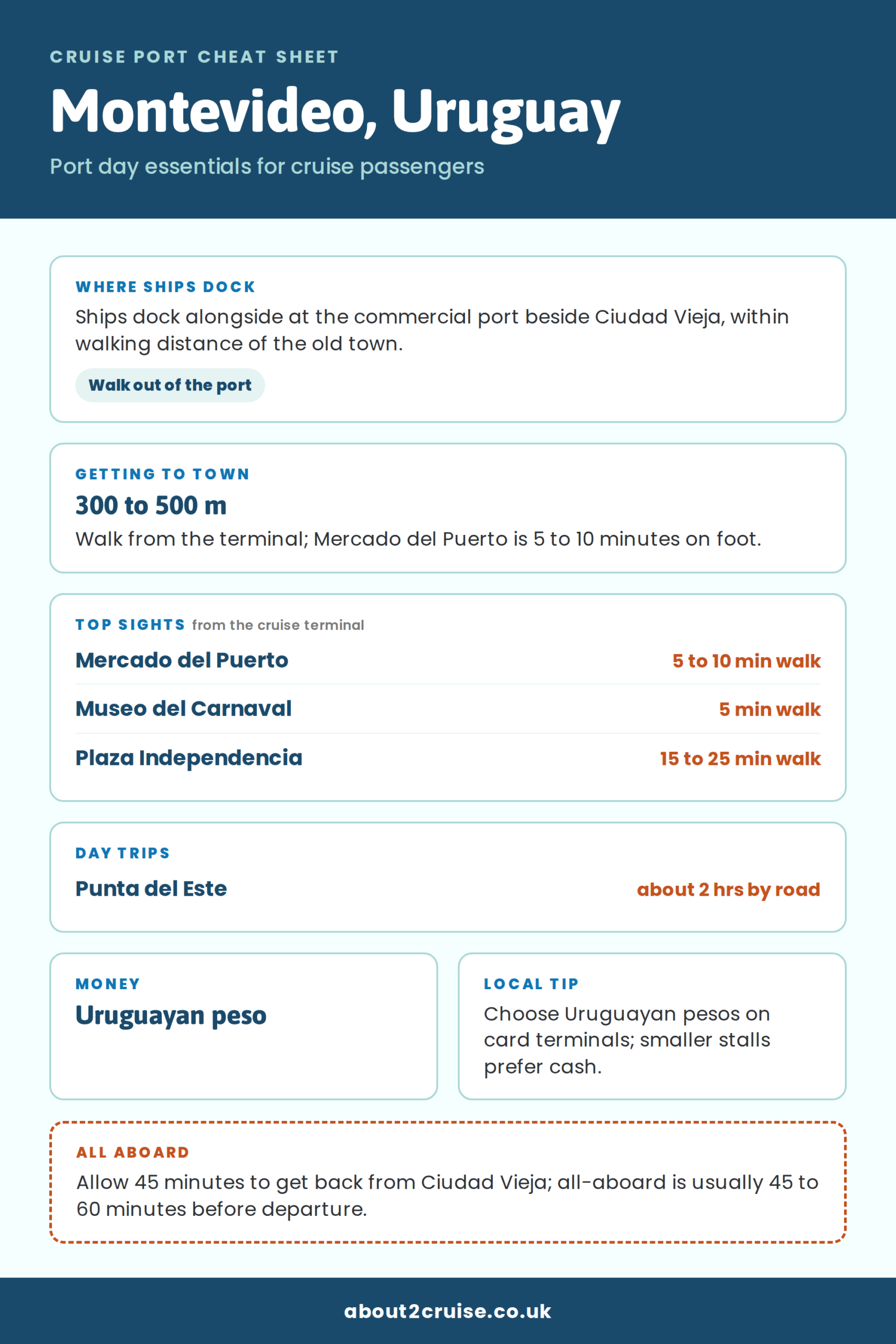
Montevideo is Uruguay’s capital and the country’s main cruise port on the Río de la Plata. Ships dock alongside at the commercial port on the western edge of Ciudad Vieja, so Mercado del Puerto, the old town and Plaza Independencia are walkable. The beaches, football stadium, wineries and Punta del Este need a taxi, bus or organised trip.
Where You Dock in Montevideo
Montevideo is a docking port, not a regular tender port. Cruise ships use the commercial Port of Montevideo on the eastern side of the bay, protected by the western breakwater from the south-west Pampero wind.
Most cruise operations happen at Muelle Central in Dársena I, berths 3, 4 and 5, a 496m quay. Muelle A holds berths 1 and 2. Muelle Maciel is the Buenos Aires ferry quay, not the cruise berth. The port covers about 110 hectares with more than 4,500m of quay, and up to four large ships can be alongside the public docks at once. The maximum stay is 36 hours unless special permission is given.
The cruise terminal entrance is signed Terminal Cruceros Entrada on Yacaré, 11000 Montevideo, at the western edge of Ciudad Vieja. Taxis wait directly outside the terminal. Remises, private vans and tour coaches can enter the port compound to pick up passengers. Tendering only happens in exceptional cases, such as a fully occupied berth or dangerous conditions.
Montevideo cruise port map
Ships dock at Muelle A. From the cruise terminal, Rambla de Montevideo is about a 6-minute walk, Mercado del Puerto about 7 minutes and Plaza Independencia about 22 minutes. Tap a pin for directions.
- Muelle AWhere ships dock
- Rambla de MontevideoWaterfront promenade · About 6 min walk from the cruise terminal
- Mercado del PuertoFood market · About 7 min walk from the cruise terminal
- Plaza IndependenciaSquare · About 22 min walk from the cruise terminal
- Teatro SolísTheatre · About 22 min walk from the cruise terminal
- Palacio SalvoLandmark building · About 25 min walk from the cruise terminal
- Tres Cruces bus terminalBus terminal · About 4 km from the cruise terminal
- Estadio CentenarioFootball stadium · About 6 km from the cruise terminal
- Museo del FútbolFootball museum · About 6 km from the cruise terminal
- Mercado de los ArtesanosCraft market · About 2 km from the cruise terminal
- Mirador PanorámicoPanoramic viewpoint · About 2 km from the cruise terminal
- Mercado AgrícolaAgricultural market · About 3 km from the cruise terminal
- Playa RamírezBeach · About 4 km from the cruise terminal
What’s at the Cruise Terminal: and What’s Not
The terminal is a processing point rather than an attraction. Inside is The Point, a café, internet and souvenir spot that also doubles as the usual meeting point for private tours. The port authority organises taxis and vans, and the hop-on hop-off tourist bus boards in front of the port.
Free Wi-Fi covers parts of Ciudad Vieja, including Peatonal Sarandí, Peatonal Pérez Castellano, Plaza Zabala and Plaza Independencia, but don’t rely on a strong signal inside the terminal.
There are no public luggage lockers at the cruise terminal. The nearest left-luggage office is at Tres Cruces bus terminal, about 5km away. Use your ship’s bathroom before you leave: street-level public conveniences around the port are scarce. The city tourist office is at Piedras 257, a short walk inside the old town.
Walking from the Ship to Ciudad Vieja: Yes, It’s Easy
Yes, and that’s what makes Montevideo one of the easiest independent ports in South America. The terminal sits at the edge of the old town. Mercado del Puerto is roughly 300–500m from the gangway, a flat 5–10 minute walk. Plaza Independencia is about 1km further along the Sarandí pedestrian street, normally 15–25 minutes.
A realistic port day gives you about five to six usable hours once you subtract disembarkation, the terminal walk-through and your return buffer. Allow 45 minutes to get back from anywhere in Ciudad Vieja. The beach neighbourhoods, Parque Batlle, Estádio Centenario and Pocitos are 4–8km out and need a taxi, bus or tour.
A Simple Self-Guided Montevideo Port Day
Walk out of the terminal onto Rambla 25 de Agosto with Ciudad Vieja to your left. Go first to the iron-framed Mercado del Puerto before the lunchtime crush: arriving between 09:00 and 10:30 gives you a calmer market for photos and early eating.
Then follow the pedestrianised Sarandí east, past Plaza Zabala and the cathedral on Plaza Constitución, to Plaza Independencia. There you can see the Puerta de la Ciudadela, the Artigas mausoleum and Palacio Salvo. Return to the ship via Teatro Solís and Pérez Castellano or retrace Sarandí. The loop takes about three hours without transport or bookings, and it’s the right first port-day plan if you have a standard call.
Mercado del Puerto: Best Time to Go and What to Eat
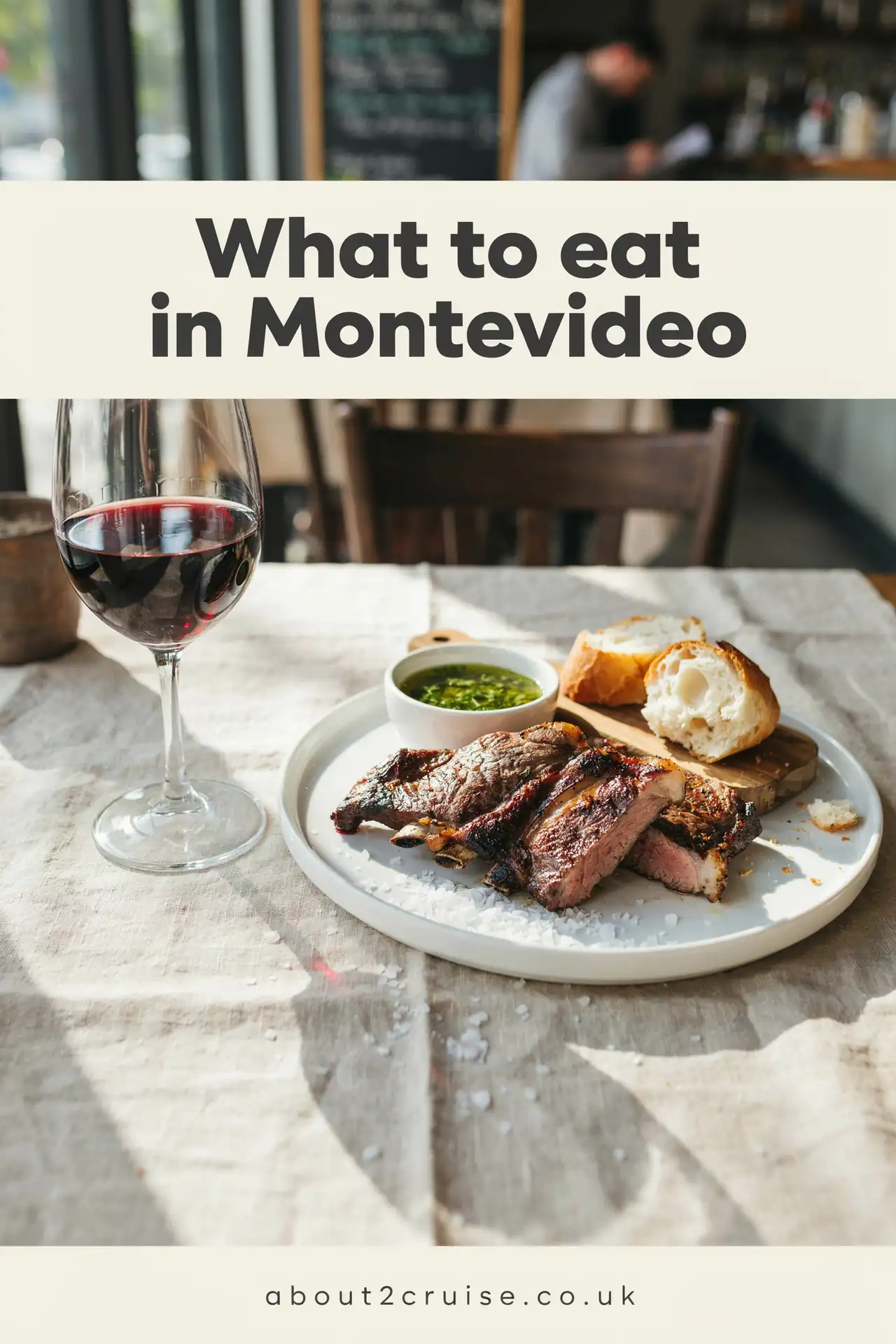
The Mercado del Puerto is an iron-framed National Historic Monument on Rambla 25 de Agosto de 1825, now a hall of parrillas and the most famous place to eat Uruguayan asado.
It opens Monday–Friday 09:00–17:00, Saturday 09:00–17:00 and Sunday 10:00–17:00. Some premises stay open until 22:00, and the outside bars until midnight. The grills get busy from 11:30 and peak between noon and 15:00. Sundays are the busiest day of the week. If you want a calm meal, go early or after 14:30, but note that many grills close mid-afternoon and only reopen on Friday and Saturday evenings.
A main grill plate runs about USD 20–40. A shared mixed parrilla for three is around USD 50. Order asado de tira (short rib), entraña (skirt) or vacío (flank), and start with provolone melted over the coals. The house drink is medio y medio, still white wine mixed with sparkling, poured at Roldós, which is also known for its chivito.
The market has an ATM and a small exchange, but it is the most tourist-priced grill area in the city. The same cuts can cost 25–40% less ten minutes inland. Vegetarians will generally find grilled provolone, roasted vegetables, salads and potatoes rather than a large meat-free menu. The grills are high turnover and the meat is cooked over hot coals; on a short port day, bottled water is the easy choice.
Mate, Coffee, Language and Local Manners
Mate is Uruguay’s national infusion, carried in thermoses and gourds everywhere from the Rambla to offices. You’ll see people sipping through a metal bombilla. It’s common to share mate among friends, but you are not expected to accept if offered.
In cafés, table service is standard, and you pay when you ask for the bill. A cortado is an espresso with milk; a café solo is black.
Spanish is the working language. Tourism staff and younger Uruguayans often speak some English, but buenos días, buenas tardes, por favor and gracias go a long way. At sit-down restaurants, tip about 10% in cash. Taxi drivers are not tipped beyond rounding up. When you enter a small shop or café, a simple buenos días or buenas tardes is the expected greeting.
Plaza Independencia, Palacio Salvo and Teatro Solís
Plaza Independencia marks the seam between Ciudad Vieja and the wider city grid of Avenida 18 de Julio. The Artigas mausoleum stands in the centre, and the Puerta de la Ciudadela leads into the old town.
On the square, Palacio Salvo is about 95m tall and was the tallest building in Latin America when it opened. Guided tours last about 45 minutes and include the rooftop mirador and the small Tango Museum dedicated to La Cumparsita, which was first performed in Montevideo. The tour desk is open Monday–Friday 10:00–17:00, Saturday 10:00–14:00 and Sunday 12:00–16:00; tickets are sold through Red Ticket. The route includes about 30 steps to the top and is not suitable for people with mobility problems.
Teatro Solís, the city’s oldest theatre, sits at the eastern edge of the old town about 1.2km from the terminal. Guided visits cost UYU 400 for foreigners and UYU 200 for Uruguayan nationals. They are free on Wednesdays, and foreign visitors showing the digital tourist-tax receipt get 50% off. Pay at the box office in cash or by card.
This square and theatre cluster makes a natural orientation loop with the Sarandí pedestrian street.
The Rambla, City Beaches and the Montevideo Sign
The Rambla is Montevideo’s 22km waterfront promenade along the Río de la Plata, a National Historic Monument. The section from the terminal runs past the working port and the old town. The true beach scene lies further east at Playa Ramírez, Pocitos, Buceo, Malvín and Carrasco. In January and February, river water temperatures peak around 23–24°C and locals swim at Pocitos and Malvín.
The famous Montevideo sign is at Pocitos, between the Rambla and Marco Bruto, in front of the Hyatt Centric. It’s free and always open. Go early for the best light and shortest queue. If you only have an hour or two, walk a short section of the Rambla rather than trying to cover all 22km. Sunset is the best time, but keep an eye on the clock if your ship sails in the afternoon or early evening.
Estádio Centenario and Uruguay’s 1930 World Cup
Montevideo hosted and won the first FIFA World Cup in 1930. Estádio Centenario, built for the tournament in Parque Batlle, is the only football stadium FIFA has declared a Historic Monument of Football. The Museo del Fútbol is in the Tribuna Olímpica next to Gate 13 on Avenida Ricaldoni. It opens Monday–Saturday 10:00–17:00 and Sunday 11:00–15:00. Foreign visitors pay UYU 400, Uruguayans UYU 200, retirees UYU 90 and under-12s go free. Non-flash photography is included.
The stadium is about 4km east of Ciudad Vieja, 15–20 minutes by taxi, and walking is impractical. For football fans, this is the best reason to leave the old town on a Montevideo call.
Carnival, Candombe, Tango and Live Music
Uruguayan Carnival runs more than 40 days from late January into March and is called the longest carnival in the world. The most distinctive categories are murga, parodistas, revistas, humoristas and lubolos. Candombe is the African-descended rhythm that underlies the whole celebration. The Desfile de Llamadas is the great candombe parade through Barrio Sur and Palermo along Isla de Flores, with more than 2,500–3,000 drums and around 6,000 performers. Candombe’s three drum voices, chico, repique and piano, are played while marching, and the tradition is UNESCO-listed.
For cruise passengers, the easiest stop is the Museo del Carnaval at Rambla 25 de Agosto de 1825 no. 218, minutes from the terminal. It opens Wednesday–Sunday 11:00–17:00. Entry is UYU 200 with under-12s free, and a free guided visit runs every Friday at 11:30. On weekends you may catch live candombe and street performers around the outer aisles of Mercado del Puerto.
Tango dinner shows include Baar Fun Fun in Ciudad Vieja, El Milongón from about USD 42 show-only, and Primuseum at about USD 95 with a six-course dinner.
Where to Shop: Leather, Tannat, Crafts and Mate Sets
Serious craft shopping is at the Mercado de los Artesanos, which has a site on Plaza Cagancha and another in the old town at Piedras 258. Opening hours are normally Monday–Saturday 11:00–19:00, with a winter Tuesday–Sunday 11:00–17:00 schedule. The stock includes leather, silver, ceramics, wood and wool textiles. The Mercado del Puerto itself has only a handful of souvenir stalls. City shops generally keep Monday–Friday 10:00–19:00 and close around 13:00 on Saturday; most are shut on Sunday. Shopping malls open 10:00–22:00 daily.
There is no fixed price list for crafts. Compare stalls before buying. A good mate set should have a real calabash or ceramic gourd and a stainless steel or alpaca bombilla; very cheap sets are usually mass-produced souvenirs. For leather, ask whether the item is full-grain or split hide, and be wary of the word cuero used loosely. Handwoven wool and silver goods should cost more than printed or plated items.
Uruguayan Wine and Tannat Tastings
Tannat is Uruguay’s signature grape, brought from southwest France and now the country’s most planted variety at around 1,555 hectares: 26.5% of the national vineyard. Uruguay is the world’s leading Tannat producer, and Canelones, immediately outside Montevideo, is the historic winemaking heart.
A proper winery visit is a 45–60 minute drive from the port. Private tours with paired lunch run from about USD 179 per person, last 5–6 hours and include port pick-up. A shorter city-based tasting lasts about four hours, pairs four Uruguayan wines with empanadas and includes port or hotel pick-up.
If you prefer to stay central, Tannat is easy to find by the glass at Mercado del Puerto and in city restaurants. Look for Tannat from Canelones; local labels vary but most are made for grilled red meat.
Money, Cards and ATMs in Montevideo
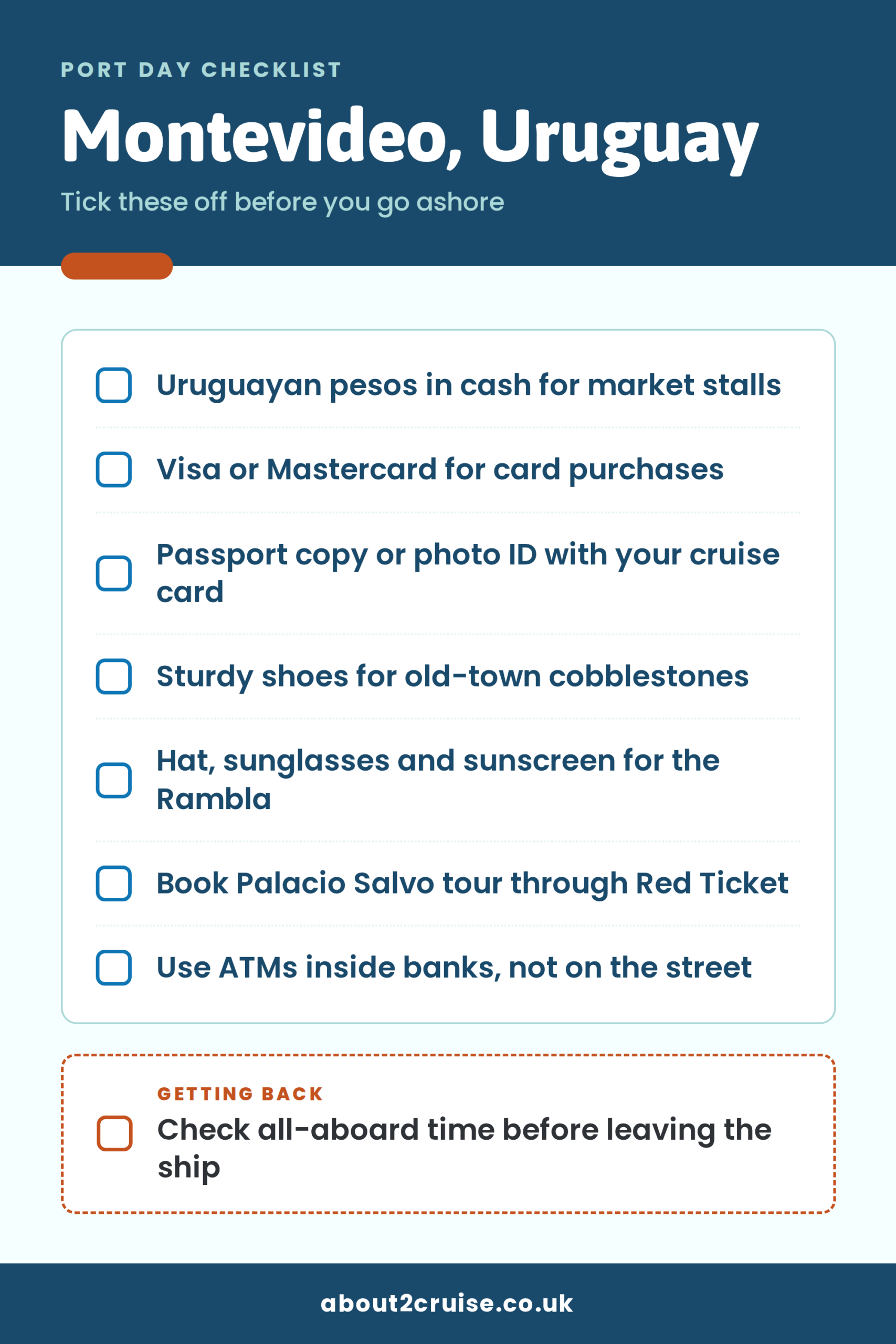
Uruguay uses the Uruguayan peso (UYU), usually written $ or $U. In shop windows, $ means pesos, not US dollars. Visa and Mastercard are widely accepted in Montevideo. Smaller market stalls, kiosks and family restaurants still prefer cash.
Two ATM networks matter: RedBROU and Banred. Many machines dispense US dollars as well as pesos, but foreign-card withdrawal caps are often around USD 200–300 or UYU 5,000, with per-withdrawal fees roughly UYU 250–450.
Non-residents paying with a foreign card get the 22% IVA rebated on restaurant and bar bills, and hotels bill non-residents without IVA. Cash gets no discount. Always choose to be charged in Uruguayan pesos when a terminal or ATM offers your home currency. Tip about 10% cash at sit-down restaurants. Avoid street ATMs after dark; use machines inside banks or shopping centres.
Getting Around Montevideo: Taxis, Uber, Buses and Hop-On Hop-Off
Metered taxis in Montevideo charge UYU 70.95 flag fall for the first 100m, then UYU 4.13 per 100m, with up to 20% extra between 22:00 and 06:00 and on Sundays and holidays. As a rough guide, a 5km day-time ride is about UYU 273, rising to UYU 328 at night or on a Sunday. Uber and Cabify operate widely.
City buses are cheap: UYU 64 cash for a one-hour ticket or UYU 52 with the STM card. A two-hour ticket is UYU 97 cash or UYU 78 electronic.
The hop-on hop-off tourist bus, Descubrí Montevideo, costs UYU 1,000 or USD 25 for 24 hours for foreign visitors. It runs a 12-stop historic-cultural circuit taking about two hours and a seven-stop coastal circuit taking about 90 minutes. The bus does not take cash onboard; pay online or by card, and the boarding point is in front of the port. Buses have ramps and audio guides in Spanish, English, Portuguese, French, German and Italian.
Safety Tips for Cruise Passengers
Montevideo is a welcoming city, but street crime includes bag-snatching, pickpocketing and robbery, sometimes armed. Keep spare cards, cash and documents in the ship safe. Use ATMs inside banks or shopping centres, not on the street. Avoid isolated or poorly lit areas at night, and do not walk downtown or near the port alone at night or at weekends. Tres Cruces bus terminal has visible security, but keep a close eye on belongings there. Wear nothing you would mind losing, and carry only what you need ashore.
On city beaches, the lifeguard flag system is green for good, yellow for caution, red for danger, red with a green cross for unsanitary water and black for thunderstorms. Occasional heavy storms can last two to three days and cause flooding; forest fires occur in the hottest months.
Montevideo Weather: What to Pack
Montevideo has a temperate climate with rain in every month. In the cruise season, average daily maxima are around 28°C in January, 27°C in February, 25°C in March, 23°C in November and 26°C in December. Rain normally comes as short heavy showers rather than all-day drizzle; expect 8–11 rain days a month and about 10 hours of sunshine in summer.
The real issue is wind off the Río de la Plata. It can turn a calm morning into a windy afternoon, so a foldable waterproof and an extra layer beat an umbrella. November and March can feel cooler and windier on an exposed quay. The old town has cobblestones and uneven pavements, so use sturdy shoes rather than dress shoes. Bring a hat, sunglasses and sunscreen; shade is limited. Shorts are fine on the Rambla and in casual cafés, but smarter restaurants call for longer trousers.
Sundays, Public Holidays and Shop Closures
Sunday is the quietest day for shops and museums, but the Mercado del Puerto’s Sunday is the busiest of the week: don’t confuse closed shops with a quiet lunch. Independent shops close early Saturday around 13:00 and most stay shut all Sunday. Museums may close on public holidays; the Museo del Carnaval, for example, closes on 1 and 6 January, 1 May, 18 July, 25 August and 24, 25 and 31 December. If your call falls on a Sunday or public holiday, the safest plan is to walk the old town, eat at the market and not count on retail or museum visits.
Accessibility in Ciudad Vieja
Ciudad Vieja has been rebuilt with smooth concrete and granite pavements and a ramp on every corner, and the city publishes an accessible tourism guide. A wheelchair circuit covers the Sarandí and Pérez Castellano pedestrian streets. The hop-on hop-off buses have ramps and wheelchair anchorages.
However, some old-town stretches are still cobbled or stepped, and Palacio Salvo’s mirador involves about 30 stairs. If you have limited mobility, a taxi from the terminal can save energy; ask the port staff for the closest accessible route. The Mirador Panorámico lends a wheelchair and a walker on request.
Immigration, Cruise Cards and Port-Day Timing
Montevideo is an alongside port. You disembark with your cruise card and photo ID; immigration and health checks take place in the terminal. Under the seasonal cruise plan, passengers who would normally need a visa may enter by ship with a valid passport, and your ship’s local agency handles the entry authorisation. Keep your cruise card, a passport copy or ID and any tour confirmation with you. A port service tax may be applied once per passenger on some voyages; your cruise line usually accounts for it.
All aboard is normally 45–60 minutes before the published departure time. If your ship is alongside from 07:00 to 17:00, you really have about five to six hours ashore. Always confirm the onboard all-aboard time before you leave: the gangway closing time is not the same as the sailing time.
Ship Excursion or DIY? How to Decide
Montevideo is one of South America’s easier do-it-yourself ports. If your goal is Ciudad Vieja, the Mercado del Puerto and Plaza Independencia, you don’t need a tour. A ship excursion or private tour earns its cost for Estádio Centenario, a Canelones winery, Punta del Este, or any plan with a long return path. Independent sightseeing works best within the old town and the Rambla. If you book a private tour, choose one that picks up inside the port compound and builds in a return buffer no shorter than 45 minutes before all aboard.
Free Walking Tours and Tourist Info
Curioso runs a free walking tour of Ciudad Vieja twice daily, lasting about 2.5 hours in English and Spanish, meeting at the Puerta de la Ciudadela on Plaza Independencia. The morning covers Plaza Independencia, the Citadel Gate, Peatonal Sarandí, Plaza Constitución, the cathedral, Mercado del Puerto, Plaza Zabala, Teatro Solís and Café Brasilero. The afternoon version omits the market because it is closed. Guides wear light blue.
The city tourist office is at Piedras 257, close to the port. The terminal has an information point at The Point, and free Wi-Fi zones cover the core pedestrian streets.
Day Trips from Montevideo: Colonia, Punta del Este and Buenos Aires
Colonia del Sacramento is not realistic inside a normal Montevideo port call. The bus from Tres Cruces takes 2h20m–2h55m each way and costs around UYU 400–600 one way; with the visit and safety buffer you need about nine hours.
Punta del Este lies about 140km east, roughly two hours by road and 2–2.5 hours by bus from Tres Cruces; fares are around USD 8–14. It is often a separate cruise stop, and because Punta del Este is an open roadstead, calls there are regularly lost to weather. From Montevideo, only attempt Punta del Este on a very long call and with a comfortable return buffer.
Buenos Aires is across the Río de la Plata. Buquebus ferries take roughly 2h45m and cost from about USD 65–85 one way, but this is an onward or transfer option, not a port-day excursion. Missing the ship in Montevideo means an expensive ferry to Buenos Aires or a bus to the next port with complicated customs. If your voyage also includes Buenos Aires or Rio de Janeiro, see our Buenos Aires Cruise Port Guide and Rio de Janeiro Cruise Port Guide.
Rainy-Day Ideas in Montevideo
When it rains, the old town has enough indoors. The Museo del Carnaval is close to the terminal and small enough for 45 minutes. Teatro Solís guided tours and the Palacio Salvo tour are largely indoor. Mercado del Puerto is covered and atmospheric, and Mercado Agrícola, the larger covered food market, is on the tourist bus route. For a view, the Mirador Panorámico at Soriano 1372 is free but you must book a QR ticket in advance; it opens Monday–Friday 10:00–20:00 and weekends 12:00–20:00. A sensible rainy-day plan is an early market lunch, one museum or theatre tour, then a taxi back to the ship.
Getting to Carrasco Airport and Onward Travel
Carrasco International Airport is about 20km east of central Montevideo. From the port allow 30–45 minutes by road. The airport’s official taxi service publishes a fare of about UYU 400 per passenger to Montevideo, including airport charges; ordinary taxis are metered. Realistic city-centre prices are about USD 30–45 by taxi, USD 25–40 by pre-booked transfer and USD 20–30 by Uber. City bus 701 connects the airport with the city in about 45 minutes, but it’s not a good idea immediately before a flight.
Buquebus ferries from Montevideo to Buenos Aires take about 2h45m–4h31m depending on the service, roughly twice daily, from about USD 65–85 one way. For long-distance buses, Tres Cruces is the main terminal, about 5km from the port.
SIM Cards, Power, Pharmacies and Medical Help
Antel is the state mobile carrier with the widest coverage. You need your passport to buy a prepaid SIM. Tourist plans start at around 3GB for UYU 400 up to about 10GB for around USD 10. The Antel counter at Carrasco airport arrivals is open Monday–Friday 07:00–19:00, so don’t count on it at weekends. Free Wi-Fi is available in parts of Ciudad Vieja.
Uruguay runs on 220V with European-style round-pin sockets; a universal adapter is the simplest solution if your ship cabin uses UK sockets.
Pharmacies are widespread and marked by a green cross. The public Hospital Maciel at 25 de Mayo 174 in Ciudad Vieja has a 24-hour emergency department, minutes from the port area. For police, ambulance or fire, dial 911.
Cruise Schedules, Port Address and Webcams
The port authority address is Rambla 25 de Agosto 160, Montevideo; telephone (+598) 2 1901. The cruise terminal entrance is on Yacaré, 11000 Montevideo. The cruise season runs roughly October/November to March/April, with around 100 cruise calls plus about 35 technical stops in a typical season. Lines include MSC, Costa, Princess, Holland America, Celebrity, Viking and Azamara. Typical published calls arrive 07:00–09:00 and depart 16:00–23:00.
There is no single dependable public terminal webcam or official passenger-facing terminal page. Your cruise line app and the port authority’s own port information are the most useful; third-party ship trackers are good for watching scheduled calls but not official.
If your cruise continues north into Brazil, Porto Alegre is often the next call after Montevideo.
On many South America cruises, Rio Grande in Brazil is the next Brazilian port you call at after Montevideo.
Souvenir Prices and How to Spot Authentic Items
No official price list exists for the craft markets, so compare stalls before buying. In the Mercado de los Artesanos, ask whether a leather item is full-grain or split hide and whether decorations are handmade. For mate sets, expect a real calabash or ceramic gourd and a bombilla made of stainless steel or alpaca. Very cheap, very light sets are usually mass-produced souvenirs. Handwoven wool textiles and real silver cost more than printed or plated items. Card is increasingly accepted, but cash in pesos gives you the clearest negotiating position and avoids dynamic currency conversion.
How to spend a port day in Montevideo
A port day in Montevideo works best if you pick one: a slow walk through Ciudad Vieja to Plaza Independencia, or a full day adding the football museum and the Rambla beaches.
Before you sail
- Check your call date against Uruguayan public holidays; many museums close.
- Book Palacio Salvo tower tour tickets through Red Ticket if you want the rooftop view.
- Order Uruguayan pesos before you sail; smaller market stalls prefer cash.
Short port day: under 6 hours
- On dockingWalk into Ciudad ViejaNo taxi neededExit the terminal onto Rambla 25 de Agosto with the old town on your left. Mercado del Puerto is 5 to 10 minutes on foot.
- +10 minMercado del Puerto before the tour groupsFree entrySee the iron-framed market hall while it is calm; on Sundays it is the busiest, so eat first if sailing then.
- +1 hrEarly asado lunch in the marketTry asadoOrder asado de tira, entraña or vacío, and try medio y medio at Roldós. The grill area fills from 11:30.
- +1 hr 45 minWalk Sarandí to Plaza IndependenciaFollow Sarandí east past Plaza Zabala and the cathedral to Plaza Independencia, about 15 to 25 minutes.
- +2 hr 15 minPlaza Independencia and Palacio SalvoBook aheadSee the Puerta de la Ciudadela, the Artigas mausoleum and the Palacio Salvo facade. A booked Palacio Salvo tower tour through Red Ticket adds 45 minutes.
- +3 hrTeatro Solís and return to the shipWalk to Teatro Solís, then head back to the terminal along Pérez Castellano or Sarandí. Allow 45 minutes.
- All-aboard minus 1 hrBack at the terminalReturn with the cruise card and photo ID you carried. If the street is blocked, take a taxi from Plaza Independencia.
The time on the map is the whole walk, every stop added together.
Open this walking route in Google Maps
If plans change: If the market is packed or many grills have closed, walk on to Plaza Independencia and eat in a café around Plaza Zabala instead.
Long port day: 8 hours or more
- On dockingWalk to Mercado del Puerto for early asadoGo earlyA 5 to 10 minute walk from the terminal. Eat before the 11:30 rush: order asado de tira or entraña with medio y medio at Roldós.
- +1 hrWalk Sarandí to Plaza IndependenciaFollow the pedestrian street past Plaza Zabala and the cathedral, about 15 to 25 minutes.
- +1 hr 30 minPlaza Independencia and Palacio SalvoBook aheadSee the Artigas mausoleum, the Puerta de la Ciudadela and the Palacio Salvo facade. Book the Palacio Salvo tower tour through Red Ticket.
- +2 hr 30 minTaxi to Estadio CentenarioUse a taxiTake a taxi or Uber from near Plaza Independencia; the stadium is 15 to 20 minutes east.
- +3 hr 30 minEstadio Centenario and the football museumVisit the Museo del Fútbol by Gate 13. It opens Monday to Saturday 10:00 to 17:00 and Sunday 11:00 to 15:00.
- +5 hr 30 minTaxi to the Rambla and Montevideo signGo east to Pocitos, photograph the Montevideo sign and walk a short section of the Rambla. This is your last sight before heading back.
- All-aboard minus 90 minTaxi back to the terminalReturn by taxi from Pocitos to the cruise terminal. Allow 45 minutes for the ride and boarding buffer.
This map shows the taxi ride from the ship. The time is the drive only, not your time ashore.
Open the taxi route in Google Maps
If plans change: If Estadio Centenario is closed or you cannot get a taxi, stay in Ciudad Vieja and add the Museo del Carnaval and the Mercado de los Artesanos before returning.
Montevideo Cruise Port FAQs
Can I use US dollars in Montevideo?
Hotels and some tourist services may accept US dollars, but smaller cafes, market stalls and kiosks usually price and return change in Uruguayan pesos. Carry pesos or use a card for most purchases.
Is there a beach within walking distance of the cruise terminal?
Not really. The Rambla starts near the terminal, but the closest proper beach is Playa Ramírez, about 2–3km east. Pocitos, the most famous city beach and home to the Montevideo sign, is further. Take a taxi, Uber or bus.
Do shops close for a siesta in the afternoon?
Montevideo doesn’t shut down for a long afternoon siesta in the same way some cities do, but independent shops close early on Saturday around 13:00 and most are shut on Sunday. Some small businesses may close briefly at lunch, but main tourist sights and markets stay open.
Is the tap water safe to drink?
Many Montevideo residents drink tap water, and there is no general boil-water advisory. On a short cruise call, bottled water is the simplest, safest choice, especially if you have a sensitive stomach.
Are there public toilets near the cruise terminal?
Street-level public conveniences are scarce around the port. Use the ship before you leave, and plan café, restaurant or museum stops when you need facilities. The terminal is more of a processing point than a service hub.
Last Updated: 17 November 2026