
Rio de Janeiro cruise ships dock at Pier Mauá in the regenerated port district, about 15–30 minutes by taxi from Copacabana and within reach of Christ the Redeemer and Sugarloaf. This guide covers the terminal, transport, tickets, timings, safety and independent touring so you can use your Rio port day well and get back to the ship.
Rio’s Big Three: Christ the Redeemer, Sugarloaf, and the Beaches
Rio is known first for its skyline: Christ the Redeemer standing on Corcovado, Sugarloaf Mountain rising at the entrance to Guanabara Bay, and the long curves of Copacabana and Ipanema. The statue and cable car are not just photo stops; they help shape the whole city. If you only have one port day, these are the sights that define Rio.
Christ the Redeemer is reached by the official Corcovado train from Cosme Velho. Sugarloaf is reached by a two-stage cable car from Praia Vermelha in Urca. Copacabana and Ipanema are the famous beach neighbourhoods south of the port, both easy to reach by taxi, Uber, or metro.
The Guanabara Bay Sail-In and Views from the Ship
The sail-in and sail-out are part of the Rio experience. Ships enter Guanabara Bay past the beaches, skirt Sugarloaf and the marinas, then dock just beyond the city centre with Christ the Redeemer high above. The deck view is best about 60–90 minutes before docking and again as the ship leaves.
From the water, you can see both Sugarloaf and Corcovado on the approach. The angles change as the ship turns, so you may need to move between port and starboard depending on your berth and sailing direction. The best plan is to go up early, find a rail, and stay there for the main skyline. Sail-away is just as scenic, especially at dusk when the city lights come on.
Carnival Dates and What They Mean for Your Port Day
Rio’s Carnival is the event most people associate with the city. The main Sambódromo parades fill the Marquês de Sapucaí, and the whole city runs on Carnival time. For 2027, the main parades are scheduled for 7, 8, and 9 February, with the champions’ parade on 13 February and the Série Ouro parades on 5 and 6 February.
If your cruise call falls during Carnival week, treat it as the busiest possible port day. The port can have three ships alongside on each main parade day, and traffic, road closures, and crowds around the Sambódromo make transfers much slower. Book anything timed with extra buffer, and do not rely on a tight return from distant neighbourhoods.
Samba, Lapa, and Nightlife Near the Port
Samba is not only a Carnival event. Rio’s samba circles run weekly in the Saúde and Lapa districts. Pedra do Sal, near the port, has samba on Mondays from 18:00 to midnight and Friday to Sunday from 18:00, with street vendors selling feijoada and cold beer. Beco do Rato in Lapa has samba every day, from 18:00 Monday to Friday and from 12:00 at weekends.
Lapa is Rio’s nightlife centre, based around the Arcos da Lapa aqueduct and the Selarón staircase. The area is lively but busy, and the UK FCDO warns that thieves target phones especially between 16:00 and 21:00. Go with a plan, keep valuables hidden, and use app-based or authorised taxis after dark.
Copacabana and Ipanema: Beach Culture Without the Stress
Copacabana is the closest famous beach to the port, about 12 km away and usually 15–30 minutes by car. Ipanema sits just beyond Copacabana and is a little more upmarket. The promenades are flat and pedestrian-friendly, and beach kiosks sell water, coconut water, caipirinhas, and snacks.
Beach culture here means bathing, jogging, beach volleyball, and footvolley. But city beaches in Rio are not a place for valuables. Never take your passport, phone, or large amounts of cash onto the sand, avoid the beach after dark, and keep your bag or towel within reach at all times.
Rio’s UNESCO Carioca Landscapes
Rio’s landscape is a UNESCO World Heritage cultural landscape. The listed area includes Tijuca National Park, Corcovado with Christ the Redeemer, Sugarloaf, Flamengo Park, Copacabana’s promenade, and the entrance to Guanabara Bay. The recognition is about the interaction between city and nature, which is why those views have been globally recognised images since the mid-19th century.
On a cruise call, the UNESCO landscape is visible for free from the ship, from the port district promenade, and from many viewpoints. If you cannot fit in both paid summits, you can still experience the listed landscape by walking parts of the port or Flamengo Park.
Where Your Ship Docks: Pier Mauá
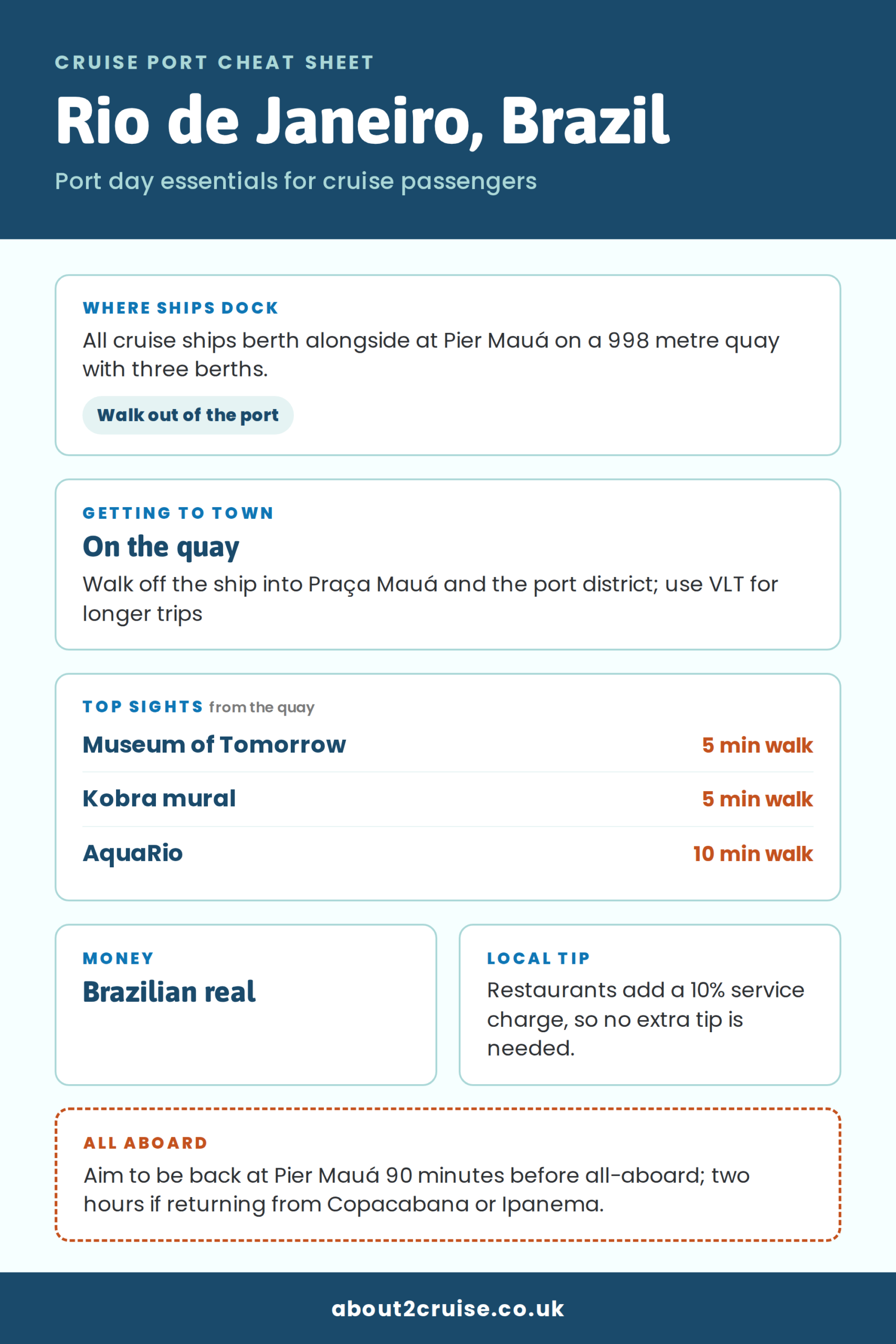
All cruise ships in Rio berth alongside at Pier Mauá, also called Terminal Internacional de Cruzeiros. The official address is Avenida Rodrigues Alves 10, Praça Mauá, Centro, Rio de Janeiro, CEP 20081-250. The terminal phone number is +55 21 3195-8000.
Pier Mauá sits in the Porto Maravilha regeneration area, facing Guanabara Bay. It is not a single terminal building in the airport sense. It is a long quay with old warehouses, a modern terminal building, and the wide Boulevard Olímpico promenade. Ships dock alongside, so passengers walk off onto the quay. There are no tenders at Rio.
Rio Cruise Port Map and Getting Oriented
Ships dock at Pier Mauá cruise terminal. From the quay, Museum of Tomorrow is about a 5-minute walk, Kobra mural about 9 minutes and AquaRio about 20 minutes. Tap a pin for directions.
- Pier Mauá cruise terminalWhere ships dock
- Parada dos Museus (vlt stop)Tram stop · About 2 min walk from the quay
- Museum of TomorrowMuseum · About 5 min walk from the quay
- Kobra muralMural · About 9 min walk from the quay
- Parada dos Navios/Valongo (vlt stop)Tram stop · About 10 min walk from the quay
- Uruguaiana metro stationMetro station · About 14 min walk from the quay
- AquaRioAquarium · About 20 min walk from the quay
- Christ the RedeemerStatue · About 7 km from the quay
- Sugarloaf MountainMountain · About 7 km from the quay
- Praia VermelhaBeach · About 7 km from the quay
- Copacabana BeachBeach · About 9 km from the quay
- Ipanema BeachBeach · About 10 km from the quay
- Lapa ArchesAqueduct arches · About 2 km from the quay
- Selarón StepsStaircase · About 2 km from the quay
Pier Mauá Berths and Terminal Layout
The quay is about 998 metres long with three berths, and the wider Pier Mauá complex manages around 70,000 m² in Porto Maravilha. The terminal can handle about 35,000 passengers a day. Check-in and embarkation are usually handled inside the old warehouses along Avenida Rodrigues Alves. Your cruise line will name the armazém, or warehouse, for your sailing. Always check that number, because “the port” alone may leave you at the wrong end of a very long quay.
The terminal has air-conditioned lounges, check-in counters, X-ray screening, tourist information, shops, a mobile clinic, and broadband internet. The quay runs in front of warehouses 1 to 5. Two VLT tram stops serve the terminal area: Parada dos Museus for the Touring building to warehouse 2, and Parada dos Navios/Valongo for warehouses 3 to 5.
Getting Around from Pier Mauá: VLT, Taxis, and Uber
The VLT Carioca tram is the cheapest public link from the port. The single fare is R$5.00, paid with a Jaé card, the app, or a QR code, and validated on board. Services run daily from 05:00 to 23:00. Line 1 connects the terminal area with Candelária, Carioca, and Santos Dumont airport, with metro connections at Uruguaiana, Carioca, and Cinelândia.
The VLT has no space for large cruise luggage, so use a taxi or app car if you have suitcases. Taxi and app-car drop-off for the cruise terminal is on Avenida Barão de Tefé. The nearest metro station is Uruguaiana, about 1.2 km or 16 minutes on foot from the terminal. The metro fare is about R$7.90.
The city publishes a pre-fixed taxi table from Pier Mauá. At tariff 1, it lists about R$30 to Centro, R$66 to Copacabana, and R$68 to Santa Teresa. You can pay by the meter instead, but using the fixed table or an app gives you more confidence. Uber and other app cars pick up in the same terminal area.
Travel Times from the Cruise Port to Major Sights
These are practical road times from the terminal, assuming normal traffic:
- Copacabana: about 12 km; 15–30 minutes by taxi or Uber.
- Christ the Redeemer, Cosme Velho train station: about 7.5 km; 30–40 minutes by car.
- Sugarloaf cable car, Praia Vermelha: about 25–30 minutes by car.
- Santos Dumont airport: about 2 km; 10–15 minutes by taxi.
- Galeão airport: about 20 km; 25–45 minutes by road.
Traffic around the Aterro do Flamengo can turn a short trip into an hour, especially in the late afternoon. Always build that into your return plan.

Airport Transfers: Galeão (GIG) and Santos Dumont (SDU)
Galeão International Airport, GIG, is about 20 km from Pier Mauá. A fixed fare taxi from Terminal 2 arrivals to the port is around R$87 by day and R$104 at night, Sundays, and holidays. Executive taxis are more expensive, about R$155 to Centro. A cheaper option is the airport bus to Centro or Novo Rio/Terminal Gentileza for about R$10–35, then the VLT or a short taxi to the terminal.
Santos Dumont, SDU, is the domestic airport only about 2 km away. A taxi takes 10–15 minutes. The VLT runs from Santos Dumont to Parada dos Navios/Valongo in about 15 minutes with no change of line. If you arrive at Novo Rio bus station, the VLT reaches Parada dos Navios in about 10 minutes, and a metered taxi is about R$27.
Embarkation and Disembarkation at Rio Cruise Port
Ships using Pier Mauá berth alongside, so disembarkation is normally a walk-off from the ship onto the quay. The terminal has customs, federal police, and Anvisa desks, so allow time for Brazilian formalities if Rio is your first port of entry or your embarkation point.
If you are starting or ending a cruise in Rio, arrive the day before embarkation whenever possible. Same-day flight delays can miss the ship. The terminal has check-in counters and air-conditioned lounges, and you should follow your cruise line’s documentation for which armazém to use. Print or download your boarding documents and passport copy before you arrive.
Port Shuttles, Meeting Points, and Luggage Storage
There is no official public port shuttle from Pier Mauá into Copacabana or Ipanema. If your cruise line runs a shuttle, it will normally be sold on board and may drop at a hotel or beach point. Otherwise use the VLT, taxi, Uber, or a pre-booked tour.
Ship-sponsored tours usually meet on the quay or inside the terminal building. Independent guides often wait outside the terminal exit, near a named warehouse or at the VLT stop. Confirm the exact meeting point in writing, including the armazém number. If your ship changes berth, the meeting point may also move.
There are no dedicated luggage lockers at Pier Mauá. Third-party luggage storage operates near the terminal, with drop points about 8 minutes’ walk away and prices from around R$11 per day. Book ahead if you have a late flight or want to explore hands-free after disembarkation.
Terminal Facilities, Wi-Fi, and Accessibility
The terminal lists air-conditioned lounges, check-in counters, X-ray screening, tourist information, shops, a mobile clinic/ICU, bus and van parking, and broadband internet for passengers and crew. Broadband is advertised, but do not rely on cruise-terminal Wi-Fi as your only connection. Download offline maps, tickets, and directions before you leave the ship or your hotel.
Accessibility details for the terminal buildings are not clearly published, so wheelchair users should contact the cruise line and terminal operator in advance. VLT stations are accessible, and the port district around Praça Mauá and Boulevard Olímpico is flat and walkable.
Port-Day Timing and Return-to-Ship Rules
Rio port calls usually run from about 08:00 or 09:00 until between 17:00 and 19:00. A four-hour call is best spent in the port district. A six-hour call allows one headline sight, such as Christ the Redeemer or Sugarloaf. You need eight hours or more to do both mountains without dangerous rushing.
When returning from Copacabana or Ipanema, allow at least two hours before the all-aboard time. The Aterro do Flamengo can turn a 20-minute ride into 60 minutes. For independent days generally, aim to be back in the terminal area at least 90 minutes before all-aboard, not just at the port gates.
Ship-sponsored excursions carry a delay guarantee: if the ship’s tour is delayed, the ship waits. Independent tours do not have that protection. If you go independently, always carry the ship’s contact number and the port address in Portuguese.
Ship Excursion vs Independent Tour in Rio
A ship excursion in Rio costs more but removes the stress of traffic, timed tickets, and late return. The ship waits for its own tours, and the guide handles Christ the Redeemer or Sugarloaf ticket timing. In a city with heavy traffic and a big list of sights, that guarantee has real value.
An independent tour or self-guided day is usually cheaper and more flexible. The VLT, metro, taxi, and Uber make the main sights open to confident travellers. The trade-off is that you must buy timed tickets, watch the clock, and provide your own buffer. If you choose independent, book Christ the Redeemer and Sugarloaf first, then build the rest of the day around them.
Christ the Redeemer Tickets and Time Budgeting
The official Corcovado train runs from Cosme Velho station through Tijuca National Park to the statue. The adult ticket including return train and monument entry costs R$134, children aged 7–11 cost R$107, and under-6s go free. Tickets are dated and timed, so book on the official site at tremdocorcovado.rio.
The train ride takes about 20 minutes each way. From the train arrival area to the statue platform there are 220 steps on the stone stairway. While escalators and inclined lifts are being replaced, the final stretch is about 80 steps from the second floor of Alto Corcovado, with stair-climbing chairs for visitors with reduced mobility.
Allow 2.5–3 hours for the whole visit including travel to Cosme Velho, the train, and the statue. The train station is about 7.5 km from the port and 30–40 minutes by car. If you have a timed ticket, get there early because traffic can eat the buffer.
Sugarloaf Cable Car Tickets and Tour Logistics
Sugarloaf is reached by a two-stage cable car from Praia Vermelha: first to Morro da Urca at 227 metres, then on to Sugarloaf at 396 metres. The entrance is at Avenida Pasteur 520, Urca. The official adult cable-car ticket is R$205, children aged 3–12 pay R$102, over-60s pay half price, and Rio state residents pay R$89. Friday and Saturday departures at 15:00, 16:00, and 17:00 cost R$230.
The park is open Monday to Friday from 08:30 to 21:00 and weekends from 07:30 to 21:00, with last boarding at 19:30. Tickets are dated and timed, and should be bought online in advance at bondinho.com.br.
Allow 2–3 hours for Sugarloaf including the drive from the port. Sunset is the most sought-after slot and can be busy from mid-morning to mid-afternoon. Mornings are quieter, and the light on the beaches and mountains is usually better for first-time visitors.
Beach Day Planning: Copacabana vs Ipanema
For a beach day, aim for Copacabana first because it is closer and has the classic promenade. Ipanema is a little further but quieter and more polished. Both are about 15–30 minutes by car from Pier Mauá, with Copacabana around 12 km away.
Before you sail
- Book timed Christ the Redeemer and Sugarloaf tickets online before you sail.
- Check Brazil entry rules and, for US, Canadian, Australian or Chinese citizens, get the e-visa.
- Download offline maps and confirm your ship's all-aboard time and armazém number.
Short port day: under 6 hours
- On dockingWalk off at Pier MauáFlat quayShips dock alongside, so you walk straight into Praça Mauá and Boulevard Olímpico.
- +15 minMuseum of TomorrowBook timed ticketFive minutes on foot from the quay. Buy a timed-entry Museum of Tomorrow ticket online for the hour you want.
- +1 hr 30 minKobra muralWalk ten minutes along Boulevard Olímpico to the Etnias mural at Armazém 3.
- +2 hrs 30 minAquaRioLast entry 16:00Ten minutes further on foot or one VLT stop. Aim to arrive before the last entry.
- +4 hrsLunch near Praça MauáTry pão de queijoPorto Maravilha botecos and padarias sell pão de queijo and açaí. Feijoada is the Saturday ritual, but it is a long lunch.
- All-aboard minus 1 hrBack at Pier MauáReturn on foot along the flat waterfront. Allow time for a toilet stop and slow walk.
The time on the map is the whole walk, every stop added together.
Open this walking route in Google Maps
If plans change: If the Museum of Tomorrow is closed on Wednesday, visit MAR art museum instead or walk the full Boulevard Olímpico.
Long port day: 8 hours or more
- On dockingTake a taxi to Cosme VelhoPre-booked taxiUse an authorised rank or app. The drive from Pier Mauá to the Corcovado train station takes 30 to 40 minutes.
- +45 minBoard the Corcovado trainTimed ticketUse your dated and timed Christ the Redeemer ticket for the next departure. The train ride takes about 20 minutes each way.
- +1 hr 30 minChrist the Redeemer statueThere are 220 steps from the train arrival area to the platform. Allow 45 to 60 minutes at the top.
- +2 hrs 30 minTaxi to UrcaDrive 25 to 30 minutes from Cosme Velho to Praia Vermelha in Urca, at the foot of Sugarloaf.
- +3 hrs 30 minLunch in UrcaTry pão de queijoBotecos near Praia Vermelha serve pão de queijo and petiscos. Feijoada is a Saturday long lunch. Afterwards, walk to Praia Vermelha for the classic Sugarloaf photo.
- +5 hrs 30 minSugarloaf cable carBook timed ticketTwo cable cars climb via Morro da Urca. Your dated ticket gives entry; allow two to three hours.
- All-aboard minus 90 minBack at Pier MauáReturn by taxi or Uber from Urca. Traffic on the Aterro do Flamengo can slow the ride to an hour, so leave early.
This map shows the taxi ride from the ship. The time is the drive only, not your time ashore.
Open the taxi route in Google Maps
If plans change: If Christ the Redeemer timed tickets sell out, do Sugarloaf first and use the saved time for a Copacabana or Ipanema beach walk.
Do not carry passports, phones, or large cash onto the sand. Bring a small amount of reais, a cover-up, sunscreen, and water. Use an official kiosk for food and drinks. Leave before dark, and return to the port with a two-hour buffer if you are travelling in the late afternoon.
Santa Teresa, Lapa, and Other City Highlights
Santa Teresa is a hilltop neighbourhood with steep cobbled streets and old houses. The historic Santa Teresa tram departs from Estação Carioca, near Carioca metro. The round trip costs R$20, with no half price. Tickets are sold only at the station and only to passengers present on the platform. The main route runs Monday to Friday from 08:00 to 18:30 and weekends and holidays from 09:00 to 17:00. A reopened historic Silvestre branch runs four departures a day at 10:00, 11:00, 14:00, and 15:00, about 30 minutes each way.
Lapa’s Arcos da Lapa aqueduct and the Selarón staircase are classic photo stops. The staircase has 215 steps and is best visited with a hand free and no valuables on show. Both Santa Teresa and Lapa involve hills and uneven surfaces, so wear proper shoes.
Museum of Tomorrow, AquaRio, and the Port District
The port district is the easiest and safest use of a short Rio call. Praça Mauá, the Museum of Tomorrow, and the MAR art museum are 5–10 minutes on foot from the terminal. The Kobra mural, “Etnias,” is on Boulevard Olímpico at Armazém 3. It is 15 metres high and 170 metres long, one of the most photographed spots in the city.
The Museum of Tomorrow at Praça Mauá 1 is open Thursday to Tuesday from 10:00 to 18:00, closed Wednesdays, with last entry at 17:00. The full ticket is R$40 and timed. AquaRio, the marine aquarium in Gamboa, is open daily from 09:00 to 17:00, with last entry at 16:00. Both are walkable or a short VLT/taxi ride from the terminal.
Staying Safe During a Cruise Call in Rio
Rio rewards alert travellers. The UK FCDO warns that robberies are common, particularly phone theft between 16:00 and 21:00. Do not hail taxis on the street; book through an app or an authorised rank, and check the plate and driver match the booking. Do not go on city beaches after dark, and carry only a copy of your passport and photo ID.
Card cloning and overcharging on payment terminals are common, so keep sight of your card and check the amount. Short-term express kidnapping to withdraw cash at ATMs can happen. Avoid favelas, including favela tours marketed to tourists, because the FCDO advises against all visits and says tourists have been shot after accidentally entering favelas. Keep your day simple, stay in busy formal areas, and use pre-booked transport.
Money, Cards, ATMs, and Tipping
Brazil uses the real, written R$ or BRL. Cards and contactless are accepted almost everywhere, including beach kiosks, markets, and taxis. Cash is still useful for beach vendors, small taxis, markets, and tips. Keep small notes because R$100 notes are hard to break.
Use ATMs inside bank branches at Banco do Brasil, Itaú, Bradesco, or Santander. Standalone Banco24Horas machines charge foreign cards around R$20–35 per withdrawal. Between 22:00 and 06:00 Brazilian ATMs often cap withdrawals at about R$300–500. Always choose to be charged in reais, not your home currency, to avoid a 6–12% conversion markup.
Restaurants add a 10% serviço, which is the tip. Tipping 10–13% is normal. US dollars are accepted by some tourist businesses and hotels but at poor rates, so use reais for daily spending.
Useful Portuguese Phrases and English Availability
English is most reliable at the cruise terminal, airport desks, large hotels, and official tour offices. Do not assume every taxi driver, VLT attendant, or small boteco has English. A few phrases help: bom dia, boa tarde, por favor, obrigado if you are male, obrigada if you are female, quanto custa, cartão, não entendi, and onde fica.
Keep your destination address written in Portuguese or saved on your phone. If your driver uses a ride app, verify the plate and destination before getting in.
Weather, Cruise Season, and What to Pack
Rio has a hot tropical climate with a rainy season from November to March. Daytime highs average about 30°C in January and February, 29°C in March, 27°C in April, 26°C in May, and 25°C in June. January averages 20 rain days and February 16, falling to 6–7 by June and July. Humidity is high in summer, and the UV index is strong.
Pack light, breathable clothing, good sunscreen, a hat, a rain layer, and sturdy shoes. Christ the Redeemer has 220 steps from the train arrival area, with about 80 on the final stretch, so sandals are a poor choice for that day. If you are travelling to or from Galeão or doing a long transfer, keep a light jumper for over-strong air conditioning.
Carnival, Public Holidays, and Other Disruptions
Carnival is the biggest disruption. The Sambódromo area, centre, and Lapa are crowded, and road closures change taxi and bus routes. If your cruise calls on a Carnival parade day, add at least one hour to every intended journey and avoid tight independent plans.
Other national holidays can affect shop opening and traffic, though the port area and major tourist sights are usually closer to normal. Check the date of your call against the local calendar and plan around it. Criminals also target large celebrations such as Carnival, so keep phone and wallet well hidden.
Brazil Entry Requirements for Cruise Passengers
British citizens can visit Brazil without a visa for up to 90 days for tourism, but the passport must be valid for at least six months after arrival. Get your passport stamped on entry, because not doing so can lead to a fine on departure.
Citizens of the US, Canada, Australia, and China need an electronic visit visa, or e-visa, applied for only through the VFS Global portal. It costs US$80.90 and is valid for stays of up to 90 days. The same entry rules apply when you step ashore, even if it is only a port day.
All e-cigarettes and vapes are illegal in Brazil and can be confiscated at customs.
Health, Vaccinations, and Insurance
Check current recommendations for yellow fever, dengue, and chikungunya before travelling. Emergency ambulances are on 192. Public hospitals can be overcrowded, and private hospitals usually require proof of insurance or funds. Bring prescription letters and enough of your own medication for the trip and any delay days.
Cruise insurance should cover medical treatment, increased cancellation risk, and missed-port or itinerary changes. If you take regular medication, keep it in its original packaging and in your hand luggage.
Rio Cruise Schedule, Ships in Port Today, and Live Tracking
Rio’s cruise season is a southern-hemisphere summer season. The latest published season runs to 8 April, with 112 calls by 29 ships and about 325,000 passengers and crew expected. The season includes 85 days of cruise-ship operation, with busy days of three or four ships alongside. The single busiest day in that season is 26 January with four ships.
Real-time ship tracking for Rio is published at cruisingearth.com. The terminal operator’s season calendar is at piermaua.rio/en. Check both before your call and again on the morning of arrival, because berth assignments can change.
The port is easy to orient once you understand the shape. Praça Mauá is the main square at the north end of the terminal area. The old warehouses run along Avenida Rodrigues Alves, with Boulevard Olímpico between the warehouses and the water. The two VLT stops, Parada dos Museus and Parada dos Navios/Valongo, sit along the same strip, so the VLT is the easiest way to move along the quay if you are at the wrong end.
Cruise Lines and Ships Docking at Pier Mauá
All cruise ships calling at Rio use Pier Mauá. Lines with calls in the latest published season include MSC, Costa, Cunard, Princess, Celebrity, Carnival, Viking, Silversea, Seabourn, Oceania, Swan Hellenic, Azamara, Scenic, Ponant, Hapag-Lloyd, and Corazul.
Thirteen ships embark passengers at Pier Mauá in that season: Buenavista, Costa Diadema, Costa Serena, Europa, Insignia, L’Austral, MSC Divina, MSC Magnifica, MSC Musica, MSC Splendida, MSC Virtuosa, Seabourn Venture, and Seven Seas Mariner. The busiest ships by call count are Buenavista with 38 calls, MSC Splendida with 16, MSC Musica with 13, and Costa Serena with 11.
Oceania Cruises Docking Location in Rio
Oceania ships dock at Pier Mauá, the same terminal used by all cruise lines in Rio. In the latest season, Oceania’s Insignia is listed among the ships embarking at Pier Mauá. As with every line, confirm the armazém, or warehouse, from your cruise documents because the long quay has multiple check-in points.
Royal Caribbean Cruises to Rio de Janeiro
Royal Caribbean does not currently base a ship in Brazil. The line has cited cabotage rules, the exchange rate, and regulatory predictability as obstacles to basing ships there. Royal Caribbean has confirmed a return to South America itineraries, including Antarctica and Patagonia, for the following season, but if you are booking a Royal Caribbean-branded Rio call, check the itinerary carefully because many Rio cruises are with other lines.
Cruises to Rio de Janeiro from the USA
Rio appears on longer repositioning cruises from the USA. Cunard’s Queen Anne has sold a 17-night Fort Lauderdale to Rio sailing with an overnight in Rio, marketed in the UK as a fly-cruise from about £3,012 per person including flights and transfers. Regent Seven Seas Mariner runs an 18-night Miami to Rio sailing. These are long-haul sailings, so the Rio call is usually part of a larger South America or transatlantic itinerary.
Rio de Janeiro Cruises in 2027
For 2027, the published season at Pier Mauá includes 112 calls by 29 ships. It includes debuts from MSC Divina, MSC Virtuosa, and Corazul’s Buenavista, plus calls from Queen Anne and Hapag-Lloyd’s Europa. The busiest single day is 26 January with four ships, and 1 December has three ships with roughly 11,500 lower berths between them.
Typical turnaround and transit itineraries call at Rio for a day or an overnight. Costa Serena runs a 9-night Rio to Buenos Aires itinerary calling at Montevideo, Punta del Este, Balneário Camboriú, and Ilha Grande. MSC Musica calls at Rio on 7-night itineraries from Paranaguá. MSC Lirica has a 20-night Rio itinerary with Búzios, Salvador, and Maceió. These are useful examples, but schedules change, so check the terminal calendar and your cruise line before booking flights or independent tours.
Nearby Cruise Ports and South America Itineraries
Other stops on Rio itineraries include Búzios, which is a tender port, Santos, Ilha Grande, Ilhabela, Paraty, Montevideo, and Buenos Aires. If you are on a South America or transatlantic repositioning, Rio often sits between South American ports and Atlantic ports. If your cruise continues south, read our Ushuaia cruise port guide. If you are crossing the Atlantic, see our Funchal port guide and Cape Town port guide.
You may call at Santos, southwest along Brazil’s Atlantic coast, the port for São Paulo and often the next or previous call on South American itineraries.
For many South America itineraries, Montevideo is often the next call after Rio, on the River Plate before Buenos Aires.
For a cruise continuing north along Brazil’s Atlantic coast, Fortaleza is a common next call after Rio.
If your cruise calls at both ports, you usually reach Ilha Grande just before or after Rio, on Brazil’s southern coast, for a quieter, greener contrast to the city.
Further south along Brazil’s coast, you may call at Itajaí before your ship turns towards Uruguay and Argentina.
Further up Brazil’s coast, Maceio is a common next or previous call on Rio itineraries.
If you sail north from Rio, Natal is often the next Brazilian port of call.
Paranagua lies further south on Brazil’s Atlantic coast and is often the next Brazilian call after Rio. Paranagua
If your cruise continues north along Brazil’s coast, Salvador da Bahia is often the next call, with a historic colonial centre and strong Afro-Brazilian culture.
If your ship calls at Búzios, it usually comes just before or after Rio and offers a smaller, beach-focused contrast to the city.
Food and Drink Near the Port
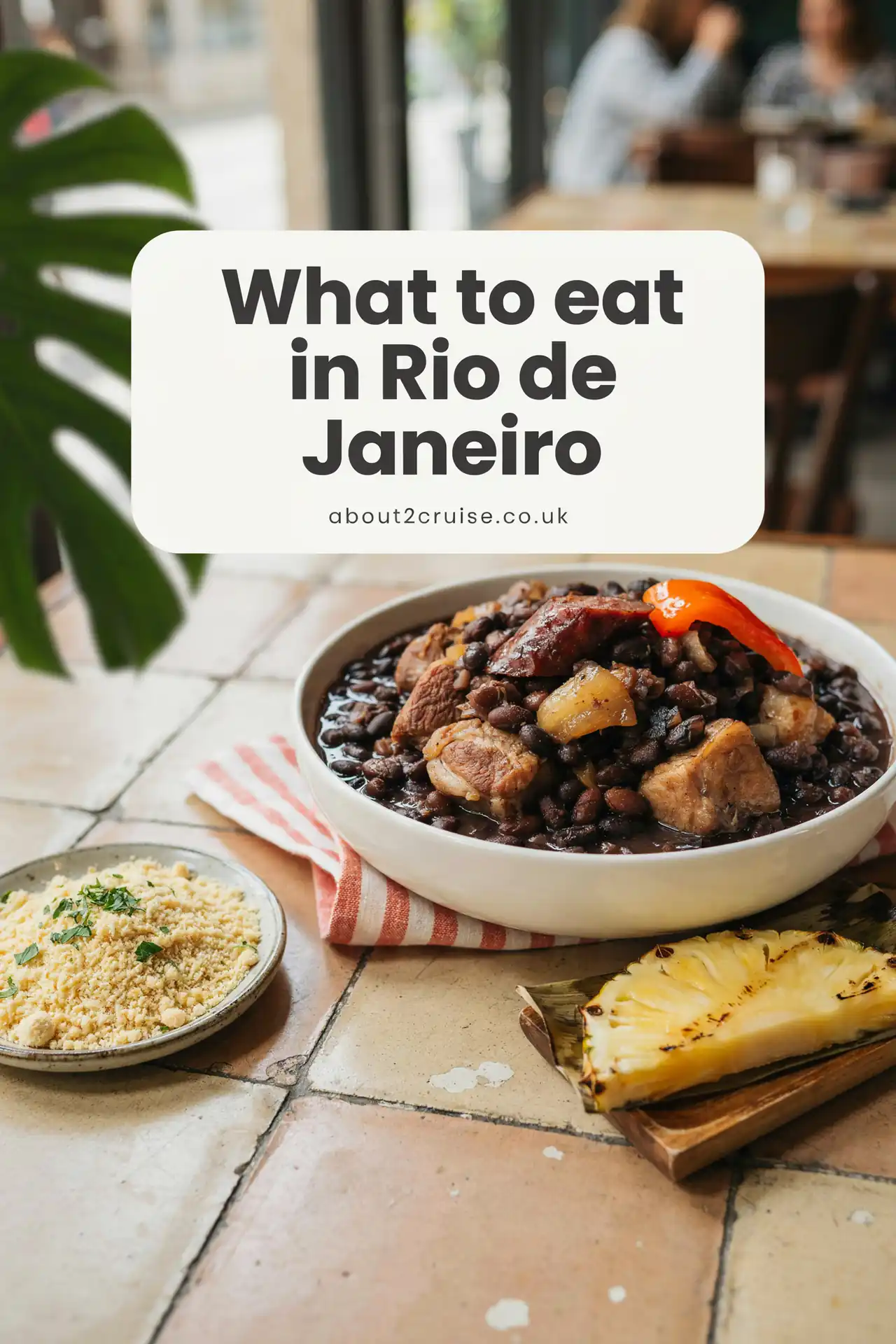
Feijoada is Rio’s Saturday ritual, served from noon with rice, farofa, collard greens, and orange. It normally costs R$45–80 per person and is a two-to-three-hour lunch, so it suits a longer port day, not a rushed one. Chopp, or draft beer, costs about R$8–15 in a boteco. Açaí na tigela costs about R$20–35, and pão de queijo is sold hot at padarias from the morning.
Near the port, the Mercado Popular da Uruguaiana at Uruguaiana metro has cheap food stalls and is open Monday to Friday from 08:00 to 18:00 and Saturday 09:00 to 14:00, closed Sundays. In the other direction, the Porto Maravilha district around Praça Mauá and Boulevard Olímpico is the easiest area for a quick snack or drink near the ship.
Favela Tours: Ethics and Safer Choices
The UK FCDO advises against all visits to favelas, including favela tours marketed to tourists, and says tourists have been shot after accidentally entering favelas. That safety advice applies even if an excursion is sold as a cultural tour.
From a cruise day, favela tourism is not a responsible choice. You cannot assess the safety of a particular route, and the visit can put both visitors and residents at unnecessary risk. If you want to support local culture and community, spend your time and money in formal businesses, markets, samba circles, and established city institutions instead.
Practical Rio Port-Day Checklist
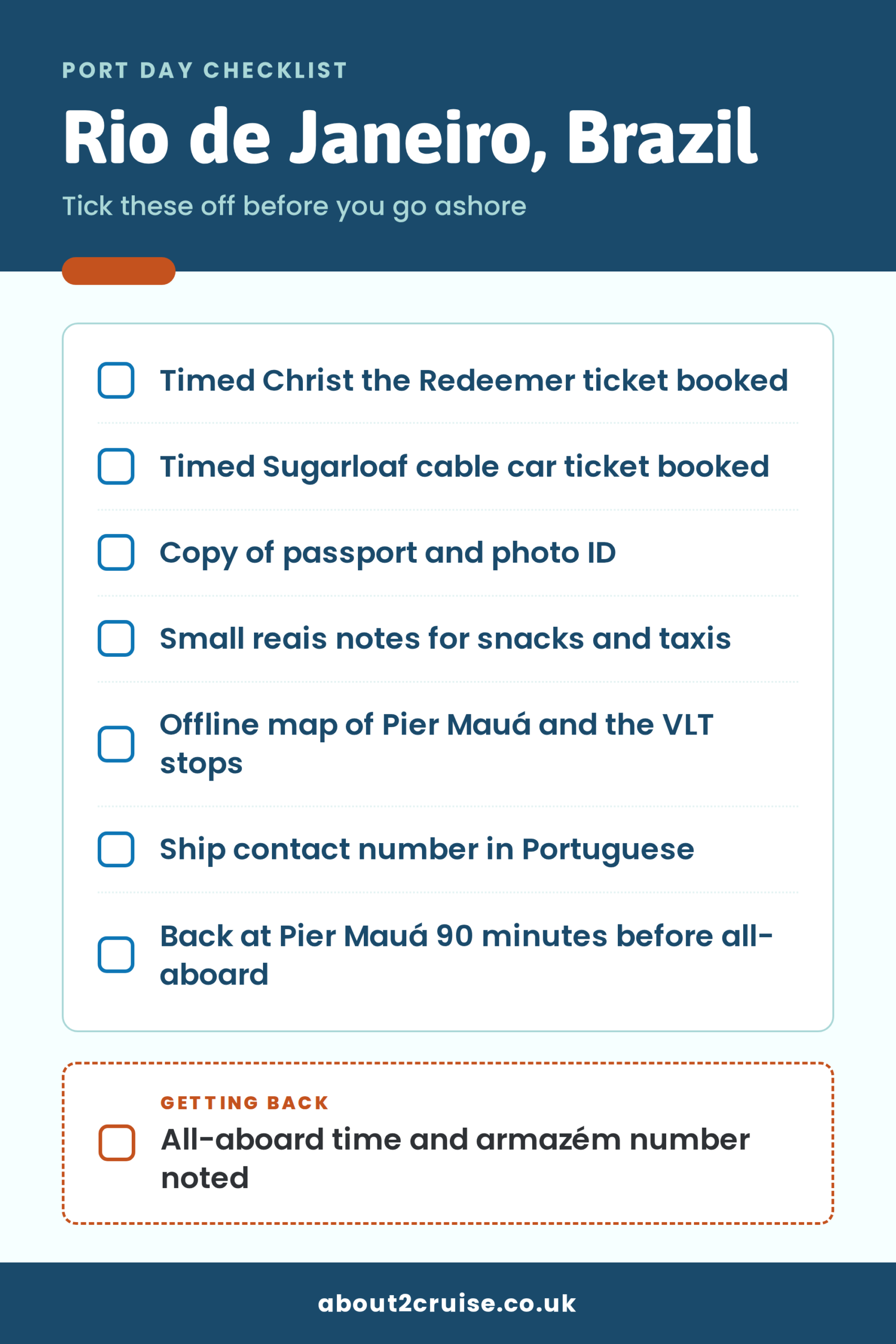
- Confirm your ship’s all-aboard time and armazém number before leaving the ship.
- Carry a copy of your passport and photo ID, not the passport itself.
- Buy timed Christ the Redeemer and Sugarloaf tickets online before you leave.
- Download offline maps and book your return taxi or Uber in good time.
- Keep reais in small notes for snacks, taxis, and tips.
- Have your ship’s contact number and Pier Mauá address written in Portuguese.
- Leave beach days for daylight hours and never take valuables onto the sand.
- Allow at least 90 minutes before all-aboard, or two hours if returning from Copacabana or Ipanema.
Our Brazil cruise ports guide covers the other ports in the region.
Rio Cruise Port FAQs
Is Rio a tender port?
No. Cruise ships dock alongside at Pier Mauá. You walk off onto the quay, and there are three berths along the 998-metre quay.
Can I do both Christ the Redeemer and Sugarloaf in one port day?
Only with a long call of eight hours or more, timed tickets, and pre-arranged transport. Each sight takes 2–3 hours including travel. On a short call, choose one and use the rest of the day for the port district or a beach.
Do I need a visa or e-visa if I only go ashore for a few hours?
Yes. The same Brazilian entry rules apply when you step off the ship. UK citizens can visit visa-free for up to 90 days with a passport valid for six months. US, Canadian, Australian, and Chinese citizens need an e-visa obtained through VFS Global.
Are there luggage lockers at Pier Mauá?
No. There are no official left-luggage lockers at the terminal. Third-party luggage storage operates nearby, with drop points about eight minutes’ walk away and prices from around R$11 per day.
Can I use US dollars or euros in Rio?
Some tourist businesses and hotels accept US dollars, but at poor rates. The practical currency is the Brazilian real. Cards and contactless are widely accepted, but keep small reais for beach vendors, small taxis, and tips.
What is the closest beach to the cruise port?
Flamengo is the closest city beach, but Copacabana is the famous one most cruise passengers head to. Copacabana is about 12 km from Pier Mauá and normally takes 15–30 minutes by taxi or Uber.
Last Updated: 19 November 2026