
Paranaguá is a working Brazilian cargo port with a walkable colonial centre, a seafood market and access to Ilha do Mel. You berth inside a commercial port and are bused to a landside reception, not released onto the quay. Most visitors choose a town-and-market day, a short bay cruise, or a ship excursion to Ilha do Mel.
Why Ships Call Here: A Working Port With a Colonial Heart
Paranaguá is Paraná’s oldest city and one of Brazil’s largest grain and soybean export ports. The harbour moves soya, soya meal, corn, sugar, fertiliser, containers, liquids and vehicles. In a recent full year, the ports of Paranaguá and Antonina handled a record 73.5 million tonnes.
The town side is completely different: a compact historic centre on the Rio Itiberê, listed as national heritage, with Portuguese colonial buildings, seafood market halls and Caiçara coastal culture.
Where You’ll Actually Dock, and Why It’s Not a Normal Cruise Terminal
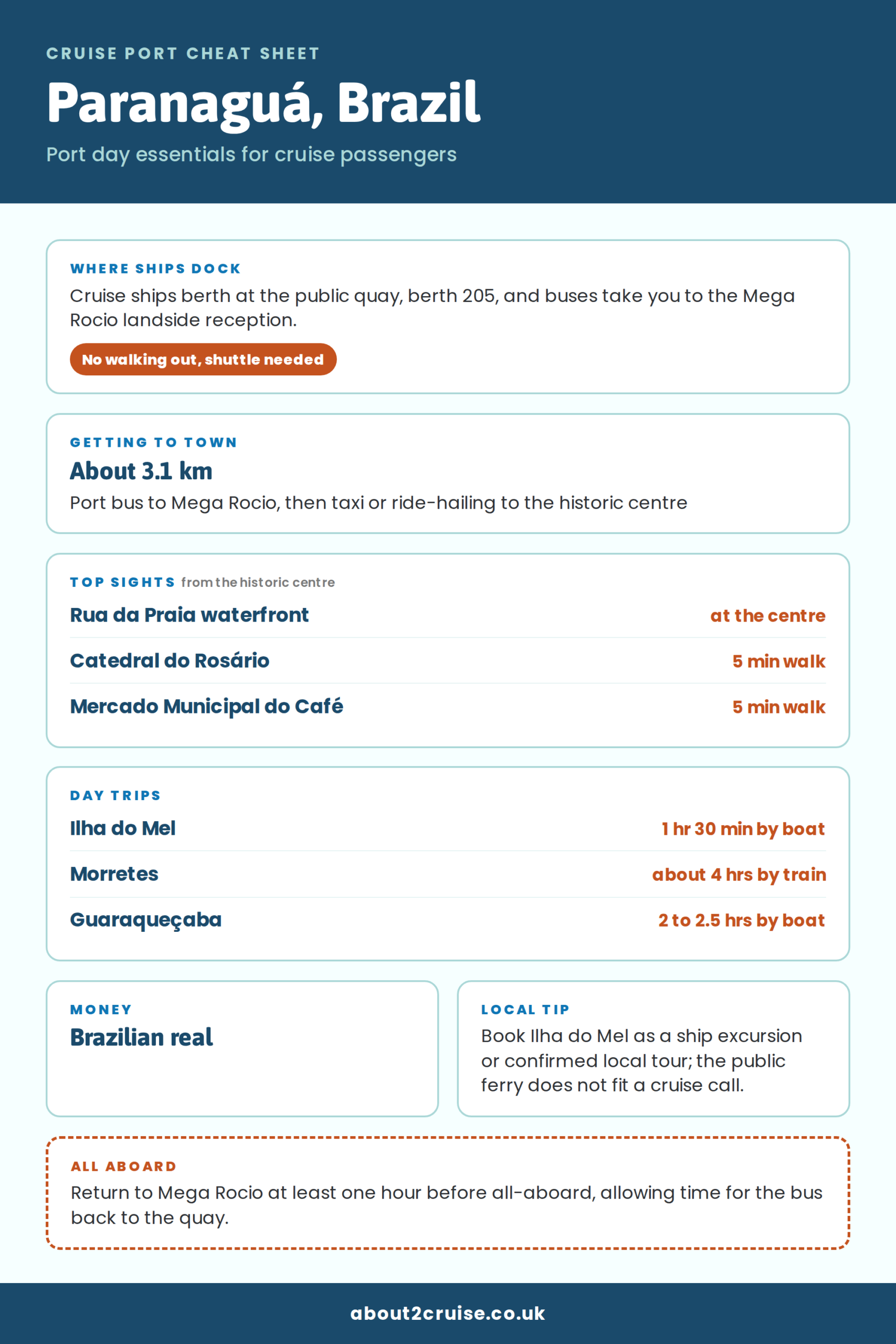
Cruise ships berth at the port’s public quay, currently at berth 205, moved from berth 215 to shorten passenger logistics. This is an active cargo port, not a cruise terminal, and there is no permanent terminal yet.
Passengers are taken by bus from the quay to the Mega Rocio complex next to the Nossa Senhora do Rocio sanctuary. That building acts as the temporary embarkation and disembarkation point. It has about 1,555 m² of space, capacity for around 1,600 people a day, check-in, X-ray and baggage-scanning areas, and a climate-controlled departure lounge with Wi-Fi.
A dedicated passenger terminal is under construction near the container terminal. It is budgeted at roughly R$80.9 million, with about 12,000 m², capacity for 5,000 passengers and two ships at once, plus a VIP room and parking for 222 cars, 11 coaches, 62 motorbikes and 14 taxi or ride-hailing spaces. It is not open yet, so plan for the temporary set-up on your call.
Getting Your Bearings: A Simple Port-Area Map
Ships dock at Public quay, berth 205. From there, Mercado Municipal do Café is about a 29-minute walk and Museu de Arqueologia e Etnologia about 30 minutes. Tap a pin for directions.
- Public quay, berth 205Where ships dock
- Mercado Municipal do CaféIndoor market · About 29 min walk from Public quay, berth 205
- Museu de Arqueologia e EtnologiaMuseum · About 30 min walk from Public quay, berth 205
- Rua da Praia waterfrontRiverside street · About 2 km from Public quay, berth 205
- Igreja de São BeneditoChurch · About 2 km from Public quay, berth 205
- Aquário de ParanaguáAquarium · About 2 km from Public quay, berth 205
- Ilha do MelIsland · About 20 km from Public quay, berth 205
- Santuário de Nossa Senhora do RocioSanctuary · About 2 km from Public quay, berth 205
Getting From the Ship to Town: The Two-Step Transfer You Need to Know
You will not simply step off the gangway onto the street. Passengers are escorted by bus from the berth to the Mega Rocio landside reception under Port Guard control, sometimes with sniffer-dog checks. From there you can take a taxi or ride-hailing car to the historic centre.
In some seasons a tourist reception has operated at Praça Mário Roque in the historic centre, about 3.1 km from Mega Rocio, where local agencies sell tours and performances may take place. On other calls a temporary tourist reception has been planned at the Praça de Eventos while Mega Rocio handles the customs side.
Treat every transfer as a two-step process: berth to Mega Rocio, then Mega Rocio to town. No official taxi or shuttle fares are published for the Mega Rocio to historic centre leg, so use a ride-hailing app or agree the fare before getting in.
Can You Walk Into Paranaguá’s Old Town? Honestly, No
In practice, no. The distance from Mega Rocio to the historic centre is about 3.1 km along urban streets in hot, humid weather, and you cannot walk out of the cargo berth area for safety and security reasons. Use the organised bus, a taxi or a ride-hailing car.
Once you are in the old town, the core is genuinely walkable.
A Walkable Old Town: Key Stops in the Historic Centre
The historic centre is compact and best explored on foot after your transfer. Start at the Rua da Praia waterfront along the Rio Itiberê, where the old colonial houses face the water.
Walk through the core and stop at the Catedral de Nossa Senhora do Rosário, the oldest church in Paraná, and Igreja de São Benedito, built by enslaved devotees. Then visit the Museu de Arqueologia e Etnologia at Rua XV de Novembro 575, the Mercado Municipal do Café on Rua General Carneiro, the fish market next door, and the Aquário de Paranaguá on Rua João Régis.
The key central sights sit within about one kilometre of each other, but the streets are stone-paved and some of the ladeiras slope, so pace yourself in the heat.
Food, Markets and the Dishes Worth Trying
The main indoor food stop is the Mercado Municipal do Café, Rua General Carneiro, open Monday to Saturday 09:00–18:00 and Sunday 09:00–12:00. Next door is the fish market, Mercado Brasílio Abud. For sit-down seafood, the upper floor of the Mercado Municipal Nilton Abel de Lima on Rua João Régis also has restaurants.
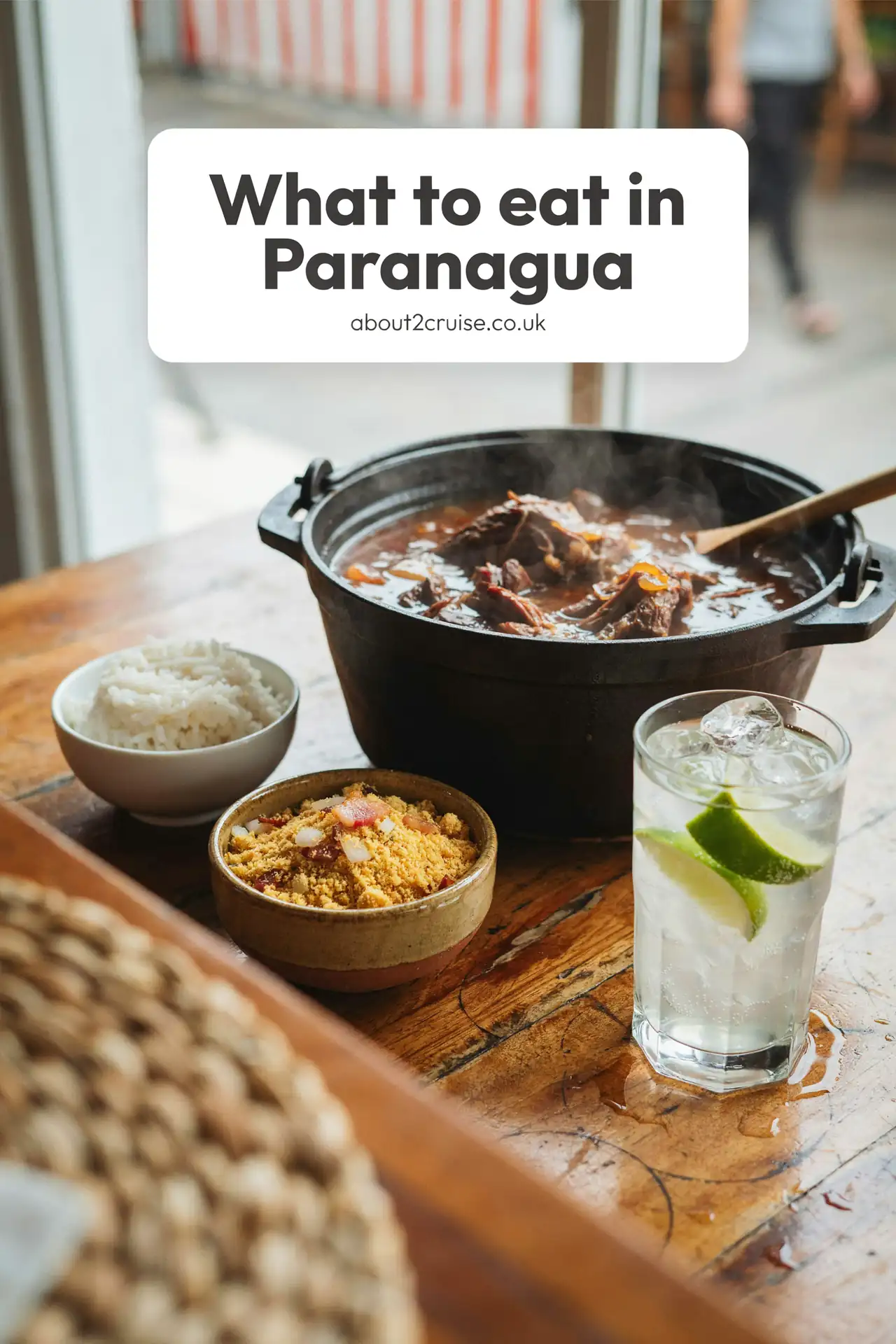
Dishes to try include barreado, beef slow-cooked in a sealed clay pot and served with cassava flour and banana; pastéis de camarão, prawn pastries made with seven-beard prawns; and tainha, mullet stuffed with farofa and roasted in a banana leaf. Cataia is the local cachaça infused with cataia leaf, sometimes called caçara whisky. Buy a bottle from the market as an easy souvenir.
Tipping is usually a 10% service charge in restaurants.
Viewpoints: Don’t Make the Morro do Cristo Mistake
A frequently repeated mistake is to send cruise passengers to Morro do Cristo in Paranaguá. The Christ statue and long staircase known as Morro do Cristo are in Guaratuba, not Paranaguá.
Paranaguá’s own viewpoints are the Rua da Praia and Rio Itiberê waterfront, best at sunset, the lighthouse hill on Ilha do Mel, and the Mirante da Fortaleza on the island. If you want a viewpoint on a short port day, stay on the waterfront or take the bay boat trip instead of chasing the wrong town.
Ilha do Mel: The Island Day People Talk About
Ilha do Mel is the standout nature excursion from Paranaguá. It is a car-free conservation island, about 93% protected, with four main villages: Nova Brasília, Farol, Fortaleza and Encantadas.
The sights are low-key and outdoors: Farol das Conchas, an 18 m cast-iron lighthouse reached by about 150 steps; Fortaleza de Nossa Senhora dos Prazeres, an 18th-century fort with free entry and a visitor centre open 09:00–17:00; and Gruta das Encantadas, a sea cave with a short trail, best entered at low tide with a torch.
Trails are sandy, there are no vehicles, there is currently no visitor entry fee, and there is little shade, so bring water, sun cream, insect repellent and proper shoes.
Ilha do Mel Ferry Logistics, and Why DIY Can Go Wrong
The public ferry from Paranaguá itself is the trap. In high season it has run daily at 09:30, with a return around 17:00, taking about 1h30 each way and costing roughly R$80 return from the historic centre. That does not fit a typical 08:00–18:00 cruise call once you add transfer time, security and the all-aboard buffer.
Outside high season the Paranaguá crossing can be as limited as Monday, Wednesday and Friday. The other public ferry leaves from Pontal do Sul, about 42 km away by road, and takes 30 minutes. It runs hourly from 08:00 to 16:00 plus a 17:30 extra, with a return fare around R$49, but you must first get to Pontal do Sul.
Ship excursions do reach Ilha do Mel, and on some calls the quota has sold out before 11:00. If the island is your priority, book a ship-organised excursion or a reputable local tour with a guaranteed return. Do not try to do it independently using the Paranaguá public ferry on a standard cruise call.
Should You Go Independent or Book a Ship Tour?
Paranaguá is easy to do independently if your plan is the historic centre, the market and a bay boat trip. For Ilha do Mel, the Serra do Mar train to Morretes, or far-flung beaches, ship-organised tours are far safer because transport times are tight and the port is not set up for casual same-day logistics.
Ship excursions from Paranaguá have included city tours, bay and dolphin trips, Fortaleza/Ilha das Peças, Ilha do Mel and the Maria Fumaça train. Local agencies at the tourist reception also sell tours, but independent passengers should confirm exactly how the return to Mega Rocio works before paying.
Half-Day in Paranaguá: An Easy, Low-Key Plan
Take the port transfer to the landside reception, then a taxi or ride-hailing car to the Rua da Praia. Walk the waterfront, step inside the cathedral, visit the MAE museum if open, and spend the rest of your time in the Mercado Municipal do Café and fish market.
Before you sail
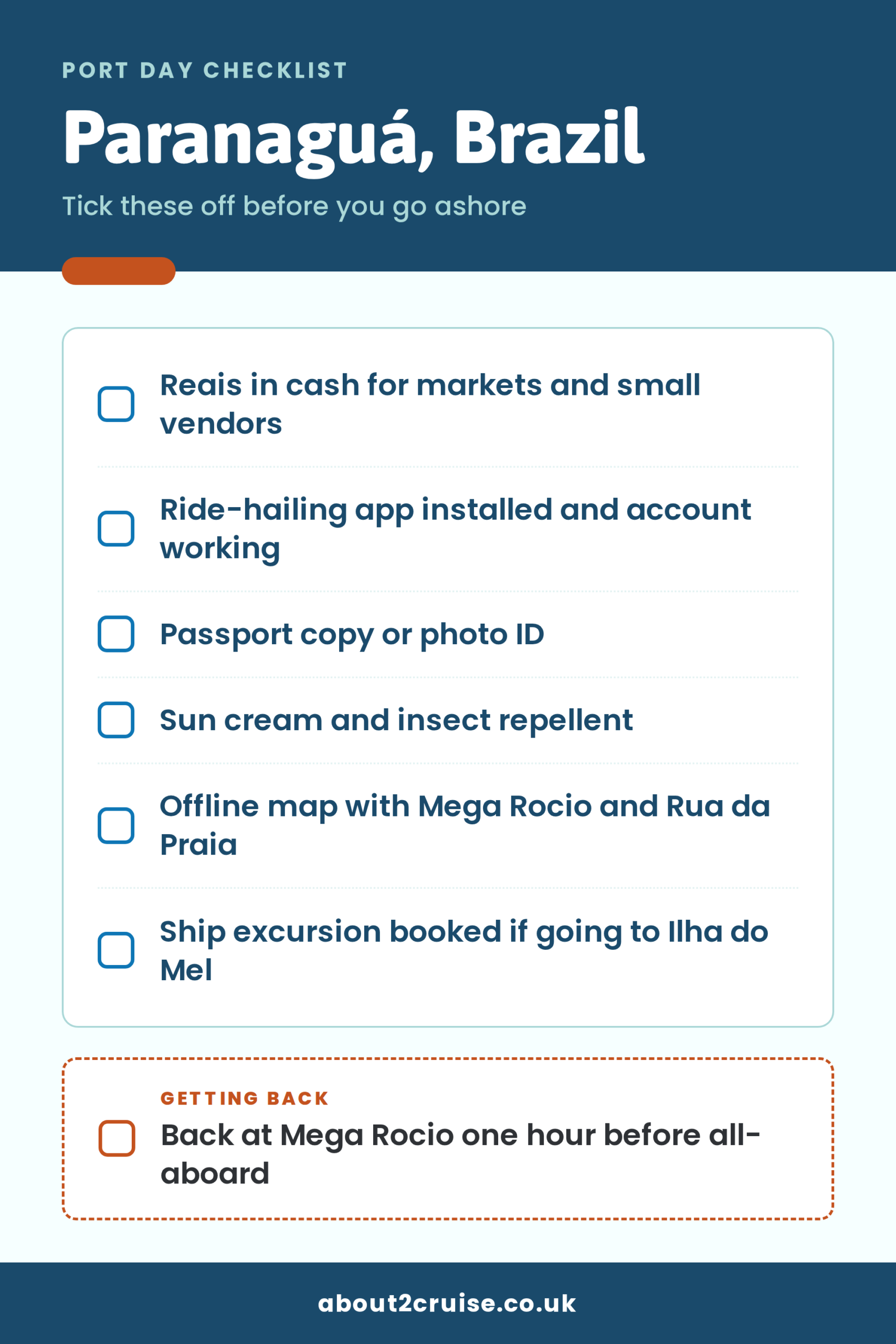
- Book an Ilha do Mel ship excursion early; boat quota can sell out before 11:00.
- Download offline maps and a Portuguese phrase pack before arriving.
- Check Brazil entry rules and carry a passport copy or photo ID ashore.
Short port day: under 6 hours
- On dockingTake the port bus to Mega RocioEscorted transferYou cannot walk out of the cargo berth. Buses run from the quay to the Mega Rocio landside reception under Port Guard escort.
- +30 minTaxi or ride-hailing to Rua da PraiaUse the appAbout 3.1 km from Mega Rocio to the historic centre. Book through the app, check the plate, or agree a taxi fare before getting in.
- +45 minRua da Praia waterfrontWalk the colonial waterfront along the Rio Itiberê. The old houses and boat piers are the heart of the listed historic centre.
- +1 hr 15 minCatedral do Rosário and São BeneditoStep inside the oldest church in Paraná, then see Igreja de São Benedito, built by enslaved devotees.
- +1 hr 45 minMAE museumFree museum at Rua XV de Novembro 575, open Tuesday to Sunday. It covers prehistoric archaeology, popular culture and indigenous collections.
- +2 hr 30 minLunch at Mercado Municipal do CaféTry barreadoOrder barreado or pastéis de camarão at the market and fish market on Rua General Carneiro. The upper floor of Mercado Nilton Abel de Lima also has seafood.
- All-aboard minus 1 hrTaxi back to Mega RocioReturn from the historic centre to Mega Rocio, then take the escorted bus back to the quay. Allow at least one hour for the full return.
This map shows the taxi ride from the ship. The time is the drive only, not your time ashore.
Open the taxi route in Google Maps
If plans change: If the cathedral or MAE is closed, stay on the Rua da Praia waterfront, visit the Aquário de Paranaguá and eat at the Mercado Municipal do Café.
Long port day: 8 hours or more
- On dockingTake the port bus to Mega RocioEscorted transferYou cannot walk out of the cargo berth. Buses take you to the Mega Rocio landside reception under Port Guard escort.
- +30 minTaxi or ride-hailing to Rua da PraiaUse the appAbout 3.1 km to the historic centre. Book through the app and check the plate, or agree a taxi fare before getting in.
- +1 hrWaterfront, cathedral and São BeneditoWalk the Rua da Praia along the Rio Itiberê, then step inside the oldest church in Paraná and Igreja de São Benedito.
- +2 hr 30 minMAE museumFree museum at Rua XV de Novembro 575, open Tuesday to Sunday, with archaeology, popular culture and indigenous collections.
- +3 hr 30 minLunch at Mercado Municipal do CaféTry barreadoOrder slow-cooked barreado or prawn pastries at the market on Rua General Carneiro, then browse the fish market next door.
- +5 hr 30 minBay boat trip from Estação NáuticaWalk behind the aquarium to the Estação Náutica. The Barcopar trip lasts about 1 hr 20 min and passes five kilometres of working quay.
- All-aboard minus 90 minTaxi back to Mega RocioReturn from the historic centre to Mega Rocio and take the escorted bus to the quay. The bay boat area is a short walk from the taxi pick-up.
This map shows the taxi ride from the ship. The time is the drive only, not your time ashore.
Open the taxi route in Google Maps
If plans change: If the bay boat cannot leave for lack of minimum passengers, visit the Aquário de Paranaguá next to the Estação Náutica and return to Mega Rocio by taxi.
Eat barreado or prawn pastries, buy a bottle of cataia, then return to Mega Rocio with at least an hour before the ship’s all-aboard. This works well even if you only want a few hours off the ship.
Full-Day Paranaguá Plan: Old Town, Lunch and a Bay Boat Trip
Use the morning for the historic centre, cathedral, museum and market. Have a seafood lunch in the market halls. In the afternoon take the 1h20 bay boat trip from the Estação Náutica behind the aquarium. It runs daily from around 09:00 to 17:00, needs a minimum of ten people and costs about R$50 per adult.
If the weather is poor, substitute the Aquário de Paranaguá, open daily 10:00–18:00, with tickets around R$36 adult or R$30 if paid in cash. If the ship offers a full-day Ilha do Mel excursion, that replaces the town day and is the best way to experience the island.
Bay Boat Trips: A Water Option That Actually Fits a Cruise Call
The practical water option inside a short call is the Paranaguá bay boat trip with Barcopar. It lasts about 1h20, costs about R$50 per person, children up to 7 free, and leaves from the Estação Náutica behind the aquarium.
You need a minimum of 10 passengers, which is usually reached on cruise days. The route gives you a close look at roughly five kilometres of working quay and ships, and can be a better fit than Ilha do Mel if you do not have a ship excursion secured.
Mainland Beaches: A Simpler Beach Option
If you want a mainland beach rather than a town day, Praia de Leste and the Pontal do Paraná beaches are reached by road from Paranaguá. Local agencies at the cruise reception have sold transfers there.
They are not as distinctive as Ilha do Mel’s car-free villages, but they are a simpler beach option on a hot summer call.
Longer Day Trips: Only With a Ship Excursion or a Pre-Cruise Stay
Several longer day trips are marketed from the Paraná coast but only make sense with a ship excursion or a pre-cruise stay.
The Serra do Mar scenic train between Curitiba and Morretes takes about four hours, with tourist-class tickets from around R$206 one way, and can be combined with lunch and a van transfer. Guaraqueçaba and the Salto Morato reserve are reached by boat from Paranaguá, about 2 to 2.5 hours each way. The Caminho do Itupava is a 22 km colonial stone path between Borda do Campo and Porto de Cima via Morretes, roughly three hours of walking. Carambeí historical park is also marketed as a Paraná day trip.
None of these are casual port-day options without a confirmed tour and a generous ship timetable.
Festivals and Events Through the Year
Paranaguá’s festivals are one reason to visit, but the main cruise window from late December to mid-March rarely overlaps the biggest ones.
The city’s Festa Julina, Fejupa, runs four days in July at the Praça de Eventos with quadrilhas, typical food and free entry. Festa do Rocio, the state patron saint’s festival, is in November at the Rocio sanctuary next to Mega Rocio. The tainha fish festival takes place in the winter months.
Fandango Caiçara, the coastal Paraná music and dance tradition, is frequently performed at the cruise tourist reception even when a full festival is not on.
Culture, Museums and Heritage Worth Knowing About
The Museu de Arqueologia e Etnologia, MAE, occupies the former Jesuit college at Rua XV de Novembro 575. It is free and open Tuesday to Sunday 08:00–20:00, with collections covering prehistoric archaeology, popular culture and indigenous ethnology, including exhibitions on the Guarani Mbyá of the Paraná coast.
Paranaguá is also a centre of Fandango Caiçara, registered as Brazilian intangible cultural heritage and danced with wooden clogs, rabeca, viola and adufo. The Igreja de São Benedito was built by enslaved devotees, and the Ilha dos Valadares, reached by a pedestrian footbridge from the centre, is a Caiçara community and fandango heartland.
Brazil Entry Rules for UK Cruise Passengers
British passport holders can visit Brazil for tourism for up to 90 days without a visa, but your passport should be valid for at least six months beyond your arrival date. Carry a passport copy or photo ID rather than the original when going ashore.
Do not take vapes or e-cigarettes into Brazil; they are illegal and can be confiscated at customs. Before travel, check the latest Foreign, Commonwealth and Development Office entry advice, because Brazilian rules for other nationalities and future eVisa requirements can change.
Weather, Heat and Rain: What to Expect on a Cruise Day
Paranaguá is hot and humid in the December-to-March cruise window. January averages about 25.8°C, with heavy rain possible. January rainfall averages around 330 mm, relative humidity is high at about 86%, and sunshine is limited to about 3.7 hours a day.
The southern Brazil rainy season runs November to March, with flash floods and landslides where mountains meet the coast. Wear light clothing, bring a rain jacket, use sun cream and insect repellent, and wear shoes that can handle stone-paved streets and possibly sandy trails.
Churches are generally relaxed, but shoulders and knees are safer if you plan to enter religious buildings.
Safety, Pickpocketing and Port Rules
Paranaguá is a working cargo port, so you must follow Port Guard instructions, stay within designated passenger areas, and never wander into cargo or rail zones. Passenger buses between the quay and Mega Rocio are escorted.
For the town, general Brazil advice applies: pickpocketing, robberies and phone theft can happen, especially in the late afternoon and early evening. Do not hail taxis in the street; book through a ride-hailing app and check the plate and driver details. Keep your card in sight during payments and avoid suspicious ATMs. If you stay overnight, use a taxi or ride-hailing car after dark rather than walking long unlit streets.
Accessibility: What Works and What’s Harder
The historic centre has stone-paved streets and some slopes, but the main sights are close together. Ilha do Mel is more difficult: it has sand tracks and no cars, but the island has four amphibious chairs, two at Encantadas and two at Nova Brasília, which must be reserved in advance through the island’s environmental office. New wider piers at Brasília and Encantadas were built to help older visitors and people with disabilities.
The scenic train has an accessible carriage adapted for wheelchair users. If you use a wheelchair or have limited mobility, a town and market day is the most practical plan. For Ilha do Mel, ask the shore excursion desk for exact accessibility arrangements before booking.
Money, Cards and Tipping in Paranaguá
The currency is the Brazilian real. Cards are widely accepted in shops and restaurants, but you will need cash for markets, small vendors, taxis and tips. A currency exchange desk has operated inside the cruise reception so passengers could change US dollars and euros.
ATMs exist, but use machines inside banks and avoid anything that looks tampered with; card cloning is a known risk in Brazil. A 10% service charge is common in restaurants. The average spend per cruise passenger in Paranaguá has been estimated at about R$500.
Language, Wi-Fi and Staying Connected
Portuguese is the language, and English is not widely spoken outside main tourist areas. Some island traders and tourism workers have taken English courses ahead of cruise seasons, but do not expect fluent English everywhere.
The Mega Rocio departure lounge has Wi-Fi, and some shops and restaurants in town may offer it. If you want mobile data, buy a local prepaid SIM at an official carrier store with your passport or use a travel eSIM that needs no registration. Download offline maps and an offline Portuguese phrase pack or Google Translate before you arrive.
Which Cruise Lines Call Here?
MSC is the main operator. MSC Musica has called weekly on Saturdays from late December to mid-March, with around 12 calls in the season. The ship is 293.8 m long with capacity for more than 3,000 passengers. Typical itineraries from Paranaguá call at Itajaí, Ilhabela, Rio de Janeiro, Búzios and Ilha Grande, with a New Year variant adding Copacabana.
Silversea’s Silver Whisper has called with passengers mainly from the US, UK and Canada, and Scenic Eclipse has anchored in the bay and landed passengers directly at Ilha do Mel. The port authority does not publish a simple public cruise calendar, so check your cruise line, your booking, and AIS tracking for call times.
Embarkation and Disembarkation: Not Like a Typical Terminal
For passengers changing ship in Paranaguá, the flow is not like a traditional cruise terminal. You are bused between the quay and Mega Rocio, where you go through check-in or disembarkation, customs, X-ray and baggage scanning.
On embarkation days, give yourself extra time for the bus and security rather than assuming you can arrive at the gangway five minutes before final boarding. On a day call, you clear the port through the same landside reception before you can head into town. Keep your cruise card, passport copy and any tour voucher with you.
Delays, Tenders and Port Traffic
Paranaguá is a busy cargo port with rail crossings, truck traffic and port security. Cruise ships generally berth at the quay rather than tendering; only expedition-style ships such as Scenic Eclipse have anchored out and landed passengers by smaller boat.
Delays can happen because of cargo operations or weather. Leave a realistic buffer for returning from any independent outing, and do not plan a public ferry or train that leaves no slack.
Where to Stay Before or After a Cruise
Hotels cluster in and around the Centro Histórico, a short drive from the cruise reception rather than beside the quay. Camboa Hotel Paranaguá has pools, a gym, parking and breakfast from 06:30, and is described as about five minutes by car from the port. Hotel Serra do Mar is on Rua XV de Novembro, close to the aquarium. Hotel Graciosa is about four blocks from the historic centre.
On Ilha do Mel itself, pousadas range from simple to premium, roughly R$190 to R$990 a night. The coach station is under 2 km from the boat terminal and historic centre. Curitiba’s Afonso Pena international airport is about 65 km away; Paranaguá’s own Santos Dumont airport has no scheduled flights.
Paranaguá sits on the Rio Itiberê. The historic centre and the boat piers line the Rua da Praia waterfront, while the working port runs along the bay to the north. The public quay is on Avenida Portuária, and Mega Rocio is beside the Rocio sanctuary on the northern edge of the centre. Ilha do Mel lies across the bay, about 20–25 km by water from Paranaguá.
Paranaguá With Kids or Older Travellers
Families can keep it simple: the Aquário de Paranaguá, a bay boat trip, the market halls and a short walk along Rua da Praia are easy to combine and do not need a car. Ilha do Mel is fine for active families but can be too sandy and hot for small children or older passengers without careful planning.
Older cruise passengers should choose a town, market and seafood lunch day. Avoid the public ferry to Ilha do Mel unless a ship excursion provides dedicated transport and a guaranteed return.
Checking Your Cruise Schedule and Nearby Ports
Because there is no official permanent cruise calendar, the best way to confirm your call is through your cruise operator, the Portos do Paraná press releases, and an AIS tracking site. Paranaguá is often combined with other Brazilian ports such as Itajaí, Ilhabela, Búzios and Rio de Janeiro.
If you are also stopping in Rio, use the linked guide below for how that port day works. If your cruise continues south to Argentina, the Buenos Aires guide covers the next major turnaround city.
Why Older Guides Get Paranaguá Wrong
Older guides often say passengers are released directly at the quay or that a permanent terminal exists. That is outdated. The current reality is more staged: berth 205, bus to Mega Rocio, and then onward transfer to town. The dedicated terminal is still under construction, so the temporary set-up remains in place.
If you are reading an old guide that mentions berth 215, do not rely on the street-level details. Use the latest call instructions from your cruise line and the port reception staff on the day.
Our Brazil cruise ports guide covers the other ports in the region.
Paranaguá Cruise Port FAQ
Do I need a visa for a cruise call if I stay in the port area? If you leave the ship, you have entered Brazil. British passport holders can visit Brazil for up to 90 days without a visa, but your passport must be valid for six months beyond arrival. Carry a passport copy, not the original, on a day call.
Are US dollars or euros accepted in Paranaguá? Some exchange desks and tourism services may take foreign currency, but shops, markets and taxis expect reais. Use cards where accepted and carry some reais for small purchases and tips.
Is Uber available in Paranaguá? Yes, ride-hailing apps operate in the city. Book only through the app, check the plate and driver details, and do not hail taxis in the street.
Is there left luggage at the cruise terminal or Mega Rocio? No official left-luggage service is published for the temporary terminal, Mega Rocio, the coach station or the airport. Some hotels offer luggage storage, but do not plan to store bags at the port.
How far is the historic centre from the ship? You first clear at Mega Rocio, then the historic centre is about 3.1 km away. Use a taxi or ride-hailing car; do not try to walk from the cargo quay.
Can I book an independent Ilha do Mel trip and still make my ship? It is risky. The public Paranaguá ferry schedule does not fit a standard 08:00–18:00 call. Use a ship excursion or a local operator who explicitly guarantees return before all-aboard, and confirm the boat-time arithmetic before paying.
What if my ship is delayed or I miss the last port bus? The port bus and security arrangements are tied to the ship call, so stay with your assigned group and follow port staff. On independent tours, plan to return to Mega Rocio at least one hour before all-aboard, with enough time for the bus back to the quay if needed.
Keep Planning Your South America Cruise
If your itinerary also calls at Rio de Janeiro, read the Rio de Janeiro Cruise Ship Port Guide. Heading south to Argentina? See the Buenos Aires Cruise Ship Port Guide.
Last Updated: 18 November 2026