
Matarani is Peru’s southern cruise gateway, but the port itself is a working cargo wharf, not a destination. The reason ships call here is Arequipa, the UNESCO White City, about 112 km inland. A standard call gives you time for Arequipa or coastal Mollendo; Machu Picchu and Colca Canyon are not realistic day trips.
Matarani is a small port town in Islay province, in the Arequipa department of south-western Peru. It’s one of Peru’s five cruise arrival ports, alongside Paita, Salaverry, Callao, and Pisco, but it’s the small one of the group. The big ships berth at Callao, so Matarani tends to attract small and mid-sized expedition or boutique vessels.
The port is operated under concession by Terminal Internacional del Sur, known as TISUR, and it mainly handles cargo and traffic from the Interoceanic Highway. If you want the wider regional picture, check our Peru and Ecuador cruise ports guide. If your cruise continues south into Chile, the next useful calls to compare are Arica, Iquique, and Antofagasta.
Docking, getting off the ship, and what’s at the port
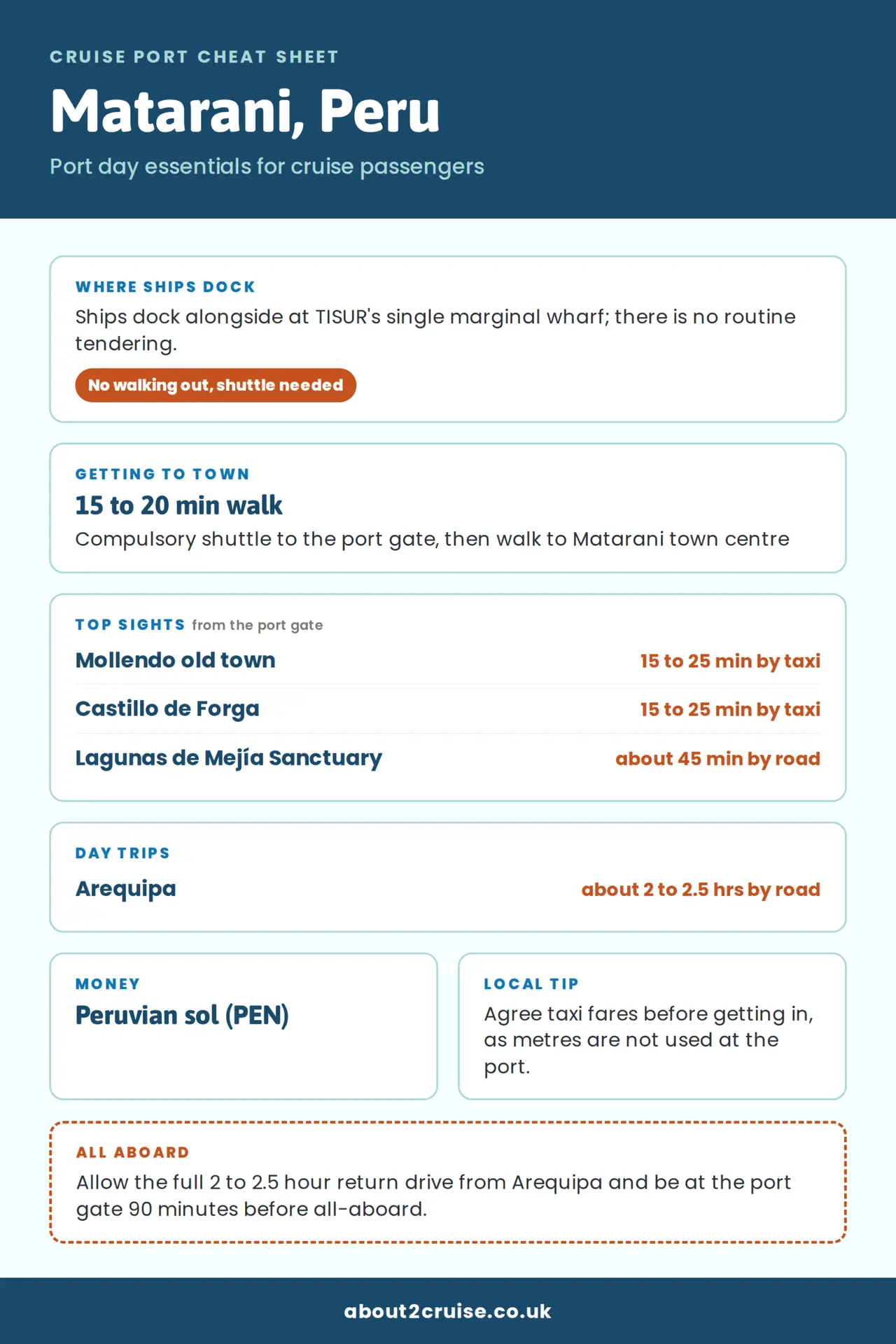
Ships dock alongside at TISUR’s single concrete marginal wharf. It’s 583 metres long and split into berths A, B, and C. There’s no routine tendering at Matarani, but the wharf can handle vessels up to 240 metres in length, 9.75 metres draft, and 80,000 DWT. That means only small and mid-sized cruise ships can use it.
A typical call here lasts 9–11 hours, often around 07:00–16:00, 08:00–18:00, or 08:00–19:00. You can’t walk through the cargo zone. Everyone takes a shuttle bus from the ship to the terminal gate, and some cruise lines extend that shuttle to Mollendo at no extra cost. Licensed taxis wait outside the gate, but they don’t use meters, so agree on a fare before you get in.
The cruise terminal package includes toilets, first aid with an ambulance, extra security, a cordoned transit area, luggage handling, a dedicated parking area for buses, and basic telephone and internet access. There’s no ATM at the port. The nearest cash machines are in Mollendo or Arequipa. There’s also no left-luggage or bag-storage facility at the port or in Mollendo, so keep your day bag with you.
Matarani town centre is a 15–20 minute walk from the port area, but the cruise terminal sits inside the secure cargo zone. You can’t simply step off the ship and wander.
Where Matarani sits on your cruise map
The map shows Matarani and the places worth seeing. Tap a pin for directions.
- MataraniTown centre
- Plaza de Armas, ArequipaMain square · About 2 min walk from the town centre
- Iglesia de la Compañía de JesúsChurch · About 2 min walk from the town centre
- Basílica Catedral de ArequipaCathedral · About 4 min walk from the town centre
- Casa del MoralHouse · About 6 min walk from the town centre
- Mercado San CamiloMarket · About 8 min walk from the town centre
- Santa Catalina MonasteryMonastery · About 9 min walk from the town centre
- Mundo Alpaca ArequipaAlpaca centre · About 14 min walk from the town centre
- Iglesia de YanahuaraChurch · About 24 min walk from the town centre
- Mirador de YanahuaraViewpoint · About 25 min walk from the town centre
- Puente de FierroIron bridge · About 28 min walk from the town centre
- Terminal Terrestre de MollendoBus station · About 86 km from the town centre
- Terminal Terrestre de ArequipaBus station · About 3 km from the town centre
- Playa MollendoBeach · About 86 km from the town centre
- Santuario Nacional Lagunas de MejíaNature reserve · About 90 km from the town centre
- Molino de SabandíaMill · About 8 km from the town centre
- Mansión del FundadorMansion · About 7 km from the town centre
Passports, immigration, and staying out of trouble
Peruvian immigration officers usually board the ship or process passengers at the terminal before you’re allowed ashore. They check your landing permit against national and international alert databases.
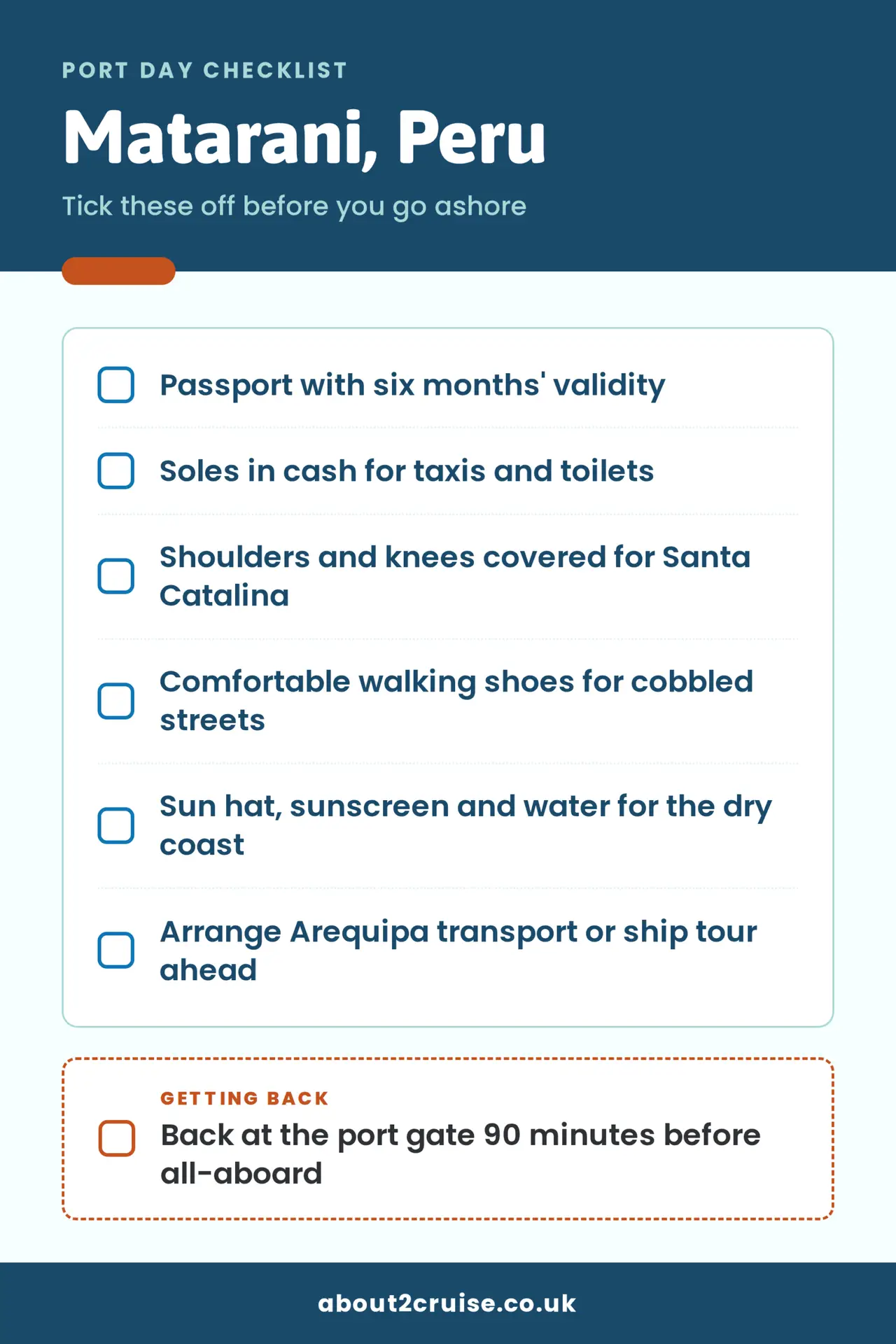
UK passport holders can enter Peru visa-free for tourism, normally for 90 days within a 180-day period. Your passport needs at least six months’ validity beyond your arrival date. Carry ID when you go ashore, police may ask to see it.
Don’t photograph military installations or anything military-related. It’s illegal and carries a prison sentence. Political protests can be unpredictable and can escalate into roadblocks, so listen to the ship’s advice on the day.
Easy option close by: Mollendo and the Mejía lagoons
Mollendo is only 12–13 km from Matarani, about 15–25 minutes by road. A taxi from the port gate costs roughly US$7–10, and you should agree the price before getting in. Shared colectivos also run regularly between the port and nearby towns.
Mollendo’s old town has turn-of-the-century wooden villas, sandy beaches, a clifftop walk, and the Castillo de Forga. For a shorter call, it’s the easiest independent option. If you’re hungry, Avenida Grau has seafood stalls and family-run restaurants serving ceviche and fried fish.
Birdwatchers should look at the Lagunas de Mejía National Sanctuary, about 10 km from Mollendo and roughly 45 minutes from the port. The sanctuary covers 690.6 hectares and has recorded 209 bird species. There’s an interpretation centre, signposted trails, viewpoints, and jetties. Migratory birds are best from September to March; resident birds are best from May to August. The site is exposed with little shade, so bring a hat, sunscreen, and binoculars.
Arequipa: the reason your ship stops here
Arequipa’s historic centre has been UNESCO-listed since 2000. The city sits at about 2,335 metres in a valley ringed by the Misti, Chachani, and Pichu Pichu volcanoes. It claims more than 300 days of sunshine a year. Most of its buildings are made from sillar, a white volcanic tuff, which is why it’s called the White City.
The drive from Matarani is 112–113 km. Route planners say about 1 hour 37 minutes, and the port concessionaire says 1.5 hours, but in practice cruise guides and private drivers quote 2–2.5 hours each way on the single desert highway. Budget for the longer figure if you have a hard all-aboard time.
Arequipa sights and how to build a day
The classic Arequipa view is the Plaza de Armas with the Basílica Cathedral and El Misti rising behind it. From there you can walk into the historic streets.
Santa Catalina Monastery covers about 20,000 square metres and was founded in 1579. It’s open daily from 09:00 to 17:00, with extended hours to 20:00 on Tuesdays and Wednesdays. It’s closed on Good Friday, 25 December, and 1 January. Foreign adult entry is S/50, and cards are accepted. A guided visit takes about one to two hours. Churches and the monastery enforce a dress code: no shorts or sleeveless tops. Cover your knees and shoulders or you may be refused entry. The monastery is not wheelchair accessible and has cobbled, uneven ground.
The Mirador de Yanahuara is a row of sillar arches framing El Misti, with quotations carved into the stone. It’s free, open all day, and about 2 km, or a 15-minute walk, from the Plaza de Armas. Thirty to sixty minutes is enough, and late afternoon often gives the clearest volcano views.
The Museo Santuarios Andinos on Calle La Merced 110 houses the frozen mummy Juanita. Foreign adult entry is S/25, and a compulsory guided tour lasts about 40–60 minutes. If you enjoy food markets, Mercado San Camilo in the city centre has cooked-food counters and is a good lunch stop.
Why Colca Canyon doesn’t fit a normal port call
Colca Canyon lies about 150 km, or 93 miles, beyond Arequipa. That’s a 3–4 hour drive each way. The Cruz del Cóndor viewpoint sits at 3,800 metres, and the best condor viewing is between 08:00 and 10:00, which means leaving Arequipa around 03:00.
A full-day Colca tour from Arequipa runs 14–15 hours. From Matarani you’d also need to add the 2–2.5 hour port transfer on top. No standard 9–11 hour call can contain that. Do not attempt Colca as a port day. If your cruise line sells a Colca excursion, check carefully whether the ship has an overnight or extended stay, and what exactly is included. A standard call cannot reach the canyon and return safely.
The honest truth about Machu Picchu from Matarani
Machu Picchu and Cusco are roughly 650 km, or 400 miles, from the Arequipa region inland of Matarani. There’s no direct transport from Arequipa. Every overland route goes via Cusco and takes 2–3 days.
Trains leave from Ollantaytambo, 1.5–2 hours from Cusco, then take another 1.5–2 hours to Aguas Calientes. From there, it’s a 25-minute bus up to the site. Tickets are personal, dated, time-slotted, and non-transferable. Book through the official Ministry of Culture platform, tuboleto.cultura.pe. A foreign adult standard ticket is S/152, plus a S/11 conservation fee from 1 May 2026. A licensed guide is required for a first visit.
No Machu Picchu trip fits inside a Matarani port call. Plan it as a 2–3 day pre- or post-cruise add-on from Cusco or Arequipa instead.
Ship excursions vs going independent
Ship-sponsored tours guarantee the vessel waits if your return is delayed. That matters on the single desert highway to Arequipa. Independent taxis and private drivers are cheaper and more flexible, but you carry the risk of a breakdown or roadblock.
An eight-hour private Arequipa tour from the port, for a small group, starts at about US$420 per booking. That usually includes transport, an English-speaking guide, the port entry permit, fees, and lunch. Public buses don’t leave from Matarani itself. You’ll need to get to Mollendo first, where buses to Arequipa cost about US$12–14 and take roughly 2.5 hours. Taxis from the port to Arequipa run about US$60–90 one way. Colca day tours from Arequipa sell from about US$35–45, but remember, they can’t be done from the ship on a normal call.
What to eat and drink
Arequipa’s signature dishes are worth trying if you have time:
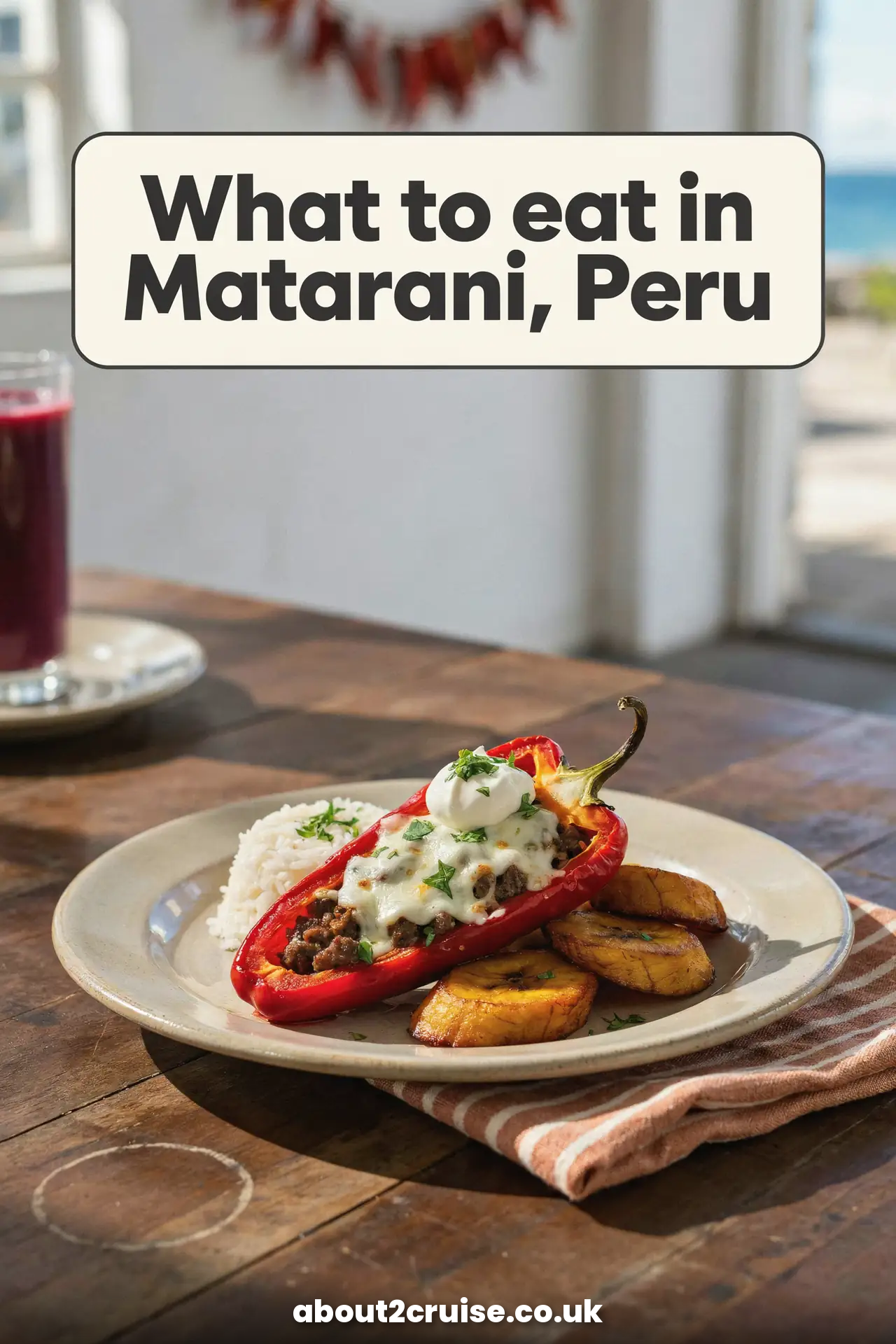
- Rocoto relleno: a stuffed spicy pepper baked with meat, olives, egg, and cheese.
- Chupe de camarones: a river-prawn chowder with milk, cheese, potato, and egg.
- Adobo arequipeño: pork cooked overnight, traditionally eaten on Sunday mornings.
- Ocopa: potatoes in a huacatay, chilli, peanut, and cheese sauce.
Queso helado is a frozen cinnamon and coconut milk dessert sold near the Plaza de Armas. Eat at a picantería, Arequipa’s traditional family-run eating house. Many close by late afternoon because lunch is the main meal, usually from about 13:00. Mercado San Camilo has cooked-food counters. Near the port, Mollendo’s Avenida Grau is the seafood strip. Set lunches in simple Arequipa restaurants cost about S/10–15.
Weather and packing
Peru’s cruise season runs from October to April. On the coast, Matarani and Mollendo are mild and dry, with an annual mean temperature around 19.8°C and very little rainfall. February can be wetter, and winter brings fog and garúa drizzle.
Arequipa has a wet season from December to March and a dry season from April to November. Mean maximums are about 20–21°C and mean minimums 7–10°C, so nights are cold and days are warm. Wear layers, a light jacket for evenings, comfortable walking shoes for cobbled streets, a hat, sunglasses, sunscreen, and insect repellent. Churches and Santa Catalina require knees and shoulders covered.
Money, cards, and tipping
The local currency is the Peruvian sol, code PEN and symbol S/. Cards work in Arequipa hotels, mid-range and upscale restaurants, and city tour agencies. Markets, street food stalls, taxis, and small restaurants are usually cash-only or rarely take cards.
ATMs are available in Mollendo and central Arequipa, but not at the port. Withdraw in soles and decline conversion to your home currency. US dollars are accepted by some hotels and agencies, but at a worse rate than paying in soles.
Tipping is about 10% in restaurants if service isn’t included. Guides usually get US$5–10 per day, drivers less, and taxis are rounded up. Toilets on tour routes commonly charge about one sol in cash.
Language and a few useful phrases
Spanish is the local language, and English is limited outside hotels and tourist-facing businesses. Useful phrases include:
- Hola
- Gracias
- Por favor
- ¿Cuánto cuesta?
- La cuenta, por favor
- ¿Dónde está…?
- No entiendo
- ¿Habla inglés?
Restaurant service is often not included in the bill, so around 10% is the norm.
Safety, health, and altitude
Street crime, including muggings and thefts, is a significant problem in Lima, Cusco, Arequipa, and other major cities. Use licensed or app-based taxis rather than hailing on the street, and ask hotels to book taxis for you. Robberies at traffic lights have been reported.
Political protests can escalate into roadblocks and transport disruption, so check local advice before hiring a car. Driving standards are poor, and bus crashes are common, especially at night. Don’t drink tap water, stick to sealed bottled or boiled water. Street and market food carries a higher risk of stomach illness, so eating in restaurants is advised. Deaths and serious illness from methanol in alcoholic drinks have occurred in Peru. The country is also in an active earthquake zone with frequent tremors.
Arequipa sits at 2,335 metres, which is low risk for altitude illness and rarely causes serious problems. Colca is high risk, but you won’t be going there on a normal port day. Drink 3–4 litres of water, avoid alcohol for the first two days, eat light carbohydrate meals, and move slowly. Coca tea helps mild symptoms. If symptoms persist after rest, seek care at Hospital Nacional Carlos Alberto Seguín Escobedo in Arequipa. Some travel insurers exclude altitude above 3,000 metres, so check your policy.
Accessibility and mobility
Private Arequipa tours from the port can be wheelchair accessible with private transport, but the historic centre itself is challenging. Streets are cobbled and uneven, and many places lack ramps. Santa Catalina Monastery is not wheelchair accessible and has stairs. Walking tours are generally described as unsuitable for wheelchair users.
If you have mobility limitations, a private Arequipa tour that mostly stays in the vehicle and visits the Plaza de Armas and Yanahuara viewpoint may still work. Discuss the exact walking distance with the operator before booking.
Staying connected
TISUR’s cruise package includes telephone, mobile, and internet facilities at the terminal, but don’t count on fast or free passenger Wi-Fi there. Local SIM cards from Claro, Movistar, or Entel require passport registration, and an eSIM bought before travel avoids the swap.
Wi-Fi in Arequipa cafes and hotels is generally good. On the desert road between the port and Arequipa, mobile signal is patchy, so download offline maps before leaving the ship.
Souvenirs worth buying, and what to skip
Wool goods and souvenirs are sold along pedestrian Calle Mercaderes in Arequipa, including ponchos, scarves, and hats in alpaca wool. Buy from reputable shops or cooperatives if quality matters; very cheap alpaca is often acrylic.
Don’t buy crafts made with condor or other wild bird feathers, turtle shells, teeth, bones, or archaeological artefacts. They’re illegal to sell and to bring home.
Three realistic Matarani port day plans
If you want the headline sight: take the shuttle to the gate, then a private transfer or ship tour to Arequipa. Visit the Plaza de Armas, Santa Catalina Monastery for 1–2 hours, and the Mirador de Yanahuara for 30–60 minutes. If time allows, stop at Mercado San Camilo for lunch. Start as early as possible and build in the 2–2.5 hour return drive.
Before you sail
- Book an Arequipa private tour or ship excursion ahead for peak-season calls.
- Check your passport has six months' validity beyond arrival in Peru.
- Bring soles in cash for taxis, market food and public toilets.
Short port day: under 6 hours
- On dockingTake the port shuttleNo walking outYou cannot walk through the cargo zone. Everyone must take a shuttle from the ship to the terminal gate.
- +15 minTaxi to MollendoAgree fare firstTaxis wait outside the gate without metres. Agree the fare before getting in; the drive is 12 to 13 km and takes 15 to 25 minutes.
- +45 minMollendo old town and clifftop walkWalk from the Plaza de Armas down to the seafront and on towards Castillo de Forga. The clifftop path looks over Pacific surf on the rocks.
- +1 hr 45 minLunch on Avenida GrauTry cevicheThe seafood strip and family-run spots serve ceviche and fried fish. Pay in soles; small restaurants are often cash only.
- +3 hrsReturn taxi to the port gateAllow 25 minutes back to the gate. Keep your ship card ready because the port shuttle is needed to rejoin the ship.
- All-aboard minus 1 hrBack at the port gateIf your taxi is late or cannot be found, call your driver or ask a local shop to book a licensed taxi.
This map shows the taxi ride from the ship. The time is the drive only, not your time ashore.
Open the taxi route in Google Maps
If plans change: If taxis are scarce at the gate, ask about shared colectivos or wait for a later cruise-line shuttle to Mollendo.
Long port day: 8 hours or more
- On dockingTake the port shuttleNo walking outYou cannot walk through the cargo zone. Everyone must take a shuttle from the ship to the terminal gate.
- +15 minTransfer to ArequipaPre-book the driverMeet a pre-arranged private transfer or ship tour. The drive is 112 km and takes about 2 to 2.5 hours on the desert highway.
- +2 hrs 15 minPlaza de Armas and Basílica CathedralWalk the central square with the cathedral and El Misti behind it. This is the classic Arequipa frame.
- +2 hrs 45 minSanta Catalina MonasteryDress codeAllow about 1.5 hours for the Santa Catalina Monastery. Keep knees and shoulders covered, and note the site is not wheelchair accessible.
- +4 hrsLunch at a picantería or Mercado San CamiloTry rocoto rellenoOrder rocoto relleno or adobo arequipeño at a picantería, or head to the market's cooked-food counters. Many picanterías close by late afternoon.
- +5 hrs 30 minMirador de YanahuaraA 15 minute walk from the Plaza de Armas. The sillar arches frame El Misti; allow 30 minutes before heading back.
- All-aboard minus 90 minBack at the port gateLeave Arequipa in time for the 2 to 2.5 hour return drive and be at the port gate 90 minutes before all-aboard. Your port shuttle will rejoin the ship.
This map shows the taxi ride from the ship. The time is the drive only, not your time ashore.
Open the taxi route in Google Maps
If plans change: If the desert road is blocked or your transfer fails, switch to the short Mollendo and Mejía plan near the port.
If you want a short, cheap, and easy day: take a taxi to Mollendo for the Plaza, seafront, and seafood. This works well on a shorter call or if you want to stay close to the port.
If you want nature and birds: head to the Mejía lagoons, about 45 minutes from the port. Bring binoculars, water, and sun protection.
Do not attempt: Colca Canyon or Machu Picchu. Both are beyond the reach of a normal Matarani port call.
So, is Matarani worth visiting on a cruise?
Matarani itself is not the attraction. The port is a gateway. If you’ve never seen Arequipa, yes, the call is worth it for the White City alone. If you’ve already done Arequipa or can’t manage the 2+ hour road transfer, a short Mollendo or Mejía day is pleasant but not world-class. The real value depends on accepting the long transfer and understanding that Peru’s two most famous sights, Machu Picchu and Colca Canyon, are not part of a Matarani port day.
Frequently asked questions
Can you walk from Matarani port to Mollendo?
No. Mollendo is 12–13 km away, about 15–25 minutes by road. Walking through the cargo port is not allowed, and the port gate isn’t a practical starting point for a long walk. Take a shuttle to the gate, then a taxi or colectivo to Mollendo.
Which cruise lines call at Matarani?
Matarani attracts small and mid-sized ships, including vessels operated by Silversea, Ponant, Paul Gauguin, Scenic, nicko cruises, and Norwegian Cruise Line, among others. Published schedules have included Silver Shadow, Silver Whisper, Vasco da Gama, Amera, Odyssey, and Scenic Eclipse. Itineraries can change, so check your own cruise confirmation.
How far is Machu Picchu from Matarani?
Machu Picchu and Cusco are roughly 650 km, or 400 miles, from the Arequipa region inland of Matarani. The overland route goes via Cusco and takes 2–3 days. It’s a pre- or post-cruise add-on, never a shore excursion from Matarani.
What are the major cruise ports in Peru?
The five cruise arrival ports are Paita, Salaverry, Callao, Pisco, and Matarani. Callao is the largest and the only Lima terminal able to handle large cruise ships. Matarani is the southern gateway to Arequipa and one of the smaller ports in the group.
Is Matarani in the Mediterranean?
No. Matarani is on Peru’s Pacific coast, about 112 km south-west of Arequipa. There is no Mediterranean port of that name. Any search mixing the two is a mismatch; this guide is only about the Peruvian port.
Does the ship wait if my independent tour is late?
Only ship-sponsored tours carry a guarantee that the vessel waits. If you travel independently and are delayed on the desert highway, the ship can sail without you. For Arequipa, many cruisers choose a ship tour or a private operator with a strong return-time plan and a buffer.
Do cruise ships tender or dock at Matarani?
Cruise ships dock alongside at the TISUR wharf. There’s no routine tendering. The wharf can take vessels up to 240 metres in length and 9.75 metres draft, so the largest cruise ships cannot berth here.
Is altitude a problem in Arequipa?
Arequipa sits at 2,335 metres, which is low risk for altitude illness. Most cruise passengers feel only mild shortness of breath or tiredness at first. Drink plenty of water, avoid alcohol on the first day, and take it slowly. Colca Canyon is high risk, but a normal Matarani call cannot reach it.