
Arica is Chile’s northernmost city, an 18 km-from-Peru Pacific port of call known for dry sunny days, the Chinchorro mummies, the Morro viewpoint and the Eiffel-linked cathedral. Cruise ships berth alongside at the commercial port, with a secure transfer to the gate; the centre is flat, walkable and best done independently for city sights, while Lauca/Altiplano day trips need altitude care and a solid time cushion.
Arica at a Glance: Why It’s Called the City of Eternal Spring
Arica sits on the Arica Bend of Chile’s far-north Pacific coast, about 18 km south of the Peru border and roughly 2,050 km north of Santiago by road. The city proper has around 241,000 residents and sits barely above sea level. It’s called the “City of Eternal Spring” for good reason: temperatures average 19.2°C across the year, with January–February daily highs around 25.7–26.2°C and almost no rain. The airport station records an average annual rainfall of 0.76 mm, making this one of the driest inhabited places on Earth. Crucially for a port day, the desert sun is strong even when the air feels mild.
Chacalluta International Airport (ARI) is about 18 km from the city centre, a 20-minute transfer. Direct Santiago flights take about 2 hours 15 minutes. The Arica–Tacna railway also runs again, but most cruise passengers will simply step ashore in the port.
Where Chile, Peru, Bolivia and the Andes Meet
Arica is not a typical Chilean seaside resort. It is a Pacific-facing Andean gateway where Chilean, Peruvian, Bolivian, Afro-Chilean and Aymara influences meet. You’ll hear it in the music, taste it in dishes such as picante de gallina and Bolivian-style salteñas, and see it in the textiles and carvings at the Poblado Artesanal. The city sits at the meeting point of the Azapa and Lluta valleys, which have supported coastal-desert agriculture for thousands of years. For a port-day traveller, that means Arica offers a genuine northern-Andean edge rather than a generic cruise-port town, especially in its markets and food.
If your itinerary continues north, Guayaquil is a common next port on Ecuador’s Pacific coast.
On many South American itineraries you call at Callao (Lima), Peru, further north on the same Pacific coast, before or after Arica.
As a cruise passenger, Matarani is a Peruvian port further north on the same Pacific coast, often paired with Arica on itineraries.
If you are cruising this Pacific coast, Pisco in Peru is another common port call before or after Arica.
Docking in Arica: The Port and the Walk into Town
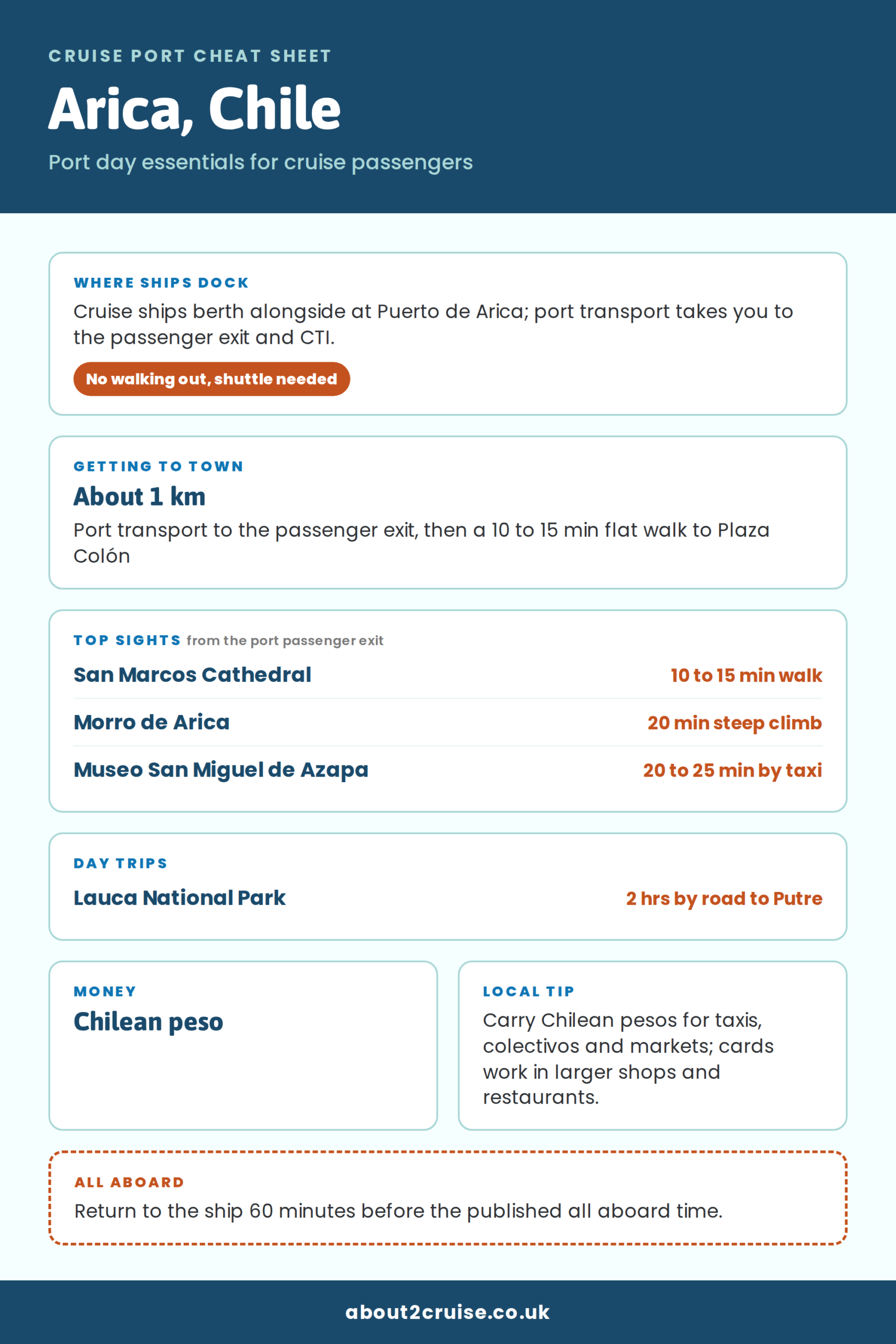
At Arica, cruise ships berth alongside inside the commercial Puerto de Arica, operated by Terminal Puerto Arica (TPA). Tendering is not normally needed. The port is ISPS-certified and secure, so passengers cannot just wander across the working quay. You will normally take port transport through the secure area from the gangway to the passenger exit and the Centro Turístico Integral, or CTI, the port’s cruise reception centre. The CTI has rest areas, free wi-fi, toilets and a regional craft and souvenir fair on cruise days.
The port and TPA offices use the address Av. Máximo Lira 389, Arica. There is no separate named passenger terminal number to look for; you will simply be directed to the Espacio Crucero/CTI area. Once you are outside the secure gate, Plaza Colón and the cathedral are about 10–15 minutes on foot. The route is roughly 1 km and flat, so most able-bodied passengers can walk in comfortably.
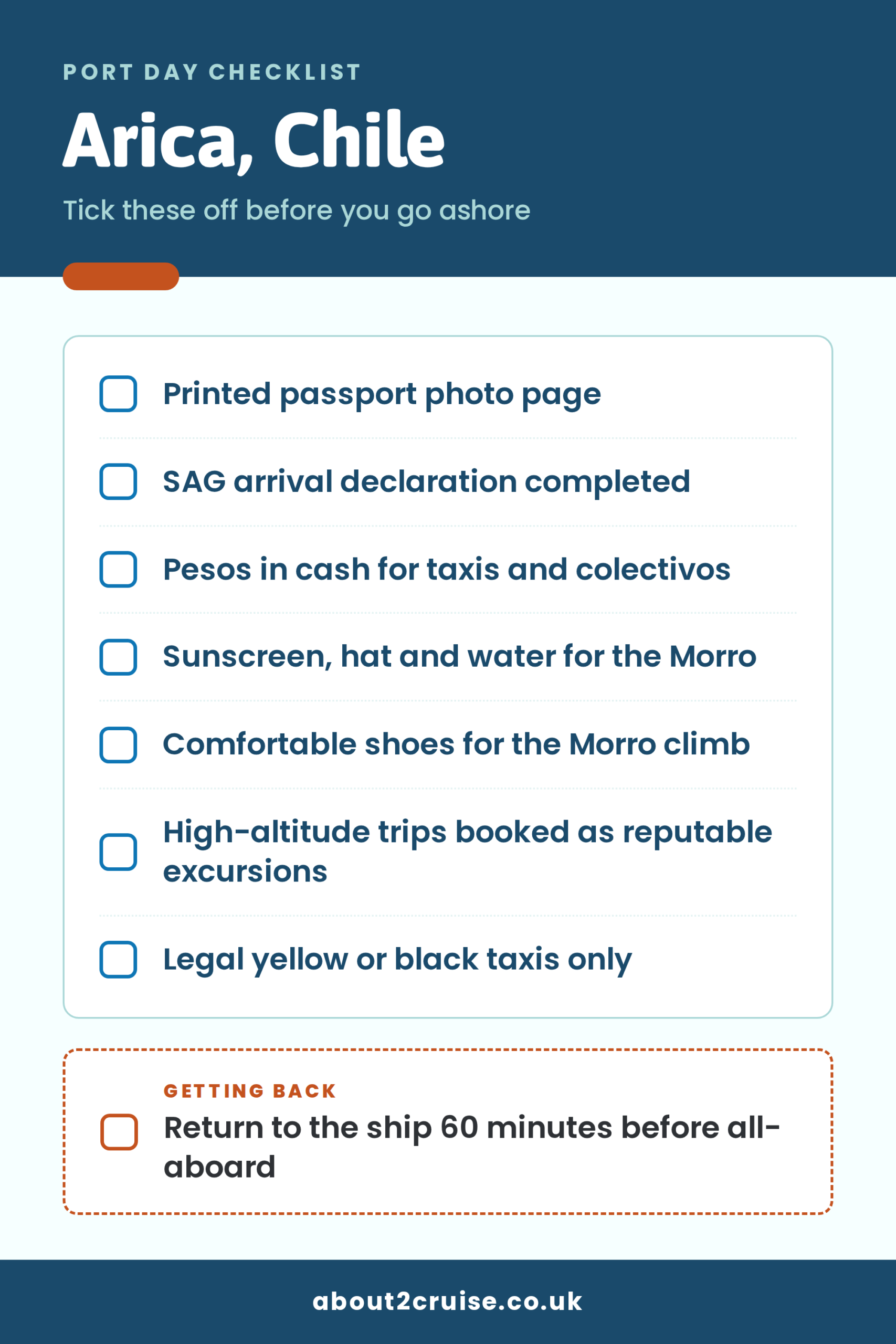
Taxis wait near the pier and port gate. Expect a short city hop to cost around 3,000–4,000 Chilean pesos. Shared taxis, called colectivos, run around 800 pesos cash. Uber also operates in the city, but the port advises using legal, regular taxis, which in Arica are yellow or black cars. A full self-guided city-and-Morro circuit is about 3.5–4.5 km in total, or 60–90 minutes of movement without stops. With cathedral, viewpoint and market stops, plan 2.5–3.5 hours. Always keep a 60-minute buffer back at the ship before the published all-aboard time.
Arica cruise port map
Ships dock at Arica cruise port. From there, Mercado Central is about a 7-minute walk, Plaza Colón about 10 minutes and San Marcos Cathedral about 10 minutes. Tap a pin for directions.
- Arica cruise portWhere ships dock
- Mercado CentralMarket · About 7 min walk from Arica cruise port
- Plaza ColónMain square · About 10 min walk from Arica cruise port
- San Marcos CathedralCathedral · About 10 min walk from Arica cruise port
- Paseo 21 de MayoPedestrian street · About 12 min walk from Arica cruise port
- Museo de Sitio Colón 10Mummy museum · About 14 min walk from Arica cruise port
- Morro de AricaClifftop viewpoint · About 15 min walk from Arica cruise port
- El Laucho beachBeach · About 30 min walk from Arica cruise port
- Ex AduanaFormer customs house · About 4 km from Arica cruise port
- Museo San Miguel de AzapaArchaeological museum · About 15 km from Arica cruise port
- Poblado ArtesanalCraft village · About 4 km from Arica cruise port
- La Lisera beachBeach · About 2 km from Arica cruise port
- Chinchorro beachBeach · About 3 km from Arica cruise port
Immigration, Customs and What Not to Bring Ashore
For UK citizens, Chile allows visa-free visits of up to 90 days. You’ll receive a tourist card, or tarjeta de turismo, on entry; keep it safe and hand it back when you leave the country. Your passport should be valid beyond the date you plan to depart Chile.
Every entry to Chile by air, land or sea requires the SAG sworn declaration. It can be completed online up to one day before arrival, and not declaring controlled goods can lead to fines. Do not bring fruit, seeds, plants, flowers, honey, meat, dairy products or natural-material crafts such as wood ashore. Chile operates a zero-tolerance policy on undeclared risk goods, though fines apply where information is concealed.
Carry a printed copy of your passport photo page ashore, and leave the original in the ship safe where possible. That gives you ID without risking the document if a bag is snatched or lost.
Money, Cards and Tipping in Arica
The local currency is the Chilean peso. Displayed prices include 19% IVA, so the price you see is what you pay. Notes run from 1,000 to 20,000 pesos; coins go down to 10 pesos. US dollars are rarely accepted for everyday spending, so carry pesos for taxis, colectivos, markets and small vendors. Cards are fine for sit-down meals and larger shops.
Banks, ATMs and exchange offices cluster along the pedestrian Paseo 21 de Mayo in the centre, including BancoEstado, Banco de Chile and Scotiabank branches. Restaurant tipping is voluntary, with 10% the usual recommendation. Taxis are not tipped in Chile.
Language and Communication: Spanish Basics for Your Port Day
Spanish is the local language, and English away from cruise staff, official guides and hotel reception is limited. Most taxi drivers are drivers, not guides, so don’t expect commentary or language assistance from a standard cab. A few phrases help: “Buenos días” (good morning), “por favor” (please), “gracias” (thank you), “¿Cuánto cuesta?” (how much?), “¿Dónde está…?” (where is…?) and “La cuenta, por favor” (the bill, please). For a fuller guided day, book a tour that separates guide from driver.
Weather, Sun Protection and What to Wear in Arica
Arica has a hot desert climate with negligible rain: as little as 2.3 mm across the whole year, and averages of about 8.5 hours of sunshine a day in January and February. Even when the air feels mild, UV is strong. Wear sunscreen, a hat and sunglasses, and carry water, especially for the exposed Morro climb or coastal walks. In the high Andes above 4,000 m, daily temperature swings can exceed 20°C, and the altiplano winter from December to March can bring rain, lightning and unstable roads. If you’re heading to Lauca, pack layers, a warm top and sun protection.


Safety and Port-Day Awareness in Arica
Pickpocketing, muggings and theft from vehicles are common throughout Chile, including at tourist sites, cafés, restaurants, hotel lobbies and transport hubs such as ports. Arica’s border-zone location has also seen security operations linked to irregular migration, so stay alert around the port and transport hubs. Do not resist a mugging; carry only a photocopy of your passport and limited cash.
Alcohol in public streets, squares and promenades is illegal. Open fires are illegal in national parks and can lead to removal from the country. In Chile’s far north, old minefields near the Peru and Bolivia borders may have ageing or hard-to-see warning signs: stick to marked roads and official paths.
The port warns that some online tour sellers have neither permits nor insurance to enter the port, and several operate unlicensed or unregistered. Use legal taxis or reputable booked transport. Public transport is not recommended by the port for cruise guests, partly because of reliability and partly because unlicensed operators target tourists.
A Self-Guided Walking Route from the Ship
Once through the port gate, make for Plaza Colón, the city’s main square about 10–15 minutes away on flat streets. On the plaza you’ll find the cathedral and the former customs house. Then walk the pedestrian street Paseo 21 de Mayo for ATMs, banks, arcades and local life. For lunch, continue to Mercado Central at Sotomayor 340, about 1.3 km or 15 minutes from the port.
After the centre, you have two choices for the Morro. The energetic option is the pedestrian staircase from Calle Cristóbal Colón by the Virgen del Carmen viewpoint, a steep 20-minute climb. The easier option is to take a taxi from the centre up Calle Rafael Sotomayor to the summit car park. From the centre, a taxi up is roughly 5,000 pesos one way or about 12,000 pesos return.
A sensible independent loop is: port exit → Plaza Colón and cathedral → Paseo 21 de Mayo → Mercado Central → Morro summit → back to the ship, with a 60-minute safety margin. Do not attempt this if it is exceptionally hot without water and a hat.
Morro de Arica: The Cliff-Top Viewpoint and War Memorial
The Morro is a rocky headland rising about 130–139 m over the city, port and beaches. The summit is open 24 hours with no access control, and it offers the classic panorama of Arica, the Pacific and the port. Late afternoon and sunset are the best times for photography.
At the top, the Museo Histórico y de Armas is a free war museum, open Tuesday to Sunday from 10:00 to 20:00, with continuous entry. The hill is also a National Monument tied to the War of the Pacific. The pedestrian staircase is steep, exposed and not accessible; the practical step-free route is to drive or take a taxi to the summit car park. There is no confirmed wheelchair-accessible path to the top.
The Morro’s flanks also contain geoglyphs linked to the UNESCO Chinchorro landscape, so even the roadside approach has archaeological context.
Chinchorro Mummies: Arica’s UNESCO Ancient Sites
Arica is the gateway to the Chinchorro culture, whose sites are UNESCO listed for settlement and artificial mummification. The Chinchorro mummies are up to about 2,000 years older than Egyptian mummification, with occupations dated from roughly 5450 BC to 890 BC. The three UNESCO components are Faldeo Norte del Morro de Arica and Colón 10 in the city, plus Desembocadura de Camarones about 100 km south.
For cruisers with only a port day, the two city-accessible highlights are:
- Museo de Sitio Colón 10, Cristóbal Colón 10: open Tuesday–Sunday 10:00–18:00, adult entry around 2,000 pesos. It preserves 48 mummified bodies in situ, in the burial positions they were found. The museum has wheelchair access and audio guides, but capacity is limited, so go early.
- Museo Universidad de Tarapacá (San Miguel de Azapa), Valle de Azapa km 12: open Tuesday–Sunday 10:00–17:00; adult 2,000 pesos, child 1,000 pesos; closed 1 Jan, 1 May, 18–19 Sep, 1 Nov and 25 Dec. This is the larger archaeological museum, 12–13 km inland. A taxi takes 20–25 minutes and costs roughly 12,000–15,000 pesos one way; a colectivo from Chacabuco/Patricio Lynch costs about 2,000 pesos.
The Faldeo Norte del Morro is the largest excavated Chinchorro cemetery, but it is an archaeological site rather than a display you can freely enter like a museum. A new Museo Antropológico San Miguel de Azapa is being built to house the main collection; until it opens, the university museum is the reliable visit.
San Marcos Cathedral and the Eiffel Workshop Story
The San Marcos Cathedral, address Bolognesi 170, faces Plaza Colón. It is an iron-framed, pre-fabricated church designed and manufactured in the workshops of Eiffel et Cie in France. The structure reached Arica in 1875 and was assembled by French technicians. It had originally been ordered by the Peruvian government for the resort of Ancón, but after the 1868 earthquake destroyed Arica’s parish church, it was redirected here and dedicated in 1876. It became a cathedral in 1959 and was declared a National Monument in 1984.
The former customs house, the Ex Aduana at San Marcos 251, now a cultural centre, is by the same French firm. Both are flat, central and easy to add to a Plaza Colón walk.
Beaches, Surf and Pacific Coast Leisure in Arica
Arica’s three bathing beaches are La Lisera, El Laucho and Chinchorro. Each has a distinct character:
- El Laucho sits at the foot of the Morro and has calm swell, toilets, changing rooms, lifeguards all year, 24-hour access control, CCTV, safety buoys and a first-aid room. It is one of Chile’s inclusive beaches, with amphibious chairs and non-sinking walking sticks.
- La Lisera is a sheltered horseshoe cove with little swell, children’s play equipment, restaurant and bars nearby, and good snorkelling. It is the family beach.
- Chinchorro has about 1,700 m of beachfront with constant swell, plus surf and bodyboard schools along the shore. It is better for active beachgoers than for nervous swimmers.
El Gringo, off the ex-Isla Alacrán, is a serious surf spot that breaks over rock and sea urchins. It hosts international surf and bodyboard events and is rated for professional-level surfers only. For casual swimming, stick to the three supervised beaches. There are no published cruise-day lifeguard hours or water-quality bulletins quoted here, so look for flags and local advice before entering the water.
Lauca National Park and Altiplano Day Trips: The Big Decision
Lauca National Park is one of the most spectacular landscapes in northern Chile, but it is not an easy casual excursion from a ship. Arica to Putre is roughly 125–130 km on Ruta 11-CH, about two hours by road. Putre sits at about 3,500 m; Lago Chungará is above 4,500 m; and the Parinacota and Pomerape volcanoes rise above 6,000 m. A day tour climbs from sea level to well over 4,500 m in a few hours, which creates real altitude-sickness risk. UK travel-health guidance is clear: avoid going from below 1,200 m to above 3,500 m in a single day. Spending a night at Putre first is the recommended way to reduce the risk.
The Chungará lakeshore sector has been closed indefinitely since a truck spilled soybean oil there. Other sectors may remain open, but you must check with the CONAF office in Putre, Teniente del Campo 301, before heading up. The park is free, open Tuesday to Sunday, and is reached only via the Arica–La Paz international highway. There are no fuel stations on the route, so fill up in Arica if driving.
If you want to see the Altiplano, do it as a ship-sponsored or reputable pre-booked excursion, with a hard look at your port timings. A long high-altitude day trip is the single easiest way to miss the ship or to spend the afternoon feeling ill. If this is your only Arica call, the city and Azapa valley offer a much safer, richer port day for most cruisers.
Food, Drink and Markets Worth Seeking Out in Arica
Azapa olives are the region’s signature product: large, fleshy, sold green, often labelled “amarga” or “sin amargo”, and protected with a Sello de Origen geographical indication. A traditional Arican breakfast is marraqueta bread with butter and an Azapa olive, washed down with hierba luisa tea. Other local dishes to look for include arroz moreno, picante de gallina, mondongo, guatía, chancho adobado, calapurca, sango and picarones.

Good places to eat near the port include Mercado Central at Sotomayor 340, about 1.3 km or 15 minutes’ walk from the port via Plaza Colón and Paseo 21 de Mayo, with set lunches typically 4,000–8,000 pesos, and Mercado Colón in the centre. Terminal Agropecuario Asoagro, Panamericana Norte 3501, has 600-plus stalls with tropical fruit, olives, marisquerías, Afro-Chilean recipes and Bolivian salteñas. Seafood restaurants line the southern beaches around La Lisera. Regional drinks include Pintatani wine from the Codpa valley and tropical fruit juices such as mango, guava and passion fruit.
Shopping and Souvenirs in Arica
The CTI at the port hosts a craft and souvenir fair with regional producers on cruise days, so you can shop before you even leave the secure area. In town, Poblado Artesanal at Hualles 2825 is a craft village modelled on Parinacota, selling textiles, alpaca knitwear, leather and ceramics; it is open Tuesday–Sunday 10:00–13:30 and 15:00–20:00. Paseo 21 de Mayo and its arcades have souvenir and craft stalls, and Plaza Colón often has a market in front of the cathedral. Shops commonly close for lunch and pick up again after about 18:00.
Ship Excursions vs Local Operators in Arica
Arica’s port cruise desk hosts tour operators and regional micro-businesses at the CTI on call days, so there is some official selection available ashore. For Lauca, Azapa and high-Andes trips, book through a reputable organised excursion; the distance and altitude make it unwise to improvise with an unknown driver. Sea caves and out-of-town sites also need pre-arranged transport, not public buses. The port itself warns that some online sellers lack permits and insurance, and those operators must start at the port gates rather than coming onto the quay. If you pre-book independently, confirm they can meet you at the gate or CTI.
Port-Call Timing and the All-Aboard Buffer
Arica calls are usually full-day alongside, with a common pattern around 07:00–18:00, but always check your ship’s published time. This is not a port for cutting it fine. Return to the ship on ship’s time, not local time if they differ, and keep a 60-minute buffer. Long excursions, especially anything heading uphill to Putre or Chungará, should only be done as a ship excursion if the ship is waiting, or with a reputable operator that gives a crew-friendly return schedule. If an excursion is running late, you need to know whether the ship will wait: normally it waits only for its own organised tours.
If Arica Is Your Embarkation or Disembarkation Port
If you are joining or leaving a cruise in Arica, Chacalluta International Airport is about 18 km or 20 minutes from the city. Airport taxis to the centre are quoted at roughly 8,000–12,000 Chilean pesos. There is no published official cruise parking or park-and-cruise product at Arica, and no confirmed left-luggage facility at the port or airport, so plan to keep bags with you or use your hotel. Hotels near the port used by visitors include Antay Hotel & Spa about 700 m away, Hotel Samaña about 550 m, Hotel Gavina Express about 750 m, and Panamericana Hotel Arica or Novotel Arica about 2 km from the terminal.
If you are on a South America itinerary that also calls at central Chile, check the Valparaiso (Santiago) Cruise Ship Port Guide and San Antonio (Chile) Cruise Ship Port Guide.
Connectivity, Wi-Fi and Staying Reachable in Arica
The CTI at the port has free wi-fi, so you can check messages and maps before venturing out. 4G mobile coverage is available in the city, but roaming and coverage vary by UK network. Download offline maps and port notes before leaving the ship, and carry a power bank if you will be using your phone heavily for navigation and photos.
Accessibility and Mobility Notes for Arica
The dock area and CTI are generally wheelchair accessible, with tourist information and souvenir shopping at the dock. Both the Museo de Sitio Colón 10 and the San Miguel de Azapa museum have step-free access, accessible toilets and accessible routes. The Morro’s pedestrian staircase is not accessible and is steep and exposed; the practical option for those with limited mobility is to take a vehicle to the summit car park. Pre-book accessible vehicles rather than assuming availability at the pier. The city centre around Plaza Colón and Paseo 21 de Mayo is flat and manageable for most wheelchairs, though pavements may be uneven.
Family-Friendly Things to Do in Arica
La Lisera is the family beach thanks to its sheltered, swell-free water and children’s play equipment. El Laucho has inflatable water games, lifeguards, CCTV and a first-aid room. The Morro war museum is free, and both Chinchorro museums have child pricing at San Miguel de Azapa. Cruise calls sometimes include staged Carnival with the Force of the Sun performances at Parque Vicuña Mackenna, which can be a lively, family-friendly cultural intro. Keep children close around roads and markets, and carry water and sunscreen.
Before you sail
- Complete the SAG sworn declaration online up to one day before arrival.
- Book high-altitude Lauca or Azapa trips only through reputable operators or the ship.
- Carry a printed copy of your passport photo page, not the original.
Short port day: under 6 hours
- On dockingTake the port transportNo walking outShips berth inside the secure commercial port, so you cannot walk the quay. Port transport takes you to the CTI and the passenger exit.
- +15 minPlaza Colón and San Marcos CathedralA 10 to 15 minute walk from the passenger exit. The iron-framed cathedral was built in the workshops of Eiffel et Cie and faces the main square.
- +45 minPaseo 21 de Mayo and Ex AduanaWalk the pedestrian street for ATMs, banks and arcades, then see the former customs house by the same French firm.
- +1 hr 30 minLunch at Mercado CentralTry local dishesAbout a 15 minute walk from the centre. Look for picante de gallina or arroz moreno with Azapa olives, the region's signature.
- +2 hrs 45 minMorro de Arica viewpointTaxi up to save timeTake a taxi from the centre up to the summit car park, or climb the steep staircase from Calle Cristóbal Colón in about 20 minutes.
- All-aboard minus 60 minBack at the shipReturn with a 60-minute buffer. If taxis are scarce, allow extra time to walk the flat route back.
The time on the map is the whole walk, every stop added together.
Open this walking route in Google Maps
If plans change: If the Morro climb is too much, stay in the flat centre and visit Colón 10 and the CTI craft fair instead.
Long port day: 8 hours or more
- On dockingTake the port transportKeep passport copyPort transport runs from the gangway to the CTI and passenger exit because the quay is secure. Carry only a printed passport photo page.
- +15 minMuseo de Sitio Colón 10Limited capacityCentral museum with 48 Chinchorro mummies preserved in situ. Go early; daily capacity is limited and it opens at 10:00.
- +1 hrPlaza Colón and San Marcos CathedralA short walk from Colón 10. See the Eiffel-workshop cathedral and the former customs house, then walk the pedestrian Paseo 21 de Mayo.
- +2 hrs 30 minLunch at Mercado CentralTry Azapa olivesAbout a 15 minute walk from the centre. Order arroz moreno or picante de gallina, and look for Azapa olives on the market counters.
- +4 hrsMorro de Arica viewpoint and war museumTaxi or steep climbTake a taxi to the summit car park or climb the staircase from Calle Cristóbal Colón. The free war museum is open Tuesday to Sunday.
- +5 hrs 30 minEl Laucho beachWalk down to the beach at the foot of the Morro for a swim or a rest. It has lifeguards, toilets and a first-aid room.
- All-aboard minus 60 minBack at the shipAllow a 60-minute buffer from El Laucho or the centre. Legal taxis are yellow or black; Uber is available but the port advises legal taxis.
The time on the map is the whole walk, every stop added together.
Open this walking route in Google Maps
If plans change: If Colón 10 is full, swap it for the San Miguel de Azapa museum by taxi and keep the rest of the city loop.
Photo Spots and Camera Safety in Arica
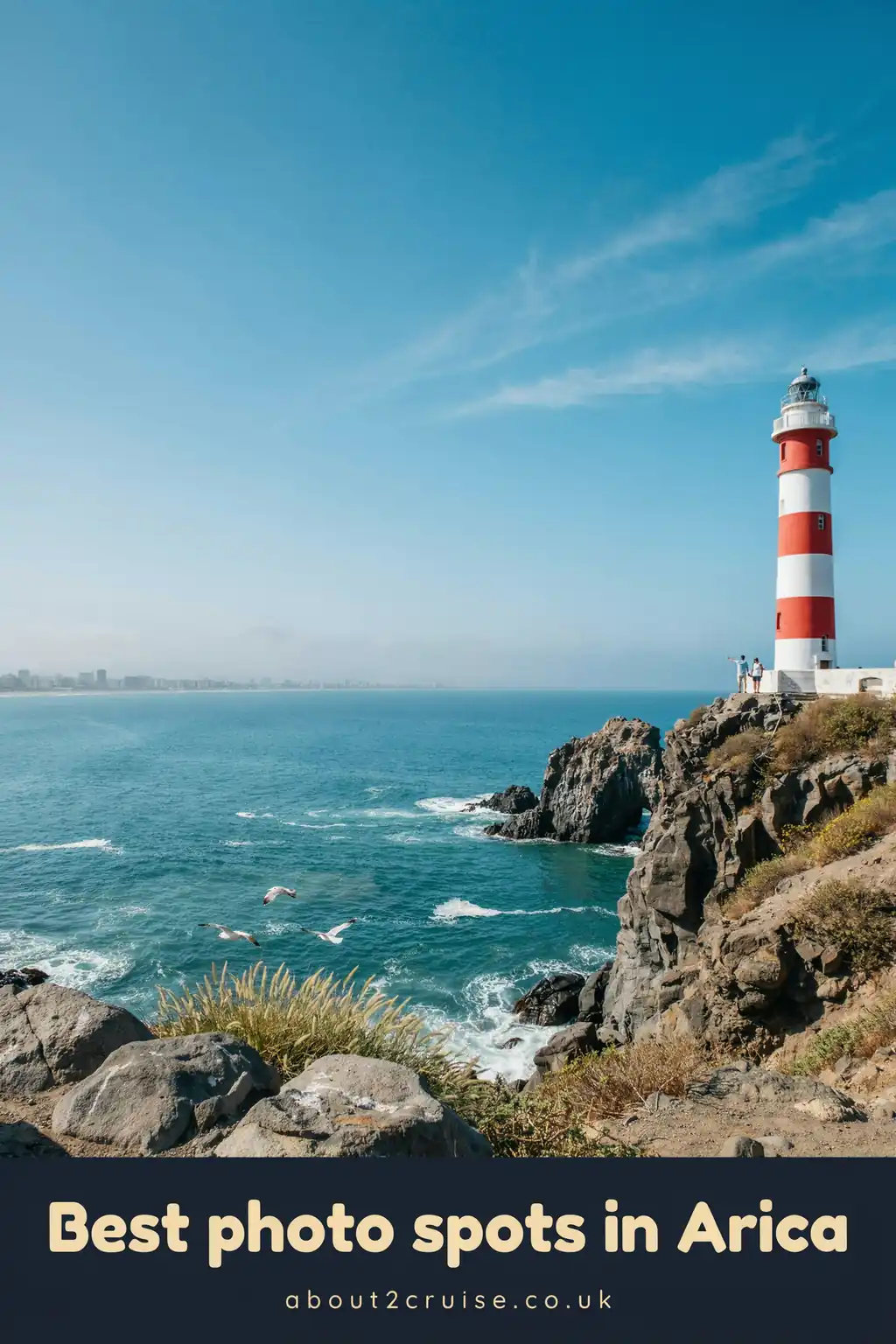
The Morro summit is the classic shot for the whole city, port and beach panorama, and late afternoon is the best light. Chinchorro’s 1,700 m costanera offers beach and surf photos. Cuevas de Anzota sea caves, about 12 km south, sit on a maintained coastal path with cliffs and archaeological landscapes. The Presencias Tutelares sculptures are about 27 km south at Ruta 5 Norte with Ruta A-31, and the Azapa valley has geoglyphs on the road to the museum.
Cameras and phones are prime targets for thieves in Chile. Avoid obvious displays on straps, don’t leave bags on chair backs or phones on café tables, and keep gear out of open tote bags in crowded areas. A cross-body bag worn to the front is safer than a backpack for a port day.
Emergency Contacts and Backup Plans for Arica
In an emergency, call 133 for Carabineros, the Chilean police, and 131 for SAMU ambulance. The nearest high-complexity hospital is Hospital Regional de Arica Dr. Juan Noé Crevani, 18 de Septiembre 1000, with a 24-hour emergency department; telephone +56 58 2204592. If you have a medical issue, get to the hospital or back to the ship’s medical team depending on severity. If you miss the ship, contact the port agent; this is another reason to carry a printed copy of your passport photo page and keep emergency numbers accessible.
Official Port Info and Useful Sources for Arica
The official cruise page is puertoarica.cl/cruceros, published by Terminal Puerto Arica/Empresa Portuaria Arica, but it is in Spanish. That page carries the official cruise calendar by ship, agency and line, and describes the CTI and secure port set-up. The SAG sworn declaration can be completed through sag.gob.cl up to one day before arrival. There is no dedicated official English-language cruise page for Arica, so use your browser’s translation tool or save key screenshots before going ashore.
Our Chile cruise ports guide covers the other ports in the region.
Quick FAQs for Arica Cruise Days
- Is there left luggage at Arica port or airport?
There is no published left-luggage or bag-storage service at the port/CTI, and sources conflict on whether Chacalluta airport has lockers. Pack a day bag and don’t plan to store luggage before a flight or after the ship. - Can I use Uber or public buses from the port?
Uber operates in the city, but the port itself advises cruise guests to use legal yellow or black taxis rather than public transport. Colectivos are a cash-only shared-taxi option, but they may be less predictable for first-time visitors. - Do I need to book the Chinchorro museums in advance?
No official timed-ticket or booking page is published, but Colón 10 has limited daily capacity. If it is a priority, go early in the day rather than treating it as an afterthought. - Will the ship wait if my Lauca day trip runs late?
Normally a ship waits only for its own organised shore excursions. If you book independently, you must build in your own buffer and confirm the operator’s drop-off time is comfortably before all-aboard. - Is it safe to swim at Arica’s beaches on a port day?
The three designated bathing beaches are La Lisera, El Laucho and Chinchorro. Look for lifeguard flags and local advice; El Gringo is a professional-level surf spot and not for swimming.