
Baltra is the main Galápagos expedition-cruise gateway: you fly into Seymour Ecological Airport, clear national-park permits and biosecurity, then cross the Itabaca Channel and board your ship by panga. Most time ashore is on Santa Cruz, especially Puerto Ayora, where close wildlife encounters happen under strict park rules.
Baltra vs Santa Cruz vs Puerto Ayora: Don’t Mix Up These Three Names
These three names confuse a lot of first-time cruisers. Baltra is a small, flat island just north of Santa Cruz. Santa Cruz is the large island with most of the tourist infrastructure. Puerto Ayora is the main town on Santa Cruz’s south coast, facing Academy Bay.
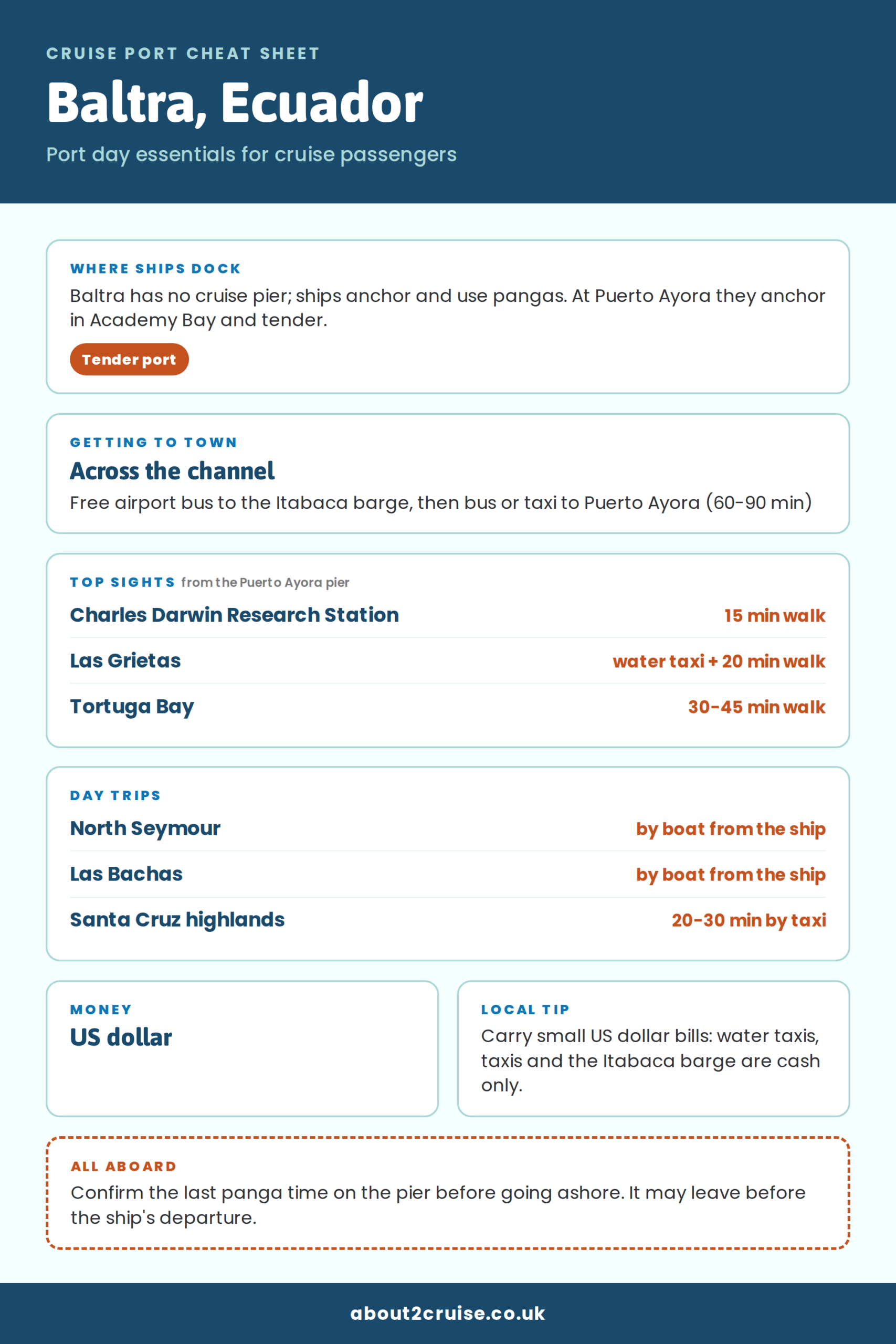
They are not the same place, and you cannot walk between Baltra and Santa Cruz: they are separate islands divided by the Itabaca Channel, which is only about 150 metres wide. Ships do not dock pier-side at either island. If you start in Baltra, you meet the ship near the airport and board by tender. If your ship calls at Puerto Ayora, it anchors in Academy Bay and pangas take you to the town pier.
Some Galápagos itineraries begin or end at Puerto Baquerizo Moreno on San Cristóbal instead, so make sure the airport, ship route and booking all match.
Baltra cruise port map
Tenders bring you ashore at Muelle de Pasajeros, Puerto Ayora. From the Puerto Ayora pier, Puerto Ayora Fish Market is about a 3-minute walk, Las Grietas about 19 minutes and Charles Darwin Research Station about 20 minutes. Tap a pin for directions.
- Muelle de Pasajeros, Puerto AyoraWhere tenders land
- Puerto Ayora Fish MarketFish market · About 3 min walk from the Puerto Ayora pier
- Laguna de las NinfasLagoon · About 8 min walk from Muelle de Pasajeros, Puerto Ayora
- Playa de los AlemanesBeach · About 10 min walk from Muelle de Pasajeros, Puerto Ayora
- Puerto Ayora Bus TerminalBus terminal · About 13 min walk from Muelle de Pasajeros, Puerto Ayora
- Playa de la EstaciónBeach · About 16 min walk from Muelle de Pasajeros, Puerto Ayora
- Las GrietasCrevices · About 19 min walk from the Puerto Ayora pier
- Charles Darwin Research StationResearch station · About 20 min walk from the Puerto Ayora pier
- Tortuga BayBay · About 58 min walk from the Puerto Ayora pier
- Los GemelosSinkholes · About 16 km from the Puerto Ayora pier
- Rancho PrimiciasTortoise ranch · About 16 km from the Puerto Ayora pier
- Seymour Ecological AirportAirport · About 33 km from Muelle de Pasajeros, Puerto Ayora
- El Chato Tortoise ReserveTortoise reserve · About 16 km from Muelle de Pasajeros, Puerto Ayora
- Playa El GarrapateroBeach · About 12 km from Muelle de Pasajeros, Puerto Ayora
- Cerro Mesa Ecological ReserveEcological reserve · About 12 km from Muelle de Pasajeros, Puerto Ayora
- Isla CaamañoIsland · About 4 km from Muelle de Pasajeros, Puerto Ayora
- Las Bachas BeachBeach · About 28 km from Muelle de Pasajeros, Puerto Ayora
- North Seymour IslandIsland · About 39 km from Muelle de Pasajeros, Puerto Ayora
What Baltra Island Is Really Like
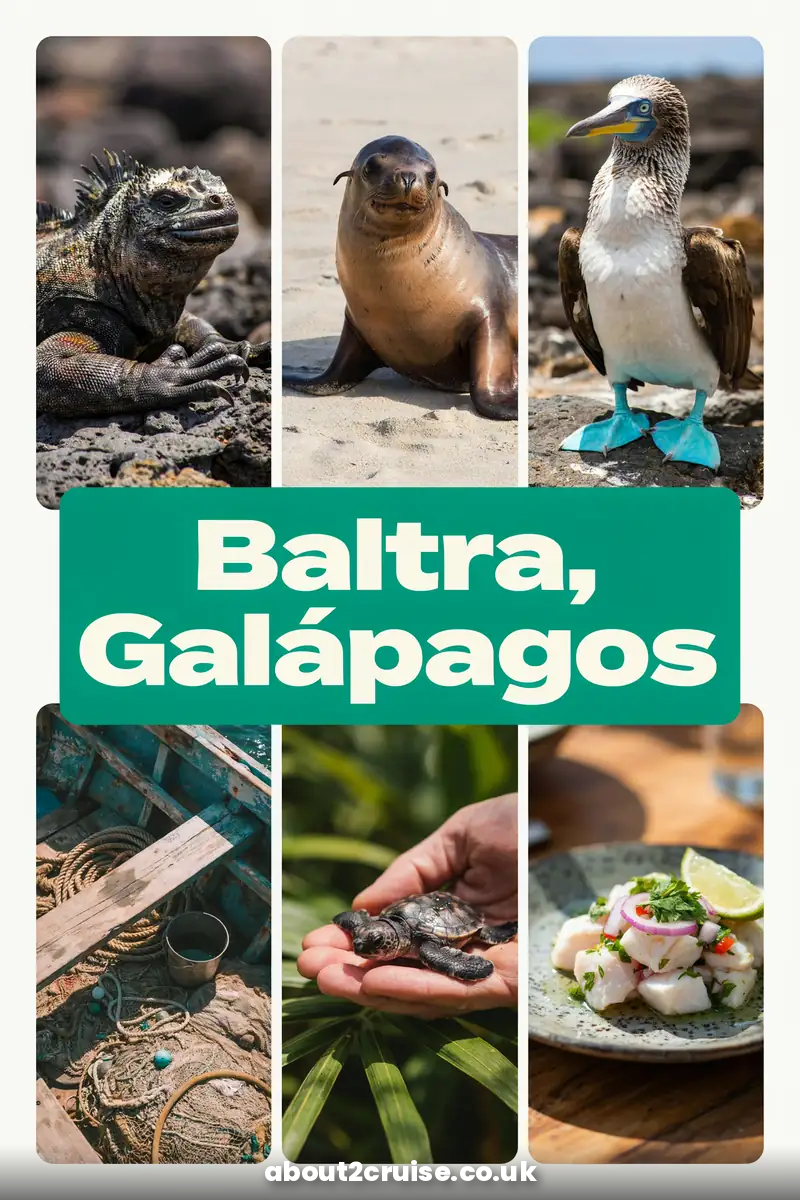
Baltra is essentially a transit strip. It has no town, no hotels and no visitor attractions beyond the airport, a small café, a gift shop and wildlife around the edges. Land iguanas sometimes graze near the terminal, marine iguanas perch on the rocks, and sea lions and seabirds use the Itabaca Channel.
Baltra was a US Army air base during the Second World War and was returned to Ecuador in 1946. Today it is best treated as a place you pass through, not a shore destination. It is also the only island in the archipelago that is not part of the national park. There is no left-luggage facility at the airport, no public car park and no car-hire desk, so do not plan to store bags or pick up a vehicle on Baltra.
North Seymour and Las Bachas, two classic landing sites, are reached by boat, not from Baltra’s shore. If your itinerary includes Las Bachas on the first or last afternoon, you will go by panga from the ship, not by land.
Arriving at Seymour Ecological Airport: Step by Step
Flights use LATAM or Avianca from Quito and Guayaquil. Guayaquil to Baltra takes about 1.5 hours; Quito flights usually stop in Guayaquil and take roughly 2.5 hours total.
On arrival you leave the aircraft, clear biosecurity hand-luggage inspection, pay or show proof of the national park entry, collect checked bags, and meet your cruise line’s naturalist guides. Cruise lines almost always meet guests at the airport: some lines, including Celebrity, begin boarding at the airport from 12:00 Galápagos time and ask guests to arrive an hour earlier.
Independent travellers take the free airport bus about ten minutes to the Itabaca Channel, cross by barge, and then pick up a bus or taxi on the Santa Cruz side. Expect baggage limits around one checked bag of 23 kg and one carry-on of 10 kg. Luggage travels on the barge roof, so pack essential medicines, documents and valuables in your hand baggage. There are no taxis at Baltra airport; taxis wait on the Santa Cruz side of the channel.
Galápagos Permits, Fees and Biosecurity: What You Pay and Bring
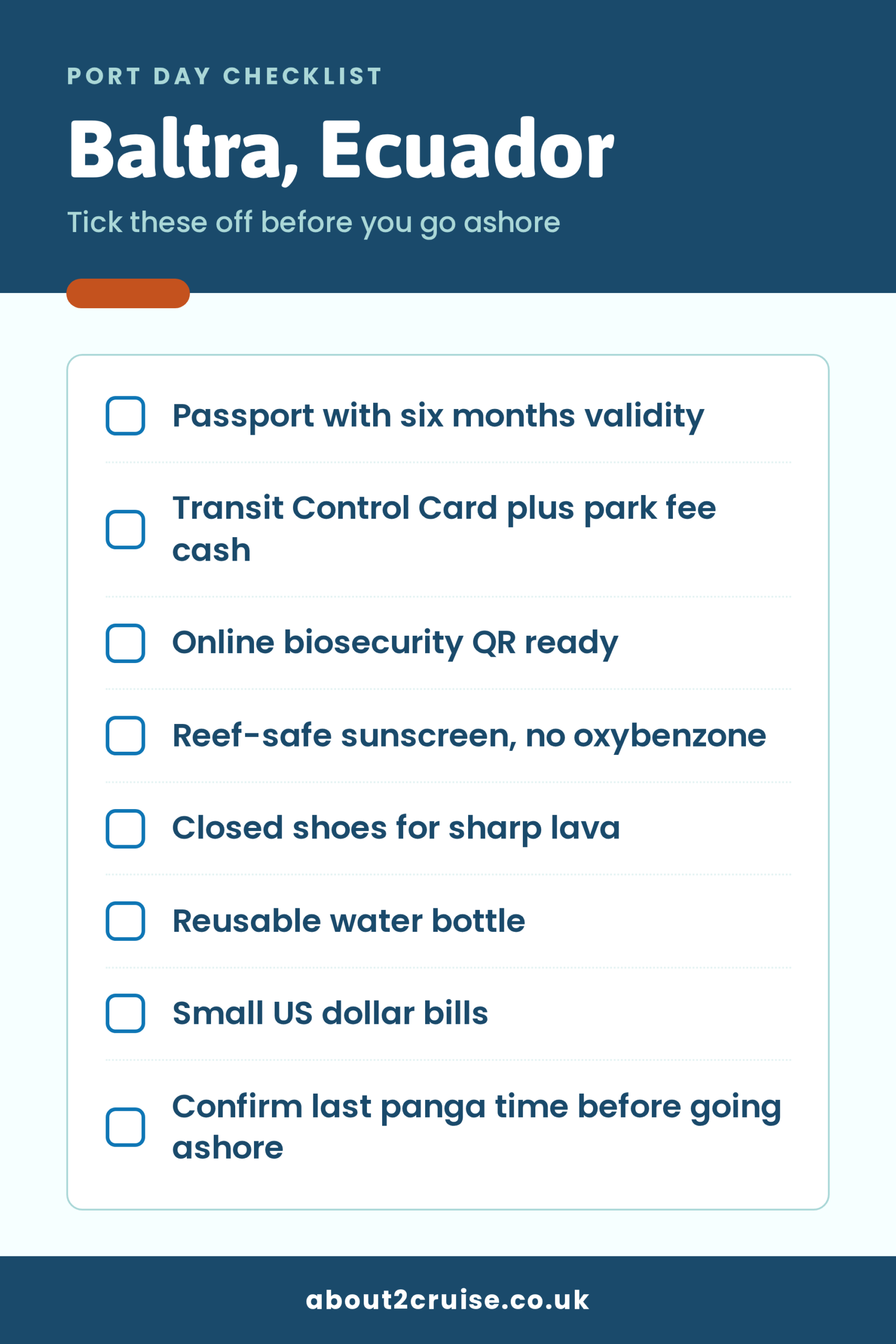
You need two documents beyond your passport: a Transit Control Card and the Galápagos National Park entry. The TCT costs US$20 per person and is obtained online before flying, then collected at the Consejo de Gobierno counters at Quito or Guayaquil airports. Under-2s are free.
The park fee is US$200 for most foreign visitors over 12, US$100 for foreign children under 12, and lower for Andean Community/Mercosur nationals and Ecuadorian residents. Have cash to avoid credit-card surcharges. Keep both documents until you leave the islands.
On some cruise-only fares the park fee is reimbursed on board, but you should still be prepared to pay on arrival unless your line confirms otherwise.
All bags must pass Galápagos Biosecurity Agency inspection on the mainland before airline check-in, and hand luggage is checked again at Baltra. The old paper declaration has been replaced by an online system: every passenger over 18 completes it before flying and shows the QR code or registration number on arrival. Prohibited items include soil, sand, live animals, fresh flowers, soft cheese, fresh milk and certain fruits. Processed foods such as roasted nuts and dried fruit are normally allowed. Single-use plastics, including plastic bags and bottles, are banned, so carry reusable bottles and avoid plastic-wrapped snacks where possible.
How to Get From Baltra Airport to Puerto Ayora
The full airport-to-Puerto-Ayora chain takes 60–90 minutes door to door. Take the free airport bus to the Itabaca Channel, cross by passenger barge (about ten minutes, around US$1.50 cash), then either catch the local bus to Puerto Ayora (about 45 minutes, roughly US$2) or take a white double-cab taxi for about US$25 per vehicle for four passengers. If a cruise line is handling your transfer, the process is smoother because guides escort you and your luggage is moved for you.
Once in Puerto Ayora, walking is the default. The main street is Avenida Charles Darwin. Taxis within town cost about US$1.50. Water taxis from the municipal pier run 24 hours, callable on VHF channel 14, and charge about US$1.50 per person by day and US$2 after 19:00. Public buses serve the road between Puerto Ayora and the Itabaca Channel, and bicycles can be rented for highland rides.
How Expedition Cruising Works in Galápagos
There is no traditional cruise terminal on Baltra and no dock big ships can use at Puerto Ayora. Ships anchor offshore and you are moved in pangas, the local name for inflatable tender boats. A wet landing means stepping into ankle- or knee-deep water and wading ashore; a dry landing means stepping directly from the panga onto rock or a small pier. The naturalist guide and panga driver steady you each time.
Land visits run in groups of up to 16 people with a park-accredited naturalist guide. The national park assigns each ship a visiting route, so sites are never crowded with multiple ships at once.
Depending on the site you may find blue-footed boobies, marine iguanas, sea lions, frigatebirds and giant tortoises at close range, but only because the rules keep the encounters predictable and low-impact. The moment you step ashore at a protected site, you are under park rules: stay on marked trails, keep at least 2 m from wildlife, never chase or touch animals, and use no flash photography. Drones are not allowed without prior park authorisation, and recreational drone use is prohibited. The islands are shield volcanoes built over a hotspot, which is why the highlands are far greener than the coast and the shoreline is sharp lava.
The routine will feel familiar if your voyage also calls at Isabela Island, although each island has different landing surfaces and resident wildlife.
Puerto Ayora as a Tender Port: What Happens When You Go Ashore
Ships calling at Santa Cruz anchor in Academy Bay and run pangas to the Muelle de Pasajeros in the centre of town, officially the Muelle Municipal de Pasajeros Gus Angermeyer. The pier is on Avenida Charles Darwin at Avenida Baltra and is open 24 hours. It is not a cruise terminal in the usual sense: it is a working town pier where sea lions haul out and, after dark, reef sharks often gather under the lights. There are public toilets opposite the pier and a waterfront lined with cafés, restaurants, dive shops and tour agencies.
The pier is also where water taxis take passengers out to anchored boats and tours. No public schedule publishes the last panga time for every ship, so confirm the final boarding and the exact meeting point on the pier before you leave the ship. It may be earlier than the ship’s departure time. The town is compact and safe to explore on foot, but give yourself a buffer for the panga ride back.
Seeing Giant Tortoises in the Santa Cruz Highlands
The highlands are the easiest place to see giant tortoises wandering outside a breeding centre. El Chato reserve is about 22 km or 20–30 minutes by taxi from Puerto Ayora. It charges about US$10 per person including a reserve guide, lends rubber boots and has a walkable lava tunnel on site. Nearby Rancho Primicias and Rancho El Manzanillo offer similar tortoise ponds and tunnels; Rancho Primicias can be walked self-guided for about US$5. Los Gemelos, two fern-lined roadside sinkholes, are free and usually combined with a tortoise stop.
A half-day taxi loop with the driver waiting at each stop costs about US$40–50 per vehicle for up to four passengers, plus entry fees. Guided highland tours booked in town cost roughly US$20–80 per person. The highlands are cooler and much wetter than the coast, so carry a light rain layer even when Puerto Ayora looks bright.
Charles Darwin Research Station and the Tortoise Breeding Centre
Charles Darwin spent five weeks aboard HMS Beagle in 1835, and the observations he made helped lead to On the Origin of Species. The Charles Darwin Research Station, founded in 1964, is the working centre of that scientific story. It sits at the eastern end of Puerto Ayora, about a 15-minute walk from the pier along Avenida Charles Darwin. The main campus and exhibition areas are free and open daily from 08:00 to 18:00.
The breeding centre, also called the Fausto Llerena centre or Ruta de la Tortuga, is a guided circuit costing about US$10 per person. Under current visitor rules it requires a timed reservation through the national park booking system, so arrange this through your ship or a local agency rather than just turning up. Allow 90 minutes to two hours. The paths are flat but hot in places. This is where you see hatchlings up to the giant adults and the programme that helped save the Española tortoise.
Tortuga Bay and Las Grietas: Two Easy Day Trips on Foot
Tortuga Bay is a free-access park site at the end of Charles Binford. Sign in at the ranger hut, then walk 2.5 km on a paved path, about 30–45 minutes each way with little shade. No guide or ticket is needed. Swimming is forbidden on the exposed Playa Brava because of strong currents; the sheltered Playa Mansa is the swimming beach. The path is open 06:00–18:00. The boat service between Puerto Ayora and Playa Mansa is currently suspended for safety reasons, so plan on walking both ways unless your expedition line arranges something specific.
Las Grietas is a lava fissure filled with clear water. Reach it by water taxi from the municipal pier to Punta Estrada, then a 20–25 minute walk over uneven ground. Entry costs US$10 per person with a mandatory naturalist guide, paid in cash. It also requires a timed reservation, so book before you go. Allow 2.5–3 hours round trip. There are no changing rooms, no food or water for sale, and sharp lava on the final stretch, so wear closed shoes and carry water. Food is not allowed into the protected area.
Snorkelling and Diving in Galápagos: What to Expect
Most expedition lines include snorkel sessions once or twice a day, either from a beach or straight from the panga. Water temperatures run roughly 23–27°C in the warm season and 18–22°C in the cool season, and western sites can be colder. Most boats loan mask, snorkel, fins and wetsuits, but mask fit is the most common complaint, so bringing your own mask solves the main problem. Flotation vests are usually available and guides are in the water. Expect sea turtles, reef fish, marine iguanas feeding near rocks and, on good days, rays and playful sea lions. Sunscreens containing oxybenzone or octinoxate are restricted, so use reef-safe alternatives.
Weather, Sea Conditions and Seasickness in Galápagos
The warm season runs December to May: afternoon highs about 28–31°C, sea 23–26°C, with short heavy showers. February is usually the wettest month. The cool, dry garúa season from June to November brings highs of 24–27°C, sea down to about 21.5°C, more cloud and stronger breeze. The highlands are much wetter and cooler than the coast.
Currents peak between August and October, and choppy inter-island crossings are common from July to December. Morning crossings are usually calmer than afternoon ones. If you get seasick, start medication before the first panga ride and choose a mid-ship cabin area when possible. The sun here burns quickly even under cloud, so reapply sunscreen more often than you think.
What to Pack for a Galápagos Cruise
Pack neutral-coloured layers, a light rain jacket, a wide hat, sunglasses, high-factor reef-safe sunscreen, a small daypack and a waterproof bag for cameras. Sturdy closed shoes with real tread are the most important item for rocky trails; lava is sharp, uneven and slippery when wet. Add wet/dry shoes or sports sandals for wet landings and beaches. Snorkel gear is usually provided, but a small dry bag for your phone and daily medicines is useful. Dinner is resort casual on the ships; there is no formal night. Single-use plastic is restricted, so a reusable water bottle is essential.
Money, Cards, ATMs and Tipping in Puerto Ayora
Ecuador uses the US dollar. Merchants often refuse US$100 bills, so carry small notes and dollar coins. Credit cards work at hotels, larger restaurants, supermarkets, dive shops and some agencies, but often with a 5–10% surcharge. Water taxis, taxis, small eateries and tips are cash only.
Puerto Ayora has the best ATM coverage in the islands, including Banco del Pacífico and Banco Pichincha machines, but they can run out of cash at busy times. The usual Galápagos cruise tipping guideline is US$10–20 per guest per day for the naturalist guide and the same pooled for the crew, roughly US$150–300 per guest for a seven-night trip in cash. Some lines include gratuities, so check before handing over envelopes.
Food and Drink in Puerto Ayora
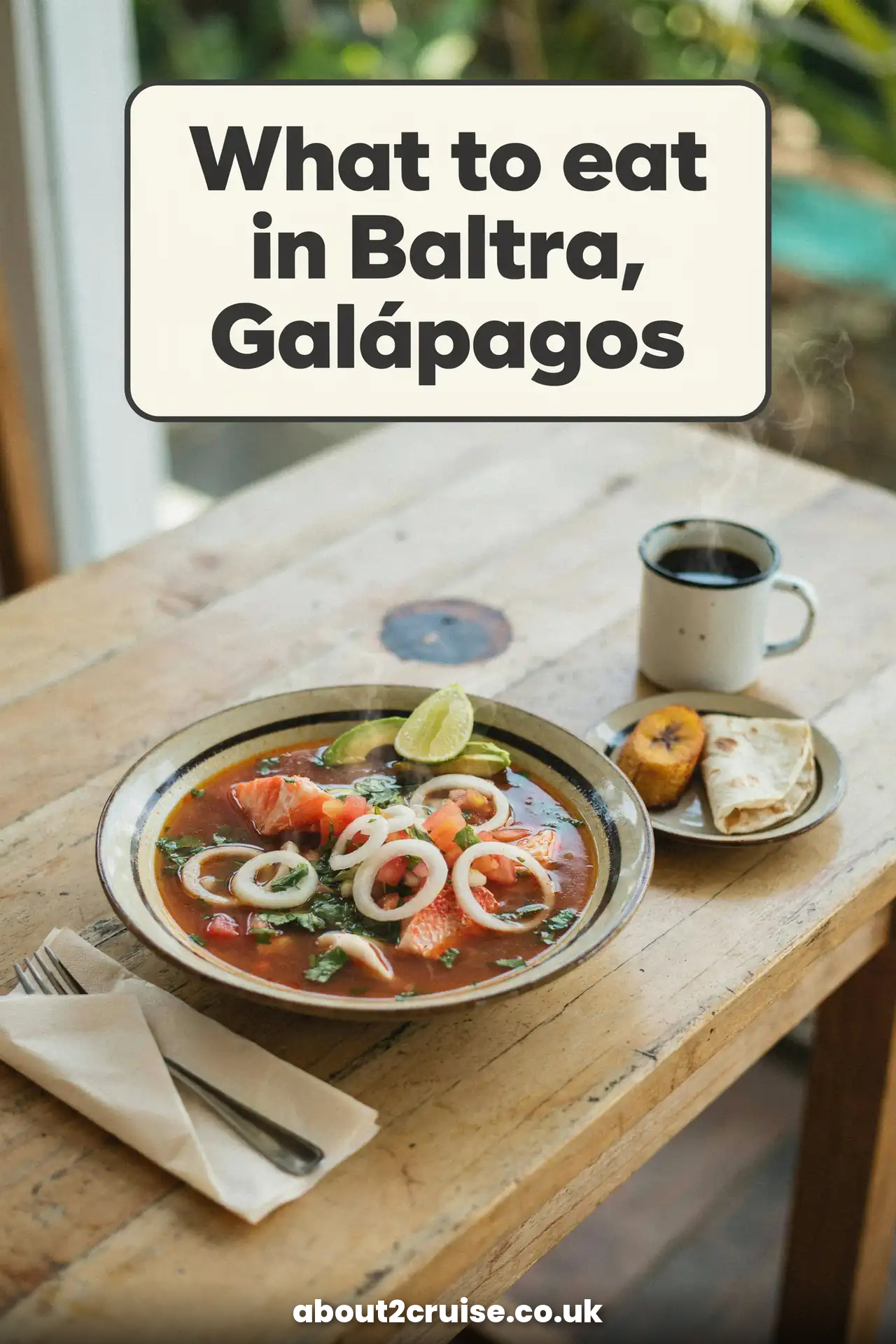
The local breakfast staple is encebollado, a tuna and yuca soup topped with pickled red onion and plantain chips, usually US$3–5. For a bigger meal, order ceviche or brujo frito, fried scorpionfish with yuca. The fish market kiosks on the waterfront grill or ceviche your chosen catch for US$8–15 while pelicans and sea lions watch the landing. In the evening, the kiosk street around Charles Binford becomes an open-air grill strip with lobster, prawn skewers and parrilladas. Tap water should not be drunk anywhere in Ecuador; stick to bottled, boiled or filtered water and skip ice unless you trust the venue.
Shopping and Souvenirs in Puerto Ayora
Avenida Charles Darwin is the main souvenir strip, with T-shirts, jewellery and Galápagos-themed gifts. There is a handicraft market near the crossing with Thomas de Berlanga selling woven bags, tapestries and shirts made in the islands. Proinsular supermarket is a good place for Ecuadorian chocolate, local coffee and groceries. Do not buy or pick up shells, coral, volcanic rock or animal parts: removing them is prohibited under park rules, and carrying them can create problems at biosecurity or customs.
Wi-Fi, Mobile Coverage and Staying Connected
4G exists in Puerto Ayora, but there is normally no signal at sea, on uninhabited islands, in the highlands or at visitor sites. Claro has the widest coverage in the islands. It is best to buy a SIM on the mainland; if you are already on Santa Cruz, there is a Claro office near Avenida Baltra and Charles Binford. Wi-Fi in Puerto Ayora hotels and restaurants is slow, and satellite Wi-Fi on ships is usually expensive and limited. Baltra airport has terminal Wi-Fi but speeds are low, so download anything you need before flying.
Medical Facilities, Pharmacies and Travel Insurance in Galápagos
Medical facilities in Galápagos are limited. Santa Cruz has a basic hospital currently undergoing refurbishment, and San Cristóbal has a relatively well-equipped public hospital. Pharmacies in Puerto Ayora stock basics, but bring all prescription medicines for the whole trip. Travel health insurance is mandatory for foreign tourists, and it should include air ambulance evacuation. Boats may ask for your blood group and emergency contacts at boarding. The tap water is not safe to drink, so use bottled or filtered water and avoid ice in local drinks.
Safety and Crime Awareness in Galápagos
Galápagos is the safest part of Ecuador, and violent crime against visitors is rare. The practical risks are mostly environmental: strong sun, strong currents, sharp lava and slippery wet rocks. Watch your bag on the Itabaca ferry and around the Puerto Ayora dock, as you would at any busy transport point. Avoid walking alone in quiet areas at night. Book tours and cruises through established agencies; never pay large sums in cash to an individual, because non-delivery scams exist around walk-up tour sales. For emergencies, Ecuador’s integrated number is 911, with a Galápagos coordination centre on San Cristóbal.
Accessibility and Mobility on a Galápagos Cruise
This is not an accessible cruise destination. The expedition vessels have no lifts and no accessible staterooms. You must be able to step from a panga into surf or onto rocks, walk over uneven ground and climb into coaches. The airport at Baltra is accessible for reduced mobility, with ramps and wheelchair assistance arranged through the airline at least 48 hours ahead. Las Grietas is a poor choice for anyone who needs a predictable step-free route because it involves a boat, rocks and steps. Charles Darwin Research Station and the first part of Tortuga Bay have the flattest walking surfaces, but there is still little formal accessibility infrastructure. Ask the expedition team before each landing whether the sea state and equipment allow you to go ashore safely.
UK Passports, Ecuador Entry and Customs Allowances
A British passport must have at least six months’ validity on arrival. UK visitors can stay visa-free for up to 90 days in Ecuador in any 12-month period, and tourists in Galápagos may stay up to 60 days. You must show a return flight to the mainland, a hotel booking or host invitation, a transit control card and travel health insurance. If you route via Guayaquil, note that the UK advises against all but essential travel to the surrounding province except airside transit, so confirm with your airline that you stay airside.
For returning to the UK, personal customs allowances include 4 litres of spirits over 22% or 9 litres of drinks up to 22%, plus 18 litres of still wine and 42 litres of beer; 200 cigarettes or 100 cigarillos or 50 cigars or 250 g tobacco; and other goods worth up to £390, or £270 if arriving by private plane or boat. If you exceed an allowance you pay tax and duty on all goods in that category, not just the excess. Leaving Ecuador with US$1,350 or more in cash must be declared and is taxed.
Where to Stay Before or After Your Galápagos Cruise
There are no hotels or visitor facilities on Baltra. If you want a night before or after the flight, stay in Puerto Ayora, about an hour away. Most cruise lines include pre-cruise hotel nights in Quito rather than on Santa Cruz. If you do stay in Puerto Ayora independently, allow the full transfer back to Baltra airport and arrange it in advance. Finch Bay Galapagos Hotel is across the bay at Punta Estrada; Angermeyer Waterfront Inn is nearby; Hotel Solymar sits on the waterfront in town and is a short walk from the pier. Hotels commonly hold bags on changeover days, which helps if you arrive before check-in or have a late flight.
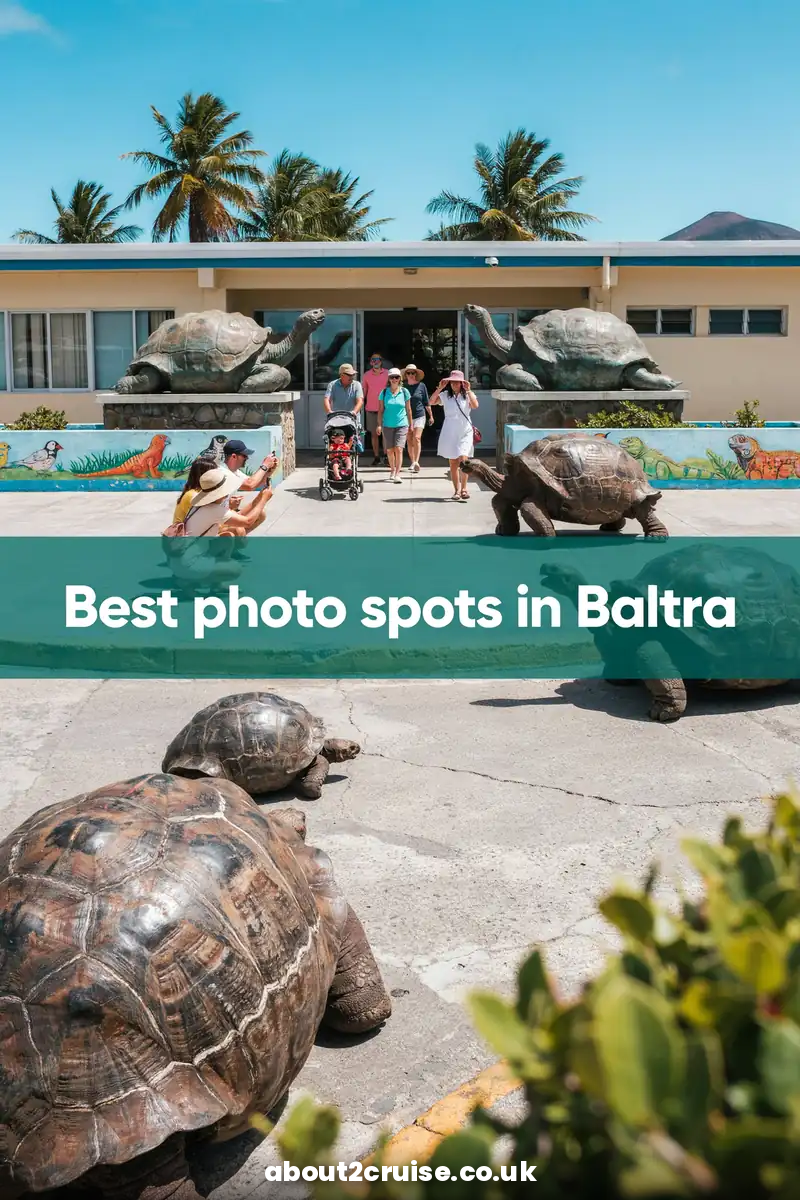
Photo Spots on a Puerto Ayora Port Day
Tortuga Bay, with its white sand, marine iguanas and mangrove lagoon, photographs best if you walk early before the heat and the strongest sun. Las Grietas has the best light and coolest walking between 07:00 and 09:00, when the first guided group enters. The Puerto Ayora fish market and pier are superb in the morning as fishermen land the catch and pelicans and sea lions wait; the same pier draws reef sharks and rays at night under the lights. Los Gemelos is a quick roadside stop with two fern-lined volcanic sinkholes and no entrance fee.
For the wider regional picture, see our guide to Peru and Ecuador’s cruise ports.
How to spend a port day in Baltra and Santa Cruz
A port day in Baltra and Santa Cruz works best if you pick one: a slow walking day around Puerto Ayora and Tortuga Bay, or a longer highlands-and-town loop by taxi.
Before you sail
- Complete the online biosecurity declaration and have the QR or registration number ready.
- Book timed slots for the Fausto Llerena tortoise centre and Las Grietas through your ship or an agency.
- Bring small US dollar bills for the park fee, taxis and water taxis.
Short port day: under 6 hours
- On dockingPanga to the Puerto Ayora pierTender portShips anchor in Academy Bay. Confirm the last panga time and meeting point before you leave the ship.
- +10 minSign in at the Tortuga Bay ranger hutWalk to the end of Charles Binford and sign the register. The trail is open 06:00-18:00.
- +45 minWalk the paved trail to Playa MansaThe 2.5 km walk takes 30-45 minutes with little shade. Swimming is only at the sheltered Playa Mansa, not Playa Brava.
- +1 hr 45 minSwim at Playa MansaAllow time for a swim and marine iguanas on the sand. The boat service is suspended, so you walk back the same way.
- +3 hrsLunch at the fish market kiosksTry cevicheWalk back to the waterfront. The kiosks grill or ceviche your chosen fish; ceviche and brujo frito are the local orders.
- +4 hrs 30 minHandicraft market and Avenida Charles DarwinBrowse the woven bags and shirts near Thomas de Berlanga, then walk back to the tender pier.
- All-aboard minus 1 hrBack at the tender pierWater taxis run 24 hours, but the last panga may leave before the ship's departure. If the pier is busy, go early.
The time on the map is the whole walk, every stop added together.
Open this walking route in Google Maps
If plans change: If the Tortuga Bay path is closed, stay central and visit the Charles Darwin Research Station instead.
Long port day: 8 hours or more
- On dockingPanga to the Puerto Ayora pierTender portShips anchor in Academy Bay. Confirm the last panga time and meeting point before you leave the ship.
- +30 minTaxi to El Chato ReserveCash for taxiA white double-cab taxi takes 20-30 minutes to the highlands. Arrange a loop with the driver waiting; fares are per vehicle.
- +1 hr 15 minEl Chato tortoise reserve and lava tunnelBoots providedEntry includes a reserve guide and rubber boots. Walk among giant tortoises and the lit lava tunnel.
- +3 hrsLos GemelosHave your driver wait, then stop at the two free fern-lined sinkholes beside the highlands road.
- +4 hrs 15 minLunch at the fish market kiosksTry brujo fritoTaxi back to the waterfront. Order ceviche or brujo frito at the kiosks while pelicans and sea lions watch the landing.
- +5 hrs 30 minCharles Darwin Research StationBook aheadWalk 15 minutes along Avenida Charles Darwin. The campus is free; the Fausto Llerena tortoise centre needs a timed reservation and guide, so book through your ship.
- All-aboard minus 1 hrBack at the tender pierStroll back along Avenida Charles Darwin, browse the handicraft market, and be at the tender pier in time for the last panga.
This map shows the taxi ride from the ship. The time is the drive only, not your time ashore.
Open the taxi route in Google Maps
If plans change: If the highlands road is closed or no taxi is available, stay in town and do the Charles Darwin Research Station and a waterfront lunch instead.
Frequently Asked Questions About Baltra and Santa Cruz
Can I walk from the Baltra cruise port into Santa Cruz?
No. Baltra and Santa Cruz are separate islands divided by the Itabaca Channel. You must cross by passenger barge, then take a bus or taxi.
Is there anything to do on Baltra?
Almost nothing. It is a transit island with an airport, a small café, a gift shop and wildlife around the edges. It has no town, hotels or left-luggage facilities.
Do I need a guide for the big Santa Cruz sights?
At the Fausto Llerena tortoise breeding centre and Las Grietas, yes: both require a guide and timed reservation. Tortuga Bay is free and self-guided. Private highland ranches such as Rancho Primicias can be walked self-guided, while El Chato includes a reserve guide in the entry fee.
How long does the transfer from Baltra airport to Puerto Ayora take?
Allow 60–90 minutes. The airport bus takes about ten minutes, the Itabaca barge about ten minutes, and the bus or taxi to Puerto Ayora about 45 minutes.
Is the national park fee cash only?
Not always, but cash is the most reliable way to pay. Card payment may attract an extra fee or be rejected, so have US dollars in small bills.
Are there taxis at Baltra airport?
No. Taxis wait on the Santa Cruz side of the Itabaca Channel. The airport bus is the only ride to the barge.
Can I swim at Tortuga Bay?
Only at the sheltered Playa Mansa. Swimming is prohibited on Playa Brava because of dangerous currents.