
Isabela Island is the Galápagos’ largest island and the main reason many cruisers choose a western Galápagos itinerary. Ships do not dock here; you land by panga at Puerto Villamil or explore west-coast sites such as Tagus Cove, Elizabeth Bay, Urbina Bay and Punta Vicente Roca directly from the vessel. Expect volcanic scenery, penguins, flightless cormorants, giant tortoises and very close wildlife under strict national-park rules. This guide covers the Ecuadorian Galápagos island only, not any other place called Isabela.
Why Isabela Is the Island Most Western Cruises Are Built Around
Isabela is huge: about 132 km long and roughly half of the Galápagos’ total land area. Its seahorse shape comes from six large shield volcanoes merging into one landmass. The island is built from six main volcanic peaks: Cerro Azul at 1,689 m, Sierra Negra at 1,100 m, Alcedo at 1,128 m, Darwin at 1,326 m, Wolf at 1,707 m and Ecuador at 808 m.
- Volcán Wolf is the highest point in the entire Galápagos at 1,707 m.
- Wolf and Ecuador sit directly on the equator.
- Sierra Negra’s caldera is roughly 7 x 10.5 km, the largest in the archipelago, and it erupted in 2018, opening five fissures and sending lava to the sea.
- Much of Isabela is young, bare lava, volcanic tunnels and scrubland, so the scenery feels more primeval than the greener highlands of Santa Cruz.
Isabela Island cruise port map
Tenders bring you ashore at Isabela Island cruise port. From there, Poza de los Flamingos is about a 5-minute walk, Los Túneles about 9 minutes and Concha de Perla about 20 minutes. Tap a pin for directions.
- Isabela Island cruise portWhere tenders land
- Poza de los FlamingosFlamingo lagoon · About 5 min walk from Isabela Island cruise port
- Los TúnelesLava arches · About 9 min walk from Isabela Island cruise port
- Concha de PerlaSnorkelling tidal pool · About 20 min walk from Isabela Island cruise port
- Wall of TearsHistoric prison wall · About 5 km from Isabela Island cruise port
- Cerro OrchillaLookout point · About 5 km from Isabela Island cruise port
- Las TintorerasLava islets · About 2 km from Isabela Island cruise port
- Sierra NegraVolcano day hike · About 25 km from Isabela Island cruise port
- Elizabeth BayMangrove bay · About 47 km from Isabela Island cruise port
The One Thing People Get Wrong About Isabela Cruise Itineraries
This is the single most important thing to check. Some cruises call at Puerto Villamil town, where you land at the pier and can visit the tortoise centre, flamingo lagoon, Concha de Perla and the Wall of Tears. Others only visit Isabela’s west-coast sites like Tagus Cove, Elizabeth Bay and Punta Vicente Roca, with no chance to walk around Puerto Villamil at all.
Seven-night outer-loop or western routes are the most likely to include Isabela properly. As a guide, Celebrity Flora’s Outer Loop has called at Elizabeth Bay, Urbina Bay and Punta Vicente Roca; Silver Origin has called at Punta Vicente Roca, Elizabeth Bay and Tagus Cove; and the yacht Isabela II has used Tagus Cove, Urbina Bay and Punta Vicente Roca on its northern route. If you specifically want the town, look at the day-by-day itinerary and make sure it says Puerto Villamil, not just Isabela Island.
How You Actually Get Ashore at Isabela
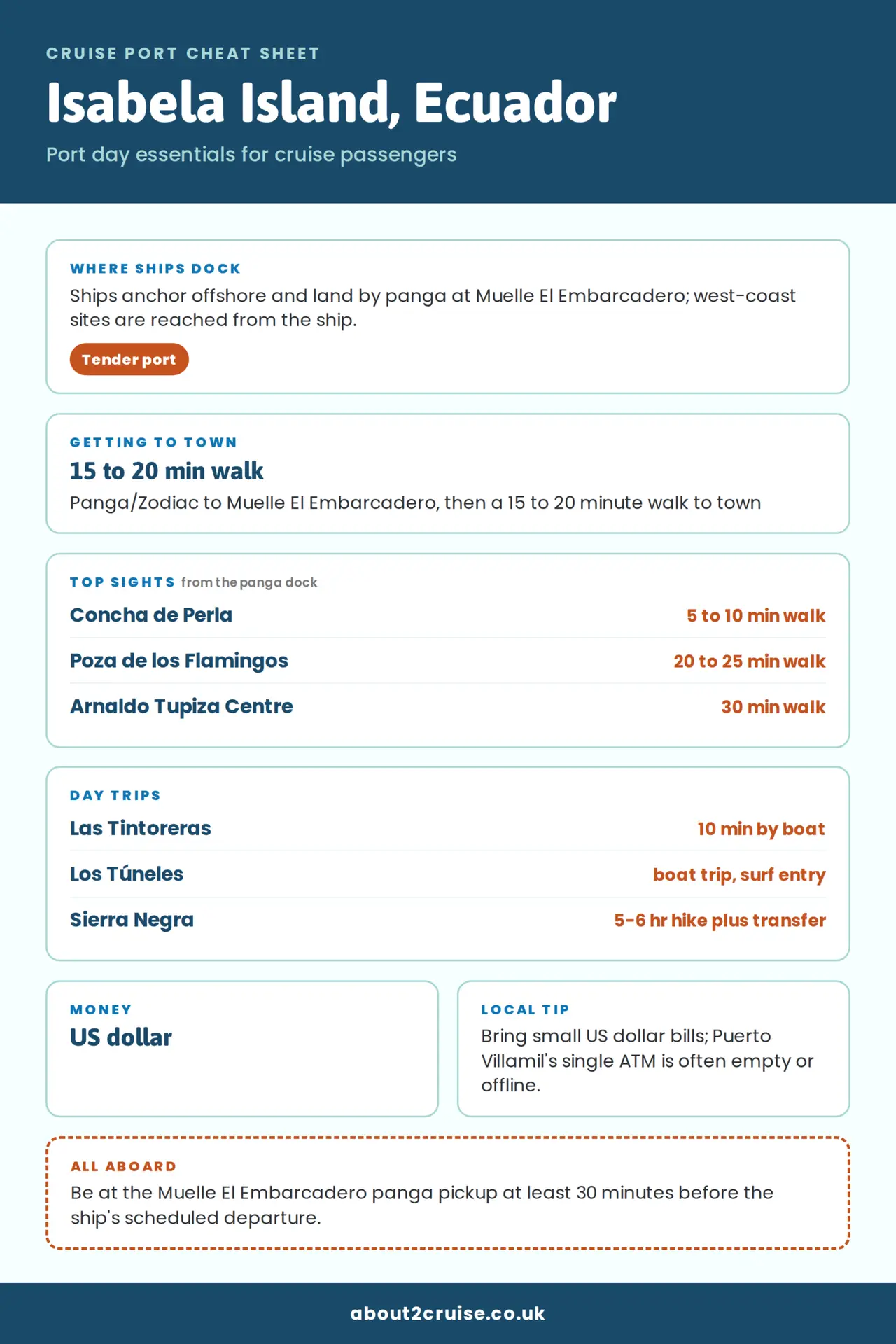
There is no cruise dock anywhere on Isabela. Ships anchor in the bay and ferry passengers ashore by Zodiac or panga. At Puerto Villamil, the main settlement, the anchorage is sheltered sand about 4–6 m deep. The dinghy dock is Muelle El Embarcadero at the far east of town. From the pier, the town centre is a 15–20 minute walk. A water taxi from the pier costs about US$2 per person.
Foreign visitors arriving at the Puerto Villamil dock are normally charged a US$10 municipal arrival fee in cash. The exact application to cruise excursion guests can be inconsistent, but carry small US dollar bills just in case. West-coast sites have no pier at all: Tagus Cove is a dry landing, Urbina Bay is a beach wet landing, Punta Moreno is a dry landing onto lava, and Elizabeth Bay and Punta Vicente Roca are panga-only or no-landing visits.
Isabela’s Wild West Coast: Tagus Cove, Urbina Bay, Elizabeth Bay & More
These are the core Isabela sites on most expedition-cruise itineraries. They are reached only by licensed vessel because there is no land infrastructure on Isabela’s wild west coast.
- Tagus Cove: a dry landing followed by a steep trail up to Darwin Lake, a saltwater lake with roughly twice the salinity of the ocean. The cliffs at water level are painted with ships’ names dating back to the 1800s. This stop often includes a panga ride, kayaking or snorkelling.
- Urbina Bay: a beach wet landing where the 1954 earthquake raised more than 4 m of seabed, stranding coral heads inland. Trails run about 1 km or 3 km, and the area is known for giant tortoises and land iguanas.
- Elizabeth Bay: no landing. The visit is a two-hour panga ride through red mangroves and narrow channels, looking for penguins, green turtles, rays and flightless cormorants.
- Punta Vicente Roca: no landing. You explore by panga beneath collapsed volcanic cliffs and snorkel the protected area, often with turtles, penguins and flightless cormorants. Occasionally mola mola are seen.
- Punta Moreno: a dry landing onto bare pahoehoe lava, then a roughly 2 km trail to brackish pools where flamingos, pintail ducks, turtles and whitetip sharks can appear.
What to Do Around Puerto Villamil: Tortoises, Flamingos, Snorkelling and the Wall of Tears
If your ship lands at Puerto Villamil, several very good wildlife and history sites are within walking distance or a short taxi ride. Puerto Villamil is a small, sandy-street settlement of around 2,200–2,500 people, founded in 1897.
Before you sail
- Book Sierra Negra or Volcán Chico through a licensed guide; park reservations are required.
- Arrange the Galápagos park fee and transit card before your flight.
- Bring US dollars in small bills; Puerto Villamil's only ATM is often empty.
Short port day: under 6 hours
- On dockingTake the panga to Puerto VillamilSmall US billsShips anchor off Puerto Villamil; you land at Muelle El Embarcadero. Have small US dollar bills for the municipal arrival fee.
- +15 minPoza de los FlamingosBest at first lightA 20 minute walk from the pier through town and the plaza to the brackish lagoon boardwalk. Flamingos are easiest at first light and late afternoon.
- +1 hrArnaldo Tupiza Tortoise CentreLicensed guideAbout a 20 to 30 minute walk from town. It raises tortoises from all five of Isabela's volcano populations. Entry is usually with a licensed guide.
- +2 hrs 15 minLunch near the plazaTry cevicheWalk back into town for seafood stalls and cafés around Avenida Antonio Gil. Fresh ceviche and grilled fish are the local staples.
- +3 hrs 15 minSnorkel at Concha de PerlaHigh tide bestA 200 m mangrove boardwalk beside the pier leads to the free tidal pool. Look for green turtles, sea lions and rays; best at high tide.
- +4 hrs 30 minBack at Muelle El EmbarcaderoIt is a short walk from Concha de Perla to the panga pickup. Be ready for the scheduled return.
The time on the map is the whole walk, every stop added together.
Open this walking route in Google Maps
If plans change: If the tortoise centre is closed, spend longer at the flamingo lagoon and walk the beachfront instead.
Long port day: 8 hours or more
- On dockingTake the panga to Puerto VillamilSmall US billsShips anchor off Puerto Villamil; you land at Muelle El Embarcadero. Have small US dollar bills for the municipal arrival fee.
- +30 minTransfer to Sierra Negra trailheadBook aheadMeet the licensed guide and take the 30 minute vehicle transfer to the Sierra Negra trailhead. Book the park permit in advance.
- +1 hrStart the Sierra Negra hikeTough hikeStart the 16 km, 5 to 6 hour hike along the caldera rim. The trail can be muddy, hot and very exposed.
- +2 hrs 30 minSierra Negra caldera rimCaldera viewsReach the Sierra Negra caldera rim, the largest in the Galápagos at 7 by 10.5 km.
- +3 hrs 30 minPicnic lunch at the calderaPicnic lunchEat a packed ceviche or fresh tuna lunch from a Puerto Villamil café at the caldera viewpoint.
- +4 hrs 30 minVolcán Chico lava fieldsStay on the trailContinue to Volcán Chico's lava fields and fumaroles. The trail is rough, so keep to the marked route.
- +6 hrs 30 minReturn to Puerto VillamilReturn transferReturn to the trailhead and take the 30 minute transfer back to Puerto Villamil.
This map shows the taxi ride from the ship. The time is the drive only, not your time ashore.
Open the taxi route in Google Maps
If plans change: If the hike is cancelled or the park reservation falls through, take the Las Tintoreras boat trip and a shorter lava walk instead.
- Arnaldo Tupiza Tortoise Breeding Centre: a 20–30 minute walk from town. It raises young tortoises from all five of Isabela’s volcano populations before release. Entry may be by guided visit or small cash fee; cruise excursions usually include the guide.
- Poza de los Flamingos: a shallow brackish lagoon about five minutes’ walk west of the town square. A boardwalk gives good views, especially at first light and in the last hour before sunset. The surrounding wetlands are a Ramsar site covering 872 hectares.
- Concha de Perla: a free, no-guide tidal pool reached by a 200 m mangrove boardwalk beside the pier. You can snorkel with sea turtles, sea lions and rays. It is best at high tide and has no lockers, shade or lifeguard.
- Wall of Tears: a lava-stone wall about 5 km west of Puerto Villamil, roughly 7 m high and 100 m long, built by prisoners of the island’s penal colony between 1946 and 1959. The route is flat but exposed. Bikes take about an hour each way, walking about 2–3 hours each way, and taxis may only reach the trailhead.
- Cerro Orchilla: a lookout reached by about 800 m of stairs and trail, with 360-degree views over the wetlands, town, beaches and volcanoes. Early morning light is best.

Short Boat Trips From Isabela: Las Tintoreras and Los Túneles
From Puerto Villamil’s harbour, day boats run to nearby islets and lava formations. Las Tintoreras is about 10 minutes by boat. Whitetip reef sharks rest in a narrow lava channel that closes at low tide, and the short excursion usually includes a lava walk and snorkelling. Los Túneles is a longer boat trip to lava arches and clear channels where seahorses, green turtles and sometimes penguins are seen. Tours cost about US$150, and the surf entry can close on rough days.
Hiking Sierra Negra and Volcán Chico on Isabela
Sierra Negra is Isabela’s big day hike. From the trailhead, expect about 16 km and 5–6 hours of walking, with a 30-minute vehicle transfer from Puerto Villamil. The caldera is the largest in the Galápagos at 7 x 10.5 km. The trail follows the rim, then continues to Volcán Chico’s lava fields and fumaroles.
This is not a casual stroll. The path can be muddy or hot, and tour operators regularly state it is unsuitable for people over 70 or anyone with heart, knee or spinal conditions. Guided day tours cost roughly US$60–100 depending on inclusions. Volcán Chico is now subject to the park’s official reservation system, so book through a licensed guide or ship excursion.
Wildlife You Can Expect to See Around Isabela
Isabela is one of the best islands in the archipelago for close wildlife without the larger crowds of Santa Cruz. Around 95% of Galápagos penguins live on Fernandina and Isabela. This is the only penguin species that lives north of the equator, and it is endangered, with roughly 1,200 mature individuals. The flightless cormorant is found only on Fernandina and the north and west coasts of Isabela, with a population of about 1,000.
- Galápagos penguins: usually around Las Tintoreras, Elizabeth Bay, Punta Vicente Roca and Los Túneles.
- Flightless cormorants: most reliable at Punta Vicente Roca and Elizabeth Bay.
- Giant tortoises: Isabela has five distinct volcano populations: Wolf, Darwin, Alcedo, Sierra Negra and Cerro Azul. In Puerto Villamil you see them at the breeding centre; in the wild, Urbina Bay is a known site.
- Marine iguanas: common on lava shores at Punta Moreno, Punta Vicente Roca and elsewhere.
- Green sea turtles: Concha de Perla, Urbina Bay and Elizabeth Bay are usually good.
- Sea lions: around Puerto Villamil and many landing beaches.
- Flamingos: Poza de los Flamingos near town and the brackish pools at Punta Moreno.
- Whitetip reef sharks: Las Tintoreras and Punta Moreno’s pools.
Park Rules, Fees and Entry Requirements in Plain Terms
The Galápagos is tightly managed. Visits to protected sites must be made with a park-accredited naturalist guide except at sites the park designates as exempt, such as Concha de Perla. Guide groups are capped at one guide per 16 guests, and only licensed vessels carrying a maximum of 100 passengers may operate.
- Galápagos National Park entry fee: US$200 for foreign visitors over 12, US$100 for children under 12 and Andean Community or Mercosur nationals, US$30 for Ecuadorians, and free for under-2s.
- Transit Control Card: US$20 per person, bought before the domestic flight from Quito or Guayaquil.
- Puerto Villamil municipal fee: about US$10 in cash at the dock for foreign visitors arriving by boat.
- Health insurance: foreign tourists must hold private health insurance before entering Galápagos.
- Biosecurity: bags are screened on inter-island departures, and organic material may not be moved between islands.
- Wildlife distance: stay at least 2 m from wildlife on foot, snorkel or dive, and 4 m from a kayak, paddleboard or panga. Do not touch, feed or chase animals.
- Drones: recreational drone use is prohibited; professional filming and remote cameras need prior park authorisation.
- Sunscreen: chemical sunscreens containing oxybenzone or octinoxate are banned in marine areas. Use reef-safe mineral sunscreen.
Money, Wi-Fi and Everyday Services in Puerto Villamil
Ecuador uses the US dollar. Puerto Villamil has one ATM that is frequently empty or offline, so bring enough cash from the mainland or Santa Cruz. Hotels and larger restaurants may accept cards with a 5–10% surcharge, but taxis, kiosks, water taxis and the Isabela dock fee need small bills.
There is no published left-luggage service at the Puerto Villamil pier or Concha de Perla. Concha de Perla has no lockers or changing facilities. Wi-Fi in town exists but is slow and can be unreliable. Food around Puerto Villamil is heavily seafood-based; fresh tuna, grilled fish, ceviche, encebollado, slow-roasted hornado and fish-and-yuca stews are common. Set lunches typically cost US$6–15.
What to Pack for an Isabela Cruise Day
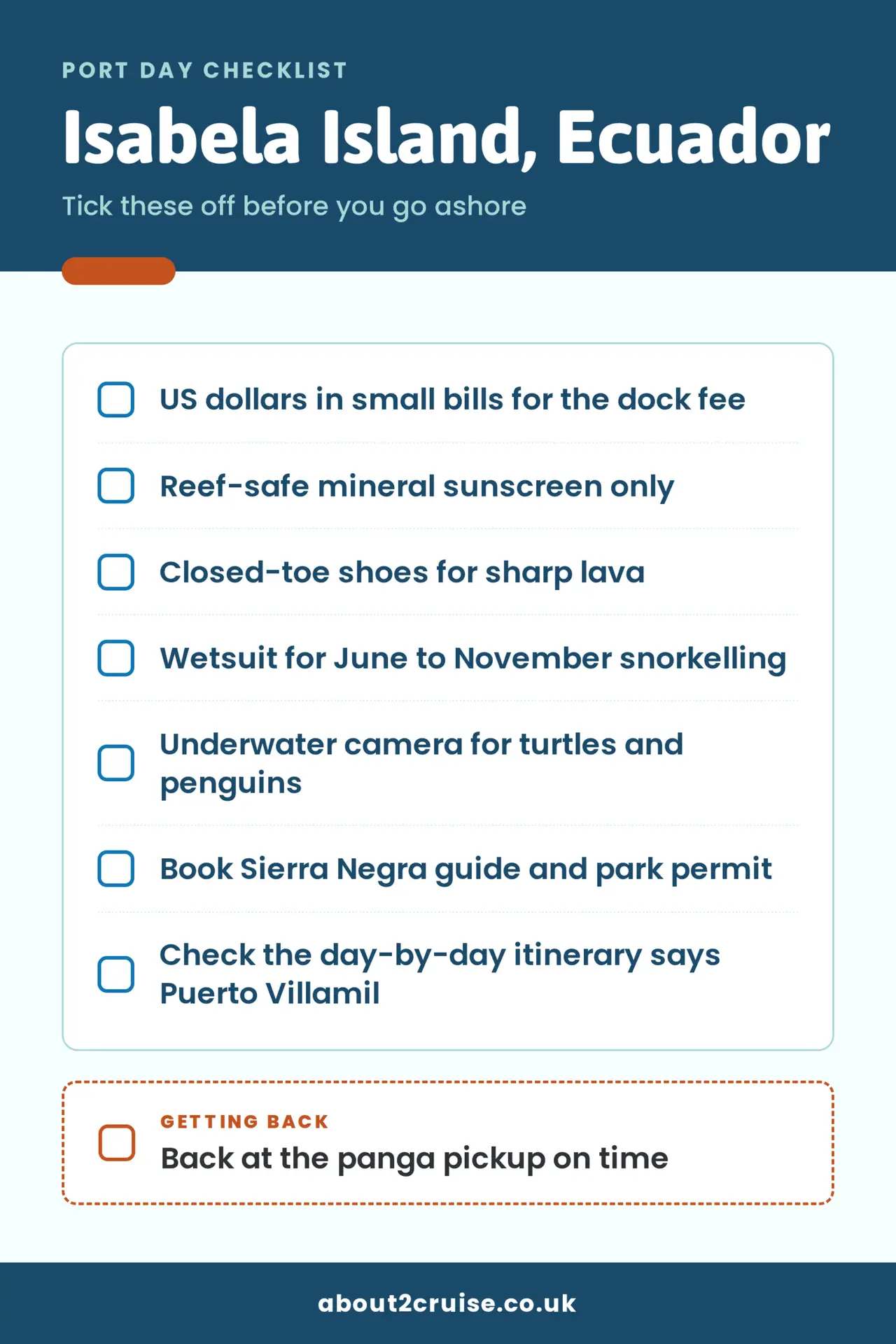
- Footwear: closed-toe shoes with good grip are essential for sharp, uneven lava. For Sierra Negra, hiking shoes are recommended.
- Clothing: light layers, a rain shell for the highlands, a sun hat and a rash guard for snorkelling. Insect repellent is useful, especially in humid areas.
- Sun protection: reef-safe mineral sunscreen is required in the water. Chemical sunscreens are restricted.
- Snorkel gear: can be rented in Puerto Villamil for about US$5 a day, but there is no rental at Concha de Perla. A wetsuit is strongly recommended from June to November, when western waters can drop to around 15°C.
- Camera: an underwater camera is worthwhile for turtles, penguins and sharks. Flash photography is not allowed.
- Cash: small US dollar bills for the dock fee, water taxi, snacks and taxis.
Weather, Water Temperatures and the Best Time to Visit Isabela
The Galápagos has two broad seasons. December to May is warmer and wetter, with temperatures of 25–30°C and brief heavy showers. June to November is cooler, drier and often misty, averaging about 23°C. At Puerto Villamil, March highs average 28°C and August highs 23°C. February is the wettest month, August the driest.
Sea temperatures range from about 30°C in March to about 19°C in September, and the colder Cromwell Current keeps Isabela’s western waters dramatically cooler. Seas are choppiest from August to October, and the Santa Cruz–Isabela ferry is rougher in the afternoon and between June and September. If snorkelling from June to November, pack or rent a wetsuit. For flamingo reflections, visit the town lagoon at first light or late afternoon. Tortoises and penguins can be seen year-round, but the cooler dry season is generally better for penguin and flightless-cormorant encounters in the west.
Can You Visit Isabela Without a Cruise?
Yes, but with important limits. Isabela has no international airport and is not a cruise turnaround port. Most independent travellers fly into Baltra or San Cristóbal, then use the public ferry from Puerto Ayora to Puerto Villamil. The ferry takes 2–2.5 hours each way and costs about US$50 per leg, with departures twice daily. Small Emetebe inter-island flights between Baltra and Isabela’s General Villamil Airport take about 30–45 minutes.
A day trip from Santa Cruz to Isabela is possible on paper but tight, because ferries run only twice daily. Land-based visitors can independently visit the Puerto Villamil sites and book day tours to Las Tintoreras, Los Túneles and Sierra Negra. The west-coast sites such as Tagus Cove, Elizabeth Bay and Punta Vicente Roca are reachable only by expedition vessel. For many cruisers, a ship-based call is the most efficient way to see the wild west of Isabela.
How Isabela Compares With Santa Cruz, Fernandina and Floreana
- Santa Cruz: the populated hub with Puerto Ayora, the Charles Darwin Research Station and highland tortoises. It is more convenient but busier. Isabela feels wilder and gives access to the western upwelling sites.
- Fernandina: the youngest island, with Punta Espinoza’s huge marine iguana colony and no introduced mammals. Isabela is older, larger and has five volcano tortoise populations.
- Floreana: the human-history island, known for Post Office Bay and Punta Cormorant. Isabela carries its own dramatic human history at the Wall of Tears.
Our Peru and Ecuador cruise ports guide covers the other ports in the region.
For most itineraries, Baltra (Santa Cruz Island) is where you join the ship before sailing west to Isabela.
Isabela Island Cruise FAQs: Quick Answers to Common Questions
Do I pay the US$200 park fee and the US$10 Puerto Villamil dock fee on a cruise?
Yes, the Galápagos National Park entry fee and transit card are part of your arrival process, unless already included by your cruise line. If you land at the Puerto Villamil pier, you may also be asked for the US$10 municipal fee in cash. Carry small US dollar bills.
Can I see penguins, tortoises and flamingos without a long hike?
Usually yes. In Puerto Villamil, the tortoise centre is a 20–30 minute walk, the flamingo lagoon is about five minutes from the square, and Concha de Perla is next to the pier. Penguins are best on boat excursions such as Las Tintoreras, Los Túneles, Elizabeth Bay or Punta Vicente Roca.
Can cruise passengers go ashore independently at Puerto Villamil?
If your ship calls at Puerto Villamil, yes. You can walk to Concha de Perla, the flamingo lagoon and the tortoise centre, or take a taxi towards the Wall of Tears trailhead. For protected visitor sites, use a licensed guide. If your ship only calls at west-coast sites, you cannot go ashore in town.
Is a day trip from Santa Cruz to Isabela realistic on a cruise port call?
No. The public ferry takes 2–2.5 hours each way and runs twice daily, which makes a cruise-day round trip too risky. Cruise passengers should visit Isabela as part of their ship’s itinerary or on a multi-night land extension.
How many days does a Galápagos cruise need to include Isabela?
Most seven-night western or outer-loop itineraries include several Isabela sites. Some five-night northern loops may skip Isabela or use only one fleeting area. If Isabela is a priority, choose a seven-night or longer itinerary and check the day-by-day list for Tagus Cove, Elizabeth Bay, Punta Vicente Roca, Urbina Bay or Puerto Villamil.
What are the best snorkelling sites around Isabela?
Punta Vicente Roca, Elizabeth Bay, Concha de Perla, Las Tintoreras and Los Túneles are commonly rated as the best. Punta Vicente Roca offers cold-water species such as penguins and cormorants, while Concha de Perla is an easy shore snorkel with turtles, rays and sea lions.
Do I need a wetsuit?
From June to November, yes. Western Isabela can drop to around 15°C, and most snorkellers are more comfortable in a 3 mm or 5 mm wetsuit.
Are there ATMs in Puerto Villamil?
There is one ATM, but it is frequently empty or offline. Bring cash from the mainland or Santa Cruz, and keep small bills for the water taxi, dock fee, taxis and kiosks.
Related Cruise Port Guides
If you are comparing tender and expedition ports elsewhere in Latin America and the Pacific, see our Colón Panama Cruise Port Guide, Puerto Limón Cruise Port Guide and Hanga Roa Easter Island Cruise Port Guide.
Last Updated: 20 November 2026