
Algiers is a striking Mediterranean cruise call: a white city stacked above a working port, with the UNESCO-listed Casbah right above the berth and French colonial boulevards behind the waterfront. You need a visa unless your line arranges one, port access varies by sailing, and the main sights are best reached by walking, taxi or your ship’s excursions.
Why Algiers Is Called the White City
Algiers is nicknamed Alger la Blanche, the White City. White terraces of Ottoman, Moorish and French colonial buildings cascade down steep slopes to a wide Mediterranean bay. The port sits directly below the city centre, so your first view from the ship is usually the arcaded seafront boulevard with the Casbah rising behind it.
The headline sights are the UNESCO-listed Casbah, the neo-Moorish Grande Poste, Notre-Dame d’Afrique on its clifftop, the soaring Martyrs’ Memorial, the Bardo Museum’s folk art, the Jardin d’Essai botanic gardens and the modernist Sacré-Cœur cathedral. Algerian food and café culture are part of the experience too, from grilled sardines at the port fish market to mint tea and pastries on rue Didouche Mourad.
Where Your Cruise Ship Docks in Algiers
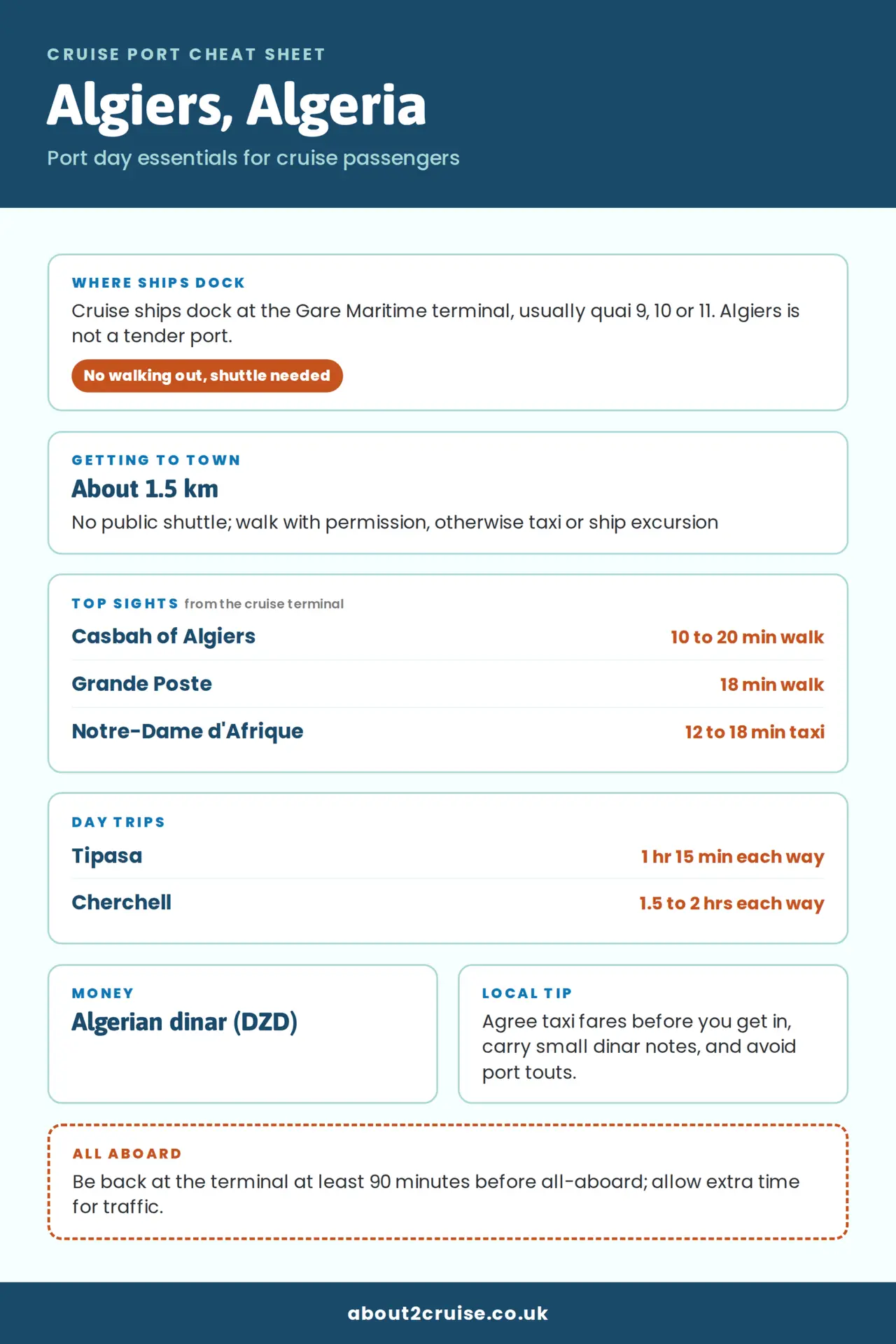
Cruise ships berth in the commercial Port of Algiers at the Gare Maritime passenger terminal on the Môle El-Djazair. Vessels normally dock at quai 9, 10 or 11. Algiers is a docking port, not a tender port. The terminal building stands directly below Boulevard Che Guevara, the arcaded waterfront road. The approximate berth position is 36.777953 N, 3.064201 E.
The port is an ISPS-secured commercial area. Expect police and customs checks when you disembark, and carry your passport, visa and ship card. The passenger car park and pedestrian gate face quai 11. The city centre is only about 1.5 km, or 0.9 miles, from the berth, but the port itself is industrial and pedestrian routes can change depending on your ship and local security instructions. There is no published public port shuttle service. Movement inside the port is usually by ship excursion coach or on foot with permission from the port authorities and your ship.
Algiers Cruise Port Map and City Orientation
Ships dock at Gare Maritime cruise terminal. From the cruise terminal, Grande Poste is about a 10-minute walk, La Pêcherie fish market about 14 minutes and Ketchaoua Mosque about 17 minutes. Tap a pin for directions.
- Gare Maritime cruise terminalWhere ships dock
- Grande PostePost office · About 10 min walk from the cruise terminal
- Tafourah-Grande Poste metro stationMetro station · About 14 min walk from the cruise terminal
- La Pêcherie fish marketFish market · About 14 min walk from the cruise terminal
- Place des MartyrsSquare · About 17 min walk from the cruise terminal
- Ketchaoua MosqueMosque · About 17 min walk from the cruise terminal
- Casbah of AlgiersOld medina · About 18 min walk from the cruise terminal
- Palais des Raïs (Bastion 23)Ottoman palace complex · About 22 min walk from the cruise terminal
- Sacré-Cœur cathedralCathedral · About 26 min walk from the cruise terminal
- Notre-Dame d’AfriqueBasilica · About 3 km from the cruise terminal
- Martyrs’ MemorialMonument · About 4 km from the cruise terminal
- Bardo MuseumMuseum · About 2 km from the cruise terminal
- Jardin d’Essai du HammaBotanical gardens · About 3 km from the cruise terminal
Visa and Passport Rules for an Algiers Cruise
British citizens need a visa to visit Algeria. Your passport must be valid for at least six months beyond arrival. A tourist visa costs about £85 and is applied for in advance through the Algerian Consulate General in London. Processing takes roughly 10 working days in person and at least 15 by post, so don’t leave it until the week before your cruise.
Some cruise lines arrange a collective visa for guests. Fred. Olsen has told passengers it arranges the visa on their behalf, but also that local authorities required guests to be on pre-arranged shore tours to disembark. Viking is widely reported to operate shore excursions only in Algiers, sometimes with a police escort for coaches. Other lines allow visa-holding passengers to walk out independently. The rule is set line by line and sometimes call by call, so confirm with your cruise line before sailing. If independent exploration is important to you, ask specifically whether you may leave the port on foot, not just whether a visa is provided.
If your cruise also calls at Oran, our Oran port guide explains the visa and shore excursion rules for going ashore there.
Getting from the Algiers Cruise Port into the City
If independent walking is permitted, Place des Martyrs and the lower Casbah are 10 to 20 minutes from the terminal on foot, up ramps and stairs. The Balcon de la Casbah viewpoint is a 700 m walk, about 11 minutes, from the boulevard above the terminal. La Grande Poste is about 1.3 km, roughly an 18-minute walk, from the boulevard.
A taxi from the Gare Maritime to the city centre around Grande Poste is usually quoted at 700 to 1,000 DZD. To the Martyrs’ Memorial, expect about 1,500 DZD. Taxis are unmetered, so agree the fare before getting in. The Yassir ride-hailing app gives a fixed cash price and is useful if you have local data or Wi-Fi. Metro line 1 runs from Place des Martyrs below the Casbah through Tafourah-Grande Poste to the Jardin d’Essai. A single metro ticket costs 50 DZD. Tram fares are about 40 DZD.
Visiting the Casbah of Algiers
The Casbah of Algiers is a UNESCO World Heritage site and the old medina that climbs the hill above the harbour. About 50,000 people still live in its dense lanes, Ottoman palaces, mosques and traditional houses. It is steep, cobbled and irregular, with steps throughout. Visit with a good local guide, tell someone your plans, and don’t wander into quiet dead-end lanes alone. The lower Casbah and Place des Martyrs are the easiest parts to reach from the port on foot.
At the foot of the Casbah, the Ketchaoua Mosque faces Place des Martyrs. It was a cathedral under French rule and is now a working mosque. Non-Muslim access is limited and at the staff’s discretion outside prayer times. The Palais des Raïs, also called Bastion 23, sits on the Casbah’s lower seaward edge. It is a complex of three Ottoman palaces and six fishermen’s houses now used as an arts centre. Admission is about 200 DA for adults and 100 DA for students, though it may close on Fridays. The Casbah’s upper lanes are atmospheric but not suitable for wheelchairs or anyone unsteady on their feet.
Algiers as the White City: French Colonial Architecture
The waterfront Boulevard Che Guevara is the best introduction to colonial Algiers. Arcaded façades line the seafront, with the port below and the old town above. Walk it at sunset for the best light and photographs. From there, the grid of French streets runs inland to the Grande Poste, the cathedral, the central markets and café-lined avenues. The city mixes Ottoman palaces, Haussmann-style blocks and twentieth-century North African modernism, which is one reason Algiers feels unlike anywhere else in the Mediterranean.
Notre-Dame d’Afrique: the Clifftop Basilica and Viewpoint
Notre-Dame d’Afrique is a 4.3 km drive from the port, usually 12 to 18 minutes by taxi. The basilica sits on a headland west of the centre and its terrace gives a panoramic view over the Bay of Algiers. Visiting hours are normally 11:00 to 12:30 and 15:00 to 17:30, but the basilica is closed to visits on Fridays. Mass is at 18:00 daily except Friday, when it is at 10:30. The old Bologhine cable car has been out of service for years, so go by taxi or car. Ask the driver to wait for you, because taxis at the basilica are not abundant.
The Martyrs’ Memorial and Modern Algiers
The Maqam Echahid, or Martyrs’ Memorial, is the 92-metre concrete monument of three palm fronds on the heights above the city. The esplanade is free to enter and gives wide views over Algiers and the bay. The underground National Moudjahid Museum below the monument charges a symbolic fee. The memorial is about 10.2 km from the port, typically an 18 to 30-minute drive depending on traffic. The best light for photographs is late afternoon, roughly between 17:00 and 19:00 depending on the season. A cable car runs from the Jardin d’Essai up to the memorial esplanade, which is a convenient way to combine the two.
Bardo Museum: Algerian Folk Art in an Ottoman Villa
The Bardo Museum is set in an Ottoman summer villa at 3 avenue Franklin Roosevelt. It holds prehistoric and ethnographic collections, including the skeleton of Tin Hinan, a figure from Tuareg tradition. Admission is about 200 DA. The building itself is part of the appeal, with tiled courtyards and a calm residential setting. Check the opening hours locally because they are inconsistently published and can change on Fridays and public holidays.
Jardin d’Essai du Hamma: Algiers’ Botanical Gardens
The Jardin d’Essai du Hamma covers 32 hectares with around 2,500 plant species. It has its own metro station on line 1, making it one of the easiest sights to reach independently from the port area or Grande Poste. Hours are roughly 10:00 to 17:00 in winter and 10:00 to 19:00 from May to August. Adult admission is about 200 DA. It is a good choice in hot weather because of the shade, and it pairs well with the Martyrs’ Memorial via cable car.
Grande Poste, Central Market and Other Central Landmarks
La Grande Poste is the neo-Moorish post office in the centre of Algiers, about 1.3 km from the boulevard above the port. It is one of the most photographed buildings in the city, but the interior has been closed to users for years because of its condition. A restoration programme is under way, including the postal museum hall, but don’t expect to go inside on every call. The surrounding streets are the most useful part of central Algiers for banking, cafés and orientation.
Nearby, Marché Clauzel is a covered neighbourhood market on rue Tanguy, open roughly 07:00 to 16:00. Marché Ali Mellah at Place du 1er Mai is the largest covered produce market in the capital and usually runs from about 07:00 to 18:00. These markets are where you see everyday Algiers rather than a tourist set-piece.
Basilica Sacré-Cœur and the National Museum of Antiquities
The Sacré-Cœur is Algiers’ Catholic cathedral, a modernist concrete building with a 35 m dome and a broad nave. Restoration works have been under way, but the building remains both a place of worship and a national heritage landmark. The National Museum of Antiquities and Islamic Arts is at 177 boulevard Colonel Krim Belkacem in the Parc de la Liberté. Adult admission is about 200 DA. It opens Saturday to Thursday, normally 09:00 to 12:00 and 13:00 to 16:30, and closes all day Friday.
Algerian Food and Café Culture in Algiers
Algiers is known for couscous, often made with fish or seafood in the capital, rechta, a thin noodle dish with chicken, chakhchoukha, a torn flatbread with lamb, karantika, a chickpea-flour flan served in a baguette with cumin and harissa, bourek, chorba frik and merguez. Karantika is sold from carts around Place des Trois Horloges in Bab El Oued, often selling out by noon. Bourek is freshest at bakeries and snack bars around Place des Martyrs. A cheap meal can cost under 300 DA and a mid-range one under 1,000 DA.
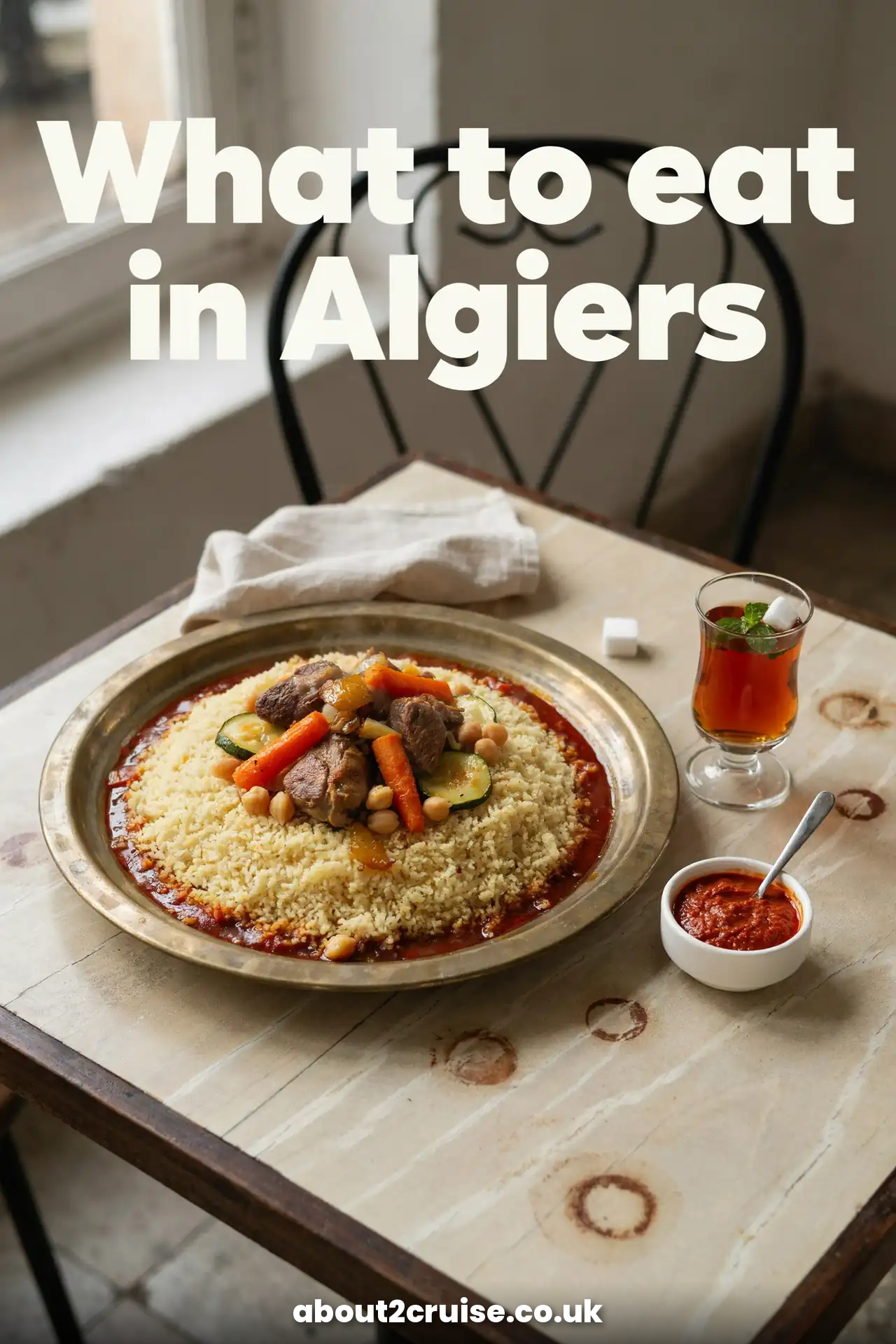
Café culture centres on rue Didouche Mourad, which is lined with cafés and patisseries. Try makroud, a semolina and date pastry in honey, and kalb el louz. The port’s own fish market, La Pêcherie, sits below the Ketchaoua ramp and has stalls grilling sardines, rouget and mérou to order. Alcohol is legal but discreet: some hotels and licensed restaurants serve it, but most ordinary restaurants and cafés do not. It is illegal to be under the influence of alcohol in a public place, and most restaurants do not serve alcohol during Ramadan.
Money, Cash and Cards in Algiers
The currency is the Algerian dinar, usually written DZD or DA. It is a closed currency, so you cannot buy dinars abroad. Recent indicative rates are around 152.86 DZD to the euro, 136.13 DZD to the US dollar and 183.18 DZD to the pound sterling, but only use those as a rough guide. Declare cash on entry and exit above 5,000 euros or equivalent. Only residents may bring in or take out Algerian banknotes, up to 10,000 DZD.
Algeria is largely a cash economy. Cards work in big hotels and some smarter restaurants and shops in the centre, but taxis, markets, museum tickets and tips need dinars. ATMs are concentrated around the Grande Poste and are not always reliable, so carry enough small notes for the day. Tipping is about 10% in sit-down restaurants, and rounding up the fare for taxis is normal. Dinars cannot be changed back without an official receipt, so avoid changing more than you need.
Language, Etiquette and Bargaining in Algiers
Arabic and Tamazight are official languages, but French is the working lingua franca. English is rarely spoken. A few words of French such as bonjour, merci and s’il vous plaît earn goodwill. Bargaining is expected in the souks, but not in fixed-price shops, cafés or taxis once a fare has been agreed. Dress modestly: shoulders and knees covered, and women should carry a scarf for mosques. During Ramadan, do not eat, drink, smoke or chew gum in public in daytime, and avoid loud music or swearing. Friday is the main prayer day, so some sights close and the rhythm of the city changes.
Safety and Security Awareness in Algiers
The UK Foreign Office says terrorist attacks are likely in Algeria and could be indiscriminate, but the threat is higher in rural and mountainous areas and near borders than in central Algiers. There is a risk of pickpocketing, robbery and petty theft in the larger cities, so avoid unknown areas, especially suburbs after dark, and do not carry large amounts of money or valuables. The authorities devote substantial resources to protecting foreign visitors, and the security presence can feel intrusive, but it is normal.
Algeria has a very high road accident rate and erratic driving, so take particular care crossing roads. For taxis, ask a hotel to phone a reputable firm, do not let unknown passengers join, and arrange for the driver to collect you for the return trip because taxis are scarce after dark. Do not photograph military or police sites, checkpoints, airports or government buildings. Cameras and media can be confiscated. Drones, binoculars, telescopes and some professional photography equipment need authorisation before import. Same-sex sexual acts are illegal in Algeria. Emergency numbers are police 17 or 1548, gendarmerie 1055, and protection civile, fire and ambulance, 14 or 1021.
Ship Excursion vs Independent Sightseeing in Algiers
In Algiers, the choice between a ship excursion and going independent is not only about convenience. On some lines, the authorities require passengers to be on an organised excursion to disembark. If your line operates excursions only, then the decision is made for you, and the ship’s coaches are usually met inside the port and sometimes have a police escort. If independent sightseeing is allowed, you have more flexibility but need to handle visas, cash, taxis and the return journey yourself.
For a first visit, the most practical independent route is to walk from the port to Place des Martyrs and the lower Casbah, then take a taxi or metro to the Grande Poste, Jardin d’Essai and Martyrs’ Memorial. A good local guide for the Casbah is worth the money. For Tipasa and Cherchell, a ship excursion is the safest use of a port day because the journey is long and taxis for the return need to be arranged in advance.
Taxis, Public Transport and Avoiding Touts in Algiers
Unofficial port touts can overcharge or take you on a detour. Arrange transport inside the terminal area through your ship or use the official taxi rank if one is present. Agree the fare before getting in, and have small notes because drivers often claim to have no change. The Yassir app is useful if you have mobile data and gives a fixed cash price. The metro and tram are cheap and safe during the day, but they do not serve every sight. A taxi from the port to the city centre should be around 700 to 1,000 DZD, not several thousand.
Return-to-Ship Timing and Traffic Buffers
Cruise lines usually require passengers back on board about 30 minutes before scheduled departure. Confirm the all-aboard time in the daily programme, not from a third-party site. From the Martyrs’ Memorial, allow at least 45 minutes for the return because the coastal road can gridlock. Be in a taxi or on the metro at least 90 minutes before departure from that part of the city. Ships generally do not hold for independent travellers; only guaranteed line excursions are waited for.
Friday, Ramadan and Opening Hours in Algiers
Friday is the main prayer day, and several key sights close or reduce hours. The National Museum of Antiquities closes all day Friday. Notre-Dame d’Afrique is closed to visits on Fridays. The Palais des Raïs is listed as closed on Friday. The Casbah’s shops and souks are quieter on Friday. During Ramadan, many cafés and restaurants stay closed or open only after sunset, and it is disrespectful to eat, drink or smoke in public during the day. Museum hours are not always published reliably, so confirm locally or through your tour guide before setting out.
Before you sail
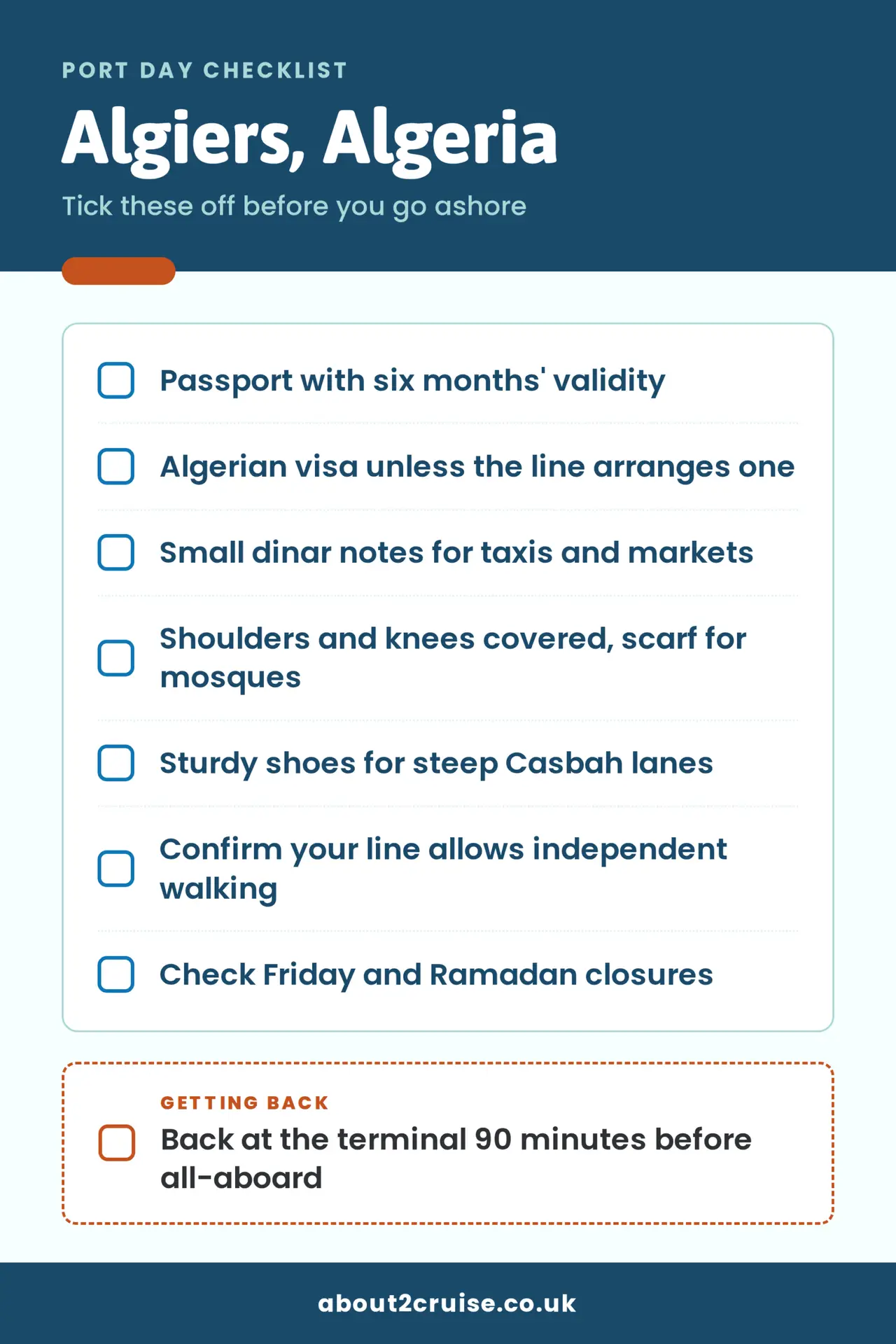
- Check with your cruise line whether independent walking or only shore excursions are allowed in Algiers.
- Apply for an Algerian tourist visa unless your line arranges a collective visa.
- Carry small euro or US dollars to change into dinars ashore.
Short port day: under 6 hours
- On dockingClear port security and check walking rulesPort is securedExpect police and customs checks. Keep your passport, visa and ship card with you.
- +20 minPlace des Martyrs and Ketchaoua MosqueA 10 to 20-minute walk up ramps and stairs from the terminal, if independent walking is allowed. Non-Muslim access to the mosque is limited.
- +1 hrPalais des Raïs (Bastion 23)Check Friday closureWalk the lower seaward edge to three Ottoman palaces and six fishermen's houses, now an arts centre. It can close on Fridays.
- +2 hrsLunch near Place des MartyrsTry bourekBourek is freshest at bakeries and snack bars around Place des Martyrs. Grilled sardines at La Pêcherie are another local option.
- +3 hrs 15 minLa Grande PosteAn 18-minute walk from the boulevard. The neo-Moorish exterior is usually viewable while restoration continues.
- All-aboard minus 1 hrBack at the cruise terminalWalk downhill to the port gate and terminal. Leave at least 90 minutes' buffer for security checks.
The time on the map is the whole walk, every stop added together.
Open this walking route in Google Maps
If plans change: If the Casbah feels too steep or the Palais des Raïs is closed on Friday, stay on the lower walkways and spend longer around the Grande Poste and colonial centre.
Long port day: 8 hours or more
- On dockingClear security and arrange a taxiAgree fareExpect police and customs checks. Use an official taxi or the Yassir app and agree the fare before leaving.
- +30 minTaxi to Notre-Dame d'AfriqueClosed FridayA 4.3 km, 12 to 18-minute drive. The terrace has a panoramic view over the Bay of Algiers. Visiting hours 11:00 to 12:30 and 15:00 to 17:30; closed to visits on Fridays.
- +1 hr 30 minJardin d'Essai du HammaMetro nearbyTake a taxi to the 32-hectare botanic garden. Open 10:00 to 17:00 in winter and until 19:00 in summer; small entry fee.
- +3 hrsLunch near the gardenTry fish couscousAlgiers is known for fish and seafood couscous. Cafés and restaurants cluster around the Jardin d'Essai and metro station.
- +4 hrsCable car to Martyrs' MemorialThe cable car runs from Jardin d'Essai to the memorial esplanade. Confirm it is running before you queue.
- +5 hrs 30 minMartyrs' Memorial and esplanadeThree 92-metre concrete palm fronds with wide views. The underground museum charges a symbolic fee.
- All-aboard minus 90 minTaxi back to the portAllow at least 45 minutes from the memorial; the coastal road can gridlock. Use Yassir or a pre-booked taxi.
This map shows the taxi ride from the ship. The time is the drive only, not your time ashore.
Open the taxi route in Google Maps
If plans change: If Notre-Dame d'Afrique is closed on Friday or queues build, go first to Jardin d'Essai and the Martyrs' Memorial, then try the basilica later if time allows.
What to Wear and Accessibility in Algiers
Dress modestly for Algiers. Shoulders and knees covered is a good baseline, and women should carry a scarf for mosque visits. Sturdy shoes are essential: the Casbah is steep, stepped and cobbled, and the stones become slippery when wet. The Casbah’s routes are difficult and irregular, so passengers with limited mobility are better served by the Palais des Raïs, the museums and the Jardin d’Essai with a vehicle. There is no published step-free route from the terminal into the upper Casbah, so don’t assume a wheelchair or rollator can manage the old lanes.

Food, Water and Hygiene Precautions in Algiers
Stick to bottled or treated water and avoid ice from unknown sources. Busy restaurants, grills and bakeries with high turnover are generally a safer bet than empty tourist restaurants. Peel fruit and avoid raw salads if you have a sensitive stomach. The grilled fish at La Pêcherie and the karantika carts around Bab El Oued are local favourites, but go early and choose stalls with queues. During Ramadan, daytime eating options are limited, so plan meals around your ship schedule.
Photography Rules and Sensitive Sites in Algiers
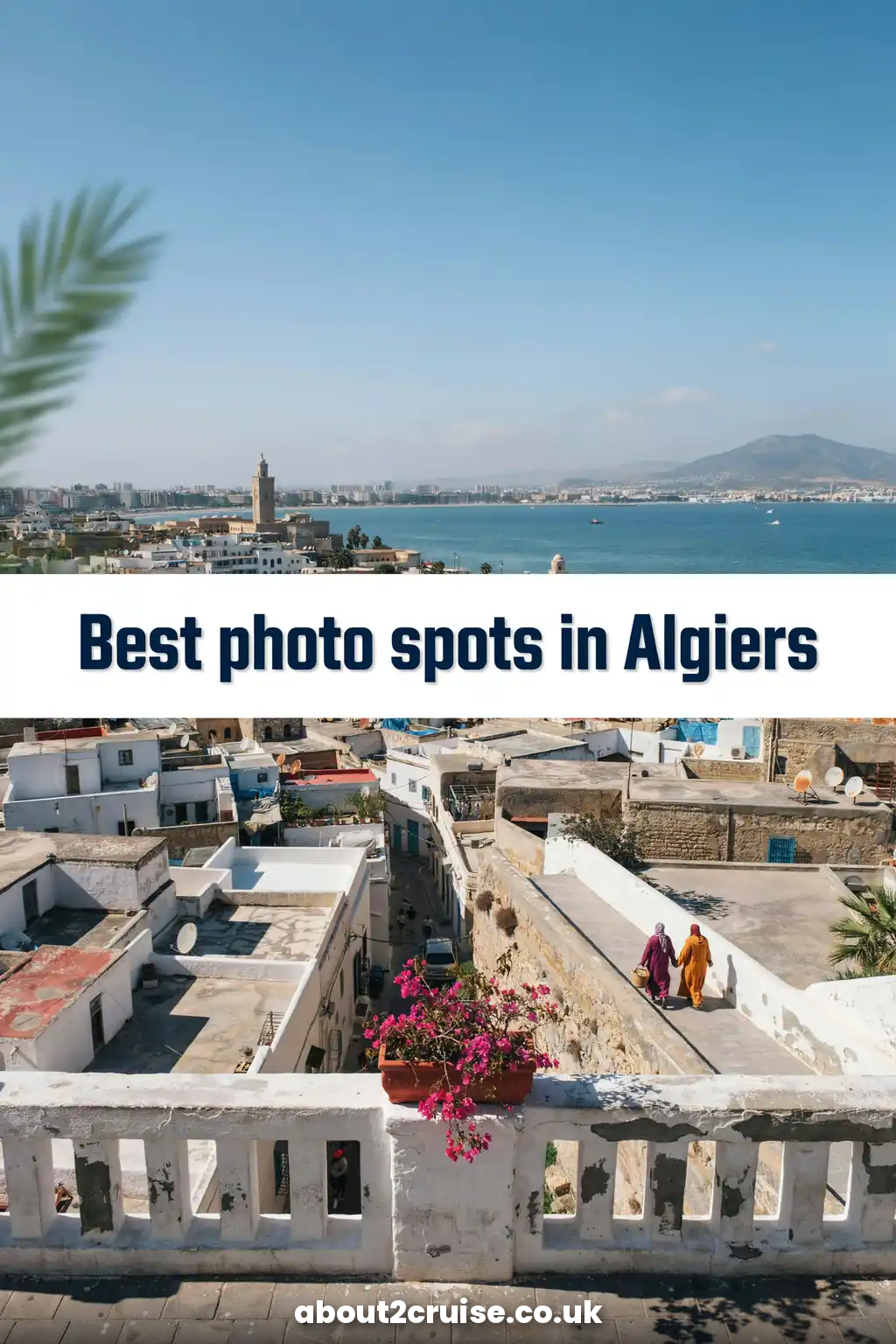
Photography in Algiers is generally fine in public spaces, but the rules are strict around security sites. Do not photograph military or police facilities, checkpoints, airports, government buildings or uniformed personnel without permission. Cameras and media can be confiscated. Drones, binoculars, telescopes and some professional photography equipment need authorisation before import, so leave those on the ship. When photographing people in the Casbah or markets, ask first. Many people are happy to be asked and less happy to be photographed without consent.
Shopping, Souvenirs and Haggling in Algiers
The souks in the Casbah, rue Didouche Mourad and the covered markets are the main shopping areas. Medina shops typically open around 08:00, close around 13:00, reopen mid-afternoon and close in the evening. Friday is quieter. Haggling is expected in the souks, but not in fixed-price shops or cafés. Be careful with anything that looks old: buying antiquities can lead to a prison sentence for smuggling, and you should get proof of authenticity for any item that could be considered antique.
Beaches, Alcohol and Leisure Near the Port
Les Sablettes is the closest urban beach to the centre, reached by tram. It is free and open around the clock, but water quality varies and swimming is only in marked areas. La Madrague, also called El Djamila, is a whitewashed fishing harbour and beach area west of the city with quayside fish restaurants and a compact beach frontage. Beaches east and west of Algiers get busy with local holidaymakers in June, July and August. Alcohol is legal but discreet; it is available in some hotels and licensed restaurants, but not in most cafés.
Day Trips to Tipasa, Cherchell and Roman Ruins from Algiers
Tipasa is a UNESCO World Heritage site about 70 km west of Algiers, with Phoenician, Roman, early Christian and Byzantine remains on the coast. Allow 1 hour 15 minutes to 1 hour 30 minutes each way by road, which makes it a realistic but tight independent day if your port time is short. Cherchell, built over Roman Caesarea, is about 97 km west, 1.5 to 2 hours by car, and is usually combined with Tipasa on a ship excursion. These are the most rewarding archaeological day trips from Algiers, but they require a reliable vehicle and driver in a country where taxis for the return are not always easy to find.
Algiers in Mediterranean Cruise Itineraries and Port Calls
Algiers is a port of call, not a turnaround port. Around 22 calls a year bring roughly 19,000 passengers, with lines including Viking Ocean Cruises, Ponant, Explora Journeys, Azamara and Swan Hellenic. A typical itinerary places Algiers between Tunisia and Spain or Morocco, often with calls at Tunis, Tangier and Málaga. If your voyage continues into Morocco, our cruise ports guide to Morocco covers the main calls there. Live AIS ship tracking and Algiers port schedules are available through sites such as CruiseMapper and Cruisedig.
For routes beyond Algeria, our guide to western Mediterranean ports covers ports from Barcelona to Rome.
Algiers Cruise Port FAQ
Is the Casbah safe for cruise passengers?
The Casbah is safe enough during the day if you stay on well-used lanes, visit with a guide, avoid empty dead-end alleys and keep valuables hidden. It is steep, uneven and crowded in places, and the main risk for most cruisers is getting lost or twisting an ankle rather than crime.
Do I need Algerian dinars before I arrive?
No. The dinar is a closed currency and cannot be bought abroad. You change money at banks, exchange offices or sometimes larger hotels in Algiers. Bring small euro, US dollar or pound sterling notes, but don’t expect to spend foreign cash in shops or taxis.
Can I use euros or dollars in Algiers?
Generally no. Taxis, markets, cafés and museums want dinars. Some hotels and established tourist shops may accept euros, but the exchange rate will rarely be good. Always carry enough dinars for the day.
Are there left luggage facilities at the cruise terminal?
There is no documented left-luggage or bag-storage facility at the Algiers cruise terminal, and the airport has none either. Keep your day bag manageable because you will be walking on ramps, stairs and cobbled lanes.
What if my ship only allows shore excursions in Algiers?
If your line and the Algerian authorities restrict disembarkation to organised excursions, you must book a ship tour to leave the port. The policy is not set by a central authority and can vary by sailing, so don’t assume you can walk off until your cruise line confirms it in writing.
Are taxis safe in Algiers?
Official and hotel-booked taxis are generally safe during the day. The main issues are unmetered fares, no change and drivers taking a longer route. Agree the price before getting in, ideally through the Yassir app or your hotel, and don’t let unknown passengers join.
Last Updated: 23 November 2026